INTRODUCTION
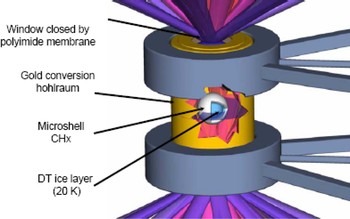
The laser megajoule (LMJ) facility, under construction near Bordeaux in France, is being built for conducting inertial confinement fusion (ICF) experiments. The required energy will be delivered by 240 laser beams focused on an LMJ cryogenic target containing a polymer capsule filled with nuclear fuel composed of a deuterium-tritium (DT) mixture (see Fig. 1). The “indirect drive” configuration chosen in the LMJ facility requires a multi-component target made up of a centimeter-sized gold hohlraum that contains a millimeter-sized capsule (microshell) charged with the DT gas mixture at room temperature. This DT mixture is then solidified by cooling under the triple point (20 K), which after conformation, leads to the expected high-quality ice DT layer before the shot.
(Color online) A schematic representation of an LMJ cryogenic target.

In order to develop such a complex target assembly, a research program concerning materials and technologies was defined almost 10 years ago. All the synthesis and study devices have been designed and are now, in large part, operational. These equipments have led to significant results in each field (Collier et al., Reference Collier, Fleury, Vincent-Viry, Viargues and Baclet2007; Baclet et al., Reference Baclet, Bachelet, Choux, Fleury, Jeannot, Lafitte, Martin, Moll, Pascal, Reneaume and Theobald2006), and the know-how developed up until today permits the fabrication of cryogenic targets very close to the specifications. Technological studies are in progress in order to attain the nominal design, and the CEA target fabrication project includes research and development on various organic polymers and materials for the cryogenic LMJ target assembly as well as for other targets that can be useful for fusion programs (pre and post-ignition). For several years, very interesting studies and developments can be noted in the field of materials that allow fabrication of components for targets in ICF (direct or indirect drive), and ablation (Bashir et al., Reference Bashir, Rafique and Ul-Haq2007; Caridi et al., Reference Caridi, Torrisi, Margarone and Borrielli2008; Chaurasia et al., Reference Chaurasia, Munda, Ayyub, Kulkarni, Gupta and Dhareshwar2008; Lam et al., Reference Lam, Tran and Zheng2007; Nobile et al., Reference Nobile, Nikroo, Cook, Cooley, Alexander, Hackenberg, Necker, Dickerson, Kilkenny, Bernat, Chen, Xu, Stephens, Huang, Haan, Forsman, Atherton, Letts, Bono and Wilson2006; Orlov et al., Reference Orlov, Gus'kov, Pikuz, Rozanov, Shelkovenko, Zmitrenko and Hammer2007; Wang et al., Reference Wang, Xu, Zhou, Chu and Fu2007). For example, low-density porous materials can provide uniform energy deposition to the targets in direct-drive ICF, and thus, stabilization of X-ray conversion regions in indirect-drive ICF. In this field, low-density target fabrication on the base of foams polystyrene, cellulose triacetate (TAC), and resorcinol/formaldehyde (RF) were elaborated (Borisenko et al., Reference Borisenko, Bugrov, Burdonskiy, Fasakhov, Gavrilov, Goltsov, Gromov, Khalenkov, Kovalskii, Merkuliev, Petryakov, Putilin, Yankovskii and Zhuzhukalo2008; Yang et al., Reference Yang, Nagai, Nakai and Norimatsu2008) for various experiments.
The present paper shows some over types of materials that also are useful for ICF applications and give promising perspectives for the future. The paper reports our recent advances concerning specific organic materials for the fabrication of target components such as a polymer for the LMJ microshell synthesis and metal-doped organic foams for the elaboration of doped-foam microshells or for the micromachining of components.
DEVELOPMENT OF A STRATEGIC MATERIAL FOR THE LMJ CRYOGENIC TARGET
For several years, a variety of specific organic materials are under investigation in the CEA Laboratories. These include materials for the synthesis of CHx microshells as well as for the synthesis of polyimide membrane shutters (Anselmi et al., Reference Anselmi, Raby, Balland-Longeau and Calonne2003, Reference Anselmi, Raby and Balland-Longeau2004; Poussard et al., Reference Poussard, Anselmi, Blondel, Buvat and Balland-Longeau2006) to be fastened on the laser entrance holes of the gold hohlraum (see Fig. 1).
This section focuses on one of the organic materials necessary for the elaboration of the nominal ablator chosen for the LMJ cryogenic target, i.e., a germanium (Ge)-doped CHx microshell. This CHx microshell is synthesized by a glow discharge polymerization (GDP) coating on a poly-α-methylstyrene (PAMS) depolymerisable mandrel, prepared by microencapsulation (triple emulsion). After the GDP coating, the inner PAMS mandrel is eliminated by thermal treatment at 300°C under nitrogen thus giving rise to the Ge-doped CHx microshell.
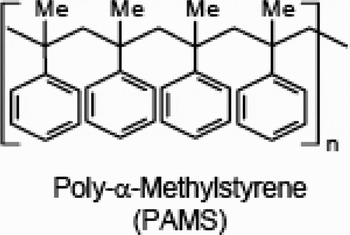
According to this technique, poly-α-methylstyrene (PAMS)—for which the chemical structure can be seen in Figure 2 is considered to be a strategic organic polymer for the elaboration of CHx microshells. This is due to it directly influencing the surface quality of the PAMS mandrels and consequently also the surface quality of the final Ge-doped CHx microshell. For several years, the CEA has decided to obtain its own supply of PAMS (Balland-Longeau et al., Reference Balland-Longeau, Calonne, Catala and Jousse2003) and has thus developed a specific process to prepare such PAMS with very stringent specifications, including: (1) A high number average molecular mass (Mn): Mn measured around 300 kg·mol−1 ±10% (based on gel permeation chromatography (GPC) detected by refractive index, calibrated with polystyrene standards). (2) A narrow molecular weight distribution (Ip): Ip inferior to 1.1. (3) A very high purity (lowest level of inorganic and organic impurities).
The chemical structure of poly-α-methylstyrene.

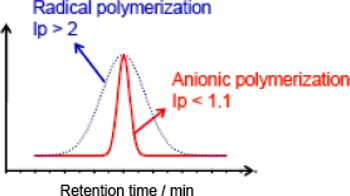
A method able to obtain such a PAMS with controlled characteristics (i.e., a high Mn and Ip < 1.1) is the “living anionic polymerization” of the α-methylstyrene monomer. As compared to radical polymerization, living anionic polymerization limits the presence of undesirable reactions, such as chain-transfer and termination reactions during the propagation phase. Such reactions are well-known in radical polymerization and give rise to a large molecular weight distribution of (Ip > 2). With a living anionic polymerization, a perfect control of Mn as well as the molecular weight distribution (Ip < 1.1) is possible (see Fig. 3).
(Color online) GPC profile of two polymers: one obtained by a radical polymerization (blue) having a large molecular weight distribution (Ip > 2) and the other obtained by an anionic polymerization (red) having a narrow molecular weight distribution Ip < 1.1.

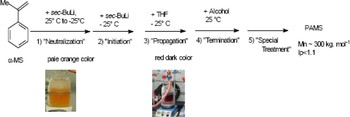
During the present study, the main objective consisted in developing a novel and efficient living anionic polymerization process in order to prepare such monodisperse PAMS. This objective was attained and the optimal process comprised five important steps (see Fig. 4) after the solution preparation of highly pure reactants: α-methylstyrene (distilled over organolithium—in an argon atmosphere) was mixed with an aprotic apolar solvent (distilled over sodium wire—in an argon atmosphere), in a specific tight anionic reactor under argon pressure. The five steps were the following (Balland-Longeau et al., Reference Balland-Longeau, Calonne, Catala and Jousse2003): (1) A “neutralization step” of the initial solution of α-methylstyrene to neutralize all protic sources by addition of an efficient amount of a nonfunctional organometallic initiator (sec-butyl lithium, s-BuLi) at 25°C and –25°C. At –25°C, after several hours, the persistence of a “pale orange coloration” of the solution was observed proving that the “neutralization point” was reached (significant color of the α-methylstyrene anion in an organic solvent); (2) An “initiation step” at −25°C of the anionic polymerization of α-methylstyrene by addition of a predetermined and very low amount of s-BuLi (calculated with the expected Mn) in order to obtain a high Mn (approx. 300 kg·mol−1 ± 10%, based on SEC according to polystyrene standards); after 1 h, a dark orange or red color of the solution appeared; (3) A “propagation step” at −25°C by addition of a predetermined amount of aprotic polar solvent (distilled over sodium wire—in an argon atmosphere); a dark red coloration of the solution was spontaneously obtained (a significant red color of the “living polymer” chains during chain growth). After 24 h the polymer solution became highly viscous; (4) A “termination step” by addition of a protic solvent (alcohol) at 25°C to the formed viscous solution in order to deactivate all the anionic sites and bring the anionic polymerization to a halt; (5) A “special treatment step” applied to the viscous solution of PAMS leading to a fine powder of PAMS with a very high purity without organic residue and a very low level of Ca, Na, Si, and Li salts (total amount of salts close to 100 ppm).
(Color online) The general scheme for the synthesis of poly-α-methylstyrene (PAMS) uses the novel and specific living anionic polymerization of α-methylstyrene (α-MS).

The key step of this anionic process was the “neutralization step,” as it was very determining for the Mn control. In order to have a perfect control of Mn (around 300 kg·mol−1 ± 10%), it was important to obtain an identical pale orange color of the solution for the “neutralization point” during each experiment. This neutralization point was reached when the last of the residual impurities potentially present in the α-MS's solution (residual oxygen or moisture) were totally neutralized by the sec-BuLi and α-MS anions started to form (giving rise to the beginning of the pale orange coloration). At this step, the polymer scientist needed to depend on his visual memory in order to remember this pale orange colour. However, despite a very good know-how, it was extremely difficult to obtain exactly the same neutralization point in each experiment simply by using the visual memory. It was also demonstrated that a slight color variation from “pale orange to slightly dark orange” had a very large impact on the Mn control of the PAMS. The ratio between the expected Mn and that measured varied between 0.8 and 1.3.
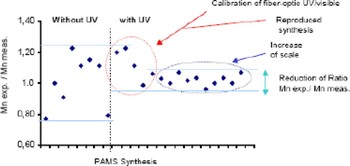
To improve the “neutralization step” and obtain a better control of Mn (i.e., a ratio between the expected and measured Mn closer to 1 ± 10%), a specific colorimetric technique with ultraviolet/visible spectroscopy was successfully developed. A fiber-optic ultraviolet/visible, connected to an ultraviolet/visible spectrometer, was immersed in the anionic reactor with respect to a perfect tightness. By using this efficient technique, and after calibration of the fiber-optic ultraviolet/visible, it was possible to monitor with high precision all the color variations (from pale orange to dark red) of the solution during the five steps of the process. This original method proved to be very efficient and resulted in the ratio between the expected and measured Mn being significantly reduced (between 1 to 1.1) (see Fig. 5). This colorimetric technique thus demonstrated an enormous utility for the PAMS synthesis.
(Color online) The optimization of the PAMS synthesis by reducing the ratio between the expected Mn/measured Mn (Mn exp./Mn meas.) and increasing the scale.

With the recent optimizations, the preparation of monodisperse PAMS of high quality and excellent control of Mn and Ip with the required specifications was facilitated (Balland-Longeau et al., Reference Balland-Longeau, Calonne, Catala and Jousse2003). A good repeatability was demonstrated and the anionic process could be successfully extended to large scales (from 20 g to more than 250 g of PAMS per batch) while maintaining a high PAMS quality. As described above, such know-how permitted the CEA to produce its own PAMS for the fabrication of PAM's mandrels for Ge-doped CHx LMJ microshells.
DEVELOPMENT OF NOVEL DOPED MATERIALS FOR NON-CRYOGENIC TARGETS: PREPARATION TO THE IGNITION EXPERIMENTS
Research and development concerning ICF experiments, such as laser/materials interaction, high energy density physics or plasma radiation, have currently required the incorporation of “doping elements” into organic materials such as low density foams that are necessary for the fabrication of a variety of target components (foam microshells, micromachining of foams…). Depending on the chosen ICF experiments, these doping elements can be halogens, deuterium, but also metallic elements such as silicon (Si), tin (Sn), germanium (Ge), gold (Au), copper (Cu), lanthanides (Ln), indium (In), etc. A controlled amount of these doping elements must be very homogeneously distributed within polymer foams (polystyrene or polyacrylate types). Several types of organic foams have been reported in the laser target literature with various methods: by radical copolymerization of co-monomers in emulsion or in organic solvents playing the role of porogenic agents.
Several approaches are possible for the preparation of these specific doped materials, such as: the dispersion of metallic particles or oxide powder during the polymerization of the reticulating monomers (divinylbenzene (DVB) or trimethylolpropanetriacrylate (TMPTA)), and the impregnation of pre-formed foams using metallic salt solutions (Rind, Reference Rind1981; Liepins, Reference Liepins1984). Another particularly efficient way to obtain a homogeneous distribution of the doping element consists in copolymerizing the reticulating compound (DVB and TMPTA) with a monomer containing the required doping element. As a counterpart to this strategy, it is necessary to develop a synthesis method for producing novel doped monomers and to evaluate their capacity with regard to copolymerization. Indeed, although halogen- and iron-containing monomers, such as bromostyrene or vinylferrocene, are commercially available, generally, metal-containing monomers with the required specifications are unavailable and often not even described in the literature.
In this context, as several years ago, the CEA has decided to focus research and development efforts on this latter elegant and versatile approach. To this end, the synthesis of vinylic polymerisable monomers (generally derived from substituted styrenes) containing doping elements has been developed. For example, a few years ago, the synthesis of styrenic monomers containing elements of the group XIV (i.e., Si, Sn, and Ge) was carried out. The developed procedure has rendered possible the synthesis of these new monomers to a quantitative yield and large scale. The polymerization study was performed with an excellent control of the molecular weight and the polydispersity index (David-Quillot et al., Reference David-Quillot, Lunot, Marsacq and Duchêne2000, Reference David-Quillot, Duchene, Catala and Balland-Longeau2002; Langle et al., Reference Langle, David-Quillot, Balland, Abarbri and Duchene2003; Croix et al., Reference Croix, Balland-Longeau, Thibonnet and Duchene2005).
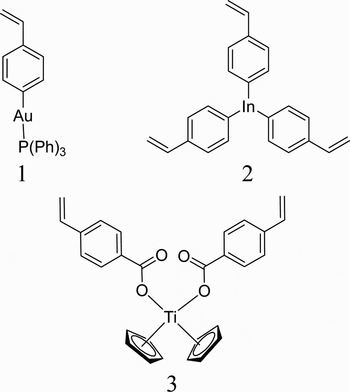
Today, efforts are dedicated to the development of organic foams doped with new metallic elements such as Au, In, Yb, and Ti, starting from novel monomers containing these elements. The incorporation of Au in foams is useful for radiative propagation studies, and the incorporation of Ti is intended for producing probes for diagnostics. In addition, radiochemistry experiments require doped foams with In and Yb. According to the nature of the metals, a variety of new monomers containing Au (1), In (2), Ti (3), and Yb (4 and 5) have been developed, respecting very stringent specifications.
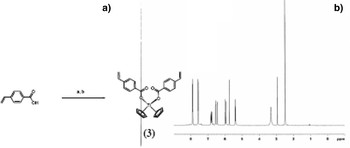
For transition metals, e.g., Au and Ti, or for poor metals, such as In, the use of carbon-metal bonds is possible and provides relatively stable compounds. Such compounds have a composition that includes carbon, hydrogen, and a controlled amount of the doping metal, with tolerance of heteroatoms (oxygen and phosphorus) (Fig. 6). Moreover, these monomers can be obtained in only one or two steps (Hoffman et al., Reference Hoffman, Chester and Fay1983; Braham et al., Reference Branham, Mays, Gray, Sanner, Overturf and Cook1997). For instance, in the case of the Ti monomer (3), the sodium salt of the commercially available 4-vinyl benzoic acid can be readily obtained by neutralization with sodium hydroxide in an aqueous medium. This solution of 4-vinyl benzoate sodium salt is then added to a solution of bis(cyclopentadienyl)titanium(IV) dichloride in chloroform at room temperature. The biphasic medium is stirred vigorously during 4 h and the organic phase is separated, dried and evaporated under vacuum. The original compound (3) is isolated as an orange powder with a yield of 83%. The Ti monomer (3) is obtained with a good purity and no further purification is necessary. Figure 7 shows a proton NMR spectrum of (3).
The chemical structure of gold- (1), indium- (2) and titanium- (3) based monomers.

(a) The synthesis scheme for the titanium-containing monomer (3): a. NaOH, H2O, b. Cp2TiCl2, CHCl3/H2O. (b) An H1 NMR spectrum of the titanium-containing monomer (3).

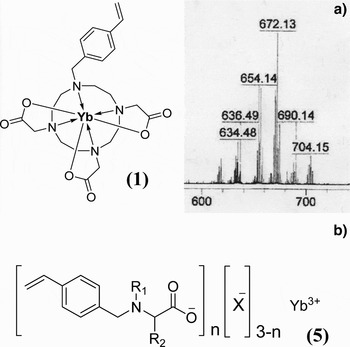
In the case of ytterbium (Yb) monomers, the synthesis of stable styrene-based monomers (4 and 5) with carbon-metal bonds is unsuitable. Indeed, Yb, like all lanthanides, is a highly electropositive metal and provides bonds of a strong ionic character. Consequently, organo-lanthanide compounds of low molecular weights are very unstable, often pyrophoric, and thus impossible to utilize for material elaboration in the presence of air and water. On the other hand, the incorporation of heteroatoms, such as nitrogen and oxygen, stabilizes Yb complexes by electronic saturation of the metal coordination sphere, thus providing stable compounds. In this context, it was chosen to synthesize Yb-containing coordination precursors. Recently, two new families of Yb complexes have been developed starting from chelating macrocyclic ligands (4), derived from cyclen, as well as from ligands based on amino acids (5), and derived from glycine (Fig. 8) (Balland-Longeau et al., Reference Balland-Longeau, Moreau, Thibonnet and Velasquez2007). The obtained Yb monomers proved to be stable and it was possible to polymerize them with DVB and TMPTA.
Structures of the ytterbium-containing monomers (4) and (5): (a) The structure of the macrocyclic ytterbium complex (4) and the corresponding MALDI-TOF spectrum. (b) The general structure of the amino-acid-based ytterbium complex (5), where X− represents a counter ion, e.g., halogen or triflate, and where R1 and R2 can be H or alkyl.

In the case of monomers based on amino-acids, according to the synthesis condition (pH of the medium, solvent nature…) and chosen stoechiometry, various complexes were prepared, differing in Yb rate and chemical properties such as the solubility in solvents or the number of cross-linkings. Moreover, these new styryl-based ligands (macrocyclic and based on amino acids) can also be used for the complexation of other metals that are interesting for targets applications. Indeed, the chelating macrocycles as well as amino acid derivatives are well-known when one wants to obtain some coordination complexes with a number of metals (Cuennot et al., Reference Cuennot, Meyer, Espinosa and Guilard2005; Bianchi et al., Reference Bianchi, Calabi, Giorgi, Losi, Mariani, Palano, Paoli, Rossi and Valtancoli2001; Praker et al., Reference Praker, Pulukkody, Smith, Batsanov and Howard1994). Generally, organic foams for laser target applications, doped or non-doped, are cross-linked polymers obtained with reticulating agents such as DVB or TMPTA giving DVB or CHO foams (Croix et al., Reference Croix, Sauvage, Balland-Longeau, Duchene and Thibonnet2008). Two principal kinds of low-density doped foams were elaborated, i.e., polyHIPE foams with a broad porosity, prepared by biphasic emulsion; and DVB or CHO foams of a finer porosity, (lower or equal to 1 µm), prepared by using a porogenic solvent such as dibutylphthalate.
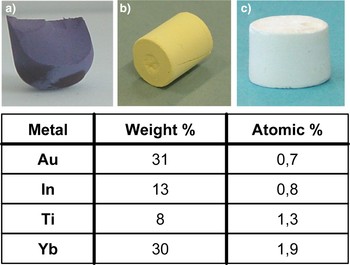
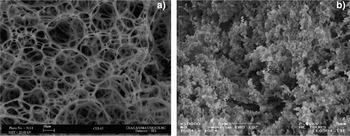
With the incorporation of the previously described metal-containing monomers in such polymerization processes, it was possible to elaborate novel doped foams with good properties in terms of density and chemical composition. The rate of incorporated doping agent, its distribution and the morphology of the obtained foam were determined by elemental analysis and electron microscopy. The table presented in Figure 9 displays the actual optimal values obtained of the doping agent incorporated in DVB foams with a density of 100 mgcc−1. As shown in Figure 10, the doped foams had a homogenous micrometric morphology.
(Color online) Examples of doped polystyrene foam pieces obtained with the monomers (1), (2) and (5) in a porogenic solvent: (a) a gold-doped foam, (b) a titanium-doped foam, and (c) an ytterbium-doped foam. The table gives the maximum rate of metal incorporated in the polystyrene foams with the monomers in question.

SEM micrographs of the doped foams. (a) The gold-doped polyHIPE foam; (b) The ytterbium-doped foam obtained in dibutylphthalate.

The use of metals-containing monomers (e.g., Au, In, Yb, and Ti) has proven to be a very powerful tool for the elaboration of low-density doped foams. Indeed, the distribution of the doping element in the materials was found to be homogeneous and the rate of the doping element could be varied and adjusted with a high accuracy. This strategy also made it possible to incorporate high rates of doping element in agreement with or very close to the specifications required for laser target experiments. These monomers have rendered it possible to prepare doped foams in various shapes which can be machined for the elaboration of specific elements for a laser target assembly. Today, in addition to the exploration of other metal-containing monomers, the aim is to demonstrate the possibility of polymerizing these novel doped monomers in triphasic emulsion conditions for foam shell elaboration. This should enable the preparation of quantitatively doped foam shells by the micro encapsulation process.
CONCLUSIONS
Much progress has been accomplished in the scope of the CEA Target Fabrication Project, in which organic materials play significant roles with regard to target fabrication components. For the cryogenic target, the CEA has developed specific processes in order to be able to produce various strategic materials with stringent specifications, of high quality and in large scale. As described in this article, a genuine know-how allows the CEA to produce its own “home-made PAMS” for the fabrication of PAMS mandrels for Ge-doped CHx LMJ microshells. In the same context, but for non-cryogenic targets, as several years ago, the CEA has also focused R&D efforts on the fabrication of novel doped foams for specific experiments. An elegant and versatile approach based on novel metal-containing monomers (comprising Au, In, Yb and Ti) developed in the CEA laboratory is currently in use. This approach has proved to be a very powerful tool for doping low-density foams with metal elements. Indeed, the distribution of the doping element in the materials has been shown to be homogeneous and the rate of the doping element can be varied and adjusted with a high accuracy. The synthesis of other metal-containing monomers is in progress, and the aim of the present paper has also been to demonstrate that these novel monomers, doped with Au, In, Yb, and Ti, can be employed in the triphasic emulsion conditions for foam shell elaboration.
ACKNOWLEDGEMENTS
The authors wish to thank CEA Le Ripault, especially the LMJ program and the Target Technolgies Project, for financial support. Many thanks are also expressed to J. M. Catala from Institut C. Sadron, in Strasbourg (France) for the helpful collaborations with regard to the PAMS development; “Service de caractérisations physico-chimiques, CEA Le Ripault” for recording the numerous SEC chromatograms, NMR and MALDI-TOF spectra; and “Service de Recherche sur les Céramiques et Composites, CEA Le Ripault” for the supercritical CO2 drying of various organic foams, for recording SEM images of foams and for carrying out the elemental analysis.