


Frederic Maurice Goadby studied law at the University of Oxford, graduating in 1901. Having worked for a few years in the City of London, in 1904 he became a lecturer at the Law Department of the University of Leeds. He then moved to Egypt, where he taught at the Khedivial Law School in Cairo. After the First World War, Goadby relocated to Palestine, serving as the Director of the newly established British law school there until 1933, when he retired and returned to England.Footnote 1
In 1910, Goadby published a book entitled Introduction to the Study of Law: A Handbook for the Use of Egyptian Law Students. A second edition was published in 1914, and a third edition, revised for the benefit of Goadby’s students in Mandatory Palestine, was published in 1921.Footnote 2 Goadby defined his book as an “elementary treatise on jurisprudence,” but it was, in fact, more sophisticated. It was a jurisprudence textbook but also a work on comparative law, comprising extensive discussions of English and French law, legal institutions, and legal theories. The scope of Goadby’s book was thus broader than that of contemporary jurisprudence textbooks published in England, and that of jurisprudence textbooks written in India, such as the book by Rattigan analyzed in Chapter 1. The legal systems of Egypt and Mandatory Palestine were greatly influenced by nineteenth-century French law. Therefore, Goadby had to devote more attention to detailed discussions of French legal theories than writers such as Rattigan, and, certainly, more attention than English textbook writers.Footnote 3
Goadby’s book was more learned and comprehensive than comparable works that appeared in England at the time; yet, just like Rattigan’s Indian textbook, Goadby’s book was not viewed this way by some Western scholars. The American legal scholar Roscoe Pound was enthusiastic, noting in his review of the first edition that the complexity of the legal system of Egypt, in which French, English, and Islamic law mingled, afforded sophisticated jurisprudential insights. Pound also praised the work because it summarized contemporary French legal theories that were inaccessible to many Anglo-American law professors.Footnote 4 However, the review of the first edition of Goadby’s book in the leading English legal periodical of the time, the Law Quarterly Review, was lukewarm. The review of the second edition was simply mean, with the anonymous reviewer focusing on a few trivial typographical and substantive errors and rhetorically wondering why the second edition was longer than the first one, containing lengthy discussions of the ideas of various legal scholars, given that the book was “intended for Egyptian students.”Footnote 5
This chapter explores works on jurisprudence written in Mandatory Palestine, such as Goadby’s book. I show, just as I did in Chapter 1, that these works were interesting and original. Like Indian works, those written in Mandatory Palestine were cosmopolitan, revealing an awareness of both English and Continental legal theories. Their authors critiqued imported European approaches, and some also provided interesting insights into the jurisprudential lessons that local religious law could teach. I begin with a brief discussion of the history of institutions providing Western-style legal education in Palestine: the law school established by the British rulers of the country, whose first director was Goadby, and two Jewish academic institutions in which law was taught. I then discuss jurisprudence textbooks and other jurisprudential works written in the territory. First, I analyze Goadby’s book and two Hebrew jurisprudence textbooks, and then I examine various works on the theoretical study of Jewish law. Finally, I explore legal works written by Arab scholars in Mandatory Palestine.
Legal Education in Mandatory Palestine
The territory that became Mandatory Palestine was part of the Ottoman Empire until the end of the First World War when it was conquered by the British, who ruled it until 1948. It was, of course, much smaller in size and population than colonial India. When the British conquered Palestine, the territory had a population of less than 700,000. By 1948, when the British left, approximately 1.8 million inhabitants lived there.Footnote 6
The relatively small size of the population was reflected in the limited number of lawyers practicing in late Ottoman Palestine. When the British took control of the territory, the number of lawyers “could be counted on the fingers of two hands.”Footnote 7 During the late Ottoman period, there was no local law school in Palestine, and anyone seeking formal legal education had to travel to other parts of the Ottoman Empire to obtain it.Footnote 8 The Ottoman system of Western-style legal education dates back to the end of the nineteenth century. A law school was established in Istanbul in the 1870s, and law was also taught in other professional schools in Istanbul, such as the School for Civil Administration, the Imperial School, and the School for Shar‘i Judges. By the beginning of the First World War, these schools had produced a few thousand graduates, several hundred of whom were Arabs, along with a few Jewish graduates. In 1908, the first Ottoman law school established in the Arab parts of the Empire opened in Baghdad. Another law school was established in Beirut in 1912.Footnote 9
During the period of British rule, the number of lawyers in Palestine steadily grew. By the time the British withdrew from the country in 1948, there were more than a thousand lawyers.Footnote 10 Many of these were Jewish lawyers who received their legal education in Europe, the United Kingdom, or North America prior to moving to Palestine.Footnote 11 Others had studied law in neighboring Middle Eastern countries or were trained locally in Palestine.Footnote 12
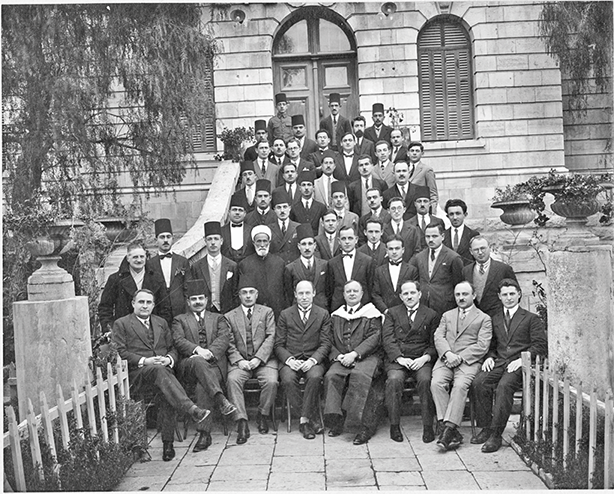
The leading institution providing legal education in Mandatory Palestine was a law school established by the British in 1920, the Jerusalem Law Classes (see Figure 2.1).
The Jerusalem Law Classes, 1920s. In the front row, Norman Bentwich, the Attorney General of Palestine, is seated fourth from the left, and Frederic Goadby, the director of the Law Classes, is seated fourth from the right.
The five-year program of studies at the Law Classes was divided into two parts. The lectures in the first part were delivered in Hebrew or Arabic. Students who passed an examination at the end of this part were allowed to continue to the second part, in which lectures were delivered in English and dealt with more theoretical subjects such as jurisprudence and legal history.Footnote 13
The Law Classes sought to provide legal education to court clerks and interpreters, as well as local lawyers and magistrates. It was, therefore, a vocational, not an academic, institution. Most lecturers were judges and other government officials. Civil servants who wanted to study there were often admitted even if they lacked the entry qualifications required of other students. The lectures took place in the evening so that these civil servants could attend.Footnote 14 The relatively practical nature of studies was also evident in the fact that most of the courses were merely descriptive surveys of various areas of law.Footnote 15
The legal system of Mandatory Palestine contained a mixture of norms and institutions drawn from various legal systems: Islamic, Ottoman, French, and English law. In the realm of personal law, jurisdiction was given to religious courts that applied religious law. The Law Classes offered its students elective courses on Islamic and Jewish law. The elective course on Jewish law (called “rabbinical law” by the institution’s administrators) focused on marriage and divorce, inheritance and guardianship, and the rules of procedure in rabbinical courts. The course included an introductory element on the principles of Jewish law, but this part, too, focused on the fundamentals of family law.Footnote 16
In addition to the Jerusalem Law Classes, two other non-governmental institutions in Mandatory Palestine taught law: the Hebrew University of Jerusalem and the Tel Aviv School of Law and Economics. The Hebrew University of Jerusalem was established in 1925.Footnote 17 It was a Zionist institution whose creation was inspired by the ideology of cultural Zionism, which sought to turn Palestine into a “spiritual center” of world Jewry. Initially, the university’s founders planned a law school as part of the university. Accordingly, in 1919, the Zionist Department of Culture and Education asked Norman Bentwich, an Anglo-Zionist lawyer (who later served as the Attorney General of Palestine and was also the driving force behind the creation of the Jerusalem Law Classes), to prepare a detailed proposal for a faculty of law at the university.Footnote 18 Bentwich envisioned a faculty of law that would not merely be a vocational school for lawyers but an institution that would also train government officials and politicians. He proposed that students would study the principles of Jewish law as well as “English and American liberalism.” Bentwich’s proposed faculty of law would thus synthesize the study of ancient Jewish law with the study of modern Western law. It would offer courses on practical subjects but also courses on political economy, sociology, legal history, and the history of Roman law.Footnote 19
Bentwich’s proposal was not implemented.Footnote 20 A law faculty was only established at the Hebrew University in 1949, after Israeli independence. Nevertheless, two legal topics were taught at the Hebrew University during the British Mandate period: Jewish law and international law. The former was one of the topics taught at the Institute of Jewish Studies from its inception in 1925 by two professors, Simha Assaf and Asher Gulak.Footnote 21 In the 1940s, a small department devoted to Jewish law was also established. The goal of this department was to teach Jewish law “with special attention to the existing law in Palestine,” that is, by focusing on Jewish family law.Footnote 22 With regard to international law at the Hebrew University, in the early 1930s, the institution received a donation from an English-Jewish industrialist, Sir Montague Burton, who was interested in international and industrial peace. Burton donated funds to establish chairs on these subjects at the Hebrew University and several English institutions. As Bentwich, who was appointed to this chair, was a lawyer by training, his courses had a legal orientation.Footnote 23 After the Second World War, Bentwich was joined by another international law scholar, Nathan Feinberg, and a Department of International Relations was established.Footnote 24 Another legal scholar hired by the Hebrew University in the 1940s was Guido (Gad) Tedeschi. Tedeschi was a young Italian-Jewish law professor appointed as a research fellow and later as a lecturer on jurisprudence at the Department of International Relations.Footnote 25
The third institution providing legal education in Mandatory Palestine was the Tel Aviv Higher School for Law and Economics (see Figure 2.2). Like their counterparts at the Hebrew University, the founders of the Tel Aviv School were also influenced by the ideology of cultural Zionism. One expression of this influence, mirroring the practice at the Hebrew University, was the use of Hebrew as the language of instruction. Unlike the Hebrew University, however, the Tel Aviv School offered a complete course of legal studies.
The Tel Nordau Primary School in Tel Aviv, where the classes of the Tel Aviv School of Law and Economics were held during the 1930s.

The Tel Aviv School was one manifestation of the movement for the revival of Jewish law, which was active in the Jewish diaspora and Mandatory Palestine in the first decades of the twentieth century. This movement was inspired by the ideas of the nineteenth-century German Historical School, which saw law as an expression of the “national spirit” (volksgeist) of each nation and argued that the legal system of every nation should, therefore, be based on its own organic national legal traditions.Footnote 26 However, the legal system envisioned by the movement for the revival of Jewish law was not rooted in a fundamentalist application of all traditional halakhic norms. Scholars affiliated with the movement viewed norms concerned with topics such as dietary purity as irrelevant to their project. Instead, they focused primarily on those aspects of traditional Jewish law that addressed “secular” domains such as property and contract law.Footnote 27
In 1917, Russian-Jewish law students, educated in Central European and Russian universities in the first decades of the twentieth century and inspired both by the ideas of the Historical School and also by cultural Zionism, established a scholarly society in Moscow for the study of Jewish Law (which they called mishpat ‘ivri, literally “Hebrew Law”).Footnote 28 In the early 1920s, growing restrictions on Zionist activities in the Soviet Union led many members of this Society to emigrate to Palestine, where the Jewish Law Society was re-established. In the 1920s and early 1930s, members of the Jewish Law Society were involved in several publishing ventures, including the publication of two legal journals, Ha-Mishpat and Ha-Mishpat ha-‘Ivri. In addition, one of its members, Judah Junovitch, established a publishing house specializing in law and philosophy books. Members of the Society were also involved in the activities of an informal system of Zionist courts, which were active during the period of the Mandate, the Hebrew Courts of Arbitration (mishpat ha-shalom ha-‘ivri). This system was staffed by lay judges who decided cases based on their own discretion, notions of justice and equity, and (sometimes) based on Jewish law.Footnote 29
Members of the Jewish Law Society were also active in the realm of legal education. As early as 1918, they proposed the establishment of a Jewish law school in Palestine. They expected the Hebrew University to implement this proposal, and, when its leaders declined to do so, they harshly criticized them. During the 1920s and early 1930s, several proposals for creating a Jewish law school in Palestine were put forward, none of which materialized. In the middle of the 1930s, however, conditions proved ripe as Jewish students and professors fleeing European anti-semitism flocked to Palestine. In 1934, a “World Conference of Jewish Law” was convened in Tel Aviv. Following the conference, four of the participants, three lawyers (Samuel Eisenstadt, Paltiel Dikshtein, and Max Laserson) and an economist (Benjamin Siew), resolved to establish a “Higher School of Law and Economics” in Tel Aviv. The resulting school, which accepted its first students in 1935, initially consisted of a department of law and a department of economics. Later, these were augmented by a business school, a political science department, and an accountancy institute.Footnote 30
The Tel Aviv School was purposely designed to offer legal education that differed from that of the British-sponsored Jerusalem Law Classes. According to one of the founders of the Tel Aviv School, Dikshtein, the British officials who had established the Law Classes did not seek to train local lawyers who would see themselves as equal to the officials sent from the metropolis. Instead, he claimed, it would serve British goals if those taught at the Law Classes would see themselves, and would be seen by others, as inferior to British officials belonging to “the superior race, sent by the great British people to instill civilization in an underdeveloped and backward country.” The Law Classes, argued Dikshtein, produced lawyers who had “narrow horizons” and viewed the existing political and legal framework of Mandatory Palestine as the optimal one, unable to imagine the “lofty ideals of proper [Jewish] national political revival.”Footnote 31
Legal education at the Tel Aviv School was characterized by its academic rather than vocational nature, by the influence of Continental rather than English law, and by the place given to Jewish law in the curriculum. About a third of its thirty-five lecturers previously held academic positions at various European universities, while the teaching staff at the Jerusalem Law Classes were mainly administrators or practicing lawyers.Footnote 32 The School’s founders regarded the training of lawyers as a secondary aim. More important aims were providing the students “with a complete, university-level education in the social sciences, affairs of state, law, economics, and commerce,” preparing future Jewish political and business leaders, and promoting the scientific research of law and the social sciences.Footnote 33 Because the training of lawyers was only a subsidiary aim, the curriculum was far more academically oriented than that of the Jerusalem Law Classes. At Tel Aviv, law students were required to take courses on the history of Jewish law, Roman law, comparative law, and one or two courses on philosophy. They were also required to take several social science courses, such as political economy, sociology, “colonial policy,” “colonial criminology,” and statistics. The legal courses they took were also more diverse. For example, the Tel Aviv School students took labor or administrative law courses, which were not offered at the Jerusalem Law Classes.Footnote 34
Another characteristic of the Tel Aviv School was the impact of Continental law on its curriculum. Since most of its law lecturers were educated in the Continental legal tradition, Continental notions were more influential than in the Jerusalem Law Classes. For example, Roman law, the basis upon which all Continental legal systems are founded, was not taught in the Jerusalem Law Classes. At the Tel Aviv School, it was a compulsory subject.Footnote 35
Finally, the Tel Aviv School was characterized by the relatively prominent role of Jewish law in the curriculum. One of the primary goals of the School was “to train jurists, lawyers, and judges who could fulfill the ideals of the [Jewish] nation in the field of legal revival, a revival that would be both Jewish and universal, absorbing the best spiritual achievements of the nations of the world, and imbued with the desires of justice and morality of Judaism.”Footnote 36
The School would thus offer a new type of legal education, one that would differ from both the Western education received by Jewish lawyers in Europe and the “colonial type legal education given by the Jerusalem law classes.”Footnote 37 Consequently, the study of Jewish law permeated the curriculum of the Tel Aviv School, where students were obliged to take an extensive course on Jewish law and its history. One could also find sections dealing with Jewish law in courses devoted to other legal topics, such as criminal law, tort law, or international law.Footnote 38
Given the Jewish nationalist agenda of the Tel Aviv School, it is unsurprising that it did not receive any support or recognition from the British authorities of Palestine, which feared that it “would be a center of radical anti-British sentiments.” As a result, graduates of the Tel Aviv School could not take the Palestine Bar exams immediately after they had completed their studies. Instead, they had to obtain a permit to practice law in Palestine in a circuitous way. After graduating, they sought graduate law degrees abroad, in French or Italian universities.Footnote 39 These degrees enabled them to take the Palestine Bar exams for foreign-educated lawyers.Footnote 40
British Jurisprudence in Palestine
The leading jurisprudence textbook used in Mandatory Palestine was the third (expanded) edition of Frederic Goadby’s book, first published in 1910 in Egypt when Goadby taught at the Khedivial Law School. Goadby stated in his preface to the first edition that he had written it because Egyptian students might find English textbooks, such as Holland’s and Salmond’s, “difficult.”Footnote 41 We might recall that Rattigan’s Indian textbook opened with a similar disclaimer, in which Rattigan renounced any intention of purporting to be an original writer and argued that the need for his book merely arose from the fact that Holland’s book on jurisprudence, written for English students, was not simple enough for Indian students. However, like Rattigan’s, Goadby’s book was also far more than a mere summary of other works.
The book was a hybrid work, manifesting English and Continental legal influences. Its structure was semi-Continental (containing, following the Continental model, three consecutive chapters on persons, things, and acts). It featured many discussions and examples taken from non-English legal systems: Egyptian, Islamic, Roman, and French law. In addition, it used examples taken from the law of several modern non-Western systems: the Ottoman Empire, India, Siam, and Japan. Goadby’s book also contained many references to nineteenth- and early twentieth-century Continental legal theorists, mostly French (for example, Capitant, Charmont, Esmein, Gény, Duguit, Planiol, and Saleilles) but also German (for example, Savigny and Jhering). The book even mentioned an Indian author (Syed Ameer Ali).Footnote 42 The ideas of Continental theorists appeared in the book side by side with discussions of English analytical and historical theories. This was true for more abstract issues, such as the role of precedent or of academic scholarship as sources of law in English and French law, but also for discussions of more technical problems, such as the criminal liability of corporations in the two legal systems.Footnote 43
The mixed, English–French orientation of the book is also evident from a quantitative analysis of Goadby’s relative use of terms referring to England and France. Table 2.1 lists the number of occurrences of terms related to England, France, and Egypt in his book versus in the 12th edition of Holland’s Elements of Jurisprudence, published at approximately the same time. We can observe that while, in Goadby’s book, terms referring to England and France were used with roughly the same frequency, in Holland’s book, the terms related to England were three times more prevalent.Footnote 44
| Terms | Number of mentions in Goadby’s book | Number of mentions in Holland’s book |
|---|---|---|
| England/English/Britain/British | 535 | 319 |
| France/French | 494 | 96 |
| Egypt/Egyptian | 253 | 0 |
What was the role of Islamic law and modern Egyptian law in the book’s first edition? Goadby envisioned a publication that would devote special attention to “three great systems” of law: Roman law (and its progeny, French law), English law, and finally “Mohammedan law.” He, therefore, sometimes compared specific institutions of ancient Western law to their Muslim equivalents (the Roman jurisconsults and the medieval Muslim jurists). He also used examples taken from medieval Islamic philosophy or literature together with Western examples, for instance, when arguing that the Western historical and evolutionary concepts of law were also found in the thought of the medieval Muʿtazilah school.Footnote 45
Goadby also sometimes used examples from modern Egyptian law to critique Western legal theories. Hence, the complex constitutional position of the Egyptian ruler, the Khedive, was mentioned as an example of the problematic nature of the Austinian concept of the sovereign. Austin defined the sovereign in a given state as the person, or persons, who had absolute, unlimited power (for example, the King-in-Parliament in England). However, the Egyptian Khedive received his powers from the Ottoman Sultan under coercion from European powers. This fact, argued Goadby, proved that Austin’s concept was uniquely English and could not be generalized.Footnote 46 The book also included some references to Arabic legal terms, such as when comparing the terms “right” and “droit” to the Arabic term “haq.”Footnote 47
However, generally speaking, far less attention was devoted in the book to Islamic law (or Egyptian law) than to French and English law, except for a relatively extended discussion of the topic of waqfs (which were discussed in comparison to the English trusts).Footnote 48 As Goadby explained in his preface, “matters not governed in Egypt by European law have been dealt with very briefly.”Footnote 49 The relatively limited scope of Goadby’s discussion of Islamic law may have resulted from his limited knowledge of the topic. Much of the discussion relied on a single source, Mahommedan Law by the Indian author Syed Ameer Ali.Footnote 50
The most interesting aspect of the role of Islamic law in the book was that Goadby sometimes used it to highlight deficiencies in Western jurisprudential theories (just like he used Egyptian law to critique the notion of sovereignty). Thus, when he discussed Austin’s theory of law, Goadby noted several conventional critiques of this theory but then added that the “Mohammedan world furnishes us with a conception of law which cannot be honestly brought within Austin’s definition.” This was because, he reasoned, the authority of Islamic law and of the courts enforcing it was based on religion – that is, on a belief in the divine nature of the law and not the power of the state. Austin’s theory, Goadby concluded, was not universal but Western, and did not explain religious legal systems such as Islamic, Jewish, or Hindu law. In another place in his book, Goadby noted that, unlike the modern Western sovereign who was seen as the source of all law, in Egypt, the notion of religion as the formal source of law “survive[d].”Footnote 51
While Goadby used Islamic law to challenge some aspects of Western legal theories, his comparative insights did not lead him to question the general superiority of modern Western law – on the contrary. His discussion of customary and religious law was disparaging, quoting an author who compared the adherence to custom in “primitive society” to the “inherited habits of animals” and noting the conservative nature of both custom and religion. Goadby argued that adherence to these conservative sources of law was the mark of “arrested civilizations” in Africa and India, and he described the Quran as one example (together with the Laws of Hammurabi and the Laws of Moses) of a code that served a “primitive society.” Goadby also claimed that “Mohammedan law” and Hindu law “retain[ed] the ideas of an earlier epoch,” giving as an example the fact that they restricted freedom of inheritance.Footnote 52
Goadby’s book was based on an evolutionary understanding that distinguished between legal systems serving people “emerging from barbarism” and those who had “attained civilization.”Footnote 53 It is unclear whether he regarded Islamic societies as the former type (Goadby may have been thinking of African societies here), but specifically regarding Islamic law, Goadby said that “in seeking to adapt law and state organization to European standards, the more progressive Mohammedan countries have introduced bodies of European law” to replace Islamic law.Footnote 54 Indeed, in his historical discussion, it is clear that Goadby saw both customary and religious law as representing two lower evolutionary stages of legal development and that he saw Western law, relying on the will of a human lawgiver (which allowed “radical and frequent” changes in the law), as representing “advanced civilization.”Footnote 55 Goadby mentioned the reception of Western law in Egypt and other non-Western countries such as Turkey, India, Siam, and Japan and said that, in the future, Western law in these places would be “modified into greater conformity to national ideas.” However, this would depend, he added, on the “formation … of a school of independent thought,” which did not exist yet in Egypt.Footnote 56
The third edition of Goadby’s book was published in 1921 after his relocation to Palestine. The title changed to Introduction to the Study of Law: A Handbook for the Use of Law Students in Egypt and Palestine. The legal system of Palestine was based on Ottoman law, with some new legislation based on English models. However, as Goadby acknowledged in the preface to the third edition, due to lack of time, he had done little to adapt the text to the needs of the students of Palestine, apart from adding a few references and remarks on the law of Palestine.Footnote 57 For example, there was no extended discussion of the Ottoman Civil Code, the Mejelle, which formed the basis of private law in Palestine in 1921.
Similarly, regarding Jewish law, which was more relevant in Palestine than in Egypt (because of the larger Jewish population in Palestine and also because the British were supposed to create a “national home for the Jewish people” there), the third edition of Goadby’s book contained only two new remarks on Jewish law. First, Goadby criticized Savigny’s view that early law developed only as customary law “by a process of silent adaptation to changing needs.” To refute Savigny’s depiction, Goadby mentioned Roman law (echoing an idea by Jhering), “Mohammedan law” (the result of “the mighty avalanche of conquest launched from Arabia”), and also Jewish law (“coming amid thunder and whirlwinds” from God on Mount Sinai).Footnote 58 A second, slightly longer, discussion of Jewish law appeared in the section dealing with juristic opinion as a source of law. After noting the role of legal scholars in English, French, Roman, and Islamic law, Goadby added a paragraph on Jewish law where he remarked that it was first based on “primitive custom,” written down in the Bible, but then developed through rabbinical interpretation in the Mishnah and the Talmud, and later through the vehicles of rabbinical responsa and medieval and early modern codes created by the rabbis. He argued that this process was similar to the one in Islamic law. Goadby based his one-paragraph survey of Jewish legal history not on any written sources but on a conversation with Gad Frumkin, a leading Jewish judge in Palestine.Footnote 59
Another characteristic of the new third edition, it seems, was that Goadby now argued that the book was important because it could expose English students and scholars to Continental legal theories. In the preface, he wrote that “Continental writings upon legal theory are unduly neglected in English law schools, and it is my hope that this book, though primarily written for law students in Egypt, may perhaps induce some would-be English lawyers to read the works of such men as Charmont, Demogue, Gény, Saleilles, and Tarde.”Footnote 60 References to Continental thinkers, however, were not limited to French scholars, and the book also mentioned other Continental works, such as the book by Russian scholar Nikolai Korkunov, General Theory of Law.Footnote 61
Works on Jurisprudence Produced by Jewish Authors in Palestine
Works on Western Jurisprudence
The mixture of English and Continental legal theories in Egypt resulted from the French influence on the Egyptian legal system. In Palestine, too, French legal influence was significant because French law was the source of inspiration from the modernization of the Ottoman legal system in the nineteenth century. In addition, Continental legal and jurisprudential ideas were imported to Palestine by Jewish immigrants from Central and Eastern Europe. This avenue of influence could be seen, for example, in the reading materials of the jurisprudence course that Max Laserson, one of the founders of the Tel Aviv School, taught during the academic year 1938/39. The polyglot list of reference books that Laserson recommended to his students included two books by Laserson himself (one in Russian and the other in Hebrew), two English works (by Salmond and Pollock), the Hebrew translation of a book by the late-imperial Russian legal scholar Iosif Alekseevich Pokrovsky, and also a German jurisprudence textbook written, ironically, by Justus Hedemann, one of the leading legal scholars of Nazi Germany.Footnote 62
Just as in India, in Palestine, too, local legal scholars produced cosmopolitan works on jurisprudence, in which analytical and historical English theories were mentioned alongside state-of-the-art Continental anti-formalist theories of law.Footnote 63 One example of this phenomenon is a textbook entitled Torat ha-Mishpat (jurisprudence) written by Paltiel Dikshtein (Daykan). The first edition of this book was published in 1942/43, and the second in 1949/50, immediately after Israel’s independence.Footnote 64 Dikshtein studied law at the University of Odessa and graduated in 1910. As a young lawyer and legal scholar, he was involved in the activity of the Jewish legal revival movement in Russia in the period before and immediately after the Russian Revolution. In 1921, he moved to Palestine, where he worked as a lawyer and a legal scholar. He was one of the founders of the Tel Aviv School of Law and Economics and a leading authority on criminal law in Palestine.Footnote 65
Dikshtein’s textbook was a stenographical summary of his lectures, divided into six chapters. The first two chapters were general and dealt with the nature of law, its sources, and the different types of legal rights. The other four chapters dealt with specific areas of civil law (property, obligations, family, and inheritance). The book included references to various legal theorists, such as the Russian legal scholar Iosif Pokrovsky and the Anglo-American scholars Oliver Wendell Holmes and John Salmond.Footnote 66
Dikshtein also mentioned the ideas of the Free Law Movement. This movement, a precursor of the American legal realists, appeared in Central Europe in the first two decades of the twentieth century. The free law thinkers sought to overcome legal formalism by making law adhere more closely to “life.” They argued that instead of rigid rules and abstract concepts divorced from social reality and found only in state-produced codes, judges should base their judgments in individual cases on customs, traditions, and norms created by non-state actors, on facts discovered by the use of the new social sciences and, ultimately, also on their own personal discretion.Footnote 67 In his lectures, Dikshtein drew on the ideas of Free Law thinkers when discussing the tension between legal formalism and justice. He relied on a 1922 article of his where he argued that the apparent contradiction facing judges of the autonomous Zionist courts of Palestine, the Hebrew Courts of Arbitration between adhering to the formal rules of Jewish law and responding to the demands of justice, of modern society, and of the economy, was in fact a false dichotomy. Only those who read Jewish legal texts in a formalist way, Dikshtein contended – that is, as “dead” and “ossified” rules incapable of legal development – perceived such a contradiction. In fact, expert judges could use discretion to reconcile formal rules and informal justice by finding (within the formal rules) pathways to internal development and change that would lead to optimal results: decisions that would be both faithful to Jewish law and just.Footnote 68
Dikshtein’s book mentioned the ideas of Anglo-American, German, and Russian legal thinkers. It was also cosmopolitan because it included examples from many legal systems: Roman law, English law, and several modern legal systems such as French, German, and American law, as well as the law of Mandatory Palestine.Footnote 69 In a few instances in the book, Dikshtein referred to the sayings of ancient Jewish legal scholars, found in texts such as the Mishnah, side by side with similar sayings of Western thinkers such as Hobbes. In other places, examples from the Bible and Talmud were mentioned.Footnote 70 However, generally speaking, Jewish law did not play a significant role in Dikshtein’s textbook.
Another example of the fact that, in Palestine, just like in India, one could find interest in state-of-the-art Continental non-formalist jurisprudential theories can be found in the work of Guido (Gad) Tedeschi. Tedeschi was born in 1907 in Rovigo in Northern Italy. His uncle, Giorgio Del Vecchio, was a leading philosopher of law and served as the Rector of the University of Rome. Tedeschi studied law in Rome and later taught in Cagliari and Perugia. In 1936, he was appointed a professor of law at the University of Siena but was dismissed two years later following the enactment of anti-semitic laws by the Italian Fascist regime.Footnote 71 Unlike many other Jewish scholars of his generation, Tedeschi had little affinity with, or interest in, Jewish law. This may have been partly the result of the fact that he was born into an assimilated family with a weak connection to Jewish traditions.Footnote 72
In 1939, Tedeschi immigrated to Palestine. He initially lectured on admiralty law at the Tel Aviv School, but in 1941, he joined the Hebrew University of Jerusalem as a research fellow. He spent the 1940s working on several legal research projects. Most of these were practical and based on a formalist conception of law.Footnote 73 However, in 1944, Tedeschi wrote a project proposal entitled “On inductive research in legal life (with special reference to Palestine).” Here, he called on scholars of the law of Mandatory Palestine to adopt a socio-legal research agenda, to “study the life of the law, the law in action,” following the ideas of Free Law thinkers such as Eugen Ehrlich, Ernst Fuchs, and Herman Kantorowicz. In his proposal, Tedeschi indicated that his socio-legal research in Palestine would focus on topics such as the prevalence of bigamy and divorce, standard clauses used in marriage contracts (ktubot); the division of estates among heirs (as well as the attempt to determine whether class or ethnic origin led to different property regimes); and the study of “legal life” in socialist communal agricultural settlements, the kibbutzim, with an emphasis on the way private law norms (regarding property, family, and inheritance) were applied in these settings.Footnote 74
Tedeschi was familiar with state-of-the-art Continental jurisprudential theories before the 1940s.Footnote 75 However, his encounter with the colonial legal system of British-ruled Palestine certainly enhanced his interest in studying the relationship between law and society.Footnote 76 Socio-legal questions, noted Tedeschi in his research proposal, were especially acute in colonial legal systems. There were several reasons for this, he explained. One reason was the heterogeneous nature of colonial societies, such as Palestine, which were also immigrant societies. In such contexts, Tedeschi argued: “… the difference between the legal habits and attitudes of the various parts of the population, according to the countries of their origin, have not yet resolved themselves as a result of unified communal life, and given the prevailing pattern of immigration, are not likely to resolve themselves for a considerable time.”Footnote 77
Second, in colonial societies, judges often applied laws without a deep understanding of the local culture. Tedeschi observed that British judges in Palestine were required to use certain norms of Jewish law, particularly in family matters, but frequently misapplied them. This, he explained, was because “they did not grasp the finer distinctions of that law, distinctions which it is difficult to discern if one does not actually ‘live’ the system: an outsider would just not understand them from a mere study of the abstract rules of the system.”Footnote 78 A third reason for the relevance of socio-legal issues in colonial legal systems, also evident in the law of Palestine, was legal pluralism. In this context, Tedeschi observed that, in Palestine, there were certain “law-making centers” that competed with and, in a sense, undermined the authority of the state, such as the Jewish Agency, the General Federation of Jewish Labor, and the kibbutzim.Footnote 79
Theoretical Works on Jewish Law
In Palestine, just as in India, one could find theoretical works that mentioned or analyzed Jewish law.Footnote 80 One example of such works is a textbook published by Baruch (Boris) Gankin in 1949, immediately after the establishment of the State of Israel. Gankin was born in 1887 in Shchedrin, a small town near Bobruysk, in what is today Belarus. He obtained a traditional religious Jewish education, studied law, and worked as a lawyer in Kiev. In 1925, Gankin became an attaché in the Soviet Embassy in Uruguay, relocating to Palestine in the 1930s. Gankin collaborated with Dikshtein, who taught jurisprudence at the Tel Aviv Law School, although he did not hold an official lecturing position there.Footnote 81
Gankin published articles on the history of the Jews in Russia, as well as two short works of fiction. One of these latter works is Shemhazai (named after a fallen angel consumed by a lust for mortal women), which tells the story of a group of Jewish students studying for the external matriculation exams in late nineteenth-century Russia. The story ends with remarks about the impact of the secular Jewish enlightenment on Jewish culture and creativity. This process, the book’s protagonist reflects, led Jews to become promoters of foreign works and ideas, rather than cultivating an “independent creative spirit [emanating from] the soul of the nation.” The hero then compares modern Jewish and Russian cultures. Before the reign of Peter the Great, he notes, Russians were a “semi-ignorant and wild” nation. A century later, Russians started to excel in producing a unique, independent culture that reflected Russia’s national spirit. The Russians had thus managed to absorb foreign influences while reshaping them to reflect their national character. The Jews, by contrast, a people once renowned for offering the world original ideas, had lost that creative vitality and now merely echoed the ideas and works of other nations.Footnote 82 The cultural nationalism that animated this story also informed Gankin’s legal scholarship.
Gankin’s main legal work was a two-volume textbook on jurisprudence. The first volume was completed in the fall of 1949, a year and a half after Israeli independence. It contained a preface by Dikshtein, the book’s editor. Dikshtein noted therein that, during the period of the British Mandate, no book dealing with the general theory of law had been published in Hebrew and that law students used foreign texts expounding English jurisprudential theories (referring here to Goadby’s book). Even the lectures on general jurisprudence at the Tel Aviv School (imparted by Dikshtein himself) were only published as “stenciled notes.” In contrast, while Gankin’s book did not presume to offer innovative ideas, it did provide a survey combining theories of Continental and English scholars with appropriate materials taken from the “thousands of years old” Jewish tradition.Footnote 83
The first volume of Gankin’s book contained an “introduction to the basic legal concepts,” and the second volume, published in 1950, dealt with subfields of law (and was divided into four subsections dealing with private and public law, procedure, and interpretation). While the two volumes contained discussions of well-known topics that could be found in countless other jurisprudence textbooks, they also had some unique features. The first notable feature, much like Dikshtein’s textbook, was its cosmopolitan character, reflecting a broad intellectual scope that included both English and Continental thinkers. Gankin cited nineteenth-century German scholars such as Savigny and Jhering, English legal theorists like Austin, as well as prominent Russian scholars. For instance, the opening chapter, which explored the “essence of law,” examined the relationship between law and morality. After tracing the historical development of natural law theory, Gankin introduced the Russian legal scholar Leon Petrażycki, who created a unique, anti-formalist theory of law influenced by the new science of psychology. Gankin discussed, and critiqued, Petrażycki’s attempt to distinguish law and morality by linking both to emotional experiences.Footnote 84 Later, within a discussion of sociological theories of law, Gankin included a brief outline of Marxist legal theory.Footnote 85
A second interesting feature of the book was that Gankin attempted to apply the theories discussed to the particular legal setting of Mandatory Palestine. For example, he ended the first chapter, which contained a survey of major jurisprudential schools, by noting that all the theories he discussed about the nature of law and its sources applied only to ordinary times and not to extraordinary moments such as revolutions or periods of emergency when a minority imposed its will on a fearful and passive majority. He then provided another example of times when there was a gap between what the legal norms had to say and the actual circumstances experienced by the people subject to the law. The example he gave was “mandated territories,” where “the English … try to impose on the local inhabitants [English] law under the assumption that this law is universal, although it is [actually] foreign to the spirit of the inhabitants and their conditions of life.”Footnote 86
The third feature of Gankin’s book was its use of Jewish law. The second chapter, entitled “The Study of Law,” began with a brief paragraph that mentioned several possible approaches to the study of law (ethical, Marxist, economical, historical, comparative, and dogmatic) but then plunged into an extended discussion of the history of Jewish law.Footnote 87 Similarly, Gankin’s exploration of the tension between law and equity began with a general overview of the topic but soon turned to a focused analysis of how this issue is addressed in the Talmud.Footnote 88 He also illustrated his discussions of other issues (such as the classification of types of norms or the question of the sources of law) with examples taken from both the Bible and the Talmud.Footnote 89
Many other examples can be mentioned. In one place in the book, Gankin discussed the distinction between private and public law. This distinction, he said, could be traced back to Roman law. He then mentioned various theories that attempted to distinguish between the two types of law, ultimately referring to Hans Kelsen’s approach, which rejected the distinction, arguing that all law, including private law, emanated from the state. This allowed Gankin to turn to Jewish law. Jewish law, he said, also rejected the distinction because it was based on the assumption that all norms ultimately emanated from God. The divine origins of all norms of Jewish law meant that all norms had the same sacred value and aimed to create a “perfect society based on social justice.” Gankin then linked the private–public distinction to the ideological tension between individualism and collectivism. Unlike individualist Roman law, Gankin noted, in Jewish law, the individual was only a tiny link in the collective chain, and the goal of law was to curb the individual’s will for the collective’s benefit in order to further social justice. The various categorization schemes used by Jewish law scholars throughout the ages, therefore, were not based on the distinction between private and public law and the individualist ideology that had inspired this distinction.Footnote 90
Another example of the same kind of move can be found in Gankin’s discussion of the notion of possession. This notion was first developed in Roman law, Gankin said, and was designed to mitigate acute disputes relating to the ownership of property. The protection granted by Roman law to the possessor against anyone threatening the latter’s hold on the possessed object was meant to provide certainty and economic stability and prevent violence. The Roman notion of possession then spread to all European legal systems and also to Ottoman law. However, Gankin continued, this notion was not to be found in Jewish law because there was no need for it, given the “moral attitude of the [Jewish] people, who always avoided violence, fistfights, or bloodshed over property.” Gankin was willing to see English law as somewhat similar to Jewish law in this regard, observing that, while medieval English law received the notion of possession from Roman law, the legal protection of possession gradually declined “as the [English] population acquired habits of peaceful living and moderation.”Footnote 91
The claim that Jewish law reflected a higher tier of social and legal development also appeared in Gankin’s book in his discussion of the prohibition of excessive and compounded interest in Jewish law and in the argument that the legality principle (nullum crimen sine lege – no punishment without law) was already well developed in the Talmud but only appeared in Europe in the eighteenth century, during the French Revolution.Footnote 92
Sometimes, Gankin’s discussion of Jewish law contained apologetic undertones. For example, the age of legal capacity in Jewish law is relatively young compared to Western legal systems: twelve for girls and thirteen for boys. Gankin justified this fact by saying that the age of adulthood varied between different countries and depended on “customs, cultural state, and climate.”Footnote 93 A similar apologetic tone was evident in his discussion of the attitude of Jewish law to the death penalty. Gankin saw the gradual abolition of the death penalty as a result of “cultural development.” Jewish law imposed capital punishment on many types of offenses. However, said Gankin, because this law was “imbued with a special [spirit] of humaneness,” it placed so many procedural obstacles in the way of actually implementing the death penalty that, in practice, it was abolished.Footnote 94 Gankin also favorably compared the cruel methods of execution found in many ancient legal systems with the limited number of methods of execution recognized in Jewish law, which, he argued, proved the progressiveness of ancient Jewish law.Footnote 95 Gankin, however, was not always apologetic. For example, when discussing the relationship between legislation and customary law, he equated the Palestinian Talmud (but not the Babylonian Talmud) with the Ottoman Civil Code, the Mejelle, and “other backward codes” because of the primacy they gave to custom over explicit rulemaking.Footnote 96
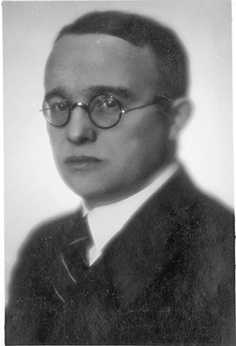
A similar interest in the nexus between jurisprudence and Jewish law can be found in the works of Max Laserson (see Figure 2.3). Laserson was born in 1887 in the Latvian part of the Russian Empire. He studied law at St. Petersburg Imperial University under the leading late-imperial Russian legal philosopher, Leon Petrażycki. In 1921, Laserson moved to the newly independent state of Latvia, where he became a member of the Latvian Parliament and worked as a lawyer and a teacher in a private institution of higher education, the Riga Commercial College. In 1934, following an authoritarian coup d’état in Latvia, Laserson was imprisoned in a concentration camp for six months and then left for British-ruled Palestine. He became one of the four founders of the Tel Aviv School, teaching courses on constitutional law, public international law, and jurisprudence. In 1939, he moved to the United States, ultimately becoming a lecturer at Columbia University.Footnote 97
Max Laserson, c. 1934.
Laserson was a polyglot, publishing works in seven languages: Russian, Yiddish, Latvian, German, Hebrew, French, and English. He wrote extensively on constitutional law, international law, and the philosophy of law.Footnote 98 One significant characteristic of Laserson’s jurisprudential oeuvre was his interest in the Jewish contribution to jurisprudence, especially natural law theory.Footnote 99 A major topic of many of his works on natural law was the Jewish notion of the seven Noahide laws – a universal moral code binding all humanity established through a covenant between God and Noah after the flood. According to the Talmud, these laws included a prohibition on idolatry, murder, theft, and incest, and a duty to establish courts of law.Footnote 100
One of Laserson’s first articles, published in 1912 in the Moscow periodical Voprosy Prava, was devoted to natural law in ancient Jewish texts. This article manifested the influence of Marx’s and Petrażycki’s legal theories. The Marxist influence is evident, for example, in the emphasis that Laserson placed on the role of economic conditions in shaping law and in a class-based interpretation of biblical legal history, inspired by the work of the Marxist theoretician Karl Kautsky. Thus, Laserson argued, the fact that the Israelites were mainly nomadic herders and farmers, and not merchants and artisans, influenced their law, which was focused on land law rather than civil or commercial law. He called the prophets advocates of the people’s rights, who stood by the “oppressed masses” and opposed the disparity between rich and poor in ancient Israel. He argued that biblical positive law served the interests of the powerful, while natural law reflected the interest of the lower classes; and he depicted the Second Temple Jewish sect, the Essenes, as “the first practical communists,” and Jesus and his followers as constituting “a movement of the Jewish proletariat.”Footnote 101 The Petrażyckian influence on Laserson’s article is clear in his discussion of the relationship between psychology and law and his interest in the development of intuitive legal consciousness.Footnote 102
Unlike other Russian-Jewish scholars at the time, in this article, Laserson did not call in any way for a revival of Jewish law motivated by a Jewish-nationalist agenda. The article, written for a Russian audience, positioned Jewish legal history as a case study that could be used to illustrate broader theoretical concerns, whether Marxist or Petrażyckian. At this point, Laserson did not view Jewish law as a repository of norms and institutions that could be revived and used in the present; nor did he seek to prove the Jewish contribution to the global history of legal thought. However, in the second half of the 1930s, after moving to Palestine and starting to teach at the Tel Aviv School, a bastion of the Jewish legal revival movement, Laserson’s use of Jewish law changed. Now, he sought to convince non-Jewish audiences that the history of Jewish law was relevant to the comparative history of global legal thought. He also worked to convince Jewish readers that Jewish law was not an archaic legal system but one based on modern values and, therefore, still relevant to the present.
These changes were evident in an article Laserson published in 1937 on the legal philosophy of the medieval Jewish scholar Maimonides. The article was first published in French in the journal of the International Institute for the Philosophy of Law and Legal Sociology, based in Paris. An expanded version of this article was later published in Hebrew as a short book.Footnote 103 The French article began with the statement that its purpose was to “fill a lacuna.” The literature on the philosophy of law had ignored legal thinkers from the “non-Christian world,” and Laserson sought to correct this omission by showing the influence of Maimonides on modern legal thinkers. Laserson argued that Maimonides’ thought had influenced Baruch Spinoza and, via Spinoza, had made an impact on the ideas of Jean-Jacques Rousseau and, therefore, also on modern doctrines of international and constitutional law.Footnote 104
In the Hebrew version of the article, Laserson sought to further a Jewish-nationalist jurisprudential agenda by arguing that Jewish scholars should devote more attention to the study of Jewish legal thought and strive to prove that Jewish law was not an obsolete legal system but one that resonated with modern democratic values. Like the article in French, the Hebrew version began with a note on the importance of Jewish legal philosophers to the global history of law. After lamenting the fact that Jews had contributed to the development of Western legal philosophy but had neglected to tend “[their] own vineyard,” Laserson argued that:
… we [Jewish law scholars] will mostly be able to permanently contribute to the global literature on law by analyzing Jewish legal philosophy and theory because our interpretative and dogmatic analysis is bound to remain, as any legal dogmatics, only on the national level … the development of Jewish legal science demands that we discover the unique [contribution] of Jewish thought to the general treasure of human civilization.Footnote 105
In particular, he claimed that the subject of his book, Maimonides, should be considered one of the foundational figures of the global science of law. Studying Jewish legal thought, Laserson continued, would also prove that commendable and modern notions such as natural rights, freedom, tolerance, and opposition to despotism were not modern Western inventions but had already appeared in ancient Jewish texts.Footnote 106
Western jurisprudential literature claimed that the distinction between positive and natural law appeared only in the West and was related to the individualist nature of ancient Greek and Roman societies. This approach gave rise to the mistaken belief that Hugo Grotius was the originator of natural law theory. However, this was wrong, said Laserson. The critique of existing laws, leading to the appearance of the idea of natural law, was not a uniquely Western phenomenon since such a critique appeared in every society, including in ancient Jewish society.Footnote 107 Moreover, during the Middle Ages, Judaism – or, more specifically, Maimonides, in his treatise, The Guide for the Perplexed – developed the idea of natural law in a way that influenced early modern Western theorists. One major innovation that Laserson attributed to Maimonides was the notion of civil religion, that is, a narrow set of moral dogmas essential for the peace and stability of any state, such as the belief in God, in the afterlife, in punishment for the wicked, and in reward for the good. The notion of civil religion, bolstering the state and guaranteeing its stability, can be found, said Laserson, in the works of Hobbes, Spinoza, and Rousseau. Laserson, however, argued that it could be traced back to Maimonides and specifically to chapter 28 of Part III of The Guide for the Perplexed.Footnote 108
In arguing for the importance of Maimonides’ thought, Laserson was motivated not only by cultural nationalism but also by a desire to show that Jewish legal thought constituted an important chapter in the history of global legal thought. He was also reacting to the events of the 1930s, attempting to use Maimonides’ ideas to create a basis for a critique of both communist and Nazi ideology. Natural law (and civil religion) became such a basis, reflecting a broader effort evident in the works of liberal legal scholars in the 1930s to find some form of non-positivist theory of law that could serve as a foundation for the defense of the beleaguered democracies of the West.Footnote 109 Thus, after arguing that the idea of a civil religion first appeared in The Guide for the Perplexed, Laserson emphasized that this idea was now extremely important. The first modern democracies – Calvinist Geneva, England during the English Civil War, or France during the French Revolution – had civil religions, Laserson explained. This idea, however, was replaced in the nineteenth century by “ideological Manchesterism,” that is, by the notion of ideological laissez-faire. Now, only anti-democratic states (the Soviet Union, Italy, and Germany) had obligatory political ideologies, Laserson said, and these were based on the denial of civic freedom.Footnote 110 Contemporary democratic states had long ignored the need to pay attention to the beliefs and opinions of their citizens, but they were now being forced (due to the threat of anti-democratic regimes) to create a “legal credo” for their subjects, a new civil religion. Laserson concluded his book by claiming that “they must rely not only on one of the last thinkers to mention the idea of [civil religion], Rousseau,” but also on one of the first thinkers who mentioned this idea: Maimonides.Footnote 111
Laserson’s interest in Jewish law continued after his move to the United States. For example, in 1948, he published a short piece on “the Hebrew Roots of International Law,” in which he claimed that the Noahide laws had influenced early modern Christian pioneers of international law, such as Grotius and Selden.Footnote 112 Perhaps the most relevant article on Jewish law written during his American period, however, was published posthumously in 1953. In this article, Laserson compared Thomas Hobbes to the biblical figure of Job. He described the Book of Job as epitomizing a higher stage of moral and legal thought, the stage of natural law, compared to Hobbes’ crass positivism, which ultimately led, he claimed, not just to the legal positivism of nineteenth-century thinkers such as John Austin but also, indirectly, to the legal theories prevalent in Nazi Germany.Footnote 113
In Laserson’s work, the interest in the nexus between jurisprudence and Jewish law was mainly expressed in an interest in the history of natural law theory. In articles published in Mandatory Palestine during the interwar period by other legal scholars, interest in this nexus found expression in works that compared Jewish law to Western law, particularly Roman law. I will now discuss these works, which can be placed on the borderline between comparative law and jurisprudence.Footnote 114
Western thought since antiquity (and also Jewish thought) often used the “Rome versus Jerusalem” dichotomy to argue that Western/Christian and Jewish culture and ideas were diametrically opposed.Footnote 115 Such notions also appeared in discussions of Jewish and Roman law. The difference between the two legal systems was a common topic of Jewish works written in the early twentieth century. One way to contrast these two systems was to argue that Roman law was based on authority and power while Jewish law was based on morality, implicitly echoing the positivism/natural law dichotomy. According to this approach, Jewish law was not just different from Roman law but also better: more moral and progressive.Footnote 116
The distinction between the two legal systems was often based on comparing two concrete and related issues: individualism versus collectivism and subjectivism versus objectivism. For example, a 1927 article by a certain “B. Safra” from Russia (this was probably a pseudonym used to hide the identity of the author), which was published in the journal Ha-Mishpat ha-‘Ivri, argued that Roman law prioritized individual liberty and the concept of absolute private property. Because of its religious nature, Jewish law regarded all property as ultimately belonging to God and did not view the right of property as paramount. Safra offered several examples to buttress this observation. For instance, he noted that Jewish law gave the poor a legal right to part of the produce of orchards and fields owned by the wealthy. Safra stated that Roman law was the source of many Western legal systems, but its influence was waning. In the future, he implied, modern legal systems would adopt the quasi-socialist notions upon which Jewish law was based.Footnote 117
A related distinction to the individual/collective one was that between subjectivism and objectivism. Asher Gulak’s 1925 inaugural lecture at the Hebrew University sought to compare “the spirit of the Jewish and Roman civil law.”Footnote 118 In this lecture, Gulak argued that one principle that distinguished Jewish and Roman law and proved that the two systems were “derived from sources foreign to each other” was related to the notion of will. Roman private and public law, said Gulak, were based on the exercise of will: the will of the individual, in the case of private law; and the sovereign’s will in the case of public law. Both Roman private and public law were thus based on a devotion to the notion of sovereignty. The Jews, however, were devoted to justice, not sovereignty. As a result, their private law did not seek to empower the individual’s will in creating legal relationships. Instead, such relationships were based on objective facts rather than subjective will.Footnote 119
Gulak then noted that, in Roman law, the pater familias could adopt strangers (for example, as a method of forging political or military alliances between families). Adoption did not require any objective criteria. It was carried out merely by the exercise of will on the part of the adopter. In contrast, Jewish law did not recognize the possibility of adoption, and family relations were based purely on “objective” bloodlines. In addition, while Roman law mainly championed the notion of free testamentary dispositions, Jewish law, although it did recognize the possibility of creating wills, focused on creating rules in the case of intestacy. Gulak claimed that Roman civil law, sanctifying the will of the individual citizen, led to “tyranny and the oppression of the weak.” In Jewish law, by contrast, the individual’s exercising of their will was subject to “the demands of justice.”Footnote 120
Nineteenth-century legal thought, shaped by liberal ideology, would have viewed the absence of emphasis on individual free will in Jewish law as evidence of its inferiority. The fact that Jewish law did not give precedence to the free will of individuals would have been perceived as an indication that this legal system belonged to a low rung of the evolutionary legal ladder, at the top of which stood legal systems based on free will. However, by the 1920s, when Gulak gave his inaugural lecture, this fact would actually have led many legal scholars to classify Jewish law as more attuned to modern sensibilities than Roman law. Gulak himself was aware of this fact when he concluded that:
… the objective principles upon which our nation’s private law is founded have many contact points with modern developments in legal science, in which, too, there is a tendency to weaken the power of the individual’s will in his private relations with other individuals and to recognize the influence of social and objective principles in individual relations. The objective principles of Jewish private law and the moral principles they reveal prove the vitality of our nation’s laws and the fertile influence they may have on modern legal ideas.Footnote 121
Jurisprudence and the Palestinian-Arab Community
In Chapter 1, I discussed theoretical works on Islamic law published in India, focusing specifically on the work of the Madras judge, Abdur Rahim. In Chapter 7, I will discuss Egypt, where there was a large community of legal scholars interested in applying Western legal theories to the study of Islamic legal history and jurisprudence. Such interest also existed among the Arab lawyers of Mandatory Palestine but on a smaller scale. In order to explain the relative difference in interest in legal theory between the Arab lawyers of Palestine and Egyptian lawyers, and also between the Arab and Jewish lawyers of Palestine, a short discussion of the history of book publishing in Palestine is required.
The Palestinian-Arab community in Mandatory Palestine was larger than the Jewish one. In 1931, Jews comprised only 17 percent of the population of approximately 1 million. By the end of British rule, the Jewish population comprised roughly 30 percent. However, while Mandatory Palestine was a major Jewish intellectual and cultural center, the centers of Arab and Islamic intellectual life were in places such as Egypt and Lebanon rather than in Palestine. The Jewish and Arab communities differed in literacy rates.Footnote 122 Another difference was that while there was an extensive Jewish autonomous school system in Palestine, which included many high schools and several higher education institutions, there were very few Arab high schools and no Arab universities.Footnote 123 In the early 1930s, the political leader of the Palestinian-Arab community, Hajj Amin al-Husayni, attempted to establish an Islamic University (partly to be funded by Indian Muslims) that would compete with the Hebrew University, but this attempt failed. Al-Husayni was unable to secure enough funds, and events in the second half of the 1930s ultimately doomed the project, specifically the British repression of the Arab Revolt of 1936–39 and the fact that al-Husayni, who played a key role in the Revolt, fled the country in 1937.Footnote 124
The difference in literacy and education rates was reflected in the number of publications in Arabic versus Hebrew in Palestine. The 1931 Census of Palestine reported that thirty-nine books in Arabic had been published in the territory between 1923 and 1931. During the same period, 1,120 books in Hebrew had been published there.Footnote 125 In the 1940s, Ishaq Musa al-Husayni, a Palestinian-Arab scholar, compiled a list of 209 Arabic books published in Palestine between 1919 and 1944, most of which were school textbooks. This number, stated Husayni, was less than the number of books published by the Jews of Palestine in a single year.Footnote 126 As for periodicals, according to the 1931 Census, thirty-nine periodicals were published in Arabic in Mandatory Palestine between 1923 and 1931, compared to 332 in Hebrew.Footnote 127
The gap between Arabs and Jews was also evident in the legal realm. There were many learned Arab lawyers in Palestine, some of whom were involved in activities beyond the ordinary practice of law.Footnote 128 However, the institutional structures of the Arab legal community were less developed than those of the Jewish one. A voluntary national Jewish Bar Association was established in 1928. Arabs had local bar associations, but the National Arab Bar Association was only established in 1945 and remained inactive.Footnote 129 By the end of British rule in Palestine in 1948, there were 1,187 lawyers licensed to appear before the government courts of Palestine. Of these, 1,059 (90 percent) were Jews at a time when Jews comprised only a third of the population.Footnote 130 The dominance of Jews in the legal profession translated into a dominance in legal writing. Four Jewish legal periodicals appeared in Palestine during the period of the British Mandate, compared to just one Arabic legal periodical.Footnote 131 This discrepancy was also evident in the realm of law books. Very few law books in Arabic were written (or translated) in Palestine. According to the Census of 1931, only five of the thirty-nine books published in Arabic during the 1920s dealt with legal topics.Footnote 132
One book in Arabic relevant, to some extent, to legal theory was a book on Bedouin customary law written by a leading Arab intellectual, ‘Arif al-‘Arif, in the 1930s. However, ‘Arif was neither a lawyer nor a legal scholar. Hence, his book did not provide a theoretical examination of the nature of Bedouin law nor even a history of this law. Instead, it was a descriptive survey of Bedouin society and customary norms.Footnote 133
In the mid-1920s, Fahmi al-Husayni, an Arab lawyer, published a legal periodical, al-Huquq. This was a practitioner-oriented publication (unlike the Hebrew journal Ha-Mishpat ha-‘Ivri, which was published at around the same time and had an academic orientation). The articles in al-Huquq included reports on the decisions of courts in Palestine and abroad, police-related articles, and even poems. However, al-Huquq did carry some articles on the nature of law, comparative law surveys (for example, on ancient Egyptian, English, Jewish, Chinese, and Japanese law), and discussions of Islamic law and Islamic legal history. Many of these articles were translated from other languages or were written by non-Palestinian authors. For example, al-Huquq published a short translation of parts of Goadby’s jurisprudence textbook or brief theoretical works written by Lebanese scholars ‘Arif al-Nakdi and Issa Iskandar al-Ma‘aluf. One could also find in it non-legal theoretical articles, such as excerpts from Karl Marx’s Communist Manifesto.Footnote 134 The journal also contained reports exposing readers to Continental theories. For example, it published a report on the visit of the French anti-formalist legal scholar Léon Duguit to Egypt. This report briefly summarized Duguit’s unique theory about the relationship between law and social solidarity.Footnote 135
Few original theoretical works were published in al-Huquq. One example was an article by Husni ‘Abd al-Hadi, a lawyer from Nablus and a graduate of the Ottoman Law School in Istanbul, who wrote an article on the nature of obligations.Footnote 136 There were also some articles with a criminological focus, such as one written by Darwish Abu al-‘Afiyah, which dealt with the economic and social factors causing crime and in which the Italian criminologist Cesare Lombroso was quoted, or an article about women as criminals that drew on the works of the French criminologist René Garraud.Footnote 137 In addition, in reviews published in the journal it is possible to find brief discussions about the progressive nature of Islamic law compared to European law and about the idea that the law of Muslim countries should reflect the “spirit” (ruh) of the Islamic nation.Footnote 138 There were also hints of a sentiment of pan-Asian solidarity in the journal, manifested in the publication of translated articles by Western writers on Chinese and Indian topics.Footnote 139
Conclusion
Despite its small size, Mandatory Palestine had a developed system of Western-style legal education. Law students in Palestine were exposed to English ideas about the nature of law and its development, but they were also exposed to state-of-the-art Continental anti-formalist theories. These were found in works written by English and Jewish legal scholars in Palestine about the philosophy and history of law. Like the Indian works discussed in Chapter 1, the writings produced in Palestine were characterized by cosmopolitanism and a willingness to critique English theories using examples taken from local law. Jewish scholars in Palestine were also interested in theoretical discussions on the nature and history of Jewish law, comparing it to Western law and using the comparison to make general claims about the nature of both systems. There were significant points of similarity between the institutional and intellectual histories of legal theory in colonial India and Mandatory Palestine. However, there were also substantial differences. Both will be explored now, in Interlude 1.


 Open access