Introduction
In many cultural groups, spiritual well-being (SWB) is considered a positive asset for interpreting caregiving and for coping with it (El Nawawi et al., Reference El Nawawi, Balboni and Balboni2012; Gardner et al., Reference Gardner2017). Several studies (Newberry et al., Reference Newberry2013; Sankhe et al., Reference Sankhe2016; Tan et al., Reference Tan2015) suggest that people who are more spiritual feel more positively about their role as caregivers, get along better with those to whom they provide care, and express less caregiver distress (Skalla et al., Reference Skalla2013). The spiritual dimension is recognized as one of the core domains in the assessment of quality of life (QoL) in oncology (Whitford et al., Reference Whitford, Olver and Peterson2008) and is mostly used as a coping strategy to deal with the caregiver burden (Delgado-Guay et al., Reference Delgado-Guay2013). Providing care to a family member with cancer has been described as a full-time job (Rabow et al., Reference Rabow, Hauser and Adams2004) and places significant demands on the caregivers’ personal time, social roles, physical and psychological states, and financial resources (Given et al., Reference Given and Maas2001).
The multidimensional burden that results from providing care to a patient with cancer is well documented; as a result, a growing number of psychosocial interventions have been developed specifically to address this burden (i.e., Meaning-Centered Psychotherapy; Applebaum & Breitbart, Reference Applebaum and Breitbart2013). As reported by Given et al. (Reference Given and Maas2001), it is linked to caregiver negotiations of the caregiving role because caregivers may be unfamiliar with the care they must provide and may not be aware of or able to use available resources. According to Lazarus and Folkman's original model of stress and coping (Reference Lazarus and Folkman1984), if perceived demands exceed perceived resources, decreased QoL may be one of the consequences of poor coping (Kim & Given, Reference Kim and Given2008; Lazarus, Reference Lazarus1993). In the experience of being a caregiver for a person with cancer, finding meaning in suffering has the potential to act as a buffer against the burden (Applebaum et al., Reference Applebaum2014).
For all these reasons, it is very important to use a biopsychosociospiritual approach to better understand all potential sources of distress in the caregiver experience. The risk is that, by failing to assess SWB, the “true” caregiver burden of cancer is largely miscalculated (Whitford et al., Reference Whitford, Olver and Peterson2008).
SWB is not the same as spirituality. Spirituality has been conceptualized as a broader search for meaning in life, involving a universal power as guide (Underwood et al., Reference Underwood2006). SWB, on the other hand, is conceptualized as an expression of spirituality, or measurement of the state of one's spirituality or spiritual health. SWB is a multidimensional concept that incorporates both religious and spiritual domains (Cotton et al., Reference Cotton1999) and is defined as “the ability to maintain hope and derive meaning from the cancer experience” (Ferrell et al., Reference Ferrell1996; Prince et al., Reference Prince2015). In fact SWB also differs from religiosity, defined as a formalized belief system experienced through ritual behaviors and shared religious beliefs, usually practiced in a community together with other individuals (Prince et al., Reference Prince2015). SWB has many dimensions including the vertical dimension, or one's sense of well-being in relationship to God, and the horizontal dimension that represents one's perception of life's purpose and satisfaction excluding any specific religious reference (Clay et al., Reference Clay, Talley and Young2010).
SWB is considered as a source of meaning in interpersonal, transpersonal, and intrapersonal processes and experiences (Adams et al., Reference Adams2014). It is reasonable to consider SWB as a way of coping with stressful events such as the moment of diagnosis and across the entire cancer trajectory for a family caregiver (de Araújo Lamino et al., Reference de Araújo Lamino, Turrini and Kolcaba2014; Puchalski, Reference Puchalski2003).
On the basis of these considerations, we regard SWB as a universal condition that can be experienced by individuals regardless of their belonging to a particular religion and may influence family caregiver burden and QoL during the course of the disease (Colgrove et al., Reference Colgrove, Kim and Thompson2007) within a meaning systems perspective (Park, Reference Park2007). For the time being, only a few studies have examined the role of SWB in the context of providing cancer care (Adams et al., Reference Adams2014; Colgrove et al., Reference Colgrove, Kim and Thompson2007; Newberry et al., Reference Newberry2013; Tan et al., Reference Tan2015) and most of them were carried out mainly in palliative care settings (Delgado-Guay et al., Reference Delgado-Guay2013; Edwards et al., Reference Edwards2010; Sun et al., Reference Sun2016). Considering this, the purpose of the present study was to explore the cross-sectional associations between SWB, burden, and QoL in primary family caregivers of patients with cancer during the course of the disease.
Method
Participants and procedures
The study was approved by the ethical committee of the Institutes involved. Subjects were sampled at the Oncology Clinics of two Italian general hospitals: “San Carlo” Hospital in Potenza and “Cardinale G. Panico” Hospital in Tricase (Lecce) between August 2013 and May 2014. Eligibility of primary family caregivers was based on the following criteria: having a relative with cancer; being at least 18 years of age; having no health problems; diagnosis of cancer and/or neurological or cognitive impairments; being identified as the main caregiver, either by the patient or self-identified; being proficient in the Italian language; and providing written, informed consent.
In the clinic, 235 caregivers meeting all inclusion criteria were approached by the physician and asked to participate in the study. Of that number, 227 decided to participate and signed a consent form regarding the study protocol after detailed explanation by the physicians. The caregivers were free to complete the questionnaire either in the hospital or at home. Participants who chose to complete forms at home were given a self-addressed, stamped envelope in which to return the forms. A total of 28 caregivers did not answer all the questions in the questionnaires; it was therefore decided not to consider them for the analysis. As such, 199 primary family caregivers of patients with cancer completed the study protocol.
Measures
All participants were asked to complete the following questionnaires:
A. A demographic form, including data on sex and age of the patients and caregivers, educational level and employment status of caregiver, assistance timing, caregiver's relationship to the patient, diagnosis timing, patient's type of cancer and Eastern Cooperative Oncology Group Performance Status (Oken et al., Reference Oken1982).
B. The Medical Outcomes Study Short Form (SF-36; Brazier et al., Reference Brazier1992) is a multidimensional self-administered rating scale designed to assess perceived health and functioning. The SF-36 contains 36 questions and 8 subscales: (1) physical functioning; (2) role limitations from physical health problems; (3) bodily pain; (4) general health; (5) vitality (energy/fatigue); (6) social functioning; (7) role limitations because of emotional issues; and (8) mental health (psychological distress and psychological well-being). The items use Likert-type scales, some with 5 or 6 points and others with 2 or 3 points. These ratings are summed to yield raw scale scores for each health concept and are converted to a 0–100 scale, with 100 indicating the best possible score. The SF-36 also yields two summary measures—Physical Component Summary and Mental Component Summary—derived using factor analysis and designed to provide more global indexes of functioning. Scores on the summary scales are expressed as T-scores (mean = 50; SD = 10; Ware et al., Reference Ware, Kosinski and Keller1994). SF-36 has been adapted and translated into various languages (Bullinger et al., Reference Bullinger1998; Wagner et al., Reference Wagner1998) and its validity and reliability established in several countries (Gandek et al., Reference Gandek1998). An Italian version of the SF-36 was used for this study (Apolone et al., Reference Apolone and Mosconi1998).
C. The Caregiver Burden Inventory (CBI) (Novak & Guest, Reference Novak and Guest1989) is a multidimensional scale proposed to evaluate the impact of burden on different aspects of a caregiver's life, reflecting various areas of the caregiver's well-being and functioning that may be differently affected: time-dependence burden, which gives a measure of flexibility with time and caregiver's time restriction; developmental burden, which evaluates the impact of failing to catch opportunities and pursue goals; physical burden, a measure of the physical consequences of caregiving; social burden, which assesses the impact on interpersonal and social relationships within the family and working environment; and emotional burden, which evaluates feelings of shame and embarrassment regarding the patient. Scores for each item are evaluated using a 5-point Likert scale ranging from 0 (not at all disruptive) to 4 (very disruptive), giving a total that ranges from 0 to 20 for each dimension. The total score ranges from 0 to 96, with higher scores showing higher caregiver burden. This scale has all the requirements including reliability and validity for use in clinical trials (Caserta et al., Reference Caserta, Lund and Wright1996; Novak & Guest, Reference Novak and Guest1992). The questionnaire was translated and validated in Italian by Marvardi et al. (Reference Marvardi2005).
D. The Spiritual Well Being Index (Daaleman & Frey, Reference Daaleman and Frey2004) contains 12 items that describe spiritual well-being. Each item is answered on a 5-point scale ranging from 1 (strongly agree) to 5 (strongly disagree). Higher scores indicate higher SWB. This test has the appropriate reliability (Cronbach's alpha = 0.804) and validity to register the complex relationship among religion, SWB, and health (Vespa et al., Reference Vespa2011).
Statistical analysis
Sociodemographic characteristics of both patients and caregivers were listed using descriptive statistics. The 75th percentile was adopted as a cut point to identify caregivers with high and low SWB. We decided on this dichotomization as the value that better discriminated our sample according to the aim of the study because it has already been carried out in a previous study (Vespa et al., Reference Vespa2011). The reliability of the SWB index was assessed by Cronbach's coefficient alpha. Statistical comparisons were performed by Student t or by chi-square test to compare high and low SWB groups. Data were analyzed using the SPSS statistical software package (SPSS, Chicago, IL), version 19.0, for Windows. All tests were considered significant at p ≤ .05.
Results
From the reliability analysis of the SWB index using Cronbach's alpha coefficient, significant congruence and reliability emerged (Cronbach's alpha = 0.804).
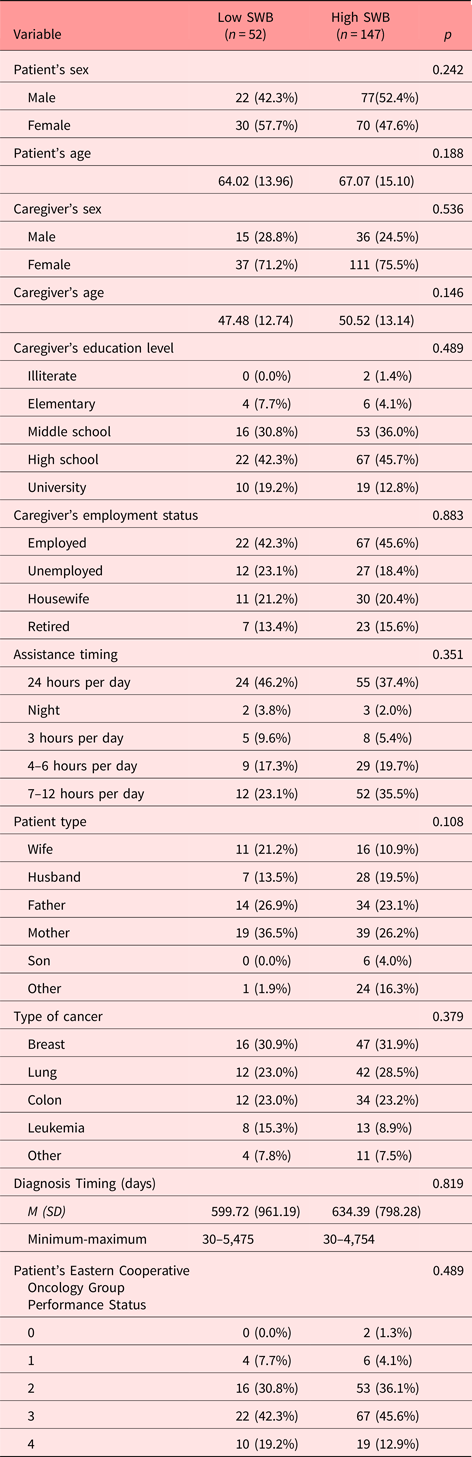
The sociodemographic characteristics of both groups (low SWB group vs. high SWB group) are shown in Table 1. Low and high SWB groups of participating caregivers did not differ with regard to sex and age of caregiver, educational level, employment status, assistance timing, type, sex or age of patient, diagnosis timing, type of cancer, and patient's Eastern Cooperative Oncology Group Performance Status.
Sociodemographic characteristics of the patients and caregivers by SWB groups (low and high)

SWB, spiritual well-being.
Spiritual well-being and QoL
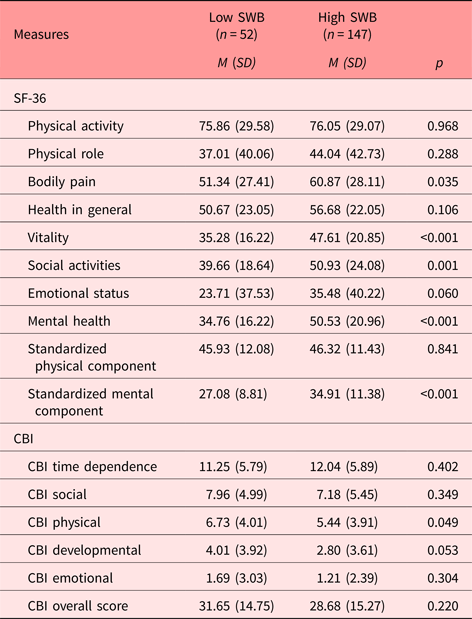
Compared with low SWB caregivers, the high SWB group reported significantly better SF-36 scores in bodily pain (p = 0.0359), vitality (p < 0.001), social activities (p = 0.001), mental health subscales (p < 0.001), and in standardized mental component scale (p < 0.001). No significant differences were detected between the two groups in physical activity, physical role, general health, emotional status, and standardized physical component scale (Table 2).
Psychometrics measures statistics for SWB groups
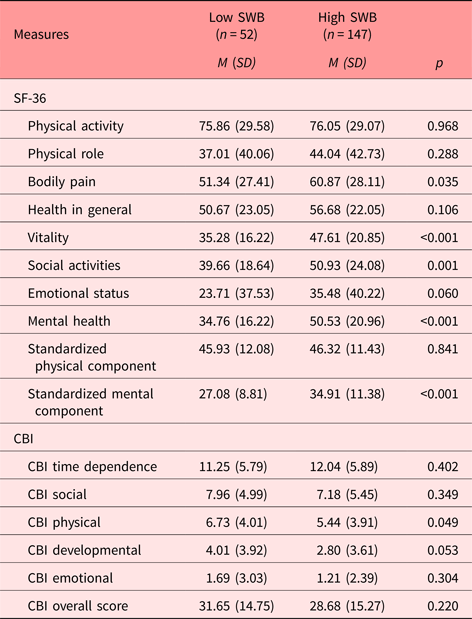
CBI, Caregiver Burden Inventory; SF-36, Medical Outcomes Study Short Form; SWB, spiritual well-being.
Spiritual well-being and caregiver burden
Compared with caregivers with high SWB, the low SWB group reported significantly higher scores in two CBI subscales: physical (p = 0.049) and developmental burden (p = 0.053). No further differences were found between the two SWB groups in the other CBI scores (overall and sections) (Table 2).
Discussion
In this study we have attempted to measure SWB from the perspective of the cancer caregiver. Comparing the psychometric measures between the low and high SWB group, no statistically significant sociodemographic differences were found. Conversely, we observed many significant differences between these two groups in caregiver burden and QoL.
In particular, the high SWB group showed better SF-36 scores for bodily pain and mental health subscales and for the standardized mental component scale, although no significant differences were detected in physical activity, physical role, general health, emotional status and standardized physical component scale. In line with Delgado-Guay et al. (Reference Delgado-Guay2013), these results suggest that SWB acts as a protective factor against psychological and physical distress.
For many years, SWB has been regarded as a component of patient care in fields closely related to pain medicine such as palliative and supportive care. Despite this, it has received relatively little attention within the field of pain medicine itself. Interestingly, in this study we observe a relationship between SWB and bodily pain. Our observations are consistent with the results of Siddall et al. (Reference Siddall, Lovell and MacLeod2015), who found increasing evidence to support the inclusion of spiritual factors as an important component in the assessment and treatment of pain. Further studies will be needed to explore the changing conceptual frameworks that have been applied to pain medicine, the emergence of the biopsychospiritual approach (Puchalski, Reference Puchalski2012) and its meaning, as well as finding evidence for the benefits of incorporating this approach for the management of pain.
The high SWB group scored better also for vitality subscale. This result shows the importance of implementing vitality, defined as a “positive feeling of having energy available to the self” (Nix et al., Reference Nix1999), as a significant dimension of spiritual health in family caregivers of patients with cancer (Griggs et al., Reference Griggs2007; Ryan & Frederick, Reference Ryan and Frederick1997).
Findings of our study also demonstrated that SWB is an important personal resource that can be drawn upon to facilitate improvements in social well-being. Many spiritual traditions encourage participation in a community. Spiritual fellowship, such as attending church or a meditation group, can be sources of social support that may provide a sense of belonging, security and community (Powell et al., Reference Powell, Shahabi and Thoresen2003).
High SWB of primary family caregivers also has positive outcomes on CBI developmental and physical burden subscales although in the other CBI subscales (time dependence, social, and emotional) and CBI overall score no difference emerged. On the basis of our results, caregivers with low SWB perceive a greater sense of isolation from the expectations and opportunities of their peers and describe a greater feeling of chronic fatigue and somatic health issues. In accordance with Newberry et al. (Reference Newberry2013), our findings suggest that SWB is an important factor that can influence caregiver burden and physical health. Maintaining faith and finding meaning in cancer caregiving can buffer the adverse effect of caregiving stress on mental health. Caregivers with high SWB should also be encouraged to pay more attention to their physical health while providing cancer care (Colgrove et al., Reference Colgrove, Kim and Thompson2007).
These results introduce a meaning-centered model (Park, Reference Park2007) of well-being and QoL for family cancer caregivers. Highly spiritual cancer caregivers may perceive caregiving as a part of their spiritual duties, yielding positive appraisals of their caregiving experience even while neglecting self-care. As reported by Colgrove et al. (Reference Colgrove, Kim and Thompson2007), family caregivers may experience physical detriment from providing intense cancer care or from additional stress related to acting in accordance with spiritual norms and still perceive their caregiving role positively because they are fulfilling a spiritual calling (body sanctification; Jacobson et al., Reference Jacobson, Hall and Anderson2013; Park, Reference Park2007). In line with Applebaum et al. (Reference Applebaum2014), we believe that these caregivers may already be making meaning of this role and/or finding benefit in caregiving, despite their burden. By promoting interconnectedness with self, others, and God, and providing guidance in the search for life's meaning and purpose, high SWB caregivers may transcend their suffering and experience a greater sense of QoL and decreased burden throughout the disease process of cancer patients (Tan et al., Reference Tan2015). This dynamic process may explain how physical and mental health are better in highly spiritual cancer caregivers. Our study has several methodological limitations such as the cross-sectional design, dichotomization, as well as its focus on QoL and burden, and a lack of comparison between groups for different tumors. This type of comparison was not been possible because of the limited number of cases in the subdivision for each type of cancer given the small sample size. Measures of caregiving demands and caregivers’ attachment patterns, coping styles, personality traits, and perceived social support were not included; thus, many confounders were not considered. Furthermore, all of the analyses were univariate, meaning that none of the analyses control for possible confounders. This may overstate the relationship between SWB and positive outcomes. Despite these limitations, our findings have theoretical implications for better understanding the practical implications for developing integrative programs to improve QoL of family members in the various phases of caregivership (Kim et al., Reference Kim2011). Currently, attention to spiritual needs is most prevalent at the end of life. Cancer treatment, whether its intent be curative or palliative, can be a demanding period for the family caregiver both physically and mentally. Some existential therapeutic models such as, for example Meaning-Centered Psychotherapy (Breitbart et al., Reference Breitbart2012, Reference Breitbart2015), demonstrating efficacy in improving spiritual well-being and a sense of meaning, might be desirable to address and resolve the issue. Assisting caregivers to access sources of meaning in the caregiving experience should lead also to improvements in their QoL (Applebaum et al., Reference Applebaum2014).
This study shows that psychosocial care and spiritual support should be made available to family caregivers from the moment of cancer diagnosis, already in active treatment settings, and not only in palliative care (Puchalski et al., Reference Puchalski2014). It is important to acknowledge the family's specific beliefs and emotions connected with grief, and that healthcare professionals need to be prepared about the spiritual and existential concerns they may come to face throughout the caring process. Only a biopsychosociospiritual approach can help those suffering from cancer and their caregivers to reevaluate the meaning of their life, which has been, often abruptly, undermined by the disease (Puchalski, Reference Puchalski2012). More research is needed to help develop new ways of supporting the specific needs of family caregivers during times of great vulnerability.
Conclusion
This study highlights the role of SWB upon the burden and QoL of family caregivers pointing out that it could be useful in preventing pathological influences of the caregiver burden and enhance psychological and physical well-being through spiritual counseling. The presence of a spiritual dimension may be a marker for a better adaptation to caregiving.