Delay of gratification has been defined as an individual's capacity to deliberately resist temptation in the service of executing a behavior that is consistent with long-term goals and values (e.g., Metcalfe & Mischel, Reference Metcalfe and Mischel1999; Mischel et al., Reference Mischel, Ayduk, Berman, Casey, Gotlib, Jonides and Shoda2011; Mischel, Shoda, & Rodriguez, Reference Mischel, Shoda and Rodriguez1989; Nigg, Reference Nigg2017). Delay of gratification reflects a form of self-regulated behavior that is supported by multiple underlying affective, cognitive, and behavioral processes (Rothbart & Bates, Reference Rothbart, Bates, Eisenberg, Damon and Lerner2006) and is facilitated through early socialization experiences (e.g., Kopp, Reference Kopp1982; Razza & Raymond, Reference Razza and Raymond2013). Individual differences in delay of gratification are associated with other forms of emotional and behavioral adjustment across the life span (e.g., Mischel et al., Reference Mischel, Ayduk, Berman, Casey, Gotlib, Jonides and Shoda2011). For example, difficulties with delay of gratification in preschool have been shown to predict obesity (e.g., Francis & Susman, Reference Francis and Susman2009; Seeyave et al., Reference Seeyave, Coleman, Appugliese, Corwyn, Bradley, Davidson and Lumeng2009), substance abuse (e.g., Ayuduk et al., Reference Ayduk, Mendoza-Denton, Mischel, Downey, Peake and Rodriguez2000), psychiatric disorders (e.g., Ayduk et al., Reference Ayduk, Zayas, Downey, Cole, Shoda and Mischel2008; Rodriguez, Mischel, & Shoda, Reference Rodriguez, Mischel and Shoda1989), and low academic achievement (e.g., Ayduk et al., Reference Ayduk, Mendoza-Denton, Mischel, Downey, Peake and Rodriguez2000). Despite the significant body of research focused on understanding the central importance of children's delay of gratification for long-term outcomes, the field still lacks a nuanced, process-oriented understanding of the developmental processes that contribute to children's delay abilities and how interrelations among them might differ across individuals.
Developmental psychopathology might offer a useful heuristic for delineating how development unfolds within individuals and what might contribute to similar or divergent pathways in delay of gratification outcomes. Specifically, two of the central tenants of developmental psychopathology are equifinality and multifinality (e.g., Cicchetti, Reference Cicchetti1993; Cicchetti & Rogosch, Reference Cicchetti and Rogosch1996). Equifinality refers to the notion that there are many developmental pathways that lead to the same outcome, whereas multifinality denotes that any one process could function differently across systems or within individuals (Cicchetti, Reference Cicchetti1993; Cicchetti & Rogosch, Reference Cicchetti and Rogosch1996). Germane to the development psychopathology perspective is the notion that individuals play an active role in processing and integrating socialization experiences and both organismic and ecological factors shape patterns of adjustment and maladjustment on stage-salient issues. Guided by a developmental psychopathology framework, our goal in the present study was to utilize a novel person-based approach to delineate the nature of the interplay between sociocontextual factors (e.g., parenting and socioeconomic context) and intrinsic child processes (e.g., temperamental reactivity and set shifting) in contributing to delay of gratification abilities in preschool-age children.
Temperamental Reactivity and Delay of Gratification
In the present study, we focused on children's temperamental reactivity as a key person-based variable in developmental models of children's delay of gratification. Our approach was informed by recent calls in the self-control literature to better account for how individual differences in bottom-up automatic reaction tendencies (e.g., discomfort, reward sensitivity, fear, and inhibition) contribute to delay of gratification (e.g., Duckworth & Steinberg, Reference Duckworth and Steinberg2015; Neuenschwander & Blair, Reference Neuenschwander and Blair2017). In the developmental literature, individual differences in automatic reaction processes are organized under the construct of temperamental reactivity. Temperamental reactivity is defined as the speed, valence, and strength of a person's behavioral and emotional reactions to evocative environmental stimuli (Henderson & Wachs, Reference Henderson and Wachs2007; Rothbart, Ahadi, Hershey, & Fisher, Reference Rothbart, Ahadi, Hershey and Fisher2001; Rothbart & Bates, Reference Rothbart, Bates, Eisenberg, Damon and Lerner2006). Individual differences in reactivity are biologically based and can be observed as early as infancy (Rothbart, Derryberry, & Posner, Reference Rothbart, Derryberry, Posner, Bates and Wachs1994), and perhaps even prenatally (e.g., Wachs, Pollitt, Cueto, & Jacoby, Reference Wachs, Pollitt, Cueto and Jacoby2004). In addition, individual differences have been shown to remain moderately stable over time and are considered to be partially genetic in origin (e.g., Sanson & Rothbart, Reference Sanson, Rothbart and Bornstein1995; Wilson & Matheny, Reference Wilson and Matheny1983).
Two primary dimensions characterize temperamental reactivity: motivational and affective (Ahadi, Rothbart, & Ye, Reference Ahadi, Rothbart and Ye1993; Rothbart et al., Reference Rothbart, Ahadi, Hershey and Fisher2001). With respect to the motivational dimension, Gray's model (Reference Gray, Strelau and Angleitner1991) proposes there are two underlying systems that guide an individual's automatic behavioral tendencies in response to environmental cues of reward and punishment. The behavioral activation system (BAS), also known as the reward motivation system, is responsive to signs of potential reward and generates the behavioral impulse to approach a reinforcing stimulus. Conversely, the behavioral inhibition system (BIS), also referred to as the punishment motivation system, is sensitive to cues of punishment and inhibits behavior that may lead to undesired consequences (Gray & McNaughton, Reference Gray and McNaughton2000). Although BIS and BAS reflect relatively independent systems in the brain, they are thought to interact in dynamic ways across motivationally significant contexts. Within individuals, the relative balance of these two opposing systems influences the form of motivated behavior (i.e., approach vs. avoidance/withdrawal) that is exhibited in response to cues of reward or punishment (Gray, Reference Gray, Strelau and Angleitner1991). Examples of these behaviors include the extent to which a child moves toward, or conversely withdraws from or avoids, motivationally significant scenarios. Individuals form stable patterns in their motivational reaction tendencies (i.e., approach vs. withdrawal/avoidance) across similar situations (Henderson & Wachs, Reference Henderson and Wachs2007).
Emotional reactions are also elicited in response to rewarding or threatening situations. Negative affectivity is considered to be another defining aspect of temperament reactivity (Ahadi et al., Reference Ahadi, Rothbart and Ye1993; Rothbart et al., Reference Rothbart, Ahadi, Hershey and Fisher2001). Negative affectivity represents the states of anger, sadness, fear, discomfort, and low soothability (Henderson & Wachs, Reference Henderson and Wachs2007; Rothbart et al., Reference Rothbart, Ahadi, Hershey and Fisher2001). Negative emotions often arise as a consequence of strong BIS (i.e., withdrawal and avoidance) and BAS (i.e., approach) reactions to motivationally significant events (Henderson & Wachs, Reference Henderson and Wachs2007). Rothbart et al. (Reference Rothbart, Ahadi, Hershey and Fisher2001) argue that children who demonstrate heightened BAS or BIS reaction tendencies (i.e., reward or punishment motivation, respectively) across novel and challenging situations often exhibit greater negative affectivity as well. As such, BIS/BAS reaction tendencies and negative affectivity are conceptualized as defining features of individual differences in temperament reactivity.
Individual differences along the motivational and affective components of temperament reactivity likely form the basis for an individual child's arousability in delay of gratification contexts (Duckworth & Steinberg, Reference Duckworth and Steinberg2015). However, empirical investigations of how individual differences in temperamental reactivity relate to children's delay of gratification has generally been lacking. For example, most research has focused on the top-down, volitional processes that support children's ability to delay gratification (e.g., attentional control; Duckworth & Steinberg, Reference Duckworth and Steinberg2015; Eisenberg et al., Reference Eisenberg, Valiente, Fabes, Smith, Reiser, Shepard and Cumberland2003). More recently, some researchers (e.g., Eisenberg, Hofer, & Vaughan, Reference Eisenberg, Hofer, Vaughan and Gross2007; Eisenberg et al., Reference Eisenberg, Valiente, Spinrad, Cumberland, Liew, Reiser and Losoya2009, Reference Eisenberg, Edwards, Spinrad, Sallquist, Eggum and Reiser2013) have argued that temperamental reactivity should be analyzed separately from top-down self-control (e.g., effortful control and executive functions) given temperamental reactivity factors are less malleable to social influence (Eisenberg et al., Reference Eisenberg, Valiente, Spinrad, Cumberland, Liew, Reiser and Losoya2009) and involve different parts of the brain (Pickering & Gray, Reference Pickering, Gray, John and Pervin1999; Rothbart & Bates, Reference Rothbart, Bates, Damon and Eisenberg1998); and furthermore, may uniquely contribute to different forms of adjustment (Eisenberg et al., Reference Eisenberg, Valiente, Fabes, Smith, Reiser, Shepard and Cumberland2003, Reference Eisenberg, Spinrad, Fabes, Reiser, Cumberland, Shepard and Thompson2004, Reference Eisenberg, Valiente, Spinrad, Cumberland, Liew, Reiser and Losoya2009; Lemery, Essex, & Smider, Reference Lemery, Essex and Smider2002). In addition, an individual's level of temperamental arousal in response to reward cues may inform the extent to which top-down control processes are needed in those moments (Duckworth & Steinberg, Reference Duckworth and Steinberg2015; Eisenberg et al., Reference Eisenberg, Valiente, Fabes, Smith, Reiser, Shepard and Cumberland2003; Neuenschwander & Blair, Reference Neuenschwander and Blair2017; Wilson, Lengua, Tininenko, Taylor, & Trancik, Reference Wilson, Lengua, Tininenko, Taylor and Trancik2009). For example, higher levels of top-down cognitive control may be required among individuals who have strong impulses to gratify immediate needs (Duckworth & Steinberg, Reference Duckworth and Steinberg2015).
Research that has examined motivational and emotional aspects of temperamental reactivity in relation to developmental outcomes has generally taken a continuous approach. In addition, studies tend to examine motivational and affective traits separately. Collectively, research has suggested that higher levels of negative emotionality (e.g., Lemery et al., Reference Lemery, Essex and Smider2002; Lengua, West, & Sandler, Reference Lengua, West and Sandler1998), withdrawal-oriented punishment motivation (e.g., Biederman et al., Reference Biederman, Rosenbaum, Hirshfeld, Faraone, Bolduc, Gersten and Reznick1990; Davis & Nolen-Hoeksema, Reference Davis and Nolen-Hoeksema2000), and approach-oriented reward motivation (e.g., Eisenberg et al., Reference Eisenberg, Spinrad, Fabes, Reiser, Cumberland, Shepard and Thompson2004; Lemery et al., Reference Lemery, Essex and Smider2002) represent predisposing vulnerabilities for greater emotional and social difficulties, and poorer self-regulated behavior (Eisenberg et al., Reference Eisenberg, Valiente, Spinrad, Cumberland, Liew, Reiser and Losoya2009). However, results have not been entirely consistent and largely depend on the trait or outcome being examined (Bates, Pettit, Dodge, & Ridge, Reference Bates, Pettit, Dodge and Ridge1998; Belsky, Hseih, & Crnic, Reference Belsky, Hsieh and Crnic1998; Goodnight, Bates, Newman, Dodge, & Pettit, Reference Goodnight, Bates, Newman, Dodge and Pettit2006). As a few investigators have previously argued (Eisenberg et al., Reference Eisenberg, Valiente, Spinrad, Cumberland, Liew, Reiser and Losoya2009; Wilson et al., Reference Wilson, Lengua, Tininenko, Taylor and Trancik2009), it may be beneficial to consider affective and motivational aspects of temperamental reactivity from a profile framework and examine how different profiles might relate to self-regulated behavior, such as delay of gratification. In particular, a profile approach may have the advantage of elucidating the extent to which children with different temperament reactivity profiles struggle within delay contexts, whether certain socialization experiences buffer or enhance risk within groups, and whether the role of more effortful regulatory processes differs across individuals with different reactivity profiles. For example, Wilson et al. (Reference Wilson, Lengua, Tininenko, Taylor and Trancik2009) examined profiles of delay of gratification with physiological variables (e.g., heart rate reactivity and electrodermal responding) related to temperament reactivity and found that multiple distinct physiological profiles were associated with the ability to delay successfully. In addition, some of the physiological patterns shared behavioral similarities with children who could not delay (e.g., Wilson et al., Reference Wilson, Lengua, Tininenko, Taylor and Trancik2009). Although Wilson et al. (Reference Wilson, Lengua, Tininenko, Taylor and Trancik2009) did not examine physiological profiles among children who could not wait, their results underscore the complexity of processes involved in delay of gratification. Furthermore, a profile approach to temperamental reactivity may help to elucidate multifinality and equifinality in delay of gratification outcomes. As a first step toward improving understanding of the different developmental pathways to delay of gratification, the present investigation adopted a profile approach to children's temperamental reactivity and accounted for both motivational and affective components.
Differential Links Between Early Maternal Discipline and Delay of Gratification
In developmental models of delay of gratification, and self-regulation more broadly, parent–child interactions are understood to be critical for fostering children's developing capabilities (e.g., Carlson, Reference Carlson2005; Kopp, Reference Kopp1982; Mischel et al., Reference Mischel, Shoda and Rodriguez1989; Rothbart & Bates, Reference Rothbart, Bates, Eisenberg, Damon and Lerner2006). Specifically, the toddler and preschool years are marked by children's gradual transition from being primarily regulated by their caregivers to being capable of more self-initiated control (Kopp, Reference Kopp1982; Stifter, Putnam, & Jahromi, Reference Stifter, Putnam and Jahromi2008). Studies have documented modest associations between parental teaching-based strategies (e.g., reasoning and explanations; Houck & LeCuyer-Maus, Reference Houck and LeCuyer-Maus2004) and sensitivity (e.g., accurately interpret child cues; Olson, Bates, & Bayles, Reference Olson, Bates and Bayles1990; Razza & Raymond, Reference Razza and Raymond2013) and children's delay of gratification. However, some research has failed to detect associations (Bernier, Carlson, & Whipple, Reference Bernier, Carlson and Whipple2010). Furthermore, prior research has generally not examined associations between children's delay of gratification and multiple parenting practices simultaneously, or considered child temperament.
In order to enhance understanding of how children with distinct temperamental reactivity profiles might respond differently to specific socialization processes, it is paramount to increase conceptual and methodological precision with respect to parenting. For example, recent domain-specific approaches to socialization and parenting (Bugental, Reference Bugental2000; Bugental & Goodnow, Reference Bugental, Goodnow, Damon and Eisenberg1998; Grusec & Davidov, Reference Grusec and Davidov2010) emphasize that parenting is not a domain-general process. Contexts or types of parent–child interactions likely serve specific functions in promoting particular socialization outcomes. In Grusec and Davidov's (Reference Grusec and Davidov2010) domain-specific approach to parenting model, the discipline context, or what they refer to as the control domain, represents the primary socialization context in which parents teach children to act in accordance with cultural values and standards, and that appropriate conduct often necessitates the inhibition of personal desires. The discipline context represents one of the primary domains of socialization during the toddler years (i.e., 24–36 months) as a result of normative increases in child behavior problems and bids for autonomy (e.g., Belsky et al., Reference Belsky, Hsieh and Crnic1998; Belsky, Woodworth, & Crnic, Reference Belsky, Woodworth and Crnic1996). While operating in the control domain, parents are charged with the task to use discipline practices and resources they have at their disposal to help children internalize societal values as their own so they can later enact them independently without parental direction (Grusec & Davidov, Reference Grusec and Davidov2010). Given the developmental relevance of discipline for self-control outcomes, it is surprising that most studies examining associations between parenting and delay of gratification have focused on other socialization contexts, such as warmth and responsiveness during free-play interactions (e.g., Razza & Raymond, Reference Razza and Raymond2013), or measured caregiving more globally (e.g., Bernier et al., Reference Bernier, Carlson and Whipple2010; Kochanska, Murray, & Harlan, Reference Kochanska, Murray and Harlan2000). Lack of attention to the context in which parents and children are operating and its salience for particular developmental outcomes may account for inconsistencies across studies (e.g., Bernier et al., Reference Bernier, Carlson and Whipple2010), and result in findings with limited clinical utility. By focusing on the discipline context, investigators might be able to better tease apart whether children with certain temperamental characteristics respond differently to specific discipline practices and its potential consequences for children's delay of gratification.
According to the “goodness-of-fit” (Rothbart & Ahadi, Reference Rothbart and Ahadi1994; Thomas & Chess, Reference Thomas and Chess1977) and organismic specificity (Wachs & Gruen, Reference Wachs and Gruen1982) frameworks, individual differences in temperamental characteristics determine how individuals respond to particular socialization experiences, which in turn affects their acquisition of stage-salient skills. For example, some parents use inductive discipline strategies, such as reasoning, rule reflection, and problem solving to help children understand why it is both necessary and beneficial to inhibit their personal desires in order to enact socially appropriate behaviors (Grusec & Goodnow, Reference Grusec and Goodnow1994; Hoffman, Reference Hoffman, Higgins, Ruble and Hartup1983). In one longitudinal study, Houck and LeCuyer-Maus (Reference Houck and LeCuyer-Maus2004) found modest associations between maternal inductive discipline at age 36 months and children's delay of gratification at 5 years. However, they also found other discipline patterns (e.g., indirect) were associated with longer delay in children, concluding that no pattern showed clear advantages (Houck & LeCuyer-Maus, Reference Houck and LeCuyer-Maus2004). Furthermore, related research on the effects of inductive discipline on children's externalizing problems has suggested that children with heightened temperament reactivity (e.g., negative emotionality) are less likely to respond to parental scaffolding approaches given their level of internal arousal (Eisenberg et al., Reference Eisenberg, Zhou, Spinrad, Valiente, Fabes and Liew2005; Raver & Leadbeater, Reference Raver, Leadbeater, Moore and Dunham1995). Some research has suggested that children with reactive temperamental characteristics seem to be more responsive to sensitive disciplinary approaches, which is defined by parental responsiveness to children's mood, feelings, and capabilities (e.g., Cipriano & Stifter, Reference Cipriano and Stifter2010; Eisenberg et al., Reference Eisenberg, Zhou, Spinrad, Valiente, Fabes and Liew2005; Kochanska, Reference Kochanska1997; Kochanska, Aksan, & Joy, Reference Kochanska, Aksan and Joy2007). Specifically, sensitive discipline practices are thought to help dampen overarousal in reactive children, which in turn makes them more likely to respond to parental efforts to control their behavior in discipline contexts (Eisenberg et al., Reference Eisenberg, Zhou, Spinrad, Valiente, Fabes and Liew2005). For example, Cipriano and Stifter (Reference Cipriano and Stifter2010) found that children with exuberant temperaments (e.g., high approach and positive affect) evinced better self-regulated behavior in response to control strategies that conveyed a positive emotional tone, whereas they responded worse to reasoning approaches. In addition, other studies have found that children with high withdrawal-orientations and negative affect demonstrate higher levels of compliance and internalization of rules following experiences of sensitive discipline (Kochanska, Reference Kochanska1997; Kochanska et al., Reference Kochanska, Aksan and Joy2007). Consistent with principles of equifinality and multifinality (Cicchetti & Rogosch, Reference Cicchetti and Rogosch1996) and broader research on children's internalization of self-control (e.g., Kochanska, Reference Kochanska1995), there are likely multiple developmental pathways toward children's delay of gratification, which vary by children's profiles of temperamental reactivity. As suggested by previous investigators (e.g., Cipriano & Stifter, Reference Cipriano and Stifter2010), inductive discipline techniques may be more closely related to delay of gratification outcomes with less reactive children, whereas sensitive discipline might be more proximal in the case of more reactive children. Toward greater conceptual clarity and precision, we integrated domain-specific models of parenting with goodness of fit/organismic-specificity principles of temperament to examine whether there are different developmental routes from stage-salient maternal discipline practices (e.g., sensitive and maternal inductive reasoning) to children's delay of gratification that vary by children's temperamental reactivity.
Socioeconomic Associations With Children's Delay of Gratification
Much of the developmental research on antecedents of children's delay of gratification has focused on parenting. Less research has examined how broader ecological factors, such as socioeconomic experiences, could impact children's delay of gratification. Of the studies that do exist, some cross-sectional and longitudinal research has detected direct associations between socioeconomic adversity and poor delay of gratification (e.g., Evans, Reference Evans2003; Evans & English, Reference Evans and English2002; Raver et al., Reference Raver, Jones, Li-Grining, Zhai, Bub and Pressler2011). However, other studies have failed to find income-based differences on delay of gratification tasks among kindergarten-age children (e.g., Noble, McCandliss, & Farah, Reference Noble, McCandliss and Farah2007). It is unclear whether socioeconomic factors directly contribute to self-regulatory processes, like delay of gratification, over and above the influence of family risk processes (Lengua et al., Reference Lengua, Moran, Zalewski, Ruberry, Kiff and Thompson2015; Sturge-Apple, Davies, Cicchetti, Hentges, & Coe, Reference Sturge-Apple, Davies, Cicchetti, Hentges and Coe2017). To our knowledge there have yet to be studies that have examined associations between children's delay of gratification and earlier parenting practices and socioeconomic experiences simultaneously, which might be because research on parenting antecedents is mostly based on middle-income samples.
With respect to person-based differences, several contemporary models of temperament (e.g., differential susceptibility theory and biological sensitivity to context) propose that children with more reactive temperaments will evince worse self-regulation and associated socioemotional outcomes in impoverished socioeconomic contexts than children with less reactive temperaments, but will do better in resource-rich environments (Belsky & Pluess, Reference Belsky and Pluess2009; Boyce & Ellis, Reference Boyce and Ellis2005; Raver, Blair, & Willoughby, Reference Raver, Blair and Willoughby2013). There have yet to be any studies to explicitly examine whether socioeconomic influences on children's delay of gratification vary by children's temperament traits, and whether patterns would hold across children with different profiles of reactivity. However, one relevant study found that children with heightened approach and negative affect may be more prone to exhibit more reward-driven behavior following early exposure to harsh environments (Suor, Sturge-Apple, Davies, & Cicchetti, Reference Suor, Sturge-Apple, Davies and Cicchetti2017). To address this gap, the present study sought to test longitudinal associations between distal socioeconomic factors and children's delay of gratification across profiles of children's temperamental reactivity in order to account for multiple levels of children's ecology in conjunction with discipline antecedents.
Direct Effects of Children's Set Shifting
Some of the previous work on delay of gratification has conceptualized performance on these paradigms as a direct measure of volitional psychological processes (e.g., executive functions). However, as previously mentioned, Duckworth and Steinberg (Reference Duckworth and Steinberg2015), among others (e.g., Metcalfe & Mischel, Reference Metcalfe and Mischel1999) have argued that top-down volitional processes are functionally different from bottom-up reaction tendencies, the latter being more involuntary in nature, and that both distinctly contribute to self-controlled behavior. One of the primary goals of the present study was to consider top-down control processes separately from temperamental reactivity. Executive functions are key volitional processes that contribute to delay of gratification (Duckworth & Steinberg, Reference Duckworth and Steinberg2015; Metcalfe & Mischel, Reference Metcalfe and Mischel1999). Specifically, executive functions are top-down cognitive mechanisms including working memory, inhibitory control, and set shifting/cognitive flexibility, which are involved in the modulation of emotions, thoughts, and actions and orchestrate the execution of goal-directed behavior (Carlson, Reference Carlson2003; Garon, Bryson, & Smith, Reference Garon, Bryson and Smith2008). Executive functions become increasingly differentiated in childhood (Diamond, Reference Diamond2013).
Executive functions are understood to facilitate flexible behavior in decision-making contexts, particularly when choices clash with one's automatic reaction tendencies, such as indulgent impulses or fear-driven inhibitions (Lee & Carlson, Reference Lee and Carlson2015; Neuenschwander & Blair, Reference Neuenschwander and Blair2017). In particular, set shifting, often referred to as cognitive flexibility, supports the ability to flexibly alternate between different rule sets or ways of thinking (i.e., contextualized vs. abstract) about an object or event (Duckworth, Gendler, & Gross, Reference Duckworth, Gendler and Gross2016; Garon et al., Reference Garon, Bryson and Smith2008; Sulik, Daneri, Pintar, & Blair, Reference Sulik, Daneri, Pintar, Blair, Balter and Tamis-LeMonda2016). Set shifting has been directly and indirectly implicated in supporting an individual's ability to delay gratification. For example, research by Mischel and Baker (Reference Mischel and Baker1975) and Moore, Mischel, and Zeiss (Reference Moore, Mischel and Zeiss1976) demonstrated children who mentally represent their choice to delay in abstract ways are able to delay longer. In addition, one recent study found that higher set-shifting ability was associated with greater delay of gratification in preschool-age children (Lee & Carlson, Reference Lee and Carlson2015).
Duckworth and Steinberg (Reference Duckworth and Steinberg2015) have recently argued that the relative contributions of executive functions, such as set shifting, to aspects of self-control may depend on the strength and valence of an individual's motivational and emotional reactions to these stimuli. Specifically, the degree to which set-shifting abilities and other executive functions are needed likely depends on the difficulty of the behavior for the individual. Being able to flexibly think about rewarding or anxiety-provoking stimuli and situations in different ways could be more critical for individuals who have strong appetitive drives toward rewards and/or experience extreme discomfort while waiting (Lee & Carlson, Reference Lee and Carlson2015). For example, in a recent cross-sectional study, Neuenschwander and Blair (Reference Neuenschwander and Blair2017) found evidence to suggest that executive functions, including set shifting, made a greater contribution to delay abilities among children who displayed greater reactivity toward reward incentives.
Mediating Effects of Set Shifting
Research suggests that set shifting and other executive functions are more highly influenced by socialization experiences than temperament reactivity given their prolonged prenatal development (e.g., Eisenberg et al., Reference Eisenberg, Valiente, Spinrad, Cumberland, Liew, Reiser and Losoya2009). The development of set shifting follows a similar developmental trajectory as delay of gratification, with rapid increases in abilities between the ages of 3 and 6 (e.g., Carlson, Reference Carlson2003; Garon et al., Reference Garon, Bryson and Smith2008). Some have proposed that parents socialization of children's delay of gratification may actually occur through the role parenting practices have in facilitating children's ability to flexibly regulate their cognition and attention in these moments (e.g., Kopp, Reference Kopp1982). In other words, set shifting might mediate the effect of specific parenting practices on children's delay of gratification. Furthermore, children with more reactive temperaments might be particularly reliant on socialization practices that help facilitate set-shifting abilities as thinking about rewarding stimuli in abstract ways may help dampen strong affective and motivational responses (e.g., Conway & Stifter, Reference Conway and Stifter2012). Therefore, the mediating effect of set shifting may be strongest in children with reactive temperaments.
Stressful socioeconomic circumstances have negative consequences for executive functions (e.g., McEwen & Sapolsky, Reference McEwen and Sapolsky1995). For example, some propose that environmental stress inhibits top-down cognition and potentiates reactivity tendencies (e.g., Gagnon & Wagner, Reference Gagnon and Wagner2016; Metcalfe & Mischel, Reference Metcalfe and Mischel1999). A few studies in adults have suggested that stress may have more deleterious effects on set shifting than other executive functions (e.g., inhibitory control). Set shifting may be particularly responsive to stress given that cognitive flexibility may not be adaptive in contexts where attention needs to be focused on salient survival cues, such as reward (Alexander, Hillier, Smith, Tivarus, & Beversdorf, Reference Alexander, Hillier, Smith, Tivarus and Beversdorf2007; Laredo et al., Reference Laredo, Steinman, Robles, Ferrer, Ragen and Trainor2015; Plessow, Fischer, Kirschbaum, & Goschke, Reference Plessow, Fischer, Kirschbaum and Goschke2011). Accordingly, reductions in set shifting may account for associations between socioeconomic adversity and children's delay of gratification. Socioeconomic experiences do not have the same impact on all children, and some may follow different developmental patterns depending on the interrelations among processes within individuals. As conceptual models and recent research suggests (e.g., Duckworth & Steinberg, Reference Duckworth and Steinberg2015; Neuenschwander & Blair, Reference Neuenschwander and Blair2017), set shifting may only mediate the effect between socioeconomic stress and delay of gratification among groups of children who are characterized by heightened arousability to motivationally significant stimuli (e.g., Duckworth & Steinberg, Reference Duckworth and Steinberg2015; Neuenschwander & Blair, Reference Neuenschwander and Blair2017)
Present Study
In sum, the present study adopted a person-based approach to delineate how multilevel processes contribute to delay of gratification outcomes within distinct profiles of children's temperamental reactivity. Previous studies have generally relied upon variable-centered approaches, which examine relations between variables and thus are limited in their ability to examine whether associations among developmental process show different interrelations within individuals. Person-based statistical techniques can identify subgroups of individuals who share similar phenotypic temperamental characteristics along multiple dimensions that may show nonlinear associations (e.g., Cipriano & Stifter, Reference Cipriano and Stifter2010; Putnam & Stifter, Reference Putnam and Stifter2005; Stifter et al., Reference Stifter, Putnam and Jahromi2008). Following profile identification, differential associations between antecedent factors and outcomes can then be examined within groups of phenotypically similar individuals in order to delineate diverse patterns of development. In the current study we specifically used latent profile analysis (LPA; Hagenaars & McCutcheon, Reference Hagenaars and McCutcheon2002) to capture different profiles of temperamental reactivity within a sample of socioeconomically and racially and ethnically diverse children assessed at 3.5 and 5 years old, whose mothers also participated in the study. Previous grouping approaches to temperament and personality have generally detected a behavioral approach profile, an inhibited profile, and a less reactive profile (e.g., Cipriano & Stifter, Reference Cipriano and Stifter2010; Merz & Roesch, Reference Merz and Roesch2011; Putnam & Stifter, Reference Putnam and Stifter2005; Stifter et al., Reference Stifter, Putnam and Jahromi2008). Guided by previous approaches and Rothbart et al.’s (Reference Rothbart, Ahadi, Hershey and Fisher2001) model of temperament, we hypothesized we might detect two heightened temperamental reactivity profiles (i.e., reward reactivity/negative affectivity and punishment reactivity/negative affectivity) and a low temperamental reactivity profile (i.e., no clear reward/punishment dominance and low negative affectivity). From a process-oriented perspective, we utilized multigroup analyses to parse the differential developmental routes toward delay of gratification across children's profiles. Drawing from relevant socialization research (Eisenberg et al., Reference Eisenberg, Zhou, Spinrad, Valiente, Fabes and Liew2005; Raver & Leadbeater, Reference Raver, Leadbeater, Moore and Dunham1995), we hypothesized that maternal sensitive discipline practices assessed at age 3.5 would be a stronger predictor of better delay of gratification at age 5 within both heightened temperamental reactivity profiles. Conversely, we expected maternal inductive discipline at age 3.5 would emerge as the stronger predictor of children's delay of gratification in the low temperamental reactivity profile. However, our hypotheses with respect to whether maternal sensitive discipline would be most proximally related to delay in both heightened temperament reactivity groups were more tentative given that prior approaches tend to examine motivational and affective components separately as opposed to adopting a profile framework.
Based on differential sensitivity models of temperament (Belsky & Pluess, Reference Belsky and Pluess2009; Boyce & Ellis, Reference Boyce and Ellis2005; Raver et al., Reference Raver, Blair and Willoughby2013), we hypothesized early socioeconomic experiences at age 3.5 would be a stronger predictor of later delay of gratification among children with highly reactive temperaments, and potentially more so among children with heightened reward drives (Suor et al., Reference Suor, Sturge-Apple, Davies and Cicchetti2017). Our hypothesis with respect to the direct and mediating effects of set shifting were largely formulated from relevant research on socialization influences on executive functions (e.g., Blair et al., Reference Blair, Granger, Willoughby, Mills-Koonce, Cox, Greenberg and Fortunato2011; Blair & Raver, Reference Blair and Raver2012) and recent findings from Neuenschwander and Blair (Reference Neuenschwander and Blair2017). Specifically, we anticipated associations between set shifting and children's delay of gratification may be specific to children with heightened reactivity to rewards; and thereby set shifting may only mediate the effects of socialization processes on delay within this profile. However, our hypotheses were largely exploratory given limited research in this area.
Method
Participants
Participants for the present analysis were selected from a longitudinal study of mothers and their children. Mothers and their children were recruited from a midsized city in the Northeastern region of the United States through posting flyers in community locations (e.g., doctor's offices, daycares, and libraries) and recruiters at local Women, Infant, and Children assistance offices. Participant recruitment was conducted in two stages: mothers were first recruited when children were 18 months of age (mothers’ ages ranged from 18 to 42, with a mean of 29), with additional dyads recruited when children were 3.5 years old (mothers’ ages ranged from 21 to 45, with a mean of 31.5). Mother–child dyads were assessed for a final time when children were 5 years old (M = 63.31 months, SD = 4.03). Mean age of mothers at the last time point was 33.98 (SD = 5.46). Given our focus on early childhood, the current study drew from mother–child dyads at both Wave 2 and Wave 3 (n = 149), as well as 11 families that participated in Wave 3 but not Wave 2. The total retention rate across the three waves was 72.7%, and it was 80.5% across Wave 2 and Wave 3.
The majority of the sample identified as White (71.9% of mothers, 66.9% of children), while 16.3% of mothers and 15.6% of children identified as Black/African American, 7.5% of mothers and 8.1% of children were Hispanic or Latino, 3.8% of mothers and 8.1% of children were more than one race, and less than 1% of mothers and children identified as Asian American and American/Indian. Half of the sample was boys. There was socioeconomic variability in the sample both Waves 2 and 3. At age 3.5, the median family income of participants was US$59,332 (range = $0–$365,000), with 35% receiving public assistance. At age 5, reported yearly family income ranged from $1,500 to $300,00, with a median family income of $65,000. Thirty-five percent of the sample reported receiving public assistance at age 5.
Procedure
Data was drawn from when mothers and their children visited the laboratory when children were 3.5 and 5 years old. Informed consent was obtained at the beginning of each visit. Laboratory visits ranged from being 2.5 to 3 hr in duration across the two waves. When children were 3.5, mothers reported on demographic characteristics of the family. Mothers and their children participated in a cleanup compliance interaction task. Prior to this task, mothers were instructed to play with their children as they normally would at home for 10 min. At the end of the 10 min, an experimenter knocked on the door and entered as a cue to the mother to have her child clean up by putting the toys in a bin in the corner of the room. The cleanup portion of the task lasted for 5 min. The mother–child interaction was videotaped for later coding. Mothers and their children returned to the laboratory when children were 5 years old. During this visit, children were administered measures of reward/punishment reactivity, delay of gratification, and set shifting, which are the focus of the present study. Mothers completed a well-established parent-report measure of child temperament during this visit as well. All of the methods and procedures of this study were approved by the university's institutional review board prior to each wave of data collection.
Measures
Maternal discipline at age 3.5
Observational ratings of maternal behavior during the cleanup compliance task were completed using the sensitive/responsiveness and inductive reasoning subscales from the Iowa Family Interaction Rating Scales (Melby & Conger, Reference Melby, Conger, Kerig and Lindahl2001). Ratings were assessed on a 9-point Likert-type scale ranging from 1 (not characteristic at all) to 9 (mainly characteristic). The sensitive/responsiveness subscale assessed the extent the mother appeared to capitalize on opportunities to appropriately engage her child and enforce rules, regulations, and constraints while considering her child's age-appropriate choices or attempts at control or autonomy. Examples included statements such as “I know you want to keep playing but it is important to clean up now” and ” Great job at putting away the baby doll.” The inductive reasoning subscale measured the extent to which the mother tried to guide the behavior of her child through an exchange of information, such as the mother encourages her child to understand the possible consequences of behavior and uses reasons to encourage her child to comply with cleaning up. Examples include statements such as “You need to put your things away so that the experimenter doesn't have to,” “If you don't clean up, how do you think the experimenter will feel?,” and “Since we took out the toys, it is our responsibility to clean them up.” Two coders independently rated the mother–child interactions and were blind to study hypotheses and family demographic characteristics. One coder rated 100% of the interactions, while the second coder rated 25% of the same interactions for the purposes of calculating interrater reliability. The average intraclass correlation coefficients, which reflect interrater reliability, were 0.70 for sensitive discipline and 0.87 for inductive reasoning discipline.
Socioeconomic context at age 3.5
Family income-to-need ratio
Mothers completed a demographics survey in which they reported their level of education, number of people living in the household, and annual household income. Income-to-need ratio ratings were computed by dividing total family income by poverty-level income based on the number of people living in the home. Poverty income guidelines per persons in household were based on the 2012 and 2013 Department of Health and Human Services Poverty Guidelines (United States Department of Health and Human Services, 2012, 2013). Income-to-need ratios below 1.00 indicate that the income of the household is below the federal definition of poverty. At age 3.5, family income-to-need ratios ranged from 0 through 15.84 (M = 2.79, SD = 2.35). At age 5, family income-to-need ratios ranged from 0 to 10.48 (M = 2.81, SD = 2.22). The correlation between family income-to-need assessments was very high (r = .89, p < .001). Given the study's focus on the influence of earlier environmental factors, only age 3.5 assessments were included in our analyses.
Children's temperamental reactivity at age 5
Reward and punishment reactivity
Children completed a revised, abbreviated version of the Reward Dominance task (Frick et al., Reference Frick, Cornell, Bodin, Dane, Barry and Loney2003; O'Brien, Frick, & Lyman, Reference O'Brien, Frick and Lyman1994) that was adapted for the current project. The revised version of the task consisted of a game in which children acquired coins that they later exchanged for a prize. Children began the game with 10 coins. The number of coins children finished the game with determined the quality of their prize. Therefore, the object of the game was to win as many coins as possible. To win coins, children participated in a card game in which they decided whether to flip the next card over or stop the game and turn their coins in for a prize. All the cards had either a happy or a sad face on them. Children gained 1 coin for each happy face card and lost 1 coin for each sad face card. Children were told they could stop the game at any time to turn in their coins for a prize by saying, “stop” or hitting a stop sign that was placed in front of them. After each card, the experimenter asked the child “flip or stop?” The card game had a maximum of 50 trials. A standardized algorithm was used for all participants to distribute wins and losses across the trials such that it was heavily balanced toward wins in the early trials and losses in the later trials. Specifically, children had a 90% win rate during the first 10 trials, which subsequently decreased by 20% after every 10 cards. This task and similar paradigms have been previously used to measure individuals’ dispositional responses to changes in probabilities of punishment and reward (Goodnight et al., Reference Goodnight, Bates, Newman, Dodge and Pettit2006). Performance on these types of tasks is hypothesized to reflect the joint contribution of BIS and BAS motivational systems (Goodnight et al., Reference Goodnight, Bates, Newman, Dodge and Pettit2006). Higher scores are thought to signify greater reward reactivity (i.e., continued playing despite greater punishment and fewer rewards), whereas lower scores indicate greater punishment reactivity (i.e., discontinued playing in the presence of greater rewards and less punishment). Playing a moderate number of cards (e.g., wins and losses are evenly balanced) is thought to reflect no clear dominance in either motivational system.
Child Behavior Questionnaire—Very Short Form (CBQ-VSF)
At age 5, mothers completed the CBQ-VSF (Putnam & Rothbart, Reference Putnam and Rothbart2006), which includes 36 items measuring different dimensions of child temperament. Mothers answered statements regarding their child's reactions to a number of situations. Items are rated on a 7-point scale that ranges from 1 (extremely untrue of your child) to 7 (extremely true of your child). The negative affectivity subscale was used for the present study. Internal consistency for the subscale was acceptable (α = 0.66) and comparable to internal consistencies reported in previous studies (e.g., α = 0.66–0.70; Putnam & Rothbart, Reference Putnam and Rothbart2006).
Delay of gratification at age 5
Delay of gratification task
At age 5, children were seated at a small table, and two plates containing different amounts of candy and a bell were placed in front of them (Mischel & Ebbesen, Reference Mischel and Ebbesen1970). Children were given a choice of candy (e.g., gummies or M&Ms). The experimenter placed three candies on one plate and eight on the other plate. Children were instructed on how to ring the bell. Then the experimenter pointed out the difference in the amount of candy on each plate. Children were told if they could wait until the experimenter returned, they would receive eight pieces of candy. If they could not wait, they were to ring the bell to signal to the experimenter to return but then they could only eat three pieces of candy. Prior to administering the task, children's understanding of the rules and preferences for the larger amount of candy were verified by the experimenter. Children were left alone in the room for a 10-min wait period. Children's delay ability was operationalized as the length of time children waited to eat the candy (Mischel & Ebbesen, Reference Mischel and Ebbesen1970). If children ate the candy before 10 min (600 s) were over or rang the bell, their scores were determined from that time point. If children waited the entire time their scores were set at 600 s. In the analyses, we created delay scores by dividing total wait time in seconds by 60 (range = 0.02–10).
Set shifting at age 5
Standard and Border Versions of the Dimensional Change Card Sort Task
At age 5, children were administered the standard and border versions of the Dimensional Change Card Sort (Frye, Zelazo, & Palfai, Reference Frye, Zelazo and Palfai1995; Zelazo, Reference Zelazo2006; Zelazo, Frye, & Rapus, Reference Zelazo, Frye and Rapus1996), which is a widely used measure of the cognitive flexibility/set-shifting component of executive function and is suitable for children up to the age of 7 years old (e.g., Zelazo, Reference Zelazo2006). The task begins with the experimenter asking children to sort a series of cards according to one dimension (i.e., color). Following this, children are asked to sort the same cards according to another dimension (i.e., shape). Then children were administered the border version, which required them to sort by color if the card had a black border around it and by shape if the card did not have a black border. Experimenters recorded response accuracy. Following previous procedures (e.g., Moran et al., Reference Moran, Lengua, Zalewski, Ruberry, Klein, Thompson and Kiff2017), children were only considered to have passed each level if they had correctly sorted ≥50% of the cards. Scores were based on the proportion of correct responses out of the 24 trials (M = 0.71, SD = 0.20, range = 0–1).
Results
Preliminary analyses
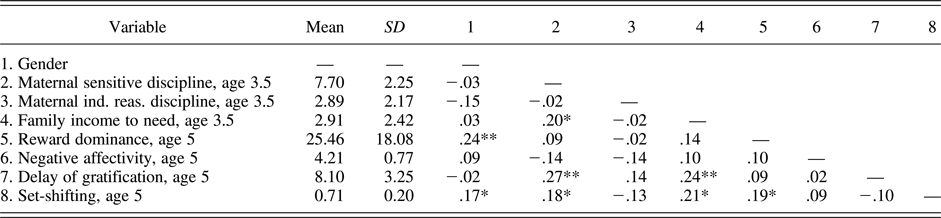
For latent profile analysis (LPA; e.g., Hagenaars & McCutcheon, Reference Hagenaars and McCutcheon2002), data is required on one or more of the exogenous variables in order to utilize missing data estimation analyses. There were 15 cases where data was missing on one of the temperamental reactivity measures (reward/punishment reactivity task: n = 13; negative affectivity: n = 2). Motivational tendencies toward reward and punishment and negative affectivity are orthogonal and may evince nonlinear associations. As such, accurate estimations of latent profiles could not be derived from only one measure. As such, these cases were excluded from the analyses. Other missing data ranged from 2% to 15.2% due to experimenter/equipment error and attrition within and across waves. To evaluate whether data were missing completely at random (MCAR), we examined the patterns of missing data using the MCAR test (Little, Reference Little1988). Results did not support rejecting the null hypothesis that data were missing completely at random MCAR, χ2 = 33.72 (50), p = .96. Given these results, we retained those cases in the analyses and utilized full information maximum likelihood for missing values available in Mplus 6.1 software (Muthén & Muthén, Reference Muthén and Muthén1998–2010). With respect to outliers, there was 1 case with an income-to-need ratio greater than 3.5 SD above the mean and 4 cases that were greater than 2 SD above the mean. We set these cases to 2 SD above the mean and reran the analyses to determine if they influenced findings. The results were identical to the ones with the original data. Given the similarity in findings, we elected to retain the original data values in our analyses. Table 1 provides the means, standard deviations, and correlations of variables used in the primary analyses.
Correlations and descriptive statistics for primary variables

Note: Ind. reas., inductive reasoning.
*p < .05. **p < .01.
LPA: Children's temperamental reactivity
The present study used LPA (e.g., Hagenaars & McCutcheon, Reference Hagenaars and McCutcheon2002) to determine the child temperamental reactivity profiles. Similar to other latent variable modeling techniques, LPA is used to extract profiles that are not directly observed by the data but are identified based on continuous manifest indicators, which in the present analyses included children's scores on the reward/punishment reactivity task and maternal report of negative affectivity on the CBQ-VSF. Specifically, individuals are classified with the notion that an underlying latent variable predicts their scores on the set of continuous manifest indicators included in the model. Each individual in the data set is assigned a probability score for his or her likelihood of being a member in one of the profiles identified.
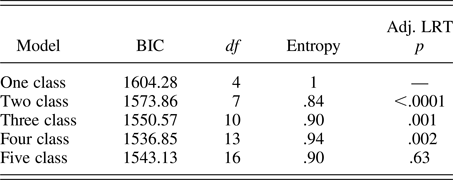
In running LPA analyses, the first step is to determine the optimal number of profiles. We accomplished this by utilizing two likelihood tests for comparing nested models: the Bayesian information criterion (BIC; Schwartz, Reference Schwartz1978) and the Lo–Mendell–Rubin adjusted likelihood ratio test (aLRT; Lo, Mendell, & Rubin, Reference Lo, Mendell and Rubin2001). The model with the lowest BIC value indicates the best fitting model, whereas for the aLRT index, a p value indicates whether the k – 1 profile model provides statistically better fit than the k class solution. When the p value is nonsignificant, the model with fewer classes is preferred. In addition, model entropy reflects the posterior probability of the number of profiles being optimally identified (maximum value = 1). As is recommended with LPA (e.g., Jung & Wickrama, Reference Jung and Wickrama2008; Muthén & Muthén, Reference Muthén and Muthén2000), we also considered parsimony, theory, practical utility, and previous findings in our determination of the optimal number of profiles as fit indices generated by LPA may favor larger class solutions in situations where it is an artifact of a nonnormal distribution (Bauer & Curran, Reference Bauer and Curran2003; Muthén, Reference Muthén2006).
For the present LPA, we utilized Mplus, Version 6.1 software (Muthén & Muthén, Reference Muthén and Muthén1998–2010). We extracted one, two, three, four, and five latent profile solutions. The BIC and aLRT values indicated the three-profile solution was a significantly better fit than the one- and two- profile solutions across all fit indices. However, the BIC, and aLRT p value for the four-profile solution suggested better fit than the three-profile solution. The fit indices for the five-profile solution did not provide statistically better fit than the four-profile solution, as indicated by the higher BIC and nonsignificant aLRT p value. See Table 2 for fit indices and entropy values for each profile solution.
Fit indices for latent profile solutions
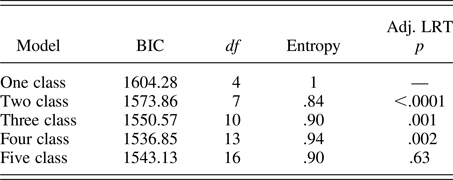
Note: BIC, Bayesian information criteria; Adj. LRT, Lo–Mendel–Rubin adjusted likelihood ratio test.
As recommended in mixture modeling (Marsh, Lüdtke, Trautwein, & Morin, Reference Marsh, Ludtke, Trautwein and Morin2009; Muthén, Reference Muthén and Kaplan2004; Muthén & Asparouhov, Reference Muthén, Asparouhov, Fitzmaurice, Davidian, Verbeke and Molenberghs2008), we next considered the substantive interpretations of the three- and four- profile solutions. The three-profile solution cohered into our hypothesized temperamental reactivity patterns along the two indicator variables. Specifically, Profile 1 was characterized by balance in reward and punishment reactivity (i.e., discontinued play following even balance of reward/punishment cues) and low negative affectivity. Profile 2 was characterized by heightened reward reactivity (continued play in the context of a high proportion of punishment cues and decreasing rewards) and high negative affectivity. Profile 3 was characterized by heightened punishment sensitivity (i.e., discontinued play following limited cues of punishment despite high proportions of reward) and high negative affectivity. The four-profile solution contained the three profiles as culled in the three-group solution, but created two profiles that were conceptually similar to Profile 1; specifically, their negative affectivity scores were not different. In addition, the means and ranges of reward dominance scores across the two profiles were not conceptually different, meaning the number of cards played did not show a clear reward or punishment dominance (i.e., continued play despite greater punishment and fewer rewards or discontinued play despite greater rewards and less punishment). One of the classes only consisted of 25 individuals. Inspection of the range of values suggests spurious classes might have been enumerated to accommodate the heavy tails of the nonnormal distribution of the reward dominance measure rather than a meaningful latent subpopulation (e.g., Bauer & Curran, Reference Bauer and Curran2003, McLachlan & Peel, Reference McLachlan and Peel2004). Given the lack of clear substantive value of the additional class and loss of power that would be incurred in the multigroup analyses, we decided to retain the three-class solution.
Our next step was to formally classify the children into each of the three profiles utilizing the posterior probabilities of likelihood membership in each latent profile produced by the LPA. The probabilities represent the estimated conditional response probabilities and estimated prevalence of each latent group. We inspected the classifications and posterior probabilities for each child participant. The average class probabilities for most likely latent profile membership for each profile were excellent. Children who were classified in Profile 1 had a 92.1% average probability of fitting the profile. Children who were classified in Profile 2 had a 96.4% average probability of fitting the profile. Finally, the children who were classified in Profile 3 had a 96.5% average probability of fitting the profile. Individual inspection of the cases revealed five children displayed some indiscrimination among profiles as suggested by their highest profile probability (range = .50–.58). We elected to retain these cases given results did not change with their exclusion from the analyses.
The conditional response means and the proportion of the sample represented in each class based on the estimated model are presented in Table 3. Analysis of variance comparisons were also conducted to verify meaningfulness of differences in response means across latent profiles (Table 3). Profile 1 (29% of sample, n = 41), which we defined as the low reactivity profile, was characterized by moderate scores on the reward/punishment reactivity task, which were significantly lower than Profile 2 and greater than Profile 3, and significantly lower negative affectivity subscale scores on the CBQ-VSF than Profile 2 and Profile 3. Profile 2 (32% of sample, n = 47) was distinguished by extremely higher scores on the reward/punishment reactivity task than Profiles 1 and 3, and significantly higher scores on the negative affectivity subscale of the CBQ-VSF than Profile 1. As such, we defined this profile as the reward reactivity/negative affectivity profile. Finally, Profile 3 (39% of sample, n = 57) was characterized by the lowest scores on the reward/punishment reactivity task and comparable scores on the negative affectivity subscale of the CBQ-VSF in comparison to Profile 2, but higher than Profile 1. Given this, we defined Profile 3 as the punishment reactivity/negative affectivity profile. In other words, all groups were significantly differentiated along the reward/punishment reactivity variable that was suggestive of their relative balance in BIS and BAS motivational systems. High levels of negative affectivity distinguished Profiles 2 and 3 from Profile 1, which is consistent with the theory that children high in reward or punishment motivations (i.e., BAS or BIS, respectively) may evince heightened levels of negative affectivity as an emotional consequence of these strong orientations (Rothbart et al., Reference Rothbart, Ahadi, Hershey and Fisher2001).
Latent profile analysis groups, conditional response means, and analysis of variance comparisons

Note: NA, negative affectivity; React., reactivity; CBQ-VSF, Child Behavior Questionnaire—Very Short Form. Proportions for the latent classes are based on the estimated model. Values with different subscripts denote significant differences across profiles (p < .05). Values with the same subscript denote nonsignificant differences.
*p ≤ .01.
Temperamental reactivity: Associations between early maternal discipline and children's delay of gratification
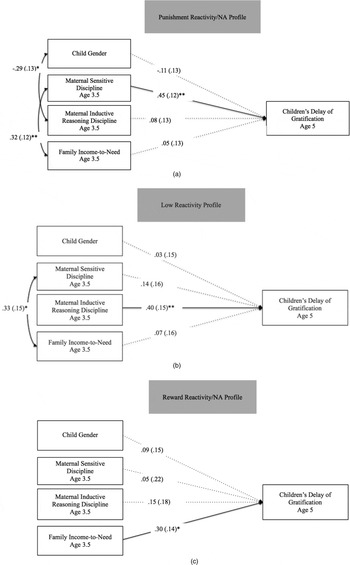
Our next set of analyses examined whether there were differential associations between early socioeconomic experiences and maternal disciplinary practices, as assessed at age 3.5, and children's delay of gratification at age 5 within each temperamental reactivity profile. We accomplished this by using multigroup path analysis in Mplus, Version 6.1 (Muthén & Muthén, Reference Muthén and Muthén1998–2010). Child temperamental reactivity profile was set as the categorical grouping variable. We included child gender as a covariate in our multigroup model. The model was fully saturated, so model fit is not applicable. For the punishment reactivity/negative affectivity profile, maternal sensitive discipline at age 3.5 significantly and positively predicted longer delay of gratification at age 5 (β = 0.45, SE = 0.12, p < .001), accounting for 20.3% of the unique variance. Maternal inductive reasoning discipline at age 3.5 did not predict children's delay of gratification (β = 0.08, SE = 0.13, p > .10). Neither family income-to-need at age 3.5 (β = 0.05, SE = 0.13, p > .10) nor child gender (β = –0.11, SE = 0.13, p > .10) was predictive of children's delay of gratification at age 5 (see Figure 1a).
Path analysis of direct effects of maternal discipline practices and family income-to-need ratio at age 3.5 on children's delay of gratification at age 5 within (a) the punishment reactivity/negativity affectivity (NA) profile, (b) the low reactivity profile, and (c) the reward reactivity/NA profile. Standardized beta coefficients and standard errors are presented. Solid lines denote significant paths, and dotted lines denote nonsignificant paths. For ease of interpretability, only significant correlations among the predictors are shown. *p < .05, **p < 01.
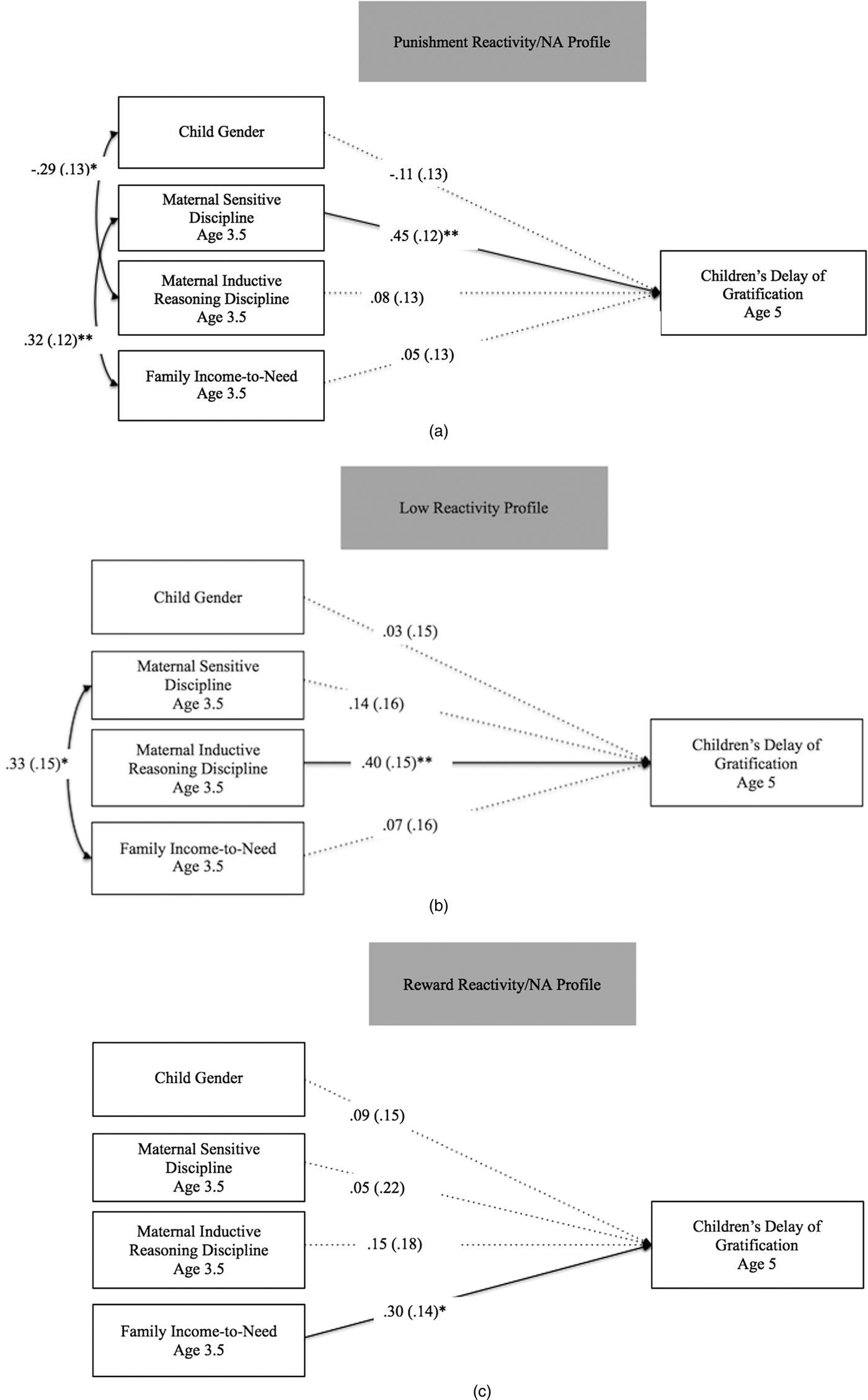
For the low temperamental reactivity profile, maternal inductive reasoning discipline at age 3.5 positively and significantly predicted longer delay of gratification at age 5 (β = 0.40, SE = 0.15, p = .01), accounting for 16% of the unique variance. Maternal sensitive discipline at age 3.5 did not predict children's delay of gratification (β = 0.14, SE = 0.17, p > .10). Neither family income-to-need at age 3.5 (β = 0.07, SE = 0.16, p > .10) nor child gender (β = 0.07, SE = 0.16, p > .10) predicted children's delay of gratification at age 5 (see Figure 1b).
For the reward reactivity/negative affectivity profile, neither maternal sensitive discipline (β = 0.05 SE = 0.22, p > .10) nor maternal inductive reasoning discipline at age 3.5 predicted children's delay of gratification at age 5 (β = 0.15, SE = 0.18, p > .10). However, higher family income-to-need at age 3.5 significantly and positively predicted longer delay time at age 5 (β = 0.30, SE = 0.14, p < .05), accounting for 9% of the unique variance. Child gender was not associated with children's delay of gratification (β = 0.09, SE = 0.15, p > .10; see Figure 1c).
Direct and indirect effects of children's set shifting at age 5
In our next model, we examined the direct and mediating effects of children's set shifting within each temperamental reactivity profile. To preserve power, we examined each parenting variable in separate models. Although parenting practices were differentially associated within profiles, we still examined their indirect effects within each profile given the growing consensus that significant direct effects should not be considered as a requirement for mediation (e.g., Hayes, Reference Hayes2009; MacKinnon, Krull, & Lockwood, Reference MacKinnon, Krull and Lockwood2000; Rucker, Preacher, Tormala, & Petty, Reference Rucker, Preacher, Tormala and Petty2011). Given child gender was not significantly associated with delay of gratification across profiles, it was not included as a covariate in these analyses.
For the punishment reactivity/negative affectivity profile, neither maternal sensitive discipline (β = 0.22, SE = 0.14, p > .10) nor family income-to need (β = –0.06, SE = 0.14, p > .10) at age 3.5 predicted children's set shifting at age 5. Set shifting was not associated with children's delay of gratification at age 5 (β = –0.03, SE = 0.14, p > .10). The significant direct effects of maternal sensitive discipline on children's delay of gratification were still present (β = 0.45, SE = 0.12, p < .001).
For the low reactivity profile, maternal sensitive discipline was not associated with children's set shifting at age 5 (β = 0.06, SE = 0.17, p > .10), though family income-to-need at age 3.5 was marginally associated with better set shifting at age 5 (β = 0.30, SE = 0.16, p < .05). However, set shifting was not associated with children's delay of gratification at age 5 (β = 0.18, SE = 0.16, p > .10). As in the previous model, the direct effects of maternal sensitive discipline (β = 0.06, SE = 0.17, p > .10) and family income-to-need (β = 0.09, SE = 0.18, p > .10) were not significant.
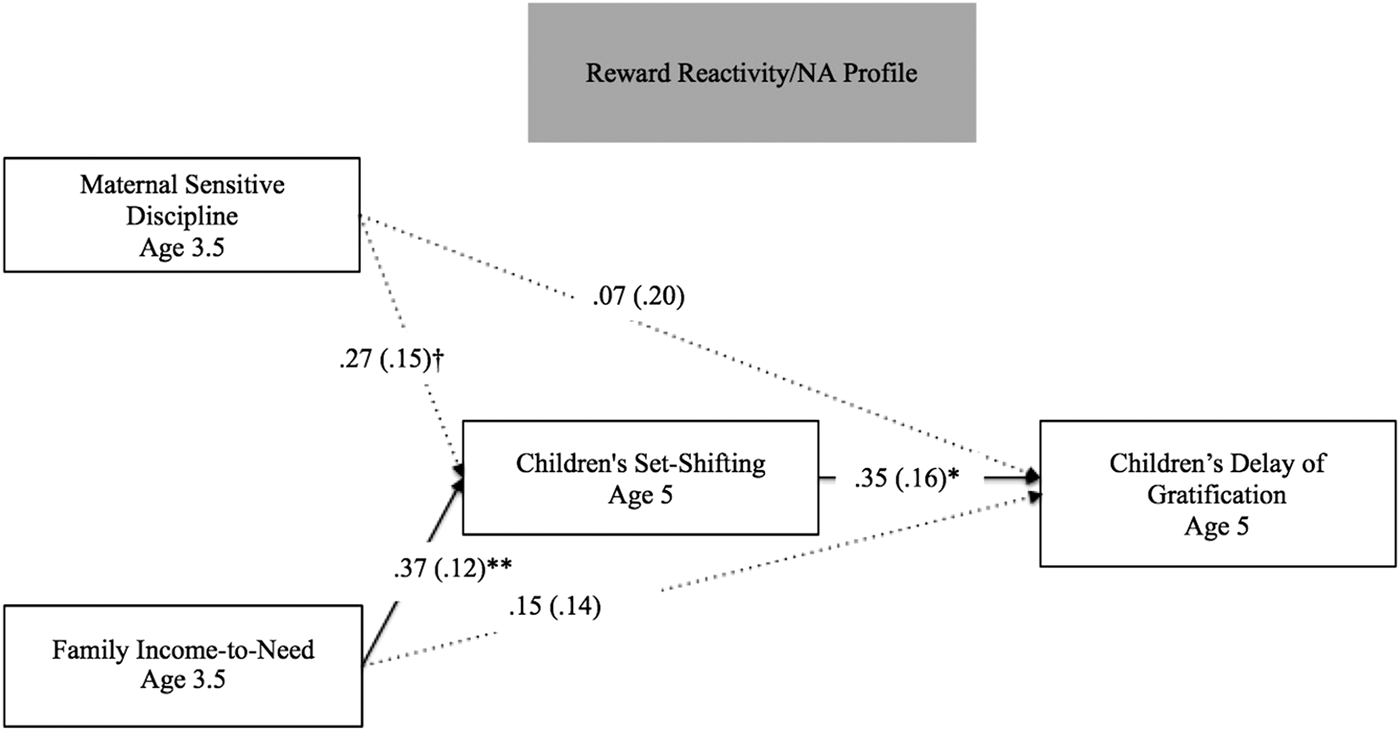
For the reward reactivity/negative affectivity profile, higher maternal sensitive discipline at age 3.5 marginally predicted better set shifting at age 5 (β = 0.27, SE = 0.15, p = .07). Higher family income-to-need at age 3.5 significantly and positively predicted better set shifting at age 5 (β = 0.37, SE = 0.12, p < .01), and higher set shifting was associated with longer delay of gratification (β = 0.35, SE = 0.16, p = .03). We also observed that the direct effect of family income-to-need on children's delay of gratification was no longer significant with the inclusion of the indirect pathway of set shifting in the model (β = 0.15, SE = 0.14, p > .10). As in first model, maternal sensitive discipline did not directly predict children's delay of gratification at age 5 (β = 0.07, SE = 0.20, p > .10) despite marginally predicting higher set shifting (see Figure 2). The model accounted for 22% of the variance in children's set shifting and 20.7% of the variance in children's delay of gratification at age 5, respectively. Next, we evaluated the significance of the indirect effect of family income-to-need on children's delay through set shifting by computing the confidence interval using the PRODCLIN program (MacKinnon, Fritz, Williams, & Lockwood, Reference MacKinnon, Fritz, Williams and Lockwood2007) via the RMediation web applet (Tofighi & Mackinnon, Reference Tofighi and MacKinnon2011). The results revealed the indirect path was significant, z = 0.14, SE = 0.08, 95% confidence interval [0.003, 0.33]. These findings suggest that for children with a temperamental reactivity profile characterized by heightened reward reactivity and high levels of negative affectivity, family income-to-need may indirectly influence children's delay of gratification via its effects on children's set shifting (see Figure 2).
Path analysis examining indirect effects of family income-to-need ratio and maternal sensitive discipline on children's delay of gratification via set-shifting at age 5 within the reward reactivity/negative affectivity (NA) profile. Standardized beta coefficients and standard errors are presented. Solid lines denote significant paths, and dotted lines denote nonsignificant paths. For ease of interpretability, only significant correlations among the predictors are shown. †p < .07, *p < .05, **p < 01.

In our next set of analyses, we examined whether children's set shifting acted as an indirect pathway between maternal inductive reasoning discipline practices and children's delay of gratification in the heightened reward reactivity/negative affectivity profile. These analyses were not conducted for the other two temperamental reactivity groups since set shifting was not associated with delay of gratification within those profiles. The results showed maternal inductive reasoning discipline at age 3.5 did not predict children's set shifting (β = 0.19, SE = 0.16, p > .10) and therefore we did not test the indirect effect.
Comparison of delay of gratification, maternal discipline, socioeconomic experiences, and set shifting across temperamental reactivity profiles
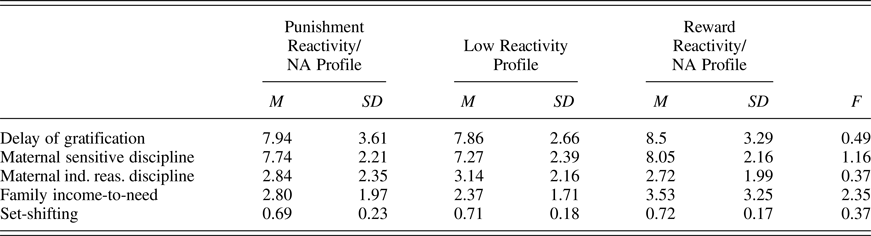
The final set of analyses sought to determine whether differences in children's delay of gratification occurred within the context of sociocontextual experiences, or at the temperamental reactivity level. We conducted an analysis of variance to examine whether there were mean differences in delay of gratification times, maternal disciplinary practices, family income-to-need, and set shifting across the three groups. We examined whether there were differences in homogeneity of the variances with respect to the variables across the groups. Results showed that variances were homogenous across groups for all the variables (p > .05) with the exception of the family income-to-need ratio, F (2, 128) = 3.602, p = .03. Thus, for this variable we examined the differences between means across groups using the Browne–Forsythe test, which is robust to violations of homogeneous variances. The results showed that the temperamental reactivity groups did not statistically differ in their mean levels of delay of gratification. The lack of average mean differences across temperamental reactivity groups suggests differences in delay of gratification outcomes must be interpreted within the context of the interplay between child temperamental reactivity and early sociocontextual experiences. In addition, there were no mean-level differences in maternal discipline practices, family income-to-need, and set shifting across the temperamental reactivity profiles (see Table 4).
Means, standard deviations, and analysis of variance comparisons for temperamental reactivity profiles

Note: NA, negative affectivity; ind. reas., inductive reasoning. p ≥ .10.
Discussion
Developmental psychopathology perspectives on human development have long emphasized the need for the application of person-oriented approaches to elucidate maladaptation and adjustment in relation to stage-salient issues (Bergman & Magnusson, Reference Bergman and Magnusson1997; Cicchetti & Rogosch, Reference Cicchetti and Rogosch1996). Heeding this call, we utilized LPA and identified three distinct profiles of children's temperamental reactivity that were distinguished along dimensions of reward/punishment reactivity and negative affectivity. Following detection of the profiles, we employed multigroup analyses to examine differential associations among sociocontextual processes (e.g., maternal discipline and socioeconomic status) assessed at age 3.5 and children's delay of gratification measured at age 5. We found that maternal sensitive discipline at age 3.5 uniquely predicted delay of gratification at age 5 for children characterized by heightened punishment reactivity and negative affectivity. Conversely, we found that maternal inductive reasoning discipline at age 3.5 was a unique predictor of delay of gratification at age 5 for less temperamentally reactive children. For children characterized by heightened reward reactivity and negative affectivity, family economic resources at age 3.5 was uniquely predictive of delay of gratification, and this effect was mediated by children's set-shifting abilities assessed at age 5. We did not detect mean-level differences in children's overall exposure to specific discipline practices and socioeconomic experiences, or differences in children's set-shifting abilities across groups. Delay times also did not differ across groups, underscoring the need to interpret these effects within the context of multiple child- and sociocontextual-level processes. To our knowledge, this represents the first study that has found evidence to suggest that developmental routes to delay of gratification may differ according to individual differences in children's temperamental reactivity.
Differential responsiveness to discipline in children's delay of gratification
Discipline represents one of the primary socialization contexts for toddlers as children at this stage become more independent and parenting goals shift from providing nurturance and protection to fostering self-controlled behavior (Belsky et al., Reference Belsky, Woodworth and Crnic1996; Grusec & Davidov, Reference Grusec and Davidov2010; Grusec & Goodnow, Reference Grusec and Goodnow1994). Consistent with the concept of equifinality (e.g., Kochanska, Reference Kochanska1997; Kuczynski, Marshall, & Schell, Reference Kuczynski, Marshall, Schell, Grusec and Kuczynski1998), some research has suggested there may be several disciplinary practices that support children's delay of gratification (e.g., Houck & LeCuyer-Maus, Reference Houck and LeCuyer-Maus2004). However, prior empirical analyses have not examined whether specific disciplinary practices may be more proximal in promoting better delay of gratification in some children more than others. One of the primary findings of the present study was that greater levels of responsive and child-centered maternal discipline as observed during a mother–child cleanup compliance task at 3.5 predicted longer delay of gratification at age 5 specifically among children characterized by heightened punishment reactivity and negative affectivity. As illustrated by prior studies, individuals with heightened punishment sensitivity and negative affectivity are prone to distress and anxiety in motivationally significant contexts (see Eysenck, Derakshan, Santos, & Calvo, Reference Eysenck, Derakshan, Santos and Calvo2007, for review). Though less understood, children with this profile of temperamental reactivity likely experience greater levels of discomfort and anxiety when trying to delay given they tend to be overly emotional and reactive to many types of stimuli (Derryberry & Reed, Reference Derryberry and Reed1994; Derryberry & Tucker, Reference Derryberry, Tucker, Cicchetti and Cohen2006). This may seem counterintuitive given individuals with these motivational tendencies are supposed to be more inclined to inhibit behavior that would lead to aversive outcomes (i.e., receive a less desired reward); however, some studies have found linkages between heightened punishment sensitivity and difficulties with regulating health-related behavior (e.g., obesity and substance abuse; Matton, Goosens, Braet, & Vervaet, Reference Matton, Goossens, Braet and Vervaet2013; Taylor, Reeves, James, & Bobadilla, Reference Taylor, Reeves, James and Bobadilla2006). Earlier experiences of sensitive discipline practices during emotionally charged parent–child conflict may help these children learn how to regulate their own arousal in other challenging contexts (e.g., Kochanska, Reference Kochanska1997; Kochanska et al., Reference Kochanska, Murray and Harlan2000). Through internalizing these experiences, children with these temperament traits may be able to persist in achieving desired outcomes instead of opting to withdraw from affectively arousing situations, which could account for why difficulties are not observed among all individuals with this type of temperamental reactivity profile, and would be consistent with the concept of multifinality. Conversely, more insensitive and more parent-centered discipline practices that do not take into account the child's level of arousal, mood, and capabilities may exacerbate these children's vulnerabilities. Moreover, without the skills for tolerating distress during affective and motivationally arousing scenarios, these children may have strong impulses to escape and thereby gratify immediate needs, which in turn alleviates their discomfort and anxiety.
Contrary to our expectations, we did not detect prospective associations between maternal sensitive discipline and children's delay of gratification within the group of children characterized by heightened reward sensitivity and negative affectivity. We did find that maternal sensitive discipline was marginally associated with children's set shifting, which may suggest an indirect effect. Prior research has largely overlooked the interplay between caregiving and heightened reactivity to reward and negative affectivity in relation to children's self-regulatory outcomes as more research has been focused on children who are more reactive to threat and punishment. Furthermore, many studies only examine negative emotionality without consideration of motivational factors that differentiate individuals and their developmental sequelae (e.g., Belsky & Pluess, Reference Belsky and Pluess2009). Of the research that has considered temperament traits related to reward sensitivity (e.g., fearlessness), some studies have found evidence to suggest that inconsistent discipline (e.g., Lengua, Wolchick, Sandler, & West, Reference Lengua, Wolchik, Sandler and West2000), parental indulgence (Xu, Farver, & Zhang, Reference Xu, Farver and Zhang2009), or harsh control (Leve, Kim, & Pears, Reference Leve, Kim and Pears2005) might be most detrimental to these types of children. Related work has also suggested that caregiving practices that enhance children's intrinsic motivation for appropriate behavioral conduct may be particularly effective for children with fearless temperaments (Kochanska, Reference Kochanska1997), though research in this area is still underdeveloped. Our null findings and limited knowledge in this area underscores the need for focused efforts toward specifying the caregiving practices that might facilitate optimal outcomes for these types of children. Alternatively, current findings might point to indirect effects of caregiving through cognitive mechanisms (e.g., set shifting), although this would require further investigation.
Many of the more recent models examining interplay between child temperament and socialization practices have argued that parenting practices may account for more variation in self-regulation and associated socioemotional outcomes in children with greater temperamental reactivity (Belsky, Reference Belsky1997, Reference Belsky, Ellis and Bjorklund2005; Boyce & Ellis, Reference Boyce and Ellis2005). Systematic reviews have also provided some support for this assertion (e.g., Belsky & Pluess, Reference Belsky and Pluess2009), which in recent years has fueled an overemphasis on how temperamentally reactive children respond to different socialization experiences to the exclusion of other types of children. These assertions are largely based on the effects of sensitive parenting practices on stage-salient outcomes. By expanding our scope beyond sensitive forms of parenting, we found that higher levels of maternal inductive reasoning discipline at age 3.5 was a unique and better predictor of better delay of gratification among children characterized by low temperamental reactivity.
This begs the question as to why this might be the case. Inductive discipline is defined by limit setting, reminding of rules, and reasoning to help children understand benefits and reasons for inhibiting impulses or desires in order to enact socially appropriate behaviors (Choe, Olson, & Sameroff, Reference Choe, Olson and Sameroff2013; Grusec & Goodnow, Reference Grusec and Goodnow1994). Children with less reactive temperaments may internalize these socialization messages more easily and then draw upon them in future contexts. In other words, given that they experience weaker affective and motivational drives toward incentives, they may be able to more readily access rule-based knowledge they internalized during earlier inductive reasoning disciplinary practices when determining whether to delay gratification. By the same token, less temperamentally reactive children who miss out on these socialization experiences might not learn and therefore internalize why it is often beneficial to inhibit immediate desires in certain contexts. To more definitively demonstrate links between early inductive reasoning parenting practices, and children's delay of gratification behaviors, it will be important for future work to identify the cognitive processes and associative learning factors that might underlie these associations. In addition, investigators should consider including self-report assessments that could directly measure the degree to which children use previously learned rules to guide their behavior in these contexts.
Differential sensitivity to socioeconomic context and mediating effects of set shifting
Recent evolutionary developmental frameworks propose cues of limited family resources in the early caregiving environment may shift some children toward satisfying immediate needs as they may observe early on that rewards and resources are less frequently and more unpredictability available in their environments (e.g., Frankenhuis, Panchanathan, & Nettle, Reference Frankenhuis, Panchanathan and Nettle2016; Sturge-Apple et al., Reference Sturge-Apple, Suor, Davies, Cicchetti, Skibo and Rogosch2016). However, research has been lacking with respect to whether these effects are present among all children or whether they differ according to individual differences in children's temperamental reactivity. In the present study, we found that family socioeconomic status at age 3.5 was associated with children's delay of gratification at age 5 only among children characterized by heightened reward reactivity and negative affectivity. Our results are consistent with emerging evidence that suggests that the effect of economic adversity on later reward-related behavior may be potentiated for children with heightened approach motivations and greater proneness to experience negative affect. Specifically, in a prospective sample of predominately lower income children assessed at 2 and 4 years old, Suor et al. (Reference Suor, Sturge-Apple, Davies and Cicchetti2017) found early experiences of environmental harshness (e.g., lower family earned income and maternal disengagement) predicted greater reward-oriented problem solving specifically among children characterized by temperamental traits of high approach toward novel stimuli and dominant negative affect. Interpreted within the context of the present study, children with this type of temperamental reactivity pattern may be more sensitive and particularly attuned to early cues of resource availability, which in turn might potentiate affective and motivational drives toward quick and immediate retrieval of rewards.
In addition, we observed that the influence of socioeconomic status on children's delay of gratification was mediated by children's set shifting at age 5 in the heightened reward reactivity and negative affectivity profile. Specifically, we found that lower economic resources at age 3.5 was associated with decreased set shifting at age 5, which in turn was associated with reduced delay of gratification. As implicated within evolutionary-developmental models, although the immediate seizure of rewards may be adaptive in high-risk contexts, it is still understood that children who adopt these strategies tend do so inflexibly, which accounts for why they experience greater difficulties in other contexts (i.e., daycares and classrooms; Blair & Raver, Reference Blair and Raver2012). However, this is the first study to our knowledge that has identified set shifting as a potential cognitive mechanism that accounts for children's behavioral rigidity. Specifically, reduced set shifting likely allows for increased potency in affective-motivational systems. This is consistent with human and animal research that suggests that environmental stress can reduce higher order cognitive functions, like set shifting, while potentiating the strength of affective-motivational neurocircuitry (e.g., Arnsten, Reference Arnsten2015; Blair, Berry, & FLP Investigators, Reference Blair and Berry2017; Gagnon & Wagner, Reference Gagnon and Wagner2016; Metcalfe & Mischel, Reference Metcalfe and Mischel1999). Conversely, experiences of socioeconomic prosperity may facilitate optimal growth of children's set shifting, an underlying mechanism that helps children to attend to different properties of desired stimuli (e.g., Stifter et al., Reference Stifter, Putnam and Jahromi2008). Set shifting may help to counteract strong motivational and affective drives by diverting attention to different aspects of the rewarding stimuli and/or situation and thus facilitate better delay among these children. In related work, Neuenschwander and Blair (Reference Neuenschwander and Blair2017) also found that higher executive functions, which included measures of set shifting, facilitated longer delay times among children with higher motivational tendencies toward reward. The present study may be interpreted as both a replication and an extension of Neuenschwander and Blair's (Reference Neuenschwander and Blair2017) findings. Collectively, this study illuminates how the relative influence of cognitive processes, such as set shifting, and distal socioeconomic factors on children's delay of gratification cannot be understood in isolation, and furthermore, how the interplay among these processes may be particularly enhanced among children with heightened motivational drives toward reward and greater negative affectivity.
Limitations
Several limitations of the study should be discussed. Our study was correlational and even though the longitudinal design of the study helps to establish temporal precedence, interpretations with respect to causality cannot be inferred. Although we assessed two defining dimensions of temperamental reactivity, our measures were limited. Moreover, we only used two indicators for our LPA. Although mixture models with continuous indicators can be identified with minimal number of indicators when there are departures from normality (Bauer & Curran, Reference Bauer and Curran2003), as was the case in the present study, it will be important for future studies to replicate our latent profile solution with a more robust set of indicators. It is also important to note that reward dominance scores primarily drove profile characterization. We did not assess positive emotionality, another component of temperamental reactivity that should be considered in future investigations (Putnam & Stifter, Reference Putnam and Stifter2005). We also did not measure children's temperamental reactivity at the same time as maternal discipline given our focus on how concurrent temperamental reactivity may relate to delay of gratification and its role in organizing prior socialization experiences into later patterns of behavior. A time interval between caregiving and temperament assessments would be problematic if we observed differences in delay of gratification across groups as this might suggest mediating effects. However, this was not the case in the current study. Furthermore, as been noted by prior investigators (Goodnight et al., Reference Goodnight, Bates, Newman, Dodge and Pettit2006), robustness of the results may be supported by the fact that differential timing of assessments would make it more challenging to detect significant paths within groups.
It is important to acknowledge that our delay of gratification measure was skewed, which often is observed in studies. We performed several transformations, reran analyses, and found identical results across approaches suggesting skewness in our delay of gratification variable did not impact findings. Although the overall objective of our study was to address gaps in developmental models of delay by testing a person-based model, there are likely other sociocontextual experiences, volitional, and temperament factors that contribute to delay of gratification abilities in important ways. For example, other top-down cognitive processes, such as attention deployment (e.g., Sethi, Mischel, Aber, Shoda, & Rodriguez, Reference Sethi, Mischel, Aber, Shoda and Rodriguez2000) and cognitive reappraisal (e.g., Magen & Gross, Reference Magen and Gross2007), have been implicated in delay of gratification and overlap with set shifting at both a conceptual and a measurement level (e.g., Sulik et al., Reference Sulik, Daneri, Pintar, Blair, Balter and Tamis-LeMonda2016). Future work aimed at refining methodological and conceptual distinctions among the multiple cognitive and affective processes involved in delay of gratification and other forms of self-regulated behavior could be beneficial for increasing consistency across studies and may help clarify boundaries between related constructs.
Another important limitation to note is that even though our overall sample was moderate in size, the size of each profile was small, which may have made it difficult to detect effects. Specifically, maternal sensitive discipline was marginally associated with children's set shifting in the reward reactivity/negative affectivity profile, and group size may have limited our ability to find significant results. In addition, our effect sizes were modest, although given the longitudinal nature, that is to be expected to some extent. Thus, it will be important for future work to try to replicate our findings with larger samples and include assessments of other developmental processes that might account for meaningful variance in children's delay of gratification outcomes.
Finally, although our sample was diverse with respect to socioeconomic backgrounds, the racial and ethnic composition of our sample was predominately Caucasian with less representation of minority racial and ethnic groups. The lack of equal representation of different racial and ethnic groups in our sample restricted our ability to consider how cultural differences in parenting and delay of gratification might fit within our model. For example, research has demonstrated that decisions to delay can be culturally bound and depend on values and customs with respect to consumption (Gallimore, Weiss, & Finney, Reference Gallimore, Weiss and Finney1974; Mischel, Reference Mischel1958). Previous work has also found that low-income minority school-age children delay less than socioeconomically matched White peers (Price-Williams & Ramirez, Reference Price-Williams and Ramirez1974; Zytkoskee, Strickland, & Waston, Reference Zytkoskee, Strickland and Watson1971). More recent work has suggested that social trust and perceived reliability of adult experimenters could play a role (e.g., Kidd, Palmeri, & Aslin, Reference Kidd, Palmeri and Aslin2013; Michaelson, de la Vega, Chatham, & Munakata, Reference Michaelson, de la Vega, Chatham and Munakata2013), which might have implications for previous findings of racial differences in delay of gratification among low-income children. From a developmental perspective, it is unclear at what age cultural differences emerge and what patterns could be observed. Future research in this area is greatly needed. Despite these limitations, we contend that our longitudinal and person-oriented approach combined with the socioeconomic diversity of the sample represent major strengths of the present study. This is especially notable given that the preponderance of prior work in this area has relied upon variable-centered, cross-sectional designs and predominately used middle-income participants.
Conclusion
In conclusion, our findings demonstrate how person-based approaches to children's temperamental reactivity may elucidate multiple developmental routes to children's delay of gratification. The study not only helps to elucidate equifinality and multifinality in outcomes but also integrates prior findings into a person-based, process-oriented developmental framework. In addition, the current results can also be viewed as being consistent with goodness-of-fit (Rothbart & Ahadi, Reference Rothbart and Ahadi1994; Thomas & Chess, Reference Thomas and Chess1977) and organismic specificity (Wachs & Gruen, Reference Wachs and Gruen1982) principles, which emphasize that socialization effects on critical stage-salient developmental outcomes depend on child temperamental traits: specifically, socialization experiences may influence children with distinct characteristics differently despite similarities in overall level of exposure to various experiences (Wachs & Gruen, Reference Wachs and Gruen1982). In addition, our study provides an important replication of prior work that has suggested specific executive functions may play a larger role in facilitating delayed gratification for children with heightened reward reactivity (Neuenschwander & Blair, Reference Neuenschwander and Blair2017), which suggests that volitional processes might have differential contributions to delay of gratification depending on strength and valence of an individual's reactivity to motivationally significant contexts. These findings offer a process-oriented understanding of how set shifting may represent an indirect path through which earlier developmental experiences, such as the family socioeconomic context, influence children's delay of gratification capacities for this group of children. From a clinical and public health perspective, these findings emphasize how it is imperative for parents and providers to consider individual differences in children's behavioral and affective arousal when selecting specific strategies and interventions for increasing self-control as opposed to applying a universal approach to all children.