A disaster refers to an unexpected or damaging event that seriously disrupts the functioning of a community or society. Devastating disasters occur around the world every year and have directly contributed to a significant increase in human mortality and economic costs.Reference Sundnes and Marvin 1 Recently, many countries have taken steps to improve preventive measures for accidents involving dangerous chemical, biological, radiological, and nuclear (CBRN) substances. However, such measures brought about controversy surrounding patient treatments in response to attacks or accidents involving CBRN substances.Reference White 2 - Reference Danzig and Berkowsky 5 A review of the medical system of response after Hurricane Katrina shows an instant response by medical professionals to be the major factor associated with patient resuscitation, demonstrating the necessity of disaster preparedness training.Reference Hamm 6 - Reference Edwards, Young and Lowe 11 The United States has further emphasized the importance of preparedness training and education on disaster relief and response to terrorism since the 9/11 terrorist attacks in 2001. The American Academy of Emergency Medicine has started to highlight the importance and efficiency of disaster preparedness training for medical students in university and residency programs.Reference Waeckerle, Seamans and Whiteside 12 The most effective response to a disaster event is learned experience obtained through practical training. In addition, on-site and tabletop simulations are the most effective for examining the cost-effectiveness, planning, and sequence of disaster relief.Reference Nigro 13 - Reference Peller, Schwartz and Kitto 16 At present, the training and education of health care professionals to better prepare them for disasters are insufficient, according to surveys that evaluated the residency training programs in emergency medicine, family medicine, and pediatrics in the United States in 2008. In addition, only 20% of the survey participants in pediatrics and family medicine were properly trained.Reference Martin, Bush and Lynch 17
This information demonstrates the insufficient implementation of the education and training required to enable disaster personnel to fulfill their obligations in response to any disaster. Currently, the universal guidelines have neither proposed a management system in preparation for disasters or CBRN incidents nor a consequential system for patient treatment. To overcome these issues, disaster preparedness training is necessary to supplement international training or cooperative systems. Therefore, the aims of this study were to examine how the domestically trained medical and rescue teams of the Korea Disaster Relief Team are trained through the international training program, the Disaster Relief Exercise, and to provide basic data in order to contribute to improvement.
The ASEAN Regional Forum Disaster Relief Exercise
The ASEAN Regional Forum Disaster Relief Exercise (ARF DiREx) is a joint civilian-military relief drill conducted by 27 member countries of the ARF every other year for the purpose of establishing a cooperative mechanism to enhance disaster response capabilities. The first relief exercise was co-hosted by the United States and the Philippines in the Philippines and included 22 member countries as participants; the second exercise was co-hosted by Japan and Indonesia and included 25 member countries. The exercise reviewed in this study was co-hosted by Korea and Thailand in Thailand and involved 27 member countries.
Korea and Thailand co-hosted the third ARF DiRex from May 7-10, 2013, in Cham-am, Thailand. In the third exercise, a total of 27 ARF member countries, including Korea, Thailand, the United States, Japan, China, and ASEAN countries, as well as more than 1600 emergency rescue personnel from 6 international organizations, participated in and carried out civilian-military cooperation and coordination procedures in order to deploy prompt and effective rescue activities in a virtual, large-scale disaster exercise. Korean rescue personnel included 66 rescue personnel from the Korea Disaster Relief Team, 40 medical professionals, and 106 military personnel. In addition, various civilian-military rescue tools and assets including a mobile hospital and military transporter (4 units) were also mobilized in the exercise. Internally, this training was an opportunity for the Korea Disaster Relief Team to clearly identify the role of each institute and their capabilities to handle international disasters. In the future, the contact system in each institute will be expected to more effectively and quickly enable the Korea Disaster Relief Team to be sent into disaster sites. In addition, the Korea Disaster Relief Team is expected to improve the dispatching system of the ARF and an international rescue team, as well as regional disaster management mechanisms in order to ultimately enhance future disaster preparedness.
METHODS
Design and Setting
This study was carried out in accordance with the training exercise conducted from May 7 through 10, 2013. The training was evaluated and observed, and a survey was administered after the training was complete. Of the total participants, 43 from the 119 rescue teams and the rescue and training teams of the Korea Disaster Relief Team were chosen to complete the survey.
The respondents were classified as physicians (5), nurses (5), EMTs (emergency medical technicians; 2), rescue staff (16), pharmacist (1), administrative staff (9), information technology staff (3), and others (2). The participants were interested or had experiences in international disaster relief activities, and Korea Foundation for International Healthcare received their applications for training participation. The selected participants participated in actual training after completing the theoretical disaster training, disaster simulation exercise training, and practical training courses. To reduce recall bias, we did not disclose the research progress and conducted blinded interviews of the training participants in each department as soon as the end of the training was declared by the disaster headquarter.
Data Collection, Intervention, and Outcome Variable
The survey was composed of 10 questions related to participant occupation, areas of involvement, and opinion on the role of team leader; 14 questions on the accuracy of roles as training participants; and 4 questions on the appropriateness of exercise situations, evaluation of training, and advantages and suggested improvements to the training.
Statistical Analysis
Scores were measured on a 5-point Likert scale. As a statistical tool, the SPSS 20.0 program was used to analyze the survey (IBM Corp, Armonk, NY). Continuous variables were expressed as averages and standard deviations, and p-values less than 0.05 were reported as statistically significant. This study was classified as exempt by the Yonsei University, Wonju College of Medicine, Institutional Review Board.
RESULTS
A total of 9 countries (Indonesia, Philippines, Brunei, Australia, Belgium, United States, Japan, Korea, and Thailand) had members on the medical team and were trained specifically to care and treat patients transported from each training site, with a focus on use of the mobile hospitals installed by Korea and Thailand. At each training site, the trainees had an opportunity to cooperate to care for and treat simulated and real patients (training participants, etc), enhancing cooperative relationships among the global medical professionals, while also improving their understanding of teamwork.
About 40 medical professionals from related institutes, such as the National Medical Center, participated in the training as the Korean medical team. The team assigned to treat simulated patients deployed specialized treatments and medical actions on patients according to international standards. Their activities were thoroughly examined by experts. The mobile hospital, developed in Korea, was mobilized by the actual disaster relief team; although it was first adopted for use in international training, its installation and operation were quite successful.
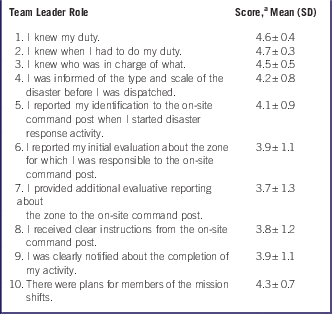
The highest scores reported in the survey were responses to questions regarding leadership roles in the team, such as “I knew my duty” (4.6±0.4) and “I knew when I had to do my duty” (4.7±0.3) (Table 1).
Responses to Survey Questions Related to Participant Occupation, Areas of Involvement, and Opinion on the Role of Team Leader

a Scores were measured on a 5-point Likert scale.
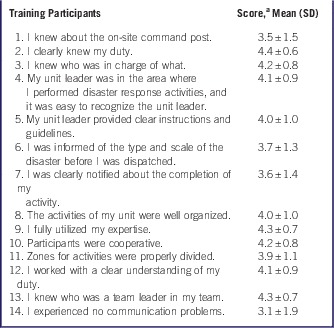
Among the specific questions asked of training participants on the general Incident Command System, the question “I knew about the on-site command post” was shown to have a low score response (3.5±1.5). Regarding communication with patients, the lowest score (3.1±1.9) was in response to the item “I experienced no communication problems” (Table 2).
Responses to Survey Questions on The Role of Training Participants

a Scores were measured on a 5-point Likert scale.
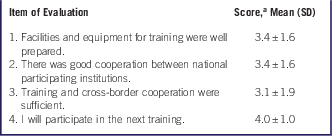
In the overall training evaluation, responses to the question “Facilities and equipment for training were well prepared” scored 3.4±1.6, whereas the question “There was good cooperation between national participating institutions” scored (3.4±1.6). The question “Training and cross-border cooperation were sufficient” scored the lowest with a value of 3.1±1.9 (Table 3).
Responses to Survey Questions on Training Evaluation for Every Section

a Scores were measured on a 5-point Likert scale.
The particular areas that participants reported to need improvements in future trainings were as follows: a close cooperative mechanism between related institutes, sharing of training progress, clarity of individual roles, local transportation and vehicles, and improvement of communication of information. In terms of the improvements to be made by each department head in the mobile site hospital, it was reported that the manuals for use for pharmacy equipment should be improved, whereas the outpatient department noted a need for more space in the waiting room, as well as more chairs and beds for patients. The intensive care unit and operation rooms reported needing manuals for their equipment. In addition, HVAC (heating, ventilation, air conditioning) facilities used for patient safety, arrangement of sufficient personnel, securing of surgical equipment, and clear guidelines for surgery patients all needed to be improved.
In the goods storage and information management departments, an improved management system was needed for better personnel operation, in addition to a sufficient water supply during hot weather, and increased supplies of necessities including food, clothing, and shelter. The communication department reported that communication with patients needed the most improvement.
DISCUSSION
On-site training that examines multinational civilian-military cooperative mechanisms from the ground, water, and air is focused on enhancing tactical civilian-military cooperation and coordination. Member countries expressed that the large-scale training involving a very large number of participants was expertly prepared and successfully executed. On the other hand, some participating countries expressed concerns that the connection between site and tabletop exercises requires improvement for future training. Therefore, we thoroughly studied the results of this training to pinpoint areas needing improvement.
The most significant implications obtained from the disaster training included accurate identification of roles and issues, planning for improvement, ensuring connectivity among roles, and establishment of preparedness for future disasters.Reference Peller, Schwartz and Kitto 16 , Reference Martin, Bush and Lynch 17 The survey results indicated that teamwork among the medical personnel could be improved through domestic training; however, the actual initial training that included multiple institutes and international and overseas cooperation might have differed from the domestic training.
In addition, strategies for action and preparedness must be implemented in concert in order to smoothly maintain a cooperative system in a global disaster circumstance. Moreover, training on the use of the Incident Command System is an essential factor for proper use in a chaotic circumstance.Reference Burkle 18 - Reference Motoyama and Sakaguchi 22 This study indicated the need for improved communication and the proper management of awareness and operation of the Incident Command System.
Limitations
Our study had several limitations. First, our study was an observation of an international disaster training exercise and did not assess an actual situation. Furthermore, the relationship between the medical team members from training starts and responses to other international professionals did not provide exact information for determining patient condition and the training situation owing to the language barrier. Second, the training evaluation was conducted to investigate the issues and improvement needed for the Korea Disaster Relief Team; therefore, it may include the training participants’ subjective opinions, and objective and comparative assessment compared to the teams of other countries should be carried out.
CONCLUSIONS
In conclusion, the understanding of team leaders and training participants about their roles in the system scored higher than any other survey questions. The higher scores were shown to be attributed to improvements achieved through the training and education of the Korea Disaster Relief Team. A smooth cooperative mechanism for international cooperation, the communication of international activities, and systematic education and preparedness for use of the Incident Command System were shown to require improvements. Therefore, the preparedness of the Korea Disaster Relief Team is expected to be significantly enhanced as long as improvements are made based on the issues found in the training.
Acknowledgments
The authors of this study participated in, organized, and conducted an evaluation of the ARF international disaster training conducted by the National Medical Center, May 7-10, 2013.
This paper was presented at the conference of the Society of Korea Disaster Medicine, May, 25, 2013.
Funding
This work was supported by KOFIH (Korea Foundation for International Healthcare) grant number 5201340. The funder had no role in study design, data collection and analysis, decision to publish, or preparation of the manuscript.