Introduction
“We speak of obsessions when someone cannot suppress the contents of consciousness, although he judges them to be senseless or dominant without reason”: this definition coined by SchneiderReference Schneider 1 (pp23-24) condenses a century of previous clinical description of the obsessive experience and forms the template for the diagnostic concept of obsessive–compulsive disorder (OCD) as later incorporated in contemporary diagnostic manuals. Compulsions (ie, the ritualistic acts stereotypically performed to mitigate the distress engendered by obsessions) are preceded, triggered, and accompanied by a variety of mental phenomena, including obsessive thoughts, and a variety of satellite experiences which are called “sensory phenomena.”Reference Hirschtritt, Block and Mathews 2 – Reference Stein, Costa and Lochner 4
Sensory phenomena are disturbing feelings, such as cenesthesias, sense of inner tension, “just-not-right” experiences (ie, a subjective sense that something in the individual or in the world around is not as it should be), and feelings of incompleteness (ie, a dissonant sense that one’s actions, intentions, or experiences have not fully or properly completed), which are increasingly acknowledged as highly prevalent in the OCD phenotype.Reference Miguel, do-Rosario-Campos and Prado 5 – Reference Ferrão, Shavitt and Prado 7 The subjective experience of the obsessive mind is therefore characterized by unwanted thoughts and sensorimotor, quasi-atmospheric perceptions, passively felt as perturbing the normal flow of consciousness and experienced with a reduced Sense of Agency (SoA),Reference Belayachi, Van der Linden and Balconi 8 , Reference Szalak 9 in particular in relation to the feeling of agency, that is, the prereflective, low-level, and nonconceptual feeling of control over one’s own mental contents or actions and their consequences (in comparison with the judgment of agency, operating at a conscious deliberate level).Reference Haggard, Clark and Kalogeras 10 , Reference Haggard 11
Given that OCD onset typically occurs in youthReference Hirschtritt, Block and Mathews 2 – Reference Miguel, do-Rosario-Campos and Prado 5 , Reference Williams and Shafran 12 , Reference Krebs and Heyman 13 and might mimic other forms of psychopathology,Reference Burgy 14 , Reference Burgy 15 understanding the genesis and the development of the obsessive mind is crucial to facilitate timely differential diagnosis and implement an early detection based on a specific focus on risk factors and putative premorbid/prodromal features emerging in preclinical stages.Reference Brakoulias, Perkes and Tsalamanios 16 – Reference Walitza, Van Ameringen and Geller 19 Despite the frequent onset in developmental ages and increasing, converging evidences, a neurodevelopmental account on OCD has been poorly pursued.Reference Rosenberg and Keshavan 20 In this paper, we propose an account that attempts to combine a phenomenological approach with a neurodevelopmental account of the obsessive mind.
Neurodevelopmental Features in OCD
Increased prevalences of perinatal hazards,Reference Brander, Rydell and Kuja-Halkola 21 early alterations in brain development (eg, hypogyrification),Reference Wobrock, Gruber and McIntosh 22 – Reference Reess, Rus and Gursel 24 neurological soft signs in motor coordination and sensory integrationReference Jaafari, Fernandez de la Cruz and Grau 25 , and an altered sensory responsivityReference Ben-Sasson and Podoly 26 , Reference van Hulle, Esbensen and Goldsmith 27 constitute an overarching pattern of early environmental risk factors and endophenotypic manifestations of an altered neurodevelopment associated with OCD. This pattern suggests a possible pathophysiological role for altered corollary discharges (CDs), which are involved in sensory prediction, sensorimotor integration, and motor coordination. CDs are copies of motor commands used to form a prediction of sensations from self-generated actions, which are identified in single-cell recordings from a range of organisms and in multiple sensory domains (eg, visual and auditory).Reference Crapse and Sommer 28 The motor system continuously compares these internally predicted outcomes with actual perceived outcomes and, if necessary, updates predictions based on received sensory feedbacks.Reference Wolpert, Ghahramani and Jordan 29 Being involved in the prediction of sensations from self-generated actions (and leading to sensory attenuation in case of congruent matching between sensory expectations and sensory consequences), CD mechanisms contribute, among other mechanisms, to the distinction between self-generated and externally generated actions and are putatively involved in the emergence of an implicit level of SoA.Reference Synofzik, Vosgerau and Newen 30 , Reference Carruthers 31 Thus, from a phenomenological perspective, CDs may have a key physiological role in the developmental process of progressive embodiment, that is, the implicit integration between conscious mental states and implicit embodied correlates.Reference Poletti, Tortorella and Raballo 32
Sensory Prediction and Sensory Phenomena in OCD
The impairment of CD signals in OCD patients has been demonstrated at electroencephalographic level measuring the suppression of the N1 component of the event-related potential during active generation and passive observation of visual feedback.Reference Gentsch, Schutz-Bosbach and Endrass 33 OCD patients showed decreased attenuation of sensory consequences of self-generated actions (ie, reduced N1 suppression to actively generated feedback as compared with passively observed feedback). Furthermore, N1 component was not modulated by additional predictive motor cues (as observed in control subjects) and OCD patients reported enhanced ascriptions of agency experience, which correlated with the severity of sensory phenomena (eg, incompleteness feelings). These findings suggested that OCD patients may partially fail to predict and suppress the sensory consequences of their own actions and the increased mismatch in sensory prediction between expected and actual outcomes may be involved in persistent feelings of incompleteness even after properly executed actions.
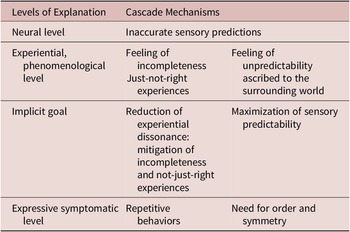
In phenomenological terms, sensory phenomena such as feelings of incompleteness and “not-just-right” experiencesReference Miguel, do-Rosario-Campos and Prado 5 – Reference Ferrão, Shavitt and Prado 7 may represent the subjective experiential resonance of an individual history of persistent inaccurate sensory predictions, which would trigger repetitive and/or compulsive behaviors pursuing the “just-right” feeling of completeness associated with a congruent sensory prediction. Similarly, the obsessive need for order and symmetry (and the related ordering and arranging compulsions) could represent a compensatory attempt to mitigate “sensory phenomena” by increasing the sensory predictability of the surrounding world. Indeed, conferring a rigidly structured spatial organization could attenuate the consequences of altered sensorimotor predictions that enhance sensory phenomena (see Table 1). This hypothesis in in agreement with the association in OCD between sensory phenomena and need for order and symmetryReference Ferrão, Shavitt and Prado7 as well as with perfectionism.Reference Lee, Prado and Diniz34
Multilevel Explanations of Basic Sensory Phenomena in Obsessive–Compulsive Disorder

In line with this background, a specific deficit in internal source monitoring (ie, the ability to distinguish whether an internally generated event was expressed in the outer vs inner space) is described in OCD patients,Reference Hermans, Martens and De Cort 35 , Reference Lavalle, Bation and Dondè 36 while an additive deficit in reality monitoring (ie, the ability to determine whether information is perceived from environment or imagined) is present only in schizophrenic patients.Reference Lavalle, Bation and Dondè 36 This suggests that (differently from schizophrenia) OCD presents a reduced SoA and a preserved Sense of Ownership (SoO; the immanent, automatic feeling of mineness that accompanies our experiences).Reference Tsakiris, Schutz-Bosbach and Gallagher 37 , Reference Braun, Debener and Spychala 38
Taken together, clinical findingsReference Brander, Rydell and Kuja-Halkola 21 – Reference van Hulle, Esbensen and Goldsmith 27 as well as preliminary experimental evidenceReference Gentsch, Schutz-Bosbach and Endrass 33 – Reference Lavalle, Bation and Dondè 36 point to a coherent view of the obsessive mind as an organized whole characterized by a predominant distortion of the SoA which does not fully saturate one’s own mental phenomena, while the SoO remains relatively preserved, so that the inner speech is felt in terms of intrusive (obsessive) thoughts and external or bodily somatosensory stimuli are felt in terms of “sensory phenomena.” In addition to the seminal empirical work of Gentsch et alReference Gentsch, Schutz-Bosbach and Endrass 33 on altered CD mechanism in OCD and their role in sensory phenomena, other recent empirical works reported an association between reduced SoA in its implicit feeling component and OCD symptoms and tendencies.Reference Fradkin, Eitam and Strauss 39 – Reference Oren, Eitam and Dar 42 In this respect, the altered CDs are a plausible key pathophysiological mechanism, early expressed phenotypically by neurological soft signsReference Jaafari, Fernandez de la Cruz and Grau 25 and sensory over-responsivity,Reference Ben-Sasson and Podoly 26 , Reference van Hulle, Esbensen and Goldsmith 27 facilitating the emergence of the obsessive mind along developmental years. In a clinical–translational perspective, this would suggest that early severe motor deviances in childhood are a potential red warning flag for an altered neurodevelopment headed to an obsessive mind,Reference Poletti, Tortorella and Raballo 32 and is in line with the predictive role of childhood poor visuospatial and fine-motor skills in relation to the persistence of childhood OCD symptoms into adulthood.Reference Grisham, Anderson and Poulton 43 – Reference Bloch, Sukhodolsky and Dombrowski 45
In sum, this neurodevelopmental account provides a bottom-up perspective on the ontogeny of the obsessive mind, not fully in agreement with top-down cognitive models of adult OCD, more focused on how an obsessive mind works rather than how a mind may become obsessive.Reference Robbins, Vaghi and Banca 3 This partial neglect on developmental issues is surprising, considering that apart from neuromotor signs described above, there is also meta-analytical evidence on neurocognitive endophenotypes in pediatric OCD emerging from experimental studies, for example, related to action monitoring.Reference Marzuki, Pereira de Souza, Sahakian and Robbins 46
It is interesting to compare this neurodevelopmental model with recent computational models on OCD. Despite its developmental focus on developmental features, a recent computational account of juvenile OCD resulted in a top-down perspective, with origins of neurocognitive impairments in OCD putatively set at the level of complex reasoning systems, formation of meta-confidence for functioning systems arbitration process of the meta-controller.Reference Loosen and Hauser 47 Instead, it is possible to detect some affinities between our neurodevelopmental model and a recent computational model of OCD.Reference Fradkin, Adams and Parr 48 Indeed, the core of our model, reduced SoA ontogenetically emerging from an individual history of altered sensorimotor prediction, due to altered CD mechanisms, has affinities with the core of such computational model of OCD, that is, an excessive uncertainty regarding state transitions, especially action-dependent transition. In this account, patients experience an excessive uncertainty in the probabilistic predictive relationship between actions and their consequences, triggering a possible cascade of subjective and behavioral consequences that in the long run may structure an OCD mind.
In comparison with such bottom-up computational perspective, our model gives more emphasis to clinical signs and endophenotypic features (in the sensorimotor domain) that are detectable along developmental years; therefore, our model, even if probably more simplistic in the description of pathogenetic mechanisms leading to habits and compulsions starting from an altered sensorimotor prediction, has more translational potentialities in the direction of an early detection of OCD risk.
A Pathophysiological Link Between the Obsessive Mind and the Psychotic Mind
A pathogenetic cascade partly echoing the putative one of obsessive mind has been proposed for the neurodevelopment of the psychotic mind (ie, from early childhood alterations of CD signals to distal psychotic symptoms as passivity delusions and auditory verbal hallucinations, through intermediate phenomena represented by an altered implicit SoA and anomalous self-experiences).Reference Poletti, Tortorella and Raballo 32 , Reference Poletti, Gebhardt and Raballo 49 , Reference Poletti, Gebhardt and Kvande 50 In this perspective, the hypothesis of a neurodevelopmentally determined dimensional gradient of altered sensorimotor prediction may offer a pathophysiological bridge between OCD and schizophrenia spectrum disorder, that 1) are epidemiologically associated above chance,Reference Cederlof, Lichtenstein and Larsson 51 – Reference Meier, Petersen and Pedersen 53 2) present a partial polygenic overlap,Reference Zilhao, Abdellaoui and Smit 54 and 3) are clinically overlapping in terms of obsessive–compulsive features in the schizophrenia spectrum and increased schizotypy in OCD,Reference Poyurovsky and Koran 55 – Reference Poletti and Raballo 58 supporting the hypothesis of a schizo-obsessive spectrum.Reference Scotti-Muzzi and Saide 59
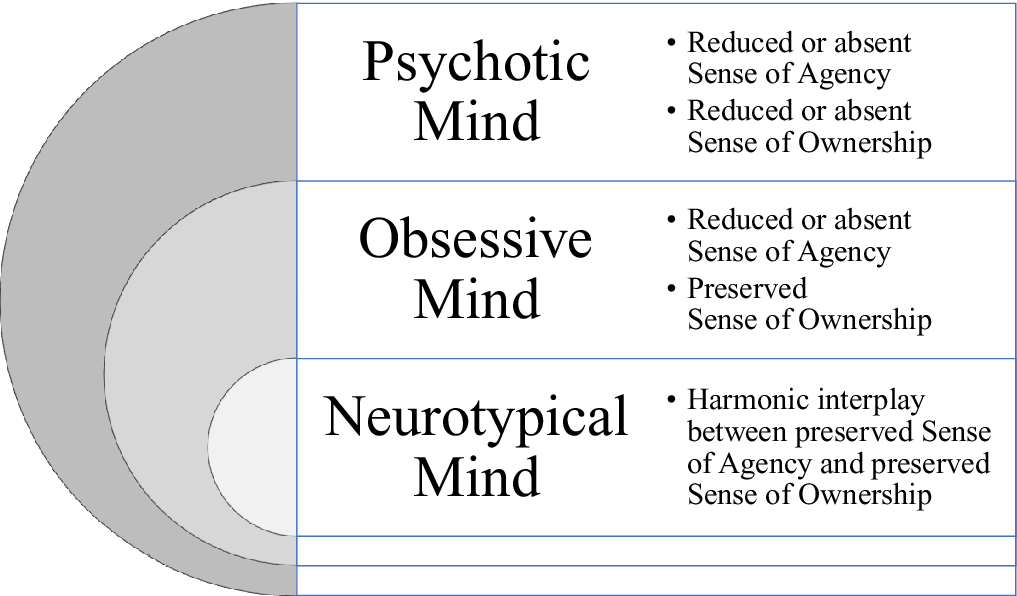
Subjective effects of altered sensorimotor predictions, indeed, cannot be considered all-or-none phenomenaReference Poletti and Raballo 60 : the failure of sensorimotor prediction that conditions the development of both altered SoA and SoO may represent a substrate for the progressive build-out of the psychotic mind; on the contrary, milder alterations of sensorimotor predictions (and related attenuation of SoA associated with preserved SoO) may represent an enabling condition for the development of the obsessive mind. Such developmental gradient may contribute to explaining the overlap between OCD and schizophrenia, in both terms of comorbidity and partial symptom affinity (see Figure 1).
Hypothesized neurodevelopmentally determined dimensional gradient of subjective implicit effects of altered sensorimotor predictions.

Conclusions
This dimensional bottom-up perspective based on altered CD mechanisms and their neurodevelopmental long-term implicit effects on SoA may offer translational suggestions for an early detection of OCD risk and partly explain reported affinities between OCD and the schizophrenia spectrum.
Disclosure
The authors do not have anything to disclose.