INTRODUCTION
Caprellids (Crustacea: Amphipoda) are an epifaunal animal commonly observed on macroalgae, hydroids and bryozoans. Caprellids are known to occur at high densities and become the dominant species in epifaunal communities associated with these substrata (Mukai, Reference Mukai1971). They feed on detritus or micro algae, and are preyed upon by higher-trophic level predators such as fish (Sano et al., Reference Sano, Omori and Taniguchi2003; Dubiaski-Silva & Masunari, Reference Dubiaski-Silva and Masunari2008; Storero & González, Reference Storero and González2008). With these traits, caprellids play an important role as a secondary producer. However, the trait of occurrence with high density also implies a negative impact on an existing ecosystem when the animals occur as non-indigenous species. Unfortunately, several caprellid species are already listed as a non-indigenous or cryptogenic species at various coasts, for example Caprella natalensis Mayer (Ranasinghe et al., Reference Ranasinghe, Mikel, Velarde, Weisberg, Montagne, Cadien and Dalkey2005), C. acanthogaster Mayer (Guerra-García & Takeuchi, Reference Guerra-García and Takeuchi2004; Hewitt et al., Reference Hewitt, Campbell, Thresher, Martin, Boyd, Cohen, Currie, Gomon, Keough, Lewis, Lockett, Mays, McArthur, O'Hara, Poore, Ross, Storey, Watson and Wilson2004), C. mutica Schurin (e.g. Tierney et al., Reference Tierney, Kane, Naughton, O'Donohoe, Copley and Jackson2004; Page et al., Reference Page, Dugan, Culver and Hoesterey2006). Especially, C. mutica is known to have invaded and become established in many regions including North America (Ashton et al., Reference Ashton, Riedlecker and Ruiz2008), Europe (Ashton et al., Reference Ashton, Boos, Shucksmith and Cook2006; Cook et al., Reference Cook, Jahnke, Kerckhof, Minchin, Faasse, Boos and Ashton2007a) and New Zealand (Inglis et al., Reference Inglis, Gust, Fitridge, Floerl, Woods, Hayden and Fenwick2006). This species is also known as a fouling species that clogs the mesh of set-nets along the Japanese coast where it occurs at high density (Arimoto, Reference Arimoto1976). In Helgoland and England, where the species has become invasive, similar high densities were observed on artificial substrates such as floating buoys or cages used for aquaculture (Willis et al., Reference Willis, Cook, Lozano-Fernandez and Takeuchi2004; Buschbaum & Gutow, Reference Buschbaum and Gutow2005). In order to anticipate the extent of seasonal fouling in aquaculture facilities due to the seasonal increases in C. mutica populations, or to estimate the potential extent of an area likely to be invaded by this species, accurate assessment of the reproductive potential of the species in response to fluctuations in environmental factors is needed.
Reproduction in marine crustaceans, which are ecotherms, is strongly affected by temperature through direct effects on metabolism (Hartnoll, Reference Hartnoll and Abele1982; Johnson et al., Reference Johnson, Stevens and Watling2001). In caprellids, the relationship between reproduction and temperature is suggested by comparisons of reproductive and latitudinal distribution patterns of several relative species. For example, in temperate regions, caprellids C. penantis Leach (Bynum, Reference Bynum1978), and C. monoceros Mayer (Aoki, Reference Aoki1992) breed continuously throughout the year, while in the boreal zone further north, the reproductive period of C. septentrionalis Krøyer is restricted to early summer (Heptner, Reference Heptner1963), implying that the length of the reproductive period is closely correlated with the temperature fluctuations of a given habitat. As with other evidence that states temperature affects reproduction in caprellids, the length of a single breeding period in C. danilevskii Czerniavski and C. okadai Arimoto, which are both multiple breeding species, has been reported to be highly dependent upon temperature (Takeuchi & Hirano, Reference Takeuchi and Hirano1992b). In a one-year study on the population structure of C. mutica inhabiting the seagrass in Posjet Bay, Fedotov (Reference Fedotov1992) reported the occurrence of ovigerous females only from spring to summer (sea surface temperature: 0–17.4°C). Cook et al. (Reference Cook, Willis and Lozano-Fernandez2007b) reared C. mutica at 13°C in the laboratory, and showed that juveniles mature 53 days after emergence from the brood pouch, and reproduce at an interval of approximately 20 days thereafter. Nakajima & Takeuchi (Reference Nakajima and Takeuchi2008) also reared the species in an exhibition tank with a constant temperature of 19°C, and inferred that there was a turnover of several generations of the species each year based on the similarity with the reproductive characteristics of C. danilevskii and C. okadai. There exist gaps between the rapid maturation shown at a constant temperature and the limited reproductive season observed at a wider range of temperature in the field. These gaps will be supplemented with quantitative data on reproductive traits of the species, such as reproductive schedule, egg production and hatching success under various temperature conditions.
In this paper I quantified fecundity in female C. mutica at various temperatures in order to provide fundamental information for the prediction of seasonal fluctuation of caprellid population size or to estimate the potential size of the area invaded by the species. I reared adult pairs of C. mutica at different temperatures (5, 10, 15 and 20°C) and: (1) examined temperatures at which the species could reproduce; (2) quantified differences in the length of four parameters of reproduction: moulting interval, oviposition interval, oviposition–hatch period, and oviposition–emergence period; and (3) counted the number of eggs per oviposition.
MATERIALS AND METHODS
The typical reproductive pattern in Caprella mutica determined through preliminary observation was used to design the present experiments (Figure 1). The following four parameters of reproduction were measured in days: moulting interval, oviposition interval, oviposition–hatch period, and oviposition–juvenile emergence period. The number of eggs per oviposition was counted and developmental abnormalities of incubating eggs were recorded in days from oviposition.
Typical reproduction schedule in female Caprella mutica.

Caprellids were collected at Usujiri, a native habitat for this species, on the Pacific coast of northern Japan (41°57′N 141°58′E) with a range in monthly mean temperatures in 1999–2003 of 2.8–19.2°C (provided by Usujiri Fisheries Laboratory, Hokkaido University). Individuals attached to laminarian rearing ropes were collected by hand on 18 and 19 January 2003 (sea surface temperature: 4.3°C) and transferred in pairs to 40-ml polystyrene containers (4 cm diameter, 7 cm height) with seawater and red algae Neorhodomela ralix (5 cm) as a substratum. Algae fragments were replaced every two days and commercial goldfish flakes (Tetrafin, developed by Tetra Japan Inc.) were added daily as a food. Photoperiod was maintained at 12 hour light:12 hour dark. To minimize the effect of field temperature, each pair experienced one moulting and oviposition event at the target temperature prior to the start of the experiments. The mean body length of female individuals at the start of the experiments was 9.96 mm (minimum–maximum: 7.02–12.56 mm).
Experimental rearing groups for observing embryonic development (10 pairs) and egg production (10 pairs) were established at each of four rearing temperatures: 5, 10, 15, and 20°C. To observe egg production, the female's brood pouch was washed out with a small syringe as soon as oviposition was confirmed, and eggs were counted. Offspring from each of the ten pairs were reared to juvenile emergence for observation of embryonic development. Adults were observed daily under a binocular microscope (Olympus SZX 150) at the same time that the seawater was exchanged. For observations at which moulting was confirmed in a female, a picture was taken with a digital camera attached to the microscope, and the body length was measured using image analysing software (NIHimage 1.56, National Institutes of Health, USA). The sum of axial length from head to pereonites 2–7 was used as the body length.
The relation between number of eggs per oviposition and temperature was analysed using analysis of covariance (ANCOVA) with log(body length) as a covariate, temperature as an explanatory variable, and log (number of eggs) as a response variable based on the positive correlation between female body length and the number of eggs in caprellids (Johnson et al., Reference Johnson, Stevens and Watling2001). The relation between temperature and the parameters of reproduction of moulting interval, and oviposition–hatch and oviposition–juvenile emergence periods were examined with the Belehrádek equation:

where x is temperature, y is duration of the specified developmental stage, and a, α, and b are parameters specific to each developmental stage. In particular, α (°C) is called the biological zero, or the temperature at which growth theoretically stops. Each parameter was estimated with the non-linear regression module in statistical software STATISTICA 6.0.
RESULTS
At all temperatures used in the rearing experiments (5–20°C), I confirmed the same basic sequence of reproductive events from oviposition to juvenile emergence. First, the female becomes less active due to moulting and the male starts pre-copulatory mate guarding behaviour. Next, the female moults, copulates with the male, and lays eggs into her brood pouch. After the eggs hatch within the brood pouch, the juveniles remain in the brood pouch for several days. The female parent continues to protect the emerging juveniles in behaviour categorized as ‘stay-around-mother’ type (Aoki, Reference Aoki1999). This reproductive sequence of events is observed after every moulting of mature females.
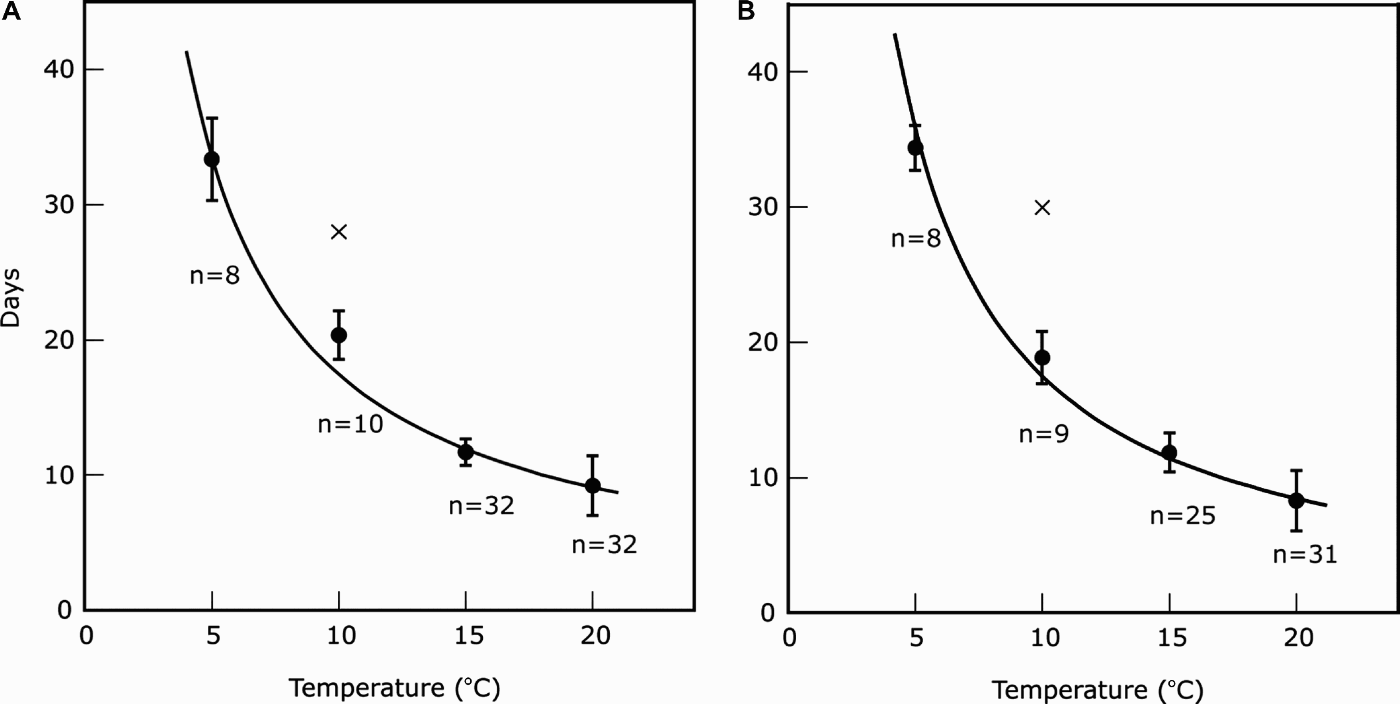
Moulting intervals were 33.4±3.07, 20.4±1.79, 11.7±0.99 and 9.7±2.20 days (mean±SD) at 5, 10, 15, and 20°C, respectively, with one outlier at 10°C (Figure 2A). The moulting interval data showed a good fit to the Belehrádek equation based on temperature (y = 152.1(x − 0.00)−0.94, r 2 = 0.93), which indicates that the moulting interval is prolonged by lower temperatures (Figure 2A). The duration from moulting to oviposition was shorter at higher temperatures (3–4 days at 5°C, 2–3 days at 10°C, and <1 day at 15 and 20°C). Accordingly, the length of oviposition intervals and moulting intervals were similar (t-test P > 0.1 at all rearing temperatures; Figure 2B), with the exclusion of data for a female that incubated decayed eggs for an extended period at 10°C. The Belehrádek equation for oviposition interval was estimated as y = 189.8(x − 0.24)−1.03 (r 2 = 0.94).
(A) Interval of moulting and (B) oviposition, at four rearing temperatures. ×, indicates outlier, and vertical lines indicate the standard deviation. The regression curve is the fitting of moulting intervals to Belehrádek's equation.

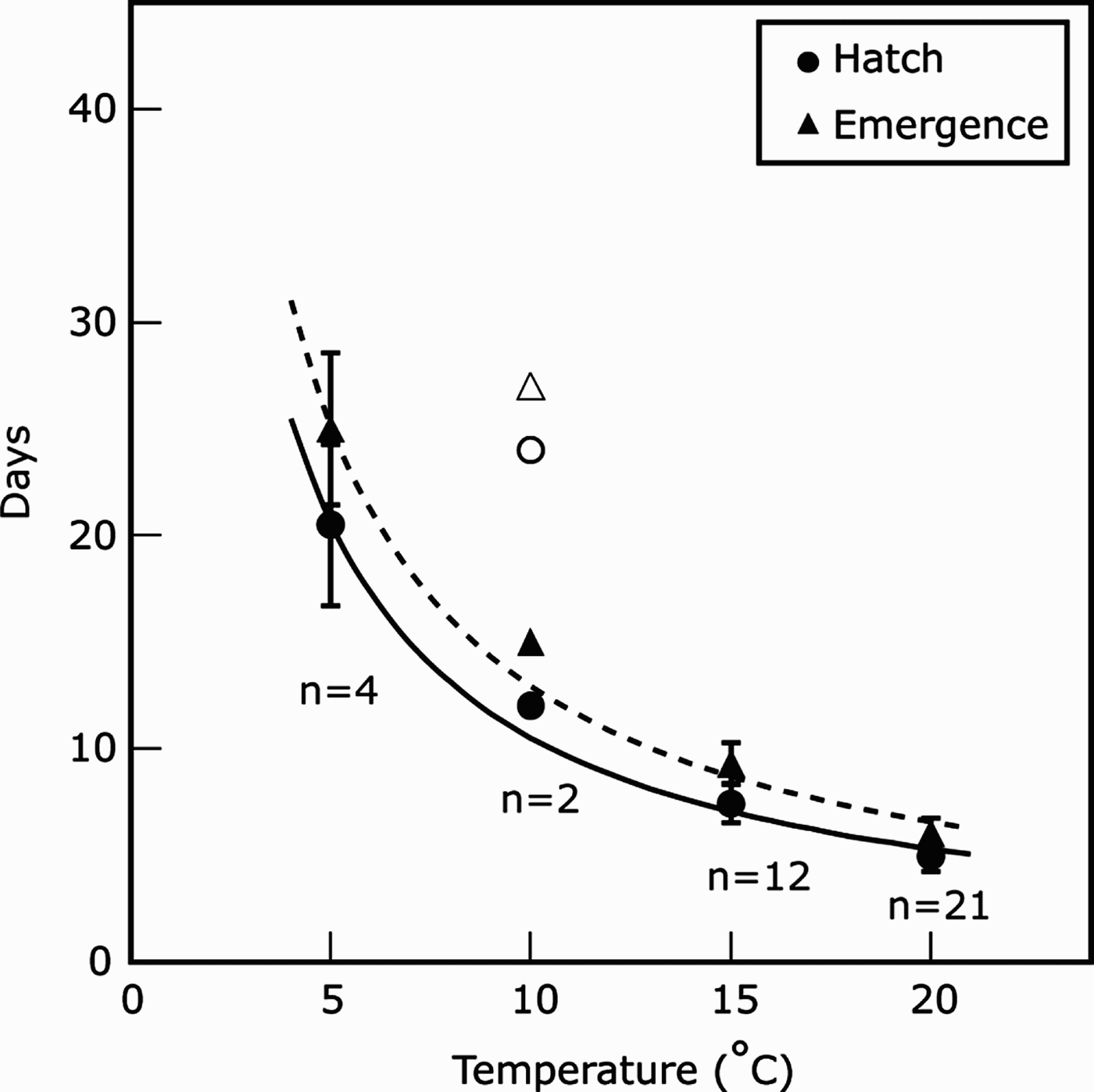
The oviposition-hatch period was 20.5±3.79, 12, 7.4±0.90 and 4.9±0.74 days at 5, 10, 15 and 20°C, respectively, and with the exclusion of outliers (Figure 3), and the oviposition-juvenile emergence period was 25.0±3.56, 15.0, 9.3±3.79, and 6.1±0.71, respectively. Application of the Belehrádek equations for these parameters produces the following relationships: oviposition–hatching period, y = 111.0(x + 0.28)−1.01 (r 2 = 0.92); and oviposition–juvenile emergence period, y = 133.1(x + 0.29)−1.00 (r 2 = 0.94). The length of both periods was notably prolonged with decreased temperature.
Durations from oviposition to hatching and juvenile emergence at four rearing temperatures. Open symbols indicate outlier, and vertical lines indicate standard deviation. Regression curves of Belehrádek's equations for the two intervals (solid line, hatching; dashed line, juvenile emergence) are shown.

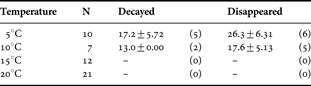
Embryonic development observations showed that all eggs developed to the juvenile stage normally at 15 and 20°C. However, decay or disappearance of eggs during the incubation period was frequently observed at 5 and 10°C. At 5°C, decayed eggs were observed in five out of ten cases in 17.2±5.72 days, and eggs finally disappeared from the brood pouch in six cases in 26.3±6.31 days (Table 1). At 10°C, decayed eggs were observed in two out of seven cases in 13.0 days, and eggs finally disappeared from brood pouch in five cases in 17.6±5.13 days. There were large variances in the timing of the decay or disappearance of eggs compared to the variance observed in development, such as moulting interval. However, both the abnormal development resulting in the decay and disappearance of eggs was always shorter than the moulting interval because females excluded the abnormally developing eggs from their brood pouches before the next moulting.
Duration from oviposition to each developmental event. Data are shown as mean (days)±SD. Number in parentheses indicates number of observations. N is total number of observations at each temperature.

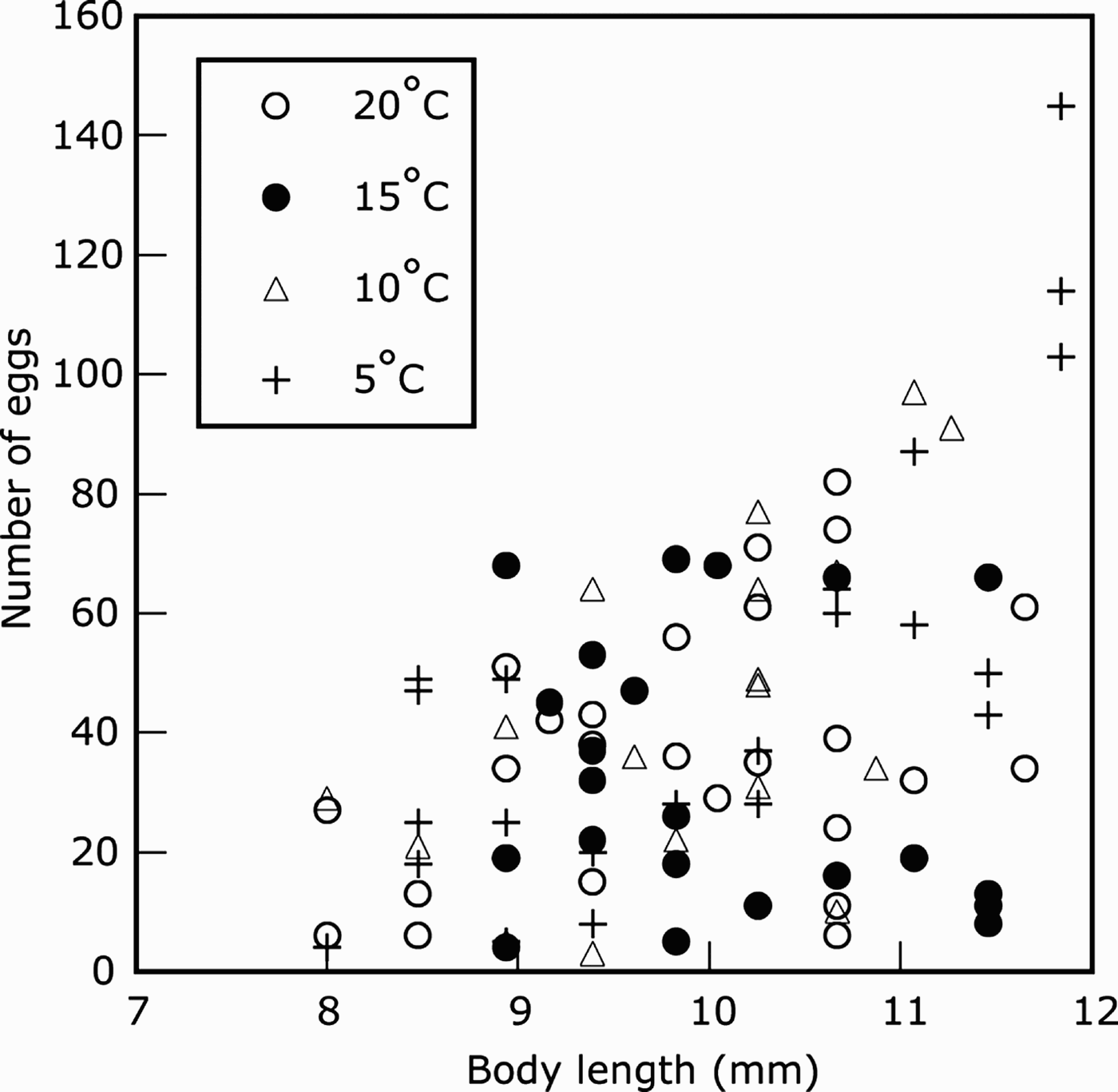
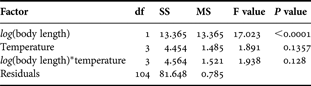
The females used in these experiments produced an average of 35.6 eggs per oviposition (minimum–maximum: 3–140 eggs; Figure 4). The analysis of variance showed that egg production was dependent only on female body length and that temperature had no significant effect on egg production (Table 2).
Relationship between body length and number of eggs of Caprella mutica at four rearing temperatures.

Results of ANCOVA for number of eggs per oviposition.

DISCUSSION
Temperature and reproduction
Quantifying reproductive potential of an invasive species at varying temperatures provides information necessary to estimate the areas in which the species can successfully reproduce and to predict seasonal fluctuations in local populations. My findings show that Caprella mutica has reproductive potential over a wide temperature range of 5 to 20°C and that egg production is not affected by temperature within this range. However, moulting interval, oviposition–hatch period and oviposition–juvenile emergence period were all markedly prolonged at lower temperatures. Moreover, eggs frequently decayed and were extruded by the female at lower temperatures of 5 and 10°C, while all eggs developed normally at higher temperatures of 15 and 20°C. Based on these results, the species is expected to show active reproduction in approximately 10-day intervals when temperature exceeds 15°C in the field. When the temperature falls below 10°C, increases in the population are reduced due to lower levels of reproduction and hatching success.
The only known report of field reproductive patterns of C. mutica investigated population dynamics of the species year round in Posyet Bay, Sea of Japan (Fedotov, Reference Fedotov1992). Based on changes in the C. mutica population structure, the author concluded that the population in Posyet Bay comprised two generations: the spring generation is typified by rapid growth and reproduces in June and July (13–17.4°C) with an incubation period of 30–40 days, while the summer generation experiences over-wintering, is typified by slow growth, and reproduces in March and April (0–1.7°C) with an incubation period of about two months. Although mature females and juveniles were observed in August to November, it was considered that they did not breed during that period but contributed to the following year's reproduction as summer-generation individuals. Fedotov's (1992) finding that the incubation period at lower temperatures is longer than that at higher temperatures was corroborated in the present study. However, the mean sea surface temperature of Posyet Bay from August to October (13–23°C; estimated from Figure 3 in Gayko, Reference Gayko2000) is considered to be within the non-reproductive season in Fedotov (Reference Fedotov1992) but largely overlaps with the temperature range for favourable reproduction observed in my rearing experiments. In addition, C. mutica was reported to reproduce and rapidly mature within 53 days from juvenile emergence at 13°C (Cook et al., Reference Cook, Willis and Lozano-Fernandez2007b). From the perspective of temperature alone, the species is able to mature and reproduce repeatedly from August to November in Posyet Bay. One possible explanation for the difference between my results and those of Fedotov (Reference Fedotov1992) is the differences between laboratory and natural conditions. In the natural environment, reproduction of amphipods is controlled not only by temperature but also by other factors such as photoperiod (Williams, Reference Williams1985; Lngólfsson et al., Reference Lngólfsson, Ólafsson and Morritt2007) or prey conditions (Powell & Moore, Reference Powell and Moore1991). For caprellids, as epifaunal animals, prey conditions directly reflect the outcome of competition for space on substrate. Considering that my research and that of Cook et al. (Reference Cook, Willis and Lozano-Fernandez2007b) were both conducted in the laboratory with no competition for food and space, the greater reproduction of C. mutica over a wider range of temperatures implied that the species could produce broods over the normal reproductive period when limiting factors, such as competition were removed.
Factors regulating reproductive speed
Although the order of reproductive events of moulting, oviposition, hatch and juvenile emergence did not change, even in the case of remarkably prolonged reproductive periods at low temperature, the extent of the prolongation was considerably different in each reproductive period. Among the four reproductive periods, moulting and oviposition intervals showed the same variation patterns for temperature change, and the variations were considerably greater than in the two embryonic periods. This suggests that delay of reproductive speed at lower temperature was caused not by a delay in developmental rate in embryos but by a delay in the moulting rate in the female.
As to the variation of embryonic periods for temperature change in caprellids, Takeuchi & Hirano (Reference Takeuchi and Hirano1992b) reared C. danilevskii and C. okadai at various temperature levels, and derived the Belehrádek equations for oviposition–hatch interval. The equations predict that oviposition–hatch intervals at 10, 15, 20°C are 12.3, 6.3, 4.3 days in C. danilevskii and 13.5, 6.5, 4.3 days in C. okadai, which are similar to the length of the intervals in C. mutica at 10–20°C observed in my experiments. Although there are fragmentary reports on the oviposition interval in female caprellids, oviposition and moulting interval is reported to be five days at 20°C in C. danilevskii (Takeuchi & Hirano, Reference Takeuchi and Hirano1991) and 5–6 days at 20°C in C. okadai (Takeuchi & Hirano, Reference Takeuchi and Hirano1992a). The oviposition and moulting interval in C. mutica, about ten days at 20°C, is considerably longer than the ones in C. danilevskii and C. okadai in contrast to the case of embryonic developments. The reproductive characteristic of the longer moulting interval in C. mutica, which is recognized from the comparisons between other caprellids, could further enhance delay of reproductive speed caused by delay of moulting at low temperatures.
The estimated value of the biological zero α means the theoretical temperature threshold for growth was the highest at 0°C for the moulting interval, suggesting that reproduction of C. mutica might be halted below 0°C because of a restriction in female moulting. The estimated threshold of 0°C may provide us with a hypothesis on how the species could rapidly expand their habitat in Europe. In a review of the habitat expansion in C. mutica on European coasts, Cook et al. (Reference Cook, Jahnke, Kerckhof, Minchin, Faasse, Boos and Ashton2007a) reported that the species has become established in the North Sea, west coasts of Scotland and Ireland, in the Irish Sea and English Channel. These coastal areas are all strongly influenced by the warm current of the North Atlantic Drift, and annual low temperature exceeds 0°C, even in the North Sea on the north margin of the invaded area (ICES, 2008). This temperature regime allows C. mutica to reproduce without interruption and to maintain a population that allows the dispersal of individuals throughout the year and may play some role in the mechanism that allows C. mutica to rapidly expand their distribution along European coasts.
In my experiments, moulting interval was occasionally influenced by a developmental delay of eggs. In the case that a female incubated spoiled eggs in the treatment at 10°C, the moulting interval was delayed for about ten days compared with the normal moulting interval at 10°C (outlier at 10°C in Figure 2A). Similarly, in one case in which brood development was delayed by 12 days compared with the other normally developing embryos (outlier at 10°C in Figure 4), the female parent did not moult during the incubation period (the moulting interval of the female could not be measured because the female died after the emergence of the juveniles). Concerning the plasticity of moulting timing in the female caprellid, Aoki (Reference Aoki1997) reported moulting in the female C. monoceros was restrained during extended parental care of ‘cling to mother’ type. Although C. mutica showed extended parental care of ‘stay around mother’ type, I removed released juveniles from the female brood pouch within one day and did not consider the effect of extended parental care on reproductive speed. Biological and behavioural aspects, such as extended parental care or interaction between female parents and conditions of their incubating eggs will need to be determined in order to more actively understand the reproductive biology of C. mutica under natural conditions.
In conclusion, I revealed that Caprella mutica was able to reproduce in a wide range of temperatures of 5–20°C and that the reproduction was strongly influenced by temperature with a drastic decline in reproductive rate with a decline in temperature. The range of temperatures suitable for reproduction determined here exceeded the temperature range in the reproductive season in the field, implying that reproduction of the species might be favourable without a restricting factor of competition.
ACKNOWLEDGEMENTS
Sincerest thanks are extended to Masashi Kiyota for much advice on my manuscript, and to Yoetu Arashida and Kiyoshi Nomura for their field assistance, and to Chieko Yamada for kindness and help in laboratory works.