Implications
This work provides preliminary information on the infection by Toxoplasma gondii in donkeys. Toxoplasmosis is a zoonotic infection and clinical forms of toxoplasmosis in humans have been associated with the consumption of unpasteurized goat milk. Furthermore consumption of raw milk products represents a possible risk, particularly for certain categories of people. Currently, relatively little is known about infection by T. gondii in donkeys. In addition there has been an increase in donkey milk consumption. For these reasons the effects of T. gondii on milk safety, yield and quality in sero-positive animals with parasitemia were investigated.
Introduction
In recent years, there has been an increase in donkey milk consumption for humans and it is also used in cosmetics (Faye and Konuspayeva, Reference Faye and Konuspayeva2012). Safety for consumers is important, especially considering that often they buy donkey milk raw, directly from farms.
As is well known, the safety of animal products also depends on the health of the livestock. Currently, there has been little monitoring of parasitic diseases in this species and, in particular, relatively little is known about infection by Toxoplasma gondii in donkeys (Mancianti et al., Reference Mancianti, Nardoni, Papini, Mugnaini, Martini, Altomonte, Salari, D’Ascenzi and Dubey2014). Toxoplasmosis is a zoonotic infection caused by T. gondii, an opportunistic protozoon belonging to the phylum Apicomplexa. Toxoplasma gondii infections are prevalent in humans and animals worldwide. Up to one-third of the world’s population is chronically infected (Dubey, Reference Dubey2010) and toxoplasmosis has been targeted by Center for Disease Control and Prevention as one of the five top priority parasitic diseases for public health action. Human infections are primarily asymptomatic, but lymph adenopathy or ocular toxoplasmosis can occur in some patients. Toxoplasma gondii infection in pregnant women can lead to miscarriage, stillbirth or other serious consequences in newborns. In immunocompromised patients, toxoplasmosis can be fatal if not treated and the reactivation of a latent infection can cause life-threatening encephalitis (Montoya and Liesenfeld, Reference Montoya and Liesenfeld2004).
The parasite has three primary modes of transmission: via the ingestion of raw meat products containing terminal oocysts, infection by ingestion of sporulate oocysts and congenital infection. Further infection can also happen through the ingestion of tachyzoites in milk. Clinical forms of toxoplasmosis in humans have been associated with the consumption of raw goat’s milk, although it is considered as a secondary mode of transmission (Camossi et al., Reference Camossi, Greca-Júnior, Corrêa, Richini-Pereira, Silva, Da Silva and Langoni2011). As previously mentioned, the consumption of raw milk products represents a possible risk, particularly for certain categories of people. The aim of this study was to evaluate the possible effects of T. gondii on donkey milk safety, yield and quality in sero-positive animals with parasitemia.
Material and methods
Eighteen healthy lactating Amiata jennies, all adults (7–10 years), with a homogeneous phase of lactation (between 90 and 180 days) were included in the study. All the jennies were semi-extensively reared on the same farm following farming systems typical of the area of origin, based on natural pasture integrated with polyphite hay ad libitum. Between November and December 2012 milk as well as blood samples were taken.
An immunofluorescent antibody test (IFAT) was performed on blood samples, using commercially available 12-well slides (VMRD Inc. Pullman, Washington, USA) as the antigen, and horse-IgG FITC antibody produced in rabbit (Sigma-Aldrich; PBS dilution 1 : 32). All serum samples were screened with a threshold dilution of 1 : 20, and the positive sera were end-titrated using two-fold dilutions. Blood and milk (50 ml) specimens from seropositive jennies were processed for molecular analysis (Mancianti et al., Reference Mancianti, Nardoni, D’Ascenzi, Pedonese, Mugnaini, Franco and Papini2013). A nested-PCR assay was used to screen blood and milk samples for T. gondii DNA, as described by Jones et al. (Reference Jones, Okhravi, Adamson, Tasker and Lightman2000).
The animals were machine milked and individual morning milk samples were analyzed for: dry matter, fat and lactose by infrared analysis (Milkoscan; Italian Foss Electric, Padua, Italy); proteins, caseins and ashes (Association of Official Analytical Chemists (AOAC), 1995); somatic cell count (Fossomatic; Italian Foss Electric), and total bacterial count (plate count agar; 30°C, 72 h). The diameter (µm) and the number of fat globules per ml of milk in each sample were measured by fluorescence microscopy following a direct method (Martini et al., Reference Martini, Salari and Altomonte2013). All the results were analyzed by ANOVA, where a positive scoring for both IFAT in blood and for PCR in blood and milk samples was the fixed effect. Significant differences were considered at the level P<0.05. The statistical analysis was carried out using JMP (2002) software.
Results and discussion
The IFAT results showed four positive cases of T. gondii, and each IFAT positive donkey presented parasitic DNA both in the blood and milk. Recent studies indicate that the elimination of the parasite in milk depends both on the stage of infection and the immune status of the animals. Physiological decreases in peripartum immunity would seem to lead to the resurgence of T. gondii tachyzoites from tissue cysts. Tachyzoites can then circulate again and be excreted in milk (Camossi et al., Reference Camossi, Greca-Júnior, Corrêa, Richini-Pereira, Silva, Da Silva and Langoni2011). As is well known, the data concerning the excretion of parasitic DNA in milk does not indicate the presence of live forms. Tachyzoite stages of T. gondii have also been found in milk of several species, including sheep, goats, camels, buffalos and cows; and infection in humans due to the ingestion of raw goat’s milk has been documented (Dehkordi et al., Reference Dehkordi, Rahimi and Abdizadeh2013). In addition, tachyzoite penetration through the oral-pharyngeal mucosa has been demonstrated in cats. Cats can become infected when high numbers of these parasitic stages are given orally. Tachyzoites are also rapidly killed outside the host, in fact these stages were shown to survive up to 2 h in pepsin solutions (Dubey, Reference Dubey2010).
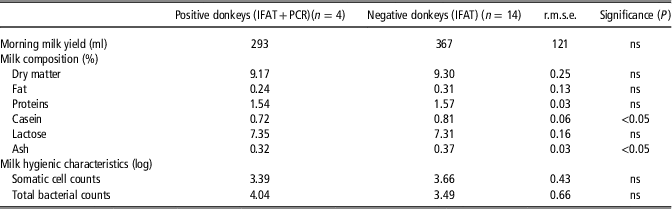
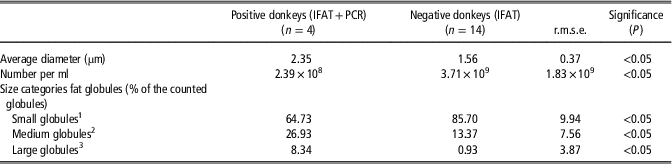
The gross composition of Amiata donkey milk was in agreement with Polidori et al. (Reference Polidori, Beghelli, Mariani and Vincenzetti2009). Although in our study no significant differences were found between morning milk yield in PCR positive donkeys compared with the negative ones, the former tended to have a greater production (Table 1). In addition, the milk quality in the positive animals showed lower (P<0.05) percentages of casein and ash. Changes in milk quality could be linked to the release of enzymes as a result of an antibody response, as shown in mice with T. gondii (Chardès et al., Reference Chardès, Bourguin, Mevelec, Dubremetz and Bout1990). According to Evers (Reference Evers2004), antibody responses promote a release of enzymes. This can alter the composition of milk and the fat globule membrane, resulting in variations in diameter. The fat characteristics found in our study are linked with those reported above (Table 2), in fact, positive animals had a larger average globule diameter (P<0.01) and fewer globules/ml (P<0.01). Some authors have reported that the composition of the membrane, and thus the physical state of the fat, could be useful for monitoring the health status of the mammary gland (Bendixen et al., Reference Bendixen, Danielsen, Hollung, Gianazza and Miller2011). However, at the time of milk sampling, in the positive animals there were no clinically forms of mastitis detected, in agreement with findings described in equidae. In addition, somatic cell and bacterial counts were normal and in agreement with the literature. In fact, according to some studies, donkey milk has a strong inhibitory activity against some bacteria due to the high contents of lysozyme and lactoferrin. It should also be highlighted that potentially pathogenic microorganisms have also been isolated in donkey milk with low somatic cell counts (Pilla et al., Reference Pilla, Daprà, Zecconi and Piccinini2010).
Quanti-qualitative and hygienic characteristics of Amiata donkey milk positive and negative for Toxoplasma gondii

IFAT=immunofluorescent antibody test.
Morphometric characteristics of milk fat globules in positive and negative donkeys for Toxoplasma gondii

IFAT=immunofluorescent antibody test.
1 Small globules with a diameter <2 μm.
2 Medium globules with a diameter between 2 and 5 μm.
3 Large globules with a diameter >5 μm.
In conclusion, Toxoplasma gondii did not seem to present a clinical form in lactating jennies, however changes in milk quality were observed, especially regarding caseins, minerals and fat globules. The present study did not demonstrate that the T. gondii DNA found in milk was from tachyzoites, anyway donkey milk is a potential source of infection for humans considered at risk. Heat treatment of the milk is therefore important before consumption. In the light of these preliminary results, we believe that in vivo studies are needed to assess more thoroughly both the risk of transmission of T. gondii through donkey milk and the impact of the various stages of infection on milk quality.
Acknowledgements
This work was supported by the Tuscany Region Rural Development Fund 2007–2013. The authors would also like to thank ‘Bandite di Scarlino’ (Grosseto-Italy).