It is perhaps self-evident to suggest that military conquest shares something with tourism because both involve encounters with “strange” landscapes and people. Thus it may not surprise that the former sometimes borrows rhetorical strategies from the latter—strategies for rendering the strange familiar or for translating threatening images into benign ones. There have been numerous studies of this history of borrowing. Scholars have considered how scenes of battle draw tourist crowds, how soldiers' ways of seeing can resemble those of leisure travelers, how televised wars have been visually structured as tourist events (e.g., the 2003 U.S. invasion of Iraq), and how the spoils of war can function as a body of souvenirs.Footnote 1 These lines of inquiry expand our understanding of tourism as a field of cultural practices and help us to rethink the parameters of militarism and warfare by suggesting ways they are entangled with everyday leisure practices.
This paper considers the ways this entanglement functions in the Israeli case. To be more specific, I am interested in the workings of Israeli tourist practices and discourses during two key moments of Israeli military engagement: the 1967 war and subsequent onset of the Israeli military occupation and the 1982 Israeli invasion of Lebanon. My analysis in both instances focuses on a reading of popular Israeli Hebrew and English-language print media,Footnote 2 with attention to the ways that Israeli newspapers represented the incursion, occupation, and/or conquest to Israeli publics in the immediate aftermath of the wartime victory (1967) and invasion (1982). Both cases have been largely overlooked within the scholarly writing on Israel, and both expand our account of Israeli militarism by considering the popular cultural avenues by which state military projects have been enabled and sustained.Footnote 3
Consider, by means of introduction, the 1967 case. The gradual dissolution of borders between Israel and its newly occupied territories in war's aftermath generated numerous new possibilities for Israeli travel to places that had been inaccessible since 1948. What resulted was a tourist event of massive proportions, passionately documented by the Israeli popular media of the period through images of surging Israeli crowds in Jerusalem's Old City, of the rush to buy souvenirs in Bethlehem and inexpensive appliances in Gaza City, and of collective wonder at sites that had been off limits to Israeli passport holders for nearly two decades. Given the nation's preoccupation with the more pressing matters of the day—namely, the future of the newly occupied territories and the conditions for a peace settlement with Israel's Arab neighbors—such coverage was typically relegated to back pages. Yet this relative marginality should not obscure the significance of such narratives or the cultural practices they described. As I argue in what follows, tourist practices and the stories they generated gave prosaic, cultural expression to the Israeli wartime victory. Tourism, and the rituals of consumption that attended it, was a crucial means by which many Jewish Israeli civilians came to know or reacquaint themselves with the newly occupied territories and confront their newfound status as occupiers.Footnote 4 Indeed, one can make the case more pointedly: such tourist practices and accompanying narratives worked to displace the violence of the new Israeli occupation by recasting military conquest as a leisure opportunity. Through stories about tourism as they circulated in the Israeli popular media, the occupation was figured as an exercise in mass sightseeing. The violence that the occupation entailed and the political interests that it served were virtually invisible.
The second case, which considers tourism's role during the Israeli incursion into Lebanon, is different in kind. As before, I am interested in a minority story line that circulated within the popular media of this period and that diverged sharply from the accounts of the incursion that dominated Israeli newspapers in the first month after Israel's initial invasion on 6 June 1982, when popular Israeli support for the invasion remained strong—that is, prior to the massacres at Sabra and Shatila. In this story line, the Israeli presence in Lebanon was recast in the language of leisure travel with the Israeli soldier illustrated as a holiday seeker who navigated Lebanese space with a consumer's itinerary. I argue that however marginal to the Israeli reporting on Lebanon, with its focus on Israeli military maneuvers and PLO terror,Footnote 5 this back-page account was an important narrative tactic employed by the press to make sense of the scene of Israeli aggression. This seemingly benign narrative intervened to displace the fact of a violent incursion that was, as weeks progressed, rapidly losing the support of the Israeli public.
The differences between these cases should be noted from the outset. The first considers a diverse set of tourist practices (including travel and sightseeing, consumption of goods and services, and pilgrimage activities) that emerge in the aftermath of warfare and are enabled by its cessation, even as they are coincident with and provide the justification for the onset of a military occupation. The second considers media stories about tourism and consumption, or those that employ the literary idiom of the travelogue, in the very midst of an incursion. While the first focuses on the leisure practices of Israeli civilians, the second studies on-duty soldiers. I contend that the heterogeneous nature of this conjoined archive is an analytic asset. Read together, these varied cases provide a means of expanding our scholarly understandings of the contours of military occupation by considering the ways that diverse leisure practices and narratives have supplemented the formal work of armies. What these cases share is their normalizing function vis-à-vis the occupations in question. In each case, stories about tourism both legitimized and naturalized the work of the Israeli army by refiguring military occupation as a field of pleasure, leisure, and consumption rather than one of violence, repression, and political interests. These narratives endeavored to stabilize and banalize the military processes they described by anchoring them in accounts of quotidian leisure practices. They worked to create an Israeli investment in occupation through images of the consumer pleasures they afforded.
As noted, my investigation focuses on stories about Israeli tourists that circulated in the popular Israeli print media in 1967 and 1982. Although the newspapers in question are undoubtedly popular texts, they are also dominant sources, whose journalists and readers came primarily from Israel's Ashkenazi (European Jewish) left. The discourse of these publications reflected these demographic and political coordinates, sometimes in subtle ways. Most of the stories about Israeli tourists that I study focused on Ashkenazi subjects, ignoring the divergent routes and leisure agendas of Israel's Palestinian and Mizrahi populations (Jews from the Middle East and North Africa). Likewise, they tended to obscure histories that did not conform with dominant Israeli accounts, such as those pertaining to the legacy of the Palestinian dispossession.Footnote 6 The tourist accounts studied here should thus be read in two veins: both as realist descriptions of the phenomena they are documenting and as normative narratives that labored to fortify hegemonic Israeli knowledges about the nation-state and its Arab neighbors. By and large, I do not endeavor to correct the discursive record through the discussion of the itineraries and histories that Israeli newspapers obscured but rather to point to the ways that the print media deployed a tourist grammar to stabilize prevailing Israeli institutions and epistemologies.
This project draws on several decades of postcolonial scholarship on colonial travel and travelers—a literature that owes its genesis to the work of Edward Said in Orientalism (1978), with its efforts to chart the ways in which elite Western travelers participated in the power-knowledge project of imperialism through their representational practices. Scholars working in this tradition have argued that we read travel writings as crucial instruments of colonial violence intimately related to the broader and blunter projects of colonial conquest, resource extraction, colonial settlement, and repressive governance.Footnote 7 Rather than assigning such narratives a merely epiphenomenal relationship to colonial conquest, postcolonial scholars have argued that they simultaneously represented and enabled colonial violence—in part, through the ways they readied the European imagination for colonial conquest by figuring would-be colonial territories as empty and primitive and thus in need of Western modernization qua salvation. This essay is invested in a similar set of questions in the Israeli context,Footnote 8 namely, how have travel practices and narratives participated in legitimating and sustaining the terms of Israeli settler-nationalism and the military projects on which it has depended? Save a few notable exceptions, this line of inquiry has been largely neglected by scholars in the fields of Israeli and Palestinian studiesFootnote 9 as has the broader question of the role of popular culture within the Israeli settler-national project.Footnote 10 I suggest that the study of tourism during times of war and incursion is one means of expanding our construal of both colonialism and conflict through a consideration of its everyday cultural avenues and forms.
TOURISM AND THE 1967 WAR
Israelis did not wait for the cessation of wartime violence (10 June 1967) to begin their tourist ventures in the soon-to-be occupied territories. Rather, as oral testimonies and memoirs suggest, tourism began among soldiers in very midst of warfare. In interviews, one learns of platoons stopping to buy souvenirs in Bethlehem during its “liberation,”Footnote 11 and soldiers' diaries narrate the war-torn landscapes of the West Bank and Gaza Strip through the visual idioms of the travelogue.Footnote 12 On 7 June, Israeli forces captured the Old City, including the highly treasured Western Wall. By 8 June, journalists had been allowed access to what most called “liberated Jerusalem,” and their ecstatic reports began to circulate in the national media. “The old city, and our singing wall,” they wrote, is “ours forever.”Footnote 13 By 9 June, the Israeli press reported that “hundreds of people [were] clamoring for seats” on flights to Israel from abroad.Footnote 14
Israeli tourism into the territories began in sizeable numbers, however, only after the formal cessation of violence on 10 June. What followed was a wave of coverage in the popular Israeli media of “the surging tourist crowds.” As crowds streamed into Jerusalem's newly conquered Old City, the media reported “curio shops doing a roaring trade” and soldiers “wander[ing] around with a gun in one hand and a camera in the other.”Footnote 15 In tandem, Israeli newspapers announced the impending opening of select West Bank cities to Israeli visitors and the reopening of luxury hotels in Palestinian resort towns.Footnote 16 Over the course of several days, newspapers described “hastily written notices [posted at travel agencies], announcing organized tours of old Jerusalem in the near future.”Footnote 17 The press anticipated “one million Israeli tourists [in the occupied territories] in the next 2 weeks, 8 million Jews in the next few months, and untold millions of Christians in the near future”Footnote 18 and noted meetings already under way in the Israeli Ministry of Tourism about ways to maximize and profit from this new market.Footnote 19
Although Israeli civilians were officially banned from the remainder of the West Bank in the first week after the cessation of violence, tourist crowds were not dissuaded. The state sought to stem their tide, fearful of the deleterious economic and social effects that a massive visitor influx might generate.Footnote 20 State officials also cited concerns about the territories' poor infrastructure—notably, the condition of their roads, many of which were unsuitable for mass transportation, and the relative absence of gas stations and potable water.Footnote 21 Yet despite official travel bans, the press reported Israeli tourist crowds and rapid souvenir sales in numerous West Bank locales.Footnote 22
The onset of mass tourism, particularly into East Jerusalem, began with the official opening of the Western Wall Plaza on 14 June.Footnote 23 Some 200,000 Israelis visited that day in an event hailed as “the first pilgrimage since dispersion.” By 17 June, it was reported that some 350,000 persons had “walked to the wall,” including “. . . old people, and the lame, mothers with infants in carriages, and a multitude of children.”Footnote 24 Private tourist companies were now operating in “liberated Jerusalem” and advertising their tours in the media (noting that “owners of accordions, who are prepared to play Hebrew songs, will travel for free”).Footnote 25 Newspapers were flush with descriptions and photographs of the swelling crowds: “Everyone who can has taken a holiday and come to Jerusalem, and spends it packed in a solid . . . mass of people who cannot see anything except the upper parts of the houses. Soldiers on leave carry their Uzis over their heads so that nobody will set them off by accident.”Footnote 26
Israeli tourist crowds in East Jerusalem continued to grow in the following weeks. When the borders between “old” and “new” Jerusalem were demolished on 29 June, the Israeli police appealed to the public “not to rush to visit Jerusalem in the first few days, at least until some more passable entrances have been arranged.” Complaints about insufficient bus service and organized tours into the territories proliferated during this period,Footnote 27 as did concerns about tourists desecrating the Sabbath in holy places.Footnote 28
The Israeli Ministry of Tourism was quick to respond to the new tourist cartography. In the week after the cessation of violence, the ministry began a “refresher course” for licensed tour guides in the “new territory” and announced plans to revise its promotional material to include these newly available places.Footnote 29 In advance of updated Hebrew-language guides for the Palestinian territories, the press intervened to fill the gap by educating readers about the places and people that now lay within their grasp. Adopting the classic idioms of the tourist guide, articles offered “health tips” to visitors, urging them to avoid tap water and educating them about the risks of flies. They outlined the proper etiquette to employ when visiting Arabs in their homes: what to wear on such visits, noting that the miniskirt would raise Arab ire; how to consume the honorific coffee (“one should drink drop by drop . . . one doesn't thank for coffee”); and how to greet one's host in appropriate Arabic.Footnote 30 Others warned of the “the pickpocket phenomenon” in Arab urban centers and encouraged visitors not to litter in natural areas or desecrate holy places on Shabbat.Footnote 31 Travel into the territories was like walking “through the looking glass,” in the words of one editorial; it was an uncanny leisure landscape, both familiar from days of the pre-state tiyul (hike or excursion) and yet strange in the context of this new Israeli cartography of power.Footnote 32
The ban on Israeli travel into the greater West Bank was lifted gradually and in stages. On 25 June, the Jerusalem–Bethlehem–Gush Etzion corridor was officially opened to Israeli visitors on a permit-only basis to much fanfare. “The Israelis Are Coming!” one headline proclaimed.Footnote 33 The demand for permits was tremendous, and many applicants complained that they were unfairly distributed.Footnote 34 Yet in practice, travel restrictions were very loosely enforced, and many Israeli civilians chose to violate them by entering closed areas without requisite permission. Others circumvented them with the aid of the thriving black market in permit sales.Footnote 35 Indeed, despite restrictions, one reads of Israeli tourists streaming into Bethlehem in mid-June during its postwar curfew and of massive Israeli traffic into the West Bank one day prior to the corridor's official opening. “The road from Jerusalem to Jericho [is] crowded with Israeli cars,” the press reported on that day, “no less than the road from Tel Aviv to Herziliya.”Footnote 36
In some instances, the state responded punitively to those traveling without permission, and “scores” awaited sentencing for this crime, punishable by fine and possible imprisonment.Footnote 37 Some civilians pleaded ignorance, citing confusion about the parameters of permissible travel. As late as 18 July, with permits still required for entry into the West Bank, the Israeli press sought to stem such confusion by answering such questions as, “When is it necessary to visit with a permit? Who distributes permits and who is eligible? What kind of currency can be used in Gaza and the West Bank?”Footnote 38 The remaining occupied territories were officially made available to Israeli civilians at later dates.Footnote 39
These stories about tourists and consumer pleasures were enabled by absences, by the near categorical erasure of the political conditions of tourism and consumption in the postwar moment, including both the violences already wrought by the nascent occupation and the political interests that the occupation served.Footnote 40 Also missing was an account of the diversity of the Israeli tourist population. Although Palestinian residents of Israel were among those traveling into the newly occupied territories, there is little discussion of their itineraries in Hebrew- and English-language newspapers—itineraries composed less of classic tourist routes than of visits to family from whom they had been estranged since 1948.Footnote 41 Given the relatively recent end of the military administration (1948–65) and its attendant restrictions on Palestinian mobility, the kinds of routes that became possible for this population in the wake of the war had profound political consequences, helping to suture the Israeli Palestinian population to the broader Palestinian nation.Footnote 42
Mizrahi Israeli tourists were equally invisible in the tourist accounts of this moment—a particularly ironic invisibility given their relatively new majority status within Israel's Jewish population.Footnote 43 Their experience as tourists in the newly occupied territories, enabled by their knowledge of both Arabic language and cultural practices, was obscured by the media's portrayal of Israeli tourists requiring cultural education in advance of their forays into Arab territory (how to drink coffee, greet hosts, etc.). These dual erasures, of both Palestinian and Mizrahi Israelis, are suggestive of the ways in which tourist discourses of this period also functioned as normative instruments—that is, as narratives that worked to secure the hegemonic terms of Israeli identity at precisely the moment that these terms were being challenged by new demographic and political realities within the nation-state.
THE CONSUMING MASSES
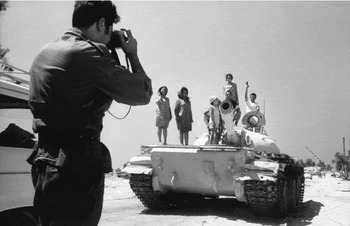
The impetus for travel into the territories was multiple. Many Jewish Israelis went as secular pilgrims to sites of biblical importance.Footnote 44 Many, particularly Ashkenazi Jews, were drawn to the West Bank's natural landscapes, often returning to routes they had enjoyed prior to 1948.Footnote 45 Having been constrained within their national borders since 1948, both pilgrims and hikers were eager to explore these newly accessible territories, reveling in their ability to cross a previously impenetrable border. Some Israelis, reveling in the euphoric victory, sought out sites of battle or the visual remains of war in the occupied landscape, and photographs taken at such sites were popular souvenirs (Figure 1). In some instances, the rush into the territories was catalyzed by a belief in the brevity of the Israeli occupation, the sense that these lands would soon be forcibly returned.Footnote 46
Israeli tourists visit Gaza battlefield after the defeat of Palestinians. Photograph by David Rubinger, 1 July 1967. Copyright Getty Images. Reprinted with permission.

Yet despite the variances in tourist agendas and imaginations, one practice reigned supreme: consumption (Figure 2).Footnote 47 Indeed, the consumer desires of Israeli travelers were meticulously documented in the press beginning in the war's immediate wake:
Irking visitors to the Old City yesterday [25 June] was the fact that they were forbidden from purchasing West Bank goods. In the bazaars behind the Damascus gate, through which thousands of tourists wound their way to reach the church of the holy sepulcher—the local populations scrupulously refused to trade against Israeli or foreign hard currency. The Jerusalem Post was the only item that could be bought with Israeli money. The magnificent figs and great variety of spices were “out of bounds” for Israelis and tourists. Mayor Kolleck promised that this tourist problem too would be shortly overcome.Footnote 48
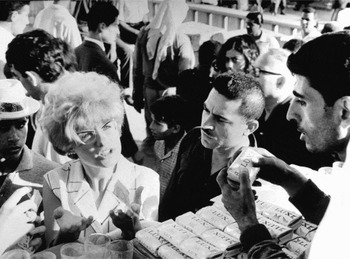
Despite the bans on consumption to which this passage alludes, and the punitive actions with which violators were threatened, the press reported shelves stripped clean of souvenirs and “cola and chocolate sold in large quantities.”Footnote 49 “Most of the tourists went shopping with a vengeance in spite of the official ban,” one paper reported on 26 June, “buying up fruit, vegetables, glassware, jars, chewing gum, and pencils with Israeli currency.”Footnote 50
Israeli tourists shopping in the newly occupied territories. Photograph by David Rubinger, 1 July 1967. Copyright Getty Images. Reprinted with permission.

Jerusalem's Old City was the initial locus of the shopping frenzy as “mass[es] of sightseers and bargain hunters surg[ed] through the narrow alleys.”Footnote 51 Yet mass consumption gradually spread to other West Bank locales as Israeli visitors “descended” on “statues, soap, and the rest”Footnote 52 in what the media referred to as a “shopping invasion.”Footnote 53 Indeed, this was an invasion in which the press actively participated; food critics documented the best place to drink European style coffee in the Old City, suggested where to buy “Indian dates” and Italian shoes,Footnote 54 and recommended restaurants in Hebron and Bethlehem, most of which were already mobbed with Israelis. “[W]hen we got to Bethlehem,” one reporter noted on 22 June, “we saw all of Dizengoff [Tel Aviv] eating hummus and pickles.”Footnote 55 Some journalists had already begun bemoaning the absence of “authentic” Arab goods in Palestinian markets such as had been available prior to 1948.Footnote 56 As one writer lamented, many of the goods available in Jerusalem's Old City had been imported from China.Footnote 57 Another speculated that Jewish shopkeepers were disguising themselves as Arabs in an effort to increase the market value of their offerings.Footnote 58
The object of Israeli consumer desire fluctuated over time. The early days of the tourist frenzy saw a run on souvenirs, culinary delights, and luxury goods. Next was the demand for the household goods and appliances that could be purchased at a fraction of their Israeli prices. “First we bought transistors, cosmetics, straw baskets, and men's shirts,” wrote one journalist, “and even English salt at a pharmacy. Today, the prices have already gone up a little, but you still won't find your friends at Israeli stores. They [West Bank stores] are still tens of percentages away from the Israeli prices.”Footnote 59 Despite the rapid rise in prices and the Israeli taxes levied on goods purchased in the territories, the rush to consume was not tempered.Footnote 60 In the middle of July, the “scope of Israeli shopping in the West Bank” was valued at 25 million liras per month.Footnote 61 Jewish merchants and sellers complained that the magnitude of Israeli purchases in the territories was devastating their profits.Footnote 62 When Gaza City opened to Israeli visitors on 21 July,Footnote 63 headlines announced that “Thirty-Five Thousand Israelis Spent a ‘Shopping Shabbat’ in Gaza.”Footnote 64 The article was vivid in its description: “The Israelis fell on the shops . . . and bought everything, almost without comprehension. The stream of buying mounted to such an extent that quickly one saw on the outskirts of town, porters traveling full of goods from the warehouses and apartments of the merchants.”Footnote 65
For some press commentators, the consumptive frenzy was a source of collective shame. “What kind of spiritual drive has pushed these men and women . . . to buy, buy, buy?” they mused. “I have no objection,” another noted, “to a population denied the right to visit certain places for twenty years. But must we descend on every shop to buy things, whether we need them or not, as if we're a country in need or in hunger?”Footnote 66 In other accounts, mass consumption was read as evidence of benign Israeli political intentions in its context as occupier:Footnote 67 “For three weeks they [‘the Arabs’] looked on as Israelis in increasing numbers flocked to [the Old City], and found them without the arrogance of conquerors, a nation of curious sightseers, and seekers of modest bargains.”Footnote 68 Consumption, in this telling, was thought to belie Palestinian fears of a repressive occupation.
As Israeli tourism in the territories rose, popular Israeli advertising began to change by integrating new tourist knowledges, desires, and consumer practices into its discourses. Royal cigarettes now employed photographs of crowded tourist sites in the occupied territories as a means of luring Israeli buyers. “This is our country,” read the copy above an image of a crowded Old City marketplace teeming with visitors, “and this is our cigarette.”Footnote 69 A similar theme structured advertisements for Click cameras, which featured tourist snapshots of the territories.Footnote 70 Such ads suggested the extent to which the West Bank had acquired widespread legibility within Israeli tourist imaginations. However, they also suggested something more: their language (“This is our country, and this is our cigarette”) explicitly conjoined practices of nation making with practices of consumption, promising Israelis that the new territories could be both enjoyed and possessed through the act of consumption (of cigarettes, cameras, etc.). In this instance, as in many others, tourism qua consumption participated in remapping the Israeli nation-state in accordance with the new cartography of the occupation.Footnote 71 One can take this argument further. In creating a quotidian investment in the territories as a tourist destination, discourses and practices of consumption effectively laid the groundwork for Israeli investments of other kinds and at other scales, namely, an investment in the occupied territories as a market for Israeli goods, as a blue-collar labor pool, and, increasingly after 1977, as a territorial extension of the nation-state in the form of Jewish settlements. In this way, discourses and practices of consumption did more than merely banalize the occupation. They worked to strengthen its hold.
PALESTINIAN TOURISTS THROUGH AN ISRAELI LENS
The tourist flows made possible by the 1967 war were not unidirectional. Rather, the occupation of the West Bank and Gaza Strip also spawned large-scale Palestinian travel from the occupied territories into Israel. Many of these itineraries retraced the route of exile, returning them to the places from which Palestinians had fled, or been expelled, during the course of the 1948 war. Many visited family from whom they had been estranged since 1948, while others returned to former homes and lands.Footnote 72 As with Israeli tourism into the territories, such flows began gradually in accordance with the lifting of the curfew on the West Bank and Gaza Strip. As late as the middle of July, residents of the West Bank were still officially banned from crossing into Israel, the bans devised to “prevent . . . [the] infiltration of residents,” save on Friday, when religious travel to Jerusalem was permitted.Footnote 73 Travel between Gaza and the West Bank was also carefully monitored and restricted during this period.Footnote 74 However, borders were porous and bans selectively enforced, and many West Bank residents made their way into Israeli cities in violation of official regulations.
Large numbers of Palestinians from the territories began to appear in West Jerusalem following the demolition of the border between the “old” and “new” cities on 29 June.Footnote 75 In the days that followed, the Israeli media documented the “many thousands of Arabs walking the New City in groups and family parties.”Footnote 76 These travelers were objects of considerable press scrutiny, and articles about them proliferated. Yet despite the state's fears of Palestinian “infiltration,” their presence in Israeli cities was usually coded as spectacle rather than as threat. One reads of the streets of West Jerusalem “thickly packed with Jews and Arabs, Moslems [sic], and Christians of the different churches, laymen and clerics, in all the varieties of garb, complexion, eye color, physiognomy, and dialect that comprise Jerusalem-United. They gawked at each other, and at one another's architecture.”Footnote 77 This account of the multicultural crowd recurred in many press narratives of the moment, narratives that glorified the occupation for catalyzing such forms of culture contact and mutual education. The following account is one such instance of this narrative, in which the author endorses incoming Arab tourism as an avenue for Israeli political education:
There are crowds of us rushing across the borders to have “a look”—can't we arrange tours for the Arabs to come and see what we've done in this country of ours? Not every Arab is a fedayeen or in el Fatah [sic]. I'm sure our school officials could pick out a busload of schoolteachers, railway clerks, engineers, shopkeepers . . . and give them a package tour of Israel . . . This will help sway the scales as against the hate propaganda fed to them.Footnote 78
This sentiment, when viewed in the context of the broader discourse in which it was situated, was rather unusual. Most stories about the incoming Arab crowd hinged on classic colonial tropes of primitivism. Newspapers were filled with stories of Arabs encountering modernity in Hebrew cities: visitors “standing in wonder before the traffic light” and amazed by “multistoried buildings.”Footnote 79 Primitivism was also enunciated through accounts of Arab consumer practices. This population, it seems, was equally engaged in the postwar rush to buy:
The Arabs of the old city have not refrained from taking advantage of the circumstances in Hebrew Jerusalem . . . [T]hey have been to the movies, to theatrical matinees, and . . . coffee houses. They are enchanted with espresso machines and the coffee they produce, rapid and steamy. In addition to the bread and challah that they are continuing to purchase in large numbers, they have also discovered cream cakes, especially chocolate cream, which aren't sold in their areas.Footnote 80
Elsewhere, one reads of Arab men in suits, conversing over coffee at West Jerusalem cafes “like it was totally normal for them to be here,”Footnote 81 of their rush on ice-cream shops,Footnote 82 and of their appearance at the Israel Museum, where they were assured that Arabic-language guides and schedules would soon be provided.Footnote 83 These stories about the Arab desire for Israeli goods, often explicitly European goods, reiterated a classic colonial narrative about a people denied Western progress and cosmopolitanism—both of which were greedily consumed by proxy in culinary form. At the same time, they highlighted the dramatic ways in which Israeli national geography was being reworked in the war's aftermath as Palestinians once prevented entry from Israel were making their way into the heart of predominantly Jewish cities.
Although largely obscured in stories about tourism and consumption, the history of the Palestinian dispossession was not entirely absent from press accounts of the postwar moment. One does read of Arab visitors returning to old neighborhoods to inquire about reacquiring property,Footnote 84 of visits to homes and businesses lost in the course of the 1948 war,Footnote 85 and of encounters with old neighbors and Jewish friends.Footnote 86 Numerous papers saw fit to interview these visitors, and what emerged was a set of rich biographical vignettes about Palestinian daily life in the postoccupation moment and the violences wrought by state formation in 1948—humanizing vignettes that wrote against the primitivizing account of “the Arab crowd.”
Yet, even these narratives were often enunciated through a tourism story line, as in the following instance:
Daoud Haj from Birzeit has a shoe store in Ramallah. Orderly, unmarried, with green eyes, he speaks English like Shakespeare . . . He came to see the views in Ramle and Tel Aviv, but he bought a lot of souvenirs: wash-and-wear shirts, shoes, and beautifully sewn skirts . . . His father lived in Lod, and his mother was born in Jaffa. Today, both of them live in Birzeit and are happy to return to Israel as tourists.Footnote 87
Although this account of Palestinian cosmopolitanism may function to unsettle the trope of Arab primitivism, it also reaffirms the trope's ahistoricist tenets, its obfuscation of the history of dispossession. By illustrating these Palestinian subjects chiefly as tourists, marked as such by their search for picturesque landscapes and souvenirs, the narrative undercuts the history of exile to which it obliquely alludes. A powerful inversion is at work here. Stories about the Arab desire to take possession of Israeli things (ice cream, cream cakes, souvenirs), functioned to displace a far more urgent Palestinian desire for possession: the desire to repossess land and territory lost in the course of the 1948 war. Through accounts of frenetic Arab consumption in the Jewish metropolis, the history of the Palestinian dispossession was being subtly overwritten, recast as a story of everyday consumer desires. In this inverted narrative, souvenirs stood in the stead of houses and wash-and-wear shirts in the place of territories. In this way, the tourist narrative functioned as an engine of both historical erasure and political obfuscation.Footnote 88
The broader point bears repeating at this juncture: tourist narratives were not merely epiphenomenal to the politics of the postwar moment. Rather, as the instance above suggests, the media's stories about everyday tourist practices, consumer desires, and leisure pursuits often functioned to secure and advance the terms of Israeli state policy and ideology—but in a seemingly banal, cultural guise.
ITINERARIES OF INCURSION
Consider, by way of introduction to my second case study, the following press report from 23 June 1982. Published in the popular Hebrew-language daily Yediot Aharonot,Footnote 89 this report circulated in the Israeli media as the Israel Defense Forces (IDF) jet bombardment of Beirut continued, as civilian casualties in the Lebanese capital rose, as the price of food mounted, and as uncollected garbage accumulated in the city:
Whoever visited Cairo in the first days after the signing of the peace accords has already identified a similar phenomenon in Beirut . . . The Israelis have already found the local restaurants, the Lebanon casino, the happenings in the south of the city and the souvenir shops. In many places, it's hard to distinguish between locals and Israelis.Footnote 90
If this account is to be believed, and my interviews with Israeli soldiers who served in Lebanon corroborate, the Israeli invasion was already taking touristic or consumer forms some two weeks after its start on 6 June 1982. In addition to their formal work in army uniform, Israeli soldiers were already navigating the Lebanese capital in the guise of the consumer–traveler.Footnote 91
The article cited above was by no means an isolated account. In the early days of the incursion, numerous Israeli newspapers departed from their standard reporting to describe Israeli army personnel enjoying espresso and ice cream in late-night Beirut venues.Footnote 92 They chronicled Israeli soldiers enthusiastically shopping in the open markets of the city (“the hit, of course, are cherries which are available in abundance”),Footnote 93 playing backgammon (sheshbesh) in cafes with members of Maronite militia,Footnote 94 and frequenting the popular urban nightclubs that “have already become routine for many soldiers in the Beirut area.”Footnote 95 “Where,” one Israeli journalist mused satirically, “do you put your gun when dancing with a local girl?”Footnote 96 The celebrated restaurants of Beirut were particularly favored by Israel's army and thus frequently covered by the Israeli print media. “Two days ago, we heard about a new restaurant for Eastern food,” read a front-page article from 17 June, under the heading “Israeli Soldiers Feel at Home”:
The restaurant was far from the house. There was terrible traffic and it was a difficult route but when we got there we weren't disappointed. It was worth every penny. We found it in Ein Sada in south-eastern Beirut. The place is called “Ameel” and adorned with a sign that reads “Eastern Cooking,” as if there was an alternative. Quite glorious, overlooking a main route. . . . Call 970378 to reserve a place.Footnote 97
This account dwells on details pertinent to the tourist, such as the restaurant's pleasant view and phone number. Indeed, its fidelity to the genre of the tourist guide continues in the article's remainder with discussion of the meal's content, the quality of service received, and its affordability (“To guests from Israel, there's a discount—four Lebanese shekels a person”). Here, as in other stories like it, there is an almost comic disregard for the broader military context that brings the Israeli “consumer” to Beirut.Footnote 98
Many media portraits of the Israeli soldier–consumer in Lebanon pivoted on the trope of Lebanese hospitality. Readers of the Israeli press were privy, for example, to images of “Beirut residents [who had] invited an Israeli solider for a picnic and glass of Araq” and of “Lebanese citizens and Israeli soldiers [dining] alongside one another in a Beirut restaurant.”Footnote 99 Rehearsing a classic colonial story line, the trope of Lebanese hospitality retold the Israeli incursion as a story of Israeli guests and Lebanese hosts within a context stripped of power. The discourse of hospitality replaced the scene of violent occupation with a fiction of mutual consumption and pleasure.
The fictional nature of these media accounts also extended to their portrayals of the Israeli army. Newspaper stories largely failed to account for racial or ethnic differences within the Israeli army population, coding it only as “Israeli.” Little if any mention was made of the heavy presence of Mizrahi soldiers within the invading army and, later, of the large proportion of Mizhrahim among Israeli wartime fatalities,Footnote 100 nor did newspapers hint at the ways that the consumer practices of Israeli soldiers might resonate differently in a Mizrahi context among a soldier population who once called the Arab world home.Footnote 101 In the absence of these racial demographics, the tourist story line advanced the fiction of Israel as a homogenously European nation-state whose encounter with the Arab world on the Lebanese battlefield qua marketplace was an experience of cultural alterity, an encounter with cultural difference.
WARTIME TRAVELOGUES
The story of the Israeli soldier as tourist or consumer also rested on the media's deployment of a particular set of narrative techniques, namely, the iconic narrative structures and visual logics of the travelogue. Newspaper portraits of Lebanon during wartime, particularly portraits of its rural landscapes, frequently inhabited this genre, relying on stock images and vocabularies of the picturesque.Footnote 102 A lengthy feature in a popular Israeli daily newspaper described, for example, soldiers swimming in the sea, “romantic views,” “nudist beaches,” and stretches of seaside whose beauty “remind one of Highway 1 between San Francisco and Los Angeles,” the latter image borrowed from the literary subgenre of the “road trip.”Footnote 103 Indeed, the press of this period was replete with breathtaking vistas, “orchards and vineyards,”Footnote 104 valleys and waterfalls, and images of “soldiers splashing in the waters of the Litani River or setting out picnics on their banks.”Footnote 105 Yet, in a departure from the genre from which it borrowed, the media tended to portray these landscapes as something of a conceptual problem. “Lebanon the Beautiful: What's War Doing Here?”Footnote 106 queried a headline from late June. “IDF soldiers discovered amazing views before their eyes in the battles of Lebanon,” the article read, “and [the soldiers] often asked themselves, what is war doing in such a beautiful area?”
This discourse of surprise merits some attention because it was frequently enunciated within the media's modified travelogue genre. At times, as in the previous quote, surprise was enunciated as a response to the simultaneity of war and the picturesque. More often, however, it coalesced around the simultaneity of landscape aesthetics and Arab culture—that is, around the seemingly confounding coupling of beauty and Arabness. For many Israeli journalists, Beirut's cosmopolitanism cityscape, with its manifest wealth and high culture, was particularly vexing in this regard. Indeed, it generated something of a category error: “Many of the residents [of Beirut] seem European in all regards, and one feels that we aren't even talking about an Arab country . . . there are neighborhoods that one wouldn't be ashamed of in Los Angeles.”Footnote 107 The category error was often repaired through recourse to analogy, that is, by likening Lebanon to non-Arab places. “Beirut, the Paris of the Middle East,” wrote one journalist of the period in a typical instance, “is a larger and lovelier version of Haifa. Steep slopes, curving high trees, wide roads, noisy traffic . . .” Another article solved the problem of the Lebanese pastoral with the following heading: “As in Switzerland.”Footnote 108 Although these analogies were not unique to the Israeli national imagination, their enunciation in the Israeli media of this period resonated with Israeli politics of the moment in highly particular ways. Analogy resolved the seeming paradox of the Lebanese picturesque (in the rural instance) and cosmopolitanism (in the urban case). At the same time, the substitution of European place names for Lebanese ones (e.g., “As in Switzerland”) conveniently turned Israeli public attention away from the geography of occupation and its attendant violence.
THE LEBANESE CONSUMER
As in the 1967 instance, the Israeli print media of this period also applied the trope of the tourist–consumer to the occupied population. Yet unlike the former instance, in which stories about the Palestinian desire to consume were tethered to a discourse of Palestinian premodern lack, the figure of the Lebanese consumer inhabited the other end of the Orientalist spectrum: that of indulgence and excess. Consider, for example, the following description of Beirut's pleasure seekers:
The grasp on the good life is the secret of every Lebanese, of every resident of Beirut. From the first glimpse, you get the impression of a delightfully self-satisfied population, driving fabulous cars with wild abandon . . . [a population] who knows where to feast in the afternoon, when to go the video parlor, or [how] to send the girls [sic] out, in groups of three or four, to wander around fearlessly before . . . the disco.Footnote 109
The paragraphs that follow describe picnics in the woods near Beirut, replete with beer and arak, and Lebanese dining at fine French restaurants. As with the use of analogy, these accounts of local extravagance (cars driven in wild abandon, frenzied and “self-satisfied” consumption) resolved the seeming paradox posed by Lebanese cosmopolitanism by rerouting it through familiar Orientalist tropes of Arab decadence.
This narrative about Lebanese decadence depended on a companion story line about Israeli tourist–consumers learning the art of urban pleasures from their Lebanese hosts—a theme enunciated clearly in the headline of the article cited previously: “IDF Soldiers in Beirut Study the Secrets of the Good Life.” “From the moment you see the Israeli soldiers and the officers in the evening hours at the restaurants and the expensive clubs,” another article read, “you fear that perhaps the fighters will quickly become accustomed to the pleasures of the place.”Footnote 110 Here, the decadent propensities of Israeli soldiers, their drive to consume and enjoy, are configured as learned practices, with locals represented as their willing instructors. Israeli pleasures, in this rendition, merely mimic Lebanese ones. Such stories should be taken seriously for their latent political content. These images of learned Israeli decadence figured the Israeli invasion and occupation of Lebanon as an instance of allure. They portrayed the war as a theater not of violence but of seduction, with the Israeli army in the irresistible clutches of Lebanon's pleasure principle. While the tourist–consumer narrative as deployed in the 1967 context functioned to normalize the Israeli military occupation, these stories did something more: in addition to obscuring the facts of a violent incursion, they cast the Israeli army as its unwitting victim.
It can be argued that the recurrence of the 1982 leisure narrative in its various forms was merely one instance of the limits of Israeli press coverage of the invasion and subsequent occupation. In the first month, such coverage was constrained not merely by the Israeli political consensus, but also by the Israeli censor, which attempted to prevent a public record of Israeli killing and devastation from reaching the Israeli and international public.Footnote 111 As the Israeli government was keenly aware, the second front in the Lebanon war was that of information itself. Israel's invasion had produced a fierce “battle over the truth,” as Prime Minister Begin noted at the time—a struggle over the numbers of Lebanese and Palestinian dead and wounded, waged between the Israeli government and the Lebanese authorities, on the one hand, and the Israeli and international media, on the other.Footnote 112 Such battles included efforts by the Israeli censor to intercept damning television footage from foreign crews, insistence by the army spokesman on the small numbers of Lebanese and Palestinian causalities, and the enduring media accounts of Palestinian terror, with refugees as the guilty party.Footnote 113 Stories about tourism colluded with such censorship practices by focusing the national lens on the seeming benign domain of cultural practice.
TOURISM AS “ANTI-CONQUEST”
As I suggested from the outset, these historical cases are by no means identical. Neither their forms of tourism nor military occupations are equivalent. Yet read together, they underscore the complicated ways in which leisure and militarism have been intertwined in Israeli history, even as they suggest linkages between tourism and war that exceed the particulars of the Israeli case. In both historical contexts, the media narrative about tourism and consumption in the midst of occupation can be understood as a kind of translation apparatus—that is, a means of translating the landscape of war and its aftermath into an everyday lexicon. Tourist practices, imaginations, and narratives enabled Jewish Israelis to understand military occupation in prosaic terms. Indeed, media narratives enabled readers of the newspaper to reconceptualize these occupations in popular cultural terms. Accounts of Israeli tourism and leisure in the Israeli media of the time can often be read as political surrogates that stood in place of other things. Stories about tourism, consumption, and the picturesque functioned to obscure a set of political accounts with far more damning consequences, namely, accounts of incursion, occupation, the political interests that subtend them, and the forms of repression and destruction that they wrought.
Of course as a translation apparatus, tourism was not without ideological content or political effects. Rather, tourism as translation also functioned as a political alibi that actively obfuscated scenes of military violence. In both historical cases, leisure narratives and acts provided a means of recasting incursion and occupation in not merely nonviolent but positively pleasurable terms, rewriting them as experiences of collective sightseeing. Tourism can thus be read as what postcolonial scholar Mary Pratt calls a tactic of “anti-conquest”—that is, a discourse or field of practices that participates in the work of colonialism through a manifest rejection of the rhetoric of subjugation. As Pratt suggests, anticonquest narratives favor tropes of benign intervention over those of violent incursion, therein making violence possible through its obfuscation.Footnote 114
Translation, in this construal, is not a passive narrative mode without real political effects. As a mode of anticonquest, tourist narratives were actively involved in the work of sustaining both of these military occupations by turning public attention away from their attendant violence and toward their (consumer) rewards. Such narratives functioned by proxy, whereby the goods and satisfaction reaped by tourists stood in for the political gains reaped (or so some Israelis argued) by military incursion and occupation. By advancing a story about the pleasures that these occupations afforded minus the profound damages and violence they wrought, these accounts helped to foster a public Israeli investment in their perpetuation.
A cognizance of multiple erasure on which these media narratives depended is crucial in assessing both their political effects and the epistemic violence that they enacted. The 1967 press accounts make little mention, for example, of the effects of Israel's conquest on local populations, of the status of Palestinian refugee populations, of the political debates surrounding the question of a Greater Israel—issues that were beginning to take shape within the Israeli press of this period and were being actively discussed within progressive Israeli circles.Footnote 115
The Lebanese case is similar. As stories of tourism and tropes of the picturesque circulated in the Israeli media in June and early July 1982, the international press was drawing the attention of readers to the vivid landscape of war. They described scenes of desolation in Sidon, Tyre, and Damur; hospitals overwhelmed with the sight and smell of the dying in West Beirut; and tens of thousands of Palestinian and Lebanese refugees streaming west to Baalbek. These and other images of the violence wrought by the Israeli incursion were largely invisible within the tourist narrative despite the growing audibility of dissent within Israel, peaking in the aftermath of the massacres at Sabra and Shatila.Footnote 116
At the same time, both narratives were premised on a set of missing populations. More to the point, they were premised on their very partial account of the Israelis in question. Subtending both was often a presumption about a homogenous Jewish state, composed strictly of European Jews, for whom the foray into Arab places as a soldier or tourist–consumer meant an encounter with cultural alterity. Needless to say, the erasure of both Mizrahim and Palestinians with Israeli citizenship within these tourist narratives was the rule rather than the exception within the left-Zionist press of the period. Yet, its recurrence in tourist representations is crucial, pointing to the need to take them seriously not only as sites of ideological production regarding the occupations in question but also as normative discourses that worked to fortify and reproduce hegemonic national categories. To linger on these missing scenes and populations is to insist that the violence of these occupations also rested in the very practice of erasure—that is, in the removal of either damning or counterhegemonic scenes, subjects, and histories from the story that dominant Israeli culture told about itself during these military episodes. As postcolonial scholars would argue, the labor of erasure was not merely a secondary effect of these occupations but was also crucial to their perpetuation.
The links between tourism and occupation in the Israeli context greatly exceed the cases and narrative forms examined here. Rather, the tourist crowds that followed in the wake of Israel's euphoric victory in 1967 were merely the first indication of the ways that Israelis would mine the military occupation for leisure purposes, a social phenomena that continued and grew in strength in subsequent decades. The catalogue of such instances is too numerous to document here, but it includes the establishment of field schools in the occupied territories catering to Israeli “nature lovers”Footnote 117; hikes and nature walks (tiyulim) conducted in these territories as a means of laying claim to landFootnote 118; the establishment of tourist facilities within Jewish settlements that helped bolster their infrastructure, build their economies, and stabilize the cartography of “Greater Israel”Footnote 119; the use of tourist development and discourses to renationalize East Jerusalem, remaking it as (in the words of the Israeli Ministry of Tourism) an “Israeli” place.Footnote 120 These tourist practices and institutions have also had numerous analogues within the Green Line in the ways that Palestinian places within Israel's borders have been remade by state and private institutions as tourist facilities that cater to Jewish Israeli clientele—a phenomenon I have studied elsewhere in detail.Footnote 121 All of these instances, however dissimilar, suggest the need to take Israeli tourism seriously as a complex political domain in which dominant national interests are both fortified and advanced.Footnote 122
In part, this essay is an attempt to intervene into prevailing scholarship on Israeli militarism and military history by turning attention away from matters of diplomacy and warfare and toward everyday cultural practices, discourses, and imaginations. The latter might help us to complicate the ways we have traditionally conceptualized these military contexts, determined their parameters, and evaluated their effects. My turn to tourism—or, in broader terms, to popular culture—provides one way to reassess militarism from below, in this case from the vantage of both the mainstream media and of the civilians and soldiers who both carried out the state's military orders and enjoyed the fruits of its victory. Rather than viewing popular culture as merely epiphenomenal to the workings of state politics as has much scholarship in Israeli and Palestinian studies, this essay suggests the deeply political meanings and effects that popular culture can generate.Footnote 123
Read together, these cases suggest a need to expand our sense of military occupation by considering how everyday cultural practices and discourses can supplement the formal work of the Israeli army. Together, they enable us to reconceptualize the contours of state violence, to consider how a body of seemingly banal cultural practices (restaurant going, touring, sightseeing) can function as appendages of occupation.