I. INTRODUCTION
Silicon carbide (SiC) particulate reinforced aluminum matrix composites (PRAMCs) are attractive as structural materials in aerospace and automobile applications due mainly to their high stiffness, high specific strength, and low density.Reference Bains, Sidhu and Payal1–Reference Rohatgi, Asthana and Das3 As one of the most successfully used methods for the fabrication of PRAMCs, powder metallurgy (P/M) shows prominent advantages over other techniques due to the relatively low processing temperature that may avoid undesired interfacial reactions between the particle/matrix interface, the uniform distribution of reinforcements, and the flexible design of constituents.Reference Torralba, Costa and Velasco4 However, numerous voids are inevitably involved in the resulting composites in addition to the long preparation time. Besides, it is difficult to fabricate the components with large size and/or complex shapes utilizing P/M. The powder thixoforming technique, a development based on P/M, is a novel semisolid processing technique for PRAMC fabrication.Reference Li, Chen and Qin5–Reference Zhang, Chen and Qin7 During this process, the material undergoes the initial blending and pressing of powder mixtures inherited from P/M, subsequent partial remelting and ultimate forming under pressure from thixoforming, which leads to a highly dense composite component and uniformly dispersed reinforcements.Reference Chen, Qin and Zhang8,Reference Qin, Chen, Wang, Zhang and Li9 Moreover, the volume fraction of reinforcements can be easily regulated and components with large size or/and complex shape be easily obtained.Reference Li, Chen and Qin5 To date, powder thixoforming has been successfully applied to produce SiCp/2024 Al,Reference Li, Chen and Qin5,Reference Li, Chen and Qin6 SiCp/6061 Al,Reference Zhang, Chen and Qin7,Reference Zhang, Chen, Qin and Wang10 Al3Tip/A356 Al,Reference Chen, Qin and Zhang8,Reference Wang, Chen, Zhang, Qin and Zhang11,Reference Chen, Gao and Tong12 and Al3Tip/2024 AlReference Qin, Chen, Wang, Zhang and Li9 based composites, which all exhibit excellent tensile properties. For instance, the as-fabricated SiCp/2024 Al composite shows a high ultimate tensile strength (UTS) of 379 MPa with an increment of 26.3% as compared to that of the matrix alloy.Reference Li, Chen and Qin6 Similarly, the UTS of the as-fabricated SiCp/6061 Al composite increases by 27.8% to 230 MPa.Reference Zhang, Chen and Qin7 However, just like other ceramic PRAMCs, the corresponding tensile elongations (TEs) are severely impaired from 10.4% to 8.0% of 2024 and 6061 matrix alloys to 4.0% and 2.6% of the SiCp/2024 Al and SiCp/6061 Al composites, respectively,Reference Li, Chen and Qin6,Reference Zhang, Chen and Qin7 which block its wide applications in engineering. To increase the ductility of the composites, numerous efforts like reducing the size, homogenizing the distribution, and spheroidizing the shapes of the reinforcements are applied,Reference Liu, Qin, Zhang and Naka13–Reference Liu and Zhang15 but these methods are generally costly and sometimes unrealistic in addition to the limited toughening effect.Reference Lloyd16
Solution treatment, as a precursor of aging treatment, is an economical and practical method to improve the ductility of PRAMCs due to the enhanced composite deformation coordination resulting from the reduced volume fraction of hard and brittle eutectic phases in the matrix. Song et al. found that by elevating solution temperature or prolonging solution duration, the tensile ductility of the SiC/Al composite can be improved with reducing the volume fraction of second-phase constituents.Reference Song and Huang17 Likewise, the authors have reported the effectiveness of solution treatment in enhancing the TE of SiCp/6061 Al composites by modifying the composite matrix.Reference Zhang, Chen and Qin7 However, a thorough understanding on the toughening mechanisms brought about by solution treatment is still lacking. As an extension of previous work, this paper is dedicated to provide a deep insight into the toughening mechanisms of the solution-treated SiCp/6061 Al composites fabricated by powder thixoforming, by examining the composite microstructure and calculating the composite’s total strain to failure (SF), which agrees reasonably well with the experimental values.
II. EXPERIMENTAL PROCEDURES
A. Materials preparation
The starting materials used in this work were atomized 6061 alloy powders (17.91 μm) and SiCp (6.94 μm). The obtained 6061 alloy complies with the nominal composition of Al–(0.8–1.2%)Mg–(0.4–0.8%)Si–(0.15–0.4%)Cu–0.7%Fe–0.25%Zn–(0.04–0.35%)Cr–(0.15%)Ti (all in weight fraction). The as-received SiCp were pre-oxidized in air at 1273 K for 8 h to form SiO2 thin films on the surface so as to improve the wettability between the SiCp and Al matrix.Reference Sharifi, Enayati and Karimzadeh18 The details for preparation of the composite can be found in Ref. Reference Zhang, Chen, Qin and Wang10. To study the effect of pre-oxidization on the interfacial reaction product, the same processing was applied to fabricate the unoxidized SiCp/6061 Al composite utilizing the as-received SiCp and Al alloy powder. A similar process without powder mixing and ball milling was also used to produce the 6061 alloy samples for comparison.
B. Microstructure characterization
Note that the reaction product of Al4C3 at the SiC/Al interface is extremely sensitive to water through the reaction belowReference Lu, Dahle and Stjohn19,Reference Chen, Ma, Lv, Li and Hao20 :
 $${\rm{A}}{{\rm{l}}_4}{{\rm{C}}_3} + 12{{\rm{H}}_2}{\rm{O}} \to 4{\rm{Al}}{\left( {{\rm{OH}}} \right)_3} + 3{\rm{C}}{{\rm{H}}_4}\quad .$$
Thus, to study the effect of pre-oxidization on the reaction products of the SiC/Al interface, specimens cut from the oxidized and unoxidized SiCp/6061 Al composites were not polished and merely finished by metallographic abrasive paper, during which their contact with water can be avoided. For the rest of microstructure examinations, standard preparation procedures were utilized to obtain the metallographic samples.Reference Zhang, Chen, Qin and Wang10 The microstructures of all the samples were observed by using an Quanta FEI 450 scanning electron microscope (SEM; FEI, Hillsboro, Oregon) equipped with an energy dispersive spectroscope (EDS) and a Nikon MeF3 optical microscope (OM; Nikon Instruments, Shanghai, China). Image-Pro Plus 6.0 software (Media Cybernetics Company, Silver Spring, Maryland) was used to measure the average grain size of the composites, which were conducted on a minimum of five OM images with 500× magnification. The phase detection was implemented on a D/MAX-2400 X-ray diffraction (XRD) analyzer (Rigaku, Tokyo, Japan).
To quantitatively investigate the SiCp distribution in the matrix of the SiCp/6061 Al composite (referring to the oxidized SiCp/6061 Al composite in the following parts if not otherwise stated), a statistical method named quadrat methodReference Sabirov, Kolednik, Valiev and Pippan21 for analyzing spatial dispersions was utilized. The micrographs to be examined was divided into numerous square cells (quadrats) and the number of reinforcement particles in each quadrat, N q, was measured. Then the skewness (β) of the N q distribution can be calculated through the following equationReference Tzamtzis, Barekar, Babu, Patel, Dhindaw and Fan22:
 $$\beta = {q \over {\left( {q - 1} \right)\left( {q - 2} \right)}}\mathop {\sum {{{\left( {{{{N_{qi}} - N_q^{{\rm{mean}}}} \over D}} \right)}^3}} }\nolimits \quad ,$$
where q is the overall amount of investigated quadrats, N qi is the amount of particles in the ith quadrat (i = 1,2,…,q),  $N_q^{{\rm{mean}}}$ denotes the mean amount of particles in each quadrat, and D represents the standard deviation of the N q distribution. In accordance with an early study,Reference Karnezis, Durrant and Cantor23 a reduction in skewness indicates an increase in the uniformity of reinforcement particles. The quadrat method was carried out on ten SEM micrographs with a magnification of 1000×, which were taken at different areas of each sample. A 36-quadrat grid covering an area of 786 × 786 pixels in size was placed on the studied micrographs, the quadrat side being 38.4 μm (131 pixels). To eliminate edge effects, SiCp merely inside and in touch with the top and right side of each quadrat were counted.
C. Solution treatment and tensile testing
The two kinds of materials (oxidized SiCp/6061 Al composite and 6061 Al matrix) were solution-treated in a resistance furnace at 808 K for different durations ranging from 0 to 24 h, which was followed by quick water quenching. The samples for tensile testing were then machined into dog-bone-shaped tensile specimens having gauge lengths of 10 mm and cross sections of 2.5 × 1.2 mm and were tested in a WDW-100D universal material testing machine (Jinan HengXu Testing Machine Technology Co., Ltd., Jinan, China) at a constant strain rate of 0.5 mm/s. The yield strength (YS) was determined at the 0.2% strain. The total SF (εf) of the composite was determined by εf = ln(A 0/A f), where A 0 is the initial cross section area and A f is the cross section area at fracture. A minimum of five tests were averaged for each material. The fracture surfaces of the tensile specimens after tensile testing were also studied using the same SEM.
III. RESULTS AND DISCUSSION
A. Microstructure evolution
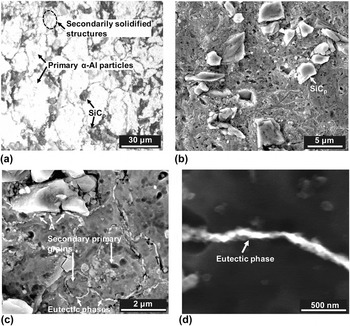
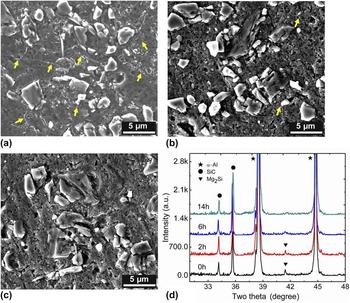
The microstructure evolution in the process of solution treatment is first investigated. Figures 1(a) and 1(b) show the as-fabricated OM and SEM microstructures of the synthesized composite, which consists of SiCp, primary α-Al particles with a mean size of 16.51 μm and intergranular secondarily solidified structures. The secondarily solidified structures are composed of secondary primary grains and surrounded eutectic phases [Fig. 1(c)]. The skeleton-shaped eutectic phases lying along the grain boundaries consist of α-Al, Mg2Si and Si phasesReference Belov, Eskin and Aksenov24 [Fig. 1(d)]. Note that there are a certain amount of eutectic phases located at or close to the SiC/Al interface [marked by arrows labeled A in Fig. 1(c)]. During the fabrication process, the liquid phase resulting from semisolid partial remelting of primary α-Al particles enwraps the SiCp and a part of eutectic phases would precipitate around the SiCp in the subsequent thixoforging and solidification process.Reference Li, Chen and Qin5 Solutonization of the composites at 808 K for different durations gradually dissolves the eutectic phases into the matrix alloy [Figs. 2(a)–2(c)], especially those lying at the SiC/Al interface with only a considerably small number of eutectic phases being left after 6 h of solutionization [Fig. 2(d)]. Besides, both the primary α-Al particles and secondary primary grains gradually get coarsened with prolonging the solution time.Reference Zhang, Chen and Qin7
(a) OM and (b) SEM images of the as-fabricated SiCp/6061 Al composite, (c) SEM image showing the constituents of secondarily solidified structures, and (d) enlarged SEM morphology of eutectic phases.

SEM images of the SiCp/6061 Al composites solutionized at 808 K for (a) 2 h, (b) 6 h, and (c) 14 h. The arrows indicate the presence of eutectic phases in the composites. (d) XRD patterns of SiCp/6061 Al composites as a function of solution time.

B. Tensile properties
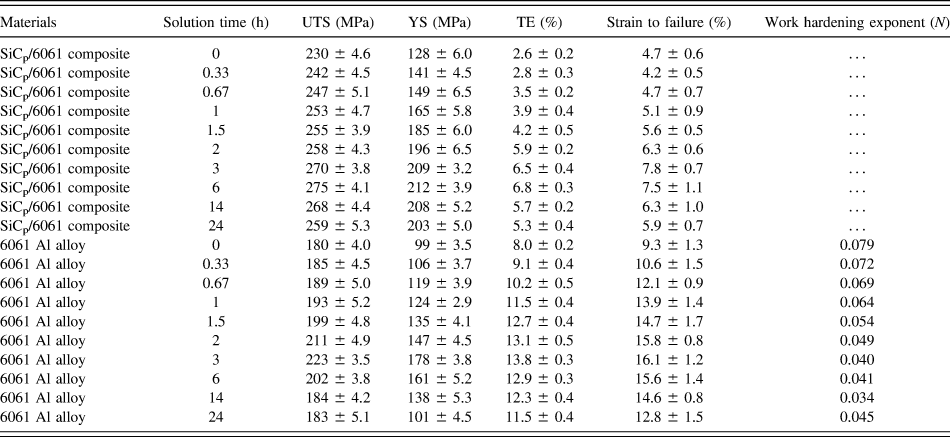
Table I lists the tensile properties of the SiCp/6061 Al composites as a function of solution time. For reference, the case of the 6061 matrix alloy was also included. Comparison of these two materials in the as-fabricated state indicates that the addition of SiCp improves the UTS and YS of the composite obviously with respective increments of 27.8% and 29.3% over those of the matrix alloy but impairs the TE with a reduction of 67.5%. The enhancement in tensile strength and the reduction in TE due to the SiCp addition are consistent well with the existing reports on similar PRAMCs.Reference Wang, Tan, Sun, Scudino, Prashanth, Zhang, Li and Eckert25–Reference Xue, Shen, Ni, Song and Xiao27 Solutionization of the composite at 808 K first increases and then slightly decreases the tensile properties with solution time, and the UTS, YS, and TE increase by 19.6%, 65.2%, and 161.5% than those of the as-fabricated one to 275 MPa, 212 MPa, and 6.8% at peak stage (6 h), respectively. By contrast, the tensile properties of the matrix alloy increase by 23.9%, 79.8%, and 72.5% to 223 MPa, 178 MPa, and 13.8% for UTS, YS, and TE at peak stage (3 h), respectively.
Experimental tensile properties of the SiCp/6061 Al composite and 6061 matrix alloy solutionized at 808 K for different durations.

The variations of the composite tensile strength with solution time can be ascribed to the co-effects of load transferring mechanism, solid solution strengthening, grain refinement strengthening, thermal mismatch, and geometrically necessary dislocation strengthening, as well as a neglected effect of Orowan strengthening.Reference Zhang, Chen and Qin7 Besides, it is found that suitable solution treatment could compensate the elongation loss of the composite to a value close to that of the as-fabricated matrix alloy. The toughening mechanisms of the SiCp/6061 Al composite brought about by solution treatment are thus examined in what follows.
C. Toughening mechanisms
1. Pre-oxidization of SiCp
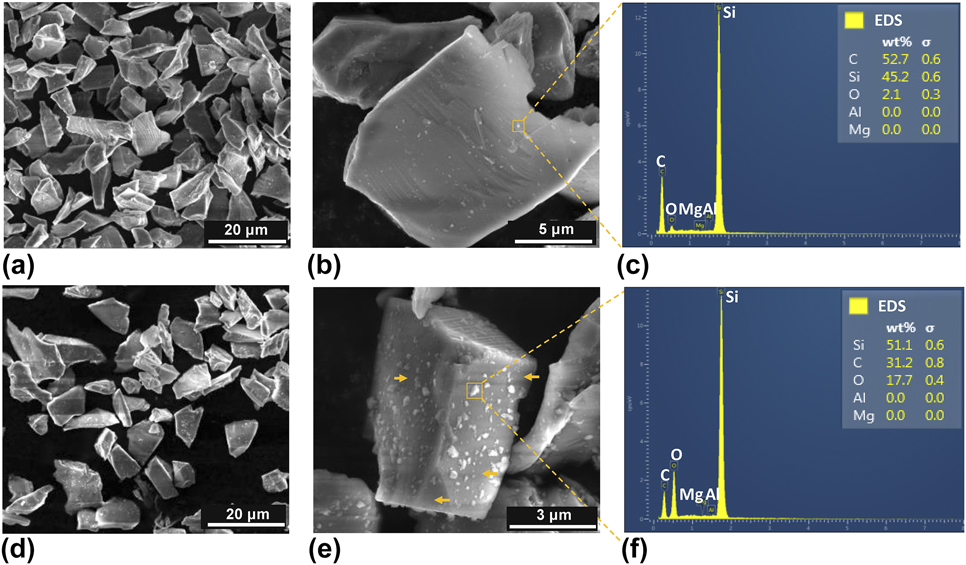
The key to the improvement of composite’s TE rests on the structure, chemistry, and the nature of SiC/Al bonding interfaces,Reference Lloyd16 thus the effect of pre-oxidization on the interfacial reaction of the SiCp/6061 Al composite is first verified. Figure 3(a) shows the SEM morphologies of unoxidized SiCp, which appears faceted and angular. There are a small number of spot-like particles on their surfaces [Fig. 3(b)], which are identified as SiO2 particles with reference to the EDS results [Fig. 3(c)]. These small SiO2 particles should generate during the fabrication process of SiCp. After being oxidized at 1273 K in air for 8 h, the amount and dimension (∼200 nm) of SiO2 particles get significantly increased on the SiCp surface [Figs. 3(d)–3(f)]. Note that the oxygen content on the rest parts except the white particles (indicated by arrows) is also increased, from nearly zero (unoxidized) to 3.5 wt% (oxidized), which suggests the formation of a thin SiO2 film throughout the surface, in addition to the visible SiO2 particles. It is reported that the thickness of SiO2 films on SiCp oxidized in air at 1373 K for 6 h was approximately 100 nm.Reference Lee, Lee, Ahn, Shim and Shi28 So there is a possibility that the thickness of the SiO2 film by oxidizing SiCp at 1273 K for 8 h be around 100 nm in this work.
(a) SEM morphology of the unoxidized SiCp, (b) magnified image showing the details of the unoxidized SiCp surface, (c) EDS spot analysis of the white spot on the surface, (d) SEM morphology of the oxidized SiCp, (e) magnified image showing the details of the oxidized SiCp surface, and (f) EDS spot analysis of the white spot on the surface.

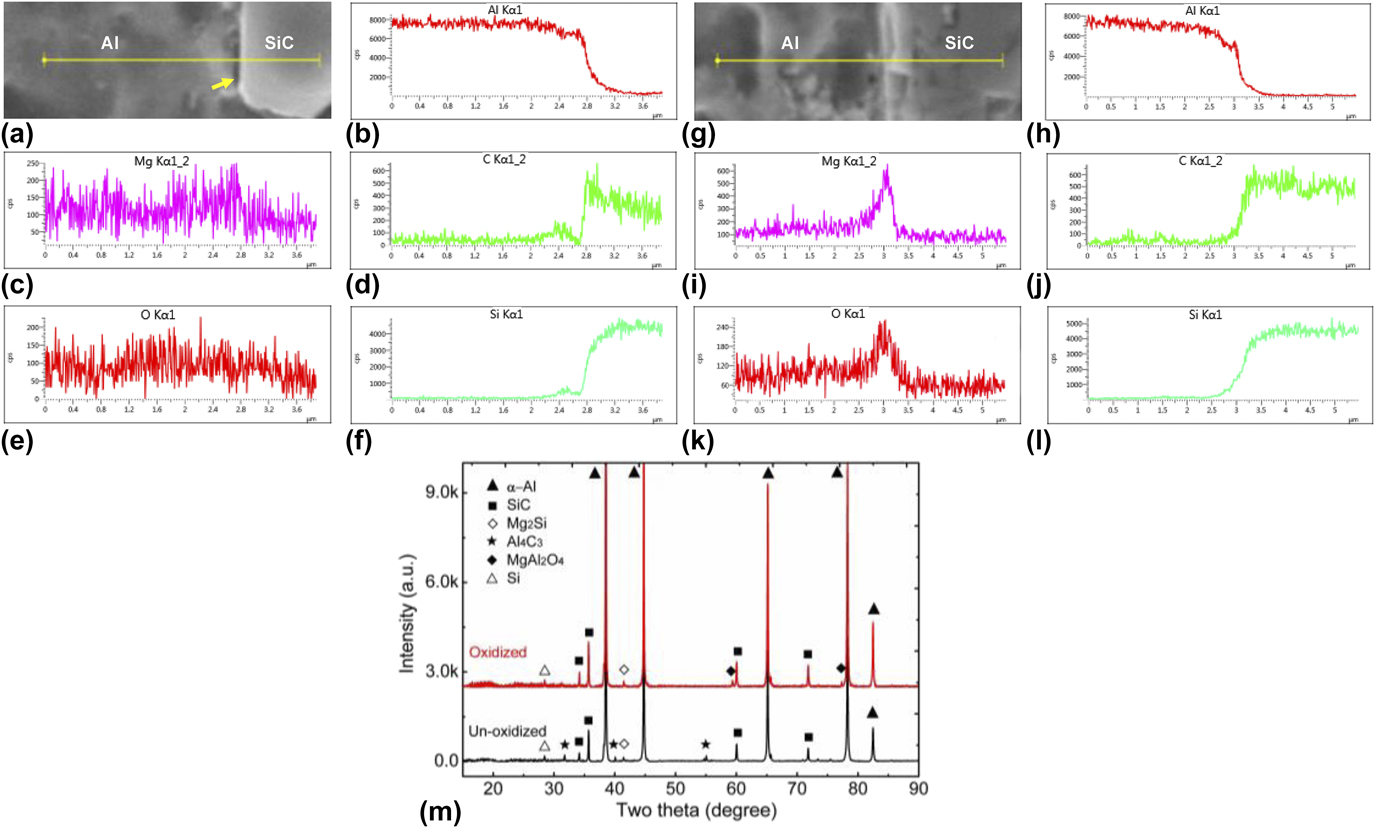
The reaction products at the SiC/Al interface in the oxidized and unoxidized SiCp/Al composites are studied in what follows. As shown in Figs. 4(a)–4(f), the EDS line scanning analysis suggests the enrichment of C, Si (and likely Al) elements at the unoxidized SiC/Al interface, which should form through the chemical reactionReference Lee, Byun, Park and Lee29,Reference Cai, Chen and Zhang30
 $$4{\rm{Al}}\left( {\rm{l}} \right) + 3{\rm{SiC}}\left( {\rm{s}} \right) \to {\rm{A}}{{\rm{l}}_4}{{\rm{C}}_3}\left( {\rm{s}} \right) + 3{\rm{Si}}\left( {\rm{s}} \right)\quad .$$
(a) SEM micrograph of the unoxidized SiCp/6061 Al composite, (b–f) corresponding EDS line scanning analysis of the SiC/Al interface, (g) SEM micrograph of the oxidized SiCp/6061 Al composite, (h–l) corresponding EDS line scanning analysis of the SiC/Al interface, and (m) XRD patterns of unoxidized and oxidized SiCp/6061 Al composites.

Since Al4C3 obtains a free energy of formation from per mole of carbon as well as a thermal stability comparable to that of SiC.Reference Mitra, Rao, Maiti and Chakraborty31 The presence of Al4C3 phase in the unoxidized SiCp/6061 Al composite [marked by arrow in Fig. 4(a)] could be further evidenced by the corresponding XRD pattern, as shown in Fig. 4(m). This result is in good agreement with previous reports on similar unoxidized SiC PRAMCs.Reference Cai, Chen and Zhang30,Reference El-Sabbagh, Soliman, Taha and Palkowski32 The Al4C3 phase is considerably brittle and unstable,Reference Sharifi, Enayati and Karimzadeh18 especially easy to fracture during tensile testing and thus would severely degrade the comprehensive mechanical properties of the composite.Reference Sharifi, Enayati and Karimzadeh18,Reference Mitra, Rao, Maiti and Chakraborty31 Besides, the hydrophilic nature of this phase makes the composite very sensitive to corrosive environments.Reference Lloyd, Lagace, Mcleod and Morris33 Hence, the formation of the Al4C3 phase should be avoided during the fabrication process.
When the SiO2 film is coated on the surface of the SiCp which have been oxidized, the content of C element at the SiC/Al interface is greatly decreased, while those of Mg, O (and possibly Al) elements are distinctly increased [Figs. 4(g)–4(l)], indicating that the formation of the Al4C3 phase might be suppressed and some new phases containing Mg, O, and/or Al elements may form at the oxidized SiCp/6061 Al interface. It is proposed that Al could react with SiO2 to form Al2O3 through the following reaction:
 $$4{\rm{Al}}\left( {\rm{l}} \right) + 3{\rm{Si}}{{\rm{O}}_2}\left( {\rm{s}} \right) \to 2{\rm{A}}{{\rm{l}}_2}{{\rm{O}}_3}\left( {\rm{s}} \right) + 3{\rm{Si}}\left( {\rm{s}} \right)\quad .$$
Besides, when Mg element exists in the composite, Mg is likely to attack the SiO2 to form MgOReference Shi, Yang, Lee, Zhang, Lee and Wu34:
 $$4{\rm{Mg}}\left( {\rm{l}} \right) + {\rm{Si}}{{\rm{O}}_2}\left( {\rm{s}} \right) \to 2{\rm{MgO}}\left( {\rm{s}} \right) + {\rm{M}}{{\rm{g}}_2}{\rm{Si}}\left( {\rm{s}} \right)\quad .$$
Another possible reaction suggested isReference Shi, Yang, Lee, Zhang, Lee and Wu34
 $$4{\rm{Al}}\left( {\rm{l}} \right) + 2{\rm{MgO}}\left( {\rm{s}} \right) + 3{\rm{Si}}{{\rm{O}}_2}\left( {\rm{s}} \right) \to 2{\rm{MgA}}{{\rm{l}}_2}{{\rm{O}}_4}\left( {\rm{s}} \right) + 3{\rm{Si}}\left( {\rm{s}} \right)\quad .$$
Since the volume fraction and activity of Mg in touch with SiO2 films is significantly lower than that of Al with SiO2, Al first reacts with SiO2. Hence, it is much more possible that MgAl2O4 should form through the combination of reactions (4), (7), and (8) shown as follows:
 $$3{\rm{Mg}} + {\rm{A}}{{\rm{l}}_2}{{\rm{O}}_3} \to 3{\rm{MgO}} + 2{\rm{Al}}\quad ,$$
 $${\rm{MgO}} + {\rm{A}}{{\rm{l}}_2}{{\rm{O}}_3} \to {\rm{MgA}}{{\rm{l}}_2}{{\rm{O}}_4}\quad .$$
Among the above reaction products, the free energy of formation per mole of MgO is the lowest, followed by that of SiO2 and Al2O3.Reference Mitra, Rao, Maiti and Chakraborty31 The change of free energy in reaction (8) is negative as well,Reference Mitra, Rao, Maiti and Chakraborty31 indicating that Al2O3 and MgO could react to form MgAl2O4. This statement can be further verified by the XRD pattern of the oxidized SiCp/6061 Al composite [Fig. 4(m)]. It was reported that the MgAl2O4 phase was prone to form within SiC/Al composites having low Mg contents (≤4.0 wt%) at high temperatures (>873 K), whereas the MgO phase tended to generate in a high Mg contents at low temperatures.Reference Lee, Lee, Ahn, Shim and Shi28 This agrees well with the present observations considering 0.8–1.2 wt% Mg content and the processing temperature of 933 K for the oxidized SiCp/6061 Al composite in this work. The MgAl2O4 phase existing on the SiCp surface has excellent thermal stability, which could inhibit the formation of harmful Al4C3 by acting as the protective barrier.Reference Mitra, Rao, Maiti and Chakraborty31 More importantly, the interfacial bonding strength of the SiC/Al composite containing MgAl2O4 phase is evidenced to be 3 to 4 times higher than those having either no interfacial reaction products or containing only Al4C3.Reference Lee, Lee, Ahn, Shim and Shi28 Hence, by oxidizing the SiCp at 1273 K for 8 h, the formation of Al4C3 in the SiCp/6061 Al composite is effectively restrained due to the presence of MgAl2O4 at the interface. Herein higher mechanical properties, especially the TE of the oxidized SiCp/6061 Al composite, can be achieved.
In addition, to maximize composite’s TE for a certain volume fraction of reinforcing particles, some researchers have reported that the following features should be achieved for the PRAMCsReference Lloyd16,Reference Tong35 : (i) a fine (<10 μm), uniform reinforcement size distribution; (ii) control of reinforcement shape; (iii) uniform reinforcement distribution; (iv) a ductile matrix; (v) a high interfacial strength. In what follows, all these factors will be examined in sequence so as to reveal their contributions to toughening mechanisms.
2. Reinforcement size distribution
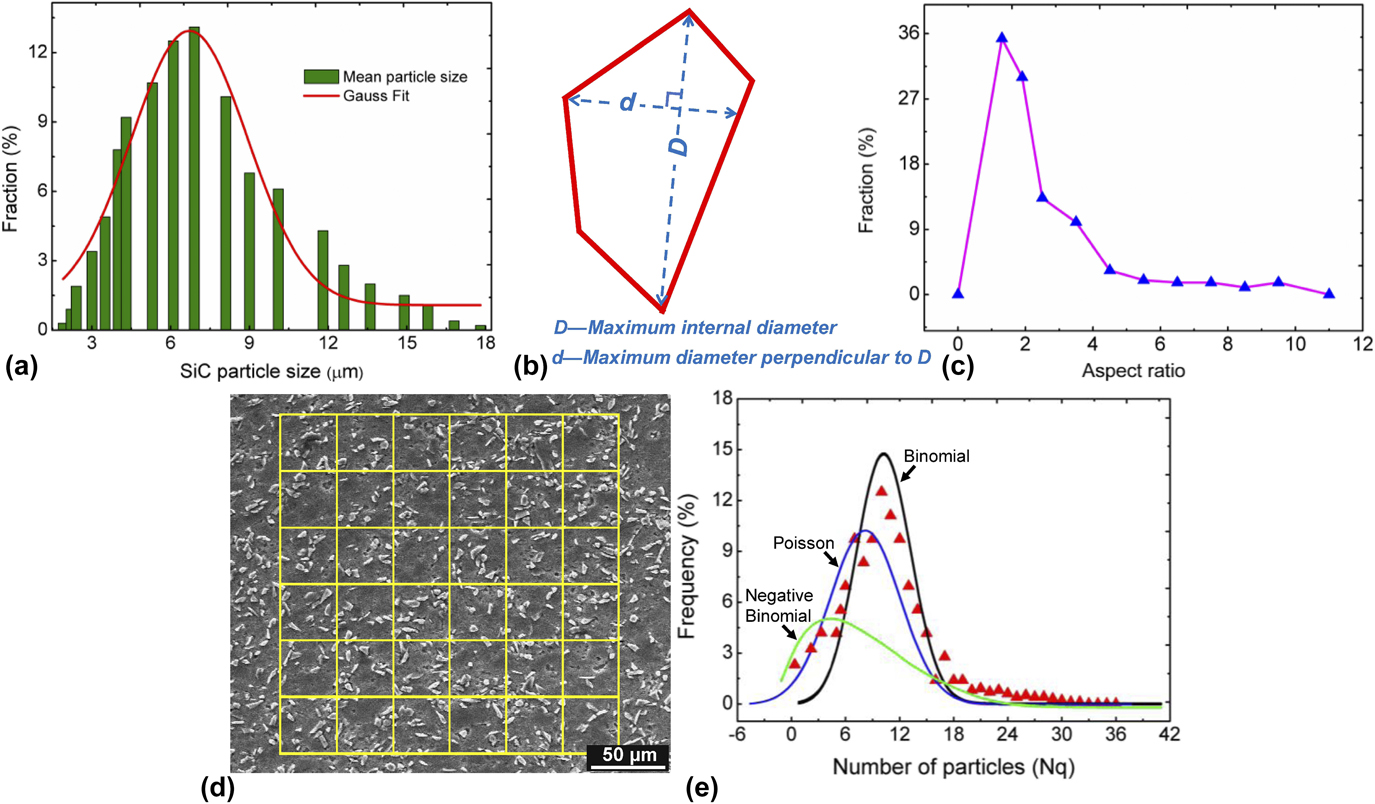
The mean diameter of the angular SiCp in this work is measured to evaluate its size distribution. The results shown in Fig. 5(a) suggests that the general particle size distribution fits Gaussian distribution. Nearly 90% of the SiCp size are below 10 μm, which are mainly distributed around the average value of 6.94 μm. This authenticates that the general distribution of SiCp size is quite uniform, which can reduce the possibility of premature failure at particular (generally at large) particles during tensile testing,Reference Lloyd16 and therefore contribute to a high TE.
(a) Particle size distribution of SiCp utilized in this work, (b) schematic illustration showing definition of aspect ratio in irregular SiCp, (c) corresponding statistical results, (d) application of the quadrat method, only SiCp inside and in touch with the top and right side of each quadrat are counted, and (e) results of quadrat analysis based on ten micrographs accompanied with theoretical distribution.

3. Reinforcement shape
The aspect ratio of D/d, as schematically shown in Fig. 5(b), is utilized to evaluate the SiCp shape. Statistical results disclose that the majority of SiCp have an aspect ratio varying between 1 and 4 with only a small portion of SiCp aspect ratio being larger than 6 [Fig. 5(c)]. Although the long and angular particles are more efficient strengtheners (like whiskers) than spherical ones in transferring load from the matrix to reinforcements,Reference Majumdar and Pandey36 which results in a higher tensile strength, they are extremely harmful to the TE because of the rapid initiation and growth of voids at sharp angles. Geni and KikuchiReference Geni and Kikuchi37 favored this statement by the findings that increasing the SiCp aspect ratio (0.25 → 0.5 → 1 → 2 → 4) increased the overall tensile strength, while degrading the TE inversely. A maximum TE and a medium tensile strength were achieved only when the aspect ratio approached 1 (i.e., spherical particles). Therefore, it can be expected that the utilization of SiCp with an average aspect ratio of 2.43 for the present composite should balance well between tensile strength and TE.
4. Reinforcement distribution
The SiCp distribution in the synthesized composite was analyzed quantitatively through the quadrat method,Reference Tzamtzis, Barekar, Babu, Patel, Dhindaw and Fan22 to evaluate the effectiveness of the powder thixoforming method in uniformizing particle distribution. Figure 5(d) shows a characteristic example of how this method was implemented on the micrograph, and the results as a frequency scatter of the amount of reinforcement particles in each quadrat, N q, in association with the according theoretical curves are displayed in Fig. 5(e). The shape of N q distribution is affected by the magnitude of clustering tendency with a higher particle uniformity making the N q distribution more symmetric.Reference Boostani, Mousavian, Tahamtan, Yazdani, Khosroshahi, Wei, Xu, Gong, Zhang and Jiang38 As proven mathematically,Reference Rogers39 a clustered, random, and regular spatial distribution follows the negative binomial model, Poisson model, and binomial model, respectively. The observed particle distribution for the SiCp/6061 Al composite is more of resemblance to the binomial curve and lies away from the negative binomial curve, which indicates a uniform SiCp distribution in this composite. More quantitatively, the skewness (β) is calculated to be 0.29 for the powder thixoforming composite. By contrast, it is 0.821 for the high-pressure die-casting composite,Reference Tzamtzis, Barekar, Babu, Patel, Dhindaw and Fan22 0.53 for the gravity-casting composite,Reference Karnezis, Durrant and Cantor23 1.04 for the squeeze-cast composite,Reference Karnezis, Durrant and Cantor23 and 0.65 for the roll-cast composite,Reference Karnezis, Durrant and Cantor23 respectively (composite here all refers to SiCp/A356 PRAMCs). An increase in β represents an increase in reinforcement clustering. It is therefore concluded that the powder thixoforming method provides a great advantage for the fabrication of PRAMCs with a more uniform distribution of the reinforcements when compared with conventional methods, which leads to a more homogeneous microstructure and thus high mechanical properties, especially the TE.
5. Matrix ductility
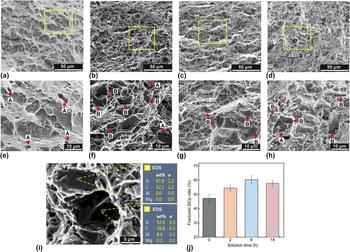
The aforementioned factors all play a crucial role in improving the TE of the composite but are independent of solution treatment. But the matrix ductility should be affected by the solution treatment. Figures 6(a)–6(h) show the fracture surfaces of the SiCp/6061 Al composite solutionized at 808 K for various durations. It is evident that the fracture surface of the as-fabricated composite is generally flat besides the existence of a few traces of large caves [Figs. 6(a) and 6(e)], which should result from the decohesion of primary α-Al particles considering that the mean size and morphology of these pulling-out caves generally agree with those of primary α-Al particles (16.51 μm). The presence of eutectic phases in the grain boundaries [Fig. 1(b)], which is prone to fracture under a low tensile load, accounts for the brittle fracture of the as-fabricated composite. An increase in solution time decreases the amounts of eutectic phases [Fig. 2(d)], leading to the formation of plentiful dimples on the fracture surface of the solution-treated composite for 2 h [Figs. 6(b) and 6(f)]. The dimples indicate ductile fracture,Reference Pineau, Benzerga and Pardoen40 whose amount becomes much larger with increasing solution time to 6 h [Figs. 6(c) and 6(g)]. Further increasing solution time to 14 h coarsens the primary particles to a large extentReference Zhang, Chen and Qin7 and numerous flat facets appear on the fracture surface [Figs. 6(d) and 6(h)]. The flat facets are thought to result from the cracks developing through primary α-Al particlesReference Zhang, Chen, Cheng and Li41 and are indicative of brittle fracture, thus the ductility of the solution-treated composite for 14 h are degraded to some extent. Overall, the ductility of the SiCp/6061 Al composite matrix first increases (0–6 h) and then decreases (after 6 h) in the process of solution treatment, which is in good agreement the variation of TE with solution time (Table I).
Fracture surfaces of the SiCp/6061 Al composites solutionzied at 808 K for various durations (a and e) 0 h (as-fabricated state), (b and f) 2 h, (c and g) 6 h, and (d and h) 14 h; (e–h) are the enlarged views of the squares in (a–d), (i) typical fracture surface of the SiCp/6061 Al composite containing SiC/Al interface debonding and SiCp fracture with corresponding results of EDS analysis, and (j) statistical result of fractured SiCp to the whole failed ones as a function of solution time.

6. Interfacial bonding strength
In addition, another phenomenon that varies during solution treatment is the number and mode of failed SiCp (including SiC/Al interface debonding and SiCp fracture) on the fracture surfaces of the SiCp/6061 Al composites [Figs. 6(e)–6(h)]. Note that it is hard to distinguish SiC/Al interface debonding from SiCp fracture in certain specific particles [Fig. 6(i)], and EDS analysis was utilized to differentiate these two modes since Al and a small amount of Mg could react with SiO2 through reactions (4) and (5) (stated in section “C”) to enrich Al (and occasionally tiny Mg) element at the oxidized SiC/Al interface (Fig. 4). As shown by the EDS results in Fig. 6(i), it should be SiC/Al interface debonding when there are no Al and Mg elements on the SiCp surface; otherwise, it belongs to SiCp fracture. Clearly, the SiC/Al interface debonding [marked by arrows labeled “A” in Fig. 6(e)] dominates the as-fabricated composite by forming pulling-out caves on the fracture surface. When the composite is subjected to solution treatment, SiCp fracture is frequently observed on the fracture surface [marked by arrows labeled “B” in Figs. 6(f)–6(h)], and the ratio of fractured SiCp number to the whole failed particle number continuously increases with prolonging the solution time to 6 h and then decreases slightly [Fig. 6(j)]. Both the debonding and fracture of SiCp are actually the results of stress concentration at the SiC/Al interface when the external stress is up to a certain level.Reference Chawla, Jones, Andres and Allison42 When the interface bonding strength is relatively weak, the SiCp would debond from the Al matrix under uniaxial tensile load, disabling the load transfer from the matrix to SiCp.Reference Chen, Ling, Xia, Huang and Fang43 But when the interface bonding strength is strong enough, external load can be effectively transferred to the SiCp, which then fracture under a higher tensile stress.Reference Chen, Ling, Xia, Huang and Fang43 Therefore, a gradual increase in fractured SiCp ratio within 6 h, in fact, indicates an enhanced interfacial bonding strength in the SiCp/6061 Al composite during solution treatment.
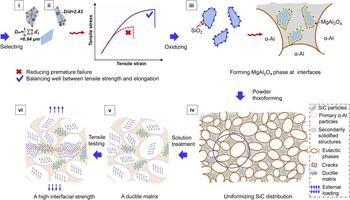
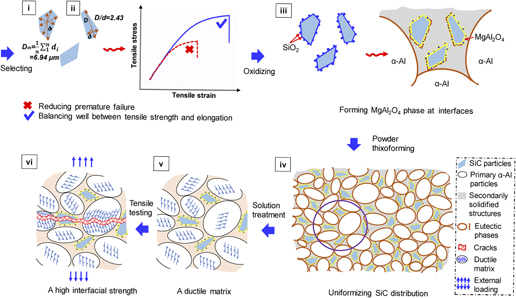
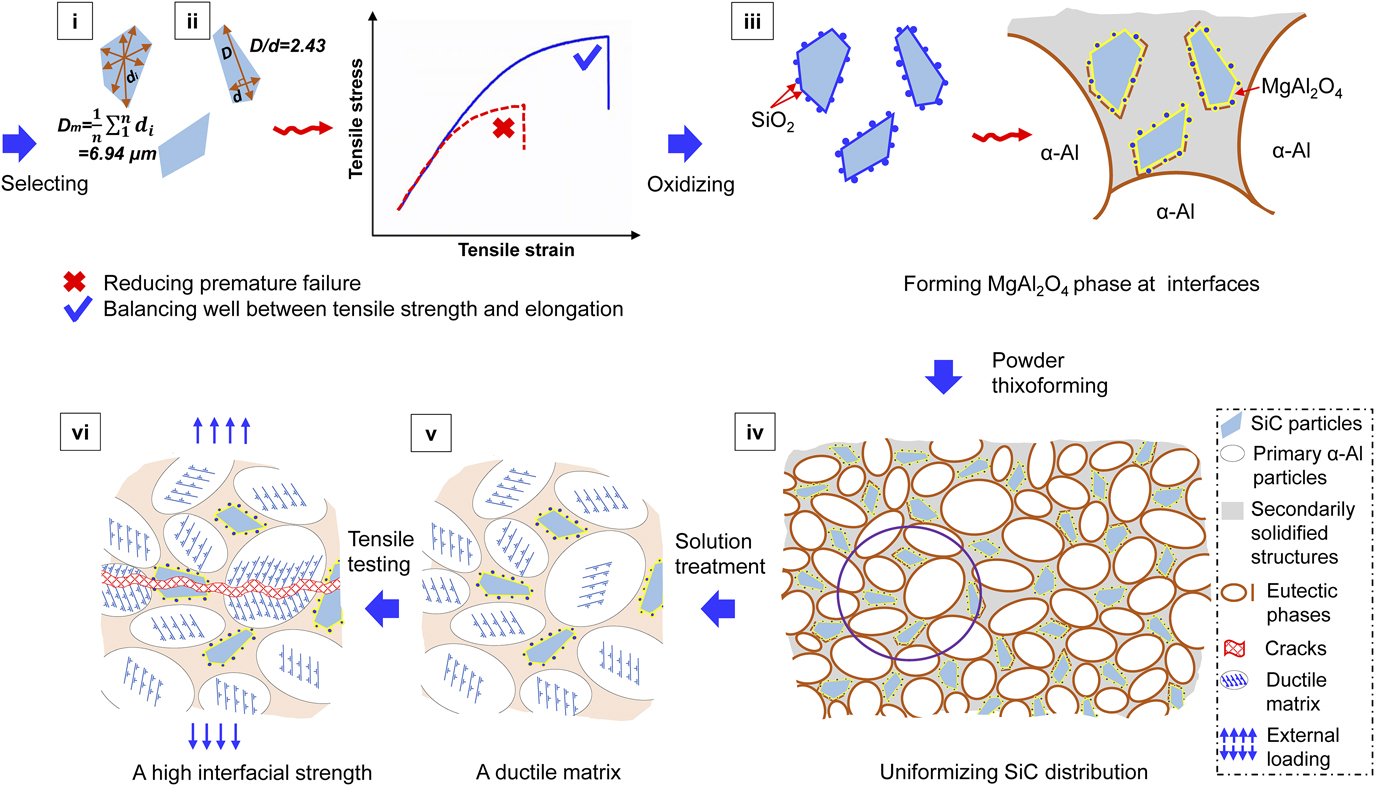
In conclusion, the toughening mechanisms of the solution-treated SiCp/6061 Al composite, as schematically shown in Fig. 7, can be summarized from the perspective of material design, powder thixoforming, and solution treatment as follows (panels labeled “i–vi” in the figure correspond to “i–vi” explanations in what follows): (i) utilization of SiCp having a mean size of 6.94 μm with nearly 90% of the particle size being below 10 μm reduces premature failure of the composite at large particles; (ii) selection of SiCp with an average aspect ratio of 2.43 achieves a good balance between tensile strength and elongation; (iii) oxidization of the SiCp provides a good interfacial bonding strength by forming the MgAl2O4 phase at the SiC/Al interface; (iv) the powder thixoforming method makes possible a considerably uniform distribution of SiCp in the Al matrix eliminating stress concentration at certain particular areas. These four factors lay foundations for the subsequent solution treatment, which dissolves eutectic phases into the matrix alloy leading to (v) a ductile matrix and (vi) a high interfacial strength in the composite.
Schematic illustration of the toughening mechanisms of the SiCp/6061 Al composite during the material design, powder thixoforming, and solution treatment processes.
7. Elongation prediction
In this part, the SF of the SiCp/6061 Al composite is calculated. In fact, the SF prediction of PRAMCs is a rather complicated issue requiring a detailed damage analysis to have an estimation of the onset of specimen instability. Available models on predicting SF, such as those proposed by Tanaka et al.Reference Tanaka, Mori and Nakamura44 or Evensen–Verk,Reference Evensen and Verk45 were found to be inadequate for the SF prediction due primarily to their partial neglect of the reinforcement premature failure including reinforcement crack and interface debonding, followed by matrix fracture in the ligament between the reinforcements during tensile testing (predictions from some of the mentioned models will be given in the following for comparison). In this work, the damage model of Majumdar and PandeyReference Majumdar and Pandey36 based on the fracture mechanics of reinforcing particles was adopted to predict the SF of the synthesized composite. This model is found to perform well in SF prediction of PRAMCs, especially when the failed SiCp are uniformly distributed in the composite and their volume fraction is small. Examination of the failed SiCp on the fracture surface, as typically exhibited in Ref. Reference Zhang, Chen and Qin7, confirms the applicability in the current composite by showing a relatively homogeneous distribution and a relatively small volume fraction of failed particles. In accordance with the Majumdar and Pandey model, the total SF for the bulk composite (εf) can be expressed asReference Majumdar and Pandey36
 $${\varepsilon _{\rm{f}}} = \left( {{1 \over {\lambda \sqrt 2 }}} \right) \cdot \left( {1 - {{\left( {{{6{V_{\rm{p}}}} \over \pi }} \right)}^{{1 \over 3}}}} \right) \cdot \left( {1.285 - 4.403{V_{\rm{p}}} + 4.122{{\left( {{V_{\rm{p}}}} \right)}^2}} \right)\quad ,$$
where V p is the volume fraction of SiCp and λ is a parameter corresponding to the local SF, which can be obtained via the following equation in accordance with McMeeking’s resultsReference Majumdar and Pandey36,Reference Mcmeeking46 :
 $$\lambda = {{9.4 + 35{\varepsilon _{\rm{B}}}} \over {0.3 + 100{\varepsilon _{\rm{B}}}}}\quad .$$
Among them, εB is the plastic strain when there is distinct void initiation and propagation, which can be given byReference Majumdar and Pandey36
 $${\varepsilon _{\rm{B}}} = \left( {{{\varepsilon _{\rm{m}}^{\rm{f}}} \over {\left( {2.2 + 7N)(N + 1} \right)}}} \right) \cdot {\left( {{{\varepsilon _{\rm{m}}^{\rm{f}}} \over {0.002}}} \right)^N}\quad ,$$
where  $\varepsilon _{\rm{m}}^{\rm{f}}$ and N are the respective tensile SF of the matrix and work-hardening exponent, which are thought to be identical in value.
As mentioned above, numerous SiCp in the work would inevitably fail through SiC/Al interface debonding and/or SiCp fracture during the tensile testing process [Figs. 6(e)–6(h)], resulting in ductility reduction of the composite. Herein, the fraction of failed SiCp (f) is introduced to modify Eq. (9):
 $$f = \left( {{n \over N}} \right) \times 100\% \quad ,$$
where N and n are the number of visible SiCp on the SEM micrograph and fractographs under the same magnification, respectively. The variations of f with solution time have been given in Ref. Reference Zhang, Chen and Qin7. Finally, a modified model for predicting the SF of the SiCp/6061 Al composite that considers the effective volume fraction of SiCp (V p(1−f)) can be developed in this work:
 $${\varepsilon _{\rm{f}}} = \left( {{1 \over {\lambda \sqrt 2 }}} \right) \cdot \left( {1 - {{\left( {{{6{V_{\rm{p}}}\left( {1 - f} \right)} \over \pi }} \right)}^{{1 \over 3}}}} \right) \cdot \left( {1.285 - 4.403{V_{\rm{p}}}\left( {1 - f} \right) + 4.122{{\left( {{V_{\rm{p}}}\left( {1 - f} \right)} \right)}^2}} \right)\quad .$$
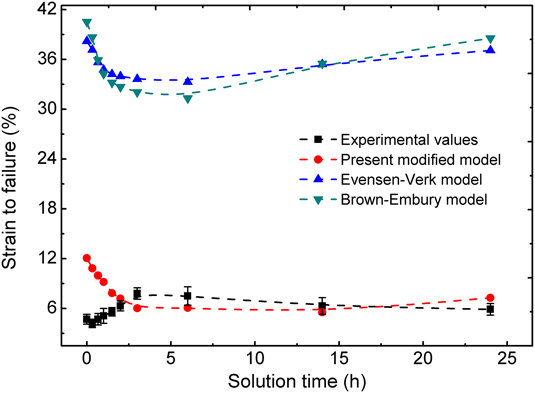
The SF of the SiCp/6061 Al composite given by Eq. (13) along with the experimental values is plotted in Fig. 8 as a function of solution time. The calculation details are listed in Table II. Predictions from this model agree generally well with the experimental values considering the measuring error, especially when compared with those from the Evensen–Verk modelReference Evensen and Verk45 and Brown–Embury modelReference Brown and Embury47 (taking C = 1.5, εn = 0 and V = V p(1−f) in these models). Note that SF predictions within the solutionization range of 1 h deviate obviously from the experimental values. This might be ascribed to the incomplete dissolution of brittle eutectic phases in this range [Fig. 2(d)], which is detrimental to the composite ductility. For instance, some eutectic phases tend to distribute around SiCp [Fig. 1(c)], which could serve as crack initiators since these eutectic phases are hard and brittle in nature. In this model, the effects of eutectic phases are only considered partially via the work hardening exponent of the matrix (N). However, the overall harmful effects of the eutectic phases cannot be fully quantified in this calculation due to complexity in its morphology and distribution, consequently leading to the overestimation of SF predictions in this range. When the number of eutectic phases decreases after 1 h, the SF predictions tend to agree well with the experimental values. This calculation again demonstrates the harmful effects of the eutectic phases on composite’s ductility and thus the effectiveness of solution treatment in improving the composite’s ductility. Furthermore, the modified model might provide references for SF prediction of similar PRAMCs that are subjected to solution treatment.
SF comparisons of the experimental values and theoretical ones calculated by the modified model in this work as well as by the reported Evensen–Verk modelReference Evensen and Verk45 and Brown–Embury modelReference Brown and Embury47 in the literature studies as a function of solution time.

Calculation details for the strain to failure prediction of SiCp/6061 Al composites by different models.

IV. CONCLUSIONS
(1) Solutinization of the composite at 808 K first increases and then slightly decreases the tensile properties with solution time, and the tensile properties at peak stage (6 h) increases by 19.6%, 65.2%, and 161.5% to 275 MPa, 212 MPa, and 6.8% for UTS, YS, and TE, respectively.
(2) The corresponding toughening mechanisms of the composite are revealed to be (i) utilization of SiCp having a mean size of 6.94 μm with nearly 90% of the particle size being below 10 μm reduces premature failure of the composite at particular particles; (ii) selection of SiCp with an aspect ratio of 2.43 achieves a good balance between tensile strength and elongation; (iii) oxidization of the SiCp provides a good interfacial bonding strength by forming the MgAl2O4 phase at the SiC/Al interface; (iv) the powder thixoforming method makes possible a considerably uniform distribution of SiCp within the Al matrix eliminating stress concentration at certain particular areas. These four factors lay foundations for the subsequent solution treatment, which dissolves eutectic phases into the matrix alloy leading to (v) a ductile matrix and (vi) a high interfacial strength in the composite.
(3) Theoretical SF calculation of the composites by the modified model agrees reasonably well with the experimental values, which highlights the harmful effects of the eutectic phases on composite’s ductility and thus the effectiveness of solution treatment in improving the composite’s ductility The modified model might provide references for SF prediction of similar PRAMCs that are subjected to solution treatment.
ACKNOWLEDGMENTS
The authors wish to express thanks to financial support from the Basic Scientific Fund of Gansu Universities (Grant No. G2014-07), the Program for New Century Excellent Talents in University of China (Grant No. NCET-10-0023), and the Program for Hongliu Outstanding Talents of Lanzhou University of Technology (Grant No. 2012-03).