Information regarding reproductive health and maternal and child health outcomes has historically been collected through surveys or qualitative research methods primarily involving women. In recent years, however, a growing recognition of the influential roles that men play in health behaviours and decision-making has prompted a number of couples' agreement studies in which male and female responses are compared. Primarily focusing on the areas of family planning/contraceptive use, sexual behaviour, and women's autonomy and household decision-making, these studies have generally found that agreement levels vary considerably across different contexts and in regards to different reproductive health topics (Becker, Reference Becker1999; Becker & Costenbader, Reference Becker and Costenbader2001; Miller et al., Reference Miller, Zulu and Watkins2001; Jejeebhoy, Reference Jejeebhoy2002; Harvey et al., Reference Harvey, Bird and Henderson2004; Becker et al., Reference Becker, Fonseca-Becker and Schenck-Yglesias2006). While Harvey et al. (Reference Harvey, Bird and Henderson2004) found that agreement between sexual partners in regards to sexual practices was relatively high in a US-based population, several comparative analyses conducted with data from international populations have found couples' responses about intention to use contraception and current contraceptive use to be quite discrepant (Becker, Reference Becker1999; Becker & Costenbader, Reference Becker and Costenbader2001). Such findings have had important implications on the design, measurement and evaluation of family planning and reproductive health interventions.
Few studies on couples' agreement have yet extended into the arena of maternal health, particularly in relation to Safe Motherhood and birth preparedness practices. In an effort to prompt greater discussion and research in this important area, findings are presented from a descriptive analysis of agreement levels regarding maternal health practices among 129 married couples that recently delivered a baby in urban Nepal.
Data were collected within a randomized controlled health education trial conducted between August 2003 and January 2004 at Prashuti Griha Maternity Hospital (PGMH), the predominant maternal health facility in Kathmandu Valley. The purpose of the trial was to evaluate the impact of including male partners of pregnant women in antenatal health education services on a number of maternal health practice and knowledge outcomes. Women who received antenatal health education services with their partners were compared with women who received the identical education intervention alone and with women who received no such intervention. As part of the intervention group, each of the 129 couples in this sample received two 35-minute long health education sessions on maternal health topics. The sessions were delivered to one couple at a time together by a male auxiliary health worker and a female nurse. Further details regarding the study design, methodology and findings have been presented previously (Mullany, Reference Mullany2005; Mullany et al., Reference Mullany, Hindin and Becker2005, Reference Mullany, Becker and Hindin2007; Beenhakker, Reference Beenhakker2005). Several important limitations to this study, noted here and discussed in greater detail in previously published material (Mullany, Reference Mullany2005; Mullany et al., Reference Mullany, Hindin and Becker2005; Beenhakker, Reference Beenhakker2005), include: (1) Limited information regarding mothers-in-law: while the influential role of mothers-in-law is a prominent feature in South Asian populations, the specific focus of this study was to examine interspousal dynamics in relation to maternal health care practices. In-depth qualitative research conducted during the formative phase of this project confirmed that this was an appropriate focus, particularly among the predominantly semi-urban to urban participants of this study. (2) Potential selection bias: this intervention targeted poor urban women seeking antenatal services, an important and growing population in Nepal. While women at PGMH are likely to be poorer than those seeking services at private hospitals or antenatal clinics in Kathmandu, they are also likely to be wealthier, better educated and/or more motivated than women receiving no antenatal care. In addition, previous research at PGMH has shown that women accompanied by husbands to antenatal care are similar with respect to most background characteristics to women unaccompanied by husbands (Mullany et al., Reference Mullany, Hindin and Becker2005).
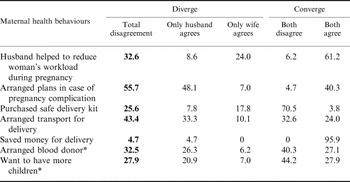
Maternal health behaviour outcomes (Table 1) were collected using a postpartum questionnaire administered to all couples within 2 weeks of delivery. Husbands and wives were questioned simultaneously, but in separate confidential rooms (i.e. a female nurse interviewed women, and a male health worker interviewed men). All questions were asked in the following format: ‘For this recent pregnancy, did you or your husband/wife …(e.g. purchase a safe delivery kit).’ Simple descriptive tabulations of convergence and divergence of spouses' responses, as well as results from Kappa statistics of agreement, are shown in Table 1.
Percentage distribution of Nepalese husbands' and wives' reports of maternal health behaviours as reported in the initial postpartum period (within 2 weeks of delivery) (n=129 couples)

* Kappa is moderately significant at 0.21–0.40.
Participants were on average young (mean (SD) age=22.1 (3.1) years), primiparous (74%), Hindu (85%) and recruited into the study during second trimester (mean (SD) gestational age=23.2 (2.8) weeks). Descriptive data on maternal health behaviours were collected at two weeks postpartum. Findings indicate that agreement levels between husbands and wives pertaining to maternal health behaviours, even those that would have been practised in recent weeks or months, are relatively low. Agreement levels are generally strongest in regards to the arrangement of a blood donor and wanting to have more children, but agreement was no different than expected by chance alone for other maternal health behaviours. For more ‘tangible’ maternal health behaviours such as whether a safe delivery kit was purchased or obtained in preparation for the recent delivery, 26% of couples disagreed over whether this purchase had been made. Given that these couples had recently participated in the education intervention, these levels of agreement may overestimate the agreement patterns of non-participating couples in urban Nepal.
As reported previously for autonomy outcomes (Miller et al., Reference Miller, Zulu and Watkins2001; Jejeebhoy, Reference Jejeebhoy2002; Becker et al., Reference Becker, Fonseca-Becker and Schenck-Yglesias2006), men in this sample tended to report more positive, or socially acceptable, behaviours in regards to several health practices (plans in case of pregnancy complication, arrangement of transportation to delivery, arrangement of blood donor, saving of money for delivery). An important exception is in regards to whether a husband helped to reduce his wife's workload during pregnancy: while both spouses agreed in 61% of couples, 32% of couples disagreed. Among divergent couples, wives appeared more likely to report that their husband had helped them to reduce their workload (24%) than men themselves reported (9%).
Disagreement between spouses in this sample is unlikely to have arisen due to insufficient understanding of the maternal health practices, as all couples had attended education sessions on the topics, and questionnaire administrators were standardized. Rather, inadequate spousal communication regarding health intentions and practices may account for much of the disagreement found between husbands and wives in this setting. Previous qualitative research among this population found that numerous communication barriers exist among both older and younger individuals, in particular related to reproductive health and health care-seeking, and that these barriers may hinder the adoption of healthy practices (Mullany, Reference Mullany2005). While the current emphasis on ‘shared responsibility’ found in many Safe Motherhood programmes is appropriate, these data indicate that such programmes must also promote more effective communication between spouses regarding the adoption of healthy practices.
The standard practice of collecting maternal and child health related information from women only assumes that a woman's word is the ‘gold standard’ for knowledge, attitudes and practice indicators. Where men tend to dominate health-related decision-making and usually make large or health-related purchases in a household, however, it seems plausible that it is the men whose responses may be more accurate.
Independent of the specific cause of low agreement in this sample, these data raise an important issue that ought to be taken into consideration when designing and evaluating maternal health programmes. Similarly, maternal health researchers should consider the variation in responses found in this sample when conducting surveys or researching maternal health practices. Although inclusion of both men and women in such surveys represents an improvement toward more comprehensive understanding, the methodological issue of determining ‘who is correct’ remains.
Safe Motherhood programmes, and in particular those programmes promoting birth preparedness, are increasingly broadening their target participants and audiences to include family members of pregnant women, especially male partners, and communities as a whole. While this represents a step in the right direction, the measurement of such programmes that attempt to extend their reach also presents new challenges. The simple findings in this sample, for instance, indicate that measuring birth preparedness and maternal health practices may depend on who you ask.
Acknowledgments
Gratitude is extended to Dr Stan Becker and Dr Michelle Hindin from the Johns Hopkins Bloomberg School of Public Health for their guidance throughout this project. The author also wishes to thank the local collaborators, Dr Bimala Lakhey and Mrs Darshana Shrestha, the local research assistants and the study participants in Kathmandu, Nepal. This study was made possible through a Hopkins Population Center Dissertation Fieldwork Grant, awarded by the Andrew Mellon Foundation, and a grant awarded by the Bill & Melinda Gates Institute for Population & Reproductive Health.