


Introduction
Efficacy and effectiveness studies have shown that cognitive-behavioural therapy (CBT) of depression is effective (e.g. Hollon and Beck, Reference Hollon, Beck and Lambert2004). However, there is a considerable variation in therapy outcome and a remarkably high proportion of patients do not respond to therapy. So far, the majority of studies examining predictors of therapy outcome have been randomized controlled trials (RCTs). In addition, it is also important to discover predictors of outcome in naturalistic settings, to study which patients benefit from treatment, given possible differences in sample or treatment characteristics between efficacy and effectiveness studies (Persons, Burns and Perloff, Reference Persons, Burns and Perloff1988). Until now, the following variables have been found to be associated with a positive therapeutic outcome by some but not all researchers: less initial severity, not having a personality disorder, positive outcome expectancy, completion of homework, social support, higher quality of life, higher education, female gender, and family status (Hollon and Beck, Reference Hollon, Beck and Lambert2004). Thus study results addressing predictors of naturalistic CBT outcomes in depression appear rather inconclusive.
Furthermore, a considerable proportion of patients do not terminate treatment regularly (completers), but discontinue prematurely (drop-outs), often showing worse results concerning symptom reduction and response. Current research on the prediction of patient drop-out from depression therapy is rather sparse. The following variables have been found to be associated with drop-out: having a personality disorder, higher initial depression severity, not having endogenous symptoms, younger age, ethnic minority, and less education (Persons et al., Reference Persons, Burns and Perloff1988).
Poor therapeutic outcome and non-response pose considerable challenges because they are linked to continuing patient suffering and higher healthcare costs. Thus the aim of the present study is to identify factors associated with symptomatic outcome, response, and quality-associated drop-out in naturalistic CBT of unipolar depression.
Method
Setting and participants
The sample consisted of 213 consecutive patients who finished their treatment between 2004 and 2010 at a university CBT outpatient clinic in Germany. At pretreatment, each patient fulfilled DSM-IV criteria for major depression or dysthymic disorder. For details concerning our setting, diagnostics according to DSM-IV as well as specifics of the German health care system, see Schindler, Hiller and Witthöft (Reference Schindler, Hiller and Witthöft2011). Other inclusion criteria were a pathological pretreatment BDI score (≥ 14.29; Seggar, Lambert and Hansen, Reference Seggar, Lambert and Hansen2002) and a minimum of one treatment session.
The total sample split into 164 completers and 49 therapy drop-outs (23%). Drop-outs were defined as patients whose allowed number of therapy sessions was not completed, i.e. fewer than the number of sessions recommended by the insurance company were accomplished (see also Schindler et al., Reference Schindler, Hiller and Witthöft2011). Not included are those who terminated treatment by mutual agreement with their therapist due to satisfactory early clinical response. We differentiated between people who dropped out for reasons associated with treatment quality (e.g. patient discontinues without giving reasons) and drop-outs of a neutral type (e.g. patient moves to another place). Twenty-nine (59%) of the drop-outs were classified as quality-associated and 20 (41%) as neutral. We decided to focus on the prediction of quality-associated drop-out rather than on drop-out in general, since the latter is not crucial for the evaluation of naturalistic psychotherapies. Thus neutral drop-outs were excluded from further analyses.
Measures
We picked several sociodemographic (age, gender, family status, years of education) and clinical (pretreatment BDI score, current medication, previous treatment, type of depression diagnosis, Axis I and II comorbidity, type of therapy termination, therapeutic alliance, outcome expectancy, early improvement) variables to be examined as possible predictors. The German version of the Beck Depression Inventory (BDI; Hautzinger, Bailer, Worall and Keller, Reference Hautzinger, Bailer, Worall and Keller1994) was used to assess depressive symptomatology at pre- and posttreatment as well as every 10th session in the course of therapy. The posttreatment BDI score referred to the last assessment available for an individual patient (last observation carried forward). Five items (e.g. “I feel accepted by my therapist”), each to be estimated on a 7-point rating scale (1 = not at all, 7 = very much), were used to assess quality of therapeutic alliance from the patients’ point of view. Outcome expectancy was assessed by one item (“I think that the psychotherapy will be helpful for me”) and the same 7-point rating scale at pretreatment. Treatment response and negative treatment outcome was defined by the Reliable Change Index (RCI) (Jacobson and Truax, Reference Jacobson and Truax1991) and the method suggested by Seggar et al. (Reference Seggar, Lambert and Hansen2002), i.e. an increase or decrease of the BDI larger than 8.46 points was required to define a change as reliable. Early improvement was defined as a decrease of at least more than 4 BDI points compared to the baseline at the 10th session, representing a 50% improvement of the RCI distance.
Statistical analyses
Analyses of variance (ANOVAs), χ2 tests and Bonferroni corrections were used to analyse differences in demographic and clinical characteristics between completers and drop-outs, as well as between responders and nonresponders. Variables showing significant correlations of at least a small effect size with our three outcomes (i.e. pre–post difference BDI, response and quality-associated drop-out) were entered into hierarchical linear and logistic regression analyses.
Results
Patient characteristics
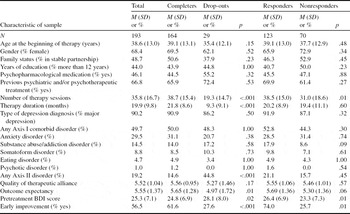
Sociodemographic and clinical characteristics of the total sample and the different subsamples are shown in Table I.
Demographic and clinical characteristics of the patients at baseline

Note: BDI = Beck Depression Inventory.
Comparison of pre- and posttreatment scores
Patients showed significant improvements of depressive symptoms after CBT. In the total sample, the pre-post effect size was d = 1.36. Completers achieved a large pre–post effect size of d = 1.63, whereas drop-outs were marked by clearly smaller treatment effects (d = 0.52), although their reduction in depressive symptomatology was still significant (t(28) = 2.67; p < .001). BDI change scores achieved by completers were significantly larger than those of drop-outs (t(191) = −4.30; p < .01).
Response and negative treatment outcomes
The response rate was 63.7% for the total sample, 70.1% for completers, and 27.6% for drop-outs. During therapy, 1.6% of the patients deteriorated reliably; the completers’ rate of deterioration was 1.2%. Drop-outs had a higher rate of deterioration, 3.4%.
Prediction of symptomatic outcome
The following variables were entered in the linear regression model: pretreatment BDI score (step 1), early improvement (step 2), and type of therapy termination (step 3). Patients with more severe baseline BDI scores (β = .28; p < .001), those who improved significantly early (β = .47; p < .001), and those who completed treatment regularly (β = .23; p < .001) achieved significantly stronger BDI reductions. While pretreatment BDI score alone accounted for 9.3% of the variance, early improvement explained another 27.7%, and terminating therapy regularly another 4.7% of incremental variance. The three factors accounted for 40.8% of the overall variance.
Prediction of response
The following independent variables were entered in a logistic regression model: pretreatment BDI score (step 1), early improvement (step 2), and type of therapy termination (step 3). Patients with more severe baseline BDI scores were slightly more likely (OR = 1.10; CI: 1.04 – 1.17; Wald χ2 = 9.86; p < .001), early improvers more than 6 times more likely (OR = 6.54; CI: 3.21 – 13.32; Wald χ2 = 26.71; p < .001), and completers 7 times more likely (OR = 7.45; CI: 2.52 – 22.07; Wald χ2 = 13.51; p < .001) to respond than those who had less severe baseline scores, did not improve early, and drop-outs, respectively. Nagelkerke's R-squared of the final regression model was .389, 76.2% of patients could be classified correctly.
Prediction of quality-associated therapy drop-out
The following independent variables were entered in a logistic regression model: Axis II comorbidity (step 1), pretreatment BDI score (step 2), outcome expectancy (step 3), and early improvement (step 4). Patients with an Axis II comorbidity were about 6 times more likely to drop out than patients without a personality disorder (OR = 6.31; CI: 2.31 – 17.22; Wald χ2 = 12.95; p < .001), and patients with a more negative outcome expectancy were 1.4 times more likely to drop out compared to those with a more positive outcome expectancy (OR = 1.35; CI: 1.08 – 1.83; Wald χ2 = 3.68; p < .001). Compared to patients who improved early in therapy, those who did not were almost 6 times more likely to drop out (OR = 5.75; CI: 2.14 – 15.46; Wald χ2 = 12.02; p < .001). In our sample, 25% of those who did not improve early dropped out, while only 7% of the early improvers terminated therapy prematurely. Pretreatment BDI score did not emerge as a significant predictor when Axis II comorbidity was already entered into the model (OR = 1.05; CI: 0.99 – 1.12; Wald χ2 = 2.65; p > .05; χ2 (1) = 2.82, p > .05). Nagelkerke's R-squared of the final model was .291, 89.1% of patients could be classified correctly.
Discussion
Our study focused on the prediction of symptomatic outcome, response, and quality-associated therapy drop-out of depressed adults undergoing CBT in a naturalistic setting. In line with the existing literature concerning prediction of these therapy outcomes and according to our exploratory surmises, we picked several sociodemographic and clinical variables to be examined as possible predictors. The total sample as well as the subsamples of completers and drop-outs showed statistically and clinically significant reductions of depressive symptomatology after treatment. Compared to completers, drop-outs had considerably poorer outcomes in terms of response rates as well as therapy effects. Consequently, it appears essential to develop techniques to improve adherence to the psychotherapeutic process, e.g. by applying more motivational strategies.
Early improvement was also shown to be predictive of positive therapy outcome. Thus continuous monitoring of change in symptomatology, especially in the first third of therapy, seems to be important. A higher degree of baseline depression severity was also associated with better symptomatic change and response, which might at least partly be attributable to regression toward the mean. None of the other variables studied (i.e. all sociodemographic variables, current medication, previous treatment, type of depression diagnosis, Axis I and II comorbidity, therapeutic alliance, and outcome expectancy) were predictive of positive therapy outcomes, indicating that prediction of therapy outcome remains a challenging endeavour.
Regarding drop-out, we found patients with a concurrent personality disorder to be more likely to drop out for quality-associated reasons. From a clinical perspective, therapists should consider whether a personality disorder may be complicating the therapeutic process and, if so, whether a more appropriate treatment plan should be designed. Patients who did not improve early were found to be more likely to drop out. Thus to receive success affirmation of the chosen therapy seems to be especially important at an early stage of therapy. Furthermore, we found positive outcome expectancies to have predictive value. That is, not only the actual experience of success but also positive outcome expectancies are important in the decision not to terminate treatment prematurely. This implies that therapists should also focus on strategies that enhance patients’ hope for a beneficial therapy and should be provided with continuous standardized feedback about their patients’ symptomatic and motivational changes.
Our study has several limitations. The use of a single outcome measure, the BDI, might be insufficient in predicting therapy outcome in depressive adults. The present study did not measure other potentially important variables, such as treatment motivation and therapy adherence ratings, which might be valuable in predicting therapy success. Due to German conventions in delivering psychotherapy, treatments of this study were quite long compared to other countries, such as the UK. This might affect the generalizability of the results.
Our findings suggest that motivational factors should be considered in more detail in the course of therapy and that premature therapy drop-out needs to be studied in depth, given its importance to satisfactory therapy success.



Comments
No Comments have been published for this article.