Implications
Goat adaptation to heterogeneous, patchy and degraded rangelands is a vital feature for the reproductive effort. Goats in this landscape experience a level of nutrition that barely supports gestation across months of severe forage scarcity, although it is not clear what rules and at what timescale the average composition of their diet is mixed to receive the nutritional benefits detected in pregnant animals. However, non-pregnant goats select diets lower in nutrients than pregnant goats, which indicates that selection is shaped by physiological effort; thus, nutrient consumption is clearly driven by physiological needs. This knowledge presents goat producers in extensive rangeland systems with opportunities for identifying individuals with superior foraging behavior capable of proficiently sustaining their pregnancy utilizing locally available forage resources.
Introduction
Much of the research into the foraging ecology of goats on rangelands has focused on the botanical composition of their diets (Papachristou and Nastis, Reference Papachristou and Nastis1993; Lopez-Trujillo and Garcia-Elizondo, Reference Lopez-Trujillo and Garcia-Elizondo1995; Bartolome et al., Reference Bartolome, Franch, Plaixats and Seligman1998). These studies indicate that goats exhibit an opportunistic foraging behavior, implying that they ingest a large range of different plants of varying nutrients and secondary compounds. This foraging behavior resembles that of cervids (intermediate feeder with a broad food spectrum; Alm et al., Reference Alm, Birgersson and Leimar2002; Verheyden-Tixier et al., Reference Verheyden-Tixier, Renaud, Morellet, Jamot, Besle and Dumont2008; Krojerová-Prokešová et al., Reference Krojerová-Prokešová, Barančeková, Šustr and Heurich2010), but contrasts with the food habits of sheep, which basically use the herbaceous layer of rangelands (grazer selectors; Kronberg and Malechek, Reference Kronberg and Malechek1997; Mellado et al., Reference Mellado, Olvera, Quero and Mendoza2005a).
Several studies in ruminants support the notion that ungulate herbivores select nutrients in amounts to meet their needs (Bugalho and Milne, Reference Bugalho and Milne2003; Verheyden-Tixier et al., Reference Verheyden-Tixier, Renaud, Morellet, Jamot, Besle and Dumont2008; Villalba et al., Reference Villalba, Provenza and Hall2008), and that this selection varies with the internal state (Kyriazakis et al., Reference Kyriazakis, Tolkamp and Emmans1999). The significance of the internal state, for example, pregnancy on nutrients intake, presents unique questions that have received less attention.
Nutrition during gestation plays a key role in the well-being of goats and their newborn kids, and further affects the pregnancy outcome (Vonnahme et al., Reference Vonnahme, Hess, Hansen, McCormick, Rule, Moss, Murdoch, Nijland, Skinner, Nathanielsz and Ford2003; Gilbert et al., Reference Gilbert, Lang, Grant and Nijland2005; Fowden et al., Reference Fowden, Giussani and Forhead2006). This is particularly important in grazing animals on rangelands, where unsupplemented pregnant animals often experience prolonged bouts of nutrient deficiencies, which results in fetal intrauterine growth restriction (Thomas and Kott, Reference Thomas and Kott1995; Redmer et al., Reference Redmer, Wallace and Reynolds2004) or abortion (Mellado et al., Reference Mellado, Valdez, Lara and García2004c).
Next to lactation, late pregnancy is the period with the greatest nutrient demands for fetal growth and the development of the potential for high milk production. Many of these requirements are met by adaptive physiological changes that occur during gestation (Rumball et al., Reference Rumball, Bloomfield and Harding2008; Jaquiery et al., Reference Jaquiery, Oliver, Rumball, Bloomfield and Harding2009), but food selection of pregnant herbivores in heterogeneous landscapes may also be altered in order to seek diets with higher protein (Cooper et al., Reference Cooper, Kyriazakis and Oldham1994) or energy (Berteaux et al., Reference Berteaux, Crête, Huot, Maltais and Ouellet1998) content and lower toxic constituents (Villalba et al., Reference Villalba, Soder and Laca2009).
Little information is available on diet selection at the plant species or plant part levels for free-ranging pregnant goats (Mellado et al., Reference Mellado, Rodriguez, Villarreal and Olvera2005b) and, as far as we know, no attempt has yet been made to assess the nutrient content of diets selected by goats in relation to increased nutrient requirement during pregnancy. Although there is widespread recognition of the importance of adequate maternal nutrition during pregnancy in goats (Tovar-Luna et al., Reference Tovar-Luna, Goetsch, Puchala, Sahlu, Carstens, Freetly and Johnson2007), there is considerable uncertainty about its role in grazing goats in landscapes with scarce and patchy vegetation, where severe malnutrition is common (Mellado et al., Reference Mellado, Foote, Rodríguez and Zárate1991). Therefore, this study was conducted in an attempt to elucidate the role of pregnancy on maternal nutrition of goats in a microphyll desert scrub.
Material and methods
Study site
The experiment was conducted from February to May in the desert area of Northern Mexico (25°07′N, 101°40′W; altitude 2150 m) dominated by a microphyll desert scrub. The mean annual temperature is 16°C and average annual precipitation is 299 mm, with 75% occurring from June to October. Historically, this communal pasture has been heavily stocked and continuously grazed by large herds of goats, bovines and equines; therefore, goats grazed on a deteriorated rangeland showing a low forage (2164 kg/ha; Mellado et al., Reference Mellado, Estrada, Olivares, Pastor and Mellado2006) production potential.
The main woody species in this landscape are Larrea tridentata (DC.) Cov., Agave lechuguilla Torr. and Acacia farnesiana (L.) Willd. Primary grasses include Bouteloua curtipendula (Michx.) Torr. Buchloe dactyloides (Nutt.) Engelm. and Aristida arizonica Vasey. The dominant herbaceous plants are Sphaeralcea angustifolia (Cav.) D. Don., Solanum elaeagnifolium Cav. and Croton dioicus Cav., which comprise 70% of the total ground cover during the rainy season. However, grasses comprised <10% of the total vegetation cover.
Animals
A commercial flock of 160 adult goats typical of the farming systems of the arid zones of Northern Mexico was used. The breed of goats was undefined (a mixture of the breed of goats that originated in the Alps, as well as Nubians and native goats); the mean condition score (1 = extremely thin; 5 = extremely fat; palpation over lumbar vertebrae, ribs and sternum) was 2.0 and goats ranged in weight from 32 to 43 kg.
Goats had been exposed to adult sexually active bucks (n = 5) of proven fertility during 4 weeks in January (buck-to-doe ratio = 1:32). Transrectal real-time B-mode ultrasound scanning was used for the diagnosis of early pregnancy (around 30 days post-mating). On the basis of this diagnosis, 18 adult goats were selected: 12 pregnant and six non-pregnant. This uneven distribution of goats was attributed to the abortion rate of pregnant unsupplemented goats during the dry season in this landscape, which is around 50% (Mellado et al., Reference Mellado, Olivares, Lopez and Mellado2005). Ultrasound examinations on days 60 and 90 post-mating were performed in order to confirm pregnancy. Half of the pregnant goats aborted in the last trimester of gestation (n = 6); thus, these goats were excluded from the study. Goat diets were obtained from the 12 goats remaining (six goats per group) fitted with a short plastic rope (1.5 m in length × 0.5 cm in diameter) tightened around their neck. This light rope allowed the goats to walk in all kinds of terrain without hindering their motion or feeding activity, and was used to momentarily restrain them to get the forage selected by them from their oral cavity.
Goats were grazed and driven by a herdsman, 8 h/day (1000 to 1800 h), and were penned from 1800 to 1000 h, with no extra food or salt supplementation. They spent the night in an open unroofed corral and had access to water only once a day. Goats were not subjected to an anthelmintic drenching program and were not immunized against endemic diseases.
Four sampling periods, each 4 days long, were conducted from February (second month of pregnancy) to May (last month of pregnancy), during the dry season. The diet selected by goats was estimated by direct collection of plants from the goat's mouth, by separating the mandibles of goats by hand, immediately after feeding bouts. This operation was repeated approximately every 5 min during a 3-h period, using one person per two goats, by restraining the animals by holding the permanent rope tightened to their necks. Collections were made during the morning grazing when goats were grazing most intensely after overnight fasting. Following forage collection, a portion of the sample was thoroughly rinsed, first with tap water and then with distilled water to remove saliva, and was used for mineral analyses.
Analytical procedures
Forages collected during the 4-day period were pooled and these samples were oven-dried and then ground to pass through a 1-mm sieve. Dry matter (DM) was determined by drying at constant weight at 60°C for 48 h in a forced-air oven, ash by incineration at 600°C for 2 h and crude protein (CP) by the micro-Kjeldahl procedure (N × 6.25; Association of Official Analytical Chemists (AOAC), 1996). All analyses were performed in triplicate. Fiber fractions – neutral detergent fiber (NDF), acid detergent fiber (ADF), acid detergent lignin (ADL) and cellulose – were determined by the procedures described by Van Soest et al. (Reference Van Soest, Robertson and Lewis1991) and Van Soest and Wine (Reference Van Soest and Wine1968). Cellulose was calculated as ADF–ADL.
Concentrations of calcium (Ca), magnesium (Mg), potassium (K), sodium (Na), copper (Cu), zinc (Zn), manganese (Mn) and iron (Fe) were determined by atomic absorption spectrophotometry. Phosphorus (P) was measured by colorimetry (AOAC, 1996).Total phenols were determined by the procedure of Swain and Hillis (Reference Swain and Hillis1959) and condensed tannins (CT) (extractable, bound to protein and fiber; CT) in feed collected by goats were determined according to Makkar et al. (Reference Makkar, Singh, Vats and Sood2003). The presence of saponins in the forages selected by goats was determined with the technique described by Galindo et al. (Reference Galindo, Rosales, Murgueitio and Larrahondo1989). The occurrence of terpenes in forage samples was determined according to the Food Chemical Codex (1981).
Statistical methods
The effects of physiological state, month of sampling and the physiological state × month interaction on nutrient content of diets were analyzed by ANOVA using the MIXED procedure of SAS (SAS Institute, Inc., Cary, NC, USA) accounting for repeated measures. The model was Yijk = μ +Gi + cj :i + Mk + (GM)ik + ßxijk + eijk, where Yijk is the observation (dependent variable) of the jth goat in the ith group at the kth month, μ is the overall mean, Gi is the ith group, cj :i is the random effect of the jth goat within the ith group (cj :i∼N[0, σ 2c]), Mk is the kth month, (GM)ik is the group by month interaction term, ßxijk = initial body weight of goats as a covariate and eijk = the residual error term (eijk∼iidN [0, Σ]); where Σ is the variance–covariance of the residual errors with a first-order utoregressive structure for repeated measures within goats. Differences in proportions of dietary samples with saponins and terpenes were tested with a χ 2 analysis (PROC FREQ of SAS).
Results
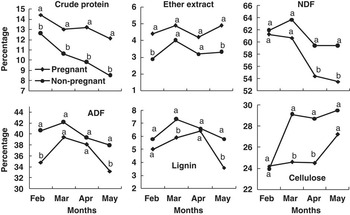
Pregnant goats selected diets higher (P < 0.01) in CP than those chosen by non-pregnant goats during the gestation period (Figure 1). Dietary CP levels decreased steadily from February to May (P < 0.01) for all categories of goats, but levels of this nutrient were relatively high throughout the dry period.
Chemical composition of dietary samples of pregnant and non-pregnant goats grazing a microphyll desert scrub during the dry period. Within months, means with different letters differ (P < 0.01). Except for ether extract, significant differences (P < 0.01) exist between months for forage constituents.

Ether extract levels in diets of pregnant goats were greater (P < 0.01) than in those of non-pregnant animals. For both groups of goats, ether extract content did not change appreciably (P > 0.01) throughout the study period. NDF and ADF were lower in the diets of pregnant goats compared with non-pregnant animals. For both groups of goats, NDF and ADF were highest at the beginning of the dry period (February) and declined through April and May (Figure 1).
Differences in lignin levels were observed between pregnant and non-pregnant goats (P < 0.01). Lignin levels were highest for both groups during March–April (middle of the dry season period; Figure 1). Diets of pregnant goats had lower (P < 0.01) mean cellulose than did those of non-pregnant goats, with levels of dietary cellulose increasing as the dry period progressed. There was no significant interaction between the classes of goats and months for protein, ether extract NDF, NDF and cellulose content of diets selected by goats, showing that patterns of forage selection were similar as the season progressed.
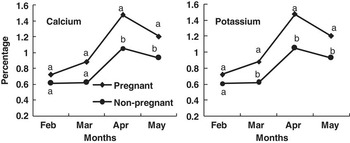
The ash content of diets was not different between classes of goats (range: 8.3% to 12.9% of dietary DM). Irrespective of the category of goats, ash concentration in diets decreased at the end of the dry period (May; P < 0.01). The Ca content of forages selected by non-pregnant goats was lower (P < 0.01) compared with that selected by goats that became pregnant (Figure 2). The Ca content in goat diets increased (P < 0.01) as the dry period progressed. This increase was particularly notorious in the pregnant goats in whom Ca levels in the forage selected increased twofold from February to April (Figure 2). No differences among goat groups were noted for P content in goat diets (0.42 ± 0.11 v. 0.37 ± 0.10% of dietary DM across months, values are mean ± s.d. for pregnant and non-pregnant goats; P > 0.05), but there was considerable fluctuation in P content of forages among months (range: 0.34% to 0.46% of DM), reflecting the diversity of species present in the diet and their differing maturation dates.
Ca and K levels of dietary samples of pregnant and non-pregnant goats grazing a microphyll desert scrub during the dry period. Within months, means with different letters differ (P < 0.01). Significant differences (P < 0.01) exist for levels of these minerals in forages selected by goats in different months.

Both the Mg and Na contents were not different among diets selected by pregnant (0.16 ± 0.06% and 0.12 ± 0.06% of dietary DM across months) and non-pregnant (0.13 ± 0.03% and 0.12 ± 0.07% of DM across months) goats, although the levels of these elements varied considerably (P < 0.01) throughout the study period. K concentrations in diets selected by non-pregnant goats were lower (P < 0.01) than the levels of this mineral found in diets of pregnant goats (Figure 2). Levels of Cu (range: 9.1 to 13.8 mg/kg DM), Zn (range: 15.6 to 23.6 mg/kg DM), Mn (range: 82.9 to 113.0 mg/kg DM) and Fe (range: 291 to 474 mg/kg DM) in the diet of pregnant and non-pregnant goats did not differ. Likewise, the average tannin (range: 1.3% to 1.8% of dietary DM) and alkaloid (range: 0.08% to 0.14% of dietary DM) content of selected goat forages did not differ among groups of goats. The physiological state of the goats did not affect the percentages of dietary samples containing saponins and terpenes.
Discussion
Regardless of the physiological state, the level of CP in forages selected by goats was higher than expected, considering that they faced a severe shortage of predominantly dormant forage throughout the study period. Comparing the values obtained in this study with those published for goats in the same type of landscape (Juárez-Reyes et al., Reference Juárez-Reyes, Cerrillo-Soto, Meza-Herrera and Nevárez-Carrasco2004 and Reference Juárez-Reyes, Nevarez-Carrasco, Cerrillo-Soto, Murillo-Ortiz, Luginbuhl, Bernal Barragan and Ramírez2008), it seems clear that goats managed to select the most nutritious plant parts and plant speciesduring the dry period in order to maximize the ingestion of protein.
Pregnant and non-pregnant goats consumed diets dissimilar in protein content throughout the study period, with the highest level for the pregnant animals. Considering that the average DM intake of adult pregnant mixed breed grazing goats in this landscape in winter is 1.2 kg per goat per day (Juárez-Reyes et al., Reference Juárez-Reyes, Cerrillo-Soto, Meza-Herrera and Nevárez-Carrasco2004; Cerrillo et al., Reference Cerrillo, López, Nevárez, Ramírez and Juárez2006), the levels of this nutrient in the pregnant goats did not meet late pregnancy requirements (National Research Council (NRC), 2007, based on high physical activity). Thus, it seems that, in this particular environment, pregnant goats that carried their fetuses to term handled ingestion of enough high-quality forage to barely maintain a nutritional status to sustain their fetuses. It is interesting to note that even though protein availability to goats was at its lowest point during the annual cycle, pregnant goats maintained a fairly high level of protein in their diet, which indicates that pregnancy forced goats to increase their selectivity on the more profitable species and possibly they diversified their diet according to their nutritional needs (Villalba et al., Reference Villalba, Provenza and Bryant2002). In this landscape, pregnant goats select twice as much forbs as non-pregnant animals (Mellado et al., Reference Mellado, Rodriguez, Villarreal and Olvera2005b), which increases nitrogen retention (Arthun et al., Reference Arthun, Holecheck, Wallace, Galyean, Cardenas and Rafique1992). These results are in agreement with the result from sheep (Cooper et al., Reference Cooper, Kyriazakis and Oldham1994) regarding the fact that goats are able to discriminate between plants or plant parts with different levels of nitrogen, according to their physiological needs.
A daily intake of energy is highly correlated with that of protein (Wilmshurst and Fryxell, Reference Wilmshurst and Fryxell1995; Olson et al., Reference Olson, Cochran, Titgemeyer, Mathis, Jones and Heldt2008) and organic matter digestibility in ruminants (Olson et al., Reference Olson, Cochran, Titgemeyer, Mathis, Jones and Heldt2008). Thus, pregnant goats showed a selective tendency toward a more nutrient-rich and digestible diet than non-pregnant goats. However, the lower protein content in the diet of non-pregnant goats indicates that there was likely no physiological need for non-pregnant goats to seek forages of exceptionally high CP. The steady decline in CP content in the diet of all groups of goats probably reflected changes in the botanical composition of the diet as well as a decline in the protein content of forages with advancing dry conditions.
Diets of pregnant goats were higher in ether extract than diets of non-pregnant goats. Ether extract in forages in arid environments consists largely of various oils and resins as well as pigments present in green forages. Gestating goats may have sought forages that remain green over winter with high content of carotenoids (part of the ether extract), as these compounds are involved in different reproductive processes (Ikeda et al., Reference Ikeda, Kitagawa, Imai and Yamada2005; Sales et al., Reference Sales, Dias, Viveiros, Pereira and Souza2007; Kawashima et al., Reference Kawashima, Kida, Schweigert and Miyamoto2009). Since leaves are higher in ether extract than stems, apparently pregnant goats selected leaves in preference to stems, which would result in greater forage digestibility, and perhaps more importantly, increased forage intakes. Lipids in forages are generally positively related to CP (Idikut et al., Reference Idikut, Boga, Atalay, Kara and Kamalak2009) and negatively related to cell walls (Ambreen et al., Reference Ambreen, Hanif and Khatoon2006); therefore, these data further show the higher diet quality of the pregnant goats compared with non-pregnant animals.
Pregnant goats selected diets lower in both NDF and ADF compared with non-pregnant animals. The energetic requirements of pregnant females peak during late gestation, and as a consequence, probably pregnant goats increased the search for forages with lower structural carbohydrates. This is important for the reproductive effort because the low forage abundance (Illius and Gordon, Reference Illius and Gordon1987) and high fiber content of forages (Abijaoude et al., Reference Abijaoude, Morand-Fehr, Tesie, Schimidely and Sauvant2000; Alonso-Díaz et al., Reference Alonso-Díaz, Torres-Acosta, Sandoval-Castro, Hoste, Aguilar-Caballero and Capetillo-Leal2008) decrease the short-term feeding rate of ruminants. Consequently, low food quality leads to higher retention periods and rumination, which lowers feed intake (Bhatti et al., Reference Bhatti, Bowman, Firkins, Grove and Hunt2008).
Thus, to meet the medium-term sustained nutritional demands for gestation, pregnant goats on rangeland seemed to select diets lower in structural carbohydrates, which would result in greater energy intake and nutrient digestibility (Moore and Coleman, Reference Moore and Coleman2001; Cline et al., Reference Cline, Neville, Lardy and Caton2009). Therefore, one behavioral adaptation needed by pregnant goats to cope with increasing nutrient demands in a resource-poor environment seems to be the avoidance of species of plants with high fiber content. In addition, pregnant goat diets contained less lignin and cellulose during the dry season than did those of non-pregnant goats, apparently because of a higher browse content of the diets selected by non-pregnant goats in this landscape (Mellado et al., Reference Mellado, Olivares, Lopez and Mellado2005); browse is generally higher in lignin than in herbaceous material (Codron et al., Reference Codron, Lee-Thorp, Sponheimer and Codron2007). The negative relationship between forage digestibility and lignin concentration has been amply documented (Jung and Vogel, Reference Jung and Vogel1986; Jung et al., Reference Jung, Mertens and Payne1997). Thus, it seems that pregnant goats avoided forages with high lignification of the plant cell wall in order to ingest forages of higher digestibility.
No differences in ash content of pregnant and non-pregnant goats were found, but ash values declined for all groups of goats as the season progressed, which was expected because the mineral content of arid rangeland forages declines as the growing season progresses (Frost et al., Reference Frost, Wilson, Launchbaugh and Hovde2008). Pregnant goats exhibited substantially higher dietary levels of Ca, and higher Ca-to-P ratios than non-pregnant goats. This means that pregnant goats foraged more selectively than non-pregnant goats in search of plants with high Ca content, whose requirement increase rapidly in late gestation, because of the rapid fetal growth (Abdelrahman, Reference Abdelrahman2008). This feeding strategy probably had the purpose of replenishing the Ca bone reserves since early gestation, in order to have at kidding enough Ca reserves to support Ca resorption from bone, as a result of immediate Ca demands for milk synthesis at kidding and through the first weeks of lactation (Liesegang and Risteli, Reference Liesegang and Risteli2005; Liesegang et al., Reference Liesegang, Risteli and Wanner2006). The strong response for Ca by pregnant goats suggests that these animals had depleted their Ca body reserves in their previous lactation. The fact that goats can select mineral content in their diet and that selection is shaped by physiological effort has been also demonstrated by Ceacero et al. (Reference Ceacero, Landete-Castillejos, García, Estévez and Gallego2010) in red deer.
Dietary P in goat diets did not differ with physiological state. Considering the 1.2 kg DM intake of goats in this landscape (Juárez-Reyes et al., Reference Juárez-Reyes, Cerrillo-Soto, Meza-Herrera and Nevárez-Carrasco2004), the levels of this mineral in forages selected by goats were sufficient to provide maximum weight gain, bone growth and pregnancy of goats (NRC, 2007). P has been identified as the most deficient macromineral in grasses used by cattle in rangelands of Mexico (Kawas et al., Reference Kawas, Armienta, Kawas, Olivares and Torres1997) and western parts of the United States (Scrivner et al., Reference Scrivner, Vaughn and Jones1988; Pinchak et al., Reference Pinchak, Greene and Heitschmidt1989; Ganskopp and Bohnert, Reference Ganskopp and Bohnert2003), but goats in this study used forages with sufficient P to keep the normal development of their fetuses. Ruminants sense deficits of P in forages (Villalba et al., Reference Villalba, Provenza and Hall2008); therefore, apparently goats selected a variety of foods from an array of plant species and made use of live tissue to obtain maximum P concentrations (Pinchak et al., Reference Pinchak, Greene and Heitschmidt1989) in order to meet their P requirements. In fact, the P levels in forages selected by goats were twice as much as those found in plants used by goats in this landscape (Barnes et al., Reference Barnes, Varner, Blankenship, Fillinger and Heiman1990).
The concentration of K in the pregnant goats’ diets was substantially higher than the levels in diets of non-pregnant goats. For goats in different physiological states, the level of this element in forages chosen was well above the requirements for optimal growth and gestation (NRC, 2007). The important increase of this element in the diet of pregnant goats could be due to a higher ingestion of halophyte plants, which possess high concentrations of Na and K (Masters et al., Reference Masters, Rintoul, Dynes, Pearce and Norman2005).
Pregnancy did not affect the levels of Mg, Na and microelements in forages selected by goats. Foraging theory predicts that herbivores are capable of assessing the nutrient content of forages, including minerals (Ceacero et al., Reference Ceacero, Landete-Castillejos, García, Estévez and Gallego2010), and adjusting their diet according to needs. Goats in this type of vegetation were able to select forages with levels of microminerals considerably above the requirements for maximum growth and the reproductive process. The varied diet of goats in this landscape apparently allowed them to obtain sufficient microminerals in this area where forages used by goats in this ecoregion are deficient in several of these minerals (Ramírez et al., Reference Ramírez, Rodriguez, Tagle, Del Valle and Gonzalez1990; Ramírez-Orduña et al., Reference Ramírez-Orduña, Ramírez, Romero-Vadillo, González-Rodríguez, Armenta-Quintana and Avalos-Castro2008).
Pregnant goats did not select forage with a lower CT content than non-pregnant goats. The levels of tannins found in goat diets were far below the 50 g/kg DM considered negative for decreasing food intake (Barry et al., Reference Barry, Manley and Duncan1986); thus, all classes of goats had no need to seek forages with low tannin content. We acknowledge that the low levels of CT found in the diets of goats was likely due, in part, to saliva mixing with the plant material during sampling.
Since tannin concentration is correlated with a sensation of astringency (Mali and Borges, Reference Mali and Borges2003), goats avoid diets containing large amounts of tannins (Holechek et al., Reference Holechek, Munshikpu, Saiwana, Nunez-Hernandez, Valdez, Wallace and Cardenas1990; Lisonbee et al., Reference Lisonbee, Villalba and Provenza2009). In this study, the reduced tannin levels in forages selected by goats probably were beneficial instead of detrimental, because proteins of forages with low levels of these secondary compounds are protected from microbial degradation by forage tannins (Waghorn, Reference Waghorn2008). Goats did not require higher levels of tannins to mitigate the impact of gastrointestinal parasites, as internal nematode parasitism is not a problem for these animals in this zone (Mellado et al., Reference Mellado, Gonzalez, Garcia and Garcia2004a).
However, on average, the total alkaloids content of forage selected by goats was not high (0.10 mg/g), which is far below the average alkaloids content of major classes of plant rich in compounds of this landscape (Pfister et al., Reference Pfister, Panter, Gardner, Stegelmeier, Ralphs, Molyneux and Lee2001). Contrary to expectation, pregnant goats selected forages with the same levels of alkaloids as did non-pregnant goats. In fact, pregnant goats selected forages with the highest levels of this secondary compound during the fourth month of pregnancy. These results are similar to those of Knubel et al. (Reference Knubel, Panter and Provenza2004), who observed that goats do not experience pregnancy-related changes in food selection when offered plants with teratogenic properties. Certain alkaloids are teratogenic and cause pregnancy losses in goats (Panter et al., Reference Panter, Weinzweig, Gardner, Stegelmeier and James2000). Even so, in this landscape, alkaloid-containing plants are avidly eaten by goats and constitute, in certain periods of the year, the major portion of the goat diets (e.g. Solanum elaeagniifolium; Mellado et al., Reference Mellado, Valdez, Lara and López2003 and Reference Mellado, Olvera, Dueñez and Rodríguez2004b). Although toxic plants can cause negative effects, goats may still consume them because of the plant's nutritional quality, availability or addictive chemical properties. Goats are somewhat physiologically adapted to cope with alkaloid concentrations in their diet (Kronberg and Walker, Reference Kronberg and Walker2007), which makes them resistant to alkaloid toxicity (Cheeke, Reference Cheeke1988), via a low rate of hepatic production of reactive metabolites (pyrroles) and (or) a high rate of activity of detoxifying enzymes. Moreover, goats ameliorate the toxic effects of alkaloids by diversifying forages with different classes of phytotoxins, which promotes chemical interactions that inhibit the toxic effects of these plant secondary metabolites in the intestinal tract (Rogosic et al., Reference Rogosic, Estell, Skobic, Martinovic and Maric2006; Lisonbee et al., Reference Lisonbee, Villalba and Provenza2009). Some foraging models show that animals minimize intake of toxins (Rapport, Reference Rapport1980), and this seems to be the case in this study where goats apparently traded off allocating resources for maintenance of pregnancy and ingestion of manageable levels of alkaloids. Hence, the alkaloid levels in forages selected by goats in this landscape are not critical factors that influence the foraging efficiency and, ultimately, fitness of pregnant goats.
Conclusions
Pregnancy played a dominant role in determining forages selected by goats, as pregnant goats selected diets richer in CP and Ca and lower in structural carbohydrates during the dry season, in order to sustain nutrient demands for development of their fetuses and synthesis of the colostrum. This suggests that pregnant goats foraged more selectively on the more profitable species than non-pregnant goats. Given that this higher selectivity for nutrients by pregnant goats occurred throughout gestation, it seems that goats are capable of identifying potential food items according to their nutrient content. Furthermore, goats seem to be able to keep track of the constantly changing nutrient content of forages and adjust their rank value in different phenological states.
Acknowledgements
The authors are grateful to Abundio Gonzales for providing the goats for this study. The study was funded by the Agrarian Autonomous University Antonio Narro.