Introduction
Reticulitermes flavipes (Kollar) (Isoptera: Rhinotermitidae) is a subterranean termite widely distributed through eastern North America, from northeastern Mexico and southern Florida to southwestern Ontario (Weesner Reference Weesner, Krishna and Weesner1970). Over this range it persists in a diversity of habitats, but in Ontario subterranean termite activity is most commonly associated with urban environments. Approximately 30 municipalities in Ontario are known to be infested; infestations outside of Essex County are considered to be non-native introductions resulting from human movement of infested material (Kirby and Harnden Reference Kirby and Harnden1963; Cutten Reference Cutten1988; Myles Reference Myles2008). There has been little study of the few free-living populations in southern Ontario (Husby Reference Husby1980). One such population occurs in Point Pelee National Park, a 16 km2 sand spit extending into the western basin of Lake Erie. Subterranean termites were first reported from this natural habitat in 1929 (Watson Reference Watson1949) but subsequently were assumed to have been extirpated (Kirby Reference Kirby1965). During that period, however, populations of R. flavipes introduced from the United States of America were expanding across Toronto and into other urban centres in Ontario (Cutten Reference Cutten1988). Our 2009 field study, reported here, confirmed the presence of R. flavipes at Point Pelee.
Colonies of R. flavipes are difficult to detect and delineate because their nests are concealed underground and are spatially amoeboid. In principle, a new colony is headed by a single pair of primary reproductives (a king and queen) but these founders can eventually give way to multiple secondary reproductives (neotenics) recruited from within the natal nest to form extended colonies (Thorne et al. Reference Thorne, Traniello, Adams and Bulmer1999). Extended colonies may lack a central nest site and, instead, have multiple reproductive centres that are interconnected and may occasionally become independent. This capacity to differentiate neotenics and form polycalic nests has well-studied genetic and demographic effects (Vargo and Husseneder Reference Vargo and Husseneder2009). First, colonies become characteristically inbred (Bulmer et al. Reference Bulmer, Adams and Traniello2001); second, colonies can reach immense population sizes estimated in the hundreds of thousands, if not millions, of inbred individuals (Myles Reference Myles1999). Secondary reproduction within established nests may be especially important in the northern range of R. flavipes, where relatively short summers may hamper the ability of alate mates to found new colonies (Esenther Reference Esenther1969).
Our objectives were to (i) test whether this population represents a single but diffuse colony or multiple genetically independent colonies, (ii) achieve better understanding of the ecological correlates that promote termite activity in this nonurban environment, and (iii) test the idea that R. flavipes has abandoned primary for secondary reproduction at the northern extent of its North American distribution. To this end we used a systematic trap survey and a microsatellite DNA screen to delimit the spatial and genetic boundaries of the cryptic subterranean colonies. Moreover, we used the trap-response data to test for association between termite activity and the physical qualities of the woody debris that foragers access through underground tunneling. Finally, we examined genetic data over hypothetical pedigrees to determine whether colonies are likely headed by single (primary) or multiple (secondary) sets of reproductives.
Materials and methods
Termite survey and collections
The secretive nature of termites within woody debris makes them difficult to observe directly. Therefore, we used easily accessed, buried subterranean traps as an indicator of termite activity in woody debris with which the traps are directly associated. Although this inference is indirect, from experience we have found a high correlation between termite activity in traps and in associated woody debris.
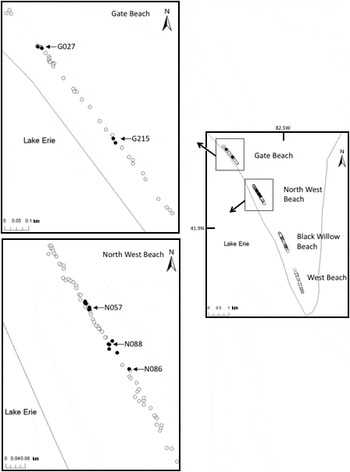
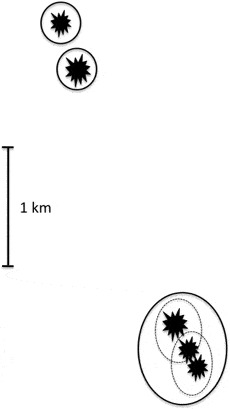
In May–October of 2009, we surveyed for termites in Point Pelee National Park (approximately 41.9°N, 82.5°W) by planting 215 subterranean termite traps. Each trap was made of a single-face, two-ply cardboard roll (10 cm × 10 cm) topped with a plywood lid (15 cm × 15 cm), and buried 5–20 cm below the surface. These traps are an attractive source of food and shelter for foraging termites; similar traps are commonly used to monitor subterranean termite activity (Grace Reference Grace1989). We recorded the location of each trap using a GPS unit (Garmin, eTrex Venture HC, Kansas City, Kansas) and used these data to map termite activity with GIS software (ArcView v9, ESRI Ltd., Redlands, California). Traps were set at points of wood-to-soil contact (i.e., under driftwood, snags, logs, and wood scrap) along the semivegetated foreshore to establish four approximately 1 km survey transects extending the length of Point Pelee—s west beach (Fig. 1). We checked traps periodically throughout the summer and autumn: on 14 June, 3 July, 2 August, 6 September, and 17 October 2009.

Ecological correlates to termite activity
We tested for association between termite activity and the structural qualities of woody debris littered on the beach. Specifically, we tested for association between termite presence and the (i) volume and (ii) state of decay of debris items associated with each trap. For a subsample of debris (n = 46 items) spanning the most heavily infested site (North West Beach) we calculated debris volume using the geometric formula for a cylinder (hχr 2, where h is total measured length, and r is radius of log, inferred from widest measured width), and applied the 5-point decay classification scheme of Hecnar and M—Closkey (Reference Hecnar and M'Closkey1998). This scheme was specifically calibrated to reflect the diversity of decayed wood along the Point Pelee foreshore. A score of 1 indicates mild decay (wood is intact but eroded and bleached), 5 indicates wood in an advanced state of decay (obvious structural decomposition and fragmentation), and intermediate scores represent transitional states of decay. To test whether termite activity was associated with debris of a certain size or decay class, we developed a predictive binary logistic model for termite presence using PASW Statistics (version 18.0, 2009, Chicago, Illinois). We used “volume” and “decay” as continuous and interval level covariates, respectively, in the regression model.
Genetic structure of termite colonies
From polymorphic microsatellite markers available for R. flavipes (Vargo Reference Vargo2000), we obtained the multilocus genotypes of a subsample of termites: one subsample (n = 12 individuals; 4 workers, 4 soldiers, and 4 nymphs) from each spatially distinct cluster of active traps (n = 5 traps; see below). We first extracted genomic DNA from termite heads using a standard Chelex suspension protocol, then we PCR-amplified this template at four microsatellite loci (Rf24-2, Rf11-1, Rf1-3, and Rf15-2) using procedures modified from Vargo (Reference Vargo2000) and Thompson et al. (Reference Thompson, Lenz, Crozier and Crespi2007). Here, we labeled the reverse primers with fluorescent dyes (Rf24-2 and Rf11-1 NED-labeled, Rf1-3 and Rf15-2 FAM-labeled) and scored alleles against a molecular size standard using an ABI 3130 Genetic Analyzer and associated software (Applied Biosystems, Foster City, California).
To estimate colony boundaries from trap-response data, we compared genotype frequencies of termites collected from representative, spatially distinct traps using GENEPOP 4.0.1 (Rousset Reference Rousset2008). Significant pairwise differentiation via exact G tests was interpreted to mean that trapped termites were unlikely to be offspring of the associated colony, whereas nonsignificant pairwise differentiation implied that trapped termites were of the associated or extended colony (Goodisman and Crozier Reference Goodisman and Crozier2002). Further, we directly examined the genotype data from single traps and colonies to determine whether a single pair of reproductives could have produced the observed offspring, or colonies were otherwise polygamous. A monogamous pair should yield offspring genotype ratios consistent with Mendelian pedigree expectations for two diploid parents (cf. Thompson and Hebert Reference Thompson and Hebert1998). Moreover, monogamous colonies should contain no more than four alleles per locus. Polygamous colonies (containing three or more reproductives), by contrast, should deviate from Mendelian ratios and may contain more than four alleles.
Results
Our survey revealed several zones of termite activity. The 16 different traps that captured live termites at least once were not uniformly distributed along transects, but rather were spatially clustered, suggesting subterranean colonies (Fig. 1). Two putative colonies were located at the informally named Gate Beach (traps G027 and G215) while three additional candidate colonies were located at North West Beach (traps N057, N088, and N086). Summing across survey dates, we made a total of 55 observations of live termites in traps. Of the four transects, North West Beach was the most active – it contained the largest number of active traps and represented 93% (51 of 55) of all observations. Gate Beach yielded an additional 4 active traps; transects at Black Willow Beach and West Beach showed no trap evidence of termite activity. However, termites were observed on Black Willow Beach in 2008 (S.J Hecnar and D.R Hecnar, personal observation).
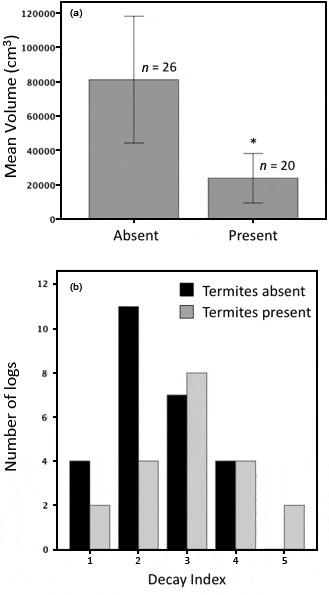
Along the northwest transect, subsampled debris showed considerable variation in size, ranging from 427 to 402180 cm3 with a mean volume of approximately 56000 cm3 (56172.19, SD = 7.67 × 10⁴, n = 46). Our trap-response data indicated that foraging termites show evidence of association by debris volume (Fig. 2A). Specifically, the mean volume of debris associated with trapped termites (23714 cm3, SE = 6878.93, n = 20) was significantly smaller than the remaining volume (81140 cm3, SE = 1.79 × 10⁴, n = 26) of sampled debris associated with termite-free traps (t = 2.68, df = 44, P = 0.010).

Decay indices varied from 1–5 among debris items with a mean decay index of 2.67 (SD = 1.05, n = 46). Trap-response data provided some evidence of association by debris decay class (Fig. 2B). The mean level of decay of debris associated with termite-infested traps (3.00, SE = 0.251, n = 20) was marginally higher than decay of debris associated with termite-free traps (2.42, SE = 0.185, n = 26; t = 1.89, df = 44, P = 0.065). These univariate associations between trap activity and each of two qualities of debris (volume, decay) were captured in our multivariate regression model: debris volume was a strong predictor of trap activity (Wald statistic = 5.787, df = 1, P = 0.016) whereas decay (Wald statistic = 2.988, df = 4, P = 0.084) and volume × decay interactions (Wald statistic = 2.868. df = 4, P = 0.090) were seemingly weak predictors.
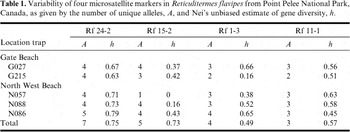
Our population genetic screen revealed modest allelic variation for a geographically isolated population (Point Pelee is bordered by water on 80% of its perimeter). All four loci were variable, with between three (Rf 11-1) and seven (Rf 24-2) alleles, and statistical estimates of gene diversity (Nei—s unbiased estimate of gene diversity; Nei Reference Nei1987) ranged from 0.57 to 0.75 across loci (Table 1), indicating that colonies were generally not fixed for particular alleles. Only one sample of trapped termites was fixed for a single allele (at one locus), whereas all remaining samples carried between two and five different alleles at each of the three loci.

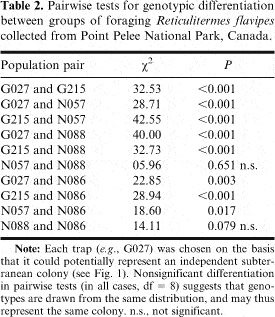
Despite observational data suggesting up to five subterranean colonies (Fig. 1), genetic data were more conservative. Our pairwise tests for genetic differentiation between the five representative traps showed that most traps were significantly differentiated from each other (Table 2), with two exceptions: at North West Beach adjacent traps within this cluster were not significantly differentiated. Specifically, traps N057 versus N088 (χ2 = 5.96, df = 8, P = 0.65) and traps N088 versus N086 (χ2 = 0.14.11, df = 8, P = 0.08) were not significantly differentiated from each other. This pattern of isolation by distance (or, similarity by proximity) suggests that nearest neighbour traps were at least partially connected by tunnels through the soil and were likely an exchange of workers, soldiers, or nymphs. The genetic data therefore suggest at least three functional colonies, two at Gate Beach and a third, polycalic colony of complex genetic structure at North West Beach.
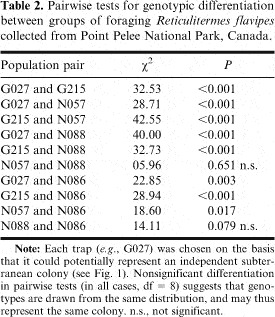
Note: Each trap (e.g., G027) was chosen on the basis that it could potentially represent an independent subterranean colony (see Fig. 1). Nonsignificant differentiation in pairwise tests (in all cases, df = 8) suggests that genotypes are drawn from the same distribution, and may thus represent the same colony. n.s., not significant.
Within each trap sample, the frequency distribution of genotypes suggests that their respective colonies were not monogamous, but rather contained multiple functional reproductives. Monogamous parents can only pass one allele per locus, i.e., there are a finite number of allelic combinations (genotypes) expected among offspring. Both traps (colonies) at Gate Beach showed offspring genotype ratios from at least one locus that qualitatively deviated from these expectations (as inferred from Punnet square analyses, not shown). The three traps (singly or combined) at North West Beach likewise showed offspring genotype ratios that indicate multiple reproductives were active at this sampling location. In addition, trap N086 contained five alleles at one locus (Rf 24-2), indicating that this trap in particular was sampling offspring from more than two unrelated parents.
Discussion
The eastern subterranean termite is the only termite species established in eastern Canada, and is commonly associated with human habitation as a structural pest. In this study, we confirmed free-living R. flavipes colonies in Point Pelee National Park that are not associated with human habitation. Although the subterranean termite colonies at Point Pelee are cryptic, our wood-associated trap survey demonstrated the presence of foraging termites of mixed castes (workers, soldiers, and nymphs; Lainé and Wright Reference Lainé and Wright2003) in association with woody debris, and revealed several zones of termite activity along the park—s western beaches (Fig. 1) in 2009. An analysis of trap response at one location indicated an association between termite activity and smaller sized, moderately decayed woody debris (Fig. 2). Microsatellite DNA analysis suggested the presence of at least three genetically distinct colonies, each likely headed by multiple inbred reproductives (Fig. 3).

Our transect sampling was not comprehensive, but does suggest that northern portions of the western beach (North West and Gate beaches) supported subterranean termites, while populations at the southern portions (Black Willow and West beaches), if present, were not detectable. The two northern beaches may be more favourable to termites because they are characterized by fine sand that retains moisture well, whereas the two southern beaches have coarse, drier substrate. Other terrestrial habitats within the park include dry forest, swamp forest, and cedar-savannas; our visual surveys did not detect termites in these habitats.
Individual trap-response data showed that termite activity was not uniformly distributed along any beach, but was spatially clustered. This pattern is at variance to the seemingly open opportunity for termites to colonize the abundant woody debris scattered more or less uniformly along the foreshore. Studies of laboratory colonies have shown that subterranean termites are well adapted to exploit patchily distributed food: they use geometric search patterns (Robson et al. Reference Robson, Lesniak, Kothandapani, Traniello, Thorne and Fourcassie1995) and nestmate recruitment (Reinhard et al. Reference Reinhard, Hertel and Kaib1997) to locate and colonize choice wood items. We do not know the exact qualities of wood that field colonies of R. flavipes prefer, but at North West Beach termite foraging activity was associated with smaller debris (Fig. 2A). A logistic regression indicated that this preference for smaller size-classes of debris was independent from state of decay (the volume × decay interaction effect was nonsignificant), despite a slight overall trend for termites to colonize debris that was more severely weathered (Fig. 2B). The steady input of driftwood from Lake Erie onto the west beach likely ensures a continuous supply of wood items that termites preferentially colonize, presumably, for food and shelter, as do other termites (Lenz Reference Lenz, Hunt and Nalepa1994). The east beach, by contrast, is isolated from westerly winds and waterborne debris is relatively scarce. This is one potential reason why our visual surveys of the east beach in Point Pelee National Park did not show evidence of termite activity.
It is difficult to delimit colony boundaries because of the cryptic nesting habits of this species. Our trap survey suggested the presence of as many as five spatially distinct colonies (Fig. 1), but because colonies of R. flavipes form spatially diffuse but interconnected nests underground, adjacent traps potentially were sampling workers from the same colony. Our genetic analysis indicated that the observed clustering of active traps generally reflected underlying colonies, but that some of the traps captured genetically related workers that probably were derived from the same colony or extended colony (Table 2). In our Point Pelee study, traps separated by as much as approximately 250 m (e.g., N057 vs. N088) appeared to sample the same underlying colony, whereas traps separated by greater distances showed divergence suggestive of reproductive isolation (Fig. 3).
Forager genotypes within colonies suggested that colonies were headed by multiple secondary reproductives descended from a monogamous pair (i.e., all but one trap contained four or fewer alleles with multilocus genotypes qualitatively deviating from ratios expected for a monogamous pair). Colonies G027 and G215 had more than four genotype classes (the maximum under diploid monogamy), as did all three traps, singly or in colony combination, at North West Beach. The presence of multiple reproductives with four or fewer alleles is consistent with multiple inbred neotenics having been recruited from within their natal nest, as is typical for this species (Thorne et al. Reference Thorne, Traniello, Adams and Bulmer1999; Lainé and Wright Reference Lainé and Wright2003), especially at the northern extent of its range (Grace Reference Grace1996; Vargo Reference Vargo2006). In these cases, we do not know exactly how many parents contribute. The presence of more than four alleles in trap N086 samples was exceptional and indicated that this trap contained termites descended from more than two unrelated parents. This result may also have indicated a fusion of two colonies, creating a genetically complex group.
It is not known if the termites of Point Pelee are native or introduced (Urquhart Reference Urquhart1953; Husby Reference Husby1980). Introduction of a small number of founding termites may have resulted in low genetic diversity in the founding population. We found limited evidence for this, with three, four, five, and seven alleles found at each locus among all Point Pelee populations collectively. This number of alleles could indicate as few as four reproductive founding individuals. Regardless of how they were established, colonies of R. flavipes seem to have retained a perennial foothold at Point Pelee, where the cool, humid temperate climate (9.2°C annual mean temperature, 809 mm total annual precipitation (Environment Canada 2011)) enables free-living colonies to persist year-round, independent from human habitation. The presence of colonies of R. flavipes in this nonurban environment contrasts with their invasive nature in many Ontario municipalities, including Toronto, where damage to man-made wooden structures on the Toronto lakefront was first reported in 1938 (Urquhart Reference Urquhart1953). If the extant population of R. flavipes in Point Pelee is descended from a population first reported from this region in 1929 and 1931 (Reference WatsonWatson 1949), then they are the oldest known eastern subterranean termite population in Ontario.
Acknowledgements
We thank Tammy Dobbie and other Point Pelee National Park staff for their continued interest and support, and Imran Tayyab and David Scaduto for help with fieldwork and molecular-data collection. We also thank Tim Myles, Ken Grace, and Helene LeVasseur-Viens for helpful comments on the manuscript. This work is supported by Discovery Grants (Natural Sciences and Engineering Research Council of Canada) to G.J.T. and S.J.H., an Academic Development Fund Grant (University of Western Ontario) to G.J.T., and Parks Canada contract support to S.J.H. This research was conducted in accordance with Parks Canada Research and Collection Permit No. PP-2008–1863. Voucher specimens will be deposited in the University of Guelph Insect Collection.