


1. Introduction
Let S be an fs log scheme,
 $(\mathrm{fs}/S)$
the category of fs log schemes over S. We endow
 $(\mathrm{fs}/S)$
with the Kummer log flat topology (resp. the classical flat topology, resp. the classical étale topology), see [
Reference Kato5
, section 2] (resp. [
Reference Kato5
, section 4], resp. [
Reference Illusie4
, section 2·4]), and denote the resulting site by
 $(\mathrm{fs}/S)_{\mathrm{kfl}}$
(resp.
 $(\mathrm{fs}/S)_{\mathrm{fl}}$
, resp.
 $(\mathrm{fs}/S)_{\acute{\mathrm{e}\mathrm{t}}})$
Footnote
1
. We have a canonical map
 \begin{equation*}\varepsilon_{\mathrm{fl}}:(\mathrm{fs}/S)_{\mathrm{kfl}}\to (\mathrm{fs}/S)_{\mathrm{fl}}\end{equation*}
of sites. To understand the cohomology of a sheaf of abelian groups F on the site
 $(\mathrm{fs}/S)_{\mathrm{kfl}}$
, one needs to understand the higher direct images
 $R^i\varepsilon_{\mathrm{fl}*}F$
.
The first higher direct image
 $R^1\varepsilon_{\mathrm{fl}*}F$
has been determined by Kato when S is locally noetherian and F is either a finite flat (commutative) group scheme or a smooth affine (commutative) group scheme over the underlying scheme of S, see [
Reference Kato5
, theorem 4·1] or [
Reference Nizioł11
, theorem 3·12]. Kato’s theorem about
 $R^1\varepsilon_{\mathrm{fl}*}F$
has been generalised to quasi-projective smooth (commutative) group schemesFootnote
2
by the author, see [
Reference Zhao17
, theorem 3·14].
Assume that the underlying scheme of S is locally noetherian. The second higher direct image
 $R^2\varepsilon_{\mathrm{fl}*}F$
has been described in [
Reference Zhao17
, theorem 3·23] (resp. [
Reference Zhao18
, theorem 1·2], resp. [
Reference Zhao18
, theorem 1·3], resp. [
Reference Zhao18
, theorem 1·4]) when F is representable by a torus (resp. a smooth affine commutative group scheme, resp. a finite flat commutative group scheme, resp. an extension of an abelian scheme by a torus) over the underlying scheme of S. When F is representable by a smooth quasi-projective commutative group scheme, the higher direct images are always torsion by [
Reference Zhao18
, theorem 1·1].
The above results all make use of the Čech cohomologies of F which can be turned into Hochschild cohomologies of certain group schemes with coefficients in F. When F is representable by a group scheme of the aforementioned types, such Hochschild cohomologies are often easy to compute in degree
 $i=1$
, complicated but doable in degree
 $i=2$
, and unreachable in degree
 $i\gt 2$
in general. However if we assume that F is representable by a group scheme which is étale locally isomorphic to either a finite dimension
 ${\mathbb Q}$
-vector space, or a finite rank free abelian group, or a finite abelian group, such Čech cohomologies can be alternatively transformed to abstract finite group cohomologies which can be determined explicitly, see Lemma 2·1. Such transformations are related to F being an étale group scheme and are usually not possible for general group schemes. Therefore we are able to determine
 $R^i\varepsilon_{\mathrm{fl}*}F$
for all
 $i\gt 0$
under these assumptions. The main results are the following three theorems presented in Section 2.
Theorem 1·1 (See also Theorem 2·10). Let S be a locally noetherian fs log scheme. Let l be a prime number, U the open locus on S where l is invertible, and
 $j:U\hookrightarrow S$
the corresponding strict open immersion. Let F be a finite étale group scheme over the underlying scheme of S, and we endow it with the induced log structure from S. Assume that F is killed by an l-power, then we have
 \begin{equation*}R^i\varepsilon_{\mathrm{fl}*}F\cong j_{\mathrm{fl!}}((j_{\mathrm{kfl}}^{-1}F)(-i)\otimes_{{\mathbb Z}}\bigwedge^i(\mathbb{G}_{\mathrm{m,log}}/\mathbb{G}_{\mathrm{m}})_{U_{\mathrm{fl}}})\end{equation*}
for
 $i\geq1$
, where
 $j_{\mathrm{kfl}}:(\mathrm{fs}/U)_{\mathrm{kfl}}\to (\mathrm{fs}/S)_{\mathrm{kfl}}$
(resp.
 $j_{\mathrm{fl}}:(\mathrm{fs}/U)_{\mathrm{fl}}\to (\mathrm{fs}/S)_{\mathrm{fl}}$
) is the morphism on the Kummer log flat sites (resp. the classical flat sites) induced by j,
 $j_{\mathrm{kfl}}^{-1}F$
is regarded as a sheaf on
 $(\mathrm{fs}/U)_{\mathrm{fl}}$
, and
 $(\mathbb{G}_{\mathrm{m,log}}/\mathbb{G}_{\mathrm{m}})_{U_{\mathrm{fl}}}$
denotes the quotient of
 $\mathbb{G}_{\mathrm{m,log}}$
by
 $\mathbb{G}_{\mathrm{m}}$
on
 $(\mathrm{fs}/U)_{\mathrm{fl}}$
.
Theorem 1·2 (See also Theorem 2·11) Let S be an fs log scheme. Let F be a group scheme over the underlying scheme of S which is étale locally representable by a finite dimensional
 ${\mathbb Q}$
-vector space. Then we have
 $R^i\varepsilon_{\mathrm{fl}*}F=0$
for
 $i\geq 1$
.
Theorem 1·3 (See also Theorem 2·12) Let S be a locally noetherian fs log scheme, and F a group scheme over the underlying scheme of S which is étale locally isomorphic to a finite rank free abelian group. Then we have the following:
-
(i)
 $R^1\varepsilon_{\mathrm{fl}*}F=0;$
-
(ii) Let
$i\gt 1$
. For each prime number l, let
$U_l$
be the locus on S on which l is invertible and
${}_lj:U_l\hookrightarrow S$
the corresponding strict open immersion. Then where
\begin{align*}R^i\varepsilon_{\mathrm{fl}*}F&\cong\bigoplus_{l\text{ prime}}R^{i-1}\varepsilon_{\mathrm{fl}*}(F\otimes_{\mathbb Z}{\mathbb Q}_l/{\mathbb Z}_l) \\&\cong \bigoplus_{l\text{ prime}}{}_lj_{\mathrm{fl}!}({}_lj_{\mathrm{kfl}}^{-1}F\otimes_{\mathbb Z}{\mathbb Q}_l/{\mathbb Z}_l(-i+1)\otimes_{{\mathbb Z}}\bigwedge^{i-1}(\mathbb{G}_{\mathrm{m,log}}/\mathbb{G}_{\mathrm{m}})_{(U_{l})_{\mathrm{fl}}}),\end{align*}
${}_lj_{\mathrm{kfl}}^{-1}F$
is regarded as a sheaf on
$(\mathrm{fs}/U_l)_{\mathrm{fl}}$
, and
$(\mathbb{G}_{\mathrm{m,log}}/\mathbb{G}_{\mathrm{m}})_{(U_l)_{\mathrm{fl}}}$
denotes the quotient of
$\mathbb{G}_{\mathrm{m,log}}$
by
$\mathbb{G}_{\mathrm{m}}$
on
$(\mathrm{fs}/U_l)_{\mathrm{fl}}$
.





The proof of Theorem 1·3 is reduced to Theorem 1·1 and Theorem 1·2 via the short exact sequence
 \begin{equation*}0\to F\to F\otimes_{{\mathbb Z}}{\mathbb Q}\to F\otimes_{{\mathbb Z}}{\mathbb Q}/{\mathbb Z}\to 0.\end{equation*}
Apparently the vanishing of
 $R^i\varepsilon_{\mathrm{fl}*}F$
in Theorem 1·2 is reduced to the vanishing of
 $H^i_{\mathrm{kfl}}(X,F)$
for any
 $X\in(\mathrm{fs}/S)$
such that the underlying scheme of X is
 $\mathop{\mathrm{Spec}} R$
with R a strictly henselian local ring. For the proof of Theorem 1·1, we first construct a canonical map
 \begin{equation*}\Phi: j_{\mathrm{fl}!}R^i\varepsilon_{\mathrm{fl}*}j_{\mathrm{kfl}}^{-1}F\to R^i\varepsilon_{\mathrm{fl}*}F,\end{equation*}
see (B·2), then determine
 $R^i\varepsilon_{\mathrm{fl}*}j_{\mathrm{kfl}}^{-1}F$
(note that the order of F is invertible on U), and finally prove that
 $\Phi$
is an isomorphism. The main computation tools are Čech cohomology, the Čech-to-derived functor spectral sequence, and the Leray spectral sequence.
In Section 3, we apply the results from Section 2 to make some computations on Kummer log flat cohomology when the base is a standard log trait or a Dedekind scheme endowed with the log structure associated to a finite set of closed points.
An application. Theorem 1·3 (i) can be used to prove that log abelian varieties with constant degeneration are sheaves for the Kummer log flat topology. According to [
Reference Kajiwara, Kato and Nakayama6
, Def. 3·3], a log abelian variety with constant degeneration A over an fs log scheme S is a sheaf on
 $(\mathrm{fs}/S)_{\acute{\mathrm{e}\mathrm{t}}}$
which is isomorphic to the quotient sheaf
 $G_{\mathrm{log}}^{(Y)}/Y$
for a pointwise polarisable log 1-motive
 $[Y\xrightarrow{u}G_{\mathrm{log}}]$
over S. One can consider
 $G_{\mathrm{log}}^{(Y)}$
as a uniformisation of A, and Y as the corresponding periods lattice. It is not surprising that Y is important for understanding A. Indeed we have
 $R^1\varepsilon_{\mathrm{fl}*}Y=0$
by Theorem 1·3 (i), and this vanishing is used in [
Reference Zhao16
, theorem 2·1 (1)] to prove that A is a sheaf for the Kummer log flat topology.
In fact Theorem 1·3 (i) is just [ Reference Zhao16 , lemma 2·4]. However the proof loc. cit. makes use of fpqc descent for which the author did not give a reference (such a reference could be [ 14 , lemma 0APK]). The original motivation of this paper is to present a new proof to [ Reference Zhao16 , lemma 2·4] without using fpqc descent.
2. The higher direct images
We give a few lemmas first.
Lemma 2·1. Let X be an fs log scheme. We make the following assumption on X, as well as some constructions associated to X.
-
* The underlying scheme of X is
$\mathop{\mathrm{Spec}} R$
with R a strictly henselian local ring. Let x denote the closed point, k the residue field of R, p the characteristic of k, and
$P_X\to M_X$
a chart of the log structure of X with P an fs monoid, such that
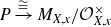
$P\xrightarrow{\cong}M_{X,x}/\mathcal{O}_{X,x}^{\times}$
. Let
$P^{1/n}$
denote the monoid P regarded as a monoid above P via the homomorphism
$P\xrightarrow{n} P$
. Let be endowed with the canonical log structure associated to
\begin{equation*}X_n\,:\!=\,X\times_{\mathop{\mathrm{Spec}}{\mathbb Z}[P]}\mathop{\mathrm{Spec}}{\mathbb Z}[P^{1/n}]\end{equation*}
$P^{1/n}$
and let
$H_n$
denote the group scheme
$\mathop{\mathrm{Spec}} {\mathbb Z}[(P^{1/n})^{\mathrm{gp}}/P^{\mathrm{gp}}]$
over
$\mathop{\mathrm{Spec}}{\mathbb Z}$
, then
$X_n$
is a Kummer log flat cover of X such that and it is even a Kummer log étale cover in case
\begin{equation*}X_n\times_XX_n\cong X_n\times_{\mathop{\mathrm{Spec}}{\mathbb Z}}H_n,\end{equation*}
$(p,n)=1$
.







Let F be the constant group scheme over
 $\mathop{\mathrm{Spec}} R$
associated to an abelian group which we also denote by F by abuse of notation, and we write
 $n=m\cdot p^t$
with
 $(m,p)=1$
. Then we have an isomorphism
 \begin{equation*}\check{H}_{\mathrm{kfl}}^i(X_n/X,F)\cong H^i(H_m(X),F),\end{equation*}
where the first term is the i-th Čech cohomology of F with respect to the cover
 $X_n/X$
, and the second term is the abstract group cohomology of the abstract group
 $H_m(X)$
with coefficients in F.
In particular, we have the following:
-
(i)
$\check{H}_{\mathrm{kfl}}^i(X_n/X,{\mathbb Q})=0$
for
$i\gt 0;$
-
(ii)
$\check{H}_{\mathrm{kfl}}^1(X_n/X,{\mathbb Z})=0$
and
$\check{H}_{\mathrm{kfl}}^i(X_n/X,{\mathbb Z})$
is torsion and p-torsion-free for
$i\gt 0;$
-
(iii) the canonical map
is an isomorphism for
\begin{equation*}\check{H}_{\mathrm{kfl}}^i(X_m/X,{\mathbb Z})\xrightarrow{\cong}\check{H}_{\mathrm{kfl}}^i(X_n/X,{\mathbb Z})\end{equation*}
$i\gt 0;$
-
(iv) suppose that F is killed by a power of p, then
\begin{equation*}\varinjlim_n\check{H}_{\mathrm{kfl}}^i(X_n/X,F)=0;\end{equation*}
-
(v) suppose that F is torsion and p-torsion-free, then
for
\begin{equation*}\varinjlim_n\check{H}_{\mathrm{kfl}}^i(X_n/X,F)\cong\varinjlim_n H^i(H_m(X),F)\cong F(-i)\otimes_{{\mathbb Z}}\bigwedge^iP^{\mathrm{gp}}\end{equation*}
$i\gt 0$
.





Proof. Since R is a strictly henselian local ring,
 $X\times_{\mathop{\mathrm{Spec}}{\mathbb Z}}H_m^r$
is the constant group scheme over X associated to the abstract group
 $H_m(X)^r$
and
 $X\times_{\mathop{\mathrm{Spec}}{\mathbb Z}}H_{p^t}^r$
is a connected group scheme over X, therefore we have
 \begin{align*}\Gamma(\underbrace{X_n\times_X\cdots\times_XX_n}_{(r+1)\text{-times}},F)=&\Gamma(X_n\times_{\mathop{\mathrm{Spec}}{\mathbb Z}}H_n^r,F) \\=&\Gamma((X_n\times_{\mathop{\mathrm{Spec}}{\mathbb Z}}H_{p^t}^r)\times_X(X\times_{\mathop{\mathrm{Spec}}{\mathbb Z}}H_m^r),F)\\=&\Gamma(\coprod_{h\in H_m(X)^r}X_n\times_{\mathop{\mathrm{Spec}}{\mathbb Z}}H_{p^t}^r,F) \\=&\prod_{h\in H_m(X)^r}\Gamma(X_n\times_{\mathop{\mathrm{Spec}}{\mathbb Z}}H_{p^t}^r,F) \\=&\mathrm{Map}(H_m(X)^r,F),\end{align*}
where the last equality follows from the fact that
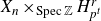 $X_n\times_{\mathop{\mathrm{Spec}}{\mathbb Z}}H_{p^t}^r$
as a scheme is connected and F is a constant group scheme. We consider the Čech complex
 \begin{equation}\Gamma(X_n,F)\xrightarrow{d_0}\Gamma(X_n\times_XX_n,F)\xrightarrow{d_1}\Gamma(X_n\times_XX_n\times_XX_n,F)\xrightarrow{d_2}\cdots\end{equation}
for F with respect to the cover
 $X_n/X$
. Let
 $\Gamma_n\,:\!=\,(P^{\frac{1}{n}})^{\mathrm{gp}}/P^{\mathrm{gp}}$
. By [
Reference Milne9
, Chap. III, Example 2·6], the Čech nerve of the Kummer log flat cover
 $X_n/X$
can be identified with the sequence

where the map
 $d_{r,i}$
on the ring level is given by the R-linear ring homomorphism
 \begin{align*}R\otimes_{{\mathbb Z}[P]}{\mathbb Z}[P^{\frac{1}{n}}\oplus\Gamma_n^{r-1}]&\rightarrow R\otimes_{{\mathbb Z}[P]}{\mathbb Z}[P^{\frac{1}{n}}\oplus\Gamma_n^{r}] \\(a,\bar{a}_1,\ldots,\bar{a}_{r-1})&\mapsto\begin{cases} (a,\bar{a},\bar{a}_1,\ldots,\bar{a}_{r-1}),&\text{if}\quad {i=0;} \\(a,\bar{a}_1,\ldots,\bar{a}_{i},\bar{a}_i,\ldots,\bar{a}_{r-1}),&\text{if}\quad 0\lt i\lt r; \\ (a,\bar{a}_1,\ldots,\bar{a}_{r-1},0),&\text{if}\quad i=r;\end{cases}\end{align*}
for any
 $(a,\bar{a}_1,\ldots,\bar{a}_{r-1})\in P^{\frac{1}{n}}\oplus\Gamma_n^{r-1}$
. If
 $m=1$
, i.e.
 $n=p^t$
, we have
 $$ \Gamma(X_{p^t}\times_{\mathop{\mathrm{Spec}}{\mathbb Z}}H_{p^t}^r,F)=F.$$
The map
 $$ d_{r,i}^*:\Gamma(X_{p^t}\times_{\mathop{\mathrm{Spec}}{\mathbb Z}}H_{p^t}^{r-1},F)\rightarrow \Gamma(X_{p^t}\times_{\mathop{\mathrm{Spec}}{\mathbb Z}}H_{p^t}^r,F)$$
is clearly just the identity map
 $\mathrm{Id}:F\rightarrow F$
. In general, the map
 \begin{equation*}d_{r,i}^*:\Gamma(X_{n}\times_{\mathop{\mathrm{Spec}}{\mathbb Z}}H_{n}^{r-1},F)\rightarrow \Gamma(X_{n}\times_{\mathop{\mathrm{Spec}}{\mathbb Z}}H_{n}^r,F)\end{equation*}
can be identified with the map
 \begin{equation*} \mathrm{Map}(H_m(X)^{r-1},F)\xrightarrow{\partial_{r,i}} \mathrm{Map}(H_m(X)^r,F)\end{equation*}
which maps
 $f\in \mathrm{Map}(H_m(X)^{r-1},F)$
to
 \begin{equation*}\partial_{r,i}(f):(h_1,\ldots,h_r)\mapsto\begin{cases}f(h_2,\ldots,\ldots,h_r), &\text{if}\quad i=0; \\f(h_1,\ldots,h_i+h_{i+1},\ldots,h_r), &\text{if}\quad 0\lt i\lt r; \\f(h_1,\ldots\ldots,h_{r-1}), &\text{if}\quad i=r.\end{cases}\end{equation*}
Therefore the complex (2·1) can be identified with the standard complex
 \begin{equation*}F\rightarrow \mathrm{Map}(H_m(X),F)\rightarrow \mathrm{Map}(H_m(X)^2,F)\rightarrow\cdots\end{equation*}
which computes the abstract group cohomology of the trivial
 $H_m(X)$
-module F. It follows that
 $\check{H}_{\mathrm{kfl}}^i(X_n/X,F)\cong H^i(H_m(X),F)$
.
In particular, we have part (i), part (ii) and part (iv) by the corresponding results for the abstract group cohomology
 $H^i(H_m(X),F)$
. Part (iii) is also clear by the construction of the isomorphism
 $\check{H}_{\mathrm{kfl}}^i(X_n/X,F)\cong H^i(H_m(X),F)$
.
We are left with part (v). We have
 \begin{align*}\varinjlim_n\check{H}_{\mathrm{kfl}}^i(X_n/X,F)\cong&\varinjlim_{n=mp^t \text{with} (p,m)=1} H^i(H_m(X),F) \\\overset{(\textrm{iii})}{=}&\varinjlim_{(p,m)=1} H^i(H_m(X),F) \\=\, &H^i(\varprojlim_{(p,m)=1}H_m(X),F) \\=\, &H^i(\mathrm{Hom}(P^{\mathrm{gp}},\hat{{\mathbb Z}'}(1)),F). \\[-10pt]\end{align*}
By the description of the profinite group cohomology of
 $(\hat{{\mathbb Z}'})^r$
from Lemma C·1, we further have
 \begin{align*}\varinjlim_n\check{H}_{\mathrm{kfl}}^i(X_n/X,F)\cong&H^i(\mathrm{Hom}(P^{\mathrm{gp}},\hat{{\mathbb Z}'}(1)),F) \\=&\varinjlim_{(n,p)=1}H^i(\mathrm{Hom}(P^{\mathrm{gp}},\hat{{\mathbb Z}'}(1)),F[n]) \\=&\varinjlim_{(n,p)=1}F[n]\otimes_{{\mathbb Z}/n{\mathbb Z}}H^i(\mathrm{Hom}(P^{\mathrm{gp}},\hat{{\mathbb Z}'}(1)),{\mathbb Z}/n{\mathbb Z}) \\=&\varinjlim_{(n,p)=1}F[n]\otimes_{{\mathbb Z}/n{\mathbb Z}}\bigwedge^iH^1(\mathrm{Hom}(P^{\mathrm{gp}},\hat{{\mathbb Z}'}(1)),{\mathbb Z}/n{\mathbb Z}) \\=&\varinjlim_{(n,p)=1}F[n]\otimes_{{\mathbb Z}/n{\mathbb Z}}\bigwedge^i\mathrm{Hom}(\mathrm{Hom}(P^{\mathrm{gp}},\hat{{\mathbb Z}'}(1)),{\mathbb Z}/n{\mathbb Z}) \\=&\varinjlim_{(n,p)=1}F[n]\otimes_{{\mathbb Z}/n{\mathbb Z}}(\bigwedge^iP^{\mathrm{gp}}\otimes_{{\mathbb Z}}{\mathbb Z}/n{\mathbb Z}(-1)) \\=&F(-i)\otimes_{{\mathbb Z}}\bigwedge^iP^{\mathrm{gp}}\end{align*}
for
 $i\gt 0$
. This finishes the proof of part (v).
Remark 2·2. In the proof of Lemma 2·1 (v), one can use Lemma C·1 to get
 \begin{equation*}H^i(\mathrm{Hom}(P^{\mathrm{gp}},\hat{{\mathbb Z}'}(1)),F)\cong F\otimes_{{\mathbb Z}}\bigwedge^iP^{\mathrm{gp}}\end{equation*}
directly. However we repeat the proof of Lemma C·1 here in order to keep track of the Tate twist.
Lemma 2·3. Let X and
 $X_n$
be as in Lemma 2·1. Let F be a sheaf on
 $(\mathrm{fs}/X)_{\mathrm{kfl}}$
. Then the family
 $\mathscr{X}_{{\mathbb N}}\,:\!=\,\{X_n\rightarrow X\}_{n\geq1}$
of Kummer log flat covers of X satisfies the condition (L3) from [
Reference Artin1
, Chap. I, Sec. 1, page 7]Footnote
3
, whence a Čech-to-derived functor spectral sequence
 \begin{equation}E_2^{i,j}=\check{H}_{\mathrm{kfl}}^i(\mathscr{X}_{{\mathbb N}},\underline{H}_{\mathrm{kfl}}^j(F))\Rightarrow H^{i+j}_{\mathrm{kfl}}(X,F),\end{equation}
where
 $$ \check{H}_{\mathrm{kfl}}^i(\mathscr{X}_{{\mathbb N}},-)\,:\!=\,\varinjlim_{n\geq1}\check{H}_{\mathrm{kfl}}^i(X_n/X,-).$$
Proof. This follows from [ Reference Artin1 , Chap. II, Sec. 3, (3·3), page 37].
Definition 2·4. Let S be an fs log scheme, and let
 $(\mathrm{st}/S)$
be the full subcategory of
 $(\mathrm{fs}/S)$
consisting of strict objects over S. We endow
 $(\mathrm{st}/S)$
with the classical flat topology, i.e. a family
 $(U_i\xrightarrow{f_i} U)$
inside
 $(\mathrm{st}/S)$
is a covering if and only if
 is a jointly surjective family of finite presentation flat morphisms of schemes, where
 denotes the underlying map of schemes of
 $f_i$
. We denote the resulting site by
 $(\mathrm{st}/S)_{\mathrm{fl}}$
.
A nice thing about the Čech cohomology with respect to all coverings, is that the zero-th cohomology vanishes, see [
Reference Zhao17
, Prop. 3·1]. This is often very useful for computations. This is of course not the case for the Čech cohomology with respect to an arbitrary family. The following lemma is about the vanishing of the zero-th Čech cohomology for the covering family
 $\mathscr{X}_{\mathbb N}$
from Lemma 2·3 under a suitable assumption.
Lemma 2·5. Let X and
 $X_n$
be as in Lemma 2·1. Let F be a sheaf on
 $(\mathrm{fs}/X)_{\mathrm{kfl}}$
, and N a non-negative integer. Assume that for any
 $U\in(\mathrm{fs}/X)$
and any
 $0\leq i\leq N$
, the restriction of the flat sheaf
 $R^i\varepsilon_{\mathrm{fl}*}F$
to
 $(\mathrm{st}/U)_{\mathrm{fl}}$
is the inverse image of some sheaf on the small étale site of U, i.e. it lies in the image of the functor
 $a_U^{-1}$
from [
14
, lemma 0DDU]. Then we have
 \begin{equation*}\varinjlim_{n\geq1}H_{\mathrm{kfl}}^i(X_n,F)=0\end{equation*}
for any
 $0\lt i\leq N+1$
, in particular
 $\varinjlim_{n\geq1}\check{H}_{\mathrm{kfl}}^0(X_n/X,\underline{H}_{\mathrm{kfl}}^i(F))=0$
for any
 $0\lt i\leq N+1$
.
Proof. Let i be an integer such that
 $0\lt i\leq N+1$
. It suffices to show that for any
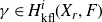 $\gamma\in H_{\mathrm{kfl}}^{i}(X_r,F)$
there exists s such that
 $\gamma$
goes to zero in
 $H_{\mathrm{kfl}}^{i}(X_{rs},F)$
.
By [
Reference Zhao17
, Prop. 3·1], we can find a Kummer log flat cover
 $T\rightarrow X_r$
such that
 $\gamma$
dies in
 $H_{\mathrm{kfl}}^{i}(T,F)$
. By [
Reference Nizioł11
, Cor. 2·16], we may assume that for some s, we have a factorisation
 $T\rightarrow X_{rs}\rightarrow X_r$
with
 $T\rightarrow X_{rs}$
a classical flat cover. It follows that the pull-back
 $\gamma_s$
of
 $\gamma$
to
 $X_{rs}$
is trivialised by a classical flat cover, i.e.
 $$ \gamma_s\in\mathrm{ker}(H_{\mathrm{kfl}}^{i}(X_{rs},F)\rightarrow H_{\mathrm{fl}}^0(X_{rs},R^{i}\varepsilon_{\mathrm{fl}*}F)).$$
By our assumption on the flat sheaf
 $R^j\varepsilon_{\mathrm{fl}*}F$
for any
 $0\leq j\leq N$
, we get
 \begin{equation*}H^a_{\mathrm{fl}}(X_{rs},R^j\varepsilon_{\mathrm{fl}*}F)=H^a_{\acute{\mathrm{e}\mathrm{t}}}(X_{rs},R^j\varepsilon_{\mathrm{fl}*}F)=0\end{equation*}
for any
 $a\gt 0$
and any
 $0\leq j\leq N$
by [
14
, lemma 0DDU]. Therefore the Leray spectral sequence
 \begin{equation*}E_2^{u,v}=H^u_{\mathrm{fl}}(X_{rs},R^v\varepsilon_{\mathrm{fl}*}F)\Rightarrow H^{v+v}_{\mathrm{kfl}}(X_{rs},F),\end{equation*}
implies that
 $\gamma_s=0$
. This finishes the proof.
Remark 2·6. The condition on
 $R^i\varepsilon_{\mathrm{fl}*}F$
in Lemma 2·5 is used to reduce the flat cohomology of
 $R^i\varepsilon_{\mathrm{fl}*}F$
to its étale cohomology. Such a condition is satisfied in the situation of Lemma 2·8 by its statement.
In the set-up of Lemma 2·5, the following lemma shows that
 $H^a_{\mathrm{kfl}}(X_{n,d},F)$
is determined only by
 $R^a\varepsilon_{\mathrm{fl}*}F$
for
 $0\lt a\lt N+1$
, where
 $X_{n,d}$
denotes the fiber product of
 $d+1$
copies of
 $X_n$
over X. Apparently this is useful for computations on the spectral sequence (2·2).
Lemma 2·7. Let the set-up be as in Lemma 2·5, and let
 $X_{n,d}$
denote the fiber product of
 $d+1$
copies of
 $X_n$
over X. Then we have
 \begin{equation*}H^a_{\mathrm{kfl}}(X_{n,d},F)=\Gamma(X_{n,d},R^a\varepsilon_{\mathrm{fl}*}F)\end{equation*}
for
 $0\lt a\lt N+1$
.
Proof. We have
 $X_{n,d}=H_n^d\times_{\mathop{\mathrm{Spec}}{\mathbb Z}}X_n=(H_n)_{X}^d\times_XX_n$
, where
 \begin{equation*}H_n\,:\!=\,\mathop{\mathrm{Spec}}{\mathbb Z}[(P^{1/n})^{\mathrm{gp}}/P^{\mathrm{gp}}]\end{equation*}
and
 $(H_n)_X\,:\!=\,H_n\times_{\mathop{\mathrm{Spec}}{\mathbb Z}}X$
. Note that
 $(H_n)_X$
is the constant group scheme associated to the abstract group
 $H_n(X)$
over X if
 $(n,p)=1$
. We write
 $n=p^r\cdot n'$
with
 $(p,n')=1$
, then we have
 \begin{equation*}X_{n,d}=(H_{n'})_{X}^d\times_X((H_{p^r})_{X}^d\times_XX_n).\end{equation*}
Thus
 \begin{align*}H^u_{\mathrm{fl}}(X_{n,d},R^{v}\varepsilon_{\mathrm{fl}*}F)&=H^u_{\acute{\mathrm{e}\mathrm{t}}}(X_{n,d},R^{v}\varepsilon_{\mathrm{fl}*}F) \\&=\prod_{x\in H_{n'}(X)^d}H^u_{\acute{\mathrm{e}\mathrm{t}}}((H_{p^r})_{X}^d\times_XX_n,R^{v}\varepsilon_{\mathrm{fl}*}F)\end{align*}
for
 $0\leq v\leq N$
. Since
 $X=\mathop{\mathrm{Spec}} R$
is strictly henselian local, so is
 $X_n$
. Since p is the characteristic of the residue field of R, we further have that
 $(H_{p^r})_{X}^d\times_XX_n$
is strictly henselian local. It follows that
 \begin{equation*}H^u_{\mathrm{fl}}(X_{n,d},R^{v}\varepsilon_{\mathrm{fl}*}F)=\prod_{x\in H_{n'}(X)^d}H^u_{\acute{\mathrm{e}\mathrm{t}}}((H_{p^r})_{X}^d\times_XX_n,R^{v}\varepsilon_{\mathrm{fl}*}F) =0\end{equation*}
for
 $1\leq u$
and
 $0\leq v\leq N$
. Therefore the result follows from the Leray spectral sequence
 $E_2^{u,v}=H^u_{\mathrm{fl}}(X_{n,d},R^v\varepsilon_{\mathrm{fl}*}F)\Rightarrow H^{u+v}_{\mathrm{kfl}}(X_{n,d},F)$
.
2·1. Case of finite abelian groups of prime power order
Lemma 2·8. Let l be a prime number, and S a locally noetherian fs log scheme on which l is invertible. Let F be a finite étale group scheme over the underlying scheme of S, endowed with the induced log structure from S. Assume that F is killed by
 $l^r$
for some positive integer r, then we have
 \begin{equation*}R^i\varepsilon_{\mathrm{fl}*}F\cong F(-i)\otimes_{{\mathbb Z}}\bigwedge^i(\mathbb{G}_{\mathrm{m,log}}/\mathbb{G}_{\mathrm{m}})_{S_{\mathrm{fl}}}\end{equation*}
for
 $i\gt 0$
.
Proof. The proof is analogous to that of [ Reference Kato and Nakayama8 , theorem 2·4]. By Kato’s theorem, see [ Reference Kato5 , theorem 4·1], we have an isomorphism
 \begin{equation*}R^1\varepsilon_{\mathrm{fl}*}F\cong\mathcal{H}om({\mathbb Z}/l^r{\mathbb Z}(1),F)\otimes_{{\mathbb Z}}(\mathbb{G}_{\mathrm{m,log}}/\mathbb{G}_{\mathrm{m}})_{S_{\mathrm{fl}}}=F(-1)\otimes_{{\mathbb Z}}(\mathbb{G}_{\mathrm{m,log}}/\mathbb{G}_{\mathrm{m}})_{S_{\mathrm{fl}}}.\end{equation*}
Using cup-product, this isomorphism induces a homomorphism
 \begin{equation*}\varphi_i:F(-i)\otimes_{{\mathbb Z}}\bigwedge^i(\mathbb{G}_{\mathrm{m,log}}/\mathbb{G}_{\mathrm{m}})_{S_{\mathrm{fl}}}\to F\otimes_{{\mathbb Z}}R^i\varepsilon_{\mathrm{fl}*}{\mathbb Z}/l^r{\mathbb Z}\to R^i\varepsilon_{\mathrm{fl}*}F.\end{equation*}
To finish the proof, it suffices to prove that
 $\varphi_i$
is an isomorphism for
 $i\geq1$
which we will prove by induction.
Base case. The case
 $i=1$
is just Kato’s theorem.
Inductive step. Let N be a positive integer, and assume that
 $\varphi_i$
is an isomorphism for any
 $1\leq i\leq N$
. We are going to show that
 $\varphi_{N+1}$
is also an isomorphism. The map
 $\varphi_{N+1}$
induces a map
 \begin{equation*}\phi_{N+1}:\Gamma(X,F(-N-1))\otimes_{\mathbb Z}\bigwedge^{N+1}P^\mathrm{gp}\rightarrow H^{N+1}_{\mathrm{kfl}}(X,F)\end{equation*}
for any
 $X\in(\mathrm{fs}/S)$
satisfying the assumption
 $({*})$
in Lemma 2·1. It suffices to show that
 $\phi_{N+1}$
is an isomorphism.
In the spectral sequence (2·2)
 \begin{equation*}E_2^{u,v}=\varinjlim_n\check{H}_{\mathrm{kfl}}^{u}(X_n/X,\underline{H}_{\mathrm{kfl}}^v(F))\Rightarrow H^{u+v}_{\mathrm{kfl}}(X,F),\end{equation*}
the terms
 $E_2^{u,v}$
with
 $u+v\leq N+1$
and
 $v\neq0$
vanish (see the picture below for an illustration of the vanishing situation of
 $E_2^{u,v}$
) by Lemma 2·9 below.

Therefore the canonical map
 $\varinjlim_n\check{H}_{\mathrm{kfl}}^{N+1}(X_n/X,F)\xrightarrow{\cong}H^{N+1}_{\mathrm{kfl}}(X,F)$
is an isomorphism. Thus we can identify
 $\phi_{N+1}$
as a map
 \begin{equation*}\Gamma(X,F(-N-1))\otimes_{\mathbb Z}\bigwedge^{N+1}P^\mathrm{gp}\rightarrow \varinjlim_n\check{H}_{\mathrm{kfl}}^{N+1}(X_n/X,F),\end{equation*}
and still call the resulting map
 $\phi_{N+1}$
. Since both
 $\phi_{N+1}$
and the isomorphisms of Lemma 2·1 (v) are constructed via cup-product, they agree. In particular
 $\phi_{N+1}$
is an isomorphism. This finishes the induction step.
Lemma 2·9. Let the set-up be as in the inductive step of the proof of Lemma 2·8. Then we have
 $E_2^{u,v}=0$
for
 $0\lt v\leq N+1$
in the spectral sequence (2·2).
Proof. We denote by
 $X_{n,d}$
the fiber product of
 $d+1$
copies of
 $X_n$
over X. We have
 $X_{n,d}=H_n^d\times_{\mathop{\mathrm{Spec}}{\mathbb Z}}X_n=(H_n)_{X}^d\times_XX_n$
, where
 $H_n\,:\!=\,\mathop{\mathrm{Spec}}{\mathbb Z}[(P^{1/n})^{\mathrm{gp}}/P^{\mathrm{gp}}]$
and
 $(H_n)_X\,:\!=\,H_n\times_{\mathop{\mathrm{Spec}}{\mathbb Z}}X$
. Note that
 $(H_n)_X$
is the constant group scheme associated to the abstract group
 $H_n(X)$
over X if
 $(n,p)=1$
.
We compute the Čech cohomology groups
 $\check{H}_{\mathrm{kfl}}^u(X_n/X,\underline{H}_{\mathrm{kfl}}^v(F))$
for
 $0\lt v\leq N+1$
. Let
 $n=p^r\cdot n'$
with
 $(p,n')=1$
, then we have
 $$ X_{n,d}=(H_{n'})_{X}^d\times_X((H_{p^r})_{X}^d\times_XX_n)$$
and
 \begin{align*}H_{\mathrm{kfl}}^v(X_{n,d},F)&=\prod_{a\in H_{n'}(X)^d}H_{\mathrm{kfl}}^v((H_{p^r})_{X}^d\times_XX_n,F) \\&=\mathrm{Map}(H_{n'}(X)^d,H_{\mathrm{kfl}}^v((H_{p^r})_{X}^d\times_XX_{n},F)).\end{align*}
By the inductive hypothesis from the proof of Lemma 2·8, the assumption of Lemma 2·5 is satisfied. Thus by Lemma 2·7, we have
 \begin{align*}H_{\mathrm{kfl}}^v((H_{p^r})_{X}^d\times_XX_{n},F)=&\Gamma((H_{p^r})_{X}^d\times_XX_{n},R^v\varepsilon_{\mathrm{fl}*}F) \\=&\Gamma((H_{p^r})_{X}^d\times_XX_{n},F(-v)\otimes_{{\mathbb Z}}\bigwedge^v(\mathbb{G}_{\mathrm{m,log}}/\mathbb{G}_{\mathrm{m}})_{S_{\mathrm{fl}}}) \\=&\Gamma(X,F(-v))\otimes_{{\mathbb Z}}\bigwedge^v(P^{\frac{1}{n}})^{\mathrm{gp}} \\=&H_{\mathrm{kfl}}^v(X_{n},F).\end{align*}
It follows that
 $H_{\mathrm{kfl}}^v(X_{n,d},F)=\mathrm{Map}(H_{n'}(X)^d,H_{\mathrm{kfl}}^v(X_{n},F))$
. The Čech complex for
 $\underline{H}_{\mathrm{kfl}}^v(F)$
with respect to the cover
 $X_{n}/X$
can be identified with the standard complex that computes the group cohomology of
 $H_{\mathrm{kfl}}^v(X_{n},F)$
regarded as a trivial
 $H_{n'}(X)$
-module, hence we get
 $\check{H}_{\mathrm{kfl}}^u(X_{n}/X,\underline{H}_{\mathrm{kfl}}^v(F))=H^u(H_{n'}(X),H_{\mathrm{kfl}}^v(X_{n},F))$
. Therefore
 \begin{align*}\varinjlim_{n}\check{H}_{\mathrm{kfl}}^u(X_n/X,\underline{H}_{\mathrm{kfl}}^v(F))=&\varinjlim_{n=p^r\cdot n'} H^u(H_{n'}(X),H_{\mathrm{kfl}}^v(X_{n},F)) \\=&H^u(\varprojlim_{n'}H_{n'}(X),\varinjlim_{n=p^r\cdot n'}H_{\mathrm{kfl}}^v(X_{n},F)),\end{align*}
where the second identification follows from [
Reference Serre13
, Chap. I, Section 2, Prop. 8]. By Lemma 2·5 we have
 $\varinjlim_{n}H_{\mathrm{kfl}}^v(X_{n},F)=0$
, and thus
 $E_2^{u,v}=\varinjlim_{n}\check{H}_{\mathrm{kfl}}^u(X_n/X,\underline{H}_{\mathrm{kfl}}^v(F))=0$
for
 $0\lt v\leq N+1$
. This finishes the proof of the lemma.
Theorem 2·10. Let S be a locally noetherian fs log scheme. Let l be a prime number, U the open locus on S where l is invertible, and
 $j:U\hookrightarrow S$
the corresponding strict open immersion. Let F be a finite étale group scheme over the underlying scheme of S, and we endow it with the induced log structure from S. Assume that F is killed by
 $l^r$
for some integer
 $r\geq1$
, then for
 $i\gt 0$
we have that
 $R^i\varepsilon_{\mathrm{fl}*}F$
is supported on U and
 \begin{equation*}R^i\varepsilon_{\mathrm{fl}*}F\cong j_{\mathrm{fl!}}((j_{\mathrm{kfl}}^{-1}F)(-i)\otimes_{{\mathbb Z}}\bigwedge^i(\mathbb{G}_{\mathrm{m,log}}/\mathbb{G}_{\mathrm{m}})_{U_{\mathrm{fl}}}).\end{equation*}
Proof. We use induction on i.
Base case. First of all we consider the case
 $i=1$
. By Kato’s theorem [
Reference Kato5
, theorem 4·1] we have
 $R^1\varepsilon_{\mathrm{fl}*}F\cong \mathcal{H}om({\mathbb Z}/l^r{\mathbb Z}(1),F)\otimes_{{\mathbb Z}}(\mathbb{G}_{\mathrm{m,log}}/\mathbb{G}_{\mathrm{m}})_{S_{\mathrm{fl}}}$
. Since F is finite étale,
 $R^1\varepsilon_{\mathrm{fl}*}F$
is supported on U. By Proposition B·4, we get
 $R^1\varepsilon_{\mathrm{fl}*}F\cong j_{\mathrm{fl!}}R^1\varepsilon_{\mathrm{fl}*}j_{\mathrm{kfl}}^{-1}F$
. By Lemma 2·8, we have
 $R^1\varepsilon_{\mathrm{fl}*}j_{\mathrm{kfl}}^{-1}F\cong (j_{\mathrm{kfl}}^{-1}F)(-1)\otimes_{{\mathbb Z}}(\mathbb{G}_{\mathrm{m,log}}/\mathbb{G}_{\mathrm{m}})_{U_{\mathrm{fl}}}$
. So the statement holds for the case
 $i=1$
.
Inductive step. Assume that the statement holds for all
 $0\lt i\leq N$
. We are going to prove that it also holds for
 $i=N+1$
. By Proposition B·4 and Lemma 2·8, it suffices to show that
 $R^{N+1}\varepsilon_{\mathrm{fl}*}F$
is supported on U. Further it suffices to show that
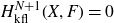 $H^{N+1}_{\mathrm{kfl}}(X,F)=0$
for any
 $X\in(\mathrm{fs}/S)$
satisfying the assumption
 $({*})$
in Lemma 2·1 with
 $p=l$
.
Let
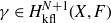 $\gamma\in H^{N+1}_{\mathrm{kfl}}(X,F)$
. By [
Reference Zhao17
, Prop. 3·1], we can find a Kummer log flat cover
 $T\rightarrow X$
such that
 $\gamma$
dies in
 $H_{\mathrm{kfl}}^{N+1}(T,F)$
. By [
Reference Nizioł11
, Cor. 2·16], we may assume that for some m, we have a factorisation
 $T\rightarrow X_m\rightarrow X$
with
 $T\rightarrow X_m$
a classical flat cover. It follows that the pull-back
 $\gamma_m$
of
 $\gamma$
to
 $X_m$
is trivialised by a classical flat cover, i.e.
 $$ \gamma_m\in\mathrm{ker}(H_{\mathrm{kfl}}^{N+1}(X_m,F)\rightarrow H_{\mathrm{fl}}^0(X_m,R^{N+1}\varepsilon_{\mathrm{fl}*}F)).$$
Note that
 $X_m$
also satisfies the assumption
 $({*})$
in Lemma 2·1 with
 $p=l$
.
For
 $0\lt i\leq N$
we have
 $R^i\varepsilon_{\mathrm{fl}*}F\cong j_{\mathrm{fl!}}((j_{\mathrm{kfl}}^{-1}F)(-i)\otimes_{{\mathbb Z}}\bigwedge^i(\mathbb{G}_{\mathrm{m,log}}/\mathbb{G}_{\mathrm{m}})_{U_{\mathrm{fl}}})$
by induction hypothesis, and thus the restriction of
 $R^i\varepsilon_{\mathrm{fl}*}F$
to
 $(\mathrm{st}/X_m)_{\mathrm{fl}}$
is the inverse image of some sheaf on the small étale site of
 $X_m$
. Thus
 \begin{equation*}H^a_{\mathrm{fl}}(X_m,R^i\varepsilon_{\mathrm{fl}*}F)\cong H^a_{\acute{\mathrm{e}\mathrm{t}}}(X_m,R^i\varepsilon_{\mathrm{fl}*}F)\end{equation*}
by [
14
, lemma 0DDU] for
 $0\lt i\leq N$
. Let x denote the closed point of
 $X_m$
. By Gabber’s theorem [
14
, theorem 09ZI], we get
 $H^a_{\acute{\mathrm{e}\mathrm{t}}}(X_m,R^i\varepsilon_{\mathrm{fl}*}F)\cong H^a_{\acute{\mathrm{e}\mathrm{t}}}(x,R^i\varepsilon_{\mathrm{fl}*}F)$
for
 $0\lt i\leq N$
. Since
 $R^i\varepsilon_{\mathrm{fl}*}F$
is supported on U by induction hypothesis and x is not above U, we get
 $H^a_{\mathrm{fl}}(X_m,R^i\varepsilon_{\mathrm{fl}*}F)\cong H^a_{\acute{\mathrm{e}\mathrm{t}}}(x,R^i\varepsilon_{\mathrm{fl}*}F)=0$
for
 $0\lt i\leq N$
. We also have
 $H^{N+1}_{\mathrm{fl}}(X_m,F)=H^{N+1}_{\acute{\mathrm{e}\mathrm{t}}}(X_m,F)=0$
. Thus the Leray spectral sequence
 $$ E_2^{i,j}=H^i_{\mathrm{fl}}(X_m,R^j\varepsilon_{\mathrm{fl}*}F)\Rightarrow H^{i+j}_{\mathrm{kfl}}(X_m,F)$$
implies that
 $\gamma_m=0$
.
It follows that
 \begin{equation*}\gamma\in \mathrm{Ker}(H^{N+1}_{\mathrm{kfl}}(X,F)\to \varinjlim_n\check{H}^0_{\mathrm{kfl}}(X_n/X,\underline{H}^{N+1}_{\mathrm{kfl}}(F))).\end{equation*}
Therefore to show that
 $\gamma$
is itself zero, it suffices to show that
 \begin{equation*}\varinjlim_n\check{H}^i_{\mathrm{kfl}}(X_n/X,\underline{H}^{N+1-i}_{\mathrm{kfl}}(F))=0\end{equation*}
for
 $0\lt i\leq N+1$
. By Lemma 2·1 (iv), we are left with the case
 $0\lt i\lt N+1$
. Further it suffices to show that
 $\check{H}^i_{\mathrm{kfl}}(X_n/X,\underline{H}^{N+1-i}_{\mathrm{kfl}}(F))=0$
for any
 $0\lt i\lt N+1$
and any n.
Let
 $n=l^rn'$
with
 $(l,n')=1$
, then we have
 $H_{n'}\times_{\mathop{\mathrm{Spec}}{\mathbb Z}}X_n$
is a constant group over
 $X_n$
and
 \begin{equation*}\underbrace{X_n\times_X\cdots\times_XX_n}_{\text{(d+1)-folded}}=X_n\times_{\mathop{\mathrm{Spec}}{\mathbb Z}} H_n^d=\coprod_{a\in H_{n'}(X)^d}X_n\times_{\mathop{\mathrm{Spec}}{\mathbb Z}} H_{l^r}^d\end{equation*}
with
 $X_n\times_{\mathop{\mathrm{Spec}}{\mathbb Z}} H_{l^r}^d$
satisfying the assumption
 $({*})$
in Lemma 2·1 with
 $p=l$
. By the same argument showing
 $\gamma_m=0$
, one can also show that
 \begin{equation*}H^{N+1-i}_{\mathrm{kfl}}(X_n\times_{\mathop{\mathrm{Spec}}{\mathbb Z}} H_{l^r}^d,F)=0\end{equation*}
for any
 $0\lt i\lt N+1$
and any
 $d\geq0$
. Thus
 \begin{equation*}H^{N+1-i}_{\mathrm{kfl}}(\underbrace{X_n\times_X\cdots\times_XX_n}_{\text{$(d+1)$-folded}},F)=0\end{equation*}
for any
 $0\lt i\lt N+1$
and any
 $d\geq0$
. It follows that
 $\check{H}^i_{\mathrm{kfl}}(X_n/X,\underline{H}^{N+1-i}_{\mathrm{kfl}}(F))=0$
for any
 $0\lt i\lt N+1$
and any n. Therefore
 $\gamma=0$
, and thus
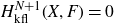 $H^{N+1}_{\mathrm{kfl}}(X,F)=0$
. This shows that
 $R^{N+1}\varepsilon_{\mathrm{fl}*}F$
is supported on U.
Conclusion. The theorem is proven.
2·2. Case of rational vector spaces
In this subsection, we consider the case that F is étale locally isomorphic to a finite dimensional
 ${\mathbb Q}$
-vector space.
Theorem 2·11. Let S be an fs log scheme. Let F be a group scheme over the underlying scheme of S which is étale locally representable by a finite dimensional
 ${\mathbb Q}$
-vector space. Then we have
 $R^i\varepsilon_{\mathrm{fl}*}F=0$
for
 $i\geq 1$
.
Proof. It suffices to consider the case
 $F={\mathbb Q}$
. We use induction on i.
Base case. First of all we consider the case
 $i=1$
. It suffices to show that
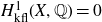 $H^1_{\mathrm{kfl}}(X,{\mathbb Q})=0$
for any
 $X\in(\mathrm{fs}/S)$
which satisfies the assumption
 $({*})$
in Lemma 2·1. The spectral sequence (2·2) gives rise to an exact sequence
 \begin{equation*}0\to \varinjlim_{n\geq1}\check{H}_{\mathrm{kfl}}^1(X_n/X,{\mathbb Q})\to H_{\mathrm{kfl}}^1(X,{\mathbb Q})\to \varinjlim_{n\geq1}\check{H}_{\mathrm{kfl}}^0(X_n/X,\underline{H}_{\mathrm{kfl}}^1({\mathbb Q})).\end{equation*}
By Lemma 2·1 (i), we have
 $\varinjlim_{n\geq1}\check{H}_{\mathrm{kfl}}^1(X_n/X,{\mathbb Q})=0$
. By Lemma 2·5, we have
 $\varinjlim_{n\geq1}\check{H}_{\mathrm{kfl}}^0(X_n/X,\underline{H}_{\mathrm{kfl}}^1({\mathbb Q}))=0$
. Hence
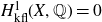 $H_{\mathrm{kfl}}^1(X,{\mathbb Q})=0$
, and thus
 $R^1\varepsilon_{\mathrm{fl}*}{\mathbb Q}=0$
.
Inductive step. Let N be a positive integer, and assume that
 $R^i\varepsilon_{\mathrm{fl}*}{\mathbb Q}=0$
for any
 $1\leq i\leq N$
. We are going to prove that
 $R^{N+1}\varepsilon_{\mathrm{fl}*}{\mathbb Q}=0$
. It suffices to show that
 $H^{N+1}_{\mathrm{kfl}}(X,{\mathbb Q})=0$
for any
 $X\in(\mathrm{fs}/S)$
which satisfies the assumption
 $({*})$
in Lemma 2·1.
By the inductive hypothesis and Lemma 2·5, we have
 \begin{equation*}\varinjlim_{n\geq1}\check{H}^0_{\mathrm{kfl}}(X_n/X,\underline{H}^{N+1}_{\mathrm{kfl}}({\mathbb Q}))=0.\end{equation*}
By the spectral sequence (2·2), to show that
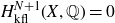 $H^{N+1}_{\mathrm{kfl}}(X,{\mathbb Q})=0$
, it suffices to show that
 \begin{equation*}\varinjlim_{n\geq1}\check{H}^i_{\mathrm{kfl}}(X_n/X,\underline{H}^{N+1-i}_{\mathrm{kfl}}({\mathbb Q}))=0\end{equation*}
for
 $0\lt i\leq N+1$
. By Lemma 2·1 (i), we are left with the case
 $0\lt i\lt N+1$
. Further it suffices to show that
 $\check{H}^i_{\mathrm{kfl}}(X_n/X,\underline{H}^{N+1-i}_{\mathrm{kfl}}({\mathbb Q}))=0$
for any
 $0\lt i\lt N+1$
and any n. Since
 $R^t\varepsilon_{\mathrm{fl}*}{\mathbb Q}=0$
for
 $1\leq t\leq N$
and
 \begin{equation*}H^r_{\mathrm{fl}}(\underbrace{X_n\times_X\cdots\times_XX_n}_{\text{$(d+1)$-folded}},{\mathbb Q})=H^r_{\mathrm{fl}}(X_n\times_{\mathop{\mathrm{Spec}}{\mathbb Z}} H_n^d,{\mathbb Q})=H^r_{\acute{\mathrm{e}\mathrm{t}}}(X_n\times_{\mathop{\mathrm{Spec}}{\mathbb Z}} H_n^d,{\mathbb Q})=0\end{equation*}
for any
 $r\gt 0$
and any
 $d\geq0$
, the Leray spectral sequence
 $$ E_2^{u,v}=H^u_{\mathrm{fl}}(\underbrace{X_n\times_X\cdots\times_XX_n}_{\text{$(d+1)$-folded}},R^v\varepsilon_{\mathrm{fl}*}{\mathbb Q})\Rightarrow H^{u+v}_{\mathrm{kfl}}(\underbrace{X_n\times_X\cdots\times_XX_n}_{\text{$(d+1)$-folded}},{\mathbb Q})$$
implies that
 $H^{N+1-i}_{\mathrm{kfl}}(\underbrace{X_n\times_X\cdots\times_XX_n}_{\text{$(d+1)$-folded}},{\mathbb Q})=0$
for any
 $0\lt i\lt N+1$
and any
 $d\geq0$
. It follows that
 $\check{H}^i_{\mathrm{kfl}}(X_n/X,\underline{H}^{N+1-i}_{\mathrm{kfl}}({\mathbb Q}))=0$
for any
 $0\lt i\lt N+1$
and any n. Therefore
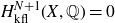 $H^{N+1}_{\mathrm{kfl}}(X,{\mathbb Q})=0$
. This finishes the proof of
 $R^{N+1}\varepsilon_{\mathrm{fl}*}{\mathbb Q}=0$
.
Conclusion. The theorem is proven.
2·3. Case of finite rank torsion-free abelian groups
Theorem 2·12. Let S be a locally noetherian fs log scheme, and F a group scheme over the underlying scheme of S which is étale locally isomorphic to a finite rank free abelian group. Then we have the following:
-
(i)
$R^1\varepsilon_{\mathrm{fl}*}F=0;$
-
(ii) Let
$i\gt 1$
. For each prime number l, let
$U_l$
be the locus on S on which l is invertible and
${}_lj:U_l\hookrightarrow S$
the corresponding strict open immersion. Then
\begin{align*}R^i\varepsilon_{\mathrm{fl}*}F&\cong\bigoplus_{l\text{ prime}}R^{i-1}\varepsilon_{\mathrm{fl}*}(F\otimes_{\mathbb Z}{\mathbb Q}_l/{\mathbb Z}_l) \\&\cong \bigoplus_{l\text{ prime}}{}_lj_{\mathrm{fl}!}({}_lj_{\mathrm{kfl}}^{-1}F\otimes_{\mathbb Z}{\mathbb Q}_l/{\mathbb Z}_l(-i+1)\otimes_{{\mathbb Z}}\bigwedge^{i-1}(\mathbb{G}_{\mathrm{m,log}}/\mathbb{G}_{\mathrm{m}})_{(U_{l})_{\mathrm{fl}}}).\end{align*}


Proof. Applying the functor
 $\varepsilon_{\mathrm{fl}*}$
to the short exact sequence
 \begin{equation*}0\to F\to F\otimes_{{\mathbb Z}}{\mathbb Q}\to \bigoplus_{l\text{ prime}}F\otimes_{{\mathbb Z}}{\mathbb Q}_l/{\mathbb Z}_l\to 0\end{equation*}
of sheaves of abelian groups on
 $(\mathrm{fs}/S)_{\mathrm{kfl}}$
, we get a long exact sequence
 \begin{align*}0\to &F\to F\otimes_{{\mathbb Z}}{\mathbb Q}\to \bigoplus_{l\text{ prime}}F\otimes_{{\mathbb Z}}{\mathbb Q}_l/{\mathbb Z}_l\to R^1\varepsilon_{\mathrm{fl}*}F\to R^1\varepsilon_{\mathrm{fl}*}(F\otimes_{{\mathbb Z}}{\mathbb Q})\to\cdots \\\to &R^{i-1}\varepsilon_{\mathrm{fl}*}(F\otimes_{{\mathbb Z}}{\mathbb Q})\to \bigoplus_{l\text{ prime}}R^{i-1}\varepsilon_{\mathrm{fl}*}(F\otimes_{{\mathbb Z}}{\mathbb Q}_l/{\mathbb Z}_l)\to R^i\varepsilon_{\mathrm{fl}*}F \\\to &R^{i}\varepsilon_{\mathrm{fl}*}(F\otimes_{{\mathbb Z}}{\mathbb Q})\to\cdots .\end{align*}
By Theorem 2·11, we get an exact sequence
 \begin{equation*}0\to F\to F\otimes_{{\mathbb Z}}{\mathbb Q}\to \bigoplus_{l\text{ prime}}F\otimes_{{\mathbb Z}}{\mathbb Q}_l/{\mathbb Z}_l\to R^1\varepsilon_{\mathrm{fl}*}F\to0\end{equation*}
and
 \begin{equation}\bigoplus_{l\text{ prime}}R^{i-1}\varepsilon_{\mathrm{fl}*}(F\otimes_{{\mathbb Z}}{\mathbb Q}_l/{\mathbb Z}_l)\xrightarrow{\cong} R^i\varepsilon_{\mathrm{fl}*}F\end{equation}
for
 $i\gt 1$
.
Since the map
 $F\otimes_{{\mathbb Z}}{\mathbb Q}\to \bigoplus_{l\text{ prime}}F\otimes_{{\mathbb Z}}{\mathbb Q}_l/{\mathbb Z}_l$
remains surjective on
 $(\mathrm{fs}/S)_{\mathrm{fl}}$
, we get
 $R^1\varepsilon_{\mathrm{fl}*}F=0$
.
Part (ii) follows from the isomorphism (2·3) and Theorem 2·10.
3. Examples
3·1. Some general results
Lemma 3·1. Let X be a locally noetherian fs log scheme, and let F be a group scheme over the underlying scheme of X which is étale locally isomorphic to a finite rank free abelian group. We endow F with the induced log structure from X. Then we have:
-
(i) an isomorphism
$H^1_{\mathrm{fl}}(X,F)\xrightarrow{\cong}H^1_{\mathrm{kfl}}(X,F);$
-
(ii) and an exact sequence
(3·1)
\begin{equation}0\to H^2_{\mathrm{fl}}(X,F)\rightarrow H^2_{\mathrm{kfl}}(X,F)\to H^0_{\mathrm{fl}}(X,R^2\varepsilon_{\mathrm{fl}*}F)\to H^3_{\mathrm{fl}}(X,F)\to H^3_{\mathrm{kfl}}(X,F).\end{equation}


Proof. The results follow from the Leray spectral sequence
 \begin{equation*}E_2^{i,j}=H^i_{\mathrm{fl}}(X,R^j\varepsilon_{\mathrm{fl}*}F)\Rightarrow H^{i+j}_{\mathrm{kfl}}(X,F)\end{equation*}
and the vanishing of
 $R^1\varepsilon_{\mathrm{fl}*}F$
from Theorem 2·12 (i).
Proposition 3·2. Let X be an fs log scheme whose underlying scheme is noetherian and normal. Then we have
 \begin{equation*}H^1_{\mathrm{kfl}}(X,{\mathbb Z})=0.\end{equation*}
Proof. This follows from the isomorphism from Lemma 3·1 (i) and the vanishing of
 $H^1_{\mathrm{fl}}(X,{\mathbb Z})$
from [
Reference Colliot-Thélene and Skorobogatov2
, Chapter 2, Prop. 2·4·2].
Lemma 3·3. Let X, F be as in Lemma 3·1, and we further assume that the ranks of the stalks of the étale sheaf
 $M_X^{\mathrm{gp}}/\mathcal{O}_X^{\times}$
are at most one. Then the exact sequence (3·1) can be extended further as
 \begin{align*}0&\to H^2_{\mathrm{fl}}(X,F)\to H^2_{\mathrm{kfl}}(X,F)\to H^0_{\mathrm{fl}}(X,R^2\varepsilon_{\mathrm{fl}*}F) \\&\to H^3_{\mathrm{fl}}(X,F)\to H^3_{\mathrm{kfl}}(X,F) \to H^1_{\mathrm{fl}}(X,R^2\varepsilon_{\mathrm{fl}*}F)\to\cdots \\&\to H^i_{\mathrm{fl}}(X,F)\to H^i_{\mathrm{kfl}}(X,F)\to H^{i-2}_{\mathrm{fl}}(X,R^2\varepsilon_{\mathrm{fl}*}F)\to\cdots .\end{align*}
Proof. By Theorem 2·12 (i), we have
 $R^1\varepsilon_{\mathrm{fl}*}F=0$
. By Theorem 2·12 (ii) and our assumption, the restriction of
 $R^i\varepsilon_{\mathrm{fl}*}F$
to
 $(\mathrm{st}/X)_{\mathrm{fl}}$
vanishes for
 $i\gt 2$
. Then the result is an easy exercise on the spectral sequence
 $E_2^{i,j}=H^i_{\mathrm{fl}}(X,R^j\varepsilon_{\mathrm{fl}*}F)\Rightarrow H^{i+j}_{\mathrm{kfl}}(X,F)$
.
Lemma 3·4. Let X be as in Lemma 3·3. Let F be a finite étale group scheme over the underlying scheme of X, endowed with the induced log structure from X. Then we have a long exact sequence
 \begin{align*}0&\to H^1_{\mathrm{fl}}(X,F)\to H^1_{\mathrm{kfl}}(X,F)\to H^0_{\mathrm{fl}}(X,R^1\varepsilon_{\mathrm{fl}*}F) \\&\to H^2_{\mathrm{fl}}(X,F)\to H^2_{\mathrm{kfl}}(X,F) \to H^1_{\mathrm{fl}}(X,R^1\varepsilon_{\mathrm{fl}*}F)\to\cdots \\&\to H^i_{\mathrm{fl}}(X,F)\to H^i_{\mathrm{kfl}}(X,F)\to H^{i-1}_{\mathrm{fl}}(X,R^1\varepsilon_{\mathrm{fl}*}F)\to\cdots .\end{align*}
Proof. By Theorem 2·10 and our assumption, the restriction of
 $R^i\varepsilon_{\mathrm{fl}*}F$
to
 $(\mathrm{st}/X)_{\mathrm{fl}}$
vanishes for
 $i\gt 1$
. Then the result is an easy exercise on the spectral sequence
 $E_2^{i,j}=H^i_{\mathrm{fl}}(X,R^j\varepsilon_{\mathrm{fl}*}F)\Rightarrow H^{i+j}_{\mathrm{kfl}}(X,F)$
.
3·2. Excellent henselian discrete valuation rings
Throughout this subsection, let R be an excellent henselian discrete valuation ring with fraction field K and residue field k. Assume that k is of positive characteristic p. Let
 $\pi$
be a uniformiser of R, and we endow
 $X=\mathop{\mathrm{Spec}} R$
with the log structure associated to the homomorphism
 ${\mathbb N}\rightarrow R,1\mapsto\pi$
. Let x be the closed point of X and i the closed immersion
 $x\hookrightarrow X$
, and we endow x with the induced log structure from X. Let
 $\eta$
be the generic point of X and j the open immersion
 $\eta\hookrightarrow X$
.
Example 3·5. Let F be a group scheme over the underlying scheme of X which is étale locally isomorphic to a finite rank free abelian group. We have
 \begin{equation*}H^1_{\mathrm{fl}}(X,F)\xrightarrow{\cong} H^1_{\mathrm{kfl}}(X,F)\end{equation*}
by Lemma 3·1 (i). Clearly X satisfies the assumption on log structure from Lemma 3·3, thus we get a long exact sequence
 \begin{align*}0&\to H^2_{\mathrm{fl}}(X,F)\to H^2_{\mathrm{kfl}}(X,F)\to H^0_{\mathrm{fl}}(X,R^2\varepsilon_{\mathrm{fl}*}F) \\&\to H^3_{\mathrm{fl}}(X,F)\to H^3_{\mathrm{kfl}}(X,F) \to H^1_{\mathrm{fl}}(X,R^2\varepsilon_{\mathrm{fl}*}F)\to\cdots \\&\to H^i_{\mathrm{fl}}(X,F)\to H^i_{\mathrm{kfl}}(X,F)\to H^{i-2}_{\mathrm{fl}}(X,R^2\varepsilon_{\mathrm{fl}*}F)\to\cdots .\end{align*}
Apparently the log structure of X is supported on the closed point x and the restriction of
 $(\mathbb{G}_{\mathrm{m,log}}/\mathbb{G}_{\mathrm{m}})_{X_{\mathrm{fl}}}$
to
 $(\mathrm{st}/X)_{\mathrm{fl}}$
is isomorphic to
 $i_*{\mathbb Z}$
. Since the only non-invertible prime on X is p, the restriction of
 $R^2\varepsilon_{\mathrm{fl}*}F$
to
 $(\mathrm{st}/X)_{\mathrm{fl}}$
is isomorphic to
 $i_*(F\otimes_{\mathbb Z}({\mathbb Q}/{\mathbb Z})'(-1))$
, where
 $({\mathbb Q}/{\mathbb Z})'$
denotes the prime to p part of
 ${\mathbb Q}/{\mathbb Z}$
. Thus we have
 \begin{align*}H^u_{\mathrm{fl}}(X,R^2\varepsilon_{\mathrm{fl}*}F)&=H^u_{\mathrm{fl}}(x,F\otimes_{\mathbb Z}({\mathbb Q}/{\mathbb Z})'(-1)) \\&=H^u_{\acute{\mathrm{e}\mathrm{t}}}(x,F\otimes_{\mathbb Z}({\mathbb Q}/{\mathbb Z})'(-1)) \\&=H^u(\mathrm{Gal}(k^{\mathrm{s}}/k),F\otimes_{\mathbb Z}({\mathbb Q}/{\mathbb Z})'(-1)),\end{align*}
where
 $k^{\mathrm{s}}$
is a separable closure of k and the second identification follows from [
14
, lemma 0DDU]. We also have
 \begin{align*}H^u_{\mathrm{fl}}(X,F)\cong H^u_{\acute{\mathrm{e}\mathrm{t}}}(X,F)\cong H^u_{\acute{\mathrm{e}\mathrm{t}}}(x,F)\cong H^u(\mathrm{Gal}(k^{\mathrm{s}}/k),F),\end{align*}
where the first identification also follows from [ 14 , lemma 0DDU] and the second identification follows from [ Reference Milne10 , Chap. II, Prop. 1·1 (b)] (here we need the condition that R is henselian and excellent as in loc. cit.). Thus we have
 \begin{equation*}H^1_{\mathrm{kfl}}(X,F)\cong H^1(\mathrm{Gal}(k^{\mathrm{s}}/k),F), \end{equation*}
and the above exact sequence can be rewritten as
 \begin{equation}\begin{split}0&\to H^2(\mathrm{Gal}(k^{\mathrm{s}}/k),F)\to H^2_{\mathrm{kfl}}(X,F)\to H^0(\mathrm{Gal}(k^{\mathrm{s}}/k),F\otimes_{\mathbb Z}({\mathbb Q}/{\mathbb Z})'(-1)) \\&\to H^3(\mathrm{Gal}(k^{\mathrm{s}}/k),F)\to H^3_{\mathrm{kfl}}(X,F) \to H^1(\mathrm{Gal}(k^{\mathrm{s}}/k),F\otimes_{\mathbb Z}({\mathbb Q}/{\mathbb Z})'(-1))\to\cdots \\&\to H^i(\mathrm{Gal}(k^{\mathrm{s}}/k),F)\to H^i_{\mathrm{kfl}}(X,F)\to H^{i-2}(\mathrm{Gal}(k^{\mathrm{s}}/k),F\otimes_{\mathbb Z}({\mathbb Q}/{\mathbb Z})'(-1))\to\cdots\end{split}\end{equation}
Assume that the cohomological dimension of k is d, then we have
 \begin{equation*}H^u(\mathrm{Gal}(k^{\mathrm{s}}/k),F)=0\end{equation*}
for
 $u\gt d+1$
and
 \begin{equation*}H^u(\mathrm{Gal}(k^{\mathrm{s}}/k),F\otimes_{\mathbb Z}({\mathbb Q}/{\mathbb Z})'(-1))=0\end{equation*}
for
 $u\gt d$
. Thus we have an exact sequence
 \begin{align*}0&\to H^2(\mathrm{Gal}(k^{\mathrm{s}}/k),F)\to H^2_{\mathrm{kfl}}(X,F)\to H^0(\mathrm{Gal}(k^{\mathrm{s}}/k),F\otimes_{\mathbb Z}({\mathbb Q}/{\mathbb Z})'(-1)) \\&\to H^3(\mathrm{Gal}(k^{\mathrm{s}}/k),F)\to H^3_{\mathrm{kfl}}(X,F) \to H^1(\mathrm{Gal}(k^{\mathrm{s}}/k),F\otimes_{\mathbb Z}({\mathbb Q}/{\mathbb Z})'(-1))\to\cdots \\&\to H^{d+1}(\mathrm{Gal}(k^{\mathrm{s}}/k),F)\to H^{d+1}_{\mathrm{kfl}}(X,F)\to H^{d-1}(\mathrm{Gal}(k^{\mathrm{s}}/k),F\otimes_{\mathbb Z}({\mathbb Q}/{\mathbb Z})'(-1)) \\&\to0,\end{align*}
an isomorphism
 \begin{equation*}H^{d+2}_{\mathrm{kfl}}(X,F)\xrightarrow{\cong}H^d(\mathrm{Gal}(k^{\mathrm{s}}/k),F\otimes_{\mathbb Z}({\mathbb Q}/{\mathbb Z})'(-1)),\end{equation*}
and
 \begin{equation*}H^i_{\mathrm{kfl}}(X,F)=0\end{equation*}
for
 $i\geq d+3$
by the exact sequence (3·2).
Moreover we assume that k is finite, then
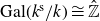 $\mathrm{Gal}(k^{\mathrm{s}}/k)\cong\hat{{\mathbb Z}}$
and
 $d=1$
. Thus we have an exact sequence
 \begin{align*}0&\to H^2(\hat{{\mathbb Z}},F)\to H^2_{\mathrm{kfl}}(X,F)\to H^0(\hat{{\mathbb Z}},F\otimes_{\mathbb Z}({\mathbb Q}/{\mathbb Z})'(-1)) \to 0,\end{align*}
an isomorphism
 \begin{equation*}H^{3}_{\mathrm{kfl}}(X,F)\cong H^1(\hat{{\mathbb Z}},F\otimes_{\mathbb Z}({\mathbb Q}/{\mathbb Z})'(-1)),\end{equation*}
and
 \begin{equation*}H^i_{\mathrm{kfl}}(X,F)=0\end{equation*}
for
 $i\geq 4$
.
Example 3·6. Let F be a finite étale group scheme over the underlying scheme of X. Then
 $F=\bigoplus_{l\text{ prime}}F(l)$
, where
 $F(l)$
is the
 $l$
-primary subgroup of F and also finite étale. To compute the Kummer log flat cohomology of F, it suffices to compute that of
 $F(l)$
for each prime
 $l$
. Without loss of generality, we assume that
 $F=F(l)$
for some prime
 $l$
. Since X satisfies the assumption on log structure from Lemma 3·3, we get a long exact sequence
 \begin{align*}0&\to H^1_{\mathrm{fl}}(X,F)\to H^1_{\mathrm{kfl}}(X,F)\to H^0_{\mathrm{fl}}(X,R^1\varepsilon_{\mathrm{fl}*}F) \\&\to H^2_{\mathrm{fl}}(X,F)\to H^2_{\mathrm{kfl}}(X,F) \to H^1_{\mathrm{fl}}(X,R^1\varepsilon_{\mathrm{fl}*}F)\to\cdots \\&\to H^i_{\mathrm{fl}}(X,F)\to H^i_{\mathrm{kfl}}(X,F)\to H^{i-1}_{\mathrm{fl}}(X,R^1\varepsilon_{\mathrm{fl}*}F)\to\cdots .\end{align*}
by Lemma 3·4. Since the base ring R is henselian local, the map
 $H^1_{\mathrm{kfl}}(X,F)\to H^0_{\mathrm{fl}}(X,R^1\varepsilon_{\mathrm{fl}*}F)$
admits a section by [
Reference Würthen and Zhao15
, Prop. D.1], and thus we have
 \begin{equation*}H^1_{\mathrm{kfl}}(X,F)\cong H^1_{\mathrm{fl}}(X,F)\oplus H^0_{\mathrm{fl}}(X,R^1\varepsilon_{\mathrm{fl}*}F)\end{equation*}
and an exact sequence
 \begin{align*}0&\to H^2_{\mathrm{fl}}(X,F)\to H^2_{\mathrm{kfl}}(X,F) \to H^1_{\mathrm{fl}}(X,R^1\varepsilon_{\mathrm{fl}*}F)\to\cdots \\&\to H^i_{\mathrm{fl}}(X,F)\to H^i_{\mathrm{kfl}}(X,F)\to H^{i-1}_{\mathrm{fl}}(X,R^1\varepsilon_{\mathrm{fl}*}F)\to\cdots .\end{align*}
Now we proceed by considering the two cases
 $l=p$
and
 $l\neq p$
.
Case (i).
 $l=p$
. In this case, the restriction of
 $R^1\varepsilon_{\mathrm{fl}*}F$
to
 $(\mathrm{st}/X)_{\mathrm{fl}}$
is zero. Thus
 \begin{equation*}H^i_{\mathrm{kfl}}(X,F)\cong H^i_{\mathrm{fl}}(X,F)\cong H^i_{\acute{\mathrm{e}\mathrm{t}}}(X,F)=H^i(\mathrm{Gal}(k^{\mathrm{s}}/k),F)\end{equation*}
for any
 $i\geq0$
.
Case (ii).
 $l\neq p$
. Since
 $l\neq p$
, the restriction of
 $R^1\varepsilon_{\mathrm{fl}*}F$
to
 $(\mathrm{st}/X)_{\mathrm{fl}}$
is isomorphic to
 $i_*F(-1)$
. Similar to Example 3·5, we have
 \begin{align*}H^u_{\mathrm{fl}}(X,R^1\varepsilon_{\mathrm{fl}*}F)=H^u_{\mathrm{fl}}(x,F(-1)) =H^u_{\acute{\mathrm{e}\mathrm{t}}}(x,F(-1)) =H^u(\mathrm{Gal}(k^{\mathrm{s}}/k),F(-1))\end{align*}
and
 \begin{align*}H^u_{\mathrm{fl}}(X,F)\cong H^u_{\acute{\mathrm{e}\mathrm{t}}}(X,F)\cong H^u_{\acute{\mathrm{e}\mathrm{t}}}(x,F)\cong H^u(\mathrm{Gal}(k^{\mathrm{s}}/k),F).\end{align*}
Thus we have
 \begin{equation*}H^1_{\mathrm{kfl}}(X,F)\cong H^1(\mathrm{Gal}(k^{\mathrm{s}}/k),F)\oplus H^0(\mathrm{Gal}(k^{\mathrm{s}}/k),F(-1))\end{equation*}
and an exact sequence
 \begin{equation}\begin{split}0&\to H^2(\mathrm{Gal}(k^{\mathrm{s}}/k),F)\to H^2_{\mathrm{kfl}}(X,F) \to H^1(\mathrm{Gal}(k^{\mathrm{s}}/k),F(-1))\to\cdots \\&\to H^i(\mathrm{Gal}(k^{\mathrm{s}}/k),F)\to H^i_{\mathrm{kfl}}(X,F)\to H^{i-1}(\mathrm{Gal}(k^{\mathrm{s}}/k),F(-1))\to\cdots .\end{split}\end{equation}
Assume that the cohomological dimension of k is d, then we have
 \begin{equation*}H^u(\mathrm{Gal}(k^{\mathrm{s}}/k),F)=H^u(\mathrm{Gal}(k^{\mathrm{s}}/k),F(-1))=0\end{equation*}
for
 $u\gt d$
. Thus we have an exact sequence
 \begin{align*}0&\to H^2(\mathrm{Gal}(k^{\mathrm{s}}/k),F)\to H^2_{\mathrm{kfl}}(X,F) \to H^1(\mathrm{Gal}(k^{\mathrm{s}}/k),F(-1))\to\cdots \\&\to H^{d}(\mathrm{Gal}(k^{\mathrm{s}}/k),F)\to H^{d}_{\mathrm{kfl}}(X,F)\to H^{d-1}(\mathrm{Gal}(k^{\mathrm{s}}/k),F(-1)) \to0,\end{align*}
an isomorphism
 \begin{equation*}H^{d+1}_{\mathrm{kfl}}(X,F)\cong H^d(\mathrm{Gal}(k^{\mathrm{s}}/k),F(-1)),\end{equation*}
and
 \begin{equation*}H^i_{\mathrm{kfl}}(X,F)=0\end{equation*}
for
 $i\geq d+2$
by the exact sequence (3·3). Moreover we assume that k is finite, then
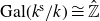 $\mathrm{Gal}(k^{\mathrm{s}}/k)\cong\hat{{\mathbb Z}}$
and
 $d=1$
. Thus we have
 \begin{equation*}H^i_{\mathrm{kfl}}(X,F)\cong\begin{cases}F^{\hat{{\mathbb Z}}},&\text{if $i=0$};\\H^1(\hat{{\mathbb Z}},F)\oplus H^0(\hat{{\mathbb Z}},F(-1)), &\text{if $i=1$}; \\H^1(\hat{{\mathbb Z}},F(-1)), &\text{if $i=2$};\\0, &\text{if $i\gt 2$}.\end{cases}\end{equation*}
3·3. Global Dedekind domains
Throughout this subsection, let K be a global field. When K is a number field, X denotes the spectrum of the ring of integers in K, and when K is a function field, k denotes the field of constants of K and X denotes the unique connected smooth projective curve over k having K as its function field. Let S be a finite set of closed points of X,
 $U\,:\!=\,X-S$
,
 $j:U\hookrightarrow X$
, and
 $i_x:x\hookrightarrow X$
for each closed point
 $x\in X$
. We endow X with the log structure
 $j_{*}\mathcal{O}^{\times}_U\cap\mathcal{O}_X\rightarrow \mathcal{O}_X$
.
Apparently X satisfies the assumption on log structure from Lemma 3·3.
Example 3·7. Let F be a group scheme over the underlying scheme of X which is étale locally isomorphic to a finite rank free abelian group. We have
 \begin{equation*}H^1_{\mathrm{fl}}(X,F)\xrightarrow{\cong} H^1_{\mathrm{kfl}}(X,F)\end{equation*}
by Lemma 3·1 (i). Since X satisfies the assumption on log structure from Lemma 3·3, we have a long exact sequence as in Lemma 3·3.
The sheaf
 $M_X/\mathcal{O}_X^\times$
is supported on the closed subset S, and thus the restriction of
 $(\mathbb{G}_{\mathrm{m,log}}/\mathbb{G}_{\mathrm{m}})_{X_{\mathrm{fl}}}$
to
 $(\mathrm{st}/X)_{\mathrm{fl}}$
is isomorphic to
 $\bigoplus_{x\in S} i_{x*}{\mathbb Z}$
. For any prime number l, let
 \begin{equation*}S_l\,:\!=\,\{x\in S\mid \text{the characteristic of the residue field of}\ x \text{is not}\ l\}.\end{equation*}
Thus by Theorem 2·12, we have
 \begin{equation*}R^2\varepsilon_{\mathrm{fl}*}F\cong \bigoplus_{l\text{ prime}} R^1\varepsilon_{\mathrm{fl}*}(F\otimes_{{\mathbb Z}}{\mathbb Q}_l/{\mathbb Z}_l)\end{equation*}
and the restriction of
 $R^1\varepsilon_{\mathrm{fl}*}(F\otimes_{{\mathbb Z}}{\mathbb Q}_l/{\mathbb Z}_l)$
to
 $(\mathrm{st}/X)_{\mathrm{fl}}$
is isomorphic to
 $\bigoplus_{x\in S_l}i_{x*}(F\otimes_{{\mathbb Z}}{\mathbb Q}_l/{\mathbb Z}_l(-1))$
. Therefore we get
 \begin{align*}H^u_{\mathrm{fl}}(X,R^2\varepsilon_{\mathrm{fl}*}F)&=\bigoplus_{l\text{ prime}}\bigoplus_{x\in S_l}H^u_{\mathrm{fl}}(X,i_{x*}(F\otimes_{{\mathbb Z}}{\mathbb Q}_l/{\mathbb Z}_l(-1))) \\&=\bigoplus_{l\text{ prime}}\bigoplus_{x\in S_l}H^u_{\mathrm{fl}}(x,F\otimes_{{\mathbb Z}}{\mathbb Q}_l/{\mathbb Z}_l(-1)) \\&=\bigoplus_{l\text{ prime}}\bigoplus_{x\in S_l}H^u_{\acute{\mathrm{e}\mathrm{t}}}(x,F\otimes_{{\mathbb Z}}{\mathbb Q}_l/{\mathbb Z}_l(-1)) \\&=\bigoplus_{l\text{ prime}}\bigoplus_{x\in S_l}H^u(\Gamma_x,F\otimes_{{\mathbb Z}}{\mathbb Q}_l/{\mathbb Z}_l(-1)),\end{align*}
where
 $\Gamma_x\,:\!=\,\mathrm{Gal}(\kappa(x)^{\mathrm{s}}/\kappa(x))$
. We also have
 $H^2_{\mathrm{fl}}(X,F)\cong H^2_{\acute{\mathrm{e}\mathrm{t}}}(X,F)$
by [
14
, lemma 0DDU]. So we can rewrite the exact sequence from Lemma 3·3 as
 \begin{align*}0&\to H^2_{\acute{\mathrm{e}\mathrm{t}}}(X,F)\to H^2_{\mathrm{kfl}}(X,F)\to \bigoplus_{l\text{ prime}}\bigoplus_{x\in S_l}H^0(\Gamma_x,F\otimes_{{\mathbb Z}}{\mathbb Q}_l/{\mathbb Z}_l(-1)) \\&\to H^3_{\acute{\mathrm{e}\mathrm{t}}}(X,F)\to H^3_{\mathrm{kfl}}(X,F) \to \bigoplus_{l\text{ prime}}\bigoplus_{x\in S_l}H^1(\Gamma_x,F\otimes_{{\mathbb Z}}{\mathbb Q}_l/{\mathbb Z}_l(-1))\to\cdots \\&\to H^i_{\acute{\mathrm{e}\mathrm{t}}}(X,F)\to H^i_{\mathrm{kfl}}(X,F)\to \bigoplus_{l\text{ prime}}\bigoplus_{x\in S_l}H^{i-2}(\Gamma_x,F\otimes_{{\mathbb Z}}{\mathbb Q}_l/{\mathbb Z}_l(-1))\to\cdots .\end{align*}
Now we assume that the residue fields of X at its closed points are finite, then we have
 \begin{equation*}H^u(\Gamma_x,F\otimes_{\mathbb Z}({\mathbb Q}_l/{\mathbb Z}_l)(-1))=0\end{equation*}
for
 $u\gt 1$
due to cohomological dimension reason. Then the above exact sequence breaks into an exact sequence
 \begin{align*}0&\to H^2_{\acute{\mathrm{e}\mathrm{t}}}(X,F)\to H^2_{\mathrm{kfl}}(X,F)\to \bigoplus_{l\text{ prime}}\bigoplus_{x\in S_l}H^0(\Gamma_x,F\otimes_{{\mathbb Z}}{\mathbb Q}_l/{\mathbb Z}_l(-1)) \\&\to H^3_{\acute{\mathrm{e}\mathrm{t}}}(X,F)\to H^3_{\mathrm{kfl}}(X,F) \to \bigoplus_{l\text{ prime}}\bigoplus_{x\in S_l}H^1(\Gamma_x,F\otimes_{{\mathbb Z}}{\mathbb Q}_l/{\mathbb Z}_l(-1)) \\&\to H^4_{\acute{\mathrm{e}\mathrm{t}}}(X,F)\to H^4_{\mathrm{kfl}}(X,F)\to 0\end{align*}
and isomorphisms
 \begin{equation*}H^i_{\acute{\mathrm{e}\mathrm{t}}}(X,F)\xrightarrow{\cong} H^i_{\mathrm{kfl}}(X,F)\end{equation*}
for
 $i\geq 5$
.
Example 3·8. Let F be a finite étale group scheme over the underlying scheme of X. Then
 $F=\bigoplus_{l\text{ prime}}F(l)$
, where
 $F(l)$
is the
 $l$
-primary subgroup of F and also finite étale. To compute the Kummer log flat cohomology of F, it suffices to compute that of
 $F(l)$
for each prime
 $l$
. Without loss of generality, we assume that
 $F=F(l)$
for some prime
 $l$
. Similar to the situation of Example 3·7, we have
 \begin{equation*}R^1\varepsilon_{\mathrm{fl}*}F\cong\bigoplus_{x\in S_l}i_{x*}(F(-1)).\end{equation*}
Therefore by Lemma 3·4 and similar arguments as in Example 3·7, we have a long exact sequence
 \begin{align*}0&\to H^1_{\acute{\mathrm{e}\mathrm{t}}}(X,F)\to H^1_{\mathrm{kfl}}(X,F)\to \bigoplus_{x\in S_l} H^0(\Gamma_x,F(-1)) \\&\to H^2_{\acute{\mathrm{e}\mathrm{t}}}(X,F)\to H^2_{\mathrm{kfl}}(X,F) \to \bigoplus_{x\in S_l} H^1(\Gamma_x,F(-1))\to\cdots \\&\to H^i_{\acute{\mathrm{e}\mathrm{t}}}(X,F)\to H^i_{\mathrm{kfl}}(X,F)\to \bigoplus_{x\in S_l} H^{i-1}(\Gamma_x,F(-1))\to\cdots .\end{align*}
Now we assume that the residue fields of X at the closed points are finite, then we have
 \begin{equation*}H^u(\Gamma_x,F(-1))=0\end{equation*}
for
 $u\gt 1$
due to cohomological dimension reason. Therefore we have an exact sequence
 \begin{align*}0&\to H^1_{\acute{\mathrm{e}\mathrm{t}}}(X,F)\to H^1_{\mathrm{kfl}}(X,F)\to \bigoplus_{x\in S_l} H^0(\Gamma_x,F(-1)) \\&\to H^2_{\acute{\mathrm{e}\mathrm{t}}}(X,F)\to H^2_{\mathrm{kfl}}(X,F) \to \bigoplus_{x\in S_l} H^1(\Gamma_x,F(-1)) \\&\to H^3_{\acute{\mathrm{e}\mathrm{t}}}(X,F)\to H^3_{\mathrm{kfl}}(X,F)\to 0,\end{align*}
and isomorphisms
 \begin{equation*}H^i_{\acute{\mathrm{e}\mathrm{t}}}(X,F)\xrightarrow{\cong} H^i_{\mathrm{kfl}}(X,F)\end{equation*}
for
 $i\geq 4$
.
Appendix A. Sites and sheaves
In this appendix, we collect some general results about sites from [ 14 , Chapter 00UZ].
A·1. Sites
Definition A·1. [
14
, definition 00VH] A site is given by a category
 $\mathcal{C}$
and a set
 $\mathrm{Cov}(\mathcal{C})=\bigcup_{U\in \mathcal{C}}\mathrm{Cov}(U)$
with
 $\mathrm{Cov}(U)$
being a set of families of morphisms with target U, such that the following conditions hold:
-
(1) if
$V\to U;$
is an isomorphism, then
$\{V\to U\}\in\mathrm{Cov}(U)$
; -
(2) if
$\{ U_ i \to U\} _{i\in I} \in \text{Cov}(U);$
and for each i we have
$\{ V_{ij} \to U_ i\} _{j\in J_ i} \in \text{Cov}(U_i)$
, then
$\{ V_{ij} \to U\} _{i \in I, j\in J_ i} \in \text{Cov}(U)$
; -
(3) if
$\{ U_ i \to U\} _{i\in I}\in \text{Cov}(U)$
and
$V\to U$
is a morphism of
$\mathcal{C}$
, then
$U_i\times_UV$
exists for each
$i\in I$
and
$\{ U_ i \times _ U V \to V \} _{i\in I} \in \text{Cov}(V)$
.









A·2. Continuous functors
Definition A·2. [
14
, Tag 00WV] A functor
 $u:\mathcal{C}\to\mathcal{D}$
of sites is called continuous, if for every
 $\{V_i\to V\}_{i\in I}\in\mathrm{Cov}(\mathcal{C})$
we have the following:
-
(1)
$\{u(V_i)\to u(V)\}\in\mathrm{Cov}(\mathcal{D})$
, and
-
(2) for any morphism
$T\to V$
in
$\mathcal{C}$
the morphism is an isomorphism.
\begin{equation*}u(T\times_VV_i)\to u(T)\times_{u(V)}u(V_i)\end{equation*}



Recall that given a functor u as above, and a presheaf of sets
 $\mathcal{F}$
on
 $\mathcal{D}$
we can define
 $u^p\mathcal{F}$
to be simply the presheaf
 $\mathcal{F}\circ u$
, in other words
 \begin{equation*}u^p\mathcal{F}(V)=\mathcal{F}(u(V))\end{equation*}
for every object V of
 $\mathcal{C}$
(see [
14
, Tag 00VC] for
 $u^p$
as well as for
 $u_p$
).
Suppose that the functor
 $u:\mathcal{C}\to\mathcal{D}$
is continuous, then
 $\mathcal{F}\in Sh(\mathcal{D})\Rightarrow u^p\mathcal{F}\in Sh(\mathcal{D})$
. We denote
 \begin{equation*}u^s:Sh(\mathcal{D})\to Sh(\mathcal{C})\end{equation*}
the functor
 $u^p$
restricted to the subcategory of sheaves of sets. Recall that
 $u^p$
admits a left adjoint
 $u_p$
, see [
14
, Tag 00VE]. This is also the case for
 $u^s$
.
Lemma A·3 [
14
, tag 00WX] Let
 $u\,:\,\mathcal{C}\to\mathcal{D}$
be a continuous functor of sites. Then the functor
 \begin{equation*}u_s\,:\,Sh(\mathcal{C})\to Sh(\mathcal{D}),\quad \mathcal{G}\mapsto (u_p\mathcal{G})^\sharp\end{equation*}
is left adjoint to
 $u^s$
.
Definition A·4 [
14
, tag 00X1]. A morphism of sites
 $f:\mathcal{D}\to\mathcal{C}$
is given by a continuous functor
 $u:\mathcal{C}\to\mathcal{D}$
such that
 $u_s$
is exact.
Notice how the functor u goes in the direct opposite the morphism f. If
 $f\leftrightarrow u$
is a morphism of sites, then we use the notation
 $f^{-1}=u_s$
and
 $f_*=u^s$
. The functor
 $f^{-1}$
is called the pullback functor, and the functor
 $f_*$
is called the pushforward functor. As in topology we have the adjunction
 $(f^{-1},f_*)$
.
See [ 14 , tag 00X2] (examples associated to maps between two topological spaces) and [ 14 , tag 0EWI] (examples for different topologies on the same space, comparison of topologies) for examples of morphisms of sites.
A·3. Cocontinuous functors
Definition A·5. A functor
 $u:\mathcal{C}\to\mathcal{D}$
of sites is called cocontinuous, if for every
 $U\in\mathcal{C}$
and every
 $\{V_j\to u(U)\}_{j\in J}\in\mathrm{Cov}(\mathcal{D})$
, there exists
 $\{U_i\to U\}_{i\in I}\in\mathrm{Cov}(\mathcal{C})$
such that
 $\{u(U_i)\to u(U)\}_{i\in I}$
refines
 $\{V_j\to u(U)\}_{j\in J}$
.
Warning: In general
 $\{u(U_i)\to u(U)\}_{i\in I}$
is not a covering of
 $\mathcal{D}$
.
Example A·6. For an fs log scheme S, we denote by
 $(\mathrm{fs}/S)$
the category of fs log schemes over S. Let
 $(\mathrm{fs}/S)_{\mathrm{k}\acute{\mathrm{e}}\mathrm{t}}$
and
 $(\mathrm{fs}/S)_{\acute{\mathrm{e}\mathrm{t}}}$
be the Kummer log étale site and the classical étale site for
 $(\mathrm{fs}/S)$
respectively, see [
Reference Illusie4
, § 2·5]. Let
 $(\mathrm{fs}/S)_{\mathrm{kfl}}$
be the Kummer log flat site for
 $(\mathrm{fs}/S)$
, see [
Reference Kato5
, Def. 2·3], and let
 $(\mathrm{fs}/S)_{\mathrm{fl}}$
be the classical flat site for
 $(\mathrm{fs}/S)$
, which is an obvious analogue of
 $(\mathrm{fs}/S)_{\acute{\mathrm{e}\mathrm{t}}}$
.
Now let
 $j:U\hookrightarrow X$
be a strict open immersion of fs log schemes, and let
 $\tau\in\{\mathrm{k}\acute{\mathrm{e}}\mathrm{t}, \acute{\mathrm{e}}\mathrm{t, kfl, fl}\}$
. Then the functor of sites
 \begin{equation*}u:(\mathrm{fs}/X)_{\tau}\to(\mathrm{fs}/U)_{\tau},Y\mapsto Y\times_XU\end{equation*}
is continuous, and the functor of sites
 \begin{equation*}v:(\mathrm{fs}/U)_{\tau}\to (\mathrm{fs}/X)_{\tau},V\mapsto V\end{equation*}
is continuous and cocontinuous.
Appendix B. The Kummer log flat site
In this appendix, we focus on the Kummer log flat site.
B·1. Morphisms of sites associated to a strict open immersion
Warning: We are going to follow [ 14 , Chapter 00UZ] and [ 14 , Chapter 03A4] to construct a homomorphism of sheaves of abelian groups. Morphisms of sites and topoi in [ 14 , Chapter 00UZ] are often formulated for sheaves of sets, while the map to be constructed is for sheaves of abelian groups. Often in order to use results from [ 14 , Chapter 00UZ], we have to use [ 14 , Tag 00YV]. Below whenever we refer to a result about sheaves of sets from [ 14 , Chapter 00UZ] for sheaves of abelian groups, we are referring to [ 14 , Tag 00YV] without mention at the same time.
Let X be an fs log scheme, and
 $j:U\hookrightarrow X$
a strict open immersion of fs log schemes. Let
 $\tau\in\{\mathrm{k}\acute{\mathrm{e}}\mathrm{t,} \acute{\mathrm{e}}\mathrm{t, kfl, fl}\}$
. The functor
 \begin{equation*}u:(\mathrm{fs}/U)_{\tau}\to (\mathrm{fs}/X)_{\tau},(V\to U)\mapsto (V\to U\to X)\end{equation*}
of sites is continuous and cocontinuous, hence it gives rise to a morphism of topoi
 \begin{equation*}g=(g^{-1},g_*):\mathrm{Ab}((\mathrm{fs}/U)_{\tau})\to \mathrm{Ab}((\mathrm{fs}/X)_{\tau})\end{equation*}
with
 $g^{-1}$
exact by [
14
, Tag 00XO] and [
14
, Tag 00XL]. For any presheaf
 $\mathcal{F}\in \mathrm{PAb}((\mathrm{fs}/U)_{\tau})$
, we define
 $g_{p!}\mathcal{F}\in \mathrm{PAb}((\mathrm{fs}/X)_{\tau})$
as the presheaf
 \begin{equation*}Y\mapsto \varinjlim_{Y\to u(V)}\mathcal{F}(V)\end{equation*}
with colimits over
 $(\mathcal{I}^v_Y)^{\mathrm{opp}}$
(see [
14
, Equation 053L] for this index category) taken in the category of abelian groups. For
 $\mathcal{F}\in \mathrm{Ab}((\mathrm{fs}/U)_{\tau})$
, we set
 $g_!\mathcal{F}$
to be the sheafification of
 $g_{p!}\mathcal{F}$
, see [
14
, Tag 04BF], and called it the extension by zero of
 $\mathcal{F}$
.
Lemma B·1. Let X, U, u,
 $g=(g^{-1},g_*)$
, and
 $g_!$
be as above. Then we have the following:
-
(i) the functor
$g_!$
is left adjoint to
$g^{-1}$
and exact; -
(ii) the functor
$g^{-1}$
is exact and preserves injective objects;
-
(iii) for any
$\mathcal{F}\in\mathrm{Ab}((\mathrm{fs}/U)_{\tau})$
, the canonical maps are isomorphisms.
\begin{equation*}\mathcal{F}\to g^{-1}g_!\mathcal{F} \text{ and } g^{-1}g_*\mathcal{F}\to \mathcal{F}\end{equation*}




Since
 $g^{-1}$
admits both a left adjoint
 $g_!$
and a right adjoint
 $g_*$
, it is exact by [
14
, Tag 0039]. Since the left adjoint
 $g_!$
of
 $g^{-1}$
is exact, it preserves injective objects by [
14
, Tag 015Z]. This finishes the proof of part (ii).
Since j is a strict open immersion, the functor u is fully faithful. The functor u is continuous and cocontinuous. Thus part (iii) follows from [ 14 , lemma 077I].
The functor
 \begin{equation*}v:(\mathrm{fs}/X)_{\tau}\to (\mathrm{fs}/U)_{\tau},Y\mapsto Y\times_XU\end{equation*}
of sites is continuous with
 $v_s$
exact, hence gives rise to a morphism
 \begin{equation*}j_{\tau}:(\mathrm{fs}/U)_{\tau}\to (\mathrm{fs}/X)_{\tau}\end{equation*}
of sites, and further a morphism
 \begin{equation*}j_{\tau}=(j_{\tau}^{-1}=v_s,j_{\tau*}=v^s):\mathrm{Ab}((\mathrm{fs}/U)_{\tau})\to \mathrm{Ab}((\mathrm{fs}/X)_{\tau})\end{equation*}
of topoi. The cocontinuous functor u is left adjoint to the continuous functor v. By [
14
, Tag 00XY], the two morphisms g and
 $j_{\tau}$
of topoi agree. We set
 $j_{\tau!}\,:\!=\,g_!$
, and call it the functor of extension by zero. To sum up, we have the following lemma.
Lemma B·2. Let
 $j:U\to X$
be a strict open immersion of fs log schemes. Then we have a morphism of sites
 \begin{equation*}j_{\tau}:(\mathrm{fs}/U)_{\tau}\to (\mathrm{fs}/X)_{\tau},\end{equation*}
and a sequence of functors
 \begin{equation*}j_{\tau!},j_{\tau}^{-1},j_{\tau*}\end{equation*}
where in each consecutive pair the first is exact and left adjoint to the second. Moreover we have the following:
-
(i) the functor
$j_{\tau !}$
is exact; -
(ii) the functor
$j_{\tau}^{-1}$
is exact and preserves injective objects; -
(iii) for any
$\mathcal{F}\in\mathrm{Ab}((\mathrm{fs}/U)_{\tau})$
, the canonical maps are isomorphisms.
\begin{equation*}\mathcal{F}\to j_{\tau}^{-1}j_{\tau !}\mathcal{F} \text{ and } j_{\tau}^{-1}j_{\tau *}\mathcal{F}\to \mathcal{F}\end{equation*}




B·2. Comparison morphism from the Kummer log flat site to the classical flat site
Let
 $j:U\to X$
be a strict open immersion of fs log schemes. We have canonical forgetful morphisms of sites
 \begin{equation*}(\mathrm{fs}/X)_{\mathrm{kfl}}\to (\mathrm{fs}/X)_{\mathrm{fl}}\end{equation*}
and
 \begin{equation*}(\mathrm{fs}/U)_{\mathrm{kfl}}\to (\mathrm{fs}/U)_{\mathrm{fl}}.\end{equation*}
By abuse of notation, we denote both of them by
 $\varepsilon_{\mathrm{fl}}$
. It is easy to see that we have the following commutative diagram

of morphisms of sites.
For
 $F\in\mathrm{Ab}((\mathrm{fs}/X)_{\mathrm{kfl}})$
, the adjunction
 $(j_{\mathrm{fl}!},j_{\mathrm{fl}}^{-1})$
gives a canonical map
 \begin{equation}j_{\mathrm{fl}!} j_{\mathrm{fl}}^{-1}R^i\varepsilon_{\mathrm{fl}*}F\to R^i\varepsilon_{\mathrm{fl}*}F.\end{equation}
Lemma B·3. We have
 \begin{equation*}j_{\mathrm{fl}}^{-1}R^i\varepsilon_{\mathrm{fl}*}F=R^i\varepsilon_{\mathrm{fl}*}j_{\mathrm{kfl}}^{-1}F.\end{equation*}
Proof. Let
 $F\to I^\bullet$
be an injective resolution of F on
 $(\mathrm{fs}/X)_{\mathrm{kfl}}$
. Since the functor
 $j_{\mathrm{kfl}}^{-1}$
is exact and preserves injective objects by Lemma B·2 (ii), we get an injective resolution
 $j_{\mathrm{kfl}}^{-1}F\to j_{\mathrm{kfl}}^{-1}I^\bullet$
of
 $j_{\mathrm{kfl}}^{-1}F$
. Thus
 \begin{equation*}R^i\varepsilon_{\mathrm{fl}*}j_{\mathrm{kfl}}^{-1}F=H^i(\varepsilon_{\mathrm{fl}*}j_{\mathrm{kfl}}^{-1}I^\bullet)=H^i(j_{\mathrm{fl}}^{-1}\varepsilon_{\mathrm{fl}*}I^\bullet)=j_{\mathrm{fl}}^{-1}H^i(\varepsilon_{\mathrm{fl}*}I^\bullet)=j_{\mathrm{fl}}^{-1}R^i\varepsilon_{\mathrm{fl}*}F.\end{equation*}
By the identification from Lemma B·3, we get a map
 \begin{equation}\Phi: j_{\mathrm{fl}!}R^i\varepsilon_{\mathrm{fl}*}j_{\mathrm{kfl}}^{-1}F\to R^i\varepsilon_{\mathrm{fl}*}F.\end{equation}
Proposition B·4. Let X be an fs log scheme and U an open subscheme of the underlying scheme of X. We endow U with the induced log structure, and let
 $j:U\hookrightarrow X$
be the corresponding strict open immersion. Let F be a sheaf of abelian groups on
 $(\mathrm{fs}/X)_{\mathrm{kfl}}$
such that
 $R^i\varepsilon_{\mathrm{fl}*}F$
is supported over U, then the map
 \begin{equation*}\Phi: j_{\mathrm{fl}!}R^i\varepsilon_{\mathrm{fl}*}j_{\mathrm{kfl}}^{-1}F\to R^i\varepsilon_{\mathrm{fl}*}F\end{equation*}
is an isomorphism.
Proof. Applying the functor
 $j_{\mathrm{fl}}^{-1}$
to the canonical map (B·1), we get a map
 \begin{equation}j_{\mathrm{fl}}^{-1}j_{\mathrm{fl}!} j_{\mathrm{fl}}^{-1}R^i\varepsilon_{\mathrm{fl}*}F\to j_{\mathrm{fl}}^{-1}R^i\varepsilon_{\mathrm{fl}*}F.\end{equation}
Since
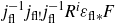 $j_{\mathrm{fl}}^{-1}j_{\mathrm{fl}!}j_{\mathrm{fl}}^{-1}R^i\varepsilon_{\mathrm{fl}*}F$
is identified to
 $j_{\mathrm{fl}}^{-1}R^i\varepsilon_{\mathrm{fl}*}F$
by Lemma B·2 (iii), the map (B·3) is an isomorphism. Since
 $R^i\varepsilon_{\mathrm{fl}*}F$
is supported on U and the extension by zero sheaf
 $j_{\mathrm{fl}!} j_{\mathrm{fl}}^{-1}R^i\varepsilon_{\mathrm{fl}*}F$
is clearly supported on U, the map (B·1) is actually an isomorphism. Therefore
 $\Phi$
is also an isomorphism by construction.
Appendix C. A lemma on profinite group cohomology
Let p be a fixed prime number, and let
 $\hat{{\mathbb Z}'}\,:\!=\,\varprojlim_{(p,m)=1}{\mathbb Z}/m{\mathbb Z}$
. Let
 $G_r=(\hat{{\mathbb Z}'})^r$
and M a torsion abelian group, we regard M as a
 $G_r$
-module with respect to the trivial action. In this appendix, we compute the profinite group cohomology
 $H^i(G_r,M)$
. The result should be well-known to the experts, but we are not able to find a reference so present a computation here.
According to [
Reference Olsson12
, A·2], the cohomology groups
 $H^i(G_r,M)$
are computed by the cohomology groups of the standard homogeneous cochain complex of
 $G_r$
with coefficients in M
 \begin{equation*}R\Gamma(G_r,M):\mathrm{Map}_{G_r}^{\mathrm{cts}}(G_r,M)\to \mathrm{Map}_{G_r}^{\mathrm{cts}}(G_r^2,M)\to\cdots\to \mathrm{Map}_{G_r}^{\mathrm{cts}}(G_r^{i},M)\to \cdots,\end{equation*}
where
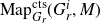 $\mathrm{Map}_{G_r}^{\mathrm{cts}}(G_r^i,M)$
denotes the set of equivariant continuous functions
 $\phi:G_r^{i}\to M$
(where M is endowed with the discrete topology). Note that
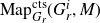 $\mathrm{Map}_{G_r}^{\mathrm{cts}}(G_r^i,M)$
is denoted as
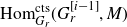 $\mathrm{Hom}_{G_r}^{\mathrm{cts}}(G_r^{[i-1]},M)$
in [
Reference Olsson12
, App. A].
First we consider the case that
 $M={\mathbb Z}/n{\mathbb Z}$
with
 $(n,p)=1$
. The complex
 $R\Gamma(G_r,{\mathbb Z}/n{\mathbb Z})$
of abelian groups is also naturally a complex of modules over the ring
 ${\mathbb Z}/n{\mathbb Z}$
. Since
 ${\mathbb Z}/n{\mathbb Z}$
as a module over itself is flat and
 $R\Gamma(G_r,{\mathbb Z}/n{\mathbb Z})$
lies in
 $D^b({\mathbb Z}/n{\mathbb Z})$
(the bounded derived category of complexes of
 ${\mathbb Z}/n{\mathbb Z}$
-modules), we have
 \begin{equation}R\Gamma(G_r,{\mathbb Z}/n{\mathbb Z})\otimes_{{\mathbb Z}/n{\mathbb Z}}^L R\Gamma(G_s,{\mathbb Z}/n{\mathbb Z})\xrightarrow{\cong}R\Gamma(G_{r+s},{\mathbb Z}/n{\mathbb Z})\end{equation}
by the Künneth formula, see [ Reference Olsson12 , theorem A·6]. We have
 \begin{equation*}H^i(G_1,{\mathbb Z}/n{\mathbb Z})=\begin{cases}{\mathbb Z}/n{\mathbb Z},&\text{ if $i=0,1;$} \\ 0,&\text{ if $i\gt 0$,}\end{cases}\end{equation*}
and
 $R\Gamma(G_1,{\mathbb Z}/n{\mathbb Z})$
is isomorphic to
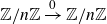 ${\mathbb Z}/n{\mathbb Z}\xrightarrow{0}{\mathbb Z}/n{\mathbb Z}$
in
 $D^b({\mathbb Z}/n{\mathbb Z})$
. By [
Reference Olsson12
, Cor. A.7], the natural map of graded
 ${\mathbb Z}/n{\mathbb Z}$
-modules
 \begin{equation*}H^*(G_1,{\mathbb Z}/n{\mathbb Z})\otimes_{{\mathbb Z}/n{\mathbb Z}}H^*(G_1,{\mathbb Z}/n{\mathbb Z})\to H^*(G_2,{\mathbb Z}/n{\mathbb Z})\end{equation*}
is an isomorphism, and thus
 $H^i(G_2,{\mathbb Z}/n{\mathbb Z})$
are free
 ${\mathbb Z}/n{\mathbb Z}$
-modules for all i. Applying [
Reference Olsson12
, Cor. A·7] inductively, we have that the natural map of graded
 ${\mathbb Z}/n{\mathbb Z}$
-modules
 \begin{equation*}H^*(G_1,{\mathbb Z}/n{\mathbb Z})^{\otimes r}\to H^*(G_r,{\mathbb Z}/n{\mathbb Z})\end{equation*}
is an isomorphism. It follows that the graded cohomology ring
 $H^*(G_r,{\mathbb Z}/n{\mathbb Z})$
is isomorphic to the exterior algebra of the module
 \begin{equation*}H^1(G_r,{\mathbb Z}/n{\mathbb Z})=\mathrm{Hom}(G_r,{\mathbb Z}/n{\mathbb Z})\cong ({\mathbb Z}/n{\mathbb Z})^r\end{equation*}
over
 ${\mathbb Z}/n{\mathbb Z}$
.
Now let M be a torsion abelian group which is killed by n with
 $(n,p)=1$
. We regard M as a module over
 ${\mathbb Z}/n{\mathbb Z}$
. Clearly we have
 \begin{equation*}R\Gamma(G_r,M)\cong R\Gamma(G_r,{\mathbb Z}/n{\mathbb Z})\otimes_{{\mathbb Z}/n{\mathbb Z}}M.\end{equation*}
Since
 $H^i(G_r,{\mathbb Z}/n{\mathbb Z})$
are free
 ${\mathbb Z}/n{\mathbb Z}$
-modules for all i, we get
 \begin{equation*}H^i(G_r,M)\cong H^i(G_r,{\mathbb Z}/n{\mathbb Z})\otimes_{{\mathbb Z}/n{\mathbb Z}}M\end{equation*}
canonically.
In general for a torsion abelian group M, we have
 \begin{equation*}M=M[p^\infty]\oplus M'=M[p^\infty]\oplus\varinjlim_{(n,p)=1}M[n],\end{equation*}
where
 $M[p^\infty]$
(resp. M’, resp. M[n]) denotes the p-primary part (resp. prime to p part, resp. n-torsion part) of M. Thus
 \begin{equation}\begin{split}H^i(G_r,M)=&\varinjlim_{(n,p)=1}H^i(G_r,M[n]) \\\cong&\varinjlim_{(n,p)=1}H^i(G_r,{\mathbb Z}/n{\mathbb Z})\otimes_{{\mathbb Z}/n{\mathbb Z}}M[n] \\\cong&\varinjlim_{(n,p)=1}(\bigwedge^iH^1(G_r,{\mathbb Z}/n{\mathbb Z}))\otimes_{{\mathbb Z}/n{\mathbb Z}}M[n]. \\\end{split}\end{equation}
We fix an isomorphism
 $G_r=\mathrm{Hom}(X_r,\hat{{\mathbb Z}'})$
with
 $X_r\,:\!=\,{\mathbb Z}^r$
, and thus
 \begin{equation*}H^1(G_r,{\mathbb Z}/n{\mathbb Z})=\mathrm{Hom}(G_r,{\mathbb Z}/n{\mathbb Z})=X_r\otimes_{{\mathbb Z}}{\mathbb Z}/n{\mathbb Z}.\end{equation*}
Therefore we further have
 \begin{align*}H^i(G_r,M)\cong &\varinjlim_{(n,p)=1}(\bigwedge^i(X_r\otimes_{{\mathbb Z}}{\mathbb Z}/n{\mathbb Z})) \otimes_{{\mathbb Z}/n{\mathbb Z}}M[n] \\=&\varinjlim_{(n,p)=1}(\bigwedge^iX_r)\otimes_{{\mathbb Z}}M[n] \\=&(\bigwedge^iX_r)\otimes_{{\mathbb Z}}M',\end{align*}
where the last two wedges are for
 ${\mathbb Z}$
-module structure. Apparently the identification (C·2) is induced by cup-product.
To sum up, we have the following lemma.
Lemma C·1. Let p be a fixed prime number, and
 $\hat{{\mathbb Z}'}\,:\!=\,\varprojlim_{(p,m)=1}{\mathbb Z}/m{\mathbb Z}$
. Let M be a torsion abelian group, and we regard it as a
 $(\hat{{\mathbb Z}'})^r$
-module with respect to the trivial action. Let
 $M[p^\infty]$
(resp. M’, resp. M[n]) denote the p-primary part (resp. prime to p part, resp. n-torsion part) of M. We fix an isomorphism
 $(\hat{{\mathbb Z}'})^r=\mathrm{Hom}(X_r,\hat{{\mathbb Z}'})$
with
 $X_r\,:\!=\,{\mathbb Z}^r$
.
Then
-
(i) for any positive integer n with
$(n,p)=1$
, we have and the cup product induces an isomorphism
\begin{equation*}H^1((\hat{{\mathbb Z}'})^r,M[n])=\mathrm{Hom}((\hat{{\mathbb Z}'})^r,M[n])\cong M[n]\otimes_{{\mathbb Z}}X_r\end{equation*}
and the latter can be further identified with
\begin{equation*}H^i((\hat{{\mathbb Z}'})^r,M[n])\cong M[n]\otimes_{{\mathbb Z}/n{\mathbb Z}}\bigwedge^iH^1((\hat{{\mathbb Z}'})^r,{\mathbb Z}/n{\mathbb Z}),\end{equation*}
$M[n]\otimes_{{\mathbb Z}}(\bigwedge^iX_r) $
;
-
(ii) for the profinite group cohomology of
$(\hat{{\mathbb Z}'})^r$
with coefficients in M, we have
\begin{align*}H^i((\hat{{\mathbb Z}'})^r,M)=\varinjlim_{(n,p)=1}H^i((\hat{{\mathbb Z}'})^r,M[n])=&\varinjlim_{(n,p)=1}M[n]\otimes_{{\mathbb Z}}(\bigwedge^iX_r) \\=&M'\otimes_{{\mathbb Z}}(\bigwedge^iX_r).\end{align*}





Remark C·2.
Clearly the above computation works also for the profinite groups
 $ \hat{\mathbb{Z}}^{r} $
and
 $ {\mathbb Z}_{l}^{r} $
for any prime number l. Such results are the profinite group cohomology analogues of the description of the singular cohomology of topological tori (see [
Reference Hatcher3
, Chap. 3, Exa. 3·16]).
Acknowledgements
The author is very grateful to the anonymous referee for their comments, and thanks Professor Chikara Nakayama for helpful discussions. Part of this work was done when the author was a member of the research group of Professor Ulrich Görtz under partial support from Research Training Group 2553 of the German Research Foundation DFG.



