Implications
The present study shows that crate opening from day 3 postpartum (pp.) to weaning did not alter suckling and nursing behaviour 24 h after opening the crate compared to permanent crating (e.g. same number of nutritive nursings (NNs), same proportion of piglets missing milk ejection). Nursing behaviour was to some extent calmer (shorter pre-massages and more piglets attended post-massages) in temporary crates on day 25. Increased litter size had a negative effect on nursing and suckling behaviour. Short temporary confinement may thus be a safe alternative to permanent crating in regards to nursing and suckling behaviour.
Introduction
Farrowing crates seriously impair sow welfare, but they are still widely used on commercial pig farms (Wechsler and Weber, Reference Wechsler and Weber2007; Kilbride et al., Reference KilBride, Mendl, Statham, Held, Harris, Cooper and Green2012). Farrowing pens with temporary confinement during the first days of lactation have been developed as a compromise between conventional farrowing crates and pens to control piglet mortality due to crushing during this time period. The few available papers on temporary crating have mostly focussed on the opening time after parturition and the effect on piglet mortality and weight gain (e.g. Mousten et al., Reference Moustsen, Hales, Lahrmann, Weber and Hansen2013) or the interaction between piglets and the sow (Chidgey et al., Reference Chidgey, Morel, Stafford and Barugh2017; Singh et al., Reference Singh, Verdon, Cronin and Hemsworth2017).
Not much is known about the consequences of temporary crating on sow and piglets behaviour during nursing shortly after opening the crate (i.e. within 24 h, short-term effect) and before weaning (long-term effect). For the introduction of temporary crating to be successful under commercial conditions, it is important to know whether nursing behaviour is affected as it influences piglet weight gain and survival (Špinka et al., Reference Špinka, Illmann, Algers and Stětková1997; Andersen et al., Reference Andersen, Naevdal and Bøe2011; Ocepek et al., Reference Ocepek, Newberry and Andersen2017). Shortly after opening the crate, the increase of the available space might trigger higher activity (Heidinger et al., Reference Heidinger, Stinglmayr, Maschat, Oberer, Kuchling, Leeb, Hatzmann, Zentner, Hochfellner, Laubichler, Dolezal, Schwarz, Mösenbacher-Molterer, Vockenhuber and Baumgartner2017; Goumon et al., Reference Goumon, Leszkowová, Šimečková and Illmann2018) and might lower the sow motivation to nurse and/or increase litter competition. So far, only Singh et al., (Reference Singh, Verdon, Cronin and Hemsworth2017) compared nursing and suckling behaviour in temporary crating pens and farrowing crates on days 4, 11 and 18 pp. The authors found no effect of housing on nursing frequency and duration but without differentiating whether the nursing was with or without milk ejection and without assessing the duration of pre- and post-massages. Both are important parameters to assess milk transfer and calmness of a nursing (Špinka et al., Reference Špinka, Illmann, Algers and Stětková1997; Pedersen et al., Reference Pedersen, Moustsen, Nielsen and Kristensen2011). Unexpectedly, in the same study (Singh et al., Reference Singh, Verdon, Cronin and Hemsworth2017), piglets of sows housed in temporary crates missed more nursing events on days 11 and 18 pp. and were more displaced from other piglets on day 11 compared to those of sow housed in permanent crates. Sows might then respond by not releasing milk (Appleby et al., Reference Appleby, Weary, Taylor and Illmann1999) or by terminating a nursing soon after milk ejection (Bozděchová et al., Reference Bozděchová, Illmann, Andersen, Haman and Ehrlenbruch2014; Illmann et al., Reference Illmann, Leszkowová and Šimečková2018). It is therefore important to know whether litter competition indeed increases in temporary crates and whether nursing behaviour is affected after opening the farrowing crate.
The removal of confinement in temporary crates might have a long lasting positive effect on the course of nursings before weaning compared to permanent crates. It has been shown that nursing and suckling behaviour was calmer in farrowing pens compared to permanent crates at weeks 2 and 4 pp. (Pedersen et al., Reference Pedersen, Moustsen, Nielsen and Kristensen2011). In that study, there were fewer teat fights, a lower number of piglets missing milk let-down, sows terminated fewer nursing bouts and allowed the piglets to perform longer post-massages in farrowing pens. Consequently, we would expect more fights and more piglets missing milk ejection in permanent crates before weaning than in temporary crates.
Thus, the aim of the study was to assess whether crate opening from the 3rd day pp. to weaning had short- (24 h post-crate opening) and/or long-term (day 25 pp.) effects on suckling and nursing behaviour compared to permanent crating.
Material and methods
This study was carried out from July 2015 to July 2016 at the research farm of the institute of animal science in Prague, Czech Republic. This work was part of a larger experiment investigating the effects of temporary crating on sows and piglets behaviour and physiology (Goumon et al., Reference Goumon, Leszkowová, Šimečková and Illmann2018). Thus, same animals, housing conditions and management were used in both studies.
Animals
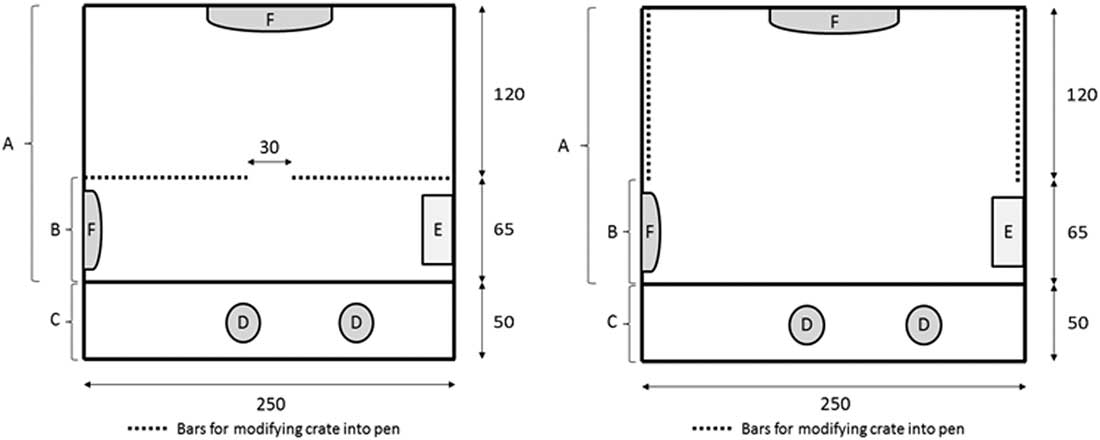
A total of 27 Large White×Landrace sows (parity: 2.5±0.5, range: 1 to 12) inseminated with Large White×Pietrain boar semen were used. Sows were moved from a group-housing gestation unit to a farrowing unit at approximately day 110 post-insemination and were farrowed in a room containing two farrowing pens with temporary crating and two farrowing pens with permanent crating. After balancing for parity, sows were randomly allocated to one of the following two treatments previously described by Goumon et al. (Reference Goumon, Leszkowová, Šimečková and Illmann2018): sows permanently crated (n = 14 sows and 192 piglets born; litter size: 13.7±0.7 piglets) were confined in a crate from 5 days pre-farrowing until weaning (approximately 28 days post-farrowing), while sows temporarily crated (n = 13 sows and 172 piglets born, litter size: 13.5±0.7 piglets) were confined in crates from 5 days pre-farrowing until 3 days post-farrowing, and were let loose (opening of the crate) on day 4 (83.0±1.3 h; day 0 being the day of farrowing) until weaning. A batch consisted of two sows, one for each treatment, housed in adjacent pens of the same type of farrowing system (Figure 1), with one treatment let loose from day 4 and the other one remained confined. One sow in the temporary crating treatment was removed due to illness. The crate was opened at around 10 h, after completion of a nursing. There was neither equalization nor cross fostering of the litters. All sows were familiar with permanent farrowing crating only. Farrowing was supervised through 24 h video recordings.
Farrowing pen equipped with movable bars, which allowed the modification from farrowing crate (left) to farrowing pen (right). A = sow area when farrowing crate is open; B = sow area when sow is crated; C = creep area for piglets; D = heating lamp; E = feed trough; F = piglet anti-crushing bars. All measurements are in centimetres.

Housing
As described in Goumon et al. (Reference Goumon, Leszkowová, Šimečková and Illmann2018), farrowing pens measured 5.88 m2 and were equipped with movable bars, which enabled them to be modified into crates and vice versa (Figure 1). The sow area (the part of the pen accessible to the sow) for crated sows measured 1.63 m2. When the sows were let loose, the sides of the crate were opened and placed along the sidewalls. In this configuration, the sow area measured 4.63 m2. There were protection rails along the sidewalls for the prevention of piglet crushing when the sow was lying down. Solid concrete flooring was present in the whole pen. The creep area (the part of the pen accessible only to the piglets) measured 1.25 m2 and was not covered, bedded with straw and had two hanging heat lamps during the whole lactation.
Management
As described in Goumon et al. (Reference Goumon, Leszkowová, Šimečková and Illmann2018), sows were fed a standard lactation diet (17% CP, 13.75 MJ digestible energy/kg) twice a day, and water was available ad libitum from one nipple for the sow and another one for the piglets. The sows received one bag of chopped straw each morning and evening until they had farrowed, and once a day during the whole lactation. Pens were cleaned once a day. Piglets were ear tagged on day 3 pp.. All piglets received an iron injection and males were surgically castrated during the 1st week of life in accordance with normal farm practices. Piglets were neither tail docked nor teeth clipped. They were provided with creep food from day 7 pp.
Data collection
Piglet BW gain
As described in Goumon et al. (Reference Goumon, Leszkowová, Šimečková and Illmann2018), piglets were individually marked using an animal marking crayon (Raidex, Germany) and weighed at the same time (around 09;30h) on day 3 (30 min before opening), day 4 (24 h after opening of the crate) and day 25. This variable was analysed by using, for each litter, the difference in individual piglet weight, respectively, from days 3 to 4 (short-term effect) and days 4 to 25 (long-term effect).
Behavioural observations
In this study, sows and piglets were observed for 4 h on day 4 (i.e. after 24 h after opening the farrowing crate) and on day 25. All nursing episodes during these 4 h were observed directly, and accompanied by continuous video recordings using handheld cameras (Panasonic H280 and H50, Osaka, Japan). The following data were recorded: beginning of nursing, end of a nursing, duration of pre-massage, duration of post-massage, terminator of a nursing and occurrence of nutritive and non-NNs (Table 1).
Behaviours of sows and piglets

The number of piglets performing each of the following behaviours was scored every 15 s during the entire nursing episode: the number of piglets present at the udder, the number of fights at the udder (de Passillé and Rushen, Reference De Passille and Rushen1989) and the number of piglets missing milk ejection (definitions in Table 1). In order to compare the duration of pre-massages for NNs in individual sows, five 15-s intervals before milk ejection were used in the statistical analysis, based on the median length of pre-massages in all NNs observed during the study. In order to compare the length of post-massages in NNs, nine 15-s intervals after milk ejection were used, based on the median length of post-massages in all NNs terminated by the sow.
Statistical procedures
An individual sow was considered as an independent subject, and therefore included as a random effect in all models. The fixed effects included in all models were housing (temporary v. permanent crating) and two continuous variables: parity and litter size. Our main focus was to assess whether there were differences between treatments on days 4 and 25, therefore we analysed these 2 days separately.
A linear mixed model (PROC MIXED) was applied to detect the effect of housing on the duration of pre- and post-massages. A Poisson or binomial model with mixed effects (PROC GENMOD) was applied to test effects on termination of post-massages, number of NNs, the proportion of non-NNs and piglet behaviour (proportion of piglets missing milk ejection, number of piglets attending in 15-s intervals during pre-massages, number of piglets fighting in 15-s intervals during pre-massages, number of piglets attending in 15-s intervals during post-massages and number of piglets fighting in 15-s intervals during post-massages).
All data were analysed in SAS (SAS Institute Inc., Cary, NC, USA; version 9.4). Results were considered statistically significant at P⩽0.05. Only significant results were shown, unless otherwise stated.
Results
Sow behaviour
Short-term effects of opening the crate
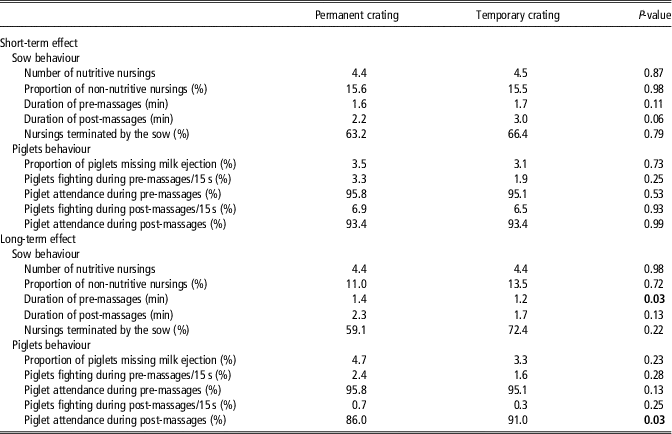
No housing effect was detected on the duration of the pre-massages, the number of NNs, the proportion of non-NNs and the proportion of nursings terminated by the sows (Table 2).
Short-term (day 4, 24-h period after opening of the crate) and long-term effects (day 25) of temporary crating on nursing and suckling behaviour of sows and piglets

Least squares means are presented.
Bold values indicate a statistically significant difference (P < 0.05).
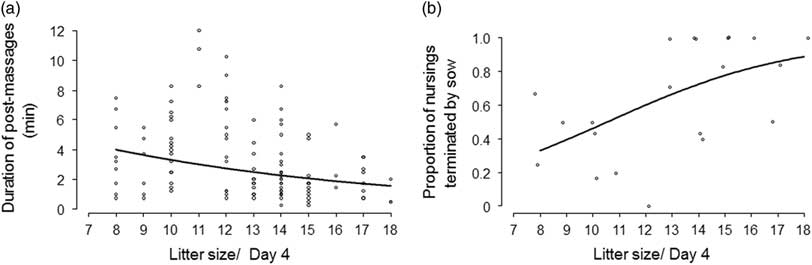
There was an effect of litter size; increasing litter size was associated with longer pre-massages (F 1,21 = 7.15; P < 0.05), shorter post-massages (F 1,21 = 11.25; P < 0.01; Figure 2a) and sows terminated more post-massages (χ 2 = 9.30; P < 0.01; Figure 2b). Duration of pre-massages increased with higher sow parity number (F 1,21 = 7.15; P < 0.05).
(a) Relationship between litter size and duration of post-massages (observed and fitted* values) on day 4. (b) Relationship between litter size and probability of a sow to terminate a nursing (observed and fitted* values) on day 4: *The curve is estimated based on the statistical model.

Piglet behaviour
Short-term effects of opening the crate
No housing effect was detected on the proportion of piglets attending and fighting during pre- and post-massages, and the proportion of piglets missing milk ejection (Table 2).
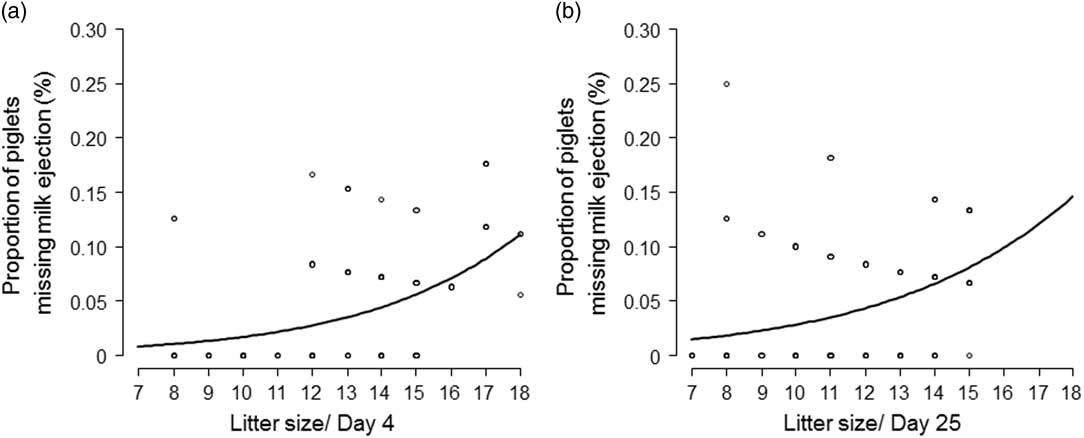
There was a litter size effect detected. More piglets missed milk ejection in larger litters (χ 2 = 5.02, P < 0.05; Figure 3a).
Relationship between litter size and proportion of piglets missing milk ejection (observed and fitted* values) on day 4 (a) and day 25 (b). *The curve is estimated based on the statistical model. The litter size differed between days 4 and 25 due to piglet mortality in some litters after day 4.

Long-term effects of opening the crate
There was a housing effect on post-massage piglet attendance, with fewer piglets attending post-massages in permanent crates (χ 2 = 4.76, P < 0.05, Table 2). Other observed suckling behaviour did not differ between treatments (Table 2).
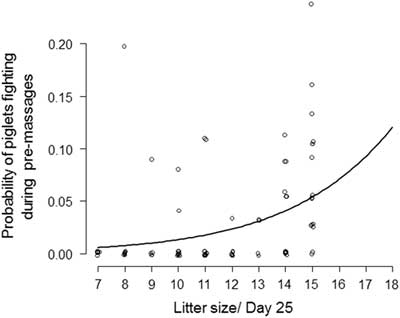
There was an effect of litter size. The proportion of piglets fighting during pre-massages (χ 2 = 5.01, P < 0.05; Figure 4) and the proportion of piglets missing milk ejection increased in bigger litters (χ 2 = 5.05, P < 0.05; Figure 3b).
Relationship between litter size and the number of piglets fighting per 15-s interval in the last five intervals before milk ejection (observed and fitted* values) on day 25. *The curve is estimated based on the statistical model.

Piglet weight gain
Piglet weight gain did not differ in the 24-h period after opening the crate and from days 4 to 25 between permanent and temporary crating housing systems (167.9 v. 178.7 g ; SEM: 9.0; and 4091.1 v. 4359.0 g; SEM: 166.8, respectively). Litter size influenced BW (P < 0.001) with piglets in bigger litters having lower weights at both ages.
Discussion
Short-term effects of opening the crate
To our knowledge, this is the second study assessing the effect of removal of confinement from day 3 pp. to weaning on nursing and suckling behaviour of lactating sows and piglets, compared to permanent crating. The behavioural analysis in the present study was more detailed than the only available study of Singh et al. (Reference Singh, Verdon, Cronin and Hemsworth2017). Specifically, more reliable indicators of litter competition, that is the differentiation between nutritive and non-NNs, the duration of pre- and post-massages and the number of piglets fighting at the udder were used (Špinka et al., Reference Špinka, Illmann, Algers and Stětková1997; Pedersen et al., Reference Pedersen, Moustsen, Nielsen and Kristensen2011; Bozděchová et al., Reference Bozděchová, Illmann, Andersen, Haman and Ehrlenbruch2014).
In the present study, the number of NNs and the proportion of non-NNs were similar in both treatments. These result indicates that nursing behaviour (e.g. the motivation to nurse and to release milk) was not impaired even when loose sows had increased activity levels, including more rolling within the 24-h period post-opening of the crate (Goumon et al., Reference Goumon, Leszkowová, Šimečková and Illmann2018). The number of NNs is an important indicator of milk transfer as it is positively correlated with milk intake and piglets weight gain (Špinka et al., Reference Špinka, Illmann, Algers and Stětková1997; Auldist et al., Reference Auldist, Carlson, Morrish, Wakeford and King2000; Tanaka and Koketsu, Reference Tanaka and Koketsu2007). Furthermore, the duration of pre-massages and of post-massages did not differ between treatments. Longer post-massage duration could support the release of prolactin and can increase the milk production (Špinka et al., Reference Špinka, Illmann, Stetkova, Krejci, Tomanek, Sedlak and Lidicky1999). Thus, the present study clarifies the results of Singh et al. (Reference Singh, Verdon, Cronin and Hemsworth2017) who showed that sows had the same number of nursings in both treatments, but without differentiating whether a nursing was nutritive or non-nutritive and considering only the whole duration of a nursing.
The results of the present study indicate that udder access was not altered after opening the crate as the same proportion of piglets attended nursings during pre- and post-massages in both treatments. This is supported by the fact that the number of piglets fighting, the proportion of piglets missing milk ejection and BW gains were similar in both temporarily and permanently crated sows. It has been shown that a high number of piglets fighting is a clear indicator of impaired teat access and of more piglets missing milk ejection during the neonatal period (days 1 and 2 pp., Bozděchová et al., Reference Bozděchová, Illmann, Andersen, Haman and Ehrlenbruch2014; Illmann et al., Reference Illmann, Leszkowová and Šimečková2018) and in established lactation (days 15 and 28 pp., Pedersen et al., Reference Pedersen, Moustsen, Nielsen and Kristensen2011). These results are in line with those of Singh et al. (Reference Singh, Verdon, Cronin and Hemsworth2017) who found that the same proportion of piglets missing milk ejection in both temporarily and permanently crated sows on day 4 pp. but without assessing piglets fight at the udder.
Long-term effects of opening the crate
The prediction that opening the crate in temporary crating might have a long-lasting positive effect on the calmness of nursings before weaning compared to permanent crating was only partly confirmed. In the present study, piglets of temporarily crated sows showed shorter pre-massages and more piglets attended post-massages on day 25 compared to those of permanently crated sows. This indicates that piglets in permanent crates had to massage the teats longer in order to stimulate milk ejection. Some piglets may have had an impaired teat access caused by the protective bars of the farrowing crates and thus they had no possibility to efficiently massage their teats, which could have prolonged the release oxytocin and consequently milk ejection (Fraser, Reference Fraser1973). On the other hand, the present study did not find any difference in other indicators of greater calmness of nursing and suckling behaviour (e.g. proportion of piglets fighting or missing milk ejection or nursing termination by the sow) in temporary crates as suggested by Pedersen et al. (Reference Pedersen, Moustsen, Nielsen and Kristensen2011). It might be that even reduced crating duration of the sow, that is before parturition and during the 1st day pp. still has a long-lasting negative effect influencing calmness during nursing.
As expected, we did not find any evidence that litter competition increased in temporary crates as found by Singh et al. (Reference Singh, Verdon, Cronin and Hemsworth2017). That study found a higher litter competition at the udder in temporary crates compared to permanent crates on days 11 and 18 pp., as indicated by a higher proportion of piglets missing nursing bouts and piglets displaced at the udder. These results are surprising because these differences become evident 1 week after opening the farrowing crates. The litter size was rather small (only 10 to 11 piglets) and the teat order should have been stable at this age (Puppe and Tuchscherer, Reference Puppe and Tuchscherer1999). The higher litter competition might be explained by management factors or the pen design where piglets did not get full access to the teats.
Litter size effect
In our study, litter size had a negative effect on nursing and suckling behaviour in both housing systems. With increasing litter size a higher proportion of piglets missed milk ejection on days 4 and 25. Furthermore, sows terminated more post-massages and allowed only shorter post-massages on day 4. It is crucial for each piglet not to miss the brief milk ejection period (typically 20 s each hour) which is the only period of the nursing bouts during which they can actually ingest milk (Illmann et al., Reference Illmann, Špinka and Štětková1999). Missing milk ejection prolongs the inter-nursing interval and lowers the milk intake for each piglet per time unit (Špinka et al., Reference Špinka, Illmann, Algers and Stětková1997; Jensen et al., Reference Jensen, Gustafsson and Augustsson1998). In our study, the average litter size was almost 14 piglets (permanent crates: 13.7±0.7 piglets v. temporary crates: 13.5±0.7 piglets). It has been shown that at an average litter size of 12 piglets, one piglet per missed the milk ejection on day 1 pp. (Andersen et al., Reference Andersen, Naevdal and Bøe2011) but also in later lactation (days 15 and 28 pp., Pedersen et al., Reference Pedersen, Moustsen, Nielsen and Kristensen2011). Even though it was not the primary aim of the study, this finding underlines that increasing litter size may be a welfare problem and highlights the importance of addressing it in further studies (Rutherford et al., Reference Rutherford, Baxter, D’Eath, Turner, Arnott, Roehe, Ask, Sandoe, Moustsen, Thorup, Edwards, Berg and Lawrence2013; Ocepek et al., Reference Ocepek, Newberry and Andersen2017).
With increasing litter size, more piglets were fighting during pre-massages on day 25. This supports the results of other studies reporting that litter competition continues in on-going lactation (Milligan et al., Reference Milligan, Fraser and Kramer2001; Pedersen et al., Reference Pedersen, Moustsen, Nielsen and Kristensen2011). Some piglets in larger litters may not be physically able to reach their teats because the surface per piglet at the udder decreases more significantly than for piglets in smaller litters.
Conclusion
Our results show that opening the crate from day 3 pp. to weaning did not impair suckling and nursing behaviour shortly after removal of confinement. Nursings were to some extent calmer (shorter pre-massages and more piglets attended post massages) in temporary crates on day 25. Increased litter size was found to impair nursing and suckling behaviour of the sow and piglets independently of the housing system. To conclude, our study shows that temporary crating is a safe alternative to permanent crating in regards to nursing and suckling behaviour.
Acknowledgements
This research was supported by grant number NAZV QJ1610390 and by the Ministry of Agriculture of the Czech Republic, institutional support MZE-RO0718.
Declaration of interest
The authors have declared that no competing interests exist.
Ethics statement
This study received approval for animal use and care from the Institutional Animal Care and Use Committee of the Institute of Animal Science and was conducted in accordance with Czech Central Committee for Protection of Animals number 60444/2011-17214.
Software and data repository resources
Data and models are not deposited in an official repository.