Introduction
The rapid pace of urbanization, changes in the retail sector and economic growth in many parts of the developing world have lead to major changes in the foods that people eat, with a growing tendency towards over nutrition (Gomez and Ricketts, Reference Gomez and Ricketts2013; Popkin, Reference Popkin2014; Tschirley et al., Reference Tschirley, Reardon, Dolislager and Snyder2015). At the same time, these changes may offer new opportunities for strengthening an important dimension of urban food systems—the connections between consumers and nearby farmers. The potential to strengthen rural–urban links in developing countries around food can support development goals related to health and nutrition, as well as local economic development (Gelli et al., Reference Gelli, Hawkes, Donovan, Prichard, Ortiz and Shekar2016). A deeper understanding of the preferences of urban consumers—their perceptions, priorities and behaviors—will provide critical insights for the design of policies and strategies to support actors in the food system to achieve impact at scale.
This study sheds light on the preferences of consumers for a set of fresh tree fruits in a developing country context. We applied a choice experiment (CE) in Cusco, Peru—a city that has experienced considerable economic and population growth in recent years—to estimate consumers’ willingness to pay (WTP) for locally grown apples, avocados and pears vis-à-vis their non-local counterparts. The remainder of this paper is divided into five sections. The next section reviews the recent insights from North America, Europe and across developing countries on consumer preferences for locally produced food. We then describe the study design and protocol we followed to conduct the CE. In the following section, we explain the theoretical framework that forms the basis of the mutinomial logit (MNL) analysis used to estimate the probability that a consumer would be WTP more for a local fruit over a nonlocal fruits. We then present the results from the estimation of the MNL analysis. The final section discusses the implications of the results for the development of urban food systems and provides suggestions for future research.
Consumer Preferences for Local Food
The revitalization of urban food systems in the North America and Europe, in response to consumers’ concerns over the environment, food quality and the viability of small-scale farming, has captured the attention of researchers for roughly two decades (Feenstra, Reference Feenstra1997; Hinrichs, Reference Hinrichs2000; Torjusen et al., Reference Torjusen, Lieblein, Wandel and Francis2001; Brown, Reference Brown2003; Prigo, Reference Prigo2003; Weatherell et al., Reference Weatherell, Tregear and Allinson2003; Schneider and Francis, Reference Schneider and Francis2005; Feagan, Reference Feagan2007; Allen, Reference Allen2010; Svenfelt and Carlsson-Kanyama, Reference Svenfelt and Carlsson-Kanyama2010; Cleveland et al., Reference Cleveland, Carruth and Mazaroli2015). The rich collection of research that has emerged explored consumers’ perceptions and WTP more for locally produced agricultural products; the effectiveness of local food labeling schemes; and challenges faced by producers, processors, intermediaries and retailers to meet demand in these regions.
Research on consumer preferences in these urban systems found that consumers in Europe and the USA were WTP from 5% up to 50% more for food that was labeled as being locally grown. These studies included various food products: potatoes in Colorado (Loureiro and Hine, Reference Loureiro and Hine2002); wine in Greece (Skuras and Vakrou, Reference Skuras and Vakrou2002); fruits, vegetables and meat in South Carolina (Carpio and Isengildina-Massa, Reference Carpio and Isengildina-Massa2009); strawberries in Ohio (Darby et al., Reference Darby, Batte, Ernst and Roe2008); and wine and apples in Germany (Grebitus et al., Reference Grebitus, Lusk and Nayga2013). The preference for local products by consumers in Colorado was stronger than it was for organic or GMO free products (Loureiro and Hine, Reference Loureiro and Hine2002). In several studies, consumers’ WTP was higher for more perishable products, demonstrating the importance of freshness in the decision for local products (Carpio and Isengildina-Massa, Reference Carpio and Isengildina-Massa2009; Grebitus et al., Reference Grebitus, Lusk and Nayga2013). WTP estimations in the Global North varied by the type of consumer with higher income households, younger consumers, more educated consumers and consumers who have young children WTP the most for locally grown food (Loureiro and McCluskey, Reference Loureiro and McCluskey2000; Loureiro and Hine, Reference Loureiro and Hine2002; Carpio and Isengildina-Massa, Reference Carpio and Isengildina-Massa2009).
When considering the Global South, researchers have brought to light various challenges facing food systems; however, few have addressed issues around localization and the interests of urban consumers. Attention has been focused on the capacity of producers to meet the safety and quality standards demanded by importers in the USA and Europe (Unnevehr, Reference Unnevehr2000; Martinez and Poole, Reference Martinez and Poole2004; Asfaw et al., Reference Asfaw, Mithöfer and Waibel2010; Lee et al., Reference Lee, Gereffi and Beauvais2012) and buyers in supermarkets (Reardon et al., Reference Reardon, Timmer, Barrett and Berdequé2003). In response to the export orientation of the agricultural sectors in developing countries, researchers have argued for ‘food sovereignty,’ or the right of peoples to healthy and culturally appropriate food based on sustainable production methods (Rosset, Reference Rosset2008; Altieri and Toledo, Reference Altieri and Toledo2011). The food sovereignty debate remains rooted in the rural sector and has yet to expand on the needs and preferences of urban-based consumers for healthy and nutritious foods.
The evidence that exists on food preferences by urban consumers in developing countries is fairly limited—despite the fact that Latin America has been over 80% urbanized for nearly two decades and Sub-Saharan Africa has the fastest rates of middle class expansion and city growth (Kharas, Reference Kharas2010; UNDESA, 2014). Various case studies from Asia suggests that urbanization and income growth have contributed to greater demand for safe and nutritious food with limited exposure to agrichemicals (Roitner-Schobesberger et al., Reference Roitner-Schobesberger, Darnhofer, Somsook and Vogl2008; Wang et al., Reference Wang, Mao and Gale2008; Aryal et al., Reference Aryal, Chaudhary, Pandit and Sharma2009; Mergenthaler et al., Reference Mergenthaler, Weinberger and Qaim2009a). Several studies have estimated that consumers were willing to pay more for organic foods in developing countries, such as in Sri Lanka (Piyasiri and Ariyawardana, Reference Piyasiri and Ariyawardana2002), Nepal (Aryal et al., Reference Aryal, Chaudhary, Pandit and Sharma2009), Vietnam (Mergenthaler et al., Reference Mergenthaler, Weinberger and Qaim2009a) and Peru (Garcia-Yi, Reference Garcia-Yi2015). While these studies did not evaluate whether consumers were also WTP more for locally produced foods in these contexts, they provide some indirect support for consumers’ potential interest in locally produced foods to the extent that organic foods are more likely to be produced and sold in relative close proximity.
A few studies have assessed the demand for locally produced food and the capacity of local suppliers to respond to local demand. An estimation of demand elasticities of supermarket purchases by Vietnamese consumers revealed that their demand for domestically produced food items remained strong irrelevant of whether the purchase was made in supermarkets or traditional markets (Mergenthaler et al., Reference Mergenthaler, Weinberger and Qaim2009b). In Nairobi, Kenya a box scheme to provide locally produced fruits and vegetables to urban consumers ultimately failed, mainly due to logistical challenges. The box scheme was able to meet the demand for locally produced fruits and vegetables only for a relatively short period of time (Freidberg and Goldstein, Reference Freidberg and Goldstein2011). Another study in Nairobi found that young, urban consumers’ demand for indigenous vegetables in local markets and restaurants has grown so much that smallholders are struggling to keep up (Cernansky, Reference Cernansky2015).
Several authors have also identified the potential to promote locally-produced fruits and vegetables in fast growing cities to address dietary trends, characterized by growing consumption of processed foods and meat and dairy products (Delgado, Reference Delgado2003; Reynolds et al., Reference Reynolds, Buckley, Weinstein and Boland2014). For instance, Penny et al. (Reference Penny, Meza, Creed-Kanashiro, Marin and Donovan2016) found that fruit consumption was altogether low but still higher than vegetable consumption (204 g compared with 117 g per day) in peri-urban Lima, Peru. These eating habits have led to rapidly rising rates of obesity in middle-income countries, which is related to the increase in non-communicable diseases (NCDs) (Kimokati and Millen, Reference Kimokati and Millen2011; Swinburn et al., Reference Swinburn, Sacks, Hall, McPherson, Finegood, Moodie and Gortmaker2011). How to promote the consumption of fruits and vegetables remains an important question, especially as poverty and limited access to fresh fruits and vegetables may limit their consumption (Rasmussen et al., Reference Rasmussen, Krølner, Klepp, Lytle, Brug, Bere and Due2006; Bigio et al., Reference Bigio, Verly Junior, de Castrol, Galvão César, Fisberg and Lobo Marchioni2011). Strategies to promote fruit and vegetable consumption in Peru and elsewhere must contend with the reality that urban households may simply prefer to spend the majority of whatever of their food budget reamains after the purchase of staple foods on energy-dense but nutrient poor foods.
Methods
Context
The study site is representative of the fast growing regional cities throughout Latin America and other developing regions. These cities have emerged as important destinations for rural migration with families attracted by growing economies and less congestion (Montgomery, Reference Montgomery2008). Insights into the preferences of consumers in Cusco is likely to shed light on the preferences of consumers in other cities in Latin America and perhaps elsewhere. Regional cities are likely to face similar social changes with growing populations and incomes with local food production dominated by poor and isolated farmers with relatively few marketing opportunities. Most of the farming households in Cusco, 59% of the department's population, balance subsistence production with market oriented production. They sell relatively small volumes in local markets (INEI, 2013). Many of these farmers are dedicated to growing traditional products (e.g. quinoa and other Andean grains, native potatoes, squash and corn) using low input methods.
The population of Cusco, Peru has been growing at an annual rate of more 0.5% between 2010 and 2015 (INEI, 2015a). At the same time, a booming tourism sector and mining industries have propelled this growth (El Comercio, 2014). Median per capita income in the department grew at an average rate of 11% per year between 2008 and 2015, more than doubling in this period from nearly US$900 to over US$1800. This growth was much more rapid than in Peru as a whole, where it grew by about 60% from around US$1500 to US$2400. This growth was spread throughout the population, as the ratio of the income that the wealthiest 25% received to the bottom 75% fell from 3.5 to 2.9 from 2005 to 2015 (INEI, 2014).
Data collection
The CE was part of a larger study to understand the food environment in the city of Cusco and determine consumers purchasing behaviors and preferences for locally grown fruits and vegetables. This research consisted of two phases. In May 2015, we held four focus groups with between 8 and 15 consumers in each group. Participants were asked about what local food meant to them and what distinguished it from non-local foods. They also described the characteristics of local foods including physical appearance, taste and freshness differences. They finally identified local foods that they sought out. Three of the most frequently listed products were avocados, apples and pears. The surveys were administered between July and August 2015 with 300 consumers. In addition to the CE, the survey included questions about the households’ demographics and food budgets; food safety practices; purchasing habits in traditional markets, supermarkets and directly from producers; and perceptions of locally grown fruits and vegetables in comparison with those grown in other regions of Peru and other countries. The questions for the CE were included at the end of the survey.
The consumer's WTP for locally produced fruit for avocados, apples and pears was determined by responses to four questions for each fruit, with the order in which the fruits were discussed assigned randomly. Firstly, the participant was asked which fruit she would prefer to purchase, the local fruit or the non-local fruit. The price for each fruit was randomly assigned to be either the same for the local and non-local fruit or 10% more for the local fruit. This strategy allowed us to control for starting point bias, whereby the first value presented influences the respondent's valuation of the good (Boyle et al., Reference Boyle, Bishop and Welsh1985; Herriges and Shogren, Reference Herriges and Shogren1996). The consumer was then asked if she would pay more for the locally produced fruit. If the participant answered in the affirmative, she was then given a card with a list of prices and asked to select the highest amount she would pay for the locally produced fruit and still prefer it to the non-local fruit. The non-local fruit maintained the same price as the starting price presented in the first question. The price on the card ranged from 10% to 50% more than the price for the non-local fruit. Finally, she was given another card to select how confident she was in her choice. She would indicate whether she was completely sure, sure, neither sure nor unsure, unsure and completely unsure of her choice. The consumer was then asked the same series of questions for the next two fruit (Fig. 1).
Example of the questions of the choice experiment section of the survey for the preference for local avocados translated from Spanish to English.

Participants in the focus groups were selected while they were shopping in one of two traditional markets. The surveys were also conducted in a large, traditional market, frequented by consumers from across the city of Cusco because of its location in the center of the city. We selected the participants from these traditional markets in Cusco because the majority of consumers in Cusco continue to make nearly all of their fruit and vegetable purchases in these traditional markets, even with the growth of supermarket sales in Peru. Key informant interviews with leaders of consumer organizations, observations made of consumer purchases in the traditional markets and supermarkets and the results of the focus group meetings, confirmed this finding. These traditional markets in Cusco have basic infrastructure provided by the municipal governments, consisting of small stalls with concrete floors, which are rented out to vendors for the sale of fresh produce, meats and household products. Most market sellers are intermediaries, who purchase their products in wholesale markets or sometimes directly from farmers. A few farmers sell small volumes of their own production at the entrance of the markets, but most prefer to sell directly to the vendors in the market.
To establish the four focus groups, we selected shoppers at different times and different days in an attempt to capture the range of shoppers in Cusco, as work and family schedules influence the shopping times of different types of consumers. Two of the focus groups were made up shoppers on a Wednesday. One group of participants was of morning shoppers and another group of participants was made up of afternoon shoppers. Likewise, another two groups, one of morning and another of afternoon shoppers, were selected on a Saturday. Two-thirds of the participants were women, covering a wide age range, with the youngest participant being 20 and the eldest being 75.
To conduct the surveys, the enumerators occupied a stall in the center of the market and approached consumers as they passed the stall to invite them to be interviewed, often just before or after they had made their purchases. As an enumerator finished one interview, she approached the next person that passed the stall to interview. The participants were compensated for their time with gifts of kitchenware. Once 100 interviews had been conducted (a third of the total), we analyzed the demographics of the participants to see how well the sample represented the population in Cusco by age and education levels. The monitoring allowed us to realize that younger consumers were not well represented in the first third of the sample. The enumerators then targeted younger consumers in the market by recruiting participants at midday when young office workers went to the market for lunch, as well as expanding the gift selection offered to items that would be more attractive to younger consumers, similar to strategies used by Karp Resources to attract younger participants (2012).
As shown in Table 1, the sample selected for the surveys well represented the overall urban population of Cusco in terms of age and education levels. On average the consumers included in the sample were slightly older, more educated and included more women than in the population of Cusco, according to the last census in 2007. As the principal female adult in the household make the decisions on the food purchases in Cusco and throughout Latin America, women were more likely to making food purchases in the market. Thus, they were more prevalent in our sample (Martinez-Zuniga, Reference Martinez-Zuniga2007; ELAC, 2010). As educational attainment has been increasing in Peru, the higher percentage of consumers that have high school or post-secondary education is likely to be well representative of the current population, as the census data are nearly a decade old (World Bank, 2016).

Households of different wealth classes in Cusco were also included in the sample, as demonstrated in self-reported per capita income levels and the construction materials of the home of the participants in Table 1. The sample was weighed toward middle-income groups of households, as classified by the Peruvian national statistics institute (INEI). There were fewer households in the least wealthy and most wealthy categories than the overall population. The types of homes of those who participated in the survey also indicated that the sample was weighted toward middle households. Their homes were more likely to be constructed of brick or cement and have cement, laminate or ceramic flooring than the overall population, which was more likely to have homes made of adobe and dirt or wood floors. As the rapid economic growth has expanded the middle class in Cusco, we expect them to be an important sector of the demand for local foods. They have a larger food budget with the ability to spend more on higher quality foods. Thus, they were important component of this study.
Consumers overstate their WTP in CEs because the experiment fails to call for actual expenditures (Diamond and Hausman, Reference Diamond and Hausman1994; Venkatachalam, Reference Venkatachalam2004; Murphy et al., Reference Murphy, Allen, Stevens and Weatherhead2005). In this case, the purchase of local foods may be a socially desirable behavior, which would encourage respondents to overstate their WTP for the local food (Bennett et al., Reference Bennett, Kerrigan, O'Reilly, Lee and Sargeant2011). Based on the research of techniques to limit this tendency of a respondent to overstate her WTP, we designed our research so that the interviews were conducted in the same environment where fruit and vegetable purchases were made and included the CE at the end of the survey after questions focused on food prices and budgets had been asked. Conducting the experiment in the environment where the decision is normally made and asking introductory questions on purchasing habits has been shown to help ensure that the respondent will make a choice that more realistically reflects her actions, as she would have the prices of the goods and her preferences in mind when making the selection (Landenburg and Olsen, Reference Landenburg and Olsen2008; Gracia et al., Reference Gracia, De Magistris and Nayga2012; Bogomolova et al., Reference Bogomolova, Loch, Lockshin and Buckley2016).
To try to evaluate the extent that hypothetical bias existed in this CE, we ask a follow up question to determine the participant's level of confidence in her stated WTP. Research has shown that if a participant expressed doubt in her response, she would be less likely to follow through on it in the real world (Champ et al., Reference Champ, Moore and Bishop2004; Murphy and Stevens, Reference Murphy and Stevens2004; Mohammed, Reference Mohammed2012). Thus, if the participants showed that they had little confidence in their responses, we would have little reason to fully accept the results. On the other hand, if the participants said that they had a high degree of confidence in their responses, we would have additional evidence to accept their WTP preferences.
Theoretical Framework
To conceptualize the choice made by the respondents in the CE, following (Alpízar et al., Reference Alpízar, Carlsson and Martinsson2001), for the local fruit j over other the non-local fruit i can be represented as δ j, which is a dichotomous variable equal to one if the local fruit j is chosen and zero if it is not
 $$\delta _j = \left\{ {\matrix{ \matrix{1\;{\rm if}\;V_j (A_j ;p_j ;y;s;\varepsilon ) \gt \hfill \cr \max [V_i (A_i ;p_i ;y;s;\varepsilon )]\forall i \ne j \hfill} \cr {0\;{\rm if}\;{\rm otherwise}} \cr}} \right.$$
A j represents the attributes of fruit j (e.g. local). We assume that these attributes are strictly exogenous to the consumer. p j is the specific price for the fruit. The consumer's personal characteristics are represented by s (e.g. consumer's gender, age, education level, income and number of young children), and y is the consumer's household income. The components that are unobservable to the researcher, (subjective) attributes of the products and/or consumer, are treated as a random variable ε (Hanemann, Reference Hanemann1984).
Equation (1) can be understood in terms of a probability of choosing the local fruit where the error term ε enters the conditional indirect utility function as an additive term.
 $$\eqalign{ P[\delta _j = 1] &= P\{ V_j (A_j ;p_j ;y;s) \cr & \quad + \varepsilon _j \gt \max [V_i (A_i ;p_i ;y;s) + \varepsilon _i ]\forall i \ne j\}} $$
To depict the distributional assumption of ε, the MNL model, described by McFadden (Reference McFadden, Griliches and Intriligator1984), has become the accepted model to use in applied work. Our CE included M choice sets (each of the three local fruits has six bids). Each choice set F m consisted of K m alternatives in terms of sequentially increasing bids, such that F m = {A 1m,,.., A km,}. Thus, the probability of choosing alternative j from a choice set F m can be expressed as:
 $$\eqalign{ P[\delta _j &= 1 \vert F_m ] = P\{ V_j (A_{\,jm} ;p_{\,jm} ;y;s) \cr & \quad +\varepsilon _j \gt \max [V_i (A_{im} ;p_{im} ;y;s) + \varepsilon _i ]\forall i \ne j\}} $$
The MNL model assumes that the random terms (ε j, ε i) are individually, identically distributed (iid) with a mean of zero and var(ε) = π 2/6μ. Then, the choice probability in equation (3) according to McFadden (Reference McFadden, Griliches and Intriligator1984) becomes:
 $$P[\delta _j = 1 \vert F_m, \beta ] = \displaystyle{{{\rm exp}(V_j (A_{\,jm} ;p_{\,jm} ;y;s))} \over {\mathop \sum \nolimits_{i\epsilon F_m} {\rm exp}(V_j (A_{\,jm} ;p_{\,jm} ;y;s))}}$$
For simplicity the indirect utility function V j(.) is assumed to have a linear functional form, where vector X′h, includes all variables (the attributes of the fruit, price, the characteristics of the consumer and household income) while β is a vector of the cofficients, which measure the effect of each of the viarbles in X′h on the probability to choose the local fruit
 $$P[\delta _{\,jm} = 1] = X^{\prime}_{\rm h} \beta $$
The empirical model of the probability of selecting the local fruit becomes
 $$\eqalign{& P[\delta _j = 1 \vert F_m, \beta ] = \alpha _i + \beta _1 {\rm gender}_i \; + \beta _2 {\rm age}_i \cr & \quad + \beta _3 {\rm education}_i + \beta _4 {\rm income}_i + \beta _5 {\rm children}_i} $$
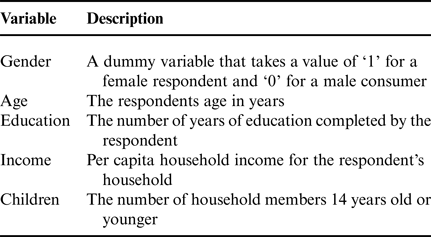
where the decision is expected to be influenced by the consumer's gender, age, education, income and the number of young children in the household, as demonstrated in previous studies (Bogomolova et al., Reference Bogomolova, Loch, Lockshin and Buckley2016) (Table 2).
Description of variables in the multinomial logit model.

The estimation of the empirical equations can be conceptualized as six different equations for each fruit F m. One equation for each of the possible WTP options presented to the respondents of nothing, 10, 20, 30, 40, or 50% more for locally grown apples, avocados and pears. Although the respondent faced six choices in the study, the analysis of the choice is a comparison of the base, paying nothing, against each one of the amounts included in the study.
Results
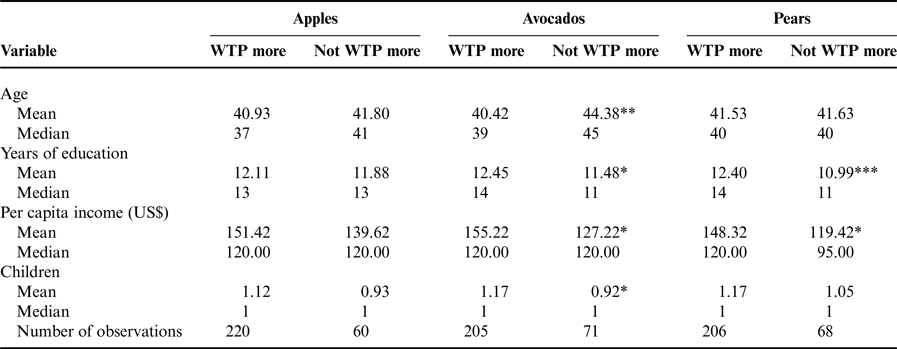
For each of the fruits considered, nearly 75% of consumers were WTP at least 10% more for these locally grown fruits while 25% were not WTP more (Fig. 2). A clear difference in the results was that more consumers were WTP much for locally grown apples than they were for the other two fruits. Eleven percent of participants were WTP 50% more for locally grown apples while only 4% were WTP 50% more for locally grown avocados and pears (This difference may be a result of apples being much less expensive than the other fruits. At the time of the study, pears and avocados were US$1.25 kg−1 while apples were US$0.75 kg−1 in the local market. So, a 50% price increase would only be US$0.38 for apples but US$0.63 for avocados and pears. The absolute price difference rather than the relative difference may have been a greater consideration for these consumers.) As demonstrated in Table 3, the consumers that were WTP more for locally grown fruits were on average younger, more educated, had higher household incomes and had more young children.
Percentage of respondents that were WTP 0, 10, 20, 30, 40 and 50% for locally grown apples (left), avocados (middle) and pears (right).

Differences in characteristics of consumers who are WTP more for local fruits and those who are not WTP more for these fruits.

***p-value ≤ 0.01, **p-value ≤ 0.05, *p-value ≤ 0.1.
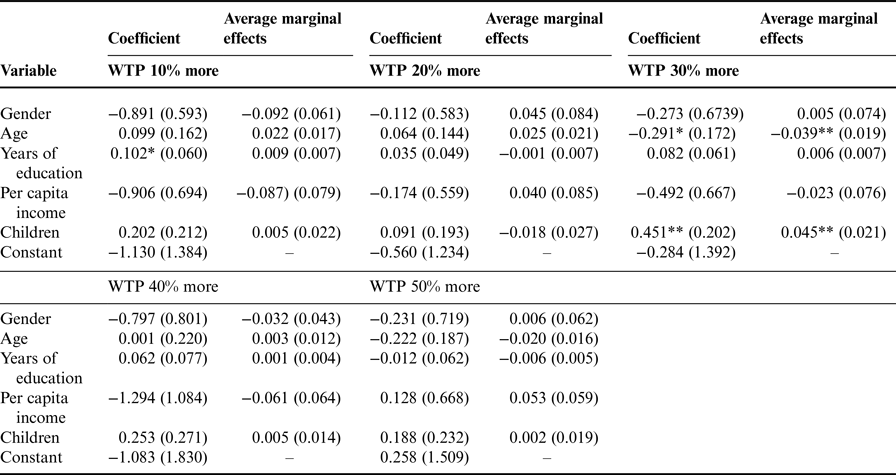
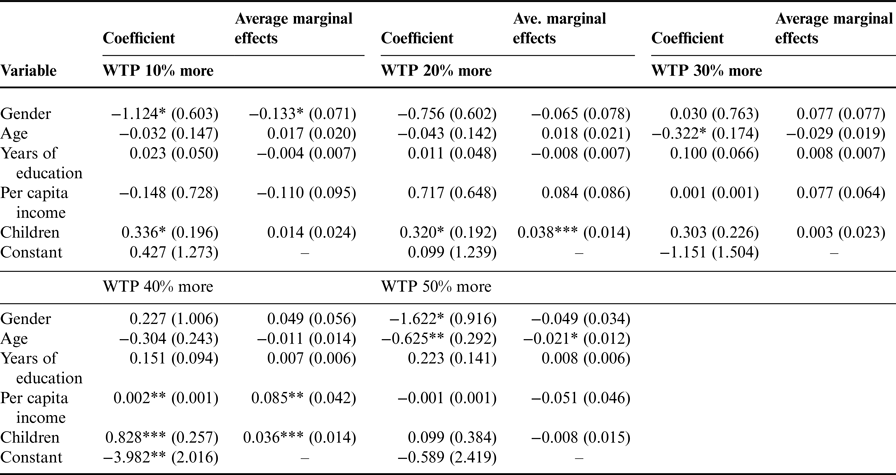
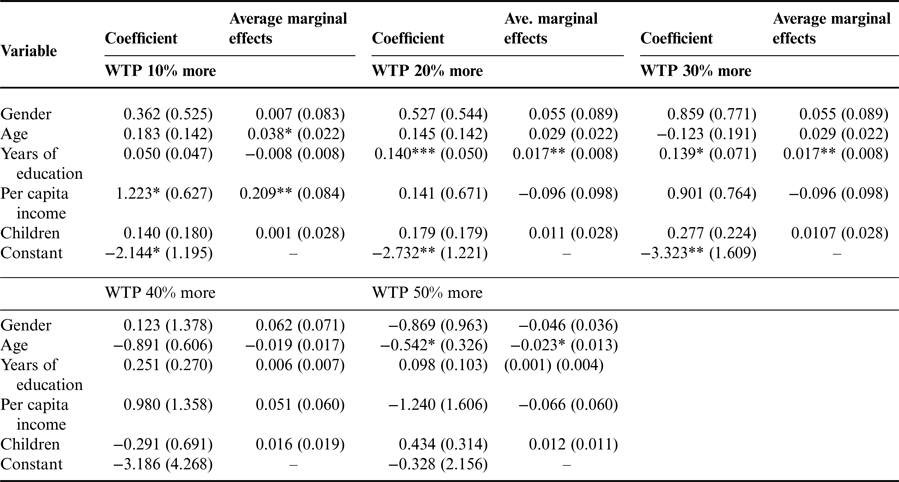
The analysis of the multinominal logit (MNL) model collaborate the results that age, educational attainment and the number of young children in the household influenced the consumers’ WTP more for locally produced apples, avocados and pears. The coefficients and marginal effects for these three variables were statistically significant for each of the fruits. The coefficients and marginal effects for the same variable across the three fruits had the same direction of statistical significance. (In a few cases, a coefficient was significant while the complementary average marginal effect for the variable was not significant or visa versa. This situation can occur because coefficients and the marginal effects are calculated differently. The coefficients are maximum likelihood estimations while the average marginal effects are the average across all participants of the effect (the partial derivative) that the variable being analyzed in the empirical equation has on the probability to choose the local fruit at the price level.) The direction of the statistical relationship for the age coefficients indicated that a younger consumer was more likely to be WTP more than older consumers for locally produced products. The direction of the statistical relationship for the education coefficients demonstrated that consumers that attended school longer had a higher probability to be WTP more for locally grown fruits. Finally, the direction of the statistical relationship for the number of children in a household under 14 revealed that the more children in a household the more probable the consumer was WTP more for the locally grown fruit.
Tables 4–6 present the coefficients and average marginal effects for each of the variables across each of the bids presented to the participants of 10, 20, 30, 40, or 50% more for the locally grown fruit. Since WTP nothing was used as the base for comparison between it and each of the WTP scenarios, paying nothing more was not estimated. Several coefficients and marginal effects of a variable were found to be significant for one or two fruits but not across all three fruits, so no conclusion could be made about the effect of these variables on all locally produced fruits. For instance, per capita household income was a significant predictor of WTP for locally grown avocados and pears, but not for locally grown apples. Wealthier consumers were WTP more for locally grown avocados and pears.
Coefficients and average marginal effects for the WTP more for local apples.

***p-value ≤ 0.01, **p-value ≤ 0.05, *p-value ≤ 0.1.
Coefficients and average marginal effects for the WTP more for local avocados.

***p-value ≤ 0.01, **p-value ≤ 0.05, *p-value ≤ 0.1.
Coefficients and average marginal effects of the WTP more for local pears.

***p-value ≤ 0.01, **p-value ≤ 0.05, *p-value ≤ 0.1.
The average marginal effects estimates provide an average across all the participants of the probability of a consumer being WTP 10, 20, 30, 40, or 50% more for the local fruit from a unit increase of the variable. For example, a consumer that is 1 year younger than another would be 0.39% more probable to be WTP 30% more for a locally grown apple than a consumer that is a year older. Thus, a 30-year-old consumer would be 11.7% more probable to be WTP 30% more for locally raised apples than a 60-year-old consumer. Likewise, she would be 6.3% more probable to be WTP 50% more for locally produced avocados and 6.9% more probable to be WTP 50% more for locally produced pears than the 60-year-old consumer would for these locally produced fruits.
The participants in the CE indicated considerable confidence in their response. For each of the fruits, 97% of the consumers were either sure or very sure of their response. At most 3% of consumers indicated they were neither sure nor unsure of their response. No one indicated that she was unsure or very unsure about the WTP responses she provided. These results allowed us to have more confidence in the validity of the participants’ responses than we would have if they were not sure of their responses.
Conclusion and Discussion
The results from the CE for selected tree fruit purchases by consumers in Cusco, Peru lend support to the emerging body of research that suggests an unmet demand for local foods in urban areas of developing countries. A growing subset of Cusco consumers seeks out locally grown fruits and is likely to pay a premium for these products. Important was the finding that more educated and younger consumers were more probable to be WTP more for locally produced fruits. Thus, the demand for locally produced foods in Cusco is likely to expand with a growing economy and population and rising education levels. The findings in Cusco and those from other studies provide justification for local governments, NGOs and others to begin to explore options in support of the production, marketing and processing of food for nearly urban food systems.
The vast majority of discussion in the rural development literature on smallholders and their engagement with markets continues to revolve around meeting the needs of distant buyers and consumers. The nurturing of urban–rural connections will require new approaches for building the capacities of local farmers and business and metrics for measuring progress. Approaches will need to address simultaneously the demand constraints to the localization of urban food systems expansion, including the potential to develop labeling and promotional material that allows urban consumers to distinguish locally produced products and marketing campaigns on the availability and characteristics of different locally produced foods during the year.
We recognize that the most consumers in developing countries have budget constraints that limit their ability to spend more on food, reducing the options available to them to consume more nutritious and healthy foods and support social and environmental goals. Therefore, the building of stronger urban-rural connections at scale around food will be a long-term process, dependent on continued economic growth and effective strategies that bring together food system actors in ways that encourage growth in the demand for and supply of locally produced foods.
In light of changing food preferences in urban areas, further research is needed to understand the buying patterns, information sources and eating preferences of consumers, who are most likely to seek out locally produced products and how to best target them. Methodologies that use experiments and observations that allow researchers to witness consumers’ buying habits in seeking out local products and reactions to interventions to promote local foods (e.g. promotional materials, displays and labels) would not only allow researchers to validate or refute these results but also provide insights in creating programs to establish linkages between smallholders and nearby urban consumers. While urban consumers in some countries rely on supermarkets for a sizable share of their food purchases, in many countries, including Peru, traditional markets will continue to represent the bulk of fresh food purchases into the distant future. Deeper insights into options that support market sellers in the storage, branding and marketing of fresh foods in these markets will be necessary for development agencies to bring interventions in urban food systems to scale.
Finally, there is a need to better understand smallholders, processors and intermediaries’ ability to meet this growing demand for locally produced food and the potential bottlenecks in developing linkages between urban areas and nearby farmers. The development of new theories on urban–rural connections around food in developing countries is needed to encourage deeper discussion on the roles of consumers, businesses, governments and development agencies in driving change in the urban food system. Such research should target the needs of stakeholders in the food system to develop strategies to address these bottlenecks at different levels in the system and engage with consumers, farmers, businesses and governments; develop marketing opportunities for rural households; and ensure the access of urban consumers to healthy and nutritious food.
Acknowledgements
We would like to thank the McKnight Foundation and the Policies, Institutions, and Markets (PIM) CGIAR research program for financing the study. We also are appreciative of the directors of the Wanchaq Market in Cusco for generously providing stall space to conduct the interviews; Viriginia Cáceres Huayata and Daniela Yépez Ormachea for conducting all the interviews; Esther Guzman Pacheco for creating the database; and Anja Gassner, Alex Riba; and the editor and reviewers at Renewable Agriculture and Food Systems for providing us with thoughtful, timely reviews.