Introduction
The way people age is not only a scientific concept but also in the minds of older people themselves, and therefore in their everyday vocabulary. In fact, ‘ageing well’ (and related concepts such as ‘active’, ‘productive’, ‘positive’ or ‘optimal’ ageing) is a common construct. Sternberg (Reference Sternberbg1990) proposes that scientific concepts are also mental constructions acting within people's cognitive systems, and as such can be assessed through their opinions and their verbal reports.
Considerable research has been carried out to test how older adults (and other social groups) define, describe or perceive successful ageing, or which are the ingredients of ‘ageing well’ or ‘ageing positively’, and some has made comparisons between countries or cultures. Following the review by Fernández-Ballesteros (Reference Fernández-Ballesteros2008), let us consider some findings. Ryff (Reference Ryff1989) carried out surveys on middle-aged and older adults with a view to defining their conceptualisations of wellbeing and positive functioning in old age. The questions in these surveys referred to general assessments of life, past experiences, conceptions of wellbeing and views of the ageing process. The author concluded that positive relationships, sense of humour, enjoying life and accepting change are criteria for successful ageing.
In the Manitoba Follow-up Study, Tate, Lah and Cuddy (Reference Tate, Lah and Cuddy2003), carried out a survey with an elderly male population of Royal Canadian Air Force mail aircrew recruited since 1948. A content analysis of their responses to two open questions, ‘What is your definition of successful ageing’ and, ‘Would you say you have aged’, was performed. Twenty classes of contents arose, the most commonly cited being: ‘health and disease’, ‘physical, mental, and social activity’, ‘having interests and goals’, ‘family relationships’ and ‘having a good diet’. Many of the topics described referred to aspects of subjective functioning such as attitudes toward life and ageing. In sum, these lay descriptions of successful ageing gave a multidimensional portrait that is consistent with findings in the scientific literature.
Knight and Ricciardelli (Reference Knight and Ricciardelli2003) explored older adults' perceptions of successful ageing and the relationship of these perceptions to the definitions given in the scientific literature. When participants were asked for a definition of successful ageing, most of them used only one or two discriminators, but when a list of standard conditions was suggested, the participants rated as very important almost all the criteria emerging from the literature, such as adapting to new situations, compensating for losses and selecting activities according to capabilities. The authors concluded that implicit theories of successful ageing reported by elders are similar to those described in the academic literature.
From a similar perspective, Von Faber et al. (Reference Von Faber, Van der Wield, Van Excel, Gussekloo, Lagaay, Van Dongen, Knook, Van der Ges and Westendorf2001) explored the meaning of successful ageing from two perspectives: expert criteria and elders' opinions. They used data from the first cross-sectional baseline of the longitudinal Leiden Study. The analysis of qualitative interviews showed that older people defined ‘success’ as the process of adaptation to obtain positive outcomes in the physical, cognitive, emotional and social domains.
Recently, Bowling (Reference Bowling2007) tried to identify perceptions of successful ageing in a British sample of over-fifties, comparing the lay perceptions of different age groups and with theoretical definitions. Successful ageing perception was measured through an open-ended question, ‘What do you think are the things associated with successful ageing?’. It was found that the most frequently-cited ingredients of successful ageing were: health and independent functioning, psychological factors (cognitive, emotional and motivational functioning), social role and activity, financial and living circumstances, and social relationships. In another study, Reichsadt et al. (Reference Reichsadt, Depp, Palinkas, Folsom and Jeste2007) carried out a study using focus-groups of elders' opinions (N=72 community dwellers, age range=60–99) about successful ageing. The 12 focus groups had an average of six individuals. Altogether 33 components of successful ageing were identified, the four major factors were: attitude/adaptation, security/stability, health/wellness, and engagement/stimulation.
Combining methods, Hsu (Reference Hsu2006) examined the concept of ageing well among elders in Taiwan. The participants were asked: (1) an open-ended question, ‘What do you think are the essential components of an ideal and satisfactory life in old age?’ and, (2) to rank 23 successful ageing criteria from a list in order of importance. The most highly rated ‘successful ageing’ criteria were: physical health, independence, living without chronic disease, living with family, and receiving emotional care. A factor analysis revealed that five factors accounted for 58.7 per cent of the variance: family and social support, mastery over life, health, enjoyment of life, and autonomy. The author concluded that successful ageing in Taiwan means being healthy and independent and having economic security and family support.
The lay concept of successful ageing in minority groups has also been analysed. Thus, in an effort to discover the extent to which acculturation affects the concept of successful ageing, Bull (Reference Bull2005) examined how Chinese-Americans – a minority group in the USA – experienced and described successful ageing. The conclusions were that Chinese-American elders showed similar patterns of ‘ageing well’ to those of the dominant culture, with minor idiosyncratic additions. This moderate agreement among different countries and cultures inspired Litwin (Reference Litwin2005) to explore the extent to which the concept of successful ageing is universal. He compared three population groups in Israel (Jewish and Arab Israelis and new immigrant groups), and examined background and health status, social environmental factors, and activity variables. The results of his analysis do not totally support a universal basis for successful ageing, but health status and independence emerged as important components in all groups, and he found idiosyncratic components such as the importance of seeking social ties beyond family members (mentioned by the new immigrant group).
Similarily exploring lay concepts of successful ageing in several cultural groups, Phelan et al. (Reference Phelan, Anderson, Lacroix and Larson2004) mailed a questionnaire to a sample of Japanese and white Americans. The survey questionnaire had three sections: the first had three questions (in a Yes/No format) on whether they had ever thought about ageing and about ageing successfully, and whether these thoughts had changed over the previous 20 years. The second section of the questionnaire had 20 items to be rated from ‘extremely important’ to ‘not at all important’. In the third section, participants were asked to select (from among 13 conditions taken from the second section) the five most important things about growing older, marking the most important. Ninety per cent of the participants said they had previously thought about ageing and successful ageing, while 60 per cent said their thoughts had changed over 20 years. The two groups listed almost the same attributes for defining successful ageing, but the white Americans added the item ‘learning new things’. Furthermore, both samples agreed with two-thirds of the 20 attributes found in the published literature as important for successful ageing. The authors concluded that the definition of successful ageing was multidimensional, and braced physical, functional, psychological and social components, and that this view was strongly shared by two cultural and ethnic groups living in one country.
In order to test whether this view of successful ageing is shared among the Japanese in their own country, Matsubayashi et al. (Reference Matsubayashi, Ishine, Wada and Okumiya2006) applied the Phelan et al. (Reference Phelan, Anderson, Lacroix and Larson2004) survey to a sample of independent older individuals living in Japan. The results showed that Asian Japanese shared only seven of the 20 attributes. While Japanese and white Americans rated as important most of the 20 items listed, but not ‘having the kind of genes (heredity) that help me age well’, 75 per cent of Asian Japanese did not consider as important the following items that were among the most important for white and Japanese Americans: ‘staying involved’, ‘making choices’, ‘able to meet needs and wants’, ‘feeling good’, ‘able to cope with challenges’, and ‘able to act according to own inner standard’. In sum, culture, perhaps more than race, appears to be an important source of variance in lay theories of ageing well.
The cultural differences found in these studies inspired Fernández-Ballesteros et al. (Reference Fernández-Ballesteros, García, Abarca, Blanc, Efklide, Kornfeld, Lerma, Mendoza-Nuñez, Mendoza-Ruvalcaba, Orosa, Paúl and Patricia2008) to make comparisons between European and Latin American and between American and Japanese older people. Seven Latin American countries (Brazil, Chile, Colombia, Cuba, Ecuador, Mexico and Uruguay) and three European countries (Greece, Portugal and Spain) participated in the study. In order to make comparisons with the United States and Japanese samples, Phelan et al.'s (Reference Phelan, Anderson, Lacroix and Larson2004) questions were included. The results showed minor differences in views about ‘ageing well’ between countries (including the Japanese and American samples). No significant differences were found between the Latin American and European samples in the ranking of the five most important outcomes for ageing well: good health, being satisfied with life, feeling life has purpose and meaning, being independent, and having good relationships with family and friends.
In summary, although there are discrepancies in the findings of different studies, older people in four continents and across several cultures (surveyed using different data-collection methods) appear to share most of the components identified in expert definitions and the scientific literature on successful ageing. From all the research carried out with a view to identifying what older people commonly think about ageing well, there emerges a multidimensional conceptualisation of successful ageing that is defined on the basis of physical, cognitive, emotional-motivational and social domains, and that is concordant with most theoretical and empirical definitions (for a review, seeFernández-Ballesteros Reference Fernández-Ballesteros2008).
Having examined the similarities in the ranking of components in the results from the USA and Japan and those from Latin American and European countries, our purpose in this article is to explore similarities and differences in the lay concept of ‘ageing well’ between Latin American and European countries and between age groups, as well as to examine the structure (or the nomological elements) of the emergent lay concept.
Method
Participants
The total sample consisted of 1,189 participants (495 males [41.6%], and 694 females [58.4%]). Mean age was 68 (s.d. 8.95, range age 50–100), with 756 (63.6%) participants aged 65 or over. The sample was recruited in 10 countries (number of participants per country in brackets): Brazil (52), Chile (42), Colombia (57), Cuba (92), Ecuador (63), Greece (492), Mexico (252), Portugal (55), Spain (49), and Uruguay (35). Therefore, 596 and 593 participants were European and Latin-American, respectively. With regard to marital status, 439 participants were single (36.9%), 523 were married (44%), 174 were widowed (14.6%) and 51 (4.3%) were separated or divorced. The educational level of the sample was distributed as follows: primary school (398; 33.5%), secondary school (261; 22%), occupational training (192; 16.1%) and university studies (337; 28.3%). No significant differences were found between countries with regard to marital status or educational level.
The qu
The 20-item questionnaire ‘Your Ideas About Growing Older’ used by Phelan et al. (Reference Phelan, Anderson, Lacroix and Larson2004) and by Matsubayashi et al. (Reference Matsubayashi, Ishine, Wada and Okumiya2006) was administered to older adults in seven Latin American (Brazil, Chile, Colombia, Cuba, Ecuador, Mexico, and Uruguay) and three European (Greece, Portugal and Spain) countries. The participants responded to the 20 items using a four-point Likert-type scale with the following categories: ‘very important’, ‘somewhat important’, ‘a little important’, and ‘not at all important’, scored respectively from ‘4’ to ‘1’. This questionnaire shows good psychometric properties, with alpha reliability coefficients for the total scale as high as 0.89 for European and Latin-American countries (Fernández-Ballesteros et al. Reference Fernández-Ballesteros, García, Abarca, Blanc, Efklide, Kornfeld, Lerma, Mendoza-Nuñez, Mendoza-Ruvalcaba, Orosa, Paúl and Patricia2008).
Procedure
The questionnaire was translated from English into Spanish, Portuguese and Greek using the guidelines for test translation (Hambleton Reference Hambleton2001). The Spanish version was revised in each Latin American country and the Portuguese version was revised for use in Brazil. Participants were contacted through programmes for older people in each country, and asked to participate in the study. In sum, participants were volunteers from elderly programmes who were able to answer the questionnaire.
Analysis
First of all, in order to test differences between countries at the item level, a one-way analysis of variance was performed, taking nationality as the independent factor and all items as dependent variables analysis was used for examining age differences (under 65 and over 65). In accordance with the Bonferroni correction, and taking into account the number of comparisons for each item (45), a mean difference was considered significant when the probability level was lower than 0.001 (0.05/45=0.001).
In order to test the internal structure of lay definitions of ageing well, given the ordinal nature of the variables, the unweighted least squares method was used, followed by an oblique rotation method (Promax). The number of factors to retain was selected by parallel analysis (Humphreys and Montanelli Reference Humphreys and Montanelli1975). If the correlations between first-order factors were large and positive, a Schmid–Leiman hierarchical factor analysis was performed to compute the percentage of variance accounted for by a second-order factor (Loehlin Reference Loehlin1992; Schmid and Leiman Reference Schmid and Leiman1957). This procedure allows us to parcel out the variance contributed by the general factor and thereby to obtain the specific percentage of variance accounted for by each component of successful ageing included in the questionnaire. To this end, the FACTOR program was used (Lorenzo-Seva and Ferrando Reference Lorenzo-Seva and Ferrando2006).
Given the cross-cultural nature of the study, it was imperative to establish if the factors compared were the same irrespective of the sample analysed (McArdle Reference McArdle1996). The congruence coefficient (rc) was used for this purpose (Cattell Reference Cattell1978). A value of rc above +0.9 is considered as a high degree of factor similarity; a value greater than +0.95 is generally interpreted as a practical identity of the factor (Jensen Reference Jensen1998). Therefore, the congruence coefficient was computed between the first-order and second-order factors presented in the study.
Results
Table 1 shows the means and standard deviations at the item level by country and continent (Europe and America). As can be seen, most of the items attained high means in all countries. As stressed in a previous study (Fernández-Ballesteros et al. Reference Fernández-Ballesteros, García, Abarca, Blanc, Efklide, Kornfeld, Lerma, Mendoza-Nuñez, Mendoza-Ruvalcaba, Orosa, Paúl and Patricia2008), most of the items were rated as important for ‘ageing well’ in European and Latin American countries. With 45 combinations of item and country by country, the total number of comparisons was 900. The analysis of variance reported just 79 significant differences, less than 10 per cent of the total. Moreover, significant differences followed no specific pattern across countries. Thus, no substantial mean differences at the item level between countries were found. It should be emphasised that the analysis did not show similarities or differences by principal language. Thus, Portugal and Brazil were considered as European and Latin American countries, respectively. Country data can therefore be merged for further analysis at the continental level, and European and Latin-America countries were grouped.
Scores on the 20 ‘successful ageing’ items by country and for Europe and Latin America, mid 2000s
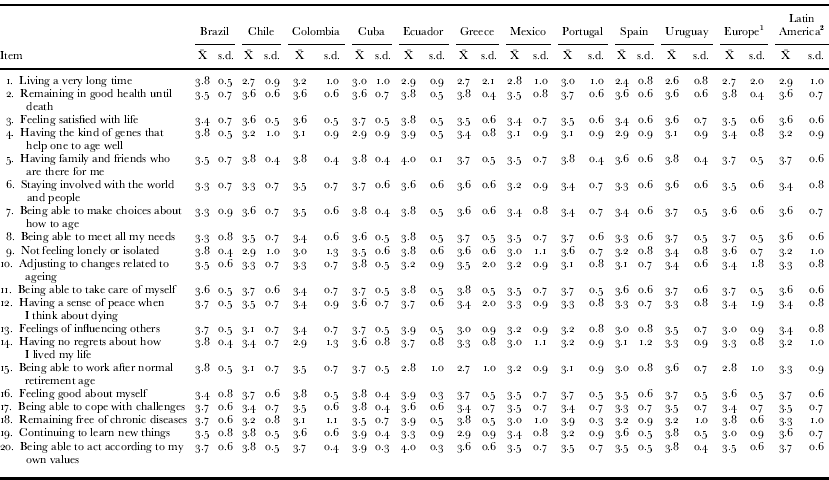
Notes:  : mean. s.d. standard deviation.
1. Greece, Portugal and Spain. 2. Brazil, Chile, Colombia, Cuba, Ecudor, Mexico and Uruguay.
With regard to the differences between younger (aged 50–64) and older (over 65) participants, adjusting for Bonferroni correction for 20 simultaneous comparisons (probability lower than 0.0025 [0.05/20]), only item 19 showed significant differences (p<0.001). That is, ‘continuing to learn new things’ was more important for younger participants than for older ones. In order to test the cross-cultural structure of lay definitions of successful ageing by countries and continent, a parallel analysis for the total sample was performed so as to decide how many factors should be retained. The real values of the first four factors were (mean of random eigenvalues in brackets): 8.90 (1.24), 2.16 (1.20), 1.49 (1.16), and 0.96 (1.14), respectively. Three factors, therefore, were retained in further factor analyses.
Table 2 shows the loadings on the three first-order factors for European countries (Kaiser-Meyer-Olkin Measure of Sampling Adequacy [KMO]: 0.90. Bartlett's Test of Sphericity: approximate chi-square: 3610.9; degrees of freedom 190; p<0.001), and Latin American countries (KMO: 0.89. Bartlett's Test of Sphericity: approx. chi-square: 3485.1; d.f.: 190; p<0.001). These three-factor solutions accounted for 45.7 per cent and 47.4 per cent of the total variance, respectively.
Item loadings on the three first-order factors (F1, F2 and F3) and the second-order factor (S1), and correlations between factors by continent
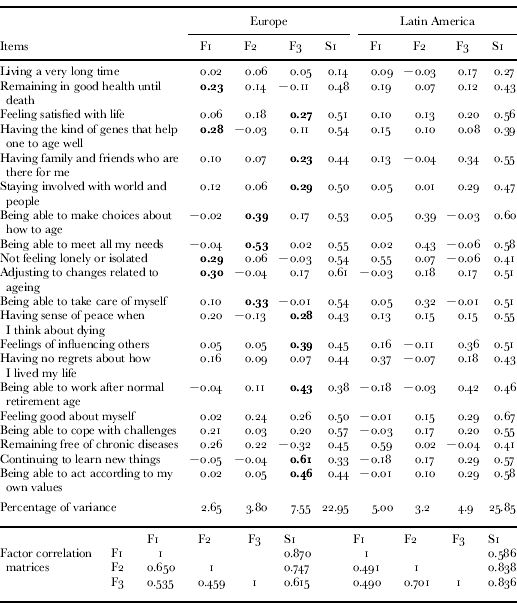
As can be seen in Table 2, correlations between the first-order factors were large and positive in both continents, so that the extraction of one second-order factor was admissible. All the items showed high and positive loadings on the second-order factor. Also, the first-order factors showed large loadings (and with similar magnitudes) on the hierarchical factor. Furthermore, when the variance explained by the second-order factor was parcelled out, the importance of the first-order factors diminished notably, especially for the third-order factor. Thus, the second-order factor explained around 24 per cent of the variance in successful ageing in the two continents, whereas the first-order factors attained much less importance, with percentages of the explained variance between 2.65 and 7.55 per cent.
Taking an overall view, the first-order factor seems to be a healthy ageing construct, since items about health (‘Remaining in good health until death’) and other aspects of ageing (‘Not feeling lonely or isolated’) loaded on this factor. The second factor was labelled independence because it related to the ability to manage oneself. In this regard, the largest loadings correspond to items 7 and 8 (‘Being able to make choices about how to age’ and ‘Being able to meet all my needs’). Finally, the third first-order factor referred to two important domains of successful ageing: social implication and positive affects, in other words, the ability to learn new things (item 19) and the ability to work after normal retirement age (item 15), as well as feelings of being able to influence others (item 6) and staying involved with the world and people (item 13). The agreement with this nomological network is in accordance with most theories of successful ageing.
The values of the congruence coefficients (rc) between the two continents were 0.72, 0.74, and 0.87 for the first, second and third factors, respectively. Although these values are somewhat high, they are still below the cut-off value for considering factor similarity across samples (0.90). In contrast, the rc was 0.98 for the second-order factor, suggesting that the most general factor of the ageing well self-report could be considered as identical across the two continents.
Since, the participants in the present study had a larger age range than in most of the studies reviewed, in order to examine the role of the age variable the results were examined in two age groups: those aged less than and those over 65 years. Table 3 shows the loadings on the three first-order factors for participants aged less than 65 years (KMO: 0.90. Bartlett's Test of Sphericity: approximate chi-squared: 2753.2; degrees of freedom 190; p<0.001) and those aged 65 or more years (KMO: 0.91. Bartlett's Test of Sphericity: approximate chi-squared: 4348.8; d.f.: 190; p<0.001). This three-factor solution accounted for 48.2 per cent and 46.5 per cent of the total variance, respectively. Thus, the second-order factor explained around 24 per cent of the variance in the two continents, whereas the first-order factors attained much less importance, with percentages between 7.41 and 3.89. On the other hand, the same first-order factors shown in Table 2 were apparent in the two age groups: factors related to healthy ageing (F1), independence (F3) and psycho-social and cognitive participation (F2).
Item loadings on the three first-order factors (F1, F2 and F3) and the second-order one (S1), correlations between first-order factors (r), and first-order factor loadings on the second-order factor (S-O) by age group

The values of the congruence coefficients (rc) between the two age samples were 0.75, 0.78, and 0.82 for the first, second and third first-order factors, respectively. As occurred with the comparison between continents, these values were below the cut-off value for considering similarity between two factors (0.90). In contrast, the rc was 0.99 for the second-order factor, suggesting that the most general factor of the successful ageing questionnaire can also be considered identical across age groups. Further analysis established the congruence coefficients (rc) between the second-order factor of the two age groups and the two continents. In the four combinations, the rc value was higher than 0.98, showing that the general factor of successful ageing was the same irrespective of the continent and age group of reference.
Discussion
This study set out to examine the similarities and differences in the lay concept of ‘ageing well’ in seven Latin American and three European countries, and in younger and older participants. Despite the continental differences and the respondents' three different languages (Greek, Portuguese and Spanish), the results provide evidence of considerable consistency across countries, continents and ages. As reported by other studies, regardless of age, country and world region, respondents to surveys find most of the presented standard items relevant for ‘ageing well’. Two items received the lowest mean scores in most of the countries: ‘living a very long time’ and ‘being able to work after normal retirement age’; that is, contrary to one biomedical perspective on successful ageing, greater longevity was not considered one of the most important components of successful ageing.
In contrast, the items that consistently received the highest means in most of the countries were: ‘remaining in good health until death’, ‘being able to take care of myself’, ‘having family and friends who are there for me’, and ‘feeling good about myself’. These aspects of ageing well were also cited as highly important in most of the reviewed different research methodologies (Bowling 2006; Hsu Reference Hsu2006). Thus, health, independence, social relationships and life satisfaction appear to be the most widespread and consistent components of ageing well as it is considered by lay elders. As regards differences item-by-item among age groups, only one item was significantly more important for younger than older respondents: ‘continuing to learn new things’. This item is also considered relatively less important in North America (Japanese and Caucasian; Phelan et al. Reference Phelan, Anderson, Lacroix and Larson2004) and Japan (Matsubayashi et al. Reference Matsubayashi, Ishine, Wada and Okumiya2006).
When the factor solutions were compared across continents, a second-order factor presented the same structure in European and Latin American countries, which lends support to the universality of the ageing well concept, as claimed by several authors (for example, Bull Reference Bull2005; Litwin Reference Litwin2005). However, when specific components of ageing well were identified, this stability across countries diminished. Thus, as Matsubayashi et al. (Reference Matsubayashi, Ishine, Wada and Okumiya2006) argued, cultural differences and other factors may modify the successful ageing concept. As those authors reported, the Japanese ageing well concept only attains agreement (with a cut-off point higher than 75% of agreement) on seven of the 20 successful ageing components, while Phelan et al. (Reference Phelan, Anderson, Lacroix and Larson2004) reported that North-American Japanese respondents rated 13 components as important and North American Caucasians 14. Fernández-Ballesteros et al. (Reference Fernández-Ballesteros, García, Abarca, Blanc, Efklide, Kornfeld, Lerma, Mendoza-Nuñez, Mendoza-Ruvalcaba, Orosa, Paúl and Patricia2008) found Europeans to rate 17 components as important, and Latin Americans as many as 19.
Previous studies using Phelan's self-report instrument analysed only samples of people aged 65 or more years. However, in the present study the lower age limit of the participants was 50 years. When the groups aged under and over 65 years were compared, the results showed a similar factor pattern across countries and continents. Therefore, the general factor of successful ageing was the same irrespective of age, though the internal structure of the concept varied with age. As stressed by Bowling (Reference Bowling2007), the lay concept of ageing well is multi-dimensional, and has health, psychological and social components. A biomedical reductionism of successful ageing and its assessment using indicators such as survival, longevity or morbidity cannot be supported by either the available research results or the lay conceptualisations.
Lay assessments do not support the argument that ‘successful ageing is in the eye of the beholder’ (Bearon Reference Bearon1996). There is a relatively consistent view of ‘ageing well’ across diverse cultural contexts, which could be understood as a consequence of the dissemination of research on successful ageing and of international efforts and action on active and successful ageing around the world (United Nations 2002; World Health Organization 2002). It is important to emphasise that the concept of successful ageing is not only independent of the age of those reporting it, but also similar in countries with very different representations of older people in the population. In Spain, for example, those aged 65 or more years are close to 20 per cent of the population, whereas the share in Brazil is close to 10 per cent. As international organisations recognise, ageing populations are an international phenomenon, and this may be one of the reasons why the ageing well concept is similar across several countries. Moreover, lay definitions of successful ageing are neither simplistic nor reductionist, and do not reduce its components to either subjective conditions such as life satisfaction or biomedical indicators of health and disability. In sum, it can be concluded that a set of key components, such as health, psychological and social components of successful ageing, constitutes a quasi-universal conceptualisation in older people themselves.
One limitation of the present study has been the small sample size in some countries. Most of the participants were from Mexico and Greece in the Latin-American and European groups, respectively. Therefore, the results reported may reflect some bias toward the lay conceptions of ageing well in those countries. Since no large mean differences at the item level emerged between those countries and the others, this limitation should not greatly affect the results, but further research with larger samples from the same (or other) countries is advisable. It is important to notice that the absence of an appropriate sampling procedure casts some doubts on the generalisability of the results.
A second limitation is that the European countries involved are all in southern Europe, and with similar Mediterranean/Greco-Latin cultural backgrounds, so that the cultural distance between the European and Latin American countries is for historical reasons relatively small. Nevertheless, similarities between our target countries and others more culturally distant (such as the USA, Japan, Taiwan or the United Kingdom), for which there are comparable emergent components of successful ageing, would seem to support the results and conclusions.
The third and final limitation we should mention concerns the method used, and particularly the questionnaire. Undoubtedly, a combination of methods (both qualitative and quantitative), as used by several authors (Bowling 2006; Hsu Reference Hsu2006; Knight and Ricciardelli Reference Knight and Ricciardelli2003), is a better approach. Phelan's instrument represents an advance insofar as it also makes possible cross-cultural research, but at the same time it could yield spurious factors without a clear theoretical interpretation. Thus, although it is advisable to use a combination of methods for collecting data, it is also true that the lay concept of successful ageing emerges as similar across studies using different methodologies. Finally, much more research should be carried out for distinguishing between the concepts discussed here and other concepts that refer to positive ageing, and multi-trait, multi-method studies are an avenue for progress in this important field.