Introduction
The Antarctic Treaty (1959) was ambitious in its intent to protect Antarctica for all of humanity. “Recognizing that it is in the interest of all mankind that Antarctica shall continue forever to be used exclusively for peaceful purposes,” reads the Treaty, and “[c]onvinced that the development of a comprehensive regime for the protection of the Antarctic environment and dependent and associated ecosystems is in the interest of mankind as a whole” (Protocol on Environmental Protection to the Antarctic Treaty 1991, Preamble), Antarctic Treaty Consultative Parties have been managing the Antarctic Treaty area collectively for over half a century “in the interest of [hu]mankind.” For example, the declaration by Contracting Parties to the Antarctic Treaty in 1991, on the 30th anniversary of the treaty coming into force, stated that:
“The Antarctic Treaty provides an example to the world of how nations can successfully work together to preserve a major part of this planet, for the benefit of all mankind, as a zone of peace, where the environment is protected and science is pre-eminent.” (Antarctic Treaty Parties, 1991).
In the 21st century, Antarctic Treaty Consultative Parties have reaffirmed their intention to manage Antarctica in the interest of humankind several times in the declarations for the 50th anniversary of the Antarctic Treaty (Secretariat of the Antarctic Treaty, 2009) and the 25th anniversary of the Protocol on Environmental Protection to the Antarctic Treaty (Secretariat of the Antarctic Treaty, 2016), as well as in resolutions on biological prospecting (Secretariat of the Antarctic Treaty, 2013) and strengthening the Protocol on Environmental Protection (Secretariat of the Antarctic Treaty, 2011).
Various models have been proposed to accommodate the interest of humanity in Antarctica (Dodds & Collis, Reference Dodds, Collis, Dodds, Hemmings and Roberts2017; Wolfrum, Reference Wolfrum, Dodds, Hemmings and Roberts2017). One of the most widely discussed models is the Common Heritage of Mankind principle, where Antarctica would belong to everyone, and everyone has the right to benefit from it (Herber, Reference Herber1991). A public trusteeship arrangement would have claimant states surrender their sovereignty claims to a supranational body that will then protect wider interests (Wolfrum, Reference Wolfrum, Dodds, Hemmings and Roberts2017). Others state that the Antarctic Treaty holds Antarctica in a state of geographical tension as something between terra nullius and terra communis (Collis, Reference Collis2017), or take the view that Antarctica should be set aside and closed to exploitation (Rolston, Reference Rolston2002; Suter, Reference Suter1991). Unlike existing studies on the meaning or operationalisation of the term “in the interest of humankind”—most of which are based on theoretical concepts—the point of departure for this study is that to manage Antarctica in the interest of humanity, it is necessary to have some knowledge of what humankind itself considers as its interest.
Research on Antarctic perceptions has mostly focused on people with Antarctic experience, including tourists (see e.g., Bauer, Reference Bauer2001; Johnston, Dawson, Childs & Maher, Reference Johnston, Dawson, Childs and Maher2014; Maher, Reference Maher2010; Powell, Kellert & Ham, Reference Powell, Kellert and Ham2008; Vila, Costa, Angulo-Preckler, Sarda & Avila, Reference Vila, Costa, Angulo-Preckler, Sarda and Avila2016), researchers and other people working in Antarctica (see e.g., Frederick & Rock, Reference Frederick and Rock2018; McLean & Rock, Reference McLean and Rock2016; Summerson & Bishop, Reference Summerson and Bishop2012), and other visitors such as artists and students (Maher, Reference Maher2010). Research has expanded to focus on people with no Antarctic experience from a variety of different countries, for example, Argentina (del Acebo Ibáñez & Costa, Reference Del Acebo Ibáñez and Costa2010), New Zealand (Colmar Brunton, 2011), Chile (Salazar, Reference Salazar, Liggett and Hemmings2013), the Netherlands (Bastmeijer & Tin, Reference Bastmeijer, Tin, Alfredsson, Koivurova and Ágútsson2015), Spain (Peden, Tin, Pertierra, Tejedo & Benayas, Reference Peden, Tin, Pertierra, Tejedo and Benayas2016), Malaysia (Shabudin, Rahim, Nor & Ibrahim, Reference Shabudin, Rahim, Nor and Ibrahim2016), and the USA (Tin et al., Reference Tin, O’Reilly, Peden, Pinkalla, Kelly, Larrea and Janssen2018), as well as from different age groups, for example, adolescents (del Acebo Ibáñez & Costa, Reference Del Acebo Ibáñez and Costa2010; Shabudin et al., Reference Shabudin, Rahim, Nor and Ibrahim2016), early or emerging adults (del Acebo Ibáñez & Costa, Reference Del Acebo Ibáñez and Costa2010; Peden et al., Reference Peden, Tin, Pertierra, Tejedo and Benayas2016), and retirees (Tin, Bastmeijer, O’Reilly & Maher, Reference Tin, Bastmeijer, O’Reilly, Maher, Watson, Murrieta-Saldviar and McBride2011). These studies have provided a collective sketch or snapshot of Antarctic perceptions.
Today, 29 countries have consultative status under the Antarctic Treaty System. They make up 15% of the world’s sovereign states, their combined population forms 58% of the world’s total population, and their combined share is 77% of the global Gross Domestic Product (Ferrada, Reference Ferrada2018). Looking forward into the next 50 years, these percentages and other balances of power may change (Liggett, Frame, Gilbert, & Morgan, Reference Liggett, Frame, Gilbert and Morgan2017); our global human population will include the young people of today and those who are not yet born. They will have to deal with the concerns of a world shaped by the choices made by the humankind of today, many members of which will no longer exist. The issue of intergenerational equity has been raised in the context of the management of natural resources in Antarctica (Bastmeijer, Reference Bastmeijer, Alfredsson, Koivurova and Hossain2011; French, Reference French1999; Verbitsky, Reference Verbitsky2013). It has been discussed with even more vigour in the context of climate change (see e.g., Gardiner, Reference Gardiner2011; Hansen et al., Reference Hansen, Pusher, Makiko, Masson-Delmotte, Ackerman, Beerling and Zachos2013), in which it has been argued that “people alive today are the last to have a chance” to take the necessary actions to “avoid dangerous climate change” (Hansen et al., Reference Hansen, Pusher, Makiko, Masson-Delmotte, Ackerman, Beerling and Zachos2013; Wynes & Nicholas, Reference Wynes and Nicholas2018). Spurred on by the idea of the special responsibility that this (and one could argue, every) generation carries towards future generations, this study examines the Antarctic perceptions of a subset of young people—university students—and focuses on their support for wilderness protection, scientific research, resource extraction, and other human interactions with Antarctica.
The present study expands on previous research by examining Antarctic perceptions of 618 students from three universities in the Netherlands, Canada and the USA. Respondents came from 47 countries across five continents and were enrolled in a range of academic majors. We seek to understand variations in meanings that students attach to Antarctica and the human activities they consider appropriate. This is the first Antarctic study that involves a group of university students of this size and level of diversity.
Literature review
University students have often been subjects of cross-cultural studies, partly due to the ease of facility of recruitment for university researchers, and partly because of their assumed low response bias (Hanel & Vione, Reference Hanel and Vione2016). The abundant data on university students provide ample opportunities to understand a cross-section of present and future humankind, albeit one that is biased towards people with higher socio-economic status and undergoing a period of identity exploration (see e.g., Crocetti et al., Reference Crocetti, Cieciuch, Gao, Klimstra, Lin, Matos and Meeus2015; Joshanloo et al., Reference Joshanloo, Lepshokova, Panyusheva, Natalia, Poon, Yeung and Jiang2014; Schwartz, Reference Schwartz2016). Students do not represent a homogeneous bloc, and the largest differences can be seen around issues of religion, regularity-norm behaviours, family roles, and ethnonationalism (Hanel & Vione, Reference Hanel and Vione2016; Saucier et al., Reference Saucier, Kenner, Iurino, Malham, Chen, Thalmayer and Altschul2014). Large-scale, cross-cultural studies (involving students from more than 20 countries) report that university students who endorse social hierarchy and inequality are less likely to engage in environmental citizenship actions and pro-environmental behaviours (Milfont et al., Reference Milfont, Bain, Kashima, Corral-Verdugo, Pasquali, Johnasson and Einarsdóttir2018); students who believe that climate change is important are more willing to take action to mitigate climate change, and this association is more pronounced in developed countries (Liu & Sibley, Reference Liu and Sibley2012). Smaller-scale studies report that students show a relatively high level of pro-environmental attitudes, but not a significant increase over previous generations (Benckendorff, Moscardo & Murphy, Reference Benckendorff, Moscardo and Murphy2012); pro-environmental behaviour is likely to increase with each additional year that a student spends at university (Meyer, Reference Meyer2016). In terms of Antarctic perceptions, studies conducted at universities in the USA, Spain, and the Netherlands reported that students who have never been to Antarctica generally had a low level of knowledge about Antarctica (Bastmeijer & Tin, Reference Bastmeijer, Tin, Alfredsson, Koivurova and Ágútsson2015; Peden et al., Reference Peden, Tin, Pertierra, Tejedo and Benayas2016; Tin et al., Reference Tin, O’Reilly, Peden, Pinkalla, Kelly, Larrea and Janssen2018). Despite the lack of knowledge, few respondents considered Antarctica to have no value. Instead, the vast majority valued Antarctica as one of the world’s largest wildernesses, a scientific laboratory for the benefit of humankind, and an important component of the Earth’s climate system (Bastmeijer & Tin, Reference Bastmeijer, Tin, Alfredsson, Koivurova and Ágútsson2015; Peden et al., Reference Peden, Tin, Pertierra, Tejedo and Benayas2016; Tin et al., Reference Tin, O’Reilly, Peden, Pinkalla, Kelly, Larrea and Janssen2018). Prior to participating in a field trip to the Antarctic Peninsula, students at a university in Canada were attracted by this “chance of a lifetime” to experience something that would be otherwise impossible to experience (Johnston et al., Reference Johnston, Dawson, Childs and Maher2014). After the trip, many respondents reported that the trip influenced their later academic and professional decisions and increased their awareness of some environmental issues.
A number of studies have concluded that students majoring in outdoor recreation, biology, and environmental studies exhibit more favourable environmental attitudes than students from other majors (see e.g., Arnocky & Stroink, Reference Arnocky and Stroink2011; Meyer, Reference Meyer2016; Prévot, Clayton & Mathevet, Reference Prévot, Clayton and Mathevet2018; Sherburn & Devlin, Reference Sherburn and Devlin2004). Business students in Australia were reported to demonstrate a tendency to regard major environmental and sustainability issues to be beyond their control and to view solutions to be the responsibility of other people (Eagle, Low, Case & Vandomele, Reference Eagle, Low, Case and Vandomele2015). However, Lambrechts et al. (Reference Lambrechts, Ghijsen, Jacques, Walravens, Van Liedekerke and Van Petegem2018) reported that business students in Belgium were not a homogeneous bloc and comprised individuals with various levels of interest and engagement in sustainability issues. While a large number of studies suggest that exposure to courses and activities related to the environment or nature has the potential to modify students’ environmental attitudes (see e.g., Meltzer, Bobilya, Faircloth, Mitten & Chandler, Reference Meltzer, Bobilya, Faircloth, Mitten and Chandler2018; Piasentin & Roberts, Reference Piasentin and Roberts2018), others posit that students choose courses that are consistent with their environmental world views (Hodgkinson & Innes, Reference Hodgkinson and Innes2001; Lang, Reference Lang2011; Rideout, Reference Rideout2014).
Studies of university students across multiple nations report various levels of convergences and divergences in environmental attitudes and behaviours across nationalities (see e.g., Chuvieco, Burgui, Da Silva, Hussein & Alkaabi, Reference Chuvieco, Burgui, Da Silva, Hussein and Alkaabi2018; Ferraz, Romero, da Costa Nogami, & Veloso, Reference Ferraz, Romero, da Costa Nogami and Veloso2015; Katz-Gerro, Greenspan, Handy, Lee, & Frey, Reference Katz-Gerro, Greenspan, Handy, Lee and Frey2015). Students from Australia/New Zealand and Canada have been found to express broadly similar views on the environment and climate change (McKercher, Pang & Prideaux, Reference McKercher, Pang and Prideaux2011). In their study of students from Canada, Germany, Israel, South Korea, and the USA, Katz-Gerro et al. (Reference Katz-Gerro, Greenspan, Handy, Lee and Frey2015) found no evidence to support the claim that students in different countries might be similar to each other in terms of their environmental behaviours. Some researchers postulate that differences in environmental attitudes and behaviours are mediated through values and world views, which, in turn, vary between countries. For example, Kilbourne, Beckmann, Lewis, and van Dam (Reference Kilbourne, Beckmann, Lewis and van Dam2001) showed that students’ belief in the dominant social paradigm of Western industrial societies—economic self-interest, technological optimism, and political liberalism—influenced their perception of the changes necessary to alleviate environmental problems. In their study of over 4000 university students from 25 countries, Milfont et al. (Reference Milfont, Bain, Kashima, Corral-Verdugo, Pasquali, Johnasson and Einarsdóttir2018) reported that the levels of inequality, achievement in key dimensions of human development, and performance on environmental issues in a given nation tended to reinforce individuals’ views of human dominance over Nature. Students who opposed social hierarchy and inequality were more likely to engage in pro-environmental actions, and the association between opposition and engagement was stronger in societies that were more equal.
Building on the wide range of studies that have examined different factors influencing students’ environmental attitudes and behaviours, the current study takes an exploratory approach to investigate whether support for a range of human activities in Antarctica varies according to nationality, academic major, opinions on the values of Antarctica, and preferences for particular management activities or courses of action. The following research question is addressed: Does support for wilderness protection, construction of scientific research stations, and mineral resource extraction vary based on students’ nationality, academic major, opinions on the value of Antarctica, and support for human activities in Antarctica?
Methods
Between spring 2012 and spring 2013, an online survey that included categorical, ordinal, and open-ended measures was distributed to undergraduate students enrolled at a large university in the Netherlands (>20,000 students) and two smaller universities (<5000 students)—one in Canada and the other in the USA. The survey was in English. All three universities offered similar fields of study including business, biological sciences, social sciences, liberal arts, law, and natural sciences and engineering. In the Netherlands, respondents were randomly selected. In Canada and the USA, invitations to participate were distributed via email to all members of the student body. The sample population is not generalisable to all students in these countries but allows for the identification of factors that influence support for different human activities in Antarctica across similar populations of students in Europe and North America.
The questionnaire follows the basic outline of the questionnaire used in the AntWILD studies (see e.g., Bastmeijer & Tin, Reference Bastmeijer, Tin, Alfredsson, Koivurova and Ágútsson2015; Peden et al., Reference Peden, Tin, Pertierra, Tejedo and Benayas2016; Tin et al., Reference Tin, Bastmeijer, O’Reilly, Maher, Watson, Murrieta-Saldviar and McBride2011, Reference Tin, O’Reilly, Peden, Pinkalla, Kelly, Larrea and Janssen2018). A short introduction at the beginning of the questionnaire provided background information on the Antarctic Treaty and explained the purpose of the study. Respondents were asked to rate their level of environmental knowledge and knowledge of Antarctica, as low, medium, or high on a three-point ordinal scale. They were also asked to specify their nationality and academic major. Respondents’ opinions on the value of Antarctica were assessed through two categorical questions with multiple response options: (1) What is, in your opinion, the importance of Antarctica? and (2) Which of the following statements represent most closely your views on the relationship between human beings and the Antarctic environment? For the first question, respondents were asked to choose among six statements: (1) a science laboratory for the benefit of mankind; (2) a tourism destination; (3) one of the world’s last great wildernesses; (4) a reserve for mineral resources that might support society in the future; (5) an important component of the Earth’s climate system; (6) Antarctica does not have any value for mankind. Respondents were asked to specify all that applied. For the second question, they were asked to choose among six statements derived from those used in the Human and Nature (HaN) scale by De Groot, Drenthen, and de Groot (Reference De Groot, Drenthen and de Groot2011). The HaN scale contains statements highlighting various degrees of anthropocentric, biocentric, and ecocentric perspectives: masters over nature consider humans to have greater importance than nature; stewards of Nature take future generations of humans into consideration; partners with nature consider that humans and nature have equal importance; participants in Nature feel connected to the holistic interdependent system of Being. In this study, we replaced the categories of partners and participants with one single category—members of nature—to capture the opinion that humans are part of nature and that Antarctica is a place where people may experience their connection with nature. Finally, respondents were asked to indicate their support for 16 resource management and tourism development practices that have been proposed or are currently taking place in Antarctica; a dichotomous yes/no response format was used.
Data were recorded in MS Excel format and uploaded into SPSS Version 23 for analysis. Missing data were addressed through casewise deletion, resulting in 618 usable surveys. Descriptive statistics were calculated prior to recoding nationality and academic major into categories based on geographic proximity and related courses of study. Academic majors were first categorised based on the taxonomic scheme of the Classification of Instructional Programs of the National Center for Education Statistics (2010) in the USA and were further amalgamated into six main subjects.
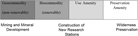
Preliminary data exploration was performed using Pearson Chi-square tests. We chose logistic regression as the tool to explore the relationships between various independent variables and respondents’ support for wilderness designation and other human activities in Antarctica because it allows the exploration of functional relationships between independent variables and dichotomous outcomes (Hosmer, Lemeshow & Sturdivant, Reference Hosmer, Lemeshow and Sturdivant2013). Results from the preliminary data exploration, published literature, and our study hypotheses guided our choice of dependent and independent variables. Selection of dependent variables was guided by the Resource Conflict Continuum, which classifies natural resources along a continuum as a function of resource renewability and whether the resource is used as a commodity or an amenity (Germain & Floyd, Reference Germain and Floyd1999). To cover the range of the continuum, we chose support for extraction of mineral resources—a non-renewable commodity or geocommodity—and support for wilderness protection—a preservation amenity—as dependent variables to represent the end members of the continuum. We also chose support for construction of new research stations as a dependent variable to represent a position along the continuum between the end members (Fig. 1); while the construction of stations consumes both renewable and non-renewable commodities, scientific research is a use amenity where transient human activity creates value without consumption of non-renewable resources from Antarctica.
Positions of dependent variables along the Resource Conflict Continuum (adapted from Germain & Floyd, Reference Germain and Floyd1999)

Independent variables were selected on the basis of a literature review, our study hypotheses, and consideration of various selection procedures. Studies of Antarctic perceptions have reported no significant differences between genders (Tin et al., Reference Tin, Bastmeijer, O’Reilly, Maher, Watson, Murrieta-Saldviar and McBride2011) and that university students’ opinions about Antarctica appeared to have greater variations based on course type than on nationality (Peden et al., Reference Peden, Tin, Pertierra, Tejedo and Benayas2016). We selected four multilevel independent variables that can address our study hypotheses and allow comparison with earlier studies (Bastmeijer and Tin, Reference Bastmeijer, Tin, Alfredsson, Koivurova and Ágútsson2015; McLean and Rock, Reference McLean and Rock2016; Peden et al., Reference Peden, Tin, Pertierra, Tejedo and Benayas2016). They included nationality, academic major, opinions on the primary value of Antarctica and support for different human activities in Antarctica. Three logistic regression models were created to explore the relationships between these variables and support for: (1) designating Antarctica as a wilderness reserve where development of infrastructure is limited, (2) construction of new research stations, and (3) mining and mineral resource extraction. With the size of our sample and the number of independent variables, each logistic regression model maintains a minimum ratio of approximately 7 observations per independent variable; this falls within the range of 5 to 15 observations per independent variable, which has been reported to be the minimum ratio needed to obtain reasonably stable model estimates (Peduzzi, Concato, Kemper, Holford & Feinstein, Reference Peduzzi, Concato, Kemper, Holford and Feinstein1996; Vittinghoff & McCulloch, Reference Vittinghoff and McCulloch2007). Multicollinearity was checked by recoding categorical independent variables into indicator variables to check multicollinearity effects and to calculate correlation matrices and variance inflation factors (VIF). Values of VIF were less than 2.1, far below the commonly adopted thresholds of 4 or 10 (O’Brien, Reference O’Brien2007), indicating minimal influence of multicollinearity.
Results
Descriptive statistics
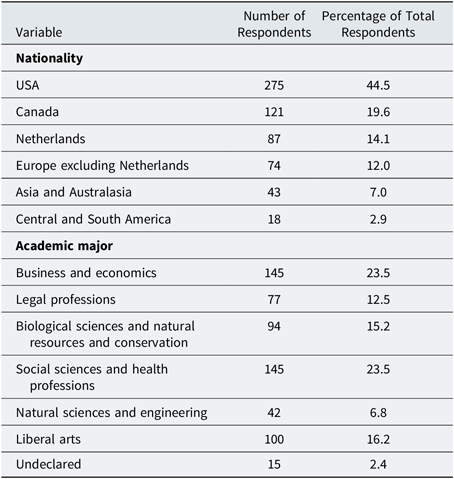
A total of 618 usable surveys were obtained from Canada (n = 122), the Netherlands (n = 221), and the USA (n = 275). Countries where the survey was conducted represented the countries of origin of the majority of respondents: USA (44.5%), Canada (19.6%), and the Netherlands (14.1%) (Table 1). The average age of respondents was 23 years. Sixty percent of the respondents were female while 40% were male. Business and economics majors, and social sciences and health professions majors each made up approximately a quarter of the respondents. Biological sciences, natural resources and conservation majors, as well as liberal arts majors each accounted for over 15% of the respondents. Students in legal studies accounted for 13% of respondents, while 9% of the respondents were majors in other subjects (Table 1).
Respondent profile

Approximately 63% of the respondents reported that they had medium to high levels of environmental knowledge. However, a vast majority (87%) reported that they had low levels of knowledge about Antarctica. In terms of human–nature relationships, the majority of respondents (92%) rejected mastery over nature while adhering to stewardship of (59%) and membership (55%) of nature.
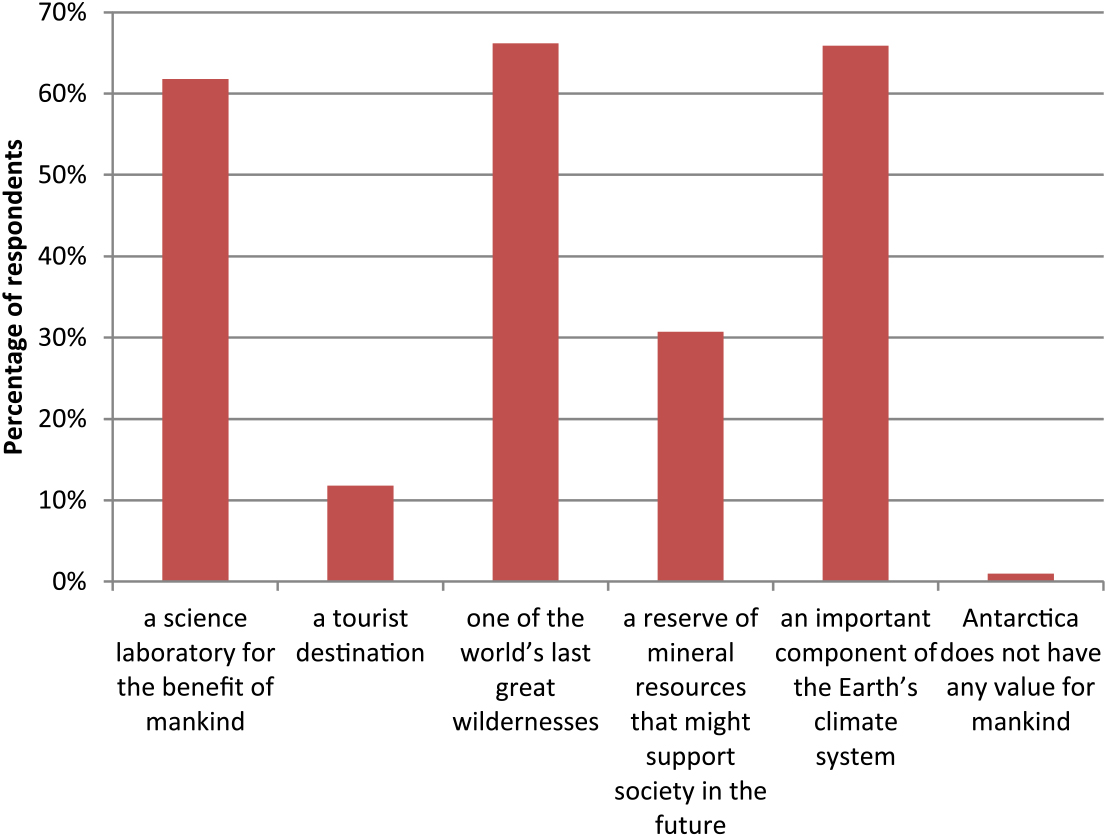
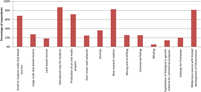
Respondents valued Antarctica as one of the world’s last great wildernesses (66%), an important component of the Earth’s climate system (66%), and as a science laboratory for the benefit of mankind (62%). Fewer respondents valued Antarctica as a mineral resource reserve (31%) and a tourism destination (12%). Less than 1% of respondents considered Antarctica to have no value for mankind (Fig. 2). Respondents strongly supported educational trips (87%), designating Antarctica as wilderness reserve where development of infrastructure is limited (81%), and the construction of new research stations (83%). Support for production of art and media projects and media productions (72%) and small- to medium-scale ship-based tourism with up to 300 tourists per ship (68%) was also high (Fig. 3).
Respondents’ opinions of the importance of Antarctica

Respondents’ support for resource management and tourism development practices in Antarctica

Logistic regression results
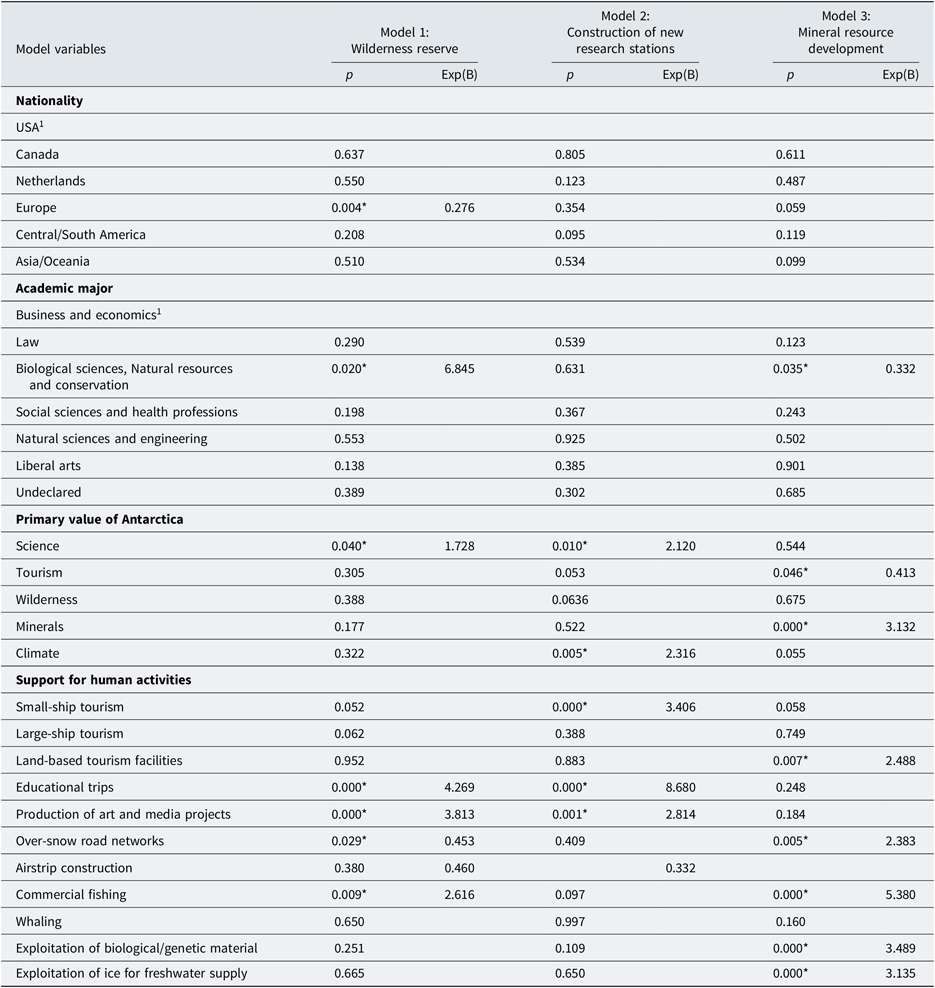
The first model tested the relationships between support for designating Antarctica as a wilderness reserve where the development of infrastructure is limited and nationality, academic major, opinions on the value of Antarctica, and support for human activities (Table 2). Results indicated significant improvement over the constant-only model, X2 (27, n = 618) = 171.58, p = 0.00. The Nagelkerke R2 suggested that the model accounted for approximately 39% of the total variance. The Hosmer and Lemeshow test revealed that the model was an acceptable fit for the data (p = 0.767). The correct prediction rate increased from 81.4% to 85.4%. Nationality, academic major, opinions on the value of Antarctica, and support for human activities were significantly associated with support for wilderness designation. Odds ratios indicated that academic major had the strongest association with the dependent variable. Those who studied biological sciences and natural resource management and conservation were more likely than business and economics students to support designating Antarctica as a wilderness reserve (Exp(B) = 6.845). Those who valued Antarctica as a science laboratory for the benefit of mankind were also more likely to support protecting Antarctica as a wilderness (Exp(B) = 1.73). In terms of human activities in Antarctica, respondents who supported educational trips (Exp(B) = 4.269), media productions (Exp(B) = 3.813), and commercial fishing (Exp(B) = 2.616) were more likely to support designating Antarctica as a wilderness reserve, while those who supported construction of over-snow road networks (Exp(B) = 0.453) were less likely to support wilderness designation. Compared with Americans, respondents from Europe (excluding the Netherlands) were less likely to support designation of Antarctica as a wilderness reserve where development of infrastructure is limited (Exp(B) = 0.276).
Support for the designation of Antarctica as a wilderness reserve where development of infrastructure is limited (Model 1), construction of new research stations (Model 2), and mineral resource development (Model 3)

1 Indicates reference group for multilevel independent variables
**Significant at α ≤ 0.05
The second model tested the relationships between support for construction of new research stations and nationality, academic major, opinions on value of Antarctica, and support for human activities (Table 2). Results indicated significant improvement over the constant-only model X2 (27, n = 618) = 205.738, p = 0.00. The Nagelkerke R2 suggested that the model accounted for approximately 47% of the total variance. The Hosmer and Lemeshow test revealed that the model was an acceptable fit for the data (p = 0.387). The correct prediction rate increased from 82.8% to 89.2%. While nationality and academic major were not significantly associated with support for new research stations, opinions on the value of Antarctica and support for human activities were significantly associated with the dependent variable. Respondents who stated that Antarctica’s primary value was as a science laboratory for the benefit of mankind (Exp(B) = 2.120) and as an important component of the Earth’s climate system (Exp(B) = 2.316) were more likely to support the construction of new research stations. Similarly, those who supported small-ship tourism (Exp(B) = 3.406), educational trips (Exp(B) = 8.680), and production of art and media projects (Exp(B) = 2.814) were also more likely to support new stations.
The third model tested the relationships between support for mining and mineral resource development and nationality, academic major, opinions on values of Antarctica, and support for human activities (Table 2). Results indicated significant improvement over the constant-only model X2 (27, n = 618) = 274.584, p = 0.00. The Nagelkerke R2 suggested that the model accounted for approximately 53% of the total variance. The Hosmer and Lemeshow test revealed that the model was an acceptable fit for the data (p = 0.695). The correct prediction rate increased from 74.1% to 84.6%. Academic major, opinions on the value of Antarctica, and support for human activities were significantly associated with support for mining and mineral resource development. Those who valued Antarctica as a mineral reserve were more likely to support mining and mineral resource development activities (Exp(B) = 3.132). Similarly, those who supported the development of land-based tourism facilities (Exp(B) = 2.488), construction of over-snow road networks (Exp(B) = 2.383), commercial fishing (Exp(B) = 5.380), exploitation of biological or genetic material (Exp(B) = 3.489), and exploitation of icebergs for freshwater supplies (Exp(B) = 3.135) were also more likely to support mining in Antarctica. Biological science and natural resources and conservation majors were less likely than business and economics majors to support mining and mineral resource development (Exp(B = 0.332). Similarly, those who stated that Antarctica’s greatest value was its suitability as a tourism destination (Exp(B) = 0.413) were less likely to support mining and mineral resource development. Nationality was not significantly associated with the dependent variable.
Discussion
Relationships between students’ support for activities and academic major, nationality, opinions on the values of Antarctica and support for human activities
Academic major was not significantly associated with students’ support for new research stations but was significantly related to students’ support for wilderness protection and mineral resource extraction in Antarctica. Compared with business and economics majors, biological sciences and natural resource management and conservation majors were much more likely to support wilderness designation and much less likely to support mineral resource development. This observed difference is consistent with reported trends. Studies that have examined the relationship between academic major and environmentalism among university students reported that biology majors displayed more pro-environmental attitudes than business, economics, and other majors in Canada (Ewert & Baker, Reference Ewert and Baker2001), Australia (Hodgkinson & Innes, Reference Hodgkinson and Innes2001), the USA (Sherburn & Devlin, Reference Sherburn and Devlin2004), and Finland (Tikka, Kuitunen & Tynys, Reference Tikka, Kuitunen and Tynys2000). A study from New Zealand reported that zoology majors held stronger pro-ecological world views than did food science, surveying, and even anatomy/physiology/biochemistry majors (Harraway, Broughton-Ansin, Deaker, Jowett & Shephard, Reference Harraway, Broughton-Ansin, Deaker, Jowett and Shephard2012). A study of 360 students at a US university reported that wildlife science majors preferred more natural and wild landscapes, while agricultural economics, horticulture, and social science majors were more inclined to choose a neat, well-kept environment around their homes (Zheng, Zhang & Chen, Reference Zheng, Zhang and Chen2011). Peden et al. (Reference Peden, Tin, Pertierra, Tejedo and Benayas2016) compared Antarctic perceptions of university students from the USA and Spain and found that students’ opinions appeared to exhibit greater variations based on course type than on nationality.
In comparison with academic major, our results on the association of nationality with support for activities were less conclusive. Nationality was not significantly associated with support for new stations and mineral resource development but was significantly related to wilderness protection. Compared with respondents from the USA, those from Europe (excluding the Netherlands) were less likely to support the designation of Antarctica as a wilderness reserve where development of infrastructure is limited. Studies of university students across multiple nations report various levels of convergences and divergences in environmental attitudes and behaviours across nationalities (see Literature Review). To understand the relationship between nationality and our respondents’ support for wilderness protection, we postulate that presence or absence of positive concepts and experiences of wilderness could be a mediating factor. In much of Europe, unlike in North America and Australasia, large legislated wilderness areas where primitive outdoor recreation is allowed or promoted are rare (Bastmeijer, Reference Bastmeijer2016; Kormos, Reference Kormos2008). Unlike in Asia and South America, there are also fewer areas in Europe that may be considered de facto wilderness areas—largely intact landscapes that are mostly free of human disturbance (Watson et al., Reference Watson, Shanahan, Di Marco, Allan, Laurance, Sanderson, Mackey and Venter2016). Studies on wilderness protection in Europe show that, historically, wild nature, as the unknown and uncivilised, has been feared by Europeans but has also been valued as a place to connect with other-than-human worlds (Bastmeijer, Reference Bastmeijer2016; Hallowell, Reference Hallowell and Diamond1960). Over the last 100 years, a shift towards a more positive appreciation of wild nature in Europe has been observed and is expected to continue as undisturbed nature becomes increasingly valued as a reference point for science and as a place to escape the busy city life (Bastmeijer, Reference Bastmeijer2016). Therefore, it is possible that the observation that university students from Europe (excluding the Netherlands) were less likely to support designating Antarctica as a wilderness reserve may be related to the fact that European students have had fewer opportunities than students in the USA to be exposed to wilderness as a positive concept or experience. If that is the case, then a paradox exists for the case of the Netherlands. Our results show no significant difference in the support for wilderness between students from the Netherlands and the USA. Yet, the Netherlands is one of the most densely populated countries in the world with a long history of human settlement; wilderness as large areas with relatively pristine landscapes is lacking (van der Windt, Reference Van der Windt, Gissibl, Höhler and Kupper2012). However, ecological restoration has become an important conservation aim in the Netherlands since the early 1990s. Rivers have received more space to flow and land with functions focused on productivity, such as agriculture, has been transformed by human interventions to strengthen the connectivity of natural areas and enhance the ecological values in these areas (Verduin, Ploegmakers, Meijerink & Leroy, Reference Verduijn, Ploegmakers, Meijerink and Leroy2015). Concomitantly, studies have reported Dutch people’s preferences for nature that develops autonomously, has little human interference, and, in other words, wild (Buijs, Elands & Langers, Reference Buijs, Elands and Langers2009; Jansen, van der Stoep, Keulartz & Jochemsen, Reference Jansen, van der Stoep, Keulartz and Jochemsen2017). These could be possible factors that underlie the lack of significant difference between Dutch and US students’ support for designating Antarctica as a wilderness reserve. However, additional targeted analyses would be needed to provide a detailed understanding of the similarities and differences in Dutch and American concepts of wilderness.
Respondents who supported the use of a range of non-renewable and renewable commodities, including biological or genetic material, icebergs for freshwater, commercial fishing, and development of land-based tourism and over-snow road networks were more likely to support mining and mineral resource development. They considered Antarctic resources as commodities, which lie at one end of the Resource Conflict Continuum (Fig. 1). At the opposite end of the continuum is preservation amenity, of which wilderness preservation is an example. In between the ends lie use amenities where transient human activity creates value without consumption of non-renewable resources from Antarctica. Educational trips for students, production of art and media projects, and small-scale ship-based tourism are examples of use amenities. Their supporters were more likely to support the construction of new research stations. Supporters of educational trips and production of media projects were also more likely to support wilderness preservation. Media productions, such as books, films and documentaries, have provided all that our respondents know about Antarctica since none of them has travelled to Antarctica. In Antarctica-related media, scientists and the work that they do in the wilderness take a prominent place (e.g., Kelly, Reference Kelly2017; Leane, Reference Leane, Nuttall, Christensen and Siegert2018; Marsching & Polli, Reference Marsching and Polli2011). Consequently, respondents may appreciate media productions as a source of information about Antarctica; wilderness protection and the construction of new research stations to support research would fit into the conception of the Antarctic wilderness that they have developed from the consumption of media. While supporters for the consumption of one resource (untouched nature, in the case of development of over-snow road networks) were less likely to support wilderness designation, supporters for the consumption of another resource (fish, in the case of commercial fishing) were more likely to support wilderness designation. This result may reflect the complexity and diversity in cultural understandings of wilderness and wilderness management practices around the world (Callicott & Nelson, Reference Callicott and Nelson1998; Kormos, Reference Kormos2008).
Respondents who valued Antarctica as a science laboratory were more likely to support designating Antarctica as a wilderness reserve and construction of new research stations. Meanwhile, those who valued Antarctica as an important component of the Earth’s climate were also more likely to support new stations. This highlights the interconnections between the value of Antarctica for science, climate, and wilderness, which are discussed in the following section.
Co-existence of the principal values of Antarctica: wilderness, science, climate
Students studying in the three universities valued Antarctica as one of the world’s last great wildernesses, an important component of the Earth’s climate system, and a science laboratory for the benefit of humankind. Fewer respondents valued Antarctica as a mineral resource reserve and as a tourism destination, consistent with findings from surveys of Antarctic researchers (McLean & Rock, Reference McLean and Rock2016), tourists (Tin, Summerson, & Yang, Reference Tin, Summerson and Yang2016), students at a university in Spain (Peden et al., Reference Peden, Tin, Pertierra, Tejedo and Benayas2016), and other members of the public (Bastmeijer & Tin, Reference Bastmeijer, Tin, Alfredsson, Koivurova and Ágútsson2015). Respondents’ opinions on the importance of Antarctica were mostly reflected in their attitudes towards human activities in Antarctica. Over 70% of respondents supported educational trips, construction of new research stations, designation of a wilderness reserve, and production of art and media projects, indicating the importance they place on the role of Antarctica in education and research and the value of Antarctica’s wilderness. Most respondents considered wilderness protection, scientific research, and maintaining Antarctica’s role as an important component of the Earth’s climate system to be compatible goals.
In their examination of the governance mechanisms under the legal instruments of Antarctic Treaty System, Bastmeijer and Tin (Reference Bastmeijer, Tin, Alfredsson, Koivurova and Ágútsson2015) concluded that coexistence of science and wilderness in Antarctica is possible in theory but is not being pursued in practice. The importance of Antarctic science for understanding global climate change has been widely recognised (IPCC, 2013; Kennicutt et al., Reference Kennicutt, Chown, Cassano, Liggett, Massom, Peck and Vaughan2014). Unchecked greenhouse gas emissions are expected to have serious ramifications in Antarctica, leading to regime shifts in Antarctic ecosystems and establishment of non-indigenous species, while warming of the Southern Ocean and melting of the Antarctic Ice Sheet are expected to have worldwide impacts (see e.g., Rintoul et al., Reference Rintoul, Chown, DeConto, England, Fricker, Masson-Delmotte and Xavier2018; Turner et al., Reference Turner, Barrand, Bracegridle, Convey, Hodgson, Jarvis and Klepikov2014). At the same time, travelling to and working in Antarctica consume large amounts of fossil fuel. Although total emissions from Antarctic operations remain a small fraction of global emissions, each person travelling to and staying in Antarctica is responsible for considerable quantities of greenhouse gas emissions (Farreny, Oliver-Solà, Lamers & Amelung, Reference Farreny, Oliver-Solà, Lamers and Amelung2011; Pertierra, Hughes, Benayas, Justel & Quesada Reference Pertierra, Hughes, Benayas, Justel and Quesada2013). At the beginning of the 20th century, the vast majority of the Antarctic continent was unvisited by humans, but by now, large contiguous areas (>10,000 km2) that have no records of human visitation constitute only 56.9% of the continent’s surface area (Leihy et al., Reference Leihy, Coetzee, Morgan, Raymond, Shaw, Terauds and Chown2019). To support the coexistence of the three most highly prized aspects of Antarctica—a scientific laboratory for the benefit of humankind, one of the world’s last great wildernesses, and an important component of the Earth’s climate system—ongoing efforts to identify globally significant Antarctic science and to reduce energy demand in Antarctic operations (Kennicutt et al., Reference Kennicutt, Chown, Cassano, Liggett, Peck, Massom and Sutherland2015; Reference Kennicutt, Kim, Rogan-Finnemore, Anandakrishnan, Chown, Colwell and Yang2016) need to be combined with the dismantling of disused infrastructure and limiting the construction of new facilities (Bastmeijer & Tin, Reference Bastmeijer, Tin, Alfredsson, Koivurova and Ágútsson2015), as well as other policies aimed at restraining the expansion of our collective human footprint in Antarctica and on Earth.
Study limitations and future research directions
As the first study that involves a group of university students of this size and level of diversity, this study is limited in its scale and in the generalisability of its results. A few studies of Antarctic perceptions have involved more than 500 participants (Colmar Brunton, 2011; del Acebo Ibáñez & Costa, Reference Del Acebo Ibáñez and Costa2010; Salazar, Reference Salazar, Liggett and Hemmings2013; Shabudin et al., Reference Shabudin, Rahim, Nor and Ibrahim2016). Most studies involve between 200 and 500 participants (see e.g., Peden et al., Reference Peden, Tin, Pertierra, Tejedo and Benayas2016; Powell et al., Reference Powell, Kellert and Ham2008; Summerson & Bishop, Reference Summerson and Bishop2012). Some involve fewer than 100 participants (see e.g., Frederick & Rock, Reference Frederick and Rock2018; Jarvis et al., Reference Jarvis, Gilbert, Orams, Pointing, Selvaraj and Breen2018; McLean & Rock, Reference McLean and Rock2016). However, in the smaller studies where there are fewer participants, information of more qualitative depth tends to be collected. In the majority of these studies, participants were interviewed or surveyed only once. A few studies, notably those involving tourists and other short-term visitors, invited their study participants to respond to multiple questionnaires and other assessment tools before, during, and after their visit to Antarctica, and sometimes, also several months to years later (see e.g., Johnston et al., Reference Johnston, Dawson, Childs and Maher2014; Maher, unpublished thesis, Reference Maher2010; Powell et al., Reference Powell, Kellert and Ham2008). Simultaneous studies that involve large random samples from different countries, similar to the International Social Survey Programme, World Values Survey, and European Values Study (Franzen & Vogl, Reference Franzen and Vogl2012) can provide comprehensive data on humankind with more breadth. Well-resourced long-term studies can allow trends and evolutions to be tracked (see e.g., Rasch, Reference Rasch2018; Wray-Lake, Flanagan & Osgood, Reference Wray-Lake, Flanagan and Osgood2010). Future studies will need to employ multilevel analyses that can control for individual-level and country-level effects separately to elucidate the effects of nationality or other groups at a finer resolution (Nezlek, Reference Nezlek, Matsumoto and van de Vijver2010). The present study involved two countries from North America with English as one of their official languages and one European country that does not have English as the official language. While in our experience most university students in the Netherlands are highly fluent in English, Mayerl (Reference Mayerl, Telesiene and Gross2016) warns that cross-national studies need to consider country-specific characteristics, including the understanding and subjective meaning of constructs based on cultural background. He considers literal translations of exact wording to be insufficient because they often fail to take into account the semantics of a question in other languages and cultural backgrounds. From our experience, we find this to be particularly pertinent for abstract concepts such as wilderness, nature, and values.
Because of the limited generalisability of the results of this study, plenty of opportunities exist for future studies to shed light on to the Antarctic perceptions of people living in other parts of the world, widening the coverage of humankind, possibly extending our knowledge beyond that of people from developed countries in the Northern Hemisphere. In addition, the breadth and depth of the studies can be increased by using mixed-methods approaches, taking advantage of the strengths of both quantitative and qualitative data (Johnson & Onwuegbuzie, Reference Johnson and Onwuegbuzie2004; Salazar, Reference Salazar, Liggett and Hemmings2013).
Last but not least, this study relied on respondents’ self-assessed support for a range of human activities in Antarctica with no access to objective validation of such self-assessments. Numerous studies have demonstrated that a consistent gap exists between people’s attitudes towards the environment and their behaviour (see e.g., Heberlein, Reference Heberlein2012; Juvan & Dolnicar, Reference Juvan and Dolnicar2014). Ultimately, it is our actions, and not our attitudes, that have the most direct impact on the environment. Therefore, it is necessary to better define the articulation between people’s values, beliefs, attitudes, and behaviour with respect to the environment, and also to Antarctica.
Conclusions
The results of the present study of students at universities in Canada, the USA, and the Netherlands echoes the findings of earlier studies of Antarctic scientists, personnel, tourists, and members of the general public. Together, these studies are collectively building a picture that shows that considerable parts of humankind value Antarctica as a scientific laboratory for the benefit of humankind, one of the world’s last great wildernesses, and an important component of the Earth’s climate system. Over 70% of the 618 students from 47 countries who participated in this study supported educational trips, construction of new research stations, wilderness designation, and production of art and media projects in Antarctica, indicating the importance they place on the role of Antarctica in education and research and the value of Antarctica’s wilderness. Compared with business and economics majors, biological sciences and natural resources/conservation majors were more likely to support wilderness designation and less likely to support mineral resource development. Respondents who supported the use of a range of non-renewable and renewable resources were also more likely to support mineral resource development, demonstrating an attitude towards supporting the commodification of Antarctic resources. To support the coexistence of the three most highly prized value elements of Antarctica, connections need to be made between climate change, fossil fuel extraction and use, importance and relevance of Antarctic research for addressing the challenges of climate change, and Antarctica’s wilderness values. Efforts in limiting the human footprint and focusing on globally significant science are much needed if the valuing of Antarctica as a wilderness, a science laboratory, and an important component of the Earth’s climate system is to go beyond theory and discourse and translated into practice.
Acknowledgements
We would like to thank Jody Phibbs and Carmen Marer for the design and implementation of the survey at the University of Northern British Columbia, and Stephanie Pinkalla, Molly Kelly, Kathy Larrea, Brynn Haugen, Angela Haun, Grace Janssen, and the students of Tilburg University’s Master of Environmental Law program for their assistance in data collection and analysis. We would like to thank Dr. Henry Fok for his assistance with statistics. We thank all the respondents and participants of the project.
Financial support
This research received a University of Northern British Columbia Undergraduate Research Experience grant.
Conflict of interest
None
Ethical standards
The authors assert that all procedures contributing to this work comply with the ethical standards of the relevant national and institutional committees on human experimentation and with the Helsinki Declaration of 1975, as revised in 2008.