




No CrossRef data available.
Article contents
- Extract
- Acknowledgements
- I. Introduction
- II. Our Progressive Contemporaries?
- III. The Progressive Era Discussion Movement
- III. World War I
- IV. Lippmann and Dewey
- V. Charles Merriam and Non-voting
- VI. New Deal Era Discussion Advocates
- VII. The Pedagogy of Discussion
- VIII. The Federal Forum Project
- IX. Remaking Citizens
- X. Class, Gender, and the Forums
- XI. Segregated Forums: Ethnicity and Race
- XII. Emily Woodward and the Georgia Forums
- XIII. World War II
- XIII. Cold War and Beyond
- XIV. National Conversation
- XV. Conclusion
Democracy and Public Discussion in the Progressive and New Deal Eras: From Civic Competence to the Expression of Opinion
Published online by Cambridge University Press: 01 March 2005
Article contents
- Extract
- Acknowledgements
- I. Introduction
- II. Our Progressive Contemporaries?
- III. The Progressive Era Discussion Movement
- III. World War I
- IV. Lippmann and Dewey
- V. Charles Merriam and Non-voting
- VI. New Deal Era Discussion Advocates
- VII. The Pedagogy of Discussion
- VIII. The Federal Forum Project
- IX. Remaking Citizens
- X. Class, Gender, and the Forums
- XI. Segregated Forums: Ethnicity and Race
- XII. Emily Woodward and the Georgia Forums
- XIII. World War II
- XIII. Cold War and Beyond
- XIV. National Conversation
- XV. Conclusion
Extract
The belief that local public discussion would strengthen national democracy has had a long history in the United States. The New England town meeting cast a long shadow over modern American democracy. In the twentieth century, democratic reformers have repeatedly struggled to invent or reinvent the social forms that would help revive public conversation, often with little knowledge of the tradition in which they worked. In seeking a “talking cure” for their democracy, these reformers have sought to affirm that democracy is not just the sum of private acts of deciding and voting, that the ability of citizens to talk civilly in public would be a crucial sign of its vitality.
Information
- Type
- Research Article
- Information
- Copyright
- 2004 Cambridge University Press
Acknowledgements
I thank the Australian Research Council for grant A59601212 for a project on “Conformity, Diversity and Citizenship” in the United States in the 1930s, focused on radio and the public sphere, which made possible the archival research in the United States on which this article rests. I would like to thank the two anonymous reviewers for Studies in American Political Development for their most helpful comments. Earlier versions of this work were read by Kat Ellinghaus, Anna Clark, Ferdinando Fasce, and Glenda Sluga. Julie McLeod read the whole thing more than once and helped with a title – this is for her and for Clara and Eva.
I. Introduction
The belief that local public discussion would strengthen national democracy has had a long history in the United States. The New England town meeting cast a long shadow over modern American democracy. In the twentieth century, democratic reformers have repeatedly struggled to invent or reinvent the social forms that would help revive public conversation, often with little knowledge of the tradition in which they worked. In seeking a “talking cure” for their democracy, these reformers have sought to affirm that democracy is not just the sum of private acts of deciding and voting, that the ability of citizens to talk civilly in public would be a crucial sign of its vitality.
There have been two traditions of advocacy of public conversation in the twentieth-century United States. One expressed the optimistic belief, the modern and Progressive hope, that out of more and better public talk would come a new unity, that in public talk, citizens could come together and move toward the best solutions for their problems. Those in this tradition have often also believed that public forums would be a means of educating the people up to their democratic tasks through the diffusion of important knowledge and skills. The other, New Deal and late- or postmodern tradition, sees the value of public conversation not so much in its leading to a new unity or better decisions, but rather as lying in the process of civil and empathetic interaction itself. The work of public conversation in this tradition is to encourage citizens to form and express publicly their own always provisional opinions in response to reason and evidence, and to foster tolerance and respect for the current views of others. We need a sense of both of these traditions to understand adequately twentieth-century democratic activism in the United States. My argument is that the former tradition remains much better remembered than the latter. This article offers a history of the New Deal era public discussion movement, and contrasts it with the much better-known Progressive Era experiments of this kind, and then more briefly reviews some 1990s revivals of the idea that organized public discussion would benefit American democracy.
While several recent scholars have seen Progressive Era proponents of public discussion as almost our contemporaries in their concern with social capital and deliberative democracy, I argue here that the New Deal experiments in public discussion have at least as much of a claim to our attention. They have been less remembered, I maintain, because New Deal era public discussion advocates were more often technicians of democracy than original theorists. Our libraries do not hold volumes of their collected works and their project has had to be reconstructed here from archival research. But the practical problems they addressed – how to go about creating a public sphere in which all might actually feel able and welcome to speak, how to understand the relationship between the abstract possibility of public speech and the person of the speaker – are closer to the concerns of today's deliberative democracy theorists than to the big question democratic theory of the Progressive Era.
In the writings and actions of the significant figures in the New Deal era forum movement – public discussion advocates such as John W. Studebaker, Chester S. Williams, Lyman Bryson, and Emily Woodward – is the record of a sustained inquiry into the conditions and strategies most likely to foster democratic conversation. That inquiry, shaped by the profound social crisis of the Depression, was preoccupied with the ways in which better public discussion might contribute to improved understanding across class lines. Their project was bringing people face to face with their fellow citizens from the other side of town. New Deal period public discussion enthusiasts proved in general less adept at thinking about the ways in which gender and race shaped and constrained American democracy. They adopted separatist or segregationist strategies with regard to gender and race, which resulted though in opportunities being provided for women and African Americans to participate in separate forum discussions.
I argue that the inevitable failure of New Deal forum advocates and managers to achieve the inclusivity they sought should not be our only conclusion about them. In simply repeating what was often their own assessment of their failure, we miss something more important – the relative historical novelty of their mission to create inclusive public spaces in which individuals would be encouraged to voice their personal opinions. Living as we do in an era saturated in the ethos of individual opinion formation and expression, we are in danger of not seeing the precocity of these New Deal state experiments in providing safe forums for the expression of individual opinion. Characteristic of this mission was an idealizing of the moment of changing one's mind in response to reasoned persuasion. There was in this a late-modern valuing of open and flexible selfhood, a prizing of responsiveness to change that alienated many conservatives. New Left historiography characterized these and other attempts to foster public conversation as ultimately conservative forms of social control. However, resistance to the idea of many-sided and open-ended public conversation came overwhelmingly from conservatives rather than radicals. I argue that we should instead see the New Deal era forums as early instances of the kind of “individualization” identified by social theorists such as Beck and Giddens as characteristic of “reflexive” late modernity. The significance to the history of selfhood and citizenship in America of these state-sponsored attempts to move citizens beyond ascribed collective identities, and towards a perception of their capacity for individual self-making, has not been appreciated. Contemporary deliberative democracy theorists and democratic activists who look back only to the Progressive Era are working with a lopsided sense of the tradition.
II. Our Progressive Contemporaries?
The past decade has seen a striking revival of interest in deliberative democracy. A large body of literature has developed commenting on the work of those political theorists who see reasoned discussion and respect for difference as being at the heart of democratic life. Some theorists perceive a tradition of American civic activism stretching across the twentieth century, from the Progressive social centers movement of the 1900s and 1910s, to the enthusiasts for electronic democracy today. Several scholars have been impressed by the affinities. Kevin Mattson argued that it is because the “idea of a democratic public framed political reform during the Progressive Era” that understanding that period is critical. Democratic activists today, he writes, “confront problems similar to those faced by social centers activists” in the Progressive Era.1
Kevin Mattson, Creating a Democratic Public: The Struggle for Urban Participatory Democracy During the Progressive Era (University Park: Pennsylvania State University Press, 1998), 8, 133.
David Schlosberg, “Resurrecting the Pluralist Universe,” Political Research Quarterly 51 (1998): 584–85.
Robert D. Putnam, Bowling Alone: The Collapse and Revival of American Community (New York: Simon and Schuster, 2000), 381, 401.
The social capital metaphor has opened up many important lines of research in recent decades. The metaphor may though falsely suggest that civic engagement has been understood in the same way in each historical period – that there are agreed units of measurement of social capital just as there are for rainfall or currency fluctuations, or that the diagnosis of deficit itself has been consensual. While in every decade of the twentieth century there have been proponents of public discussion who have lamented the decline of public conversation, and who have proposed strategies for fostering more and better public discussion, the differences in what they said may be as important as the similarities. Democracy activists in different eras have wanted the same thing for different reasons, and with different kinds of expectations. Polemically useful as the social capital idea is in the present, it may obscure some historically significant differences in the ways in which public conversation has been valued and understood in the past.
This recent characterization of Progressive Era democracy and public discussion advocates as almost our contemporaries contrasts sharply with the dismissive treatment of them that characterized New Left historiography from the 1960s. Interested in explaining the solidity and endurance of the liberal capitalist order, New Left historians looked skeptically at the democratic and inclusive rhetoric of public discussion advocacy. They recognized in Progressive experiments with public discussion what they already knew to be the generic characteristics of Progressive reform in general – elitism, respect for expert rather than popular knowledge, and concern for efficiency above all else. Edward W. Stevens Jr. stressed the quest for efficiency and the admiration of the corporate model in his assessment of the social centers discussion movement in the Progressive Era.4
Edward W. Stevens, Jr., “Social Centers, Politics, and Social Efficiency in the Progressive Era,” History of Education Quarterly 12 (1972): 16–33.
R. Jeffrey Lustig, Corporate Liberalism: The Origins of Modern American Political Theory, 1890–1920 (Berkeley: University of California Press, 1982), 148–49.
William Graebner, The Engineering of Consent: Democracy and Authority in Twentieth-Century America (Madison: University of Wisconsin Press, 1987), 18.
Behind the new system was the American middle class . . . this class looked to the social sciences to forge a system of authority that would explain and limit social change, con- trol the masses, and guarantee its offspring respectability.7
Ibid., 34.
Graebner thus sees class interest behind the advocacy of democratic discussion, and ultimately describes the democratic reformers as “conservative” because even the most socially conscious of them “appears to have been concerned with encouraging stability, order, and adherence to fundamental social values.”8
Ibid., 189.
That these people were reformers rather than revolutionaries, that they valued social cohesion more than radical critique, should no longer surprise us. I think we need a more contextual history of Progressive public discussion advocates, one that neither sees them as our contemporaries in their concern about social capital nor sees them as entirely self-interested schemers. I want now briefly to characterize the Progressive Era interest in public discussion, in order to contrast it with the much less well-known New Deal era history of organizing and advocating public conversation.
III. The Progressive Era Discussion Movement
Progressive reformers in the first couple of decades of the twentieth century engaged in some notable experiments in fostering public discussion in order to create a democratic public – one important part of what Putnam has identified as a wave of civic inventiveness and a boom in association building.9
Putnam, Bowling Alone, 382–83.
William Keith, “Dewey, Discussion, and Democracy in Speech Pedagogy,” in Rhetorical Democracy: Discursive Practices of Civic Engagement, ed. Gerard A. Hauser and Amy Grim (Mahwah, NJ: Lawrence Erlbaum, 2004), 205–11.
Julie A. Reuben, “Beyond Politics: Community Civics and the Redefinition of Citizenship in the Progressive Era,” History of Education Quarterly 37 (1997): 399.
Ibid., 405.
Mattson, Creating a Democratic Public, 66.
Ibid., 72.
There were some utopian expectations associated with this movement – that public discussion in local communities would change the process of government, that frank discussion would create social unity rather than division, and that, through the practice of a different kind of public life, a better society would be made. The pragmatic insistence that ideas were apprehensible only in practice was also important to discussion advocates, as was the stress on community which led Progressive intellectuals to insist that people achieved their fullest development only within multiple social networks. This generation's critique of individualism was so strong, that the main point of public discussion was taken to be the strengthening and uniting of society rather than individual development. In 1911, Woodrow Wilson told the First National Conference on Social Center Development that the centers offered the possibility of “the restoration of the unity of communities.”15
Quoted in Joan C. Tonn, Mary P. Follett: Creating Democracy, Transforming Management (New Haven, CT: Yale University Press, 2003), 236.
Boston intellectual Mary Follett can stand as a case study of the great hopes the Progressives had for public discussion. Although her complex and unstable synthesis of Hegelian idealism and Jamesian pragmatism was clearly not typical, she did forcefully and persuasively articulate many of the reasons that Progressives had for valuing public conversation. Follett was herself an active democratic reformer in Boston who used her personal influence and energy to great effect. Harvard's Ernest Hocking described her as a “perfectly good Hegelian, and also a very charming lady.”16
Ibid., 319.
M. P. Follett, The New State: Group Organization the Solution of Popular Government, 3d ed. (New York: Longmans Green and Co., 1920), 70.
Ibid., 6–11.
Ibid., 241.
Follett began from the fact of diversity. Here her Hegelian optimism about a new synthesis shone most brightly. Common thought had to be produced together but out of difference – she insisted that “heterogeneity, not homogeneity . . . makes unity.”20
Ibid., 40.
Ibid., 212.
Most of this wonderful transformation was to take place just around the corner. Follett argued that it was in the neighborhoods that people would learn “the technique of association,” which was what would make them believe in democracy.22
Ibid., 156, 195.
Quoted in Tonn, Mary P. Follett, 211.
Follett, The New State, 205.
Follett believed that this community discussion and deliberation would create better individuals. “A new man is needed for the New Life,” she wrote, “a man who understands self-discipline, who understands training, who is willing to purge himself of his particularist desires, who is conscious of relations as the stuff of his existence.”25
Ibid., 341.
Ibid., 238.
Ibid., 207.
III. World War I
For Follett, better public conversation would be the glue to cement together a better state. She does not use the language of nation, and, in 1918, was more interested in civic education for world peace than in assisting wartime morale. But American involvement in World War I had significantly altered the nature of the public discussion programs then widely established in the United States. Mattson sees the vibrant Progressive tradition of public discussion as dead by the end of WW1. He argues that collaboration by social centers activists with the effort to gain public support for U.S. involvement in WWI led to “a long-term defeat of both democratic institutions and ideas.” The Community Center Division of the U.S. Bureau of Education, created to use community centers to build support for the war, closed in 1920 when that work was done.28
Mattson, Creating a Democratic Public, 106, 112.
This was one of the contexts for the doubts expressed by Walter Lippmann, Edward Bernays, Harold Lasswell, and other intellectuals through the 1920s about the validity of public opinion in an age of propaganda and hence about the viability of democracy itself in a complex modern society. Having seen the forum movement coopted for creating war-time unity, American intellectuals through the 1920s expressed skepticism about deliberative democracy. The story Mattson tells is a gloomy one. Community centers were taken over by social workers, intellectuals came to think of the local as provin- cial and backward rather than democratic, and the emerging new mass media such as radio seemed to further reduce the importance and originality of local debates and forums. There was, Mattson concludes, a “death of democratic ideals” during the 1920s, which left the American democratic imagination “severely impoverished.”29
Ibid., 125.
IV. Lippmann and Dewey
The 1920s debate between Walter Lippmann and John Dewey about the very possibility of modern mass democracy looms larger and larger in the historiography. There is sometimes indeed now a danger that it can come to stand for the whole concern of the age with persuasion and public discussion and democracy.30
For some recent treatments of the Lippmann – Dewey debate see: Michael Schudson, The Good Citizen: A History of American Civic Life (New York: Free Press, 1998), 211–15; James T. Kloppenberg, The Virtues of Liberalism (New York: Oxford University Press, 1998), 132–37; Eric Alterman, Who Speaks for America? Why Democracy Matters in Foreign Policy (Ithaca, NY: Cornell University Press, 1998), 64–69; Robert H. Wiebe, Self-Rule: A Cultural History of American Democracy (Chicago: University of Chicago Press, 1995), 173–77; Eric Foner, The Story of American Freedom (New York: Norton, 1998), 181–82; Douglas B. Craig, Fireside Politics: Radio and Political Culture in the United States 1920–1940 (Baltimore, MD: Johns Hopkins University Press, 2000), 206–9; Brett Gary, The Nervous Liberals: Propaganda Anxieties from World War I to the Cold War (New York: Columbia University Press, 1999), 29–37; Mattson, Creating a Democratic Public, 118–20.
Lippmann made his pessimistic case in Public Opinion (1922) and The Phantom Public (1925). Taking the Progressive preoccupation with knowledge and expertise to its logical conclusion, he argued that the public simply did not possess the array of competences necessary to govern: “it is no longer possible . . . to believe in the original dogma of democracy; that the knowledge needed for the management of human affairs comes up spontaneously from the human heart.”31
Walter Lippmann, Public Opinion (1922; New York: Free Press, 1997), 158.
the student with a rule by which he can know whether on Thursday it is his duty to consider subways in Brooklyn or the Manchurian Railway, nor how, if he determines on Thursday to express his sovereign will on the subway question, he is to repair those gaps in his knowledge of that question which are due to his having been preoccupied the day before in expressing his sovereign will about rural credits in Montana and the rights of Britain in the Sudan. Yet he cannot know all about everything all the time, and while he is watching one thing a thousand others undergo great changes.32
Walter Lippmann, The Phantom Public (New York: Macmillan, 1927), 15.
For Lippmann, there was at the root of the prob- lem a false way of thinking about citizens and their capacities:
The ideal of the omnicompetent, sovereign citizen is, in my opinion, such a false ideal. It is unattainable. The pursuit of it is misleading. The failure to achieve it has produced the current disenchantment.33
Ibid., 29.
Lippmann thus responded to Progressive enthusiasm for public conversation by shifting attention to the prior question of civic competence.34
The issue of civic competence still preoccupies political scientists – see the interesting contributions to Stephen L. Elkin and Karol Edward Soltan, eds., Citizen Competence and Democratic Institutions (University Park: Pennsylvania State University Press, 1999).
John Dewey replied in his 1927 The Public and its Problems, accepting – as several recent commentators note – much of what Lippmann had to say about the “eclipse of the public” and the currently-existing limits to citizen competence, but still making a strong pragmatic as well as ethical case for participatory and deliberative democracy.35
Robert B. Westbrook contends that Dewey chose to address the “democratic realist with whom he had the greatest affinity” (John Dewey and American Democracy [Ithaca, NY: Cornell University Press, 1991], 294).
John Dewey, The Public and Its Problems (London: George Allen and Unwin, 1927), 158.
Ibid., 184.
Ibid., 208.
Ibid., 184.
Dewey was among the most influential proponents and most loyal defenders of the idea that more and better public discussion would improve American democracy. Public conversation, not expertise brought in from outside, would be, for Dewey, the means of gaining wisdom. The democratic process was not merely a way of making decisions that might be contrasted with other perhaps more efficient modes of decision-making. The practice and experience of democratic talk was actually what made democracy possible. The “expansion and reinforcement of personal understanding and judgment by the cumulative and transmitted intellectual wealth of the community” could take place only “in the relations of personal intercourse in the local community.”40
Ibid., 218.
Ibid., 215.
In The Public and its Problems, he stood on the cusp of two strands of thought about democratic conversation. His conclusions about the need for improved conditions of “debate, discussion and persuasion” echoed the views of those practical reform Progressives who, since the beginning of the century, had sought, in Robert Wiebe's words, “close, continuous communication between government and citizenry,” and who had also insisted that thinking about citizens and governments made sense only relationally.42
Wiebe, Self-Rule, 163.
Dewey, The Public and Its Problems, 143.
Dewey's belief that public conversation could help produce a Great Community was in line with the speculations of Follett and others. But the generation that took up the cause of public discussion in the 1930s and struggled to turn it into practices and techniques responded more to Dewey's second emphasis – that public conversation itself produced wisdom, that it created knowledge and understanding obtainable in no other way. It was this emphasis on the self-justifying process of democracy rather than the Progressive hopes (which Dewey also shared) of alchemical transformation of individuals into community, which was to be more influential into the 1930s.
V. Charles Merriam and Non-voting
The Lippmann–Dewey debate grew out of concerns about propaganda and about citizen competence. It was a debate about the knowledge available to the citizen, but not centrally about motivation or willingness to become civically active. There was another thread to Progressive concern about public conversation, one which had to do rather with the desire or lack of desire of citizens to participate in democratic public life. There was, from the beginning of the twentieth century, concern about a marked decline in voter turn out at elections. Voting was down at all levels of government and in all parts of the country. In the North, voter turnout in presidential elections declined from 83 percent in 1896 to 58 percent in 1924. The fall in the South, down to 20 percent in 1920 and 1924, was steeper because of the disenfranchisement of black voters.44
Michael McGerr, The Decline of Popular Politics: The American North 1865–1928 (New York: Oxford University Press, 1986), 186.
Harold F. Gosnell, Getting Out the Vote: An Experiment in the Stimulation of Voting (Chicago: University of Chicago Press, 1927), 1–2.
McGerr, The Decline of Popular Politic, chap. 7.
In a remarkable study, Charles Merriam and Harold Gosnell had interviewers talk with 6,000 non-voters in the 1923 Chicago mayoral election. The problem for these new behaviorist social scientists was not simply to understand non-voting, but to cure it. The study, published as Non-Voting: Causes and Methods of Control, gave insights into the thinking of the half of Chicago citizens who had chosen not to vote. The interviewers found many recently-enfranchised women who did not believe in voting, and many African Americans whose memory of attempting to vote in the South did not predispose them to try again in Chicago. Merriam and Gosnell reported that one- third of the non-voters exhibited signs of “general indifference”: “The interviewers were instructed to label a voter as indifferent when he or she merely replied to questions with a shrug of the shoulders or with some such remark as, ’put down any reasons that you want'.”47
Charles E. Merriam and Harold Foote Gosnell, Non-Voting: Causes and Methods of Control (Chicago: University of Chicago Press, 1924), 160.
Ibid., 188.
Ibid., 193.
Gosnell, Getting Out the Vote, 93.
Lippmann, The Phantom Public , 10.
Here was another context for Progressive concern about public conversation and democratic life. In a rapidly-changing immigrant society, a diminishing proportion of citizens seemed to feel able to participate in civic life. The social scientists wanted people to vote now: “Voting is itself an educational process,” observed Gosnell. But they also wanted steps to be taken to improve their competence for the future. Noting that many ignorant people had the right to vote, Gosnell argued that, “until the existing qualifications for voting and the voting process itself are changed,” government had a duty to educate people up to the intelligent use of their vote.52
Gosnell, Getting Out the Vote, 7.
Charles E. Merriam, New Aspects of Politics (Chicago: University of Chicago Press, 1925), 203–5.
Ibid., 206. Merriam also wrote about civic education in his The Making of Citizens: A Comparative Study of Methods of Civic Training (Chicago: University of Chicago Press, 1931). See also Barry D. Karl, Charles E. Merriam and the Study of Politics (Chicago: University of Chicago Press, 1974), chap. 9.
To Gosnell and Merriam, non-voting was at least in part remediable. Showing voters how to register, familiarizing them with the ballot forms, and making available information about candidates, would increase the likelihood that they would vote. In Chicago, much of the work that seemed to need doing was about inducting people who had been unfamiliar with voting – because they were women or recent immigrants from Europe or the Jim Crow South – into the practical skills needed to turn up and fill out the form, and to make the political choices involved in casting a vote. Merriam and Gosnell kept their eyes resolutely on some small and practical reforms – reducing the size and complexity of the ballot, making voter registration less onerous, and distributing reminders about how and when to vote. The voices heard in their interviews, though, raised larger issues. How could women, immigrants, and refugees from Jim Crow, be made to feel capable of and desirous of participating in public conversation and hence in democratic life? Merriam and Gosnell had little to say about the gendering of public life, or about how different racial and ethnic groups and people from different economic classes might be induced to share a common conversational space. Those would be the questions that would begin to be taken up during the 1930s.
VI. New Deal Era Discussion Advocates
In contrast to the iconic status granted 1920s debates about democracy, historians have not had a lot to say about American democracy and public discussion in the 1930s – a decade in which of course democracy was under scrutiny as never before. There is no index entry for “democracy” in such important works as William Leuchtenberg's Franklin D. Roosevelt and the New Deal, David Kennedy's Freedom from Fear, or Alan Brinkley's Voices of Protest. In part, this is because historians looking for explicit commentary on democracy see less of it in the 1930s than in the preceding decades. Robert Wiebe has written that this period was surprisingly uninterested in the problem of popular participation in government – “Indicatively, no important study of democracy appeared in the 1930s” – and he sees this lack of interest reflected in the New Deal's centralist style of decision making, based in the Washington bureaucracy.55
Wiebe, Self Rule, 207. Richard Hofstadter commented that the New Deal “produced no . . . body of political writing that would survive the day's headlines” (The Age of Reform: From Bryan to FDR [New York: Alfred A. Knopf, 1966], 316–17).
Progressive Era proposals for franchise restrictions in the North, and the actual disfranchisement of blacks throughout the South by 1908, form a backdrop to the history of democratic reform and public discussion advocacy in the United States – though the attempts of some Americans to strengthen democracy in the 1920s and 1930s existed in relative isolation from the attempts of others to limit it. There was a continuing debate about the viability of democracy, now more often flanked by rival political systems – socialism, communism, and fascism. Some in the 1930s followed Lippmann, Lasswell, and others to the conclusion that the public was scarcely competent to rule. The president of the American Political Science Association in 1934 called for a system of tests to prevent “the ignorant, the uninformed, and the antisocial elements” from voting.56
Walter Shepard, quoted in Westbrook, John Dewey and American Democracy, 285.
On the other side, many Americans continued to work at the project of extending and improving democracy. In the United States in the 1930s, there were many who feared that democracy was in danger – internationally from new forms of government such as fascism and communism, and at home from the mass media, propaganda, and the technical complexity of managing modern society. Many liberals in government and outside it reembraced the belief that democracy could be saved by discussion – by encouraging the population to talk about their situation, about current events and social problems. The issue now was not just citizen competence, but persuading citizens of the viability of democracy in a time of crisis. Part of that persuasion was to be a Deweyan optimism that democratic competence would grow with practice. The urgent point now was not to stand back and evaluate civic competence but to devise practical ways to improve it.
In the 1930s once again community forums and discussion groups were established all over the nation. A 1938 text, Modern Group Discussion, contended that the “growth of the discussion movement, particularly since the beginning of the present decade, can only be expressed as extraordinary.”57
Lyman Judson and Ellen Judson, Modern Group Discussion, Public and Private (New York: H.W. Wilson, 1938), 3.
Stanley High, “America Talks It Over,” Reader's Digest, April 1938, 73–74.
Paul H. Sheats, Forums on the Air (Washington, DC: U.S. Office of Education, 1939), 8.
The encouragement of forums and discussion groups by voluntary associations and every level of government in the New Deal era amounted to a major attempt to persuade the population to the somewhat contentious liberal truth that discussion was a positive good in itself, a process far more valuable than any particular conclusions or decisions reached. This was a different goal to that of the Progressives. There was in the charged atmosphere of the 1930s an incitement to discourse, an encouragement to talk about the social and political questions of the day, as proof that democracy was still possible and as legitimation of democracy's capacity to deal with crisis. The forums would make government possible by converting the mass into articulate and reflexive citizens.
VII. The Pedagogy of Discussion
Recent interest in deliberative democracy arose in part as a response to Jurgen Habermas's work on communicative action and the public sphere, which was often concerned with specifying either historically or theoretically the conditions of ideal communication. His critics then began pointing to the ways in which he had underestimated the gap between ideal and actual public sphere discussions. The critics pointed to all the reasons why actual men and women were not likely to be equally positioned as participants in public discussion.60
See Johanna Meehan, ed., Feminists Read Habermas: Gendering the Subject of Discourse (New York: Routledge, 1995); Craig Calhoun, ed., Habermas and the Public Sphere (Cambridge, MA: MIT Press, 1992); Bruce Robbins, ed., The Phantom Public Sphere (Minneapolis: University of Minnesota Press, 1993).
A particular preoccupation of recent deliberative democracy scholars, too, has been the relationship between the person of the citizen and democratic discussion. The deliberative model, Benhabib argues, “encourages discourse about the lines separating the public from the private” and is “oriented to the ways in which political processes and the ‘background culture’ interact.”61
Seyla Benhabib, The Claims of Culture: Equality and Diversity in the Global Era (Princeton, NJ: Princeton University Press, 2002), 109.
Ibid., 107.
Benjamin R. Barber, Strong Democracy: Participatory Politics for a New Age (Berkeley: University of California Press, 1984), 174, 182.
Amy Gutmann and Dennis Thompson, Democracy and Disagreement (Cambridge, MA: Belknap Press of Harvard University Press, 1996), chaps. 2–4.
There is a line that runs from Dewey's belief in the “expansion and reinforcement of personal understanding and judgment by the cumulative and transmitted intellectual wealth of the community,” through the New Deal experiments, to the belief of contemporary deliberative democracy theorists that public conversation is a creator of knowledge as well as wisdom. Barber talks of “politics in the participatory mode” as “the source of political knowledge”; Young argues for “social difference as a political resource.”65
Barber, Strong Democracy, p.167; Iris Marion Young, Inclusion and Democracy (New York: Oxford University Press, 2000), chap. 3.
New Deal era democracy activists focused on teaching techniques, on writing “how to” manuals – the pedagogy of citizenship rather than the theory. These technicians of democracy have not been well remembered. Major theorists such as Lippmann, Dewey, and Follett have a far better chance of being written into history – their books are in every library, the commentary on them grows each year. The work of New Deal advocates of public discussion did not rise to the heights of original social theory, but their contributions to twentieth-century thought about democratic conversation were distinctive and creative and investigated issues which still matter.
Historians such as Wiebe, who note the relative lack of interest in democracy in the 1930s, might have been looking in the wrong places. There was considerable practical interest during the New Deal era in techniques of stimulating popular participation in government. If we look below the heights of political philosophy, we find a considerable literature in the 1930s on such democracy-building topics as how to organize a discussion or speak in public, how to run or participate in a forum, or how to chair a meeting. Works such as James McBurney and Kenneth G. Hance's The Principles and Methods of Discussion (1930); Thomas Fansler's Discussion Methods for Adult Groups: Case Studies of the Forum, the Discussion Group, and the Panel (1934); Mary Ely's Why Forums? (1937); Lyman Judson and Ellen Judson's Modern Group Discussion: Public and Private (1937); and J. V. Garland's Discussion Methods Explained and Illustrated (1938) are evidence of this practical interest in democracy as both a way of life and a set of skills, and in democratic conversation as its mode of operation. This body of advice literature offered instruction in democratic technique and comportment. The Judsons in Milwaukee, self-described as “authors, lecturers, and teachers in the field of applied private and public discussion,” exemplified this practical and pedagogical interest in democratic conversation as something one could learn to do. They argued that hitherto “little emphasis has been placed upon the actual step by step technics for organizing, conducting, participating in, and evaluating group discussion.”66
Lyman Judson and Ellen Judson, Modern Group Discussion: Public and Private (New York: H.W. Wilson, 1937), 3.
J. V. Garland, Discussion Methods Explained and Illustrated (New York: H.W. Wilson, 1938), 6.
Public discussion advocacy had moved from the realm of political theory into that of adult education. Institutional support was crucial to the forum movement in the 1930s, and it was through the classification of public conversation as a kind of adult education that some funding flowed – most notably from the American Association for Adult Education with its Carnegie Corporation money, and the federal government through its Office of Education in conjunction with the WPA. Amidst all the idealizing of the colonial New England town meeting during the 1930s, there was a clear sense that modern community discussion would not be a naturally occurring phenomenon. In a mass and immigrant society, people were either unskilled or had lost their skills at public conversation and would have to be taught. They would have to be instructed in the particular protocols that marked off the discussion from the chat or gossip or story telling in one direction, and from the harangue or tirade in the other. With reasonable discussion went a certain demeanor. The participants in these discussions were to be relaxed and the discussion “informal” – to signal that affect was controlled. This was in part an attempt to create a more rational public sphere, to make places where reasoned rather than emotional discussion of public affairs could occur, where diverse opinions could be stated and defended without anger. The difference between the group and the crowd had been a preoccupation of Mary Follett's, but, by the 1930s, the distinction seemed even more critical.
Such ideal conversations sustained the belief that the discussion itself was the fullest expression of democracy. The relativism and pragmatism of Dewey was reflected in the 1930s movement in a sense that it mattered less what views people held at any given time, than that they were actively thinking and arguing and receptive to other points of view. This view permeated the public discussion advocacy of the 1930s, and underlay the great attention given in that decade to the public forum as the foundation of a revitalized American democracy.
VIII. The Federal Forum Project
The 1930s forum movement found institutional expression and inspiration in Des Moines, Iowa. John W. Studebaker began his working life as a bricklayer, developing his public speaking skills in union forums.68
“Democracy and What to Do With It,” The Journal of Electrical Workers and Operators, June 1936: 240.
J. W. Studebaker, Our Country's Call To Service: Through Public and Private Schools: Work-Save-Give (New York: Scott, Foresman and Co., 1918).
J. W. Studebaker, Education for Democracy, (Washington DC: U.S. Office of Education, 1936), 18.
Studebaker became U.S. Commissioner of Education in 1934. He retained his keen sense that one of the most important tasks of education was the preservation of democracy. “We may be perilously close to once again letting democracy die,” he wrote in 1936, “as other peoples who had won it, let it die. . . . Too many of us are susceptible to the courtship of dictators.”71
John W. Studebaker, Plain Talk (Washington DC: National Home Library Foundation, 1936), 16.
Letter, Carroll H. Wooddy (Des Moines Public Schools, Department of Adult Education, Division of Public Forums) to Lyman Bryson, Nov. 5, 1934. Box 5, Lyman Bryson Papers, Library of Congress, Manuscripts Division.
In Washington, Studebaker argued for the importance of forums as continuing education:
At no other point in our whole system of human influences, whether public or private, is there to be found a setting which is so conducive of genuine education as in a public forum.
Studebaker skillfully employed the language of New Deal state activism to sell the idea that protecting democracy was an issue of even clearer national interest than protecting the nation's farmlands:
But, how much more important it is that we understand how to prevent the winds of demagogy from carrying away the top soil of our democracy and depositing it where it can no longer be cultivated for free self-government. How much more important that we learn how to prevent the rains and rivers of economic and social maladjustment from washing our topsoil of independent and critical citizenship into a sea of chaos. In agriculture we need to plant trees as wind-breaks, and certain crops which hold soil in place. In democracy we need to plant centers for public discussion in every rural and urban community. We need a free platform where public issues may be debated as a wind-break against the gusts of emotionalised propaganda.73
Radio address by John W. Studebaker, “Democracy's Demands Upon Education,” Box 1, Folder 12, Chester S. Williams Papers, University of Oregon Library, Special Collections. Aired on the Columbia Broadcasting System (CBS), 10:15 pm, Sept. 8, 1935. The presence of the speech in Williams's papers suggests that he may have written it.
Studebaker argued that the federal government ought to fund a federal forum program, because the most perplexing issues were now national and international rather than local: “the voter can understand his local problems much more easily than he can the national or international ones. It is these which puzzle him today.”74
Quoted in article on Studebaker by Frank Ernest Hill in New York Times Magazine, Sept. 15, 1935.
Studebaker succeeded in making the case. The Federal Forum Project of the U.S. Office of Education operated between 1936 and 1941, during which time over two and a half million citizens attended its “modern American town-meetings.” Forums were held in 600 communities at a total cost of $1.5 million.75
Memorandum to Dr. Studebaker, May 21, 1940, Entry 189, Box 5, Office of Education records, RG 12, National Archives and Records Administration (NARA), College Park, MD.
J. W. Studebaker, “‘Let There Be Light’: Federal Emergency Funds Advance Education,” Work 3 (1936).
An entire school building . . . turned over to him for the use of the forum staff. He has spared no expense in providing desks, typewriters, mimeograph machines, mimeoscopes, and poster duplication materials. There is even a private telephone exchange and switch board with a full-time telephone operator.77
Memorandum, Paul Sheats to Studebaker, May 7, 1937, Entry 190, Federal Forum Project Correspondence File, Box 1, RG 12, NARA.
There were different levels of federal, state, and local funding in each place. But every local forum project was an experiment in democratic public conver- sa-tion that struggled with particular local obstacles to achieve the ideal of full and frank exchange of opinion.
In the second phase of the forum project, new forum centers were established with state assistance in the twenty-nine states not reached in the first year of the project. There was an emphasis on topics in economics, political science, sociology, and on a variety of local issues.78
Press Release, U.S. Department of the Interior, Office of Education, “Statement of Plans for the Federal Forum Demonstrations,” Entry 196, Box 1 Promotional Programs File; Federal Forums Project, RG 12, NARA.
Annual Report, Pulaski County Public Forums, June 1938, pp. 12–13, Entry 194, Box 1, RG 12, NARA.
In a decade preoccupied with the power of propaganda, the prospect of government-directed public conversation could appear both alarming and alien. It was important to insist that the forum was an American idea. The Forum Project produced a four-part radio series, “The American Way,” which dramatized moments from what it identified as “a high tradition” of public discussion in America. The linking character was Phineas Todd, a small-town newspaper editor, who traveled back in time to relive key moments in the history of public discussion in the United States. At the end of the fourth episode, he summed up the forum philosophy:
Catholic, Protestant, Jew, Liberal, conservative – discussion belongs to all of us. The way I look at it, the better understanding of each other's viewpoints, the better adjustment people can make to change. Understanding is the beginning of wisdom you know!80
Transcript, “The American Way,” Radio Program no. 4: “Discussion: The Principal Way to Progress,” p. 23, Entry 189, Box 1, RG 12, NARA.
There is an echo here of the Deweyan principle that democracy begins with the actual community – “only when we start from a community as a fact . . . can we reach an idea of democracy which is not utopian.”81
Dewey, The Public and Its Problems, 149.
Forum organizers turned to radio. Radio could publicize the regular forums, and it could broadcast special radio forums. One of the questions addressed in the 1939 Forum Planning Handbook was: “Why plan forums when we can listen to all sorts of discussions on the radio?” The answer provided emphasized the importance of participating in discussion as well as hearing it:
We do not ourselves grow in understanding and articulate ability as much as we should when we merely consume prepared presentations which come out of scepticisms. If they are to mean much to us, we must digest them, challenge them, and talk them over in groups. . . . The radio increases rather than diminishes the need for face to face discussion.82
J. W. Studebaker, Forum Planning Handbook (Washington, DC: U.S. Office of Education, 1939), 59.
An Office of Education survey published in July 1939 found that only 44 of 557 forums used radio to “extend the range of the forum's influence.”83
Office of Education, Summary of a Survey on Public Forums Under Various Sponsorships, July 1939: 8.
Chattanooga-Hamilton County Public Forum, Final Report of the Chattanooga–Hamilton County Public Forum April 1936–June 30, 1937: 126. Copy in Chattanooga-Hamilton County Bicentennial Library.
Forum movement leaders accepted the diagnosis of a deficit of civic competence and saw forums as a remedy. If democracy was to be effective, Studebaker proclaimed in 1935,
it must be intelligent, and if it is to be intelligent it must assume the competence of the men and women who control the machinery of the nation . . . we must work for democracy if we want it.85
Frank Ernest Hill, “Back to Town Meetings,” New York Times Magazine, Sept. 15, 1935.
Studebaker had a fairly pessimistic assessment of the current capacity of the American population for self-government. “The enemy of democracy is civic ignorance,” he wrote, and he clearly thought there was a great deal of it.86
J. W. Studebaker and C. S. Williams, Education for Democracy: Public Affairs Forums (Washington, DC: Office of Education, 1935), 7.
Ibid., 10.
Studebaker always maintained that forums were directly and urgently needed for the preservation of democracy. He saw the forum as an effective antidote to fascism and communism, as an answer to those who maintained that “in all of its forms democracy is decadent and ready for the scrap heap of governmental anachronisms.”88
J. W. Studebaker, Education in the New Democracy (New York: McGraw Hill, 1935), 4.
Today subtle voices suggest that we give up the struggle to solve our own problems, that we give these problems into the care of those who profess to know the solutions. Today selfish voices suggest that the people are not competent to decide on policies and representatives; that this or that group should lose its franchise; that the rights of free speech, press, or assemblage should be curbed.89
Radio Address, J. W. Studebaker, “Still Fighting for the Ideal of 1776,” Box 1, Folder 12, Chester S. Williams Papers, University of Oregon Library, Special Collections. This address aired on Radio KSO (National Broadcasting Corporation [NBC]) Des Moines, IA, July 4, 1935.
By the 1930s, questioning citizen competence had a darker context, and the task of rapidly augmenting it appeared urgent.
The Federal Forum program was locally managed. Decisions about the employment of forum leaders and the choice of subjects for discussion were made by local administrators and committees. The resources of the Office of Education were quite inadequate to supervise in any detail forums all over the nation. Local administrators were told that they were on their own in making decisions: “inasmuch as the administrative staff of the forum project is very small, it is impossible to maintain direct correspondence concerning project matters with all of the Superintendents involved.” While centralized control was never thus a possibility, it was crucial to avoid even the appearance of dictation from Washington. One persistent problem the forum program faced was the perception that it was just a vehicle for New Deal propaganda. Radio commentator Upton Close, working as a forum leader in Connecticut, reported that in his area the belief that the forum program was only a means of spreading New Deal propaganda was the greatest obstacle to its success.90
Memorandum, Paul Sheats to Studebaker and Williams, 30 Mar. 1937, Entry 190, Box 1, Office of Education records, RG 12, NARA.
Office of Education, “Report on Federal Forum Project 1936–1941”: 4; Entry 189, Box 1, RG 12, NARA.
Conservative opponents of the Federal Forum program saw danger in any government involvement in discussion management. New York lawyer Ralph C. Roper founded the American Discussion League, which argued for forums based on voluntary associations, perhaps assisted by public funds. “In a country like ours,” he wrote, “public forums cannot safely be made an integral part of government, or of any agency. . . . Such a move would be a step towards fascism.” 92
R. C. Roper, The American Discussion League, Bulletin No. 1 (1936): 14. On the other side, adult education leaders viewed Roper himself as a fascist. On July 13, 1938, Morse Cartwright of the AAAE phoned Frederick Keppel of the Carnegie Corporation to talk about Roper: “MAC called up to discuss Roper, who, he says, is a very bothersome person and is really a fascist, but thinks he can handle him” (Box 11, Folder 3, Carnegie Corporation Papers, Rare Book and Manuscript Library, Columbia University).
This argument echoed those heard in American society at the same time about radio broadcasting. With a little prompting from industry publicists, many Americans professed difficulty imagining that a publicly-funded broadcaster could be anything other than a propaganda arm of the government of the day.
Letter, Chester Snell to George V. Denny Jr., Feb. 1, 1940, Box 13, Town Hall Inc. Records, New York Public Library Manuscript and Archives Division.
The forums were certainly intended to be a means of subjecting propaganda to public scrutiny and thus robbing it of its insidious power. The forum was a place where a democracy could “bring its propaganda out into the open, for debate and discovery of the truth.”95
Typed Report, J. W. Studebaker and Chester Williams, Summary Report of Forum Conferences July 15, 1938, Entry 196, Box 1, Promotional Programs File, RG 12, NARA.
Office of Education, Ways and Means, 5.
The federal forums were led by paid professionals, usually recent graduates, or college teachers who took on forum work in addition to their other duties. Forum leading was an exacting task, wrote Studebaker, compared to which college teaching was relatively simple.97
Studebaker, Education for Democracy, 21.
“The figure of $5000 per year for a forum leader . . . is approximately the compensation that will attract good forum leaders to a community program, and the figure is low rather than high” Studebaker and Williams, Forum Planning Handbook, 27.
He is not engaged in converting his audiences to his opinions or to a point of view considered desirable by the school board or by any other group in the community. He is rather engaged in a high grade teaching process, the end result of which is a critical and many-sided analysis of real public problems for the purpose of enlightening public opinion.99
Ibid., 18.
The forum leader, it was recommended, should make use of a range of techniques – informal group discussion, panel discussion, lecture forum, and debate – to help impart this “critical and many-sided” perspective.
A goal of the New Deal forums was enhanced citizen competence which would be manifested in displays of public self-expression. The forums addressed a set of relatively intractable issues about how individuals of different characteristics could be made to feel able to speak in public. A report on the Birmingham, Alabama, forums observed: “Democracy has been called government by discussion. It assumes that every person shall be free to formulate and express his own opinion.”100
“Public Forum Project Report 1938: Jefferson County, Birmingham, Alabama,” Federal Forum Project, State Projects File, 1936–41, Entry 194, Box 1, RG 12, NARA.
IX. Remaking Citizens
The discussion movement also aimed to create a more rational public sphere. Participation in public discussion was said to make citizens more reasonable. Forum movement luminary Lyman Bryson (he had organized forums in San Diego, worked for Studebaker in Des Moines, and gone on to a career in New York at Teachers College and CBS radio) argued in a 1936 lecture that while one function of public forums was to bring relevant facts to people who could not find them out any other way, another was to “encourage tolerant exchange of opinion in the hope of making political and social processes more rational.”101
Lyman Bryson, “Public Forums” Oct. 20, 1936, Box 20, Lyman Bryson Papers, Manuscript Division, Library of Congress.
Tolerance was the second great goal of the New Deal forum movement. “Education for democracy,” John Studebaker wrote, meant analysis and discussion of problems and propagandas “in an undogmatic, tolerant spirit as the educational basis for social action.”102
J. W. Studebaker, Safeguarding Democracy through Adult Civic Education, Office of Education Bulletin no.6 (1936): 19.
A. F. Wileden and H. L. Ewbank, How to Conduct Group Discussion (Madison: University of Wisconsin College of Agriculture Extension Service, 1935), 6.
Office of Education, Choosing Our Way: 15 Months of Forum Demonstrations (Washington, DC: U.S. Office of Education, 1938), 72.

Lyman Bryson forum in Des Moines. WPA poster, from Library of Congress American Memory site: http://memory.loc.gov/cgi-bin/query/D?wpapos:9:./temp/~ammem_RxhN.
One forum study surveyed forum directors about the effects they had observed in their communities after forums had been held. They nominated things such as increased levels of reading, critical mindedness, community defence of free speech, civic interest and activity, and increased interest in local elections. Some described sociological effects such as better understanding among the different groups of the community, decrease in racial prejudice, cooperation of people of different religions, and increased interest in peace movements.105
Ibid., 95–96.
It is absolutely certain that, as a result of our work, the ideal of fair-play in discussion, and the habit of pro and con analysis of common public problems, have been advanced in this community . . . There has been an appreciable increase in readiness to tolerate divergent views . . . 106
James Sheldon (Director), “Final Report: Fairfield County Public Forums July 1937,” Entry 194, Federal Forum Project, State Projects File, Box 5, RG 12, NARA.
The omnicompetent citizen of the Progressive social imaginary had here been replaced by the omniempathetic citizen of the New Deal.
The forums aimed then to remake the person of the citizen, to make him or her more rational, tolerant and open to change – as Studebaker put it, to “promote tolerance and open-mindedness,” to “reduce the power of emotionalism and prejudice,” “to stimulate a sense of public responsibility” and to foster neighborliness: “for the true forum . . . is not concerned with organizing people for social action. It is an institution devoted to a courageous program of presenting all sides of important issues.”107
Studebaker and Williams, Education for Democracy, 12–14.
Chester Williams was a UCLA graduate who had been active in student, Christian, and ACLU groups in California in the early 1930s. In 1935, friend and National Student Federation colleague Edward R. Murrow recommended him to John Studebaker for some work on an emergency youth program in the Office of Education. Williams had been involved with the ACLU in defending the free speech and the right to join unions of Mexican fieldworkers in central California, and earlier in free speech issues on the UCLA campus. Williams wrote to Studebaker that observation of “the fascist tendencies in California has increased my appreciation of the Des Moines program.”108
Letter, Chester Williams to John Studebaker, 5 Feb. 1935, Box 1 Folder 9, Chester Williams Papers, University of Oregon Library, Special Collections.
“Interrogatory with Chester Williams,” 18; Box 1, Chester Williams Papers, University of Oregon Library, Special Collections.
Memorandum, C. S. Williams to J. W. Studebaker, 10 Mar. 1936, Entry 190, Box 2, RG 12, NARA.
The New Deal forums were thus clearly meant to be incorporative, even a means of social control. William Graebner argues that, despite the claims that the forums were open to all opinions and were not intended to reach particular conclusions, “the game was fixed,” in that the discussions were intended to lead to the conclusion that democracy was superior to any alternative. The forums, Graebner contends, were “democratic social engineering.”111
Graebner, The Engineering of Consent, 102.
Mary L. Ely, Why Forums? (New York: American Association for Adult Education, 1937), 211.
Studebaker, Education for Democracy, 67.
Graebner though, in describing the forums as part of a conservative strategy to retain power for existing elites, sets the bar for what qualifies as conservative far too low. The advocates of forum discussion were not seeking to aid in the establishment of a wholly different social and economic order; they were quite explicitly trying to repair the existing one. The aim was not to substitute deference to authority and endless discussion for actual social change. Discussion was itself understood as enacting social change – it was the sign of a more porous but also more rational society. Discussion advocates sought to bring more people to the kind of awareness that would make them civic participants rather than propaganda victims. In a democracy in which most citizens could choose whether to vote, the activity of educating people on current political and social questions was a way of facilitating change. In the 1930s, the types of discussions that forums sponsored – in which, say, a socialist or an isolationist or an advocate of world government or the Townsend Plan or municipal electricity, could attempt to change minds and ultimately win votes – regularly raised the question of reform and constantly pointed to the mutability of existing social and political and economic arrangements. The forums were not conservative in any obvious way.
What is overlooked in describing the forums as conservative, and in the preoccupation with the way liberalism blunted more radical social prescriptions, is the popular conservative reaction to the liberal idea that discussion was innately good and that out of the exchange of ideas would come a more rational and tolerant democracy. The advocacy of public discussion was part of a liberal democratic movement, which was far more likely to alienate conservatives than it was radicals, for whom their share of time on the platform was some reward. Those who were most offended by the forums were conservatives who recognized and rejected the assumption that everything was discussible and that the conversation itself, rather than any particular conclusion, was what mattered.
Forum advocates had often little sense of the contentious nature of what they were doing. Not all Americans welcomed many-sided and insistently tolerant discussion. Some found the whole forum idea – that being exposed to all sides of the question was somehow good for them, would help make them better and more tolerant people – offensive and contrary to their most cherished beliefs. Stanley Fish has written of the way fundamentalist Christians today identify the indoctrination of their children at school
not at the level of the urging of this or that belief but at the more subliminal level at which what is urged is that encountering as many ideas as possible and giving each of them a run for its money is an absolutely good thing.114
Stanley Fish, “Mutual Respect as a Device of Exclusion,” in Deliberative Politics: Essays on Democracy and Disagreement, ed., Stephen Macedo (New York: Oxford University Press, 1999), 93.
On matters of race and religion, on questions of war and peace, many 1930s Americans had fixed and strongly-held beliefs – for them, participation in open-ended conversation in order to learn more about other views was not an appealing prospect.
Conservative critics struggled to locate the New Deal propaganda they were sure underlay the forum project. The case was usually difficult to sustain, because of the strong commitment to presenting all sides of public issues. More difficult to voice in public was residual conservative discomfort with the forums' underlying commitment to the belief that “critical and many-sided” was better than living one faith, that the examined life was unquestionably superior to the unexamined. Yet, from Little Rock, for example, it was reported that the most vocal critics of forums were “church people, and the most vocal of these were found among the pre-millenarians and a particular branch of the Baptist church.”115
“Pulaski County Public Forums September 1, 1936 to July 1, 1937,” Entry 194, Box 1, RG 12, National Archives.
Within hegemonic 1930s liberalism, there could be no question that open discussion was a good thing, and the more of it the better. However, many ordinary American critics of forums accurately identified and rejected this underlying belief in the absolute virtue of empathetic discussion. These critics saw open-ended discussion as itself an unwelcome intrusion in their lives. Chester Williams lamented in 1936 that “those who want free discussion of everything, a chance for everybody to be heard, are suspected of wanting to overthrow what now exists quite as much as those who possess that inclination.”116
Chester S. Williams, “And Bring on the Hessians,” The National Student Mirror, 3 (1935): 59.
It was clear that one of the most important measures of success for forums would be their capacity to alter the opinions of participants on important issues. Citizens had to be ready for change, responsive to new evidence, and open to persuasion. Studebaker suggested taking surveys of the opinions of audience members on the question of the day both before and after attendance at the forum: “the results of such a survey of forum opinion and shifts in opinion make excellent publicity for the forum.”117
Studebaker, Education for Democracy, 57.
Lyman Bryson, “The Limits of Discussion,” 6; typescript, Apr. 1937, Box 20, Lyman Bryson Papers, Library of Congress, Manuscripts Division.
The whole regime of encouragement to voicing one's own individual opinions and to showing that those opinions were responsive not fixed seems perhaps unremarkable to us because the underlying ideas are so familiar a part of the texture of our lives. Children at school today are asked from a young age to express their opinions, and we have whole apparatuses – talk radio, opinion polls, internet chat rooms – set up to call forth and to provide an audience for personal opinions. Educational regimes reward individual response, often puzzlingly demanding from students their own original views on Shakespeare or the American Revolution. Recent social theorists regard the process of “individualization” as characteristic of late or “second” modernity. Ulrich Beck writes of the way that in late modernity citizens are expected to undertake a complete individualization of themselves, to confront their own life as a project, as a “do-it-yourself biography” in which everything must be decided.119
Ulrich Beck and Elisabeth Beck-Gernsheim, Individualization (London: Sage, 2002), 3.
Nikolas Rose, Powers of Freedom: Reframing Political Thought (Cambridge: Cambridge University Press, 1999), 87.
Attendance at forums was generally substantial but never enough for organizers, for whom there were also never enough attendees from outside the middle class. Forum enthusiasts naturally hoped that the promise of lively discussion of current issues would in itself be enough to draw in all sections of the community. In many places Forum Project organizers found, to their dismay, that they had to supplement the pleasures of discussion with other forms of entertainment. In Chattanooga, forum staff had made announcements about the forums at meetings of PTAs, Labor Councils, churches, and social organizations, and they had regularly sent home invitations to the forums with school children, but had gained “no noticeable increase in attendance.” After instituting a story-telling hour for children which made it possible for parents to attend forums and bring their children with them, they saw an immediate increase in attendance and a heightened enthusiasm for the program; the employment of educational and entertaining films and “song services by Negro choruses, and the community sing to start out the meeting” showed similar results. There was a tacit admission here that music and religion and theater tapped community feeling in ways that just plain forums did not. In one Tennessee town, the scheduled forum conflicted with a church revival, and the forum meetings were transferred to a nearby rural community for a few weeks.121
Final Report of the Chattanooga-Hamilton County Public Forum, April 1936–June 30, 1937, 75, 114.
Public Forum Project Report 1938—Jefferson County, Birmingham, Alabama, Entry 194, Box 1, RG 12, NARA.
Final Report of the Chattanooga-Hamilton County Public Forum, 126.
How will one analyze the case of a miserably unsuccessful forum meeting in a high-brow community, on a rainy night, on a subject repeatedly requested by the neighborhood, presented by a good leader after wide publicity, but on a date in conflict with a popular minstrel show?124
Final Report–Fairfield County Public Forums July 1937, Entry 194 Box 5, RG12, NARA.
Repeatedly, forum organizers found that religion, theater, and music, especially forms of African American musical culture, had greater hold on the public imagination than did earnest presentations of all sides of public issues. The pleasures of open-mindedness and tolerance, of reasoned and well-mannered debate, of shifting positions and open identities, were proving less than compelling to many Americans.
X. Class, Gender, and the Forums
The local managements of the forum projects were constantly inquiring into the characteristics of the audiences they were gaining and worrying about how to draw in under-represented social groups. In their preoccupation with the relation of the characteristics of the individual to participation in public discussion, New Deal era discussion activists were most concerned about class, then about gender. Less commonly did they feel that race and ethnicity ought to be acknowledged in their forms of address to citizens, or that race and ethnicity could be regarded as discussable issues.125
See Gary Gerstle, American Crucible: Race And Nation in the Twentieth-Century (Princeton, NJ: Princeton University Press, 2001), chap. 4, for an argument along these lines about the New Deal era in general.
New Deal forum advocates, responding to the social crisis of the Depression, saw dialogue across class lines as the most urgent task. Forum managers developed some practical insights into the difficulties of getting an economic cross-section of society to participate in the same discussion. The leaders at a 1937 forum project conference in Washington acknowledged that they were not getting all social classes participating. The feeling was that they missed those at the bottom and at the top of the social scale – that the middle classes attended, but neither the unskilled workers and dirt farmers nor the bankers and yacht owners participated. As one forum leader pointed out though, the presence of all could be an inhibition to many: “The owner comes and sharecroppers will not talk.”126
“Federal Forum Project Administrators, Directors and Forum Leaders Conference,” 27–29, Entry 189, Box 1, RG 12, NARA.
Final Report of the Chattanooga-Hamilton County Public Forum, 1.
“Editorial,” Chattanooga News, 7 Sept. 1936, 21.
The New Deal forums were intended to get all citizens to “express their own opinions,” and organizers understandably felt they had failed when whole sections of society seemed reluctant to do so. Local business elites were said to have little time for the forums. From Little Rock, it was reported that:
Business men are slow to appreciate the value of the civic forum. In fact influential citizens have become so habited to the group pressure method of securing governmental action that the democratic process seems to them only a beautiful dream to be indulged in by intellectuals who can prevail in such a forum, but have little weight in practical politics.129
“Forum Project–Little Rock, Pulaski County, Arkansas, Report to March 1, 1939,” 3, Entry 194 Federal Forum Project, State Projects File, Box 1, RG 12, NARA.
The forums were not sites of consequence for such economically powerful men. Both their absence and their presence could in different ways be reminders that democratic discussion might be threatened by economic inequality.
Chester Williams was concerned that forum directors make greater efforts to get the educationally and socially “underprivileged” to attend. Many local forum administrators felt in this context that there was a problem with the forum leaders they had recruited – “there are too damn many Ph.D.s” said one.130
“Federal Forum Project Administrators, Directors and Forum Leaders Conference,” Entry 189, Box 1, RG 12, NARA.
B. J. Jackson, manager, North Carolina Mutual Insurance Co., quoted in Final Report of the Chattanooga- Hamilton County Public Forum, 78.
It was emblematic of the processual ethos of the New Deal forums that it was now important that people of all classes not only attended together but spoke up for themselves. Here was where democratic theory met a set of issues about personal bearing and demeanor, clothing and appearance. From Colorado Springs, it was observed that:
The problem of reaching the working classes of people is extremely serious and in this we did not find a very satisfactory solution. Men who have been at labor during the day report that they have very little energy left for attendance at a forum in the evening; especially when that attendance involves the changing of clothes and the breaking down of a degree of resistance toward meeting with people who are better dressed and very much better prepared for forum discussion.132
Final Report Colorado Springs Public Forums, Mar. 16, 1936 to 31 May 1937, 13, Entry 194, Box 4, RG 12, NARA.
In Chattanooga, “the under-privileged were highly sensitive, easily offended, and prone to desert the program if in any way they felt that it did not give to them full sympathetic consideration, or that the character of the meetings manifested their poorness of dress and station.”133
Final Report of the Chattanooga-Hamilton County Public Forum, 54.
Organizers talked about the historic importance of public forums and about the centrality of public conversation to the almost sacred responsibility to keep democracy alive. Perhaps they did convey to people the idea that these were occasions for which best clothes were appropriate.

Photograph, adult audience at Broadway High School, Seattle, Office of Education records, RG 12, PF 131, National Archives at College Park, MD.
A constant concern for forum organizers was that the forums were attracting disproportionate numbers of women. The women whose presence was most often noted by forum organizers were “housewives” – middle-class women. Despite the fact that most forum leaders and guest speakers were men, the forum was in danger of becoming perceived as a feminine space. Forum organizers struggled to get more men to attend. From Atlanta in 1939, it was reported hopefully that “we have noticed the increasing number of men who are attending and enjoying the forums” and that “at the night meetings for the month of January, 40 percent of the attendants were men and 60 percent were women.”134
“Progress Report,” January 1939, Entry 194, Federal Forum Project, State Projects File, 1936–41, Box 5, RG 12 NARA.
Office of Education, Choosing Our Way, 71.
Final Report–Orange County Public Forums, 48, Entry 194, Box 3, RG 12, NARA.
Office of Education, Choosing Our Way, 70.
Forum organizers clearly thought they were attracting too many middle-class women. Drawing more working-class men into public discussion became a major preoccupation. In the forum project poster shown in Fig. 3, the middle-class woman welcomes the working-class man to the forum. She is well-covered in clothing, clasping a book, and has something of the solemn, concerned and downward gaze of the missionary, while he is shirtless and still carries his pick. Although the forum speaker points to the globe of the world, the working man's attention is fixed on the city where he lives and works. Yet, for the speaker and the female attendee, he is the object of their gaze and their attention, as they try to get him to turn for a time away from his industrial neighborhood and enter the forum and its discussion of the world.

Forum Project poster, Office of Education records, RG 12, PF 003, National Archives at College Park, MD.

Norman Rockwell, Study for “Freedom of Speech” 1942. Printed by permission of the Norman Rockwell Family Agency. Copyright © 1943 the Norman Rockwell Family Entities.

Norman Rockwell, ‘Freedom of Speech’ 1943. © 1943 SEPS: Licensed by Curtis Publishing, Indianapolis, IN. All rights reserved. www.curtispublishing.com
The working-class man speaking his mind at a public meeting became an elusive object of desire for democracy activists of this period. The power of the image was never better shown than when Norman Rockwell produced his image of “Freedom of Speech,” which appeared on the cover of the Saturday Evening Post for 20 February 1943 and was then used as a poster to sell U.S. War Bonds.
Rockwell made three earlier versions of the scene, which differed in several ways from the final painting.138
Maureen Hart Hennessey, “The Four Freedoms,” in Norman Rockwell: Pictures for the American People, ed. Maureen Hart Hennessey and Anne Knutson (New York: Harry N. Abrams, 1999), 100.
On this point, see M. F. Baker's interesting website: http://web.syr.edu/~mfbaker/freedom_of_speech.html.
In revising the work, Rockwell clearly wanted to emphasize even more sharply the class contrast. He has made the working man more heroic by having him gaze upward rather than forward. The final version also makes the town meeting a more masculine event–the preliminary version has three women, while the final painting has only one woman clearly visible.
Rockwell's revisions were in the direction of making of this Vermont town meeting something closer to the ideal type forum of the New Deal years – a space in which working men could speak their minds and earn the respect of sage professional men. New England town meetings were decision-making bodies not just discussion forums, which might account for the greater number of men at the Vermont meeting upon which Rockwell based his painting. But the demonstrated ability of Rockwell's image to function as a national rather than a regional symbol arguably rested upon a more general idealizing of the image of the working man, fresh from his manly toil, speaking his mind in public. For the generation that had lived through the social crisis of the Depression, this was a reassuring symbol – it reconnected masculinity, work, and place in the community in a comforting way. The reality of New Deal era forums was quite different. Women were usually the majority of attendees and working men seldom felt so enabled to speak or so appreciated. Against this ideological background, the presence of all those middle-class women seemed to forum organizers a sign of their failure.

Forum at Morris Brown College, RG 12 PF 131, National Archives at College Park, MD.
XI. Segregated Forums: Ethnicity and Race
If New Deal forum organizers were aware of some of the reasons why their project of conversation between people from different sides of the tracks was likely to be difficult, they also acknowledged that public conversation across the race line was in many parts of the country impossible. In the South, the forums were segregated, and significant numbers of separate “Negro forums” were provided. In Georgia, for example, in 1939 and 1940, there were 283 forums held – “of these, 166 were for adult whites; 94 were for Negroes; and 23 were for white youths.”140
“Report on Federal Forum Project 1936–1941,” 12, Entry 189, Federal Forum Project, Subject File, Box 1, RG 12, NARA.
“Report Made by Director of Forums for Negroes at Annual Convention NYA,” Entry 194, Box 6, RG 12, NARA.
relieving the administration of the embarrassing question of interracial meetings. Attendance of Negroes at scheduled white meetings is utterly impossible in Atlanta, but more open-minded whites are welcome at the Negro meetings.142
Walter Paschall Report, Mar. 4, 1937, Entry 194, Box 6, RG 12, NARA.
The result was a significant achievement in the South, where, as Gunnar Myrdal was to note, “a special effort is made to prevent Negroes from thinking about the duties and privileges of citizenship.”143
Gunnar Myrdal, An American Dilemma: The Negro Problem and Modern Democracy, 2 vols. (New York: Harper and Brothers, 1944), 2:949.
As if to resist the all too common logic by which whites were trained to discuss world affairs and blacks to discuss the problems of their neighborhood, the Negro Forums, under black leadership, often made a particular point of addressing national and world topics as well as ones relating to the African American community.144
For example, Atlanta had a “separate advisory board of outstanding Negro citizens” (Walter Paschall Report, Mar. 4, 1937, Entry 194, Box 6, RG 12, NARA).
“Rayford Logan Report, 8 Apr. 1937”; Entry 194, Box 6, RG 12, NARA.
“A Complete List of Exact Subjects Discussed by Race Leader,” Entry 194, Box 5, RG 12, NARA.
San Diego Forum Project, “First Report to the U.S. Office of Education Jan. 24 to Feb. 24, 1938,” Entry 194, Box 2, RG 12, NARA.

Leaders of Atlanta Colored Forums, RG 12, PF 156. National Archives at College Park, MD.
For all the positive aspects of having resources spent on separate black-led forums, the segregated forums were also an admission that race could not in many parts of the United States be a topic for reasoned public conversation. But the existence of segregated black forums in the South had the effect of aligning the mainstream forums more closely with whiteness. This was evident in the appeals made to democratic tradition. Despite the special provisions made to bring people of many backgrounds into the forum discussions, the forums as invented traditions looked back resolutely to a colonial and Anglo Saxon past. Walter G. Paschall, director of the Atlanta Federal Forum Project, suggested that Atlanta had been chosen as one of the locations for the project because it was
the metropolis of that section of the nation which is most largely Anglo-Saxon in heritage and therefore most devoted to the ancient democratic principles of free speech and free assembly in the interests of real democratic government.
In this extraordinary claim for the Anglo-Saxon democratic credentials of the Jim Crow South, we see both the race-blindness of the New Deal forum imagination and an unambiguous statement of the common perception that democracy was intrinsically an Anglo-Saxon and white tradition.148
Atlanta Federal Forum Project, “Bulletin No.2, February 1937,” 1; Entry 194, Box 6, RG 12, NARA.
“Final Report–Orange County Public Forums,” 17; Entry 194, Box 3, RG 12, NARA.
Office of Education, Choosing Our Way, 26.
“Minutes of the Negro State Advisory Committee of the Georgia Statewide Forum Project,” Oct. 22, 1938, 14, Entry 194, Box 6, RG12, NARA.
Consequently, forum organizers almost always rejected the idea of ethnic-specific forums as compromising the broader mission of bringing together different kinds of people who would learn tolerance from each other's differences. A 1937 Forum Project conference discussed whether organizers should insist that forums be held only in school buildings, in order to make the school houses “stand in the public consciousness as the people's own buildings,” or whether forums might also be held in churches, union premises, women's clubs, or ethnic societies. Some forum directors reported better ethnic attendance at forums held in ethnic community buildings rather than in the public school. In an ethnically homogenous community group, “they know one another and are more likely to get on their feet and do not feel inferior.”152
“Federal Forum Project Administrators, Directors and Forum Leaders Conference,” 11–14; Entry 189, Box 1, RG 12, NARA.
everybody feels welcome; where you have as broad a cross-section of the communities as possible to get the maximum points of view into the discussion . . . so that the people would come to a sense of ownership and control over those public buildings for purpose of public discussion.
The New Deal forum was all about the education to be gained from the experience of difference. As one forum director put it: “When all think alike, there is not much thinking done.” The forum was meant to be a place where one entered a new and better public sphere, one constituted by open rhetorical exchange. Studebaker articulated the compromise solution that, while some meetings could be held in the meeting places of private organizations, the justification for doing so could only be that “in spite of the fact you are operating in these closed groups you are getting more people interested and you develop a panorama of light.”153
“Federal Forum Project Administrators, Directors and Forum Leaders Conference,” 18–26; Entry 189, Box 1, RG 12, NARA
Office of Education, Choosing Our Way, 9.
XII. Emily Woodward and the Georgia Forums
It was at the local level however that forum organizers had to work through the practical problems of running a forum that would come as close as possible to the ideal that Studebaker had articulated for them. Where forums succeeded, it was often as a result of the efforts of a particularly energetic local forum administrator. Emily Woodward in Georgia was one of these outstanding local leaders. Youngest in a family of eight children, she was born in 1885 on a large plantation at Vienna, Georgia. At 31, she became the owner of the Vienna News, and two years later, its editor and publisher. She was the founder of the Georgia Press Association, and remained active in journalism circles throughout her long life.155
Emily Woodward, Forums: Why and How (Athens, GA: University of Georgia Press, 1943), 24.
Typescript, “Report to May 1941,” Additions, Box 1, Emily Woodward Papers, Special Collections and Archives, Robert W. Woodruff Library, Emory University.
Woodward was a tireless advocate of the forum idea and argued often that the greatest danger to the American democratic system lay in the apathy of citizens at home. She, like most forum enthusiasts, thought of the forum in class terms: “for the Community Forum, the ideal goal is attained when recruits are drawn from every social and economic level represented in the community.” Her belief was that “the greatest common good is served by Forums when opinions and ideas on one side of the railroad track are exchanged and pooled with those on the other side.”157
Woodward, Forums: Why and How, 24.
Emily Woodward, “Georgia Public Forums: A History,” 1, Additions, Box 1, Emily Woodward Papers, Special Collections and Archives, Robert W. Woodruff Library, Emory University.
Ibid., 3.
Woodward, Forums: Why and How, 1.
Ibid., 5.
In her book Forums: Why and How, Emily Woodward recommended that forums began with local problems: “A little digging beneath the surface of any community is likely to discover a host of evils and injustices which should be brought into the light of open, honest discussion.”162
Ibid., 55.
I have had the research workers compile statistics that are available for each county showing status in education, illiteracy – school attendance etc., health service – or lack of it, welfare and relief, agricultural and industrial agencies and activities, natural resources. . . . It has been very interesting to see the effect of the information on the groups – and rather startling to see how little the people know about their own counties.163
Emily Woodward, “October 1938 Narrative Report for Georgia State Forums,” Entry 194, Box 6, RG12, NARA.
These strong views on the local role of forums in mitigating economic and educational inequalities were not matched by equally strong commitments to ameliorating gender or race inequalities. Although a prominent public woman of generally liberal and progressive views, Woodward was opposed to feminism. “It is hardly probable,” she wrote, “that women can achieve any great reform working as a sex segregated group.” As a young woman, she had opposed women's suffrage.164
Emily Woodward, “Feminism at the Bat,” typescript, [1933?], Additions Box 2, Emily Woodward Papers, Special Collections and Archives, Robert W. Woodruff Library, Emory University.
Letter, Doxey A. Wilkerson to Emily Woodward, 20 Nov. 1939; letter, Emily Woodward to Doxey A. Wilkerson, 25 Mar. 1940, Additions, Box 1, Emily Woodward Papers, Special Collections and Archives, Robert W. Woodruff Library, Emory University.
Transcript of forum led by Emily Woodward at Fore-men's Club, 9 Apr. 1945, Box 4, Emily Woodward Papers, Special Collections and Archives, Robert W. Woodruff Library, Emory University.
XIII. World War II
The rise of fascism and speculation about war posed new challenges to the forum movement. The core liberal belief underlying the advocacy of democratic discussion was that out of conversation would come greater understanding, empathy, and, ultimately, unity and peace. Yet the events of the late 1930s seemed to cast some doubt on that assumption. What if more conversation produced only a clearer understanding of difference and prejudice and division? What remained of Progressive optimism about the capacity of public discussion to create a more rational and consensual politics was becoming strained. But the New Deal era emphasis on the importance of the formation of individual opinion in democratic discussion continued.
Charles Merriam exemplifies both trends. He was still writing of what reason and science could do for public life, but acknowledging more often the “vast and persuasive influence of custom” and the power of contrary forces in the world.167
Charles E. Merriam, Systematic Politics (Chicago: University of Chicago Press, 1945), 74.
Charles E. Merriam, Prologue to Politics (Chicago: University of Chicago Press, 1939), 27. See also Charles E. Merriam, The New Democracy and the New Despotism (New York: McGraw Hill, 1939).
Merriam, Prologue to Politics, 21.
Ibid., 99–100.
Charles E. Merriam, On the Agenda of Democracy (Cambridge, MA: Harvard University Press, 1941), 101.
Merriam, Systematic Politics, 58.
World War II brought swift and dramatic changes to the forums. Mattson, as we have seen, attributed the decline of the Progressive Era forum movement to the cooption of forums and group discussion methods to generate enthusiasm for U.S. participation in World War I. There has so far been no consideration of what the deployment of forums for morale building during World War II did to the New Deal forum movement.
The threat of American involvement in war made the role of forums in preserving democracy seem even more urgent. Chester Williams began writing a book in 1938 which argued that American education had to be open to change and capable of producing students ready to adapt to circumstances: “The first duty of modern education is to get people young and old to organize their pictures of the real world on the basis of the latest and most reliable reports.” Education needed to produce “ready and agile” people. “What we are after,” Williams stressed, “is an education which will help us create new social orders as we need them.” This was the civic competence required in late modernity. However, all of this modern flexibility would be lost, Williams feared, if the United States entered another war:
If we go in, at least for the duration of the war, the schools will become instruments of a necessary fanaticism. There is no point to these pages in such an event. Once the fighting begins there is a moratorium on thinking and planning. Freedom of thought is ground under the caterpillar tanks of the inevitable war-time dictatorship.173
Draft of incomplete book by Chester S. Williams, The Crisis of Education 1938, 30; Box 2, Folder 4, Chester S. Williams Papers, University of Oregon Library, Special Collections.
This pessimistic book remained incomplete because Williams himself was soon working on the problems of educational mobilization for the impending war emergency. By 1940, his task in the Office of Education was thinking about how the existing infrastructure of forums might be useful during war. In June, he proposed an adult civic education program to “train millions of aliens in Americanization classes” and to “promote fundamental study and discussion among citizens generally on public affairs, particularly related to defense aims and the meaning of democracy.”174
Memorandum, Williams to Commissioner Studebaker, 5 June 1940, Entry 190, Federal Forum Project, Correspondence File 1936–1941, RG 12, NARA.
Memorandum, Williams to Commissioner Studebaker, 8 Nov. 1940, Entry 190, Federal Forum Project, Correspondence File 1936–1941, RG 12, NARA.
The third phase of the Federal Forum project, from 1940 forward, placed special emphasis on national defense, citizenship education, and Americanization. Chester Williams argued in 1940 that “the only protection against an effective invasion by propaganda is a state of enlightenment and understanding among the people generally which will immunize them and enable them to resist the appeals to fear, prejudice and unreasoning emotions.”176
U.S. Office of Education, “Memorandum on Citizenship Education,” 9 Aug. 1940, 1, 6.
Memorandum, Williams to Studebaker, Oct. 24, 1940, Entry 190, Federal Forum Project, Correspondence File 1936–1941, RG 12, NARA.
Williams wrestled with the issue of how citizenship education could move from the New Deal emphasis on discussion, critical questioning, tolerance, open-mindedness, and uncovering social problems at home toward building a positive national faith. In 1940, he proposed a national Pictorial Institute for Democracy be formed to make educational films that would help “stem the tide of skepticism, disillusionment, fear, and conspiracy which threatens democratic societies” and move citizens toward the “positive forces of faith, pride, confidence and loyalty”:
Positive psychological forces are brought into play largely by winning people through positive processes and methods of enlightenment from scepticism to faith, from disillusionment to pride, from fear to confidence.178
Proposal for a Pictorial Institute for Democracy, Box 3, Folder 2, Chester S. Williams Papers, University of Oregon Library, Special Collections.
This was a wholly new direction for the New Deal forums, which had been committed to the sceptical methods of propaganda fighting and to the relativism of learning to see all sides.
By 1943, Williams was working for the Office of War Information (OWI) as Assistant Deputy Director of Information Policy, Overseas Branch. When, during the war, he was called upon to think about what the content of American education should be in the postwar world, he placed enormous stress upon the teaching of history: “History should be the very core of the curriculum. . . . Children can learn to read and read history at the same time.” There seemed something self-critical in Williams's elevation of historical knowledge at this point:
[History] is urged as the heart of the curriculum because we are in need of a generation that really knows what it is all about, so that it is prepared to deal with current controversies involving peace and war. Today's state of affairs, instead of being considered in social problems or civics or problems of democracy, should be hitched to history.179
Chester S. Williams, “The Beam in Our Own Eye,” 439; offprint of Approaches to World Peace, Box 4, Folder 6, Chester S. Williams Papers, University of Oregon Library, Special Collections.
In 1943, it seemed to Williams that a positive identity and a commitment to peace would not come just from a trading of opinions in the present, but from a sense of how we got here.
Chester Williams was obviously feeling dispirited about his work in early 1942. John Studebaker wrote to him urging “don't let anything discourage you”:
In the fly leaf of a book I am reading, “Windswept,” is this sentence: “Life is a pure flame, and we live by an invisible sun within us.” You and I have had a sun within us which we are sure will put light in the shadows, the dark places. Just because there are dark fogs which our sun hasn't yet penetrated we mustn't let the sun lose its glare. Keep yours shining Chet and I will too, in spite of any number of black clouds.180
Letter, John Studebaker to Chester Williams, Feb. 28, 1942, Box 4, Folder 6, Chester S. Williams Papers, University of Oregon Library, Special Collections. The book he refers to is possibly Mary Ellen Chase, Windswept (New York: Macmillan, 1941).
Again Studebaker worked with metaphors of light to symbolise the kind of participatory democracy he sought, and the self-evidence of its superiority over darkness. Yet behind this brave talk about the certainties of dark and light, many of the verities of the New Deal democracy by discussion movement were being questioned.
Williams went to Britain for OWI in 1942. Meeting the task with great enthusiasm, he retained enough of his faith in the capacity of education to create civic empathy to view the outbreak of war itself as evidence of a global failure of citizenship education. He offered this striking diagnosis to a conference of educationalists at the University of Bristol in 1942:
The failure to get the kind of education and really prepare the man in the mass for his responsibilities as a social being lies at the root of the war in the first place and the solution to the problem of education for citizenship is the solution to the winning of the peace in a great measure181
“Report of an address given by Mr. Chester S. Williams and the discussion at a conference of Educationalists held at Bristol University June 9, 1942,” 4; Box 4, Folder 4, Chester S. Williams Papers, University of Oregon Library, Special Collections.
Emily Woodward was also sent to Britain by OWI to promote forums and democracy. Incessant British curiosity about American race relations – partly stimulated by Gone With the Wind – bothered her a good deal. She found herself as a Southerner fielding questions about “our treatment of the Negro” again and again: “They have very little understanding of our race problems,” she concluded.182
Atlanta Journal, Aug. 11, 1944, 6; Atlanta Journal, Nov. 12, 1944, 5.
Woodward was also losing her faith in the transformative power of open and many-sided public discussion. In her 1943 book, she articulated the emerging new orthodoxy: “Freedom of speech may easily become a menace to human freedom when left to those who are untrained and undisciplined in its use.”183
Woodward, Forums: Why and How, 13.
Variety, Mar. 12, 1947.
There was then by the end of the war a double perception of failure regarding the New Deal era forums – first that they failed in their stated class mission of attracting all elements of the population and bringing together people from both sides of the tracks, and second that the open and many-sided discussion so sought after in the 1930s seemed even to its proponents outmoded when war brought the new task of building morale and a positive national faith.
After the war, this memory of the perceived failure of the forums remained. One legacy was a lingering perception that forums and discussion groups were mainly for women. At the postwar Commission on the Freedom of the Press, University of Chicago president Robert Maynard Hutchins seemed impressed by the discussion group as a social phenomenon, and enthused about “the enormous number of local discussion groups in this country.” University of Pennsylvania law professor John Dickinson disagreed:
Dickinson: However, nobody who is of any importance belongs to those groups.
Hutchins: That is the most aristocratic piece of boloney I ever listened to in my life.
Dickinson: Lawyers with extra time on their hands, who sit around in the evening and talk; it consists of all the women in the United States.185
“Records of Discussion on January 27–29 1946, New York City,” 144; Box 4, Folder 10, Commission on the Freedom of the Press Papers, University of Chicago library, Special Collections Research Center.
The exchange captured one of the problems that plagued the New Deal forum movement. Its own democratic rhetoric gave rise to expectations of completeness – that the whole community would come together to talk things over. When, as inevitably happened, the forum participants were disproportionately drawn from those groups in society that had more time at their disposal or more confidence in public speaking than the average, the forums were said to have failed. The forum movement's own ambitious democracy-saving rhetoric gave rise to expectations far greater than the reasonably well-attended discussions at the local school could sustain. That is no reason that we should share in the judgment of failure. New Deal era forum managers built up an impressive body of practical wisdom about their attempts to use public conversation to ameliorate class hostility. It was a bold project, unimaginable today. We have at least as much to learn from the experiences of these New Deal technicians of public discussion – Studebaker, Williams, Bryson, and Woodward among them – as we do from the more elevated theorists of public discussion in the Progressive Era.
The New Deal era forums offered a glimpse of a new kind of modernity, one not just about solidarity and unity, but about individualization and self reflexivity. They were controversial in their day in part for this reason. What business had the government in unsettling opinions, disturbing the certainties of identity and outlook? While the prospect of government dispensing propaganda for its own regime was disturbing to many, the more profound attempt to sell a restless and flexible kind of self was, when perceived, even more distressing. Historians have repeatedly stressed the importance of the idea of security in the 1930s. But security was not immunity from change – security might lie only in the creation of a more flexible and responsive society. The New Deal era forums offer us tantalizing glimpses of an emergent mode of presentation of self in public life and a pedagogy devised to enable it. Responding to Fordism's first great stumble, the New Deal forums provide a harbinger of something new, of a late-modernist era of governance through individualization – just as Follett's faith that out of more and better public discussion would come a triumphant unity seems to belong to that earlier era of heroic modernism. The perceptions New Deal era forum organizers had of the need to create a public discursive space into which all might come, regardless of class or gender – their practical uncertainty as to whether in the America in which they lived race was as responsive to rational and discursive solvents – show them to be the practical discursive democracy theorists of their day. Yet remarkably, the history of these public discussions has been largely neglected. Far more attention has been given to what the Progressive era said and did about public discussion.186
One exception is William Keith's recent contrasting of the history of the Federal Forum project with attempts to foster electronic democracy – although Keith elides the Progressive and New Deal programs for public discussion (“Democratic Revival and the Promise of Cyberspace: Lessons from the Forum Movement,” Rhetoric and Public Affairs 5 [2002]: 311–26).
XIII. Cold War and Beyond
During the Cold War, state-organized forums had a distinctly un-American feel about them. The whole premise of the forum movement – that American democracy was itself still a work in progress, an incomplete achievement – became less admissible. Forum movement leaders came under suspicion. During the war, informers were suggesting that Chester Williams was a security threat and that he had belonged to a number of Communist front organizations. Robert Sproul, President of the University of California, wrote to John Studebaker about his concerns. Williams had clashed with Sproul in 1934 when he publicly defended the right of UCLA students to organize public forums on campus.187
See Chester S. Williams, “UCLA Provost Ousts Five Students for ‘Revolutionary Activities’,” The Open Forum 11 (1934). Williams had written: “They wanted to invite speakers such as their parents may hear at the public forums in the city, to fire questions at them, and to cross intellectual swords on controversial subjects among themselves.”
Letter, John Studebaker to Robert G. Sproul, 31 Mar. 1942, Box 1, Folder 15, Chester S. Williams Papers, Box 4, Folder 6, University of Oregon Library, Special Collections.
“Transcript of Testimony before Harold E. Brennan, Investigation Office, Central Administrative Services of the Office for Emergency Management,” Oct. 1943, 14, Box 4, Folder 6, Chester S. Williams Papers, University of Oregon Library, Special Collections.
Letter, Conrad E. Snow to Chester Williams, Apr. 4, 1952, Box 1, Folder 15, Chester S. Williams Papers, University of Oregon Library, Special Collections.
XIV. National Conversation
With the 1960s came a renewed and vigorous interest in revitalizing democracy in the United States, yet, the organized forum in the local school seemed to be a somewhat formal and fusty relic. The limitations of liberal democracy were being scrutinized – both in the streets and in the revisionist historiography which proclaimed the earlier discussion movement simply a form of insidiously incorporative conservatism.
By the 1990s, as we have seen, political theorists were beginning to take a new interest in deliberative democracy. The development of the Internet gave rise to a new set of speculations and experiments about the possibilities of electronic democracy – either as an aid to local decisionmaking or as a forum for civic discussion. Alongside talk of “cyberdemocracy,” though, the 1990s also saw a revival of actual forums and a return to the New Deal idea of a nationally-organized program of local public conversations. This time, however, race and ethnicity were at the center of attention. Sheldon Hackney, President Clinton's appointment as chair of the National Endowment of the Humanities, launched a “National Conversation on American Pluralism and Identity” in 1994, designed to help Americans of different backgrounds discover their similarities, and to help foster a “civic nationalism beyond race.”191
“Footsteps After the March,” Christian Science Monitor, Oct. 23, 1995: 1.
“Conversation Grants,” Pittsburgh Post-Gazette, Apr. 13, 1996, A6.
Remarks by Sheldon Hackney at Vanderbilt University, 30 Mar. 1994; published online at http://www.vanderbilt.edu/rpw_ center/conversation.htm (accessed on June 15, 2004).
Russell Jacoby, “Can We Talk? We'd Better—Or Else Multicultural America Is in Big Trouble,” Washington Post, June 26, 1994, C1.
William H. Honan, “Unity to be Theme of Town Meetings,” New York Times, Jan. 16, 1994, 22.
Quoted in The Nation, Apr. 18, 1994. Vol. 258, No.15: 513.
George Will, “Let's talk about the conversation,” Pittsburgh Post-Gazette, Mar. 26, 1995, F3.
http://www.acsu.buffalo.edu/~niman/neh.html (accessed on June 15, 2004).
In June 1997, President Clinton announced a “great and unprecedented” National Conversation on Race, “to promote a dialogue in every community of the land to confront and work through” issues of race. “Honest dialogue will not be easy at first,” Clinton warned. “We'll all have to get past defensiveness and fear and political correctness and other barriers to honesty. Emotions may be rubbed raw, but we must begin.”199
http://usinfo.state.gov/journals/itsv/0897/ijse/clint11.htm (accessed on June 15, 2004).
XV. Conclusion
The belief that more and better public conversation would strengthen democracy has a distinguished American history. Memory is still very uneven and clusters round the ever-increasing number of accounts of the Lippmann – Dewey debate. We need a better sense of the history of and the interactions between the two American traditions of thinking about public conversation. Meanwhile, the public sphere is now internationally a subject of intense scholarly interest. A quick search of the Library of Congress catalogue revealed 150 books with the phrase “public sphere” in the title, almost all of them published since the 1989 English translation of Jurgen Habermas's The Structural Transformation of the Public Sphere.200
Jurgen Habermas, The structural Transformation of the Public Sphere: An Inquiry into a Category of Bourgeois Society (Cambridge, MA: MIT Press, 1989).
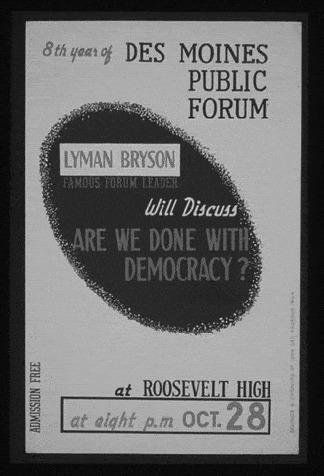
Lyman Bryson forum in Des Moines. WPA poster, from Library of Congress American Memory site: http://memory.loc.gov/cgi-bin/query/D?wpapos:9:./temp/~ammem_RxhN.
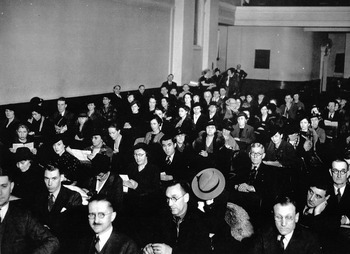
Photograph, adult audience at Broadway High School, Seattle, Office of Education records, RG 12, PF 131, National Archives at College Park, MD.
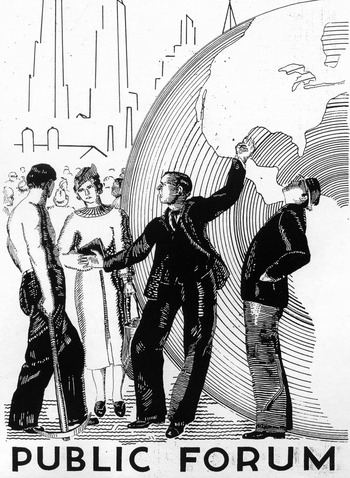
Forum Project poster, Office of Education records, RG 12, PF 003, National Archives at College Park, MD.
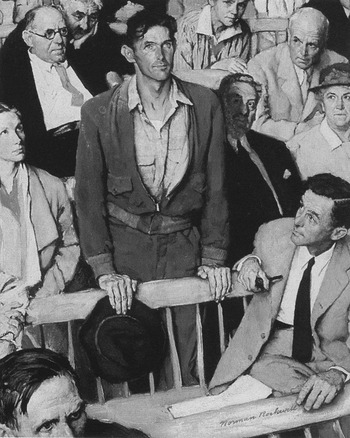
Norman Rockwell, Study for “Freedom of Speech” 1942. Printed by permission of the Norman Rockwell Family Agency. Copyright © 1943 the Norman Rockwell Family Entities.
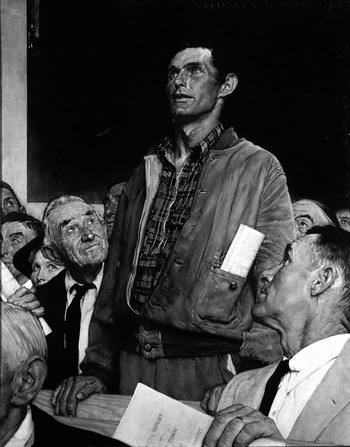
Norman Rockwell, ‘Freedom of Speech’ 1943. © 1943 SEPS: Licensed by Curtis Publishing, Indianapolis, IN. All rights reserved. www.curtispublishing.com
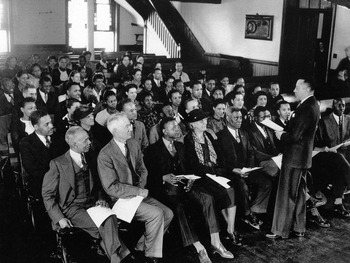
Forum at Morris Brown College, RG 12 PF 131, National Archives at College Park, MD.
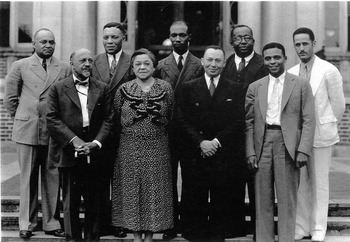
Leaders of Atlanta Colored Forums, RG 12, PF 156. National Archives at College Park, MD.
 You have
Access
- 8
- Cited by