1 Introduction
Sound patterns are often affected by the morphological structure of words, not only in the obvious sense that affixation creates new contexts in which phonological processes can apply, but also in more complex cases, with some phonological processes applying only at morpheme boundaries (i.e. not morpheme-internally) or only to a subset of morphemes (e.g. to loanwords, or to affixes but not roots).
This paper focuses on a subset of such morphologically derived environment effects (MDEEs) that present particular challenges for existing accounts of morphophonological interaction because they involve long-distance interactions between affixation and root-internal segments. In Dutch, for example, some speakers produce [ɹ] in recent English loanwords, but the native segment [ʀ] in derived words (Jurgec Reference Jurgec2011: §3.4.2, Reference Jurgec2014).
(1)


Unlike most previously described MDEEs, in this pattern the alternating segment can be at any distance from the triggering affix. Because of this, and because the alternation does not depend on the segmental content of the affix, non-local MDEEs cannot be accounted for by systems of constraint indexation like that proposed in Pater (Reference Pater, Bateman, O'Keefe, Reilly and Werle2007, Reference Pater and Parker2009), which requires that the locus of violation involve an exponent of the indexed morpheme (in this case the affix).
One intuition about patterns like (1) is that a non-exceptional suffix somehow overrides or conceals the exceptional status of the root. In this paper we implement this intuition with a modest extension of indexed constraints, allowing indexation not only to individual morphemes, but also to potentially complex constituents such as the stem or word. This extension derives the regularisation patterns typical of long-distance MDEEs. The core of our proposal is that complex constituents are treated by phonology as lexically exceptional only when every morpheme within them is independently exceptional. We show that this system can model variation both within and across languages in terms of which classes of affixes (e.g. prefixes vs. suffixes, inflectional vs. derivational) trigger root-internal alternations. We also argue that the resulting system has conceptual advantages over Gouskova & Linzen's (Reference Gouskova and Linzen2015) account of similar data from Russian, which directly encodes regularisation factors for individual morphemes. Other approaches to local MDEEs, such as cophonologies (Yu Reference Yu2000, Inkelas & Zoll Reference Inkelas and Zoll2007) or stratal accounts (Burzio Reference Burzio, Dekkers, van der Leeuw and van de Weijer2000, Kiparsky Reference Kiparsky2000), cannot be easily extended to the long-distance MDEEs discussed in this paper.
We begin in §2 with an introduction to the theory of lexical constraint indexation, and to our minimal extension of allowing constraints to be indexed not only to individual morphemes, but also to larger constituents. In §3 we illustrate how this extension accounts for loanword nativisation in Tagalog and Dutch, complemented by a short survey of loanword nativisation patterns in other languages. In §4 we analyse multiple interactions of indexed constraints in Slovenian. §5 addresses the factorial typology predicted by a system that allows only faithfulness constraints to be indexed (e.g. Itô & Mester Reference Itô, Mester, Beckman, Dickey and Urbanczyk1995, Reference Itô and Mester2001, Inkelas et al. Reference Inkelas, Orgun, Zoll and Roca1997, Inkelas & Zoll Reference Inkelas and Zoll2007).
In §6 we turn to the question of whether other constraint types can be similarly indexed. We show that the lexically triggered vowel alternations in Russian discussed by Gouskova & Linzen (Reference Gouskova and Linzen2015) can be expressed in our lexical indexation model, but only if indexed markedness constraints are possible. We also sketch indexation-based analyses of trisyllabic shortening in English and word-minimality effects in Turkish, neither of which can be captured by indexed faithfulness.
Finally, in §7 we review a number of other accounts that have been offered for similar data, and argue that none matches the empirical coverage of the lexical indexation account we propose.
2 Lexical indexation
Phonology is frequently sensitive to properties of the morphemes to which an operation or constraint applies. In Optimality Theory (OT), one way to account for this is by allowing constraints to be indexed to certain classes of words, for example roots (McCarthy & Prince Reference McCarthy and Prince1993), loanwords (Itô & Mester Reference Itô, Mester, Beckman, Dickey and Urbanczyk1995, Reference Itô and Mester2001), nouns (Smith Reference Smith, Kirchner, Pater and Wikely2001), specific lexical items (Pater Reference Pater2000, Becker et al. Reference Becker, Ketrez and Nevins2011, Gouskova Reference Gouskova2012) or exceptional suffixes (Pater Reference Pater, Bateman, O'Keefe, Reilly and Werle2007, Reference Pater and Parker2009).
An important observation of work on constraint indexation has been that morphologically sensitive constraint evaluation is local: the presence of an exceptional affix in a word does not cause other affixes to behave as though they were also exceptional. To account for this, Pater (Reference Pater, Bateman, O'Keefe, Reilly and Werle2007, Reference Pater and Parker2009) explicitly limits the reach of indexed constraints with the metaconstraint in (2), so that the locus of violation of an indexed constraint must be within the morpheme with that index.
(2)

As illustration, consider the following example from Colloquial Helsinki Finnish (henceforth Finnish; Anttila Reference Anttila, Hanson and Inkelas2009). In Finnish, hiatus of a high vowel followed by a low vowel is possible in non-derived words, but not in derived words, where the vowels coalesce into a long high vowel, as in (3) (from Anttila Reference Anttila, Hanson and Inkelas2009: 436).
(3)

Finnish constitutes a case of a derived environment effect (DEE) applying at morpheme boundaries. To illustrate the mechanism of lexical constraint indexation, we adapt Anttila's account of these facts, in terms of privileged root faithfulness. We capture this with an indexed constraint Faithroot, which is violated by any change to a segment that belongs to a root morpheme. It outranks *IA, a constraint that is violated by a sequence of a high vowel and a low vowel, which in turn outranks unindexed Faith.
To see how these constraints interact in Finnish, consider first cases where hiatus is root-internal: (4a) shows that the indexed constraint Faithroot prevents any change to either of the two vowels of the root. This constraint cannot apply to vowels in affixes, thus *IA is able to rule out the fully faithful candidate in (b), forcing the affix vowel to match the preceding root vowel in all features (resulting in a single long vowel).
(4)

This approach can be easily extended to most other DEEs where a particular process applies only at or close to a morpheme boundary. However, though the locality requirement expressed in (2) successfully accounts for patterns of the Finnish type, it is challenged by the existence of clearly non-local MDEEs, where an exceptional property of a root is suppressed in certain morphological contexts. Recall the Dutch pattern from (1), for example, in which [ɹ] is possible in certain loanwords when they appear in underived forms, but is replaced by [ʀ] in derived words. Such alternations appear to require non-local interactions between affixes and root-internal segments.
We propose that this type of apparently non-local effect can be captured in terms of local constraint evaluation if constraints can be indexed not only to individual morphemes, but also to complex morphological constituents such as stems and words. This is a natural extension of ideas already present in the literature. We share with many others the view that indexed constraints can be sensitive to both morpheme type (e.g. root, affix) and arbitrary lexical specification (see e.g. McCarthy & Prince Reference McCarthy and Prince1993, Itô & Mester Reference Itô, Mester, Beckman, Dickey and Urbanczyk1995, Reference Itô and Mester2001, Beckman Reference Beckman1998, Pater Reference Pater2000, Flack Reference Flack2007, Gouskova Reference Gouskova2007, Jurgec Reference Jurgec2010). What we add is the idea that indexed constraints must be further specified for the morphophonological domain in which they apply. Maximally local constraint evaluation of the type proposed by Pater (Reference Pater, Bateman, O'Keefe, Reilly and Werle2007, Reference Pater and Parker2009) reflects indexed constraints applying in the domain of a single morpheme; we argue that indexed constraints can also apply to larger constituents, consisting of a root plus zero or more affixes (i.e. stems or words). In each case, the indexed constraint will identify both a property (e.g. lexical category, status as a root, belonging to an exceptional class, etc.) and a domain (morpheme, stem or word).
If properties belong to individual morphemes, though, we must ask when indexed constraints will apply to complex domains. We propose that morphosyntactic notions of headedness are not visible within the phonological component, and further assume that complex constituents are not themselves ‘lexicalised’ (i.e. represented in the lexicon without any internal morphological structure, and treated as morphologically simplex by the grammar). Because constituents are not lexicalised, their properties must be calculated on the basis of their component parts; but because morphosyntactic hierarchy is not preserved in the phonology, this calculation cannot distinguish head from non-head elements.Footnote 1 We thus propose that phonology resorts to an all-or-nothing calculation of the properties of complex constituents: if a constraint indexed to stems or words is further restricted to some class S, the constraint will apply only if all morphemes in the stem or word are specified as S.
(5)

This predicts patterns where marked structures are preserved in stems or words that contain a single morpheme (i.e. a root belonging to an indexed class), but not in stems or words that are complex (i.e. contain at least one non-exceptional affix). However, cases where the root and all affixes are specified for the same lexically exceptional property are special, as we will see for English trisyllabic shortening in §6.2.
If any of the morphemes in a complex stem or word is not specified for an indexed property, then that stem or word will be treated as not specified for that property, and a general/non-indexed version of a constraint will apply instead. In §3 we briefly show how this extension of indexation accounts for MDEEs in Tagalog and Dutch loanwords, with a brief survey of other loanword nativisation patterns, and in §4 we extend the model further to more complex MDEE interactions in Slovenian.
A final remark is in order regarding our assumptions about the morphology–phonology interface, specifically the status of zero affixes. Throughout this paper it will frequently be crucial that forms without any overt affix are treated as having no affix at all, rather than as containing a null affix. Our framework predicts a phonological contrast between an affix that happens to be phonologically null and one that is entirely absent: only the former should ever prevent a lexically indexed constraint from applying to complex constituents. We show that this prediction is borne out by contrasts in zero derivation in §3.2 and in zero inflection in §4.1.
3 Case studies: loanword nativisation
3.1 Tagalog
This section illustrates our proposed extension of lexical indexation, with reference to non-local MDEEs in Tagalog loanword adaptation.
Consider the Tagalog labial alternations in (6) (Zuraw Reference Zuraw2006, Jurgec Reference Jurgec2014, Kie Zuraw personal communication). As first observed by Bloomfield (Reference Bloomfield1917: 137), Tagalog allows [f] in bare loanword roots from Spanish, but not in prefixed or suffixed words, where [p] surfaces instead. Note that the segmental content of the triggering affix does not play a role.
(6)

As outlined in §2, we propose that constraint indexation should be divided into two components: the lexical property to which constraints are sensitive (e.g. loanword), and the morphophonological domain that is potentially specified for that property (e.g. morpheme, stem, word). Each index is thus a pair, consisting of a property and a domain. If no domain is specified, we adopt the convention that the constraint applies at the level of individual morphemes. This will yield the type of locality discussed by Pater (Reference Pater and Parker2009), which can apply to both roots and affixes. For constraints indexed to larger constituents, there will be an inherent asymmetry between roots and affixes. While it is possible for a root to be the sole morpheme in a stem or a word (allowing the stem or word to ‘inherit’ any lexical properties for which the root is specified), the same is not true of affixes. Any stem or word that contains an affix will always contain at least one other morpheme – a root – and so affixes will only be able to pass on lexical properties that they share with the root with which they combine.
In Tagalog, what appears to be relevant is whether a word consists only of morphemes specified as belonging to the class of loanwords (L) – i.e. whether the word consists of a single loan root. The relevant Ident constraint is defined in (7).
(7)

Following the conventions discussed in §2, the constraint in (7) will not apply in words where a non-native root occurs with a native affix, as illustrated in (8a), because the word-level domain contains non-L-marked morphemes (assuming that no prefixes or suffixes are L-marked in Tagalog). In contrast, the constraint IdentL,word does apply in non-affixed words where the word contains only an L-marked root, as illustrated in (8b). As a result, [f] surfaces in bare roots, but not in prefixed or suffixed words.
(8)
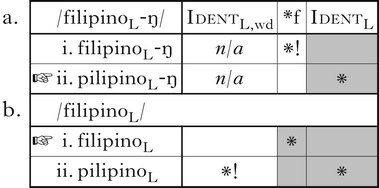
This rather simple analysis captures the intuition that it is the status of some roots as loanwords that allows non-native segments to be preserved, together with the idea that the addition of morphology somehow ‘conceals’ the loanword status of the root. This intuition has previously been implemented in different terms, particularly in Inkelas & Zoll's (Reference Inkelas and Zoll2007) proposal invoking cophonologies, to which we return in §7.2. We show in the next few sections that accounting for other MDEEs requires the greater flexibility of indexing constraints not only to individual morphemes or to words but also to intermediate morphological constituents such as the stem.
3.2 Extension to stems: Dutch
In this section, we detail our analysis of the Dutch rhotic nativisation data seen in (1). Dutch resembles Tagalog in that nativisation is required only in affixed words, but differs in that only derivational affixes trigger nativisation. As we will see, this type of pattern is predicted by the system of indexation proposed in this paper.
Recall that Dutch exhibits an alternation between [ɹ], which occurs in some bare roots borrowed from English, and [ʀ]. While in (1) it appeared that [ɹ] was incompatible with all suffixes, closer examination reveals that it can occur in some suffixed words, as long as the suffix is inflectional, as shown in (9).
(9)
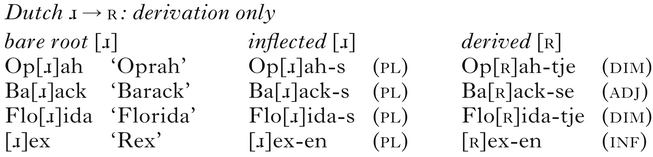
We see in (9) that English [ɹ] is retained not only in bare roots in Dutch, but also in words with inflectional affixes only, represented here by plurals. When a loan root undergoes derivational affixation, by contrast, English [ɹ] is replaced by [ʀ].
This is similar to Tagalog, in that morphological complexity affects the phonological exceptionality of loans. In Tagalog, we accounted for this pattern by indexing the relevant faithfulness constraints to the word domain: these constraints applied only to words that contained only borrowed morphemes (i.e. consisting solely of a borrowed root). In Dutch, we suggest that the constraint refers instead to a smaller domain, the stem, a morphological constituent that contains the root and all derivational affixes, but excludes inflectional affixes. The relevant constraint is defined in (10), which is identical to (7), except for the domain over which indexation is evaluated.
(10)

Just as with words, a stem will be treated as having a property P if and only if every morpheme within the stem is specified as P. In words where the stem consists only of a root specified as P, this will be trivially satisfied regardless of whether the word as a whole contains any other morphemes (i.e. inflectional morphemes affixed to the stem). But in words that contain at least one derivational affix, it will not be, assuming again that only roots are specified for the relevant property.
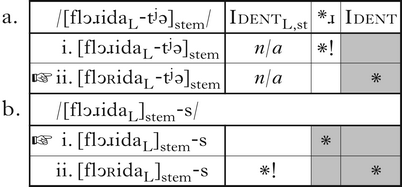
The constraint IdentL,stem does not apply in words with derivational suffixes, as illustrated in (11), where the constraint *ɹ rules out the faithful candidate in (11a.i). In words with only an inflectional suffix, by contrast, high-ranked IdentL,stem prefers the faithful candidate.
(11)
So far we have focused on segmentally overt affixes, and have not considered the issue of possible zero affixes. As pointed out by a reviewer, our analysis predicts that zero affixes should pattern with segmentally overt affixes for the purposes of evaluating constraints indexed to stems or words. Data from Dutch shed light on this issue.
1st person singular verbs and uninflected nouns in Dutch can be segmentally identical, as in [tekən] ‘sign’ and [tekən] ‘(I) draw’. Despite their segmental identity, they interact differently with a phonological process of final n-deletion. Most Dutch words ending in [ən] show optional deletion, as in [tekən] ~ [tekə] ‘sign’. 1st person singular forms are not subject to n-deletion: [tekən], but never *[tekə] ‘(I) draw’. Zonneveld (Reference Zonneveld1982) attributes this exception to the morphological structure of the verbal forms, which have a zero derivational affix, the ‘theme vowel’, while uninflected nouns lack a suffix altogether.
This same zero derivational affix can account for the data in (12); the derived 1st person singular verbs in the second column exhibit obligatory nativisation of [ɹ], despite lacking any segmentally overt suffix.
(12)
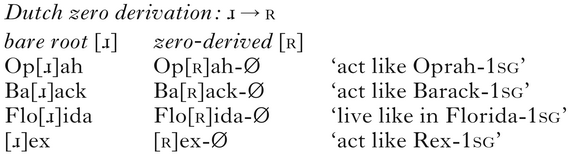
The prediction of the indexed approach is thus confirmed: zero derivational affixes pattern with segmentally overt counterparts. We show the same for zero inflectional affixes in §4.1.
The analysis of Dutch is a straightforward extension of that of Tagalog, the principal difference being the domain of the indexed faithfulness constraint. The comparison between the two languages highlights the fact that non-local MDEEs behave differently across languages, even when we restrict our attention to loanword nativisation, but that this variation can be captured in terms of the domain to which an indexed constraint applies.
3.3 Loanword nativisation cross-linguistically
The two examples of non-local MDEEs discussed so far involve loanword nativisation. We have seen variation in whether nativisation is triggered by all affixes, or only by derivational affixes. What we have not seen is a language where nativisation is triggered by inflectional affixes only. Indeed, our proposed model of constraint indexation predicts that such a pattern is impossible: if derivational morphology is structurally closer to roots than inflectional morphology is, no complex constituent could include inflection but exclude derivation.
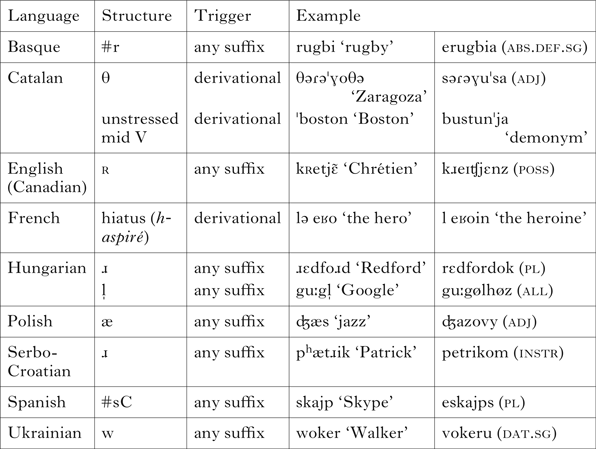
This prediction is borne out by a preliminary survey of loanword MDEEs, summarised in Table I. We have found languages where all suffixes trigger nativisation, and others where only derivational suffixes do. Furthermore, some languages show multiple, different loanword MDEEs.Footnote 2 All of these patterns can be captured within the framework developed here. For MDEEs triggered only by derivational morphology, indexation will be to the stem; for those triggered by all affixes, indexation will be to the word. To be clear, not all of the examples in Table I necessarily represent synchronic alternations. While the pattern of nativisation seen for Dutch in §3.2 applies productively to recent loans such as Barack, other cases may instead reflect historical variation in the extent of nativisation. We nonetheless include this table to illustrate the point that loanword nativisation is often sensitive to different classes of morphology (derivational vs. inflectional), beyond the cases we discuss in detail in this paper. This yields a profile that can be accommodated within the system of constraint indexation we propose, though further investigation is necessary in any individual case to determine whether a particular alternation is best analysed as an MDEE, or has arisen for independent historical reasons.
Cross-linguistic survey of MDEEs in loanwords.

Table I is also limited to loanword nativisation, though MDEEs potentially also arise in other areas of the grammar. In §4 we turn to the interaction of several MDEEs in Slovenian, some of which involve loanword phonology, but one of which (schwa fronting) also occurs in the native vocabulary. This demonstrates that a single language can have MDEEs which are sensitive to different domains, as predicted by the indexation approach.
4 Multiple interactions: Slovenian
Standard Ljubljana Slovenian (henceforth Slovenian) exhibits several different MDEEs. We first look at a pattern that involves loanword nativisation under affixation (§4.1). We then turn to a pattern of schwa fronting that occurs only in words with derivational affixes, not those with inflectional affixes, and which we argue requires constraint indexation to the morphological stem (§4.2). Finally, we look at words that exhibit both types of MDEEs, demonstrating that this interaction is predicted by our approach (§4.3).
4.1 Loanword nativisation
The pattern observed in Slovenian loanwords very closely resembles the Tagalog and Dutch patterns analysed above: bare roots allow onset [ɹ] and [w] in words borrowed from English, as shown in (13a, b), but these segments are replaced by the corresponding native sounds, [ɾ] and [ʋ], in suffixed words. Similarly, front round vowels such as [y] are possible in loanwords from German, French and other varieties of Slovenian, but are replaced by the corresponding unrounded vowels in words containing a suffix, as seen in (13c).Footnote 3
(13)

Parallel to Tagalog and Dutch, Slovenian data illustrate a long-distance interaction between the presence of a suffix and the segmental properties of the root. The same interaction can be seen in (14), but triggered by the presence of a prefix rather than a suffix.
(14)
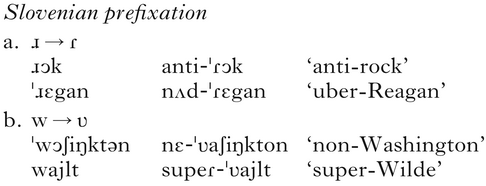
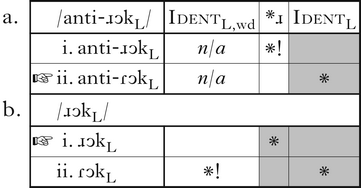
The constraint proposed to account for nativisation in Tagalog, IdentL,word, also accounts for the Slovenian data. As before, this constraint applies to words that contain only a loanword root, but fails to apply to words that contain any non-loanword morpheme. This is illustrated for nativisation of [ɹ] in (15a), and its preservation in (15b).
(15)
Indexing constraints to words, as opposed to any other constituent, makes the prediction that all affixes should behave in the same way. We have already seen that nativisation of [ɹ] and [w] is triggered by both prefixes and suffixes, but have not yet considered the distinction between derivation and inflection. For the alternations we have considered so far, it turns out that this distinction plays no role. The English rhotic is replaced by the native flap in both inflected and derived words, as shown in (16). The same holds for both [w] ~ [ʋ] and [y] ~ [i], though for reasons of space we do not include data for those alternations.
(16)

Before moving on to another MDEE in Slovenian, which does exhibit a contrast between derivational and inflectional morphology, we briefly address the morphological structure of the Slovenian nominative singular. Our analysis crucially relies on the assumption that the nominative singular involves a bare root, rather than a root followed by a zero nominative case affix. Traditionally, though, the nominative singular in the main masculine paradigm is represented as a zero suffix, as is the genitive plural/dual in the feminine and neuter (Toporišič Reference Toporišič2000). However, for the analysis advocated in this paper to work, the nominative must differ from all other cases, because long-distance MDEEs do not apply in the nominative, but do apply in all other cases, including the feminine and neuter genitive plural/dual.
There are strong syntactic reasons to consider the nominative to be different from other cases, corresponding to the absence of case morphology. Caha (Reference Caha2009) argues on a variety of grounds for the view that nominative corresponds to the absence of structure associated with other case forms. This sets the nominative apart from all other structural cases. There are equally strong phonological reasons for singling out the nominative singular. These come from stress shift and segmental patterns parallel to the Dutch zero derivation discussed in §3.2. A detailed analysis of these data is beyond the scope of this paper, but see Jurgec (Reference Jurgec2007).
4.2 Schwa fronting
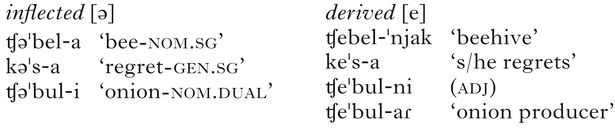
Slovenian allows schwa in bare roots, but though this schwa is retained in inflected words it is fronted to [e] in the presence of a derivational affix, as shown in (17a); note that this alternation can occur at any distance from the derivational affix, and that it occurs in both open and closed syllables. The examples in (17a) involve loanwords, which often preserve schwa from the source language. The same effect can be seen in a small number of native roots, illustrated in (17b).
(17)
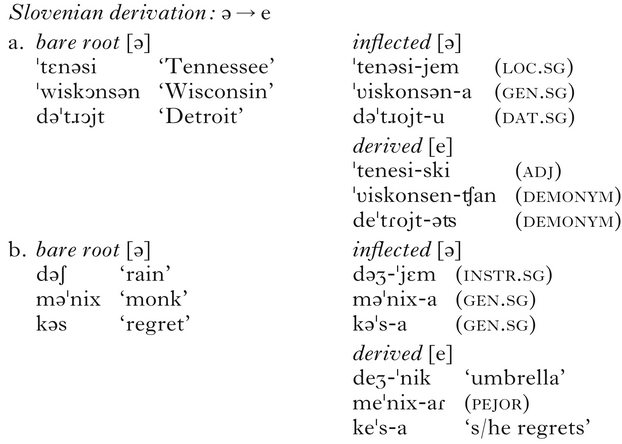
Importantly, the alternation between [ə] and [e] cannot be attributed to some other vowel-related process. The examples in (18) show that fronting applies across intervening front and back vowels, and in words containing front and back suffix vowels. Even more strikingly, some inflectional and derivational suffixes are identical (e.g. /-a/, which is both genitive singular and verbaliser), yet only the latter trigger fronting.
(18)
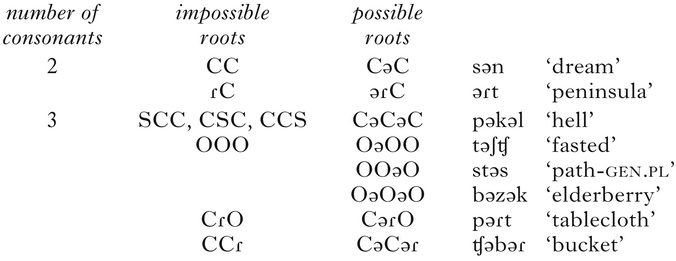
Before showing that an analysis of Slovenian schwa follows straightforwardly from our approach to indexing, we give more background on the distribution of schwa in Slovenian. First, note that the distribution of schwa in native Slovenian roots is fully predictable, determined by the phonotactics of root consonants, as illustrated in (19). In other words, it is never the case that two roots have the same three consonants, but differ in the position of schwa. For instance, while [bəzək] ‘elderberry’ is an attested word, all of the following are unattested: *[bzk, bzək, bəsk, əbəsk, əbzək, əbəzək]. Slovenian does not allow syllabic consonants (Toporišič Reference Toporišič2000), and restricts combinations of consonants (Srebot-Rejec Reference Srebot-Rejec1975, Chen Reference Chen2017). The predictable distribution of schwa supports the view that it is epenthetic, at least in native words. (C = consonant other than [ɾ], S = sonorant consonant other than [ɾ], O = obstruent.)
(19)
If schwa is epenthetic in native roots, this means that fronting of schwa to [e] cannot be viewed as a violation of Ident – indeed, it means that ‘schwa fronting’ is not strictly accurate as a label, though we continue to use it, in keeping with prior literature. We view insertion of schwa as the minimal epenthetic repair, i.e. it is a vowel with no other features. Fronting of [ə] to [e] requires epenthesis of a further feature, namely [front], and so is less faithful to the input. We adopt Dep[front] as the constraint militating against [e].
This single constraint, appropriately indexed as in (20), is sufficient to account for the distribution of schwa in (17) and (18). It prohibits the insertion of a feature [front] in a constituent specified for the morphological property of being a root, but it is indexed to the morphological stem rather than to either single morphemes or to the word as a whole, parallel to the analysis developed for Dutch in §3.2. It applies to stem constituents that contain a root and no other morphemes (we return below to the different distribution of schwa in final suffixes).
(20)

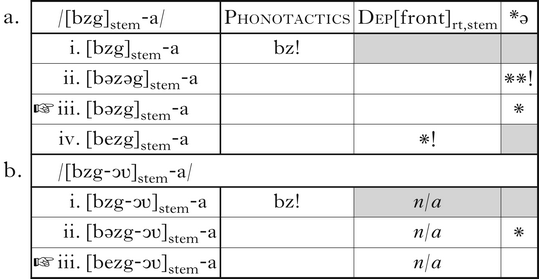
We assume that phonological constituents are never discontinuous, so that vowels epenthesised within the root must be treated as part of the stem, thus potentially subject to this constraint. We capture the markedness of schwa by invoking a markedness constraint *ə (van Oostendorp Reference Oostendorp1995), and the complex phonotactic restrictions resulting in the distribution of schwa in (19) with an undominated cover constraint Phonotactics. The application of the indexed constraint Dep[front]root,stem is illustrated in (21a), where epenthesis of schwa is possible in an inflected word – i.e. in a word where the stem contains only a root morpheme. (21b), meanwhile, illustrates that this constraint fails to apply to a derived stem, resulting in fronting to [e].
(21)
This analysis predicts that schwa should occur in underived words, but also only within the root. Yet schwa does occur in some suffixes, as we have already seen in (16) and (17a) with the diminutive suffixes /-ʧək/ and /-əʦ/. As in roots, the distribution of schwa in affixes is predictable, though it is subject to different generalisations. Supporting the view that affixal schwa is epenthetic, (22) shows that schwa alternates with zero in all suffixes in which it occurs, whenever that suffix is followed by another vowel-initial suffix.
(22)

Comparing (22) and (23), we see that schwa occurs in affixes so as to prevent complex codas that are licit in bare roots: /ɾk#, ŋk#, nts#, jm#, jn#/. In other words, Slovenian permits certain clusters root-internally, but epenthesises schwa to prevent affixation from creating new instances of such clusters.
(23)
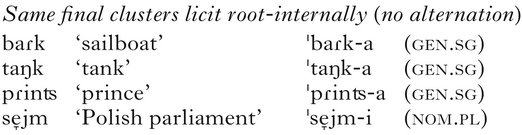
This is a classic example of a local derived environment effect of the type discussed above for Finnish, and can be captured by classic locally indexed constraints. In this case, an indexed constraint preventing epenthesis within the root, Dep(V)root, would outrank the markedness constraints that penalise complex codas (a subset of the constraints that fall under our general Phonotactics constraint), but these markedness constraints would in turn outrank the unindexed version of Dep(V).
Complicating matters further, we find in Slovenian that schwa in affixes alternates not only with zero, but also with [e]. Descriptively, fronting in suffixes is subject to different generalisations in affixes than in roots: while in roots fronting is triggered by derivational affixes, in affixes it is triggered by the addition of any further affix, whether inflectional or derivational.Footnote 4
(24)
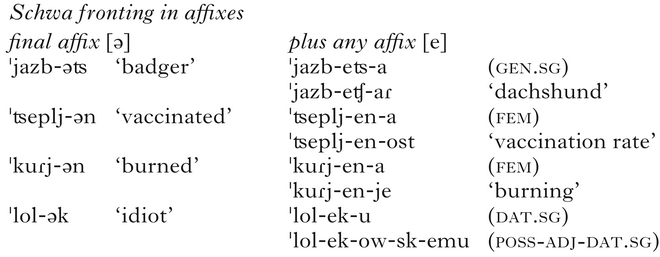
While this might appear to be a morphological condition, we suggest here that it instead illustrates a positional licensing effect: schwa is possible only in prominent positions, including not only roots (as seen above), but also final syllables. While initial syllables are typically associated with prominence (Beckman Reference Beckman1997, Reference Beckman1998), word-final positions have also been independently argued to be associated with enhanced faithfulness (Barnes Reference Barnes2006, Jurgec Reference Jurgec2011). There is independent evidence for this in Slovenian: the contrast between the two low tense vowels [ʌ] and [a] is limited to word-final closed syllables. The relevant constraint is Dep-σ#[front], defined in (25).
(25)

The interaction of Dep-σ#[front] with other constraints is illustrated in (26a). When affixation creates an illicit consonant cluster, high-ranked markedness (phonotactics) requires epenthesis. In general, the language prefers to epenthesise [e], due to the markedness constraint dispreferring schwa (*ə). Epenthesis of [e] violates Dep[front], but also its positionally restricted variant Dep-σ#[front], which outranks *ə and so preserves schwa as the epenthetic vowel in final syllables. When the word is further affixed, the epenthetic vowel no longer occurs in the final syllable, and so surfaces as [e], as shown in (26b).
(26)
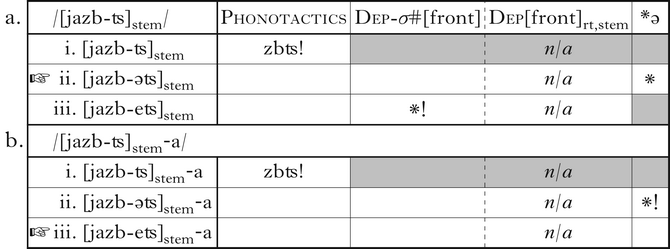
To summarise, schwa in Slovenian occurs both in loans and in native morphemes. In the native lexicon, its distribution is fully predictable as a means of preventing illicit consonant clusters (with a local derived environment effect making the set of illicit clusters larger for affixes than for roots). At the same time, schwa is generally dispreferred in Slovenian, and so is preserved only in contexts of enhanced faithfulness. There are two such contexts: final syllables (a positional faithfulness effect), and stems that are also roots. It is the latter that gives rise to the MDEE of central interest to this paper.
4.3 Interaction
Slovenian MDEEs involve several interacting alternations, subject to different classes of affixation. This is illustrated by inflected words such as [dəˈtɾojt-u] ‘Detroit-dat.sg’, where schwa is preserved, while [ɹ] undergoes nativisation to [ɾ]. Despite the complexity of the system, the constraint indexation proposed in this paper can account for these interactions without any further constraints or mechanisms: the divergence between schwa fronting and the nativisation of other segments is captured by different domains of application for different indexed constraints. Because the constraint preserving schwa is indexed to the stem rather than the word, it applies in contexts where the more general constraint requiring total identity in loanwords does not, as illustrated in (27).
(27)
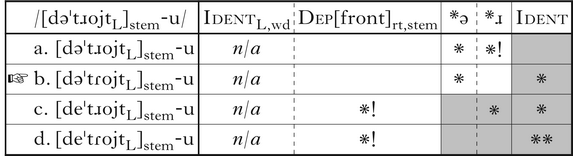
The interaction of MDEEs in Slovenian cannot be accounted for in other systems of constraint indexation (e.g. Itô & Mester Reference Itô, Mester, Beckman, Dickey and Urbanczyk1995, Reference Itô and Mester2001, Pater Reference Pater2000, Reference Pater and Parker2009, Flack Reference Flack2007, Gouskova Reference Gouskova2007, Jurgec Reference Jurgec2010). Such approaches could take two routes. First, some faithfulness constraint would need to be indexed to bare roots, making them exempt from the effects of a low-ranking markedness constraint. However, this would predict that there would be no nativisation in affixed words, since affixes could not erase the root index. Second, affixes could be indexed for markedness constraints driving nativisation, but it would be unclear how indexed constraints would apply over roots in suffixed words. In any case, while locality of evaluation in these approaches could perhaps be relaxed sufficiently to account for the long-distance nativisation of [ɹ], [w] and [y] – as well as for the alternation between [f] and [p] in Tagalog – this could not account for the contrast between derivational and inflectional affixes for the purposes of schwa fronting.
5 Indexed faithfulness: a factorial typology
Our analysis accounts for non-local MDEEs by allowing constraints to be indexed not only to the arbitrary properties of individual morphemes, but also larger morphological domains. This is combined with the assumption that for the purposes of constraint evaluation, a complex morphological constituent is treated as being specified for some property P only if each of its subconstituents is individually specified as P. Traditional indexed constraints, which produce only local effects, can be reinterpreted in this framework as having the morpheme as their domain of application, but both stem and word are also possible domains.
An indexed faithfulness constraint will lead to a phonological effect only if it outranks some markedness constraint that in turn outranks the unindexed version of the faithfulness constraint. This is shown schematically in (28), with the additional consequences determined by the domain to which the indexation is relativised.
(28)
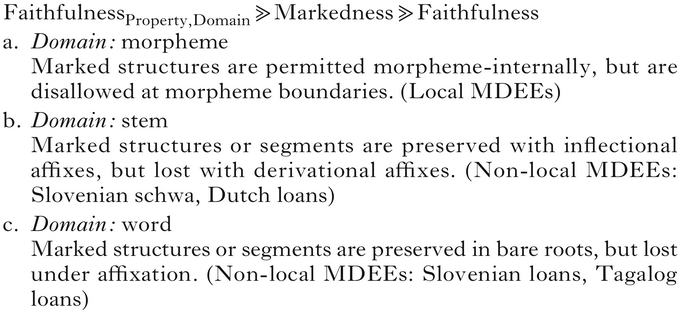
The second point of variation is the lexical property to which indexation can be sensitive. Following much other work on constraint indexation, we assume that morphosyntactic properties of morphemes can be indexed (i.e. lexical category, root vs. affix), as well as classes of exceptional morphemes, of which loanwords are a prototypical example. This is in line with the large literature on constraint indexation (e.g. Itô & Mester Reference Itô, Mester, Beckman, Dickey and Urbanczyk1995, Smith Reference Smith, Kirchner, Pater and Wikely2001, Pater Reference Pater2000, Reference Pater, Bateman, O'Keefe, Reilly and Werle2007).
Consider (28b) in more detail. (29) shows potential combinations of roots and affixes with an indexed property P. Under the ranking FaithfulnessP,stem ⪼ Markedness ⪼ Faithfulness, with the top-ranked constraint indexed to a stem constituent, roots can preserve exceptionality as long as no derivational affixes are present (29a), while inflectional affixes have no effect (e). By contrast, any non-P derivational affix will be stem-internal and will trigger regularisation (c). The remaining two combinations both involve derivational affixes that bear the indexed property P: when such affixes co-occur with indexed roots, exceptionality of the whole stem is preserved (b); when they co-occur with non-indexed roots, the whole word is regularised (d). While (d) is generally unproblematic, since it would be difficult to distinguish from a non-indexed affix, (b) presents a potential challenge to our proposal, because we predict the possibility of indexed affixes that exceptionally fail to trigger regularisation.
(29)
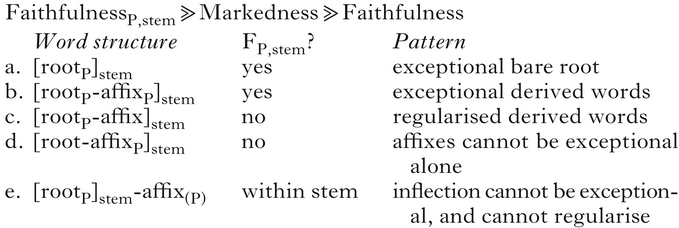
As it turns out, languages contrasting (b) and (c) are attested. In Tagalog, the overall trend is clear: affixed words prefer roots with [p], rather than [f], as in (6). A few affixes do not have a nativising effect, for instance the prefix [mag-]: [mag-filipino] ‘Filipino language’ is much more common than the expected [mag-pilipino] (Zuraw Reference Zuraw2006). This may be surprising, but it is actually predicted by the present approach, which allows for affixes to be indexed, and thus to have no effect on regularisation. At the same time, no affix can contain [f], exactly as predicted by the typology in (29).
In the following sections we examine two further examples. In Russian only some affixes trigger regularisation, a pattern best accounted for with indexed markedness constraints (§6.1). A similar case is found in English trisyllabic shortening, where Latinate roots preserve their exceptionality with Latinate derivational affixes, but not with non-Latinate affixes (§6.2).
The comparative rarity of interactions involving indexed affixes can be explained if we consider the sources from which they would arise. For the contrast between (29b) and (c) to arise in a language, there must be a phonologically exceptional class of morphemes that includes both roots and affixes. Some morpheme classes (such as the class of morphemes that are roots) by definition exclude affixes. Others exclude affixes incidentally: as we have seen, one of the most frequent phonologically exceptional classes is the class of loanword morphemes, but because it is comparatively uncommon for languages to borrow affixes, it is unsurprising that there have been only a few reported cases involving roots and affixes belonging to the same exceptional class.
This system of indexation does exclude a number of patterns – patterns that are, as far as we know, unattested. Some of these are due to morphological constituency: any pattern in which marked structures or segments are preserved under derivation but lost under inflection is impossible to capture in the present system, precisely because there is no constituent that includes both a root and all inflectional affixes, but excludes derivational affixes.
Also excluded is any pattern in which marked structures or segments are preserved only in complex words or stems, but lost in bare roots. In contrast to preservation under derivation but not inflection, such patterns are not impossible within the system we propose, but would be predicted by indexed markedness constraints. In §6 we suggest that indexed markedness constraints may explain some non-local MDEEs that cannot be explained in terms of indexed faithfulness. This requires some explanation for the absence of indexed markedness effects in classic patterns of loanword nativisation – in §6.4 we suggest that this may be due to historical and learnability factors.
6 Extending the account: indexing other constraint types
As noted in §1, Itô & Mester (Reference Itô, Mester, Beckman, Dickey and Urbanczyk1995, Reference Itô and Mester2001), Inkelas et al. (Reference Inkelas, Orgun, Zoll and Roca1997) and Inkelas & Zoll (Reference Inkelas and Zoll2007) argue that morphological indexation is limited to faithfulness constraints, which predicts that indexed morphemes can contain structures that are illicit in non-indexed morphemes, but not the reverse.
In §5 we saw that including indexed markedness constraints in the system we have proposed in this paper would predict that there should be languages where morphologically complex words are permitted to contain marked structures that are banned in their simplex counterparts. While this prediction might be pathological in the domain of loanword nativisation, there are nonetheless phenomena that appear to have the formal profile of MDEEs, but that cannot be explained by indexed faithfulness. Here we discuss two such cases: lexically conditioned vowel alternations in Russian prepositions and trisyllabic shortening in English. We also consider morphologically sensitive word-minimality effects in Turkish, which can be accounted for by indexing a constraint such as MParse, often viewed as neither a faithfulness nor a markedness constraint. Finally, we discuss the broader typological predictions made by extending indexation to markedness constraints.
6.1 Russian vowel alternations
Our first potential case of indexed markedness constraints is taken from Gouskova & Linzen (Reference Gouskova and Linzen2015), who discuss a pattern of lexically triggered vowel deletion in Russian prepositions: with most roots and prepositions the preservation of a vowel is phonologically predictable (to avoid certain consonant clusters), but when some prepositions (e.g. /so/ ‘with, from’, /ko/ ‘towards’, /vo/ ‘in, into’) occur with specific roots, the vowel is exceptionally preserved. Of further interest is that roots which are exceptionally vowel-preserving lose their exceptionality when they occur with certain derivational suffixes (e.g. the diminutive suffix [-(n)ik] is not regularising). This basic pattern is illustrated in (30).
(30)
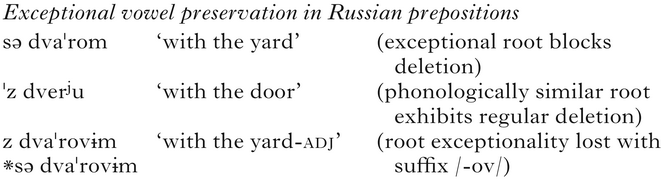
This is very much the type of pattern we have been considering throughout this paper: certain roots exhibit phonological behaviour that is otherwise blocked in the language, but this exceptionality is lost with the addition of further morphology. Russian resembles Dutch and Slovenian in that only derivational morphology triggers loss of exceptionality, and this can be again captured by the indexation of constraints to the morphophonological stem, rather than to the word.
At the same time, the vowel alternation in (30) cannot be straightforwardly captured as an instance of indexed faithfulness, if indexed constraints have to be evaluated locally. The reason for this is that though the pattern in (30) involves the exceptional retention of the prepositional vowel, that vowel is not associated with the morpheme that triggers the exceptionality (the following root), but instead with the preposition itself.
Constraint indexation can nonetheless account for these data if indexed markedness constraints are possible alongside indexed faithfulness constraints. Here we outline such an account, using the constraints proposed by Gouskova & Linzen (Reference Gouskova and Linzen2015), whose analysis is framed within a Maximum Entropy model. The crucial constraint is *#CCC, which is violated by word-initial clusters of three consonants. Following Gouskova & Linzen, we assume that the locus of violation of this constraint is the medial consonant rather than the entire string; as Russian lacks CC prepositions, this will always be a root consonant. To account for the data in (30), we index this constraint to stems specified as lexically exceptional, represented here as E. The other relevant constraint is *V, which favours vowel deletion; this is a locally indexed constraint applying to morphemes that bear a prepositional categorial feature, notated here as P (parallel to *PrepV in Gouskova & Linzen Reference Gouskova and Linzen2015). As shown in (31), *VP outranks the general constraint *#CCC, but is outranked by the more specific constraint *#CCCE,stem.
(31)
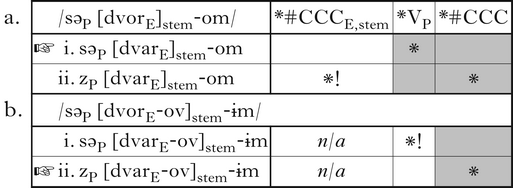
These vowel alternations closely resemble the previously discussed patterns of loanword nativisation, and the Slovenian alternations involving schwa, in that the addition of derivational morphology prevents a root from imposing exceptional phonological behaviour on the whole word. They differ only in that they cannot be explained in terms of locally evaluated faithfulness constraints, because the locus of the faithfulness violation (the vowel of the preposition) is distinct from the locus of exceptionality (the nominal root), and there is no domain which contains the preposition and the following stem but excludes inflectional suffixes. Accounting for this pattern with the indexed markedness constraint *#CCC shifts the locus of violation into the root itself, where lexical exceptionality also resides.
In §7.1 we return to these data, arguing that the account in terms of indexed faithfulness is also preferable to Gouskova & Linzen's Maximum Entropy analysis, in part by providing a fully principled explanation for the fact that only derivational affixes (not inflectional affixes) trigger loss of exceptionality.
6.2 Trisyllabic shortening in English
Trisyllabic shortening in English resembles other phenomena discussed in this paper in being restricted to a subset of the vocabulary, but is of particular interest not only because it requires indexation of markedness constraints, but also because it is sensitive to lexical properties of both roots and derivational affixes. Trisyllabic shortening thus supports our prediction that complex morphological constituents should be treated as lexically exceptional when all roots and affixes bear the same indexed property.
Here we focus on the core phenomenon of quality/length alternations that are independent of any shift in stress. Relevant examples appear in (32): words in the left column have a stressed tense (i.e. long) vowel in penultimate or final position, alternating with a stressed lax (i.e. short) vowel when derivation moves that syllable into antepenultimate position.
(32)
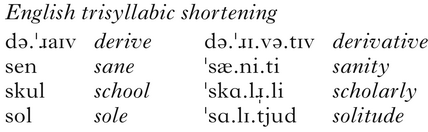
Though trisyllabic shortening reflects quality alternations that were once productive (Lahiri & Fikkert Reference Lahiri and Fikkert1999), it is now limited to words containing only Latinate roots and affixes, i.e. morphemes borrowed directly from Latin or via French – though not all etymologically Latinate morphemes are synchronically treated as members of this exceptional class. The examples in (33a), which all exhibit tense antepenultimate stressed vowels, demonstrate that the restriction seen in (32) is not attested elsewhere in English.
(33)
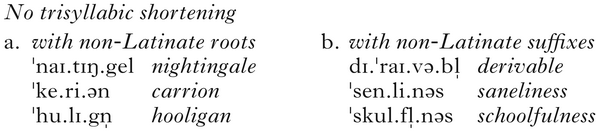
More interestingly, the ban on antepenultimate tense vowels does not apply in words with fully productive derivational suffixes, as shown in (33b). Thus -able does not trigger shortening, despite being disyllabic (though this suffix was historically backformed from French loanwords, it is evidently not synchronically treated as belonging to the exceptional Latinate class). The same is seen with sequences such as -ful-ness and -ly-ness; these affix combinations are not always entirely natural, often having a playful or metalinguistic quality, but, to the extent that they are possible, they very clearly do not allow trisyllabic shortening.
The standard analysis of trisyllabic shortening is that long vowels are only licensed in the Latinate vocabulary when they are both stressed and either final or penultimate (e.g. Chomsky & Halle Reference Chomsky and Halle1968, Kiparsky Reference Kiparsky1979, Myers Reference Myers1987, Hammond Reference Hammond1988, Kager Reference Kager1989).Footnote 5 We analyse trisyllabic shortening as being motivated by prosodic optimisation, and assume moraic trochees (Prince Reference Prince1990), together with the constraint FtBin(μ) in (34) (McCarthy & Prince Reference McCarthy and Prince1993, Hewitt Reference Hewitt1994), which must be indexed to Latinate stems (marked as R for ‘Romance’), and Ident[long].
(34)

We attribute final syllable extrametricality to a constraint Non-finality, which applies in English both to nouns and to a subset of adjectival suffixes, following Hayes (Reference Hayes1982); we do not show Non-finality in the following tableaux, but it would be a locally indexed constraint. We assume that there are no ‘superheavy’ syllables in English; for the purposes of this constraint, syllables with a long vowel always count as containing two moras, regardless of whether there is a final consonant. Non-finality interacts with a constraint aligning stress at the right edge of words, preventing the main stress foot from retreating more than one (extrametrical) syllable from the right edge (Pater Reference Pater2000). (35) shows the constraint in (34) applying to different kinds of stems.
(35)
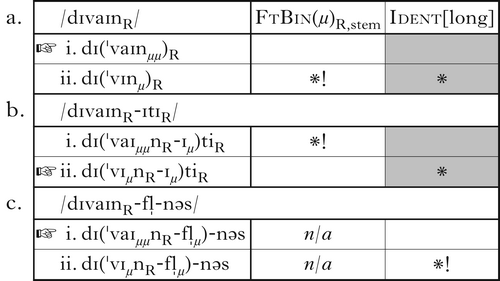
As noted above, what is interesting from the perspective of our analysis is that that the generalisation in trisyllabic shortening holds only in words where both the root and derivational affixes belong to the same exceptional class.
This analysis cannot be replaced by fully local indexation to Latinate affixes themselves. This would require non-local evaluation of constraints, as the affected vowels are root-internal. Also, though Latinate suffixes cannot generally attach to non-Latinate roots, some such forms are attested: betweenity, for example, appears in the Oxford English Dictionary as a ‘playful formation … after words from Latin’ (example due to Daniel Currie Hall). If shortening were the result of indexation to the affix alone, we would expect it to apply here. Indexed constraints of the type we have proposed, by contrast, automatically fail to apply to such words, because the root is not specified for the feature R. This explanation extends to well-known exceptions to trisyllabic shortening, such as obese ~ obesity or condole ~ condolence: our analysis allows the possibility that such roots are not indexed for the feature R by modern speakers, despite being etymologically derived from Latin.
Reframing this analysis in terms of indexed faithfulness, rather than markedness – indexing Ident[long] to words containing only non-Latinate morphemes – is also not successful. The pattern is crucially sensitive to whether all morphemes in a domain are Latinate, while the hypothetical constraint Ident[long]¬R,word would fail to apply whenever any morpheme in a word was Latinate. This would incorrectly predict that words like betweenity or derivable would exhibit shortening, faithfulness to underlying length being blocked by the presence of a Latinate root or affix.
6.3 Turkish word-minimality
Turkish exhibits an MDEE whereby a word-minimality restriction applies only to derived words. This is a prosodic restriction that in some respects resembles the English trisyllabic shortening pattern discussed in §6.2.
As the data in (36) (from Inkelas & Orgun Reference Inkelas and Orgun1995) show, bare roots in Turkish can be monosyllabic or longer, while affixed words must be at least disyllabic. The monosyllabic forms that would be predicted by regular inflectional morphology constitute paradigmatic gaps. Unlike the cases above, there is no possible repair for these words, whether via epenthesis or allomorphy, resulting in ineffability for the relevant paradigm cells. (Some speakers do allow repair via lengthening; this pattern is easily captured in the current framework with a top-ranked Ident[long]¬R,word.)
(36)
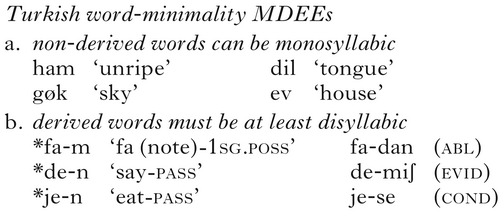
Orgun & Sprouse (Reference Orgun and Sprouse1999) analyse the Turkish pattern using standard OT constraints, and conclude that the ranking of these constraints would have to be different for bare roots and affixed words. As a solution, they propose Control, an additional component of the grammar alongside Gen and Eval. Any candidate which wins under Eval is submitted to Control. If the candidate violates a particular Control-imposed constraint, then the output for that particular input is not parsed.
The pattern in (36) can be captured within our system of lexical indexation by indexing the parallel constraints proposed by Orgun & Sprouse, thus obviating the need for an additional Control component. The constraint in (37a) (Prince & Smolensky Reference Prince and Smolensky1993, Orgun & Sprouse Reference Orgun and Sprouse1999) imposes the disyllabic minimal word in Turkish. This constraint must be satisfied by all affixed words, but can be violated by bare roots. To account for the fact that roots will surface regardless of size, we adopt the constraint MParse in (37b) (Prince & Smolensky Reference Prince and Smolensky1993, Fanselow & Féry Reference Fanselow and Féry2002a, Raffelsiefen Reference Raffelsiefen2004). In Turkish, only bare roots can violate this constraint, while affixed words do not. This suggests that MParse must be indexed, as in (37b). As before, we treat status as a root as an indexable property to which constraints can be sensitive. MParseroot,word is indexed to apply to whole words, and thus applies only when the root is the only morpheme in the word.
(37)
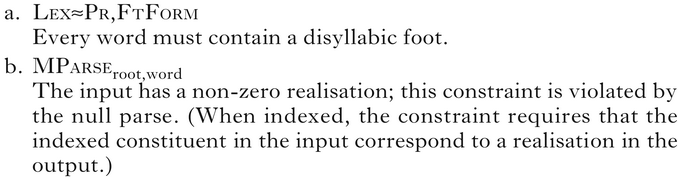
In Turkish, MParseroot,word outranks the word-minimality constraint. As such, monosyllabic bare roots surface faithfully, as shown in (38a). In affixed words, the indexed version of the constraint does not apply, and the word-minimality constraint rules out the faithful parse, as shown in (b). Finally, (c) demonstrates that longer affixed words satisfy the minimality constraint.
(38)
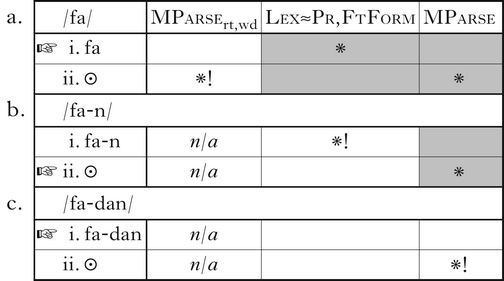
This implementation of indexed constraints solves the apparent ranking paradox in Turkish without recourse to any additional mechanisms. It illustrates another type of constraints to which lexical indexation can apply: not only faithfulness and markedness constraints, but also MParse.Footnote 6
6.4 Generalised indexing: the predictions
We have now seen several cases of MDEEs that cannot be captured with indexed faithfulness. In Russian, indexed faithfulness requires reference to a domain that includes prepositions and the root to the exclusion of any suffixes. In English, an indexed faithfulness approach cannot capture the generalisation that trisyllabic shortening applies only when all morphemes in a stem are exceptional. Finally, in Turkish, the indexed faithfulness approach cannot capture ineffability (rather than unmarkedness) of derived words.
This section addresses some of the typological predictions indexed markedness constraints make, parallel to the predictions made by indexed faithfulness constraints in §5. Again, indexed markedness constraints can differ in their domain of application, and traditional indexed constraints, which produce only local effects, can be reinterpreted as having the morpheme as their domain of application, though both stem and word are also possible domains. This generates the range of possibilities in (39).
(39)

The pattern described in (39b) is found in the case of Russian vowel deletion discussed in §6.1, as well as in English trisyllabic shortening (though in the English case, both affixes and roots can be indexed for the exceptional property of being Latinate). We have not discussed any MDEEs following the pattern in (39c), but Dinnsen & McGarrity (Reference Dinnsen and McGarrity2004) discuss a possible case from child language acquisition, where some segments are acquired first in complex words and only later in bare forms: for example [θup] ‘soup’ but [supi] ‘soupy’, reflecting the activity of a markedness constraint against strident segments, indexed to words that are roots (*Stridentroot,word).
Let us consider the ranking in (39b) in more detail. (40) shows the crucial combinations of roots and affixes together with their indexes. Several combinations have been considered in the previous subsections. Roots must be unmarked as long as no derivational affixes are present (a), while inflectional affixes have no effect (e). In contrast, marked structures are allowed if a derivational affix is present as long as it is itself not indexed (c). The remaining two combinations both involve indexed derivational affixes: when such affixes co-occur with indexed roots, regularisation of the whole stem obtains (b), as in English trisyllabic shortening; when such affixes co-occur with non-indexed roots, the whole word is regularised (d).
(40)
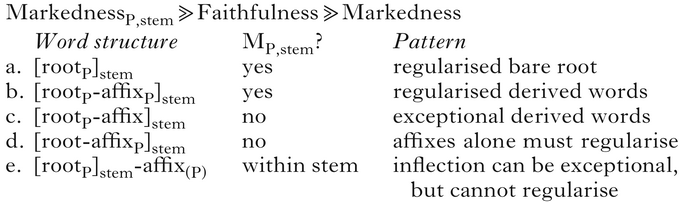
The typology of indexed markedness constraints correctly predicts the attested languages. Here we have focused primarily on prosodic markedness constraints, disregarding segmental markedness. We leave the investigation of potential cases of indexed segmental markedness for future research, together with the broader question of whether these phenomena could be captured in a system with indexed faithfulness alone.
7 Alternatives
In this section we discuss several alternative accounts of similar data, comparing them with our model of constraint indexation. These include the Maximum Entropy model proposed in Gouskova & Linzen (Reference Gouskova and Linzen2015) for regularisation effects in Russian, accounts of loanword phonology in terms of morphologically indexed cophonologies, as in Yu (Reference Yu2000) and Inkelas & Zoll (Reference Inkelas and Zoll2007), and the analysis of trisyllabic shortening using Stratal OT and output-to-output correspondence in Burzio (Reference Burzio1994, Reference Burzio, Dekkers, van der Leeuw and van de Weijer2000).
7.1 Maximum Entropy grammar with scaling factors
The first alternative we consider is Gouskova & Linzen's (Reference Gouskova and Linzen2015) analysis of non-local MDEEs with respect to the Russian data in (30) above. Gouskova & Linzen's analysis is framed within a Maximum Entropy (MaxEnt) grammar, which uses weighted constraints to model probabilistic rather than categorical outputs (Wilson Reference Wilson2006, Hayes & Wilson Reference Hayes and Wilson2008). In addition to the weights associated with constraints in MaxEnt, they propose that individual morphemes can be associated with two types of factors that influence constraint evaluation. The first are constraint-specific scaling factors, which can be associated either with roots or with affixes: these have an additive effect on violations of individual constraints, and are evaluated locally, just as indexed constraints are. The second are regularisation factors associated with some affixes: regularisation factors are between 0 and 1, and multiply the scaling factors of adjacent morphemes.
To account for the data in (30), Gouskova & Linzen propose that the root /dvor/ ‘yard’ is associated with a scaling factor of 9 for the constraint *#CCC, which causes it to exceptionally preserve the vowel of a preceding preposition. In the absence of any derivational suffix, this scaling factor privileges vowel deletion. The suffix /-ov/, however, is associated with a regularisation factor of 0; this multiplies the scaling factor of the adjacent root, cancelling it out.
This proposal resembles lexical indexation, in particular by attributing exceptionality to morpheme-specific properties that weight violations of a given constraint more heavily. Scaling factors play the same role in their system as constraint indexation plays in ours, and Gouskova & Linzen also do not assume that scaling factors are limited only to faithfulness constraints – they apply potentially to either faithfulness or markedness constraints.
Beyond that similarity are a number of differences. A superficial difference is that the MaxEnt model generates a range of probabilities across several candidates, rather than a single winning candidate. We have not addressed the debate between probabilistic and categorical models of grammar; our core proposal of lexical indexation to complex constituents could be adapted to a probabilistic model such as MaxEnt.
A more significant difference is the role of Gouskova & Linzen's proposed regularisation factors. For us, certain morphemes disrupt root exceptionality because they create a complex constituent that does not, as a whole, count as bearing a lexically exceptional property. For Gouskova & Linzen, by contrast, morphemes disrupt exceptionality more directly: regularisation factors do not impact the applicability of constraints, but instead the calculation of morpheme-specific scaling factors.
There are both conceptual and empirical issues with this implementation. First, for regularisation factors to work as intended, it is crucial that they do not influence the evaluation of the morpheme with which they are associated, but instead the evaluation of adjacent morphemes. This essentially abandons the locality principle proposed by Pater (Reference Pater, Bateman, O'Keefe, Reilly and Werle2007, Reference Pater and Parker2009) – a principle that Gouskova & Linzen themselves adopt for the application of scaling factors. To the extent that this weakens the overall role of locality in the phonological grammar, this is an issue for their account.
A second conceptual issue with Gouskova & Linzen's model arises from their observation that only category-defining derivational morphemes are ever regularising. Following work in Distributed Morphology, particularly Embick (Reference Embick2010), they argue that such morphemes form a natural class, consisting of the set of morphemes that are spelled out on the same cycle as the root, and suggest that only such morphemes can be associated with regularisation factors. Within their theory, however, there is no natural connection between the morphosyntactic status of an affix and its ability to be associated with a regularisation factor, and so the link between regularisation and category-defining morphemes remains a stipulation. Indexing constraints to stems or words, by contrast, builds in sensitivity to morphological constituency: the fact that derivational affixes trigger regularisation, while inflectional affixes do not, can be captured by indexing the relevant stem to exceptional stems, rather than to exceptional roots or words. Note also that the appeal to morphosyntactic cycles leaves unexplained those languages where inflectional morphemes do have a regularising effect, as in the Tagalog and Turkish cases discussed earlier in this paper.
Finally, the MaxEnt approach to non-local MDEEs faces significant empirical limitations. It cannot account for cases of the trisyllabic shortening type, where not only roots but also affixes can be indexed for the same lexically exceptional property, allowing complex constituents to show exceptional behaviour if and only if all morphemes within them are indexed for the relevant property. Similarly, it is not clear how this model could account for the interaction of [ɹ]-nativisation and [ə]-deletion in Slovenian. We saw in §4 above that though both [ɹ] and [ə] in Slovenian are preserved in bare roots, [ɹ] is lost with the addition of any affix, while [ə] is compatible with inflectional morphology, but not derivational morphology. This type of mixed pattern could technically be accommodated by the MaxEnt model, by making regularisation factors constraint-specific: we could say that inflectional suffixes have a regularisation factor only for Dep, while derivational suffixes have regularisation factors for both Dep and the more specific Dep[front] (responsible for schwa preservation). At this point, Gouskova & Linzen's approach is burdened with a duplication of constraint-specific information for each morpheme; the same patterns are captured in our system by general principles of constraint indexation to complex constituents.
To conclude, despite the similarities between our account and the MaxEnt model, there are both conceptual and empirical reasons to prefer the account framed in terms of lexical indexation, as a simpler theory that nonetheless accounts for a wider range of data.
7.2 Cophonologies
Another approach to exceptionality in OT is cophonology theory (Inkelas et al. Reference Inkelas, Orgun, Zoll and Roca1997, Anttila Reference Anttila2002, Inkelas & Zoll Reference Inkelas and Zoll2007). Put simply, the idea is that specific words or morphemes can be associated with distinct constraint rankings, so that multiple rankings coexist within a single language. The choice among these cophonologies depends on the morphemes present in a word: one cophonology applies to regular morphemes, while another applies to exceptional morphemes. The choice of cophonology is determined by the outermost morphological layer of a word. For instance, the loanword Dutch cophonology has the ranking Ident ⪼ *ɹ, allowing bare roots like Op[ɹ]ah. Once a native suffix is added, the native ranking *ɹ ⪼ Ident applies to the whole word, correctly predicting forms like Op[ʀ]ah-tje.
A theory that allows morpheme-specific constraint rankings is very powerful, and should be preferred only if that power is necessary to account for attested phonological patterns. In this section we first argue that some of the difficult cases for which cophonologies have been proposed can also be accounted for in terms of lexical indexation, and then that lexical indexation makes stronger predictions about the range of possible MDEE patterns, and so should be preferred on conceptual grounds.
The test case we consider comes from patterns of stress in Tohono O'odham (Yu Reference Yu2000). This language has a left-to-right trochaic rhythm with a final unparsed syllable in unsuffixed words: (σ́ σ)σ, as shown in (41a). Crucially, suffixed words parse this final syllable into a separate monosyllabic foot: (σ́ σ)(σ̀). This is a clear case of an MDEE.
(41)

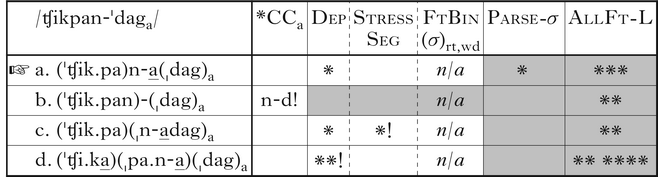
Yu (Reference Yu2000) attributes the difference between unsuffixed and suffixed words to cophonologies. The root cophonology ranks FtBin(σ) above Parse-σ, predicting unparsed final syllables in odd-syllable words. The affix cophonology applies to all affixed words, and reverses the ranking between these two constraints, thus preferring the candidate with the final monosyllabic root. To this point, this analysis can be directly restated in terms of constraint indexation, using the constraint FtBin(σ)root,word, indexed to roots and words. This constraint applies only in words without suffixes, as in (42a), favouring the candidates without monosyllabic feet. In affixed words, Parse-σ instead favours candidate (42b.ii), with final secondary stress.
(42)
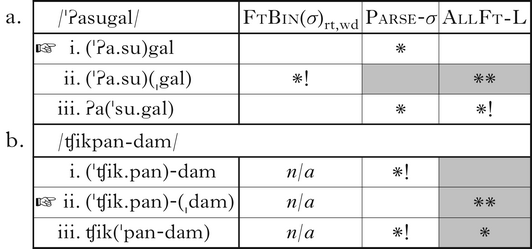
These patterns are somewhat complicated by words with an epenthetic [a], as in (43). Some consonant-initial suffixes are preceded by this epenthetic vowel, as in (43a), where the epenthetic vowel is underlined, whereas others are not, as in (b).
(43)
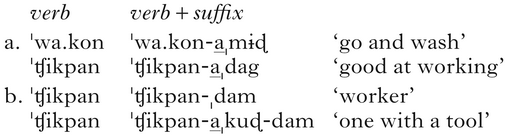
One way to analyse the distribution of epenthetic [a] is to say that there is a latent segment preceding those suffixes that trigger epenthesis, which is realised when the preceding morpheme is consonant-final (Zoll Reference Zoll1998). While this would be consistent with the indexation approach, indexation also allows us to see these cases as a local DEE, triggered by specific suffixes. We represent such suffixes as having a property a. Epenthesis can be captured by the ranking of *CCa ⪼ Dep. This is directly parallel to Gouskova's (Reference Gouskova2012) analysis of Russian latent vowels (yers) with constraint indexation.
A second complication is that epenthetic a cannot bear stress in most words. To capture this generalisation, Yu (Reference Yu2000) proposes the constraint StressSegment in (44).
(44)

The interaction of these constraints with the ranking in (42) is shown in (45). The winning candidate has epenthetic unstressed [a], thus violating only high-ranked Dep. The remaining candidates fatally violate either top-ranked *CCa ((b); no epenthesis), StressSegment ((c); stress on the epenthetic vowel) or Dep ((d); additional epenthesis in the root).
(45)
The final complication is that Tohono O'odham exhibits a morphological pattern of truncation, which overrides the restriction against stressing epenthetic [a], as shown in (46). Yu (Reference Yu2000) proposes that truncation is associated with another distinct cophonology – but this can again be seen as a DEE.
(46)
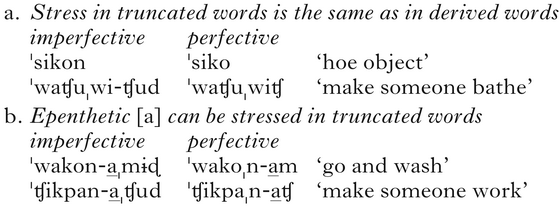
Truncation is unlike other kinds of affixation, in that its locality is unclear. In some sense, the whole word is the realisation of truncation, so that Pater's locality condition in (2) would allow any constraint that is indexed to the truncative morpheme to apply locally to the whole word. This underlies the evaluation of the indexed Parse-σ trunc in (47). This constraint applies to the whole word, preferring the winning candidate with a degenerate foot (a).Footnote 7
(47)

This concludes our demonstration that lexical indexation can account for the kind of complex morphological interactions for which cophonologies have been proposed. By contrast, cophonologies cannot capture most local MDEEs. Recall the Finnish case discussed in §2: hiatus is possible root-internally, but at morpheme boundaries the vowels coalesce into a long high vowel. In a cophonology approach, the root cophonology would have to apply to the whole word, but this would incorrectly predict coalescence not only at morpheme boundaries, but also root-internally. This cannot be easily saved by reference to an affix-specific markedness constraint such as Hiatusaffix, as this constraint cannot distinguish between segments internal to the affix and those that occur across the morpheme boundary. This demonstrates the inability of cophonologies to capture local MDEEs, whereas lexical indexation can capture both local and non-local effects.
Moreover, cophonology theory does not make any explicit predictions about how similar individual cophonologies within a single language can be. In all attested cases, including those discussed in this paper, derived and non-derived environments differ only in a small number of constraint rankings. For instance, the underived and derived cophonologies of Tohono O'odham differ in a single ranking, which is the typical case. But nothing in the approach based on cophonologies would rule out much more radical differences, for example a language exhibiting the overall constraint ranking of English for bare roots, but the overall phonology of Tohono O'odham in derived environments. No such cases have been reported. In short, cophonologies make few predictions about limits on how exceptional an exceptional morpheme can be, while lexical indexation makes very specific predictions. Parsimony thus favours lexical indexation over cophonologies, all other considerations being equal.
7.3 Stratal OT
The final alternative we consider is the possibility that at least some cases of long-distance MDEEs could be captured using Stratal OT (Burzio Reference Burzio1994, Reference Burzio, Dekkers, van der Leeuw and van de Weijer2000, Kiparsky Reference Kiparsky2000, Bermúdez Otero Reference Bermúdez-Oteroto appear). The basic idea of Stratal OT is that forms are built up cyclically by grammars, with (potentially) different rankings on each level. Here we discuss root, stem and word strata.
The challenge of stratal analyses is that all cycles should apply equally to both derived and non-derived words. To illustrate why this is a problem, we return to Tagalog. Recall from (6) that [f] is possible in unaffixed loanwords, but is replaced by [p] in affixed words; here reference to two strata (root and word) is needed, so we omit the stem level in the following tableaux. At the root level, Ident would outrank *f, ensuring that [f] can surface in bare roots (48a). At the word level, the ranking of the two constraints would be reversed, so that the long-distance MDEE applies in affixed words (48b).
(48)

The problem is that this analysis does not work for unaffixed words. The analysis at the root level is directly parallel to affixed words shown in (48a), resulting in the winning [filipino]. At the word level, the ranking *f ⪼ Ident still applies, leading to the undesired candidate with [p] in (49).
(49)
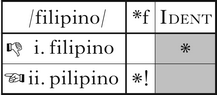
The crux of the problem is that the word-level ranking applies equally to affixed and unaffixed words, so the system cannot distinguish between bare roots and derived words.
To account for MDEEs, Stratal OT must rely on other mechanisms. Stratal OT models local MDEEs using a constraint that refers to a sequence at the morpheme boundary. As such, cases like Finnish hiatus in (3) are unproblematic. However, this analysis is unavailable for long-distance MDEEs. To solve this challenge, Burzio (Reference Burzio, Dekkers, van der Leeuw and van de Weijer2000) combines Stratal OT with output–output faithfulness constraints. In his analysis, bare root forms are subject to input–output faithfulness, which is ranked above some markedness constraint. For English trisyllabic shortening, for example, the bare root forms are subject to a ranking in which IO-faithfulness is higher than *LongV, as in (50a). Crucially, OO-faithfulness does not apply in this stratum. In the derived stratum, the situation is reversed, with IO-faithfulness not applying, because the underlying representation is no longer accessible. The next highest-ranked constraint, *LongV, favours the shortening candidate, (50b.ii).
(50)
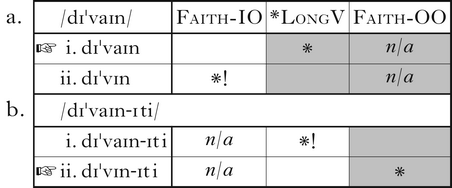
This approach can account for most of the data reported in this paper, but not all. Recall the Slovenian [ə]-fronting and [ɹ]-nativisation data. Both these long-distance MDEEs apply in derived words, but only [ɹ]-nativisation applies in inflected words. While it is clear that derivation constitutes a separate derivational stratum, inflection may or may not. Thus, for [ə]-fronting and [ɹ]-nativisation, we are logically left with two possibilities: either inflected words will pattern with bare roots (in which IO-faithfulness applies) or inflected words will pattern with derived words (in which only OO-faithfulness applies). The problem is that neither solution works for Slovenian, as shown in (51). The general ranking must be the same in Slovenian as in English, with IO-faithfulness ranked above some markedness constraint, which is in turn ranked above OO-faithfulness. If this general ranking did not apply, no MDEEs would be predicted. To make the argument explicit, we present separate IO-faithfulness constraints and markedness constraints. Whether we consider inflection together with the root stratum (a) or with the derivation (b), the attested candidate (ii) loses to the unattested faithful candidate (i) or completely nativised candidate (iii).
(51)
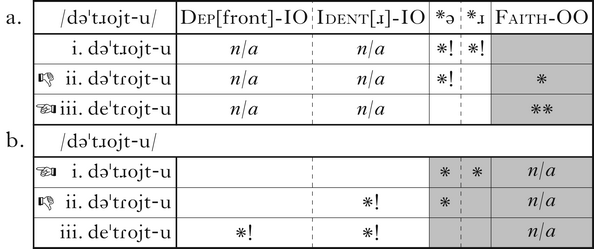
The shortcoming of OO-faithfulness is that it can make only a single distinction, between a first phonological cycle (subject to IO-faithfulness) and all subsequent cycles (subject only to OO-faithfulness). What the case of Slovenian demonstrates is that more granularity is needed, to capture languages that make multiple cuts along a continuum of nativisation. OO-faithfulness thus cannot be easily extended to all cases of MDEEs presented in this paper, while the lexical indexation approach we have argued for can. In these circumstances, there is reason to prefer the lexical indexation approach for its wider empirical scope.
8 Conclusions
This paper has discussed morphologically derived environment effects, which constitute an unusual case of long-distance interactions arising from the interplay of exceptional phonological patterns and the morphological structure of words. These patterns have constituted a serious challenge for theories of locality and exceptionality in phonology.
A simple extension of lexical indexation can successfully account for these effects. Our proposal is that indexed constraints are not only sensitive to lexically determined properties such as ‘root’ or ‘loanword’, but are also specified to apply within particular morphological domains. In maximally local cases, the relevant domain is a single morpheme, but larger constituents such as stems and words are also available for indexation. An indexed constraint applies to such larger constituents only when all the morphemes within them are individually specified for the relevant lexical property. This proposal captures the intuition that the exceptional status of roots can be ignored when a suffix follows; exceptional loanword patterns are lost once a native affix is added.
This model of lexical indexation accounts not only for well-known local morphological effects, but also the non-local effects that are characteristic of loanword adaptation or found in other domains as well. We argue that lexical indexation provides a better account of these data than other proposals, accounting for the attested range of phenomena, while also making predictions about patterns that should not be possible.