


Introduction
A population’s height is the result of how genetic and environmental factors interact during an individual’s growth stage, which also includes fetal growth. It is an anthropometric measurement that is widely used as a health indicator. Apart from being easy to measure, it has an approximately normal distribution and relative stability during adulthood. Reference Jelenkovic, Sund and Hur1 At growth cycle completion, stature will have been influenced by various factors. Among these are improved levels of nutrition among the population, integral health care during childhood, and suitable living conditions. Reference Costa-Font and Gil2,Reference María-Dolores and Martínez-Carrión3
Various studies demonstrate that genetically similar populations that evolve under distinct environmental conditions present different average statures. Reference Falkner and Tanner4–Reference Costa, Steckel, Steckel and Floud6 Environmental factors can influence an individual’s entire growth period, and early life is the stage that is most sensitive to these external factors. Reference Jelenkovic, Sund and Hur1,Reference Eveleth and Tanner7–Reference Stulp and Barrett10
Steckel’s physical growth curves Reference Steckel11 are commonly used to compare the statures of historical populations. Steckel Reference Steckel12 states that the stages most sensitive to gains in stature are early childhood and adolescence, although, during the latter stage, the growth rate is about half that experienced during early childhood. Floud et al. Reference Floud, Gregory and Wachter13 also consider the first stage of childhood as the one in which the growth rate is accelerated. Quiroga Reference Quiroga14 describes how the average growth rate is around 50 cm during the fetal stage and 20 cm during the first year of age. However, the rate is 10 cm per year during the years of greatest growth within adolescence. Schmidt et al. Reference Schmidt, Jørgensen and Michaelsen15 calculated the correlation between a child’s height with maximum height. At birth, this correlation falls between 0.25 and 0.30, rising to 0.70 and 0.80 in the first 2 years of age.
Nutrition and the incidence of diseases during childhood are among the environmental factors considered to have the greatest impact on adult stature. Different studies highlight the contribution of gastrointestinal and infectious diseases in determining physical growth, since they affect the absorption of nutrients indispensable to physical development. Reference Martorell, Blaxter and Waterlow16,Reference Martorell17 With regard to the complex manner in which nutrition and infection interact, authors like Floud et al. Reference Floud, Gregory and Wachter13 and Haines Reference Haines, Komlos and Baten18 argue that the nutritional state may also be affected by the incidence of infectious diseases. If a population’s nutrition is enhanced, infectious diseases could be less virulent and, consequently, adult health indicators would be better. Fogel Reference Fogel, Engerman and Gallman19 attributes nutrition improvement among the population to a 40% drop in the British mortality rate between 1800 and 1980.
As for analysing determining factors in the Spanish population’s stature, Carrión Reference Carrión20,Reference Carrion and Komlos21 provides evidence on how the differential trends for diseases in the region of Murcia (Spain) conditioned the population’s stature between the last decade of the nineteenth century and the first one of the twentieth. Quintana-Domeque et al. Reference Quintana-Domeque, Bozzoli and Bosch22 studied the relationship between environmental conditions for the year a person was born and his or her stature at adult age among cohorts from the Spanish population born between 1961 and 1980. A primary finding was that a reduction in the infant mortality rate is associated with an increase in stature of approximately 2.7 cm at adulthood. María-Dolores and Martinez-Carrión Reference María-Dolores and Martínez-Carrión3 show how, between 1850 and 1958, in addition to various economic indicators, the mortality rate was negatively related to a population’s height. Spijker et al. Reference Spijker, Cámara and Blanes23 study the health transition experienced by Spain in the twentieth century. Their results suggest that childhood is a critical period for physical growth. Infant mortality rate reduction could be associated with improved growth up to adulthood.
While there are several studies that cover the relationship between general mortality rates and physical growth, there is a paucity about the incidence that the burden from certain groups of diseases could have on the population’s final stature. It is important to highlight that, in historical populations, those who survive certain diseases – mainly infectious and digestive diseases, which affect the absorption of nutrients indispensable to physical development – are assumed to pay some kind of permanent price in their long-term health. Reference Bozzoli, Deaton and Quintana-Domeque9 Spijker et al. Reference Spijker, Cámara and Blanes23 state that mortality could not be considered directly as a proxy for adolescent conditions, given that a high proportion comes from external causes of death, making it a less suitable predictor of height. In this sense, including various types of causes of death (e.g., accidental injuries or suicide) could introduce some bias in the estimations. This research adds a new approach to studying the relationship between the early disease environment and adult height in historical populations, since some causes of death that are not related to the height reached at adult age are excluded from the analysis.
The literature that exists on this concept is not transversal and only deals with modern populations. Therefore, the main objective of this study is to determine the relationship between adult height and the incidence of certain diseases – approximated using specific mortality rates – during gestation and the first year of life among cohorts born across Spanish regions between 1916 and 1930.
Henceforth, this article has the following structure. “Methods” section describes the data and the methods used in the empirical analysis. “Results” section presents the evolution in stature and long-term mortality trends in Spain and the results of the regression analysis. A discussion of the study’s main conclusions is found in the final section.
Method
Information about height was obtained from Quiroga, Reference Quiroga14 who estimated the average adult height series across Spanish regions using a demographic document called Filiation Sheets. This document accompanied the Conscription and Call-Up Records, produced jointly by Spanish local governments and military authorities. It collected data about males at 21 years of age who received a medical checkup each time replacement troops were conscripted.
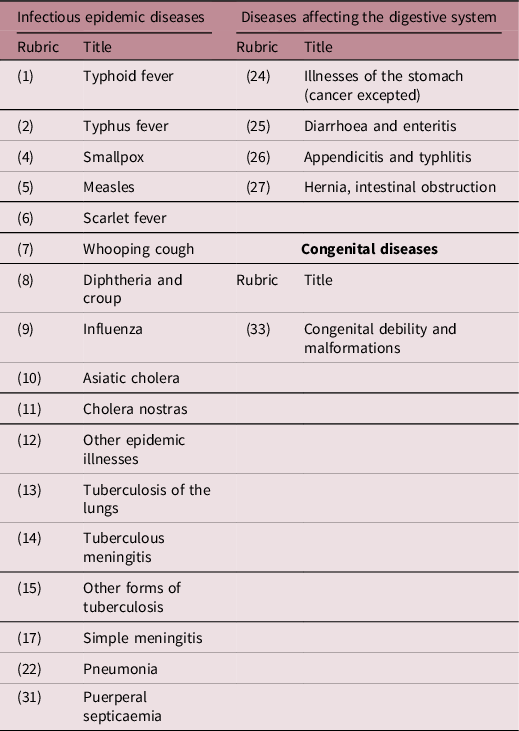
Mortality data were obtained from the natural population’s growth statistics, gathered in Statistical Yearbooks of Spain. 24 The data used in the empirical analysis were obtained from the reduced list with 38 causes of death on the International Disease Classification (IDC) second edition. Desegregated statistics were used at the regional level on the incidence of infectious, gastrointestinal, and congenital diseases. In Table 1, the causes of death from the empirical analysis and its rubrics were placed in three groups: infectious-epidemic diseases, those involving the digestive system, and congenital diseases.
Causes of death included in the empirical analysis

International Disease Classification-second edition (1910–1930).
Two variables were included to capture the environmental disease burden for the selected population cohorts. The variable diseaseburden_1 collects the specific mortality rates in the year of birth for each of the considered causes of death. Nevertheless, if only the disease burden at the year of birth was considered, a sensitive period of physical growth – during the first year of life – may be overlooked. To capture the disease burden during the gestation and fetal periods, an “average” variable (diseaseburden_2) was constructed. This variable is obtained as the average mortality rates for each of the considered causes of death in the year of birth and the first year of life.
To analyse the relationship between height in adulthood and the disease burden in early childhood, population-averaged models were employed. These models are useful when the number of spatial units and the data available at the time are limited, as is the case here. They enable a pooled analysis that simultaneously captures variations between regions and years. This analysis combines cross-sectional data on 17 Spanish regions for 15 years. As a starting point, pooled ordinary least square (OLS) regression for height was used for all regions in all the years. Using an OLS estimation of the parameters is consistent because individual effects are assumed to be random. The general model presents the following basic functional form:
 $$h_{it}\, = \,\alpha \, + \,x^{'}{}_{it}\beta + ({\alpha_i} - \alpha + \varepsilon _{it}),$$
in which i and t represent, respectively, regions and years; h it is the adult height for the region i in the year t; x it is a load vector for the disease; α relates to the individual; and (α i − α + ε it ) is the error term. Error correlation may exist; feasible generalised least square (FGLS) estimation can lead to estimators of the parameters that are more efficient than OLS estimation. The results from pooled FGLS estimations are also presented in the following section.
Results
As for the epidemiological transition in Spain, the mortality rate started to drop in the 1860s. Reference Nicolau, Carreras and Tafunell25 Compared with other European countries, this transition came later but was more accelerated, especially in the second half of the last century. Reference Spijker, Cámara and Blanes23
As the epidemiological transition progressed, mortality reduction was closely linked to a drop in diseases associated with poverty, malnutrition, and inadequate levels of sanitation and environmental health. In 1911, the mortality rate for infectious diseases reached a total of 594 deaths per 100,000 inhabitants. This rate fell to 272 per 100,000 inhabitants in 1951. Nevertheless, this downward trend in infectious disease mortality was interrupted by the influenza pandemic of 1918 and 1919, where the rate peaked at 1429 deaths. This pandemic represented about 52% of the total number of infectious disease deaths for those years (approximately 19% of the total cause of death). When examining the evolution of infectious disease mortality, it is important to bear in mind that wide-scale, practically universal, vaccination programmes did not begin in Spain until 1963.
As for mortality due to gastrointestinal diseases – diarrhoea, gastritis, enteritis and others related to parasites – the trend was also downward during that period. The rate declined from 480 deaths per 100,000 inhabitants in 1911, to 98 deaths per 100,000 inhabitants in 1951. Although lower in number, deaths from congenital illnesses also dropped, from 48 to 7 deaths per 100,000 inhabitants during the same period. Fig. 1 illustrates the evolution of the mortality rate for infectious, gastrointestinal, and congenital diseases in Spain between 1911 and 1951.
Mortality from infectious, congenital, and digestive diseases, 1911–1951 (rates per 100,000 inhabitants). Source: Authors’ own based on Blanes. Reference Blanes26

This steady decrease in the mortality rate meant that, during the first half of the twentieth century, life expectancy increased by approximately 27 years. However, two events jeopardised this increased life expectancy trend from birth: the influenza pandemic and the Spanish Civil War (Fig. 2). During the twentieth century, life expectancy rose by 48 years, a steeper increase than the one experienced in countries where the demographic transition started earlier. Reference Spijker, Cámara and Blanes23
Life expectancy at birth (1911–1951). Source: Authors’ own based on Human Mortality Database. 27

As a final consideration, Fig. 3 shows height in the year of conscription for the different male cohorts born in Spain between 1911 and 1951.
Average height of Spanish males, 1911–1951. Source: Authors’ own based on Quiroga. Reference Quiroga14 Note: Values are 3-year moving averages.

During the twentieth century, the average height of the Spanish male population increased by 12 cm, an average increase of 0.8 cm per decade over the century. The 1920s and 1930s saw a growth hiatus and even a decrease in the average stature (of −0.3 and −0.6 cm, respectively).
The average height increase commenced in the mid-1940s. Until this time, average height had barely increased by 2 cm since the beginning of the century. In its evolution, what stands out is the average height reached by the cohort born during the influenza pandemic (1918–1919), marking one of the minimums in a time series and similar to the height of those born a century earlier.
Table 2 provides the descriptive statistics of the variables used in the estimations. The burden attributed to a specific group of diseases on a population was approximated through the number of deaths for each 100,000 inhabitants produced in a region in a specific year.
Descriptive statistics

CI, confidence interval; Obs., observations; SD, standard deviation.
Following the classification proposed in Table 1, the individual effect that the disease at early childhood had on height was studied by taking three groups of diseases into account: epidemic-infectious, gastrointestinal, and congenital. With an average rate of 415 deaths per 100,000 inhabitants, the epidemic-infectious group had the greatest incidence during this period, followed by a rate of 216 deaths for the gastrointestinal category and 60 for congenital diseases. The average height was 165 cm for both disease-burden indicators.
Table 3 presents the main results for the estimated models. As expected, all the disease groups that define the early-life environment presented a statistically significant negative effect on adult height. This effect was verified by the models using both diseaseburden_1 and diseaseburden_2 indicators. Considering infectious and gastrointestinal diseases, the effect was more marked in the diseaseburden_2 models (physical growth inside the uterus and during the first year of life). In the case of the congenital diseases, the results practically remained the same.
Estimated disease burden effects on adult height: pooled OLS estimator

Standard errors clustered at region level are reported in parenthesis. OLS, ordinary least square.
* P < 0.01.
** P < 0.05.
*** P < 0.10.
The greatest impact of disease burden on physical growth was related to congenital diseases; its effect was more marked than that of infectious and gastrointestinal diseases. The estimated coefficient showed that if the cause of death by congenital diseases fell to 100 deaths per 100,000 inhabitants, average stature would rise by approximately 4 cm. With gastrointestinal diseases, the estimated coefficient meant that a drop of 100 deaths per 100,000 inhabitants would increase adult height by 0.9 cm. The effect was more modest with infectious diseases. If the mortality rate for these fell to 100 deaths per 100,000 inhabitants, there would be a 0.3 cm height rise (diseaseburden_1 models), and 0.6 cm in the models that consider the average incidence for the diseases over 3 years (diseaseburden_2 models).
Table 4 presents the results from the pooled FGLS estimation. All the variables have the expected negative effects. Moreover, the coefficients have slightly decreased, compared with those obtained from the pooled OLS estimation.
Estimated disease burden effects on adult height: pooled FGLS estimator

Robust standard errors clustered at region level are reported in parenthesis. FGLS, feasible generalised least square.
* P < 0.01.
** P < 0.05.
***P < 0.10.
Discussion
According to previous research, nutrition and the incidence of diseases during childhood are the environmental factors that have the greatest influence on adult height. To the authors’ knowledge, this study is the first that uses historical population series from Spanish regions to relate early-life disease burden with the physical growth reached in adulthood. Another aim of this study was to assess the quantitative importance of the main disease groups that the literature considers determining factors of physical growth in gestation and early childhood: gastrointestinal, congenital, and infectious diseases.
To examine the relationship between the early disease environment and adult height, mortality and height data from each of the 17 Spanish regions in the period between 1916 and 1930 were used. The advantages of including these data should be mentioned. Using data from the Filiation Sheets, rather than other military registers, enabled correction of a truncated distribution bias. This improvement was because all 21-year-old males were subject to a medical checkup, regardless of whether they were considered fit to join the army. As a data source, this register had another advantage. Military service was compulsory during these years; these documents represented the general male Spanish population, rather than just those recruited as professional soldiers. With the latter group, the selection bias would have been greater. Since conscription age was subject to different military regulations, it could vary among replacement forces. Another advantage of these data is that the conscription age did not change during the study period. Thus, all cohorts in this study present a standardised height at 21 years of age.
Disease-related nomenclature is revised periodically with different editions of the IDC. This revision presents one of the main problems with studying how time trends evolve according to the cause of death. This problem is especially relevant for historical mortality registers, which can be assumed to be of a poorer quality and with more limited data when compared to more modern registers. IDC changes in disease codification could produce a discontinuity in the evolution of certain causes of death. In this sense, it is also necessary to take into account that systems for certifying death are modified, and this change may impact the number of deaths with the specific codes ‘other illnesses’ and ‘unknown or ill-defined illnesses’. One of the main advantages of considering the 1916–1930 period is that the IDC codes were not altered, and the causes of death were codified according to the same IDC (second edition, which was valid in Spain between 1910 and 1930).
It is essential to outline the four key features of this period: (1) it is one in which the causes of death were recorded at the regional level for each year; (2) throughout this entire period, these causes of death were codified in a uniform manner; (3) in the data on the recruits’ height, the compulsory conscription age remained the same throughout the entire period; and (4) within a secular trend in stature growth, the time period for these population cohorts when they reach adulthood (1937–1951) reveals how height experienced a clearly defined hiatus.
A large body of literature has shown that adult height reflects the physical development occurring throughout childhood and adolescence. It is related to diet, healthcare, exposure to diseases, and the time spent on activities with high-calorie consumption. Reference Fogel28,Reference Strauss, Thomas, Behrman and Srinivasan29 The average height will increase among those cohorts of individuals whose childhood – the critical phase of a person’s biological development – coincides with periods of reduced disease burden. Reference Costa, Steckel, Steckel and Floud6,Reference Fogel28,Reference Fogel and Costa30,Reference Arora, Lopez-Cassanovas, Rivera and Currais31
Various studies also highlight the role played by genetics. Reference Floud, Gregory and Wachter13,Reference Riley32–Reference Estrada, Krawczak and Schreiber34 According to these studies, the relationship between mortality and height is basically determined by environmental and genetic factors. In this sense, certain favourable environmental conditions – including diet and disease burden – make it more likely for individuals to reach their genetically defined potential height. These conditions not only determine physical development in the early stages of childhood; they can also affect fetal growth. Reference Barker35,Reference Scrimshaw36
The results from this study reveal a significant association between environmental factors in early childhood – particularly exposure to specific disease groups – and health capital accumulation. This association was substantiated for a period in which the final height reached by the population born in those years plateaued (the average stature even decreased by 0.1 cm). Nevertheless, the quantitative effect obtained for these groups of diseases is, however, lower than the one obtained by other studies based on individual data.
All the disease groups considered to approximate the early-life disease burden present a statistically significant negative effect on stature when the cohorts reached 21 years of age. This result could be explained by an improvement in the disease environment, leading to a greater number of short children surviving and thus a reduction in the average height of survivors. As the epidemiological transition progressed in Spain, mortality reduction was closely linked to a drop in diseases associated with poverty, malnutrition, and inadequate levels of sanitation and environmental health. The mortality rate for infectious and gastrointestinal diseases – diarrhoea, gastritis, enteritis, and others related to parasites – declined between 1911 and 1951.
By way of comparison, the study that most resembles the current one is Bozzoli et al. Reference Bozzoli, Deaton and Quintana-Domeque9 To analyse the relationship between post-neonatal mortality by cause of death and average adult height, 316 observations were used that combined cross-sectional and time series for the population of 12 countries over 31 years (1950–1980). The authors present evidence on the inverse relationship between post-neonatal diseases (between 1 month and 1 year of age) and average adult height.
This analysis can be compared with those from other studies that use general mortality rates as an indicator of the early disease environment. For those cohorts born in Spain between 1911 and 1976, Spijker et al. (2012) found that improvements in infant mortality are positively associated with survivors’ adult height in the same cohort. Unless the authors did not differentiate this impact by disease group, they hypothesise that child mortality from communicative and perinatal diseases is the main factors that impeded the survivors reaching a higher stature.
Similar results were obtained by María-Dolores and Martinez-Carrión (2011) for the Spanish population. The authors examined the relationship between a range of economic-development indicators and height between 1850 and 1958. They found that height responds positively to a decrease in the mortality and infant mortality rate. The authors also infer that the effects of the 1918 flu epidemic and Civil War had a negative impact on the height for those generations measured during the 1933–1959 period. This result is entirely consistent with the effect found in this article for those measured during the 1937–1951 period. Using modern individual data from the European Community Household Panel for Spain, Quintana-Domeque et al. (2011) analyse, for those cohorts born between 1961 and 1980, the relationship between environmental conditions in the year of birth – reflected in the infant mortality rate, as a proxy for exposure to infections – and adult height. The results show that infant mortality is a strong predictor of the survivors’ average height, increasing by 3.3 cm for every 30 individuals per 1000 population reduction in the infant mortality rate.
When analysing the influence of diseases in early life on adult height, it is important to point out that this relationship is a net sum of a scarring effect – sick children experience slower growth and lower final adult height – and a culling or selection effect – weak children are more likely to die from infectious diseases. Since the scarring effect reconfirms this negative relationship, the culling effect leads to a positive relationship between mortality and height. Reference Bozzoli, Deaton and Quintana-Domeque9,Reference Hatton37,Reference Schneider and Ogasawara38
Regarding the individual effect of each disease group, certain aspects need to be considered. First, the coefficient estimated for congenital diseases may show the influence of all the factors affecting a mother’s health during pregnancy. This incidence would reveal not all the factors affecting a mother’s health during pregnancy -not only endogenous factors, but also the weight of exogenous factors related to the mother’s nutrition, illnesses suffered, workload, and health care conditions throughout pregnancy. Therefore, these types of elements, far from being congenital in themselves, would have a clear relationship with the living conditions of the affected populations, especially with the mothers’ health. The results obtained in this study are confirmed by others. Harambat et al. Reference Harambat, Bonthuis and van Stralen39 show how patients with congenital anomalies in their kidneys and urinary tract have a lower final height when compared with those who simply experience the normal ailments associated with the later stages of childhood. Similarly, hyperthyroidism slows down the growth rate, delays bone maturity, and stunts growth. Reference Lèger40
Second, with the coefficients estimated for infectious diseases, it is important to highlight the role played by the population’s eating habits and nutrition. In this sense, how a person responds to the infection burden will be determined by his or her nutritional status. Reference Spijker, Pérez and Cámara41 Moreover, a factor that could explain the lesser impact of infectious diseases on adult height (compared with gastrointestinal and congenital diseases) is that those who survived may have acquired greater immunity, and height could have been recovered during the remaining growth period. Similarly, gastrointestinal diseases prevent the body from absorbing nutrients during growth periods. This impairment, in turn, may mean that an adult does not reach his or her potential stature. Reference Quintana-Domeque, Bozzoli and Bosch22
When interpreting the results of this study, a series of methodological shortcomings must be considered. The mortality records may be biased, and the number of deaths may have been underestimated. This problem would be due to the fact that the cause of death was incorrectly classified on the death certificate. With historical mortality records, problems arise because of the high number of deaths classified as ‘Unknown or Ill-Defined Illnesses’. Hence, mortality figures may not reflect full disease incidence among the population.
A time series that included the incidence of diseases during the entire physical growth period of the population cohorts was not available. If it was, the negative relationship these diseases had on height would have undoubtedly been more intense. This information would have allowed confirmation as to whether the delayed growth produced by certain diseases during early childhood was completely compensated at a later stage of physical growth and if individuals reached the genetically marked height targets. At this point, the fall in infant mortality that resulted from the epidemiological transition appears to indicate that adolescence is a critical and decisive stage in physical growth for these populations. Reference Linares-Luján and Parejo-Moruno42
Despite the limitations outlined earlier, the evidence obtained by this research shows the differential impact on the state of health in adult life produced by the most significant disease groups during a specific period of the Spanish epidemiological transition. This evidence was found for a period of time when height underwent a clear hiatus. Future research on environmental factors and a historical population’s state of health could focus on how gastrointestinal and infectious diseases are interrelated and how they jointly affect health capital accumulation among these populations.
Acknowledgements
None.
Financial support
This work was supported by the European Union, the European Regional Development Fund (ERDF), and Spain’s Ministry of Science and Innovation – State Research Agency – for the project entitled “The historical keys of hospital development in Spain and its international comparison during the twentieth century”, ref. RTI2018-094676-B-I00.
Conflicts of Interest
The authors declare no conflict of interest.