In 1912, Gülʿazar bin Hamid, along with her six female and two male relatives, sold six shops and a sixteen-room residence, the largest house in Amman at the time, to Yusuf al-Sukkar.Footnote 1 Gülʿazar bin Hamid came from a wealthy Circassian family, part of a community of Muslim refugees, or muhajirs (Arab.: muhājirūn; Ott. Turk. muhacirler), from the Russian Empire's North Caucasus region who were dispersed across the Ottoman Balkans, Anatolia, and Greater Syria.Footnote 2 Having arrived in Transjordan only a few decades prior, these refugees established agricultural villages that, with time, became major urban economic centers; in fact, three out of the four largest cities in modern Jordan—Amman, al-Zarqaʾ, and al-Rusayfa—were founded by muhajirs from the North Caucasus.Footnote 3 The buyer, Yusuf al-Sukkar, was a prominent merchant from Salt and an elected Greek Orthodox representative to the Ottoman Assembly.Footnote 4 The commercial transaction between the two parties reflected a rapid growth of muhajir settlements and the expansion of Levantine mercantile capital to interior parts of Greater Syria.
This article examines the process of settlement of Circassian refugees-turned-immigrants and the integration of Amman into local networks of capital. I focus on the registration, sale, and purchase of property by North Caucasian muhajirs, Syrian and Palestinian merchants, and Transjordanian communities in the period from 1878, when Amman was established as a Circassian refugee settlement, to 1914, when Amman acquired the status of a district center. This study is based on an analysis of Ottoman land registers and court records, underutilized types of primary evidence in the scholarship on Ottoman refugees.Footnote 5 It makes three arguments. First, in the 1890s, North Caucasian muhajirs actively utilized an Ottoman land registry and the court to register land, thus entrenching a new property regime, based on the 1858 Ottoman Land Code, in the Balqaʾ region in central Transjordan. Second, the opening of the Damascus–Amman section of the Hijaz Railway in 1903 accelerated the influx of Syrian and Palestinian capital, creating a vibrant real estate market in Amman. Third, the convergence of muhajir labor, Levantine capital, Ottoman infrastructure, and access to the bedouin economy led the transformation of the village of Amman into an important economic outpost on the nomadic frontier—a status that allowed Amman to be considered a viable option for the Jordanian capital city after World War I.Footnote 6
Refugees of the late Ottoman era were victims of nationalism, sectarianism, and colonialism. In the last half century of Ottoman rule, several million Ottoman and foreign Muslims were displaced and resettled throughout the Ottoman domains due to Russian imperial conquests and independence movements in, and conflicts between, Greece, Serbia, and Bulgaria.Footnote 7 In the same period, several million Ottoman Christians lost their lives in genocides and massacres, were forcibly displaced, or emigrated, and tens of thousands of eastern European and Yemeni Jews sought refuge in Palestine. One scholar recently suggested viewing “Ottoman refugees” as victims of globalization and capitalism.Footnote 8 The commodification of land and an increased competition over resources contributed to sectarian upheavals that turned numerous communities into refugees in the late Ottoman period.Footnote 9 I adopt yet another lens to explore forced migrations and their role in transforming the late Ottoman state. This article examines the settlement of refugees after their displacement and regards refugees as facilitators of the expansion of Ottoman networks of capital. Circassian muhajirs, supported by the state, established bustling frontier villages, engaged in agriculture, boosted regional trade, and attracted outside investment.
By emphasizing the economic aspect of refugee resettlement, this article explores the process of integration, of which we know very little, and positions the village of Amman as part of the economy of the Balqaʾ region and the broader Ottoman Levant. While the historiography of Amman often stresses the British Mandate period, I investigate the emergence of an economically vibrant urban community in the 1900s and 1910s, integrating Circassian and interior Levantine (Transjordanian/Syrian/Palestinian) lineages of the city.Footnote 10 This article further challenges how we view the relationship between Muslim refugees and the late Ottoman state. Muhajirs are often regarded as “imperial pawns” or instruments of Ottoman centralization. According to different narratives of refugee resettlement, the Ottomans employed muhajirs to alter the demographics of Christian-majority and frontier regions, especially in the Balkans and eastern Anatolia, or to impose state control on nomadic areas, particularly in central Anatolia and Syria.Footnote 11 Such frameworks often rely on a retrospective analysis of how Muslim muhajir communities behaved in times of crisis and overstress the agency of the state in refugee histories. I hold the state to have been of primary importance for muhajirs’ settlement in Transjordan, but in a less direct way, by means of providing legal frameworks and infrastructural investment, which refugees employed to their advantage.
The settlement of muhajirs was part of the broader projects of Ottoman agricultural expansion and land development, and this study focuses on how Ottoman refugees utilized the 1858 Land Code and its generated market opportunities. The changes in land tenure and property sales in the eastern Balqaʾ were different from those in other parts of Greater Syria that did not experience muhajir immigration.Footnote 12 Areas settled by muhajirs witnessed increased contention over land between newcomers and established communities, high rates of state-sanctioned land registration, and a prevalence of communal farming and small land ownership. Moreover, market forces, namely the penetration of nonlocal capital, drove the registration and sale of property in the region.Footnote 13 The confluence of Salti, Damascene, and Nabulsi mercantile capital and Circassian real estate resulted in the growth of commerce and urban development in muhajir villages. Commercial transactions within and outside of muhajir settlements stimulated further land registration by local Arab and immigrant communities, thus reaffirming the new Land Code–based property regime.
REFUGEES AND LAND IN TRANSJORDAN
The arrival of Circassians in Transjordan constituted a part of the mass displacement of Muslims from the Russian Empire's North Caucasus region. In the final years of the protracted Caucasus War (1817–64), over one million Russian Muslims arrived in the Ottoman Empire.Footnote 14 Most of them, especially western Circassian and Abkhaz communities from the Northwest Caucasus, were expelled or prompted to flee in the course of the ethnic cleansing perpetrated by the Russian military.Footnote 15 Muslim communities from the Northcentral and Northeast Caucasus, such as Kabardins (eastern Circassians), Chechens, Ossetes, and Daghestanis, emigrated throughout the 1864–1914 period. Their exodus combined elements of forced and voluntary migration, but economic and political transformations brought by Russian rule served as “push” factors for most muhajirs.Footnote 16 During the 1863–64 Circassian refugee crisis, the Ottoman government resettled most muhajirs in Anatolia and the Balkans.Footnote 17 Following the 1877–78 Russo-Ottoman War, Circassian muhajirs, who had previously been resettled in territories now part of Serbia, Bulgaria, and Romania, became refugees for the second time and had to move to Anatolia and Greater Syria. The Damascus province, including the subprovinces of Hawran and Balqaʾ, emerged as the southernmost area of refugee resettlement in the empire.
North Caucasian muhajir communities founded several settlements in Ottoman Transjordan. Circassians set up villages in Amman (1878), Wadi al-Sir (1880), Naʿur (1901), and al-Rusayfa (1904) in the Salt district and Jerash (1884) in the ʿAjlun district.Footnote 18 Chechens established settlements in al-Zarqaʾ (1902), al-Sukhna (1905), and Sweileh (1906) in the Salt district, and, in 1932, settled near Druze refugees from Syria in the al-Azraq oasis to the east.Footnote 19 The overall Circassian and Chechen population in Ottoman Transjordan never exceeded 5,000 to 6,500 individuals, and the population of Amman equaled around half that number.Footnote 20 Other immigrants in the area included Turkmen settlers in al-Ruman and al-Lajjun.Footnote 21 Muhajirs’ settlement contributed to a broader process whereby sedentary cultivation expanded at the expense of pastoralism.Footnote 22 Thus, Muslim and Christian urban dwellers from Salt and Karak and nomadic and seminomadic bedouin tribes established a host of wheat-producing villages in the Balqaʾ in the final decades of Ottoman rule.Footnote 23
Refugee migration into the Ottoman state came under the general framework of immigration, in accordance with the 1857 Ottoman Immigration Law.Footnote 24 The Ottoman Refugee Commission (Ott. Turk. Muhacirin Komisyonu), established in 1860, managed the process of resettlement.Footnote 25 Muhajirs were eligible for Ottoman subjecthood, received free land for cultivation, and were temporarily exempt from taxation and military service.Footnote 26 The allotment of land to refugees unfolded within the framework of the 1858 Ottoman Land Code, which provided an updated and centralized system governing land ownership.Footnote 27 The government's long-term economic objective was to increase its tax revenue by enlarging its tax-paying sedentary population, ensuring state control over real estate transactions, and opening up more areas for agricultural development.
The transition to a new land regime proceeded unevenly across the empire, and a land registry in Salt only opened in 1891. The new institution recorded land registration in the Balqaʾ region in two types of registers: yoklama and daʾimi. Refugees completed the yoklama registration following the allotment of land and paid no initial taxes.Footnote 28 Daʾimi registers recorded transactions on the property that had already been registered, followed by a tax payment.Footnote 29 At the sale of urban property—houses, gardens, stables, and wells—registered in the mülk category, a seller transferred the right of ownership to a buyer. During the sale of agricultural miri land, refugees merely transferred the right of usufruct to the land because the legal title belonged to the state. Muhajirs were allowed to sell or transfer usufruct rights to the land that was given to them for free only after twenty years of cultivation.
In Transjordan and elsewhere across the Ottoman realm, North Caucasian refugees played a crucial role in implementing the transition to a new land regime. Muhajirs increased the area of cultivated land and the number of small-scale title holders in the empire. In places like the Balqaʾ, the authorities typically allotted muhajirs agricultural lands and pastures in the miri category, which previously laid uncultivated but were claimed by local communities, often leading to communal contestation over land.Footnote 30 In other parts of the empire, such as Çukurova, the government allotted muhajirs “dead,” or uncultivated and often malarial, land in the mevat category.Footnote 31 Through refugee resettlement, the government sought to “reclaim” the land from non-tax-paying communities or from nature and turn it into a profit in the long term. Refugee resettlement also led to the “defensive registration” of land, whereby local communities sought to preempt muhajirs’ claims on the land by formally registering their real estate in new Ottoman land registries.Footnote 32 In doing so, they not only paid all taxes to the state but also tacitly accepted the stipulations of the 1858 Land Code that regulated their usufruct rights.
AMMAN AS A REFUGEE SETTLEMENT
Circassian refugees founded Amman shortly after the end of the 1877–78 Russo-Ottoman War.Footnote 33 At the time, the Ottoman government prioritized colonizing the Balqaʾ and even considered creating an “Amman province,” when Amman still lacked a permanent population.Footnote 34 The chief attraction of Amman was its water resources. The young agricultural settlement had two sources of water: the Amman springs, or Raʾs al-ʿAyn, and a stream in the valley, Sayl ʿAmman, which ran through the village.Footnote 35
Ottoman Amman was far from a homogeneous settlement; it was divided into four quarters—Shapsugh, Qabartay, Abzakh, and Muhajirin—founded when different waves of Circassian refugees arrived in Amman.Footnote 36 The spatial division was reinforced by ethno-cultural diversity within the Circassian community and the nature of muhajirs’ migration: some were displaced from the Balkans, others came from older refugee settlements in Anatolia, and many arrived directly from their homeland in the Caucasus.
The first settlers in Amman were of a Shapsugh subgroup of Circassians who settled among the ruins of the Roman theater and used its stones in the building of their first homes in what became the Shapsugh quarter. Displaced from Circassia in the 1860s and then from Ottoman Bulgaria during the 1877–78 Russo-Ottoman War, this first wave of Circassians constituted “double refugees.”Footnote 37 Kabardin and Abzakh Circassians, who arrived in 1880–92, formed the next refugee wave. They established the Qabartay and Abzakh quarters, and, in the Ottoman period, came to be referred to as ahl ʿAmmān (people of Amman) to differentiate them, the core population of the town, from all others.Footnote 38 The youngest Circassian quarter was founded by new Kabardin immigrants who came from the Russian Empire around 1902. They settled near the Amman springs, which gave the name to their neighborhood, Raʾs al-ʿAyn, also known by local communities as the Muhajirin quarter.Footnote 39
The timing of arrival mattered for the economic prospects of each community. Thus, Shapsugh muhajirs laid claim to the best rainfed plots of land in the valley. In 1901–3, the average market price of a dönüm of agricultural land held by residents in the Shapsugh quarter was 103 kuruş, compared to 33 kuruş in the Qabartay quarter and 52 kuruş in the Abzakh quarter; in 1904–9, the respective average prices for land sold by residents of these three Circassian districts of Amman were 186, 37, and 30 kuruş.Footnote 40
The arrival of Kabardin newcomers set in motion a conflict over land within the Circassian community. The earlier waves of Circassian refugees had already claimed the land surrounding the Amman springs in the yoklama survey of 1893, when fourteen households received on average 57.5 dönüm each, and in 1896, when seventeen families claimed on average ninety-seven dönüm each.Footnote 41 Some of the 1902 immigrants were ejected from the village and had to go to Damascus to complain to the provincial governor about their mistreatment by their coethnic muhajirs.Footnote 42
The settlement in Amman also became a focal point of contention between Circassian refugees and bedouin over the rights to water and fertile lands in the eastern Balqaʾ. Before the arrival of muhajirs, two rival tribes—the ʿAdwan, who led the Balqawiyya tribal confederation, and the Bani Sakhr—used the springs.Footnote 43 Within a year of the arrival of the first refugees, the al-Hadid clan of the Balqawiyya confederation, with the support of Salti notables, attempted to register lands around Amman, but this preemptive registration was never formalized, perhaps due to high tax obligations.Footnote 44 The expansion of the Circassian settlement towards the Amman springs jeopardized access to water for nearby bedouin clans, which led to several armed confrontations between muhajirs and local bedouin communities.Footnote 45 In 1910, Circassian immigrants fought the so-called Balqawiyya War with the Balqawiyya tribes, widely regarded to have been a contestation over land and water access.Footnote 46 This localized conflict was mediated by the Bani Sakhr, with whom the Circassian community had established a military alliance in the late 1890s.Footnote 47
Shortly after the establishment of the settlement in Amman, muhajirs turned to the Salt shariʿa court, the oldest Ottoman institution in the region, to facilitate their economic interests.Footnote 48 In their first years of going to court, Circassians primarily attended to the business of marriage. Legal matrimony, affirmed by the court, was an economic instrument of wealthier immigrant families to solidify business alliances. By the first decade of the 20th century, muhajirs actively used the court to legitimize their economic transactions. Thus, out of all court cases involving Balqaʾ Circassians in 1901–3, 34 percent concerned inheritance and dower, 25 percent the repayment of loans, and 23 percent usufruct rights or ownership of farm animals.Footnote 49 North Caucasian muhajirs in Transjordan treated the court as an extension of the state, crucial to affirming their rights to property. Similar to other communities in the Balqaʾ, they continued to regard the shariʿa court as an official record keeper of their real estate history even after the Salt land registry took over the court's historic function of registering land. Muhajirs often registered changes in ownership and transfer of land in both the shariʿa court and the land registry.Footnote 50
LEVANTINE INVESTMENT IN THE BALQAʾ
The muhajir settlement in Amman soon attracted Arab investors and was integrated into the Levantine networks of capital. The chief attraction of the Balqaʾ for regional merchants was cheap grain that they could resell at higher prices in Jerusalem, Nablus, and Damascus. In the decades prior, the grain market of the Levant centered around the plain of Hawran, to the north of the Balqaʾ. The production of Hawrani wheat went up in the wake of increased European demand during the Crimean War (1853–56).Footnote 51 Syrian landowning notables and coastal merchants made a profit from the rising cost of grain on global markets. However, the end of the US Civil War (1865) and the opening of the Suez Canal (1869) precipitated the arrival of cheaper American, Indian, and Australian grain in Europe. Then came the Long Depression, which suppressed global prices for grain in the 1870s and 1880s. These developments crushed a prior price advantage of Syrian grain for export and lowered prices for cereals on the Ottoman market. By the 1890s, the demand for grain increased again, especially in the booming Levantine ports, such as Jaffa, Haifa, and Beirut, and the great interior cities of Nablus and Damascus.Footnote 52
Cereal harvests from the Damascus hinterland had long been accounted for by the leading Damascene landowning families.Footnote 53 The Hawrani grain cultivators were locked in a complex system of dependence on, and resistance to, Damascene merchants and local Druze shaykhs.Footnote 54 A fierce competition amid an unfavorable economic climate in the 1870s and 1880s pushed small-scale grain merchants to develop new supply chains, especially in the Balqaʾ. Urban Levantine merchants were previously wary of investing in the Balqaʾ, with its sparse and mostly nomadic population and meager agricultural surplus. It was the establishment of wheat-producing villages by North Caucasian muhajirs and others, as well as the expansion of Ottoman administrative power to Salt, that raised the “investment grade” of the Balqaʾ.
The first Arab merchants in Amman came from Salt, from both long-settled Christian and Muslim communities and recently arrived Nabulsis and others, known locally as aghrāb.Footnote 55 Thus, in the early 1890s, Raghib bin ʿAbd al-Qadir Shammut, a Salti merchant, bought four shops in the Shapsugh quarter for 2,300 kuruş each.Footnote 56 Shammut was among the leading moneylenders in Salt and played a part in the Ottoman administration of the district.Footnote 57 Many Saltis and aghrāb made their fortunes and assembled their real estate portfolios through money-lending to Balqaʾ villagers and tribes, some of whom eventually defaulted on their obligations and handed over their land.Footnote 58 Saltis extended their services to muhajir communities. The Salti commerce was linked to broader networks of capital in central and northern Palestine, and merchants operating in the Balqaʾ had benefited from Nablus's growing economy in the late Ottoman period.Footnote 59
The commercial significance of Amman increased after the construction of the Hijaz Railway, which connected Damascus to Medina, operational in central Transjordan since 1903.Footnote 60 The train would leave Damascus at 8:00 a.m. and arrive in Amman at 9:00 p.m.Footnote 61 A route that once took several days in a heavily guarded caravan could now be completed in one day, with Turkish coffee served on demand. The southernmost North Caucasian refugee settlements in the Ottoman Empire became connected to the emerging Levantine railway grid. The Hijaz Railway bolstered regional trade and delivered solid advantages to Amman over the old administrative center in Salt, which was not serviced by the railroad. Merchants could now send Balqaʾ grain and other produce directly to Damascus by train. From Damascus, through the French-built railway network, products of the Balqaʾ could be delivered to Beirut, Homs, Tripoli, and Aleppo. Amman was also linked to Haifa, the fastest growing port in Palestine in the final decades of Ottoman rule, via a branch of the Hijaz Railway.Footnote 62
The Ottoman-built railway came with the much sought-after telegraph that tied Amman closer to the Levantine communication networks and facilitated regional commerce.Footnote 63 Amman further benefited from the good roads that muhajirs built between their chief town and its surrounding villages.Footnote 64 The settlement prospered. In 1905 an American traveler wrote that her group was “utterly unprepared, after six hours of riding across a lonely tableland, to find an orderly town,” like Amman, “of an aspect so superior to anything we had seen since leaving Jerusalem.”Footnote 65
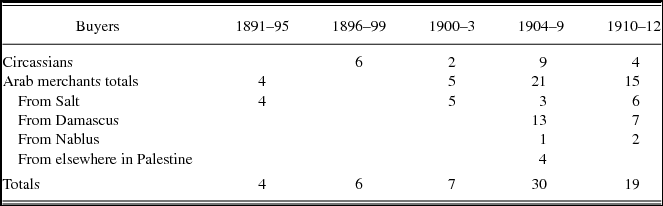
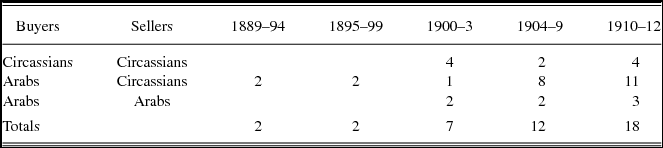
After the opening of the Hijaz Railway, Amman experienced a boom in the construction of shops and their sale to Syrian buyers. Between 1904 and 1909, Damascene merchants alone purchased thirteen shops, or 43 percent of all transactions (see Table 1). The average price of a shop in the Qabartay quarter rose from 543 kuruş in the 1890s, to 1,580 kuruş in 1901–3, to 4,086 kuruş in 1904–9, and to 6,839 kuruş in 1910–12.Footnote 66 The sale of houses to non-Circassian buyers also increased after 1904 (see Table 2). Notably, Arab merchant families who bought shops and houses in Amman did not belong to the old Syrian and Palestinian political or commercial elites but represented “new money.”Footnote 67 Many of them made their wealth in the Hawran grain trade, having benefited from the high prices in the 1850s and 1860s and the 1858 Ottoman Land Code, which eased their expansion into the southern Hawran and the Balqaʾ.Footnote 68 Most Syrian merchants came from the Maydan area of Damascus, a premier Levantine marketplace that was oriented towards southern Syrian markets.Footnote 69 Damascene merchants, with a wealth of experience in the Hawran and a history of trade with Druze and bedouin communities, regarded Transjordan as an extension of their already existing market of supply and demand.
Shops purchased in Amman, 1891–1912

Houses purchased in Amman, 1889–1912

It was common for Damascene merchants, such as Muhi al-Din al-Saʿdi,Footnote 70 Abu al-Khayr, Salih and Muhammad al-Hatahet, Muhammad Darwish, and Ibrahim and Abu ʿAbd Allah al-Qattan, to enter into partnerships with each other when buying shops, houses, and stables.Footnote 71 Other Syrian mercantile families included al-Bustanji, al-Humsi, al-Shami, al-Wahhab, al-Sahadi, al-Raghib, and al-Habib. The arrival of Syrian capital and an increase in general security in the area accelerated an influx of capital from elsewhere. The al-QabsiyyaFootnote 72 and al-MushrishFootnote 73 families from Salt, al-SaymaniFootnote 74 and ʿAsfurFootnote 75 from Nablus, and al-SamadiFootnote 76 from Fuheis bought shops in Amman in the 1900s. Furthermore, some bedouin leaders purchased property in the booming settlement, most likely as guest houses for their tribal members who would visit Amman for business. Thus, in 1912, shaykh Idris Effendi, son of shaykh Rajab Effendi, bought a house in the Abzakh quarter for 5,340 kuruş.Footnote 77
The purchase of Circassian real estate by Arab buyers was part of the broader phenomenon of the expansion of Syrian and Palestinian capital in Transjordan. In 1912, for example, Hanna Effendi bin Fransis Batatu, a Jerusalemite Catholic merchant, purchased a share in the 12,500-dönüm plot of land in the Bani Sakhr village of Tunayb, in the vicinity of Amman, from the Nabulsi Abu Jabir family, who previously registered thousands of dönüm of land around Amman.Footnote 78 These and other families belonged to the Syrian and Palestinian landowning class that by the early 20th century came to dominate economic life in Salt and, to a lesser extent, Irbid and ʿAjlun.Footnote 79 Their economic power often translated into political power in the Ottoman administration, and vice versa, cementing their position at the helm of an emerging Transjordanian society.Footnote 80
The muhajir settlement in Amman offered Levantine merchants relative security in what was still a largely nomadic region and, at the same time, an additional access point to bedouin communities. The alliance between Circassians and the Bani Sakhr bolstered the security of Amman as a trading post and provided new opportunities for trade with the bedouin tribe, whose territories lay to the east of the railway. Furthermore, the construction, maintenance, and protection of the railway necessitated the arrival of Ottoman troops, who were stationed outside of Amman, thus guaranteeing further protection to the town, its inhabitants, and its growing wealth. By the 1910s, Circassian muhajirs had secured a peace agreement with most of their bedouin neighbors and, under the leadership of Circassian officer Mirza Wasfi, established a volunteer force.Footnote 81 These developments bolstered the security of property in the eastern Balqaʾ, further entrenching the post-1858 land regime.
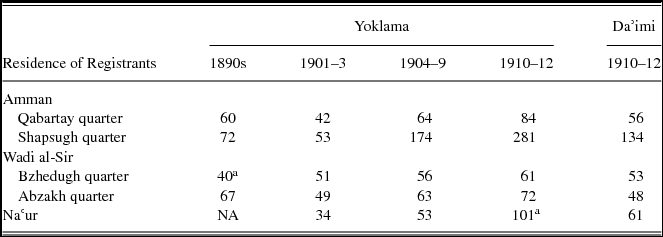
Within one generation, prices of agricultural land increased in muhajir settlements throughout the Balqaʾ (see Table 3). Market prices, as reflected in sales transactions, did not always match the government's estimates of land value through the yoklama process. Thus, in the early 1910s, the average sales prices of land lagged behind the average yoklama price by 33 percent for the residents of Amman's Qabartay quarter and Wadi al-Sir's Abzakh quarter, 52 percent for Amman's Shapsugh quarter, and 13 percent for Wadi al-Sir's Bzhedugh quarter. The prices of land in Circassian villages, despite a considerable hike over a few decades, were low for regional and Ottoman standards, stimulating an influx of Syrian and Palestinian capital to the Balqaʾ.Footnote 82
Average price of agricultural land in Circassian settlements in the Balqaʾ, 1891–1912 (kuruş per dönüm)

Note: The yoklama prices are government-estimated prices at the time of the initial registration of land. The daʾimi prices are dictated by the market and represent monetary transactions.
a The number of transactions on record for some periods is too low to serve as a reliable estimate.
MUHAJIR ECONOMIES
Members of the Circassian community were active in not only selling their original land allotments but also building up capital to purchase more real estate, some of it for further resale. For example, Ahmad bin Yaʿqub Lukhud, a Circassian, registered a group of houses, shops, gardens, and a cave in his name; he sold three shops to the al-Bustanji family and a house to the al-Habib family from Damascus.Footnote 83 The Ottoman period witnessed an emergence of a nascent Circassian bourgeoisie, such as the Khurmas,Footnote 84 the Khutats,Footnote 85 and the Qurshas,Footnote 86 that invested in shops and houses and conducted business with Arab merchants. As early as 1895, Emruz Bey, a Circassian, bought into a business with several Transjordanian Arabs to purchase four mills near Amman.Footnote 87 The mills, constructed prior to the refugees’ arrival, served local wheat-producing fellahin communities.
In modern Middle Eastern history, North Caucasian muhajirs are associated with agriculture and the military, not trade. One of the reasons muhajirs found it difficult to occupy the commercial niche is that they lacked financial and social capital for the establishment of successful trading operations. Merchants from neighboring Salt, Nablus, and Damascus who moved to Amman commanded sizeable cash resources and access to established markets in Palestine and Syria. Well into the Mandate period, Levantine merchants managed businesses across the British- and French-drawn borders and could reinforce their capital in Amman with cash from elsewhere.Footnote 88 Furthermore, Circassians, who were not well integrated into regional trade networks, could not deliver manufactured goods to the Balqaʾ market as easily as Syrians and Palestinians. Nor were they in a position to deal directly with the largest grain buyers in Damascus, Haifa, and Beirut.
Nevertheless, Circassian muhajirs did engage in local and regional trade. These vendors remain largely invisible in the historical record because they served local immigrant villages, rarely conducted long-distance and bulk trade, and had little interaction with the authorities. A large part of their trade was artisanal. Circassians had advanced skills in jewelry, carpentry, and metalwork and introduced oxen-drawn wheel carts to the region. European travelers in the late 19th century commonly praised Circassians’ artisanal skills, especially when compared to those of Transjordanian and Palestinian peasants.Footnote 89 Muhajirs also established a profitable trade in timber. Upon Circassians’ arrival, forests of pine and oak trees grew around Amman and Wadi al-Sir. Muhajirs sold timber and charcoal to settled Transjordanian and Palestinian communities.Footnote 90
Circassian Amman gradually became a regionally important hub for agricultural produce. By the 1910s, Circassian settlements in Amman and Wadi al-Sir had already produced a surplus of grain for sale.Footnote 91 Moreover, Circassians served as intermediaries who marketed the bedouin agricultural or artisanal production for export. The Bani Sakhr, for example, stored their grain harvest in a Circassian Wadi al-Sir.Footnote 92 Circassians also bought cattle from the Bani Sakhr and wheat from semisettled bedouin tribes in the Balqaʾ.Footnote 93 A British traveler to Amman wrote that in 1893 “most of the corn of the Balqa [was] brought here and afterwards sent in charge of Circassians to Jerusalem.”Footnote 94 Oral history confirms that local Circassians established direct trade links with buyers in Jerusalem and traveled there for business to trade in wheat and barley; those ties survived into the Mandate period.Footnote 95 By the early 20th century, the Circassian population, Syrian and Palestinian merchants, and Transjordanian urban, rural, and nomadic communities turned Amman and its environs into an interior marketplace of growing importance for the expanding Levantine economy.
GÜLʿAZAR'S FAMILY HISTORY
This article opened with the story of Gülʿazar, a Circassian heiress who sold her house and shops to a Salti merchant-turned-politician. Through land and court records, I reconstruct her family history, which demonstrates the consolidation of property within a well-off muhajir household and its economic engagement with other residents of an expanding Amman. In 1901, the patriarch of a Circassian family, Hajji Islam bin Muhammad bin ʿAbd Allah, died. He had fathered two children: a daughter, Khadija, and a son, Hamid. The latter predeceased his father and was survived by his widow, Sayetkhan, and their two underage children, a five-year-old girl, Gülʿazar, and a two-year-old boy, ʿAzir. Upon the death of their father sometime in 1896–97, the two children inherited four plots of land around Amman, totaling 100 dönüm with a government-estimated value of 10,370 kuruş, as well as half of the shares in seven more plots of land totaling 1,158 dönüm, with the children's combined shares estimated at 20,120 kuruş.Footnote 96 The family likely bought these lands directly from bedouin or Salti fellahin using the cash capital that it had brought to Transjordan from either the Russian Kabarda or the earlier Circassian settlements in the Golan Heights, where the two children's mother came from.
The demise of their grandfather further increased Gülʿazar and ʿAzir's wealth.Footnote 97 They and their aunt came into possession of the late Hajji Islam's household property, estimated at 25,581 kuruş. The court ordered a detailed inventory, which listed all debts, cash, cattle, household items—from a Circassian dagger to thirty-three pillows—and a slave girl.Footnote 98 The stored harvest of wheat, barley, and burghul comprised 58 percent of the total value of the inheritance. Despite its upper-class status, this family, like most muhajirs in Transjordan, derived much of its income from agriculture, the surplus of which it exported.
The death of the patriarch unraveled familial dynamics. A male relative, ʿAmr Effendi, accused Sayetkhan of having concealed a part of the inheritance after the death of her late husband, and the court temporarily stripped her of guardianship of her children.Footnote 99 ʿAmr Effendi then initiated a lawsuit against the imam of Amman's Circassian community, Hajji Shaʿb Effendi. ʿAmr Effendi alleged that the children's late grandfather had given the imam sixty Ottoman liras and twenty French francs as zakat for those in need. He claimed that the late family patriarch was insane (maʿtūh), recognition of which would render the transaction invalid and the money returned. The imam denied that the community's benefactor was mentally incapacitated. ʿAmr Effendi called forward two witnesses, whose sole role was to put in doubt the sanity of the late Hajji Islam. They both recalled how “the late Hajji Islam entered the running stream, by his village, naked. People who were passing by, old and young, told him that it was shameful. He replied to them that it was not shameful.”Footnote 100 The judge eventually dismissed the unflattering testimonies and ruled in favor of the imam. This scandalous lawsuit, reclaiming zakat from the imam and accusing a prominent deceased member of one's own family of skinny-dipping, certainly challenged social norms within the Circassian community.
Sayetkhan soon regained legal guardianship of her children after having remarried to Muhammad Agha, a distant relative from ʿAziziye—the heart of the North Caucasian settlements in the Sivas province, in central Anatolia—who arrived to oversee the family finances. Muhammad Agha became the sole custodian of the children's wealth.Footnote 101 He engaged in moneylending by loaning a share of the children's inheritance, first to two business partners, an Arab merchant from the Damascene al-Khayr family and a local Circassian, and then to the Circassian family lawyer.Footnote 102 While married to Muhammad Agha, Sayetkhan sued him to settle a long-standing dispute over her dower of 240 Ottoman liras from her first marriage, which she claimed she had never received and was therefore entitled to claim out of her late husband's financial estate now controlled by her new spouse.Footnote 103
Sometime towards the end of the first decade of the 20th century, Sayetkhan and her son ʿAzir passed away. Sayetkhan's only surviving child, Gülʿazar, inherited most of their shares in movable and immovable property.Footnote 104 With the death of a distant family member, Gülʿazar further increased her property portfolio. She received over two-thirds of shares of a sixteen-room house, valued at 12,500 kuruş, and six shops, each estimated at 3,000 to 5,000 kuruş.Footnote 105 At the time, Gülʿazar was one of the richest women in Amman and the eastern Balqaʾ. Gülʿazar re-registered all her properties in the land registry, with cross-referenced records of prior court-sanctioned transactions, because she wished to establish a legally traceable history of succession should she find a prospective buyer. In 1912, Gülʿazar and her family sold their sixteen-room house and six shops to Salti merchant Yusuf al-Sukkar, who paid them 98,340 kuruş, almost triple the estimated price in the land registry.Footnote 106 Al-Sukkar must have appreciated the strategic importance and economic potential of Amman, which was still several times smaller than Salt, and moved in to secure prime real estate in the up-and-coming town.
During the preceding decade, various members of Gülʿazar's family utilized two Ottoman institutions in the area—the Salt shariʿa court, to increase and consolidate their liquid capital, and the Salt land registry, to ensure their legal titles to the land and other real estate holdings. Through these two institutions, North Caucasian muhajirs affirmed their property rights and negotiated their position as equal partners within the socioeconomic fabric of the Balqaʾ. Gülʿazar's family history is not a typical refugee story. Neither is it atypical, as dozens of muhajir families prospered during the economic rise of Ottoman Amman, similar to other immigrant families across the country that, through land registration and real estate speculation, managed to forge a fortune in the final decades of imperial rule.
CONCLUSION
Amman expanded from a town of 3,000 to 5,000 residents on the eve of World War I to an urban sprawl of over 4 million people by 2015.Footnote 107 Over the past century, Amman grew thanks to an influx of new, larger waves of refugees and immigrants: Armenians after 1915, Palestinians in 1948 and 1967, Iraqis since 2003, and Syrians since 2011. Yet the economic basis laid out by Circassian muhajirs, together with Levantine merchants and first Transjordanian residents, was pivotal to the growth of the eastern Balqaʾ region.
In the late Ottoman period, Circassian refugees established lasting urban settlements, created new chains of supply and demand, and served as intermediaries for bedouin produce in regional markets. Their settlements prompted registration and resale of land by Transjordanian communities and attracted Syrian and Palestinian merchants, who invested their capital in commerce and set up cash-oriented agricultural estates. The state was crucial to the success of muhajirs because it provided a legal-economic framework, based on the 1857 Immigration Law and the 1858 Land Code, that was favorable to new agricultural settlers. Facilitated by the land registry and the shariʿa court in Salt, this framework proved functional in central Transjordan. The construction of the Hijaz Railway, which was funded by the state, was also instrumental in bringing Syrian capital to Amman. In other words, muhajirs were successful in the Balqaʾ region because, through their agricultural and artisanal labor, they tapped into the needs of the Levantine economy and because the empire created institutions that allowed an emerging real estate market to flourish.
The Circassian settlements in the Balqaʾ were but a southernmost patch of a vast network of muhajir villages across the Ottoman Empire. In the marshes of Çukurova, the plateaus of Uzunyayla, and the mountains of Kurdistan, North Caucasian muhajirs built agricultural settlements on the land granted to them by the government. Their villages—and those of Crimean, Cretan, Bosnian, Albanian, Balkan Turkish, and other refugees—took up the cultivation of cereals and various cash crops, engaged with interior and coastal merchants, and, whether they thrived or failed, altered the economic dynamics within their host regions. The participation of muhajirs in the registration, transfer, and sale of land or usufruct rights to land, in accordance with the government's requirements, entrenched localized variations of the post-1858 property regime, which opened up the empire to new forms of capital accumulation.