1. Introduction
Heritage language (HL) children refers to those who are raised in homes where they hear and use their first language (L1) with their parents and grandparents. Later on, they are exposed to the societal language (L2) that eventually becomes their dominant language (Valdés, Reference Valdés, Peyton, Ranard and McGinnis2001). While HL children usually achieve native-like or near native-like L2 ability, their HL can show deficits that could be the result of incomplete acquisition or attrition (Polinsky Reference Polinsky2006; Montrul Reference Montrul2008; Anderson, Reference Anderson and Goldstein2012). Incomplete acquisition of the L1 means that HL speakers fail to reach age-appropriate levels of proficiency for certain grammatical structures, possibly in other linguistic domains (e.g., lexicon, phonology). L1 attrition means that the grammatical system of the speakers’ L1 had a chance to develop initially, but later some grammatical aspects began to deteriorate. Both incomplete acquisition and attrition point to the presence of differences between the lexicon and grammar of HL speakers and that of monolingual speakers of the same language in the heritage country.
To date, a number of studies examining the acquisition of L1 phonology, morphology, and syntax in adult HL speakers of Spanish, Russian and Korean have found that adult HL speakers show deficits in their HL, possibly due to incomplete acquisition/attrition (Montrul, Reference Montrul2002, Reference Montrul2005, Reference Montrul2009; O’Grady, Lee & Choo, Reference O’Grady, Lee and Choo2001; Polinsky, Reference Polinsky2006, Reference Polinsky2008; Silva-Corvalán, Reference Silva-Corvalán, Seliger and Vago1991, Reference Silva-Corvalán1994). Adult HL speakers in these studies include those who were either born in a host country or who immigrated to the host country at a young age. By contrast, there has been relatively less research focusing on HL development and maintenance in school-aged children, i.e., on HL speakers who are in the process of acquiring both their L1 and the predominant societal language (L2) in a host country. The research with adults suggests that HL children are at risk for incomplete acquisition or attrition, primarily due to the fact that, in general, they receive insufficient L1 input in the host country (Anderson, Reference Anderson and Goldstein2012; Montrul, Reference Montrul2008; Polinsky, Reference Polinsky2008; Schmid, Reference Schmid2004, Reference Schmid, Köpke, Schmid, Keijzer and Dostert2007) and they use the HL in limited contexts (i.e., home, community). However, it is not well known in which linguistic subdomains HL children differ from their monolingual peers, and what the influence of different language environment factors is on HL development and maintenance. Research identifying the most vulnerable linguistic domains for HL children could inform whether the deficits found in adult HL speakers’ L1 are the result of incomplete acquisition or attrition. For example, if studies find both adult and child HL speakers do not reach native-like levels in the same linguistic subdomains, it is likely the limitations found in adult HL speakers are due to not having fully acquired that L1 knowledge in childhood. By contrast, if HL children display more native-like abilities in a subdomain than adult HL speakers, this would suggest attrition. Furthermore, the study of the language environment factors that contribute to the processes of L1 development could inform educational programs for children aimed at promoting HL maintenance, as well as improve advice given to parents. As immigrant populations are growing in many multilingual/multicultural countries like Canada, preserving immigrants’ HLs would offer many benefits. At the individual level, the continued development of L1 in immigrant children can help them understand their heritage culture and be able to communicate with their family members. At the societal level, the bilingual skills of heritage speakers would contribute to both cultural diversity and global economic opportunities.
The present study investigated Mandarin HL children's use of referring expressions in first mentions in narratives. Referring expressions in first mentions are the linguistic devices a speaker uses to introduce participants or entities when telling a story, for example, names, definite/indefinite NPs or NP-modifying relative clauses. The use of referring expressions in first mentions requires convergent knowledge of the lexicon, morphology and syntax, and, thus, can reveal a child's linguistic abilities across multiple linguistic subdomains. Since Mandarin–English bilingual programs exist in the city where the present study was conducted, we recruited the children from both English-only schools and Mandarin–English bilingual schools. Our objectives were to find out how Mandarin HL children apply their linguistic knowledge in first mentions, whether their first mention abilities are different from those of their monolingual peers, whether the children from different types of schools perform differently in first mentions, and what language environment factors account for individual differences in HL children's Mandarin abilities.
1.1. Research with HL children
In comparison to the extensive research on adult HL speakers, fewer studies have examined HL development in children (Anderson, Reference Anderson1999, Reference Anderson2001; Kaufman & Aronoff Reference Kaufman, Aronoff, Seliger and Vago1991; Kaufman, Reference Kaufman, Ravid and Bat-Zeev Shyldkrot2005; Li & Lee, Reference Li and Lee2001). Studies on HL children have found that morphology and the lexicon are two domains vulnerable to incomplete acquisition/attrition. For example, Li and Lee (Reference Li and Lee2001) investigated the acquisition of specific classifiers and the quantifier dou1 in thirty-four Cantonese HL children living in the UK, 5–16 years old. Data from conversational and narrative tasks showed that these children overgeneralized classifiers and did not use the quantifier dou1 in the required context. Given that 4-year-old Cantonese monolingual children already know the meaning of quantifier dou1, and already use half as many specific classifiers as Cantonese adults, this study suggested that the difficulties in classifier and the quantifier use displayed by the Cantonese HL children could be due to incomplete knowledge of Cantonese when it is acquired in an English majority context. Also focusing on morphology, Anderson (Reference Anderson1999, Reference Anderson2001) conducted a longitudinal study of two Spanish HL children who immigrated to the United States when they were 4;7 and 6;7. At the beginning of L1 recording, the two siblings showed 0% and 8% errors, respectively, in gender agreement in Spanish. However, after two years of intense contact with English at school, the errors increased to 6% and 18%, respectively. In contrast, for verb morphology marking mood, the two siblings had errors across all the recording sessions. Anderson argued that gender showed signs of attrition and mood showed more of an incomplete acquisition profile.
Kaufman's (Reference Kaufman, Ravid and Bat-Zeev Shyldkrot2005) study examined lexical choice for introducing referents in narratives by Hebrew HL children, 6;2–13;11, living in the United States. The results showed that the children had poor lexical abilities when referring to the animate referents in their story telling. For example, when naming the specific animate beings such as the frog, deer, and owl, the children preferred code-mixed L2 words. Moreover, children also used demonstratives to describe the animate referents when they did not know how to name the animate referents in Hebrew. Kaufman (Reference Kaufman, Ravid and Bat-Zeev Shyldkrot2005) concluded that the various lexical choices used by these children were constrained by diminishing productive knowledge of their L1. However, this study only examined the lexical ability of these Hebrew HL children when they introduced animate referents in story telling, and not morphological markings or syntactic structures. Therefore, whether HL children are able to master the convergence of lexical, morphological and syntactic knowledge required for first mentions in narratives remains unknown.
1.2 Sources of individual differences in HL acquisition
Studies of adult HL speakers have indicated that HL abilities vary considerably among individuals. Several relevant variables have emerged as having a significant impact on HL maintenance and loss in the long term. The impact of these factors on HL acquisition by children in the shorter term was examined in the present study.
Age of Arrival
Age of arrival (AOA) in the immigrant country is a significant predictor of HL maintenance (Montrul, Reference Montrul2008). Studies have also shown that younger AOA is associated with lower levels of HL proficiency in pronunciation, the lexicon and morphosyntax (G. Jia, Aaronson, Young, Chen & Wagner, Reference Jia, Aaronson, Young, Chen, Wagner, Minami, Kobayashi, Nakayama and Sirai2005; Montrul, Reference Montrul2008). Long-term attainment studies have documented an increased likelihood of rapid dominant-language shift from L1 to L2 among immigrants who arrived in a host country at an early age. G. Jia and Aaronson (Reference Jia and Aaronson2003) found that Chinese immigrants who arrived in the United States before 9 years old switched their preferred language from their Chinese language to English within a year of English immersion. Because AOA signals a change in a child's language environment, it is a contributing factor to HL development and maintenance.
Socioeconomic status (SES)
SES background is a broad environmental factor that predicts developmental outcomes, including language, and is typically measured by family income or maternal education (Hoff, Reference Hoff2006). Regarding HL children, research has shown some conflicting findings about the role of SES background on children's development of the HL. On the one hand, Sánchez (Reference Sánchez1983) found that among Mexican–Americans, those with low-SES backgrounds used Spanish more than those with high-SES backgrounds, presumably because those with high-SES backgrounds were more assimilated into the mainstream English culture. Similarly, Bohman, Bedore, Peña, Mendez-Perez and Gillam's (Reference Bohman, Bedore, Peña, Mendez-Perez and Gillam2010) large-scale study found that low-SES background was associated with a higher likelihood of speaking Spanish among kindergarteners in the United States. On the other hand, researchers have found that immigrants with high- SES backgrounds value using the HL more (Amastae, Reference Amastae, Barkin, Brandt and Ornstein-Galicia1982) and have a greater awareness of the importance of the heritage culture and language (G. Jia, Reference Jia, He and Xiao2008). Hammer, Komarooff, Rodriguez, Lopez and Goldstein (Reference Hammer, Komaroff, Rodriguez, Lopez, Scarpino and Goldstein2012) found that higher maternal education was associated with higher story recall scores in Spanish among Spanish HL children in the United States.
Language environment
Bilingual children, including HL children, hear and use their languages differentially with various people and in various contexts (Paradis, Reference Paradis2011). Both the quantity and the quality of HL input are crucial for HL development and maintenance (Kondo-Brown, Reference Kondo-Brown2005; G. Jia, Reference Jia, He and Xiao2008). Quantity of language input typically refers to the amount of input received in a language, while quality of language input typically refers to the richness, i.e., complexity and diversity, of input received (G. Jia & Aaronson, Reference Jia and Aaronson2003; Paradis, Reference Paradis2011). Examples of the quantitative and qualitative properties necessary to facilitate HL learning and maintenance include: (1) the percentage of time spent speaking the HL vs. the L2 (G. Jia, Reference Jia, He and Xiao2008); (2) the number of different people with whom the HL is spoken (G. Jia, Reference Jia, He and Xiao2008); (3) the percentage of time that the HL is used in leisure activities (Kondo-Brown, Reference Kondo-Brown2005; G. Jia, Reference Jia, He and Xiao2008), such as reading books and magazines, or watching TV and movies; and (4) the frequency with which children attend activities conducted in the HL (Kondo-Brown, Reference Kondo-Brown2005; G. Jia, Reference Jia, He and Xiao2008), such as swimming class, piano class or weekend HL school.
1.3. Referring expressions for first mentions in narratives in Mandarin
In narrative production, when the event involves more than one entity or participant, a speaker has to use appropriate referring expressions to introduce the entities or participants so that the listener can understand them in the absence of shared physical context. First mentions comprise the referring expressions the speaker uses to refer to animate referents, objects, places or concepts when they occur for the first time in a story. In English, adequate first mentions often consist of indefinite NPs, names, or NP-modifying relative clauses (Schneider, Hayward & Dubé, Reference Schneider, Hayward and Dubé2006). For example, when telling a story about Alice in Wonderland in English, when the animate referent Alice is first mentioned, the appropriate expression would be a girl not the girl. The indefinite article a signifies that the referent has not been referred to in prior discourse, whereas expressions like the girl, or a pronoun, she, are only appropriate in subsequent mentions of Alice. Moreover, a proper name such as Alice, or a relative clause like a girl who is playing with a rabbit, are also appropriate to introduce the animate referent Alice for the first time because these forms provide adequate information for the listener to identify the target referent in the absence of shared knowledge.
Crosslinguistic research examining how monolingual children introduce referents in story telling has suggested that there are some universals in the use of referring expressions in first mentions (Spanish: Álvarez, Reference Álvarez2003; Kail & Sanchez-Lopez, Reference Kail and Sanchez-Lopez1997; Mandarin: Hickmann & Liang, Reference Hickmann and Liang1990; German, French, English, and Mandarin: Hickmann, Hendriks, Roland & Liang, Reference Hickmann, Hendriks, Roland and Liang1996; French: Kail & Hickmann, Reference Kail and Hickmann1992; Cantonese: To, Reference To2006; Italian: Serratrice, Reference Serratrice2006). For example, indefinite forms are typically used to introduce the referent for the first time, whereas personal pronouns are used in subsequent, not first, mentions (Hickmann et al., Reference Hickmann, Hendriks, Roland and Liang1996; To, Reference To2006). However, given crosslinguistic differences in morphosyntactic structure, some linguistic devices for encoding first mentions are language-specific. For the remainder of this section, the linguistic devices used in Mandarin first mentions are described.
In Mandarin, similar to English, names, possessive NPs and relative clauses can help the listener to identify the target referent for the first time, as in examples (1), (2) and (3):
-
(1)

-
(2)
-
(3)


In example (1), xiang4ma1ma1 is a proper name and thus it encodes adequate information for a first mention. In example (2), the possessive NP xiang4ma1ma1 de peng2you3 “mama-elephant's friend” is used to define the relationship between the target referent and xiang4ma1ma1. In example (3), note that the relative clause precedes the noun lao3 ye2ye2 “old man”, thus the basic word order is modifying clause + particle de + noun.
In addition to names, possessive NPs and relative clauses, indefinite NPs, which consists of the numerical determiner, yi1 “one”, classifiers, and nouns can also mark a new referent, as in the indefinite construction: yi1 + classifier + N. Classifiers in Mandarin are usually categorized into two types: (1) 75 sortal classifiers that are associated with particular entities (Erbaugh, Reference Erbaugh, Li, Tan, Bates and Tzeng2006), e.g., zhi1 is used with some animate entities, and zuo4 is used to describe buildings or houses; (2) the general classifier ge4 that can be combined with any type of entityFootnote 2 . When we introduce the main character rabbit in Alice in Wonderland for the first time, we could use the NP yi1 + zhi1 + tu4zi “a rabbit”, as in example (4a):
-
(4a)

Here the noun tu4zi “rabbit” is marked by the numerical determiner yi1 “one” and the specific classifier zhi1 to indicate an indefinite meaning. If we use the general classifier ge4 instead of the specific classifier zhi1 with the noun tu4zi “rabbit” (see example (4b)), it is a less adequate first mention in comparison to the example (4a), i.e., the specific classifier is more appropriate in this context:
-
(4b)

If the noun tu4zi “rabbit” is only marked by the classifier or by the numerical determiner yi1 “one” in the clause-initial position, they are ungrammatical expressions in Mandarin, as in (4c) and (4d):
-
(4c)
-
(4d)


Not only are Mandarin first mentions marked by NP-internal morphology, but syntactic placement of the NP is also a device for conveying new information (Hickmann & Liang, Reference Hickmann and Liang1990). For example, an NP consisting of CL + N, zhi1 + tu4zi “rabbit”, is not acceptable in the pre-verbal position (see (4c)), but if we place this NP in the post-verbal position, it is an acceptable referring expression for a first mention, as in example (4e):
-
(4e)

It should be noted that the NP yi1 + N is still unacceptable even we place it in the post-verbal position, as in (4f):
-
(4f)

Hickmann and Liang (Reference Hickmann and Liang1990) identify three types of post-verbal clauses that were frequently used by Mandarin native speakers for first mentions in narratives: (1) a post-verbal NP in an existential construction with the verb you3 “have” (there is. . .); (2) a post-verbal NP in motion verb construction with lai2 “come”, and (3) a post-verbal object in a transitive, SVO, clause. The NP construction CL + N is only acceptable if it occurs in these post-verbal clauses, as in (4e), (4g) and (4h).
-
(4g)
-
(4h)


The indefinite NP (i.e., yi1 + CL + N) is also acceptable in post-verbal position to mark new referents, as in (5a)–(5c):
-
(5a)
-
(5b)
-
(5c)


However, names and possessive NPs cannot occur in the lai2 and you3 post-verbal clauses (see (6a) and (6b)). They can only occur as the object in an SVO clause, as in (6c).
-
(6a)
-
(6b)
-
(6c)


Another specific feature of Mandarin first mentions is the use of a bare noun. Some researchers have argued that a bare noun (with no numerical determiner yi1 and classifiers) could be employed to encode new or old information in Mandarin (Li & Thompson, Reference Li and Thompson1981), as in (7):
-
(7)

In (7), if the referent ping2guo3 is not mutually known by the speaker and the listener, it conveys new information. If the referent ping2guo3 is mutually known by the speaker and the listener based on the prior discourse context, the referent ping2guo3 encodes old information. Therefore, in this study, if the prior discourse contextual information is clear and sufficient to identify the referent for the first time, a bare noun can be interpreted as having an indefinite meaning, and thus, constitute an adequate first mention. For example, if the speaker mentioned the “swimming pool” or the “diving board” previously in the narrative, and then the speaker used the bare noun form jiu4sheng1yuan2 “lifeguard” without using yi1 or classifiers or any type of post-verbal placement, it is still considered as an adequate first mention because the previously mentioned contextual information “swimming pool” was clear and sufficient to help the listener to identify the referent jiu4sheng1yuan2 “lifeguard” for the first time. By contrast, if there is no clear contextual information provided previously, it is inappropriate to use the bare noun to introduce a new referent.
Finally, regarding subsequent mentions in Mandarin, an NP marked by the demonstrative pronoun na4 “that”, can only convey old information, regardless of syntactic position, as in (8a) and (8b):
-
(8a)
-
(8b)


Similar to English, personal pronouns, such as ta1 “he/she/it” can only be used in subsequent mentions, shown in (9)
-
(9)

1.4. First mention abilities in Mandarin monolingual children
Studies on first mentions in Mandarin-speaking children's narratives have demonstrated how children of varying ages use the relevant linguistic forms in their story telling. Hickmann and Liang's (Reference Hickmann and Liang1990) study examined the first and subsequent mention abilities of Mandarin adults (N = 9) and Mandarin children (N = 49) aged 4–10 years old. The results revealed a developmental progression in children's uses of the numerical determiner, classifiers, and NP position when they introduced referents for the first time. With respect to the numerical determiner yi1 “one” at the NP level, only 7- and 10-year-old children made systematic use of this determiner; the 4–6 year-old children did not use the determiner yi1 “one” frequently. With respect to classifiers, children started to increase the use of specific classifiers at age 6, whereas 4- and 5-year-old children either did not use classifiers or used the general classifier, ge4. With respect to the NP position in the sentence, children only started to use post-verbal position to mark first mentions frequently at age 7. In contrast, Mandarin adults tended to introduce new referents with the numerical determiner and the specific classifiers at the NP level, as well as post-verbal NPs. The study concluded that appropriate Mandarin first mention abilities developed gradually and tended to be acquired by age 10. In general, the 10-year-old Mandarin-speaking children were close to the adult standard in terms of using the numerical determiner yi1 “one” and the specific classifiers at the NP level, as well as placing new referents in post-verbal position. Another longitudinal study with Mandarin-speaking preschool children (N = 5) found that, before the age of 3½ years, children did not use the numerical determiner yi1 “one” and post-verbal placement of the NP productively to signal new referents in conversational and story-telling activities (Min, Reference Min1994).
Hickmann and Liang (Reference Hickmann and Liang1990) and Min (Reference Min1994) both show that the developmental trajectory of using linguistic devices to mark first mentions in narratives extends fairly late (i.e., 10-year-olds) in Mandarin monolinguals. Based on these observations, it could be expected that the school-aged Mandarin HL children's first mention abilities would be affected by their limited exposure to and contexts of use for Mandarin in an English majority country. In addition, limited or no literacy/schooling experience in Mandarin could have an impact because narrative skills constitute a bridge between oral and written language genres (Schneider, Hayward & Dubé, Reference Schneider, Hayward and Dubé2006). In sum, the use of referring expressions in first mentions is likely vulnerable to incomplete acquisition in Mandarin HL children. In particular, it would be expected that Mandarin HL children may not be able to use the numerical determiner yi1 “one” consistently, or they may predominately use the general classifier ge4 and pre-verbal NP placement, because these are features of earlier developmental stages in monolinguals.
1.5 Research questions
The purpose of this study was to investigate how Mandarin HL children use referring expressions in first mentions in narratives in order to examine their linguistic abilities across the domains of the lexicon, morphology and syntax. The following three research questions were addressed in this study:
-
(1) Do Mandarin HL and Mandarin monolingual children differ in their overall abilities to use adequate referring expressions in first mentions in narratives?
-
(2) What are the specific referring expressions used by Mandarin HL and Mandarin monolingual children in their first mentions? Do they use different linguistic devices in their first mentions?
-
(3) Do factors like AOA, SES background and language environment predict individual differences in Mandarin HL children's abilities with first mentions in narratives? Do children with educational experience in Mandarin have stronger first mention abilities than children with English-only educational experience?
2. Method
2.1. Participants
Thirty-eight Mandarin HL children (Mage = 8;7, SD = 1;2, range = 6;9–10;10) participated in this study. Nineteen children were born in Canada and nineteen children were born in China but immigrated to Canada with their parents at an early age (N = 38, AOA: M = 2;0, SD = 1;2, range = 0;0–7;5). All children were exposed to Mandarin from birth and their parents were all Mandarin native speakers. Twenty-one children were recruited from Mandarin–English bilingual public schools (HL_BIL) and seventeen children were recruited from English-only public schools (HL_ENG), all in Edmonton, Canada. The AOA of HL children who attended two types of schools were significantly different, with a slightly older mean AOA for the English-only schooling group (MHL_ENG = 2;3, range HL_ENG = 0;0–5;7; MHL_BIL = 1;10, range HL_BIL = 0;0–7;5; p = .02); however, for both groups, the mean AOA was in the toddler years, and there is considerable overlap in the ranges.
This study also included 15 Mandarin monolingual children (Mage = 7;1, SD = 0.2, range = 6;8–7;4) as a comparison group. They were all first grade students and were tested in an elementary school in Lanzhou, Mainland China. While the two groups of children overlap in age, the Mandarin HL children were older as a group (MHeritage = 8;7, Mmonolingual = 7;1, p < .001). The age difference between the two groups of children was unavoidable because we first collected the monolinguals’ data in China and then recruited the HL children in Canada. We found the HL children were older than monolinguals but we could not go back to China at that time to recruit and test new age-matched monolingual participants. The age difference was controlled in the statistical analyses. Note that the age range of both groups is within the developmental period in Hickmann and Liang's (Reference Hickmann and Liang1990) study where monolinguals could use the full range of referring expressions in first mentions, just not in every appropriate context.
2.2. Procedures
Edmonton Narrative Norming Instrument
Stimuli for the present study were the two story picture sets of the ENNI (Edmonton Narratives Norms Instrument) developed by Schneider, Dubé and Hayward (Reference Schneider, Dubé and Hayward2005) (http://www.rehabresearch.ualberta.ca/enni/home). The stories were created according to story grammar principles and depict information that is considered to be essential to good stories. Each story set contains three stories in wordless pictures, with two main animal characters of different species, a young male and a young female, introduced in the first story in the set (5 pages long, single basic episode). The second story (8 pages, 2 episodes) introduces a third character that is an adult animal (the same type of animal as one of the main characters) and the third story (13 pages, 3 episodes) introduces a fourth character in addition to the previous three (another adult of the same type of animal as the third character, opposite gender).
The children completed this storytelling task individually in their homes with a native Mandarin-speaking researcher (first author). Before the test stories, the children and the researcher went through a training story to ensure the child understood the task. Following the guidelines in the ENNI instruction manual, when telling the story, the children were seated opposite the researcher so that the researcher could not see the pictures. This was done to discourage children from assuming shared knowledge of the story by joint viewing of the pictures. The researcher then asked each child to go over the picture book page-by-page to familiarize him/herself with the story, and then when the child was ready, the child told the story from beginning to end.
Following the ENNI instruction manual, the researcher did not provide explicit assistance during the task. The only feedback provided to children included general encouragement, repetition of the child's previous utterance, or if the child did not say anything, a request to tell what was happening in the story. The child was reminded before each story that the researcher would not be able to see the pictures. The children's narrative productions were video recorded for later transcription and analysis.
Alberta Language Environment Questionnaire
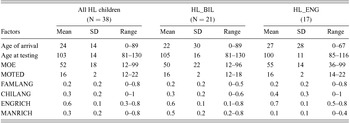
(ALEQ: Paradis, Reference Paradis2011; http://www.linguistics.ualberta.ca/CHESL_Centre/Questionnaires.aspx) Language background information for each Mandarin HL child was collected through the ALEQ, a parental questionnaire which includes such topics as age of arrival in Canada, child's age at testing, months of exposure to English (MOE), mother's level of education (MOTED), language use among family members in the home, and the child's experiences with media, organized activities and playmates in both English and Mandarin. For language use in the home, parents were asked a series of questions with scaled responses about the use of languages from each household member to the child (FAMLANG), and the use of language from the child to each household member (CHILDLANG): for example, 0 = only speak Mandarin at home; 1 = English seldom, Mandarin usually; 2 = English 50%, Mandarin 50%; 3 = English usually, Mandarin seldom; 4 = only speak English at home. The proportion of language use at home was derived from these responses by totaling the responses and then dividing by the highest total possible number. Effectively, the proportion of language use indicates the proportion of English in the home, since Mandarin was set at 0. Parents were also asked about the language and frequency of children's experiences with media (e.g., computer games, television and books), organized activities and friends within an average week. Points were assigned according to how often the child engaged in each media type, activity or playing with friends within an average week, and what language each took place in. Again, points were totaled and divided by the highest possible score for each language. Thus, an English richness (ENGRICH) and a Mandarin richness score (MANRICH) were derived. Higher scores indicate a richer environment in that language. Because they are proportions, the richness score range is from 0 to 1.0. However, a child's two language richness scores are not inverses of each other, i.e., a MANRICH score of 0.3 does not necessarily entail an ENGRICH score of 0.7. The information collected from this questionnaire is summarized in Table 1, and was included as predictors in the statistical analyses.
Mandarin HL children's characteristics

Note: HL_BIL = the HL children who attended Mandarin-English bilingual schools; HL_ENG = the HL children who attended English-only schools; Age of arrival and Age at testing were calculated in months; MOE = months of exposure to English; MOTED = mother's level of education in years; FAMLANG = proportion of English spoken among adults at home; CHILANG = proportion of English spoken by child at home; ENGRICH = richness of the English environment outside school; MANRICH = richness of the Mandarin environment outside school.
2.3. Transcription
Children's narratives were video recorded and then transcribed in full using the CHAT/CLAN system from the Child Language Date Exchange System (CHILDES) database (MacWhinney, Reference MacWhinney2000, http://childes.psy.cmu.edu/). The transcriber was an experienced CHAT/CLAN user and a Mandarin native-speaker (first author)Footnote 4 .
2.4. Coding referential NPs in first mentions
The ENNI includes a coding and scoring system for referring expressions used in first mentions in English. This system was adapted for Mandarin by the first author together with a second Mandarin-speaking research assistant. In the ENNI Manual for English, first mentions scoring targets 8 animate and 6 object referents from the stories, 14 in total, and this was followed in the Mandarin adaptation. These referents were selected on the basis of the likelihood that a speaker would mention them, i.e., a study with 377 English monolingual children showed these 14 referents were commonly mentioned by children when telling ENNI stories (Schneider & Hayward, Reference Schneider and Hayward2010).
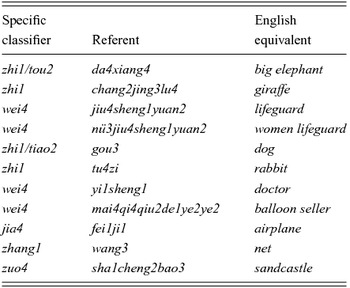
The NPs used in first mentions by the children for these referents were first coded into six different NP types, based on Hickmann and Liang (Reference Hickmann and Liang1990) and To (Reference To2006): indefinite NPs, CL + N, bare Ns, proper names, possessive NPs, demonstratives + N, personal pronouns, and non-specific lexical items (i.e., dong1xi1 “something”). Details of coding and examples are illustrated in supplementary materials online (Appendix A). In addition to the coding of different types of NPs, we also coded the indefinite NPs, CL + N, proper names, and possessive NPs in terms of their clause positions (cf. 1.3). Furthermore, classifiers in the construction CL + N and NUM + CL + N were coded as “SCL” or “GCL”. The specific classifiers that should be used with each reference in ENNI story-telling are listed in Table 2.
Appropriate specific classifiers with each referent assessed in first mentions

2.5. First mentions scoring criteria
Subsequent to the coding, the Mandarin first mentions scoring criteria was developed based on the guidelines provided for English First Mentions in the ENNI manual. As noted in 2.4, there are 14 referents across all the stories selected for scoring. Only the first mentions of these target referents were scored. Like the English system, first mention scoring was scaled. A score of 3 indicated a fully adequate expression for its context. A score of 2 indicated a less than adequate expression for a referent that was still partially informative, and a score of 1 indicated an inadequate expression. If the referent was omitted entirely, the score was 0. Full details on the scoring system are provided in supplementary materials online (Appendix B), but we describe the essentials of the system here. First, if the referent was introduced with the numerical determiner yi1 “one” and a specific classifier, in either pre- or post-verbal position, this constituted a fully adequate referring expression for a first mention and was given a score of 3Footnote 5 . By contrast, the use of the general classifier ge4 preceding the noun or the demonstrative pronoun (na4 “that”) preceding a noun constituted a less adequate but still informative expression, and was given a score of 2. Second, proper names such as xiang4 ma1ma1 “Mama-Elephant”, possessor NPs, such as da4 xiang4 de peng2you3 “elephant's friend”, and referents modified by relative clauses were also given a score of 3. Third, a CL + N expression was considered as a fully adequate first mention if it appeared in the post-verbal position. If a CL + N expression occurred in the pre-verbal position, it was given a score of 2. Fourth, with respect to bare Ns, these were given a score of 3 when there was clear close contextual information to help the listener identify a referent for the first time. For example, if the child mentioned “the swimming pool” or “the diving board” in an utterance immediately before or two utterances distant from the referent, then it was adequate to use the bare noun form jiu4sheng1yuan2 for the first time, in pre- or post-verbal position. Fifth, non-specific expressions such as yi1 ge4 ren2 “someone” or yi1 ge4 dong1xi1 “a thing”, no matter if it occurred in the pre- or post-verbal position, were less adequate but still informative in first mentions and received a score of 2. A personal pronoun such as ta1 “he/she/it” was not appropriate to first introduce the target referent and was given a score of 1. If the child did not mention the target referent in the story telling process, a score of 0 was given for that referent.
The coding and scoring system was adapted and implemented jointly by two Mandarin speakers, the first author and a research assistant, in a subset of the transcripts. All disagreements were resolved through consensus, and a final coding/scoring system was arrived at. After this process, the remainder of the transcripts were coded and scored by the first author.
3. Results
3.1. Overall first mention scores of monolingual and HL children
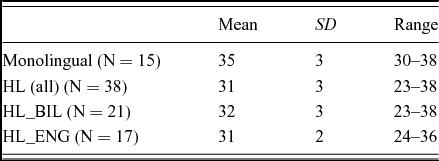
Table 3 presents the descriptive statistics for the overall first mention scores of the Mandarin monolingual and HL children. Note that the maximum first mention score is 42 (3 × 14 referents). The Mandarin HL children were divided into two groups based on whether they attended Mandarin-bilingual or English-only schools. Two observations can be made about these raw scores: the monolingual scores are slightly higher than those of the HL groups, who have similar individual scores (35 vs. 32 and 31), and the lowest scores come from children in the HL groups (30 vs. 23 and 24).
HL and monolingual children's first mention scores

Note: HL = Heritage language children; HL_BIL = the Heritage language children who attended Mandarin-English bilingual schools; HL_ENG = the Heritage language children who attended English-only schools.
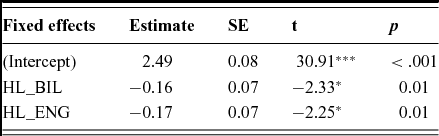
Mixed-effects modeling in R (Baayen, Reference Baayen2008) was used to investigate whether the monolingual and HL children were significantly different in overall first mentions performance. The reason for using mixed-effects modeling instead of a two-sample t-test was that the age of the two groups of children was significantly different (MHeritage = 8;7, MMON = 7;1, p < .001). Thus, in order to filter out the impact of the age difference between the two groups, children's age at testing was modeled as a random-effect factor with a mean of zero and unknown variance. The fourteen referents (e.g., giraffe, elephant, or lifeguard) were coded as Referent, and children were coded as Subject, both modeled as random-effect factors. The dependent variable is Referent Score, which consisted of the individual score for the 14 target referents. The fixed-effect factor in the model was Language Group (three levels: Monolingual, HL_BIL, and HL_ENG). The model was based on 742 observations (i.e., 38 HL children + 15 monolinguals x 14 individual referent score = 742 observations). The model (Table 4) explains 25% of the variance (R2 = 0.254). The model took the monolingual group as the reference level, and so the -0.16 (p = .01) coefficient estimate for the HL_BIL children and the -0.17 (p = .01) coefficient estimate for the HL_ENG children indicate that both HL groups had lower overall scores than the monolinguals.
Model results for first mention scores of monolingual and HL children

Note: SE = standard error; HL_BIL = the Heritage language children who attended Mandarin-English bilingual schools; HL_ENG = the Heritage language children who attended English-only schools.
*p < .05. *** p < .001.
3.2. The specific linguistic devices used in first mentions by monolingual and HL childrenFootnote 6
Recall that referring expressions in first mentions require a convergence of lexical, morphological and syntactic abilities. Following the results in 3.1, this analysis was aimed at determining where HL children show relative strengths and weaknesses in the different linguistic subdomains of referring expressions.
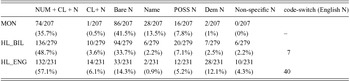
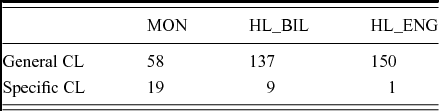
Table 5 presents the occurrence of different NPs used by the monolingual and HL children. One difference is that the HL children used more NUM + CL + N and CL + N constructions than monolinguals. While the HL children and monolinguals used the numerical determiner yi1 equally correctly, the HL children used the general classifier ge4 as opposed to specific classifiers more in these constructions than the monolinguals, which lowered their scores – since, if a specific classifier were required, use of a general classifier earned a score of 2 instead of 3. Table 6 displays the distribution of specific and general classifiers used by the children in NUM + CL + N and CL + N constructions, which a Chi-Square test revealed as being significantly different among the three groups of children X2 (2, N = 53) = 41.95, p < .001. The monolingual children were able to use the classifier jia4 with fei1ji1 “airplane”, zhang1 with wang3 “net”, zhi1 with animals, wei4 with jiu4sheng1yuan2 “lifeguard”, and zuo4 with cheng2bao3 “castle”, whereas the HL children only used zhi1 with chang2jing3lu4 “giraffe” and pi1 with ma3 “horse”. Note that the HL_BIL group produced more specific classifiers than the HL_ENG group.
Types of noun phrases used by monolingual and HL children

Note: For this analysis, we excluded cases when the monolingual and HL children used relative clauses to introduce the target referent.
The general and specific classifiers used by monolingual and HL children

Note: CL = classifier; MON = monolingual children; HL_BIL = the Heritage language children who attended Mandarin-English bilingual schools; HL_ENG = the Heritage language children who attended English-only schools.
Table 5 also shows that the HL_BIL children were close to monolinguals in terms of using bare nouns in first mentions (33.7% vs. 41.5%), but the HL_ENG group used bare nouns infrequently (14.3%). Next, the monolingual children used proper names (score of 3) more often than the HL children (13.5% vs. 2.2% and 0.9%). Similar use of possessive NPs was found for all groups (7.8% vs. 7.1% and 5.2%). Furthermore, Table 5 shows that, for the Dem + N construction and non-specific lexical items, the HL children used them more often than the monolinguals (2.5% and 12.1% vs. 1%; 2.2% and 4.3% vs. 0%). The HL_ENG group in particular used more Dem + N constructions and non-specific lexical items; both of which were assigned a score of 2. By contrast, only one monolingual child used a Dem + N construction (twice), and all monolingual children were able to use specific lexical terms to introduce the target referent. Finally, the final column of Table 5 reveals that the HL_ENG children used code-switched English nouns more often than the HL_BIL group (40 vs. 7).
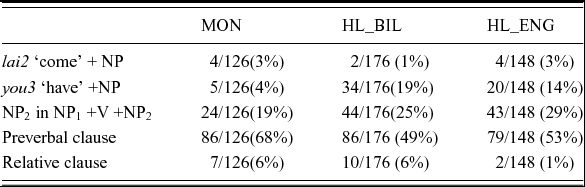
At the clause level, Table 7 shows that the HL children used each of these different syntactic structures, like their monolingual counterparts. Mandarin monolinguals used more preverbal clauses (68%) than the HL children (49% and 53%). This is likely because monolinguals used more proper names and possessive NPs to introduce referents. These expressions are appropriate in the pre-verbal position only (cf. 1.3). With respect to the post-verbal clauses, Table 7 shows that, like the monolinguals, the HL children were able to use three types in first mentions. As shown in examples (10a) and (10b), the indefinite NPs (NUM + CL + N) were placed correctly after the verb you3 “have”. Examples in (11a) and (11b) illustrate correct placement of CL + N after the motion verb lai2 “come”. With respect to the NP2 in the NP1 + V + NP2 clause, the monolinguals and the HL children preferred to use the full indefinite NPs (NUM + CL + NP) after the verb, as in examples (12a) and (12b). Correctly constructed prenominal relative clause first mentions are shown in (13a) and (13b).
The occurrences of post-verbal, pre-verbal, and relative clauses used by Mandarin monolinguals and HL children (percentages in parenthesis)

Note: MON = monolingual children; HL_BIL = the Heritage language children who attended Mandarin-English bilingual schools; HL_ENG = the Heritage language children who attended English-only schools. Only animate referents were included in the analysis. This is because inanimate referents are likely appearing in the object position of the subject-verb-object clause. It will create a bias in calculating the occurrence of NP2 in NP1 +V +NP2 clause.
-
you3 “have” + NP postverbal clause
-
(10a)
-
(10b)


-
lai2 “come” + NP postverbal clause
-
(11a)
-
(11b)


-
NP2 in NP1 + V + NP2
-
(12a)
-
(12b)


-
Relative clause + de + NP
-
(13a)
-
(13b)


In sum, although Mandarin monolinguals outperformed Mandarin HL children in terms of using specific classifiers and specific lexical items, the HL children were comparable to their monolingual peers in terms of using the possessive construction, the numerical determiner yi1 in the indefinite NP construction, and in the use of different post-verbal and relative clauses.
3.3. Sources of individual differences in the HL children
Mixed-effects regression modeling in R (Baayen, Reference Baayen2008) was used to determine the factors predicting individual differences among the HL children. The random-effect variables included in the model were Child (coded as Subject) and the 14 target referents (coded as Referent). The fixed variables included were age of arrival (AOA), the length of exposure to the English (MOE), mother's level of education (MOTED), the language spoken among family members at home (FAMLANG), the language spoken by the child at home (CHILANG), and the richness of the English (ENGRICH) and Mandarin (MANRICH) environments. Before modeling, correlations among the fixed variables were calculated to probe for potential collinearity effects. If significant correlations were found, factors were decorrelated, and a residual factor for one of them was created, which was then entered into the model. Residual factors were correlated with the original factors. Details of the residual factors are given in supplementary materials online (Appendix C).
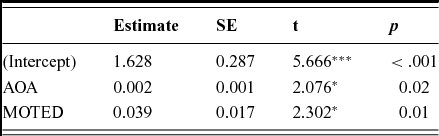
The first analysis was based on all 38 HL children. The analysis started with a full model that overfitted the data, and then the non-significant predictors were removed in a step-wise fashion. Nested models that differed in complexity (number of predictors) were compared by using the maximum likelihood ratio test, and if the reduced model accounted for the same amount of variance as the full model, the reduced model was chosen. The final, best-fitting model (based on 532 observations, 38 children) is summarized in Table 8. The model explained 27% of the variance (R2 = 0.268). The positive coefficient estimate of 0.002 for AOA indicates that HL children who arrived in Canada at a later age performed better with Mandarin first mentions. The positive coefficient estimate of 0.039 for MOTED shows that children whose mothers had higher educational levels performed better with Mandarin first mentions.
Model results of individual differences of all HL children (N = 38)

Note: SE = standard error; AOA = age of arrival; MOTED = mother's level of education.
*p < .05. *** p < .001.
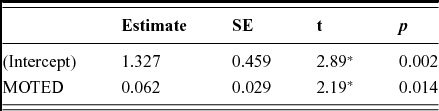
Given that the HL group included children who attended Mandarin-bilingual (HL_BIL, N = 21) and English-only (HL_ENG, N = 17) schools, we conducted two sub-group analyses to see whether their first mention abilities were predicted by different factors. The random factors were still Subject and Referent. The fixed factors were still AOA, MOE, FAMLANG, CHILANG, ENGRICH, MANRICH and MOTEDFootnote 7 . The model selection process was parallel to that described above for the HL group as a whole.
The final, best fitting model for the HL_BIL group (N = 21, 294 observations) is summarized in Table 9. The model explained 32% of the variance (R2 = 0.323). The positive coefficient estimate of 0.062 for MOTED shows that, for HL_BIL children, those whose mothers had higher educational levels performed better on Mandarin first mentions.
Model results of individual differences of the HL children attending bilingual schools (N = 21)

Note: SE = standard error; MOTED = mother's level of education
*p < .05.
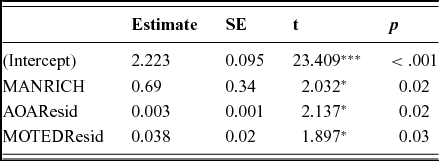
For the model of the HL_ENG children, the final, best fitting model (N = 17, 238 observations is summarized in Table 10. The model explained 28% of the variance (R2 = 0.275). Three factors emerged as significant in this model: MANRICH, AOAResid and MOTEDResid, indicating that children with richer Mandarin environments at home, who arrived later to Canada and who had mothers with higher levels of education had superior abilities with first mentions in narratives.
Model results of individual differences of HL children attending English-only schools (N = 17)

Note: SE = standard error; MANRICH = richness score of Mandarin; AOAResid = residual factor of age of arrival; MOTEDResid = residual factor of mother's level of education.
*p < .05. *** p < .001.
4. Discussion
The first objective of this study was to determine if Mandarin HL children's use of referring expressions in first mentions in narratives was similar or dissimilar to that of their monolingual Mandarin peers. The second objective was to determine the predictive factors accounting for the individual differences exhibited by Mandarin HL children. In a nutshell, the Mandarin HL children scored lower than the monolinguals overall for first mentions on the Mandarin-adapted ENNI, and this was largely because they used the general classifier ge4, the demonstrative pronoun na4 “that”, and non-specific lexical items more often than the monolinguals. However, Mandarin HL children did not show weaknesses in all linguistic domains. They were able to use the numerical determiner yi1 “one” in the indefinite NP structure (as shown in example (4a)), possessive NPs (example (2)), post-verbal NPs (example (4e)) and relative clauses (example (3)) appropriately in first mentions and akin to their monolingual peers. With respect to the predictive factors accounting for individual variation in first mention scores, the results showed HL children's AOA and mother's education level to be significant. When divided into groups based on school experience, for the HL group who attended English-only schools, richness of the Mandarin environment was also a significant predictor.
4.1. The first mention abilities of Mandarin HL children
Adequate first mentions in Mandarin require the convergence of lexical, morphological, and syntactic knowledge. In the current study, Mandarin HL children displayed weaknesses in their knowledge of classifier morphemes and vocabulary, but otherwise exhibited comparable morphsyntactic skills to their monolingual peers.
Regarding classifiers, in comparison to the Mandarin monolinguals, Mandarin HL children overused the general classifier ge4 in contexts where a specific classifier was required. According to Hickmann and Liang's (Reference Hickmann and Liang1990) study on the development of first mentions in Mandarin monolingual children, only children aged 4–5 years overused the general classifier ge4 in indefinite NPs; monolingual 6-year-olds had already begun to increase their use of specific classifiers. Given that the HL children in this study were older than 6;0, overuse of the general classifier is not an expected developmental error at this age. Since the repertoire of classifiers in Mandarin is large and noun-classifier correspondences must be learned mainly one-by-one, this might explain why HL children showed limited diversity in the use of but, at the same time, consistently showed grammatical NP-internal morphological structure. Furthermore, the sub-group analysis revealed that the HL children who attended Mandarin-bilingual schools produced more specific classifiers than the HL children who attended English-only schools, thus suggesting that formal schooling bolsters knowledge of morphological systems. Our findings with classifiers are in accordance with previous studies on morphological acquisition in HL speakers, where it has been argued that the morphological domain often exhibits incomplete acquisition because of insufficient L1 exposure and use in a host country (Anderson, Reference Anderson and Goldstein2012; Li & Lee, Reference Li and Lee2001; Montrul, Reference Montrul2008; Polinsky, Reference Polinsky2006). While incomplete acquisition is the most likely explanation for the use of classifiers exhibited by HL children in this study because the mean AOA was 2;0, it is entirely possible that for some of the older AOA children, attrition could have taken place. Future longitudinal studies would enable us to differentiate between incomplete acquisition and attrition.
Our results also showed that Mandarin HL children were not comparable to their monolingual peers with respect to lexical knowledge. For example, they used more non-specific lexical items, such as yi1 ge4 ren2 “someone” or yi2 ge4 dong1xi1 “a thing” in their first mentions. Moreover, they code-switched to English words sometimes. These results are consistent with Kaufman (Reference Kaufman, Ravid and Bat-Zeev Shyldkrot2005) who found that when mentioning specific animate referents, Hebrew HL children were not able to produce the specific animal names in Hebrew because of insufficient lexical knowledge. It should be also noted that, in the HL group in this study, the HL children who attended English-only schools used more non-specific lexical items and code-switched more often than the HL children who attended Mandarin-bilingual schools. This difference within the HL group highlights the potential importance of formal schooling and literacy on lexical knowledge in a HL.
The analysis of the specific linguistic devices used by Mandarin HL children showed that they did not have weaknesses in all linguistic domains. For example, we found that when using indefinite NPs, Mandarin HL children were able to place the numerical determiner yi1 “one” with classifiers appropriately. At the syntactic level, similar to Mandarin monolinguals, Mandarin HL children were able to use different types of post-verbal clauses and relative clauses appropriately in first mentions. For example, they could correctly place the construction CL + N after the verb you3 “have” and the motion verb lai2 “come”. They could place the modified clause before the head noun to form a correct relative clause. Note that the use of the numerical determiner yi1 “one” in the full indefinite NP and the use of post-verbal NPs in you3 “have” and lai2 “come” clauses are language-specific ways of introducing the referents, and, thus, cannot be transferred from the children's knowledge of English.
In sum, this study found that children's weaknesses in their HL were uneven. For linguistic domains requiring a great deal of input and experience to acquire, such as specific classifier morphemes and lexical terms, HL children performed worse than their monolingual peers. By contrast, their more limited exposure to Mandarin did not seem to hinder them from acquiring language-specific morphosyntactic structures such as the indefinite determiner construction and post-verbal NP placement to signal new information. Therefore, it can be argued that some linguistic domains are more vulnerable in the HL acquisition context than others.
4.2. Individual differences
When considering all HL children as a group, we found two significant predictors: AOA in Canada and mother's level of education (MOTED). Regarding the former, the HL children who immigrated with their parents to Canada at a later age tended to outperform the children who had an earlier arrival age or were born here. Thus, early arrival in the host country is associated with diminished development and maintenance of the HL, even for children. This finding is consistent with research on adult HL speakers (Montrul, Reference Montrul2008; G. Jia, Reference Jia, He and Xiao2008) showing that those who arrived in a host country at a younger age maintained a lower level of L1 competence in adulthood and tended to shift to the societal language as their dominant or preferred language when they were very young. With respect to the sub-group analysis on the HL children who were recruited from different schools, AOA was only a significant predictive factor for the HL children who attended English-only schools. Perhaps after years of English-only immersion at schools, those HL children were likely to have switched their dominant language from Mandarin to English early on. As a result, they tended to have lower proficiency in Mandarin, as evidenced in their first mention skills. For the HL children who attended Mandarin-bilingual schools, although some immigrated to Canada at a young age or were born here, they all had consistent exposure to Mandarin at school every day. The difference between these two groups in terms of the impact of AOA points to how schooling in the HL could help counteract the negative effects of early L2 exposure on L1 maintenance. This interpretation is reinforced by the fact that, among this sample of children, the HL children in bilingual schools had a slightly earlier AOA than the HL children in English-only schools.
The second significant predictor in the whole group analysis was mother's level of education, and it was also a significant predictor in each sub-analysis. The results revealed that the children whose mother had more years of education performed better with first mentions. This finding is consistent with the studies by Amastae (Reference Amastae, Barkin, Brandt and Ornstein-Galicia1982) and Hammer et al. (Reference Hammer, Komaroff, Rodriguez, Lopez, Scarpino and Goldstein2012) on Spanish HL speakers. It is possible that the mothers who had a higher education level in this study tended to value the heritage culture and language, and transmitted these values to their children. It is also possible that mothers with higher education tended to use more talk overall and more complex Mandarin vocabulary and morphosyntax when speaking with children, as has been found in studies of maternal education and language use with monolingual, English-speaking children (Hoff, Reference Hoff2006). A fruitful domain for future research would be to examine HL input in immigrant families as a function of maternal education levels directly, for example, recording mother-child interactions in the home and analyzing them for differences based on mother's level of education.
Still on the topic of input factors, one interesting finding of this study was that, for all HL children as a group, the richness of the Mandarin environment (MANRICH) was not a significant predictor of first mention scores, but for the sub-analysis of HL children in English-only schools it was significant. In this study, the richness of the language environment was determined by the density of engagement in HL media, activities and friends in an average week. Kondo-Brown (Reference Kondo-Brown2005) and G. Jia (Reference Jia, He and Xiao2008) found HL maintenance in adult speakers was likely facilitated by continued exposure to a rich HL environment through media (i.e., radios, TV programs, movies), books, and interactions with peers. Like the HL adults included in Kondo-Brown's and G. Jia's studies, the HL children recruited from English-only schools in this study did not have formal schooling in the HL. By contrast, the non-significant effect of richness of the Mandarin environment found in the first mentions of the HL children who attended Mandarin-bilingual schools was probably due to the fact that they already had consistent and rich Mandarin exposure at school every day. Thus, for the HL children who lacked formal HL schooling, diverse and rich HL exposure at home becomes extremely important for them to develop and maintain their HLs. Furthermore, we found that the mean score of the MANRICH variable for the HL children who attended English-only schools was 0.1 (range = 0–.4), whereas the mean score of MANRICH for the HL children who attended Mandarin-bilingual schools was 0.5 (.2–.8). Thus, while the latter had a richer Mandarin environment, the richness of the environment impacted the first mention abilities of the former. Perhaps a richness level of 0.5 is a kind of critical threshold, where anything above this level does not exert a strong effect on HL development and maintenance, while variation within the 0–.5 range does have an effect. Future research is needed to verify this hypothesis.
In contrast to AOA, maternal education and richness of the HL environment, other variables did not emerge as significant in any analyses, and this is inconsistent with prior research. First, home language use varied among the children and their families in this study, but this did not significantly predict the first mention abilities of the Mandarin HL children. This variable measured how much English vs. Mandarin was used by family members. Kondo-Brown (Reference Kondo-Brown2005) and G. Jia (Reference Jia, He and Xiao2008) both found evidence for the use of the HL at home predicting stronger HL abilities in the speakers. Namely, the more the HL was used by the parents and the child at home, the better the HL was maintained long-term. One explanation for this discrepancy between our study and these others could be the distinction between the genre of language used in daily interactions, and the genre of language used in story-telling. For example, in a home context, the parents and the child's daily conversations might not involve various specific classifiers and the lexical items used in the contexts represented in the ENNI stories (i.e., animal names or professional names). Because reading/being read to were activities included in our MANRICH variable, this might explain why a simple quantitative measure of HL use did not emerge as a significant predictor of narrative performance. Another reason for this discrepancy might have to do with having child vs. adult participants in the study. Perhaps home language use has a significant long-term impact on HL maintenance because it establishes language use patterns among family members that could stretch from childhood to adulthood.
Another inconsistency between our findings and previous research is the role of exposure to English on HL development and maintenance. Children's length of English exposure (MOE) and the richness of their English environment (ENGRICH) did not significantly predict individual differences in Mandarin first mention scores. In contrast, some studies on adult HL speakers (G. Jia, Reference Jia, He and Xiao2008; Montrul, Reference Montrul2008; Polinsky, Reference Polinsky2008) found that longer L2 exposure time significantly predicted lower levels of L1 ability. This relationship exists presumably because intensive contact with the L2 would restrict the speaker's L1 input and output. However, since exposure time to English and AOA are related conceptually, the significance of AOA in our study means that some part of the relationship between L2 onset and L1 maintenance found in other studies is also present in ours. In addition, as with the absence of an effect of home language, perhaps length of exposure to English would have a greater impact in adult HL speakers. Certainly, in a study with adult HL speakers, length of exposure to English would likely vary more as well. Finally, our ENGRICH and MANRICH variables were not inverses of each other, so children could have a rich English and a rich Mandarin environment at home. This could be a reason why no “trade-off” between English and Mandarin emerged in this study. On the contrary, our findings suggest that immigrant families might not have to sacrifice the HL for acquiring the societal language, because exposure to English did not have a significant negative impact on first mention abilities in the HL.
Supplementary Material
For supplementary material accompanying this paper, visit http://dx.doi.org/10.1017/S1366728914000728.