Introduction
International security is usually presented as a complex mosaic of separate agendas and multiple issues, with each political unit pursuing its own egotistical interests, constructing its own threats, and making temporary alliances as and when necessary. This is the realist view of the self-help consequences of life under anarchy, and Europe during the eighteenth century was an exemplar of this condition. But sometimes, international security is structured by one over-arching conflict, as it was most strikingly during the Cold War. At such times a higher order of securitisation embeds itself in such a way as to incorporate, align and rank the more parochial securitisations beneath it. Thus during the Cold War whatever securitisations existed between, say, Japan and China, or Germany and Russia, or the US and Japan, were all subordinated to, or at least framed within, the overarching construction of the grand struggle between East and West. More parochial concerns took second place to a general ideological and power struggle over how the future political economy of humankind was to be organised. The very few exceptions to this dominance (for example, the bilateral feuding of the Greeks and Turks within NATO) were striking enough to show the overall power and pervasiveness of the Cold War framing. The relevance of such higher-level securitisations is not just historical. After September 11th 2001 (9/11) the Bush (and Blair) administrations tried to do something similar with the so-called ‘Global War on Terror’ (GWoT). The contemporary discourse about climate change increasingly also takes this higher-level form, and examples from earlier ages include the Crusades (mobilising in the name of a ‘universal’ religion), and the 18th and 19th century mobilisation of monarchies against the threat of republicanism.
The purpose of this article is to revisit the securitisation theory of the Copenhagen school to see how to bring it into focus on these higher order securitisations. The Copenhagen school (CS) has mainly concentrated on the middle levels of securitisation in which egotistical collective political actors (often but not always states) mainly construct their securitisations against (or in the case of security communities with) each other. The CS has argued that securitisation is generally easier at the middle level, and more difficult at both the individual level (where the referent object is human beings) and the system level (where the referent object is in some sense all of humankind).Footnote 1 What we do here is to look more closely at the space between the middle and system levels. To do this, we make two theoretical moves: we revisit and refurbish an existing but little developed CS concept, security constellations; and we introduce a new concept, macrosecuritisation. The next section reviews levels of analysis in securitisation theory and opens up these two concepts. In section 3 we look at the politics of macrosecuritisations and constellations. In section 4, we hint at what macrosecuritisation looks like in historical perspective. Section 5 draws conclusions about the utility of extending securitisation theory in this way. All of this proceeds on the basis of the conventional CS understanding of securitisation.Footnote 2 This article does not attempt to address the space between the middle and individual levels in securitisation theory now occupied by the expanding literature on human security. That is a different topic requiring separate treatment. Neither does it attempt to deal with the growing literature that discusses securitisation theory and its shortcomings in terms of silences, non-verbal securitisations, causal explanations, and the need to refine the understanding of audience(s).Footnote 3 This literature is mainly about how to refine and improve the application of securitisation theory, and we are in the process of addressing it elsewhere.Footnote 4 Although this discussion might well bear on how one applied the concepts developed here, it does not, we think, affect the basic setting out of them which is our main purpose in this article.
Levels of analysis in securitisation theory
Up to now the Copenhagen school position on levels can be summarised as follows:
The referent object for security has traditionally been the state, and in a more hidden way the nation. For a state, survival is about sovereignty, and for a nation it is about identity.Footnote 5 But if one takes the securitization approach then a much more open spectrum of possibilities has to be allowed. In principle, securitizing actors can attempt to construct anything as a referent object. In practice, however, the constraints of facilitating conditions mean that they are much more likely to be successful with some types of referent object than with others. Security action is usually taken on behalf of, and with reference to a collectivity. The referent object is that which you can point to and say: ‘it has to survive, therefore it is necessary to [ … ]
Size or scale seems to be one crucial variable in determining what is or is not a successful referent object of security. At the micro end of the spectrum, individuals or small groups can seldom establish wider security legitimacy in their own right. They may speak security to, and of, themselves, but few others will listen. While some actions may at first seem to be about individual security, the referent object is often better understood as a universalist principle at the system or subsystem level, for example, human rights. At the system end of the scale there are also problems in establishing security legitimacy. For example, attempts have been made to construct all of humankind as a security referent: most notably in terms of shared fate during the Cold War with the fear of nuclear annihilation, but increasingly now in the context of environmental fears. So far, however, the system-level has rarely been able to compete with the middle-scale, though this does not mean that it will not become more attractive in the future as international circumstances change. In practice, the middle-scale ‘limited collectivities’ have proved the most amenable to securitisation as durable referent objects. One explanation for this success is that such limited collectivities (states, nations, and as anticipated by Huntington, civilisations) engage in self-reinforcing rivalries with other limited collectivities and that such interaction strengthens their we-feeling. Because it involves a reference to a ‘we’, it is a social construct operative in the interaction among people. A main criteria of this type of referent is that it forms an interpretative community: that it is the context in which principles of legitimacy and valuation circulate and within which the individual constructs an interpretation of events. It is a social context with the dignity of a ‘site of judgement’.Footnote 6 If rivalry is a facilitating condition for successful securitisation, then middle-level collectivities will always have an advantage in this respect over the system-level. Somehow the system level candidates are still too subtle and too indirect to trigger the levels of mass identity necessary for securitisation. Lacking the dynamic underpinning of rivalry, their attempt at universalist political allegiance confronts the middle level collectivities and loses.
It is not our intention in this article to attack the basics of this position, which we think are still sound. We do, however, want to explore the space between ‘the middle level’, in which individual collectivities mainly engage in interdependent securitisations with other collectivities, and the universal one, where the absence of an Other makes it difficult to securitise the total collective Self of humankind. We want to suggest that there is more of interest to be found there than the existing formulation suggests. Partly this is about looking at civilisations, mentioned above, but potentially carrying the ‘middle level’ argument well beyond state and nation and towards a very large scale of collectivity. But it is also about recognising larger scale patterns where a set of interlinked securitisations become a significant part of the social structure of international society. Think of the way in which the Cold War securitisations of East and West constituted a package that not only framed the fundamental relationships of the superpowers and great powers for over forty years, but also defined and created political space for the third world. It is easy to understand the GWoT, especially in its ‘long war’ formulation, as representing similar aspirations to provide an overarching securitisation that relates, organises and possibly subsumes a host of other middle-level securitisations.
Opening up this space exposes new ways of thinking about securitisation. The existing ‘middle-level’ formulation emphasises the individual securitising actors and referent objects, and how securitising moves by such actors interact in ways that reinforce each other. This is certainly an important part of the picture, and one that contains an essential core of securitisation as a discursive practice. But it is not all there is. In a sense, this middle level model is rather like crude realist thinking about the balance of power, where the national security concerns of states A, B, C, D, etc. interact with each other on the basis of materialist calculations of threat. Actors and their securitisations remain essentially egotistical and self-centred, and the system atomised. In such a system only alliances provide any scope for actors to link their securitisations together, and in the realist framing alliances are necessarily temporary and instrumental. In some times and places this model comes close to reality. But when larger framings are in play, whether as secular or religious ‘universal’ ideologies, or as civilisational-scale identities, this purely egotistical model cannot capture the possibilities for large numbers of individual securitisations to become bound together into durable sets. Just as in regional security complex theory, securitisations can be bound together positively (where a group of actors share, or partly share, a definition of threat and referent object), or negatively (where actors, or groups of actors, construct each other as threats) in the process forming potentially durable patterns of security interdependence. We have already researched in detail how this type of security interdependence works at the regional level,Footnote 7 and part of what we want to do here is to push that logic beyond the regional level.
Thinking along these lines opens the door to the concept of security constellations (hereafter, constellations)Footnote 8 which was designed to link across all of the levels and sectors in which securitisations occur. Constellations suggest strongly that larger patterns exist in the overall social structures of securitisation. Security constellations have not been much discussed in the CS literature, and one purpose of this article is to flesh out the content of the concept. So far, it has mostly been deployed in the context of discussion about regional security, where the idea is to set the regional level dynamics into those above and below them (for example, the India-Pakistan rivalry in the context of the Cold War above, and religious and ethnic divisions below). A regional security complex is always embedded in, and thus dependent on, the constant reproduction of social identities at lower levels and often also bound up with regional-global and occasionally inter-regional relations. Thus, a regional security complex – while its essential structure is defined by relations among units at the regional level and by the complex's external boundary – always exists within and as the core of a wider constellation. The concept of constellation serves to avoid a picture of isolated securitisations unrelated to social identities and political processes at other levels. At best, a securitisation analysis then includes the identity and political constitution of the particular referent object for an act of securitisationFootnote 9, but since identities, politics and security practices are relational, deep understandings of processes of securitisation demand a concept for the larger social formation. In what follows we want to focus on, and elaborate, those elements of constellations that form on a scale above that of both the middle level and regions.
To explore this area we also need an additional concept to cover securitisations that speak to referent objects higher than those at the middle level (for example, ‘universal’ religions or political ideologies; one or more of the primary institutions of international society) and which aim to incorporate and coordinate multiple lower level securitisations. These we will refer to as macrosecuritisations. The most powerful macrosecuritisations, such as the Cold War, will impose a hierarchy on the lower level ones incorporated within them, but it is also possible for a macrosecuritisation simply to bundle other securitisations together without necessarily outranking them. The GWoT seems mainly to work this way in relation to the securitisations of drugs, crime and weapons of mass destruction. Previously, we have mainly dealt with this challenge in discussions of ‘principles’ and to some extent institutions primarily in the economic and political sectors.Footnote 10 Macrosecuritisations are defined by the same rules that apply to other securitisations: identification of an existential threat to a valued referent object and the call for exceptional measures.Footnote 11 The key difference is that they are on a larger scale than the mainstream collectivities at the middle level (states, nations) and seek to package together securitisations from that level into a ‘higher’ and larger order. Macrosecuritisations have a more complicated structure than ordinary ones. Because they contain both higher and lower level securitisations they embody permanent tensions across the levels, and are vulnerable to breakdowns not just by desecuritisation of the macro-level threat (or referent object) as at the end of the Cold War, but also by the middle level securitisations becoming disaffected with, or pulling away from, subordination to the higher level one, such as the Sino-Soviet split.Footnote 12 This vulnerability is most obvious when the higher level becomes blurred with the middle-level securitisation of a leading great or superpower. The US, for example, might succeed in projecting the GWoT as a macrosecuritisation, only to find this being destabilised because others come to think that the GWoT is more to do with particular US goals and interests in the Middle East than with some higher common concern about a threat to Western civilisation. Managing a macrosecuritisation successfully requires permanent sensitivity to the fact that the local securitisations contained within it have the option to defect if contradictions seem to undermine their linkage to the higher level.
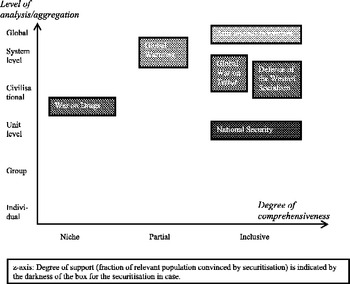
Macrosecuritisations can be compared to other levels of securitisation in three dimensions as in figure 1.Footnote 13 The x-axis is degree of comprehensiveness, from niche to inclusive. More inclusive securitisations will usually operate across sectors, but comprehensiveness cannot be defined in terms of sectors, because it is possible for a securitisation to be multi-sectoral but incomplete within sectors, while another one is limited by not reaching into more than one sector. Therefore while, everything else being equal, more sectors means more comprehensive, the definition as such has to be that a securitisation is comprehensive to the extent that it minimises the number of separate concerns, issues and conflicts that achieve strong securitisation separately from the macrosecuritisation. The y-axis is levels: from individual level to global-universal. The z-axis is the degree of success in terms of convincing proportions of the relevant audience. The competing macrosecuritisations that composed the Cold War, as well as many cases of national security, are both comprehensive (high on the x-axis) and thoroughly successful (much z), but located at different levels in terms of y. The War on Drugs, as a niche securitisation,Footnote 14 is middle level to sub-systemic in terms of levels (y), but while relatively successful in relation to especially the domestic audience (z), it is not comprehensive, that is, it does not structure securitisations in other spheres. The anti-nuclear movement during the Cold War was high on both x and y, but low on z, because it only convinced a minority of the relevant audience and did not succeed in underpinning decisive action transforming its object of concern. Global warming is very high on the y-axis, including the living conditions for all humans and existential threats to other species, but not the survival of the planet or life on it, as such. Climate change has however, been contested both as to empirical projections and the degree of urgency it should be addressed with (z), and – in this case, largely following variation on z – there are also along the x-axis widely differing approaches as regards whether other issues should be seen differently – and securitised more, less or differently – due to climate change (for example, energy issues between Russia and the West, military balancing as such, space policy and global development). So far, the result is that climate change is somewhere on the middle of the x-axis, but this could change rapidly if it became a unified global object of concerted action with security-style urgency. When assessing in combination the three criteria to see if you deal with a macrosecuritisation, the y-axis will usually be the first and easiest to address: at what level is the referent object? Along the x-axis, macrosecuritisations are compatible with – and can usefully be contrasted to – the idea of ‘niche’ securitisations (for example, environmental threats, epidemic diseases, organised crime, drugs) that get onto the agenda as accepted threats, but do not rise to top priority. Macrosecuritisations are necessarily launched as candidates for top-rank threats (though they may not make it: for example, geo-economics, terrorism, nuclear proliferation).Footnote 15 The z-axis finally, is not strictly determining whether something is a macrosecuritisation or not, but whether it is a powerful one. As previously argued,Footnote 16 there is no defensible way to delineate securitisations ‘downwards’ in terms of the importance of the actions legitimated, but the power of a securitisation can be indirectly observed through its impact on constellations.
The Three Dimensions of Macrosecuritization: Comprehensiveness, Level, Degree of Support.

Having clarified the concept of macrosecuritisation, it is now possible to return to that of constellation and add an important element. Macrosecuritisations generate constellations, because they structure and organise relations and identities around the most powerful call of a given time. When two macrosecuritisations are mutually opposed, each construing as the ulimate threat what the other defends, they generate one integrated constellation. This way, the Cold War became a constellation containing two momentous macrosecuritisations and a huge network of identities and policies interlinked around these.Footnote 17
The politics of macrosecuritisations and constellations
What are the sources of macrosecuritisations and constellations, who constructs them, and what forms can they take? From a more political angle, who will try to construct macrosecuritisations, for what purposes and under what conditions, and what dynamics will ensue? What referent objects can be projected at this higher level, and how are the possibilities conditioned by the structure of political identities at the unit level?Footnote 18 To ask these questions is immediately to note that macrosecuritisations and constellations are often linked. The Cold War illustrates such linkage, where the US and the Soviet Union promoted two universalist ideologies (each generating a macrosecuritisation against the other in defence of its claim to own the future of humankind) in zero-sum competition, thus generating the Cold War constellation. One key to understanding these macrosecuritisations, and the stability of the constellation they generated, is the availability of universalist ideologies that played not only to the core identities of the two superpowers, but also spoke to both elites and masses in the wider audiences of the West and the socialist world. Watchwords like ‘democracy’, ‘freedom’, ‘socialism’ (but interestingly not so much ‘capitalism’ except as used negatively by the left) could be played not just to the domestic audiences of the superpowers but also to much wider international audiences. The sharing of the values associated with these watchwords facilitated the construction of an intersubjective sense of threat, and the mutually exclusive character of the values in opposition meant that a strength and depth of securitisation comparable to national security could be created across a wider scale.
Constellations can of course be generated without ideologies being in play, as was the case in 18th century Europe where several great powers all with the same (in this case monarchical) ideology pursued empire and a balance of power on a global scale. But the Crusades, the opposition between monarchy and republicanism, and the Cold War examples draw attention to universalist beliefs and claims as one central source for macrosecuritisations and their associated constellations. The Cold War represented a particular type of universalism (inclusive) which is not the only possibility. There are four types of universalism, and which ones are in play makes a difference to the character and likely dynamics of the macrosecuritisations and constellations that can be projected from them:
1. inclusive universalisms: ideological beliefs, whether secular or religious, about the best way to optimise the human condition. These are universalist in the sense that they claim to be directly and immediately applicable to all of humankind (for example, Liberalism, Marxism, Christianity, Islam).
2. exclusive universalisms: ideological beliefs that claim superior rights and status for one group over the rest of humankind (for example, Nazism, white supremacy European imperial doctrines; Japanese imperial doctrine). These are universalist in the sense that they claim the right of one group to rule over, or even replace, all of humankind.
3. existing order universalisms: political claims about threats to one or more of the institutions of international society, which are universalist in the sense that they take the global level international social structure as their referent object. Such claims could overlap with (1) if one universalist ideology had provided the framework for international society, as for example liberalism has done for the current global economy. But existing order universalisms could be independent, where for example in a pluralist international society claims were made that sovereignty was being threatened by transnational actors.
4. physical threat universalisms: claims about dangers that threaten humankind on a planetary scale (for example, nuclear weapons, global warming, new diseases). These are universalist because they take the physical fate of humankind as their referent object.
The Cold War was notable for being a clash between two inclusive universalisms each of which posited deep similarity within its sphere and deep difference with the Other. To the extent that securitisation is rooted in the identity politics of Self and Other, similarity and difference are at the heart of the matter. But it is the particular nature of similarity or difference that matters most, not the mere fact of it. In the democratic peace argument it is the fact that the shared values are liberal ones that enables desecuritisation of relations to occur.Footnote 19 The historical record suggests that some other forms of similarity do not have this effect. The monarchies of 18th century Europe hardly treated each other as friends, and were regularly at war. During the Cold War it was not uncommon for one communist state to attack or occupy another.Footnote 20 It is hard to imagine that a world of fascist or social Darwinist great powers would be peaceful. It is therefore worth exploring in more depth the logics of identity that underpin how inclusive (cosmopolitan) and exclusive (communitarian) universalisms generate macrosecuritisations and constellations.
An exclusive form of identity works by emphasising the difference between the set of people sharing it and all others. Nationalism, particularly where based on blood ethnicity, is a clear example.Footnote 21 Such identities generally emphasise an internal reproductive logic and will be difficult or impossible for outsiders to join. Exclusive forms of identity may or may not generate universalist claims. Inclusive identities work by setting up membership criteria that are acquirable as an act of will, and in principle (sometimes less so in practice) open to anyone who acquires the necessary characteristics. Universal religions and political ideologies are the clearest examples. Some forms of national identity have elements of this quality but usually without a universalist aspiration. Immigrant countries such as the US and Canada, for example, have civic identities that can be acquired, in principle, by anyone willing to conform to their requirements, but that does not mean that they aspire to become global states. Taking this route could lead to the large debate amongst political theorists between communitarians and cosmopolitans, and thus back to the Self-Other logics discussed above.Footnote 22 But we are not so much interested here in the philosophical difficulties raised by the communitarian-cosmopolitan distinction, as in the relatively simple matter of how these two types of identity might play into international relations through the agency of the macrosecuritising actors.
Exclusive forms of identity can play into international relations in either of two basic ways: coexistence or hierarchy. The coexistence model is captured in Herz's idea of’ ‘self-determining and self-limiting nationalism’, and by pluralist thinking within the English school.Footnote 23 This way of thinking is closely harmonious with ‘middle level’ processes of securitisation. Here the identity in question is characterised by a contained and status quo view of Self without universalist pretentions. It seeks the right to maintain and reproduce itself, and makes no claims against others except that they allow it the necessary degree of self-control to do that. Nationalism can have this self-limiting quality, especially when the sense of identity it carries is firmly tied to a specific, well-delineated and not contested territory: the rare case of a neat line up between ethno-national population and territory. This is the benign, pluralist form of the nation-state ideal-type, where each nation has its own historic territory, and a society of states based on sovereignty, mutual recognition and non intervention allows each to pursue its own path of cultural development as it wishes. With culture, territory and politics all in alignment, coexistence becomes feasible, albeit limited by concerns about the balance of power. Religious identities can also be exclusivist, especially where linked to ethnicity, as in the case of Judaism, or (more loosely) to a specific territory, as, up to a point, is the case with Hinduism, and in this form can also fit into a logic of coexistence (although the practical realisation of this logical possibility usually runs into the problem that neighbouring identities will not be able to agree how to coexist; for example, the situation today in the Levant and South Asia).
But exclusive forms of identity can also project themselves as hierarchical universalisms, where the specifics of difference are interpreted as making the Self superior to Others.Footnote 24 The general framing of this is in terms of social Darwinism, where international relations is seen as a ruthless game of survival of the fittest, an interpretation that neatly fits into power politics, where ‘fittest’ can be understood as ‘most powerful’. History is replete with examples of imperial exclusivisms. Much of nineteenth century imperialism rested on racial theories that construed one race (or sometimes nation), as superior to others, thereby justifying unequal treatement in terms of rights and resources. The French and British empires, the US doctrine of manifest destiny, and the Japanese drive for a ‘Greater East-Asia Co-Prosperity Sphere’ all rested on versions of this reasoning, which reached its ghastly peak in Nazi theories of the master race, with its right to expropriate, enslave or exterminate lesser breeds in pursuit of Lebensraum. Extreme claims of this sort are not a necessary feature of hierarchical exclusivism, which can also be driven by survival claims. If a state pursues its own survival needs as the highest priority, then even without an explicit vision of superiority, or an imperial mission, a position can develop in which the needs of the Self override the rights of Others. National security, revolutionary and imperial logics all flow easily in this direction, with the need to make the Self secure involving an ever-expanding range and degree of control over others. Germany (or France, or Russia or …) could only be secure when they could gain hegemony over Europe; the US can only be secure when the world is safe for its version of democracy and capitalism; Israel can only be secure when it has killed all ‘terrorists’, and so forth. The presence in a system of two or more great power political identities that are exclusive and hierarchical is of course a recipe for mutual macrosecuritisations and the creation of a large-scale constellation.
Inclusive universalisms by definition cannot be self-contained, especially if they are committed to active proselytising (as opposed to the more non-aggressive, self-contained, ‘teaching by example’). If one or more such identities are loose in an international system they will easily clash both with each other and with exclusive identities. It is easy to read the history of the 20th century in this light. The First World War was basically about a clash amongst a set of exclusive hierarchical great power identities, though it put into play two (the US and the Soviet Union) that were later to become inclusive and universalist. The Second World War featured a mixture of hierarchical exclusivist great power identities (Britain, France, Germany, Italy, Japan) with two inclusive universalist ones (American liberalism and Soviet communism). Since the inclusive universalist powers came out on top of that conflict, the Cold War was about the rivalry between them. A success for either superpower in terms of a third country converting to one ideology or the other, was a direct blow to the legitimacy of its rival.
Almost any mixture of exclusive and/or inclusive universalisms, especially when driven by great powers, points towards the generation of rival macrosecuritisations and large-scale constellations (by oppositions to macrosecuritisations or by rivalries between opposing universalisms). The only way in which an inclusive universalist identity can reach stability is if it succeeds in taking over the whole system. Something like this happened in some of the ‘universal’ empires of ancient and classical times, where a single polity and culture came to dominate a known world over a substantial period of time (for example, Rome, China, Incas). But nothing like this has happened in modern times, and nothing like it is in immediate prospect. The only candidate is the form of liberal market democracy projected as an inclusive universalism by the US in particular and the West in general. Having seen off its communist rival, this has successfully dominated the industrial core, but still remains heavily contested in the Islamic world and Asia. One of the worries about the ‘neocon’ doctrine dominant in Washington after 9/11, was that it represented precisely such an imperial universalist project bent on using the superiority of US military power to enforce its model across the world. Unipolarity has therefore been securitised as a threat by both other great powers and by smaller powers fearing to become the object of this project.
In bringing universalism into the picture it is essential to keep clear that the making of universalist claims does not necessarily mean that the macrosecuritisation is in fact universal in terms of participation. This is particularly true where inclusive universalisms about the best way to optimise the human condition are in play. Such beliefs cannot achieve planetary scale macrosecuritisation if they require an earthly Other as the threat. So-called ‘universal’ religions or political values are universal only in that they claim to be applicable to the whole of humankind. In practice, they almost never are, and therefore find themselves in opposition to both other universalisms (for example, Christianity vs. Islam) and more localist beliefs. It is those oppositions that generate large scale constellations when this type of universalism is in play, and such constellations, as in the case of the Cold War, can occasionally achieve fully global scale. The same difficulty of actually achieving global scale macrosecuritisation would be true of hierarchical exclusive universalisms, and the opposition against them. This self-limiting quality of universalist claims is why they play an important role in shaping securitisations between the middle and system levels: it is their claim to universality, not the fact of it, that generates securitisations.
Nevertheless, some macrosecuritisations, particularly those stemming from existing order and/or physical threat universalisms, can achieve global scale. The difficulty for inclusive and exclusive universalisms is that they usually require, or generate, a threat which is the same type of entity as themselves (ideology against ideology, superpower against superpower), making universal scale impossible by definition. But where the threat is of a different type from the collectivities sharing the securitisation, then universal scale is possible. All states, and all nations, and all faiths, and all people can, in principle, share a universal physical threat perception against themselves as referent objects, from nuclear weapons, or a variety of environmental threats from global warming (or cooling) through disease to the planetary impact of asteroids or comets. In terms of existing order by sovereignty-denying transnational actors (whether corporate or criminal or terrorist), for all nations to be threatened by migration or cosmopolitanism, and for a world of only secular states to feel threatened by a general re-mobilisation of religion. When the GWoT is depicted a notch higher in the figure than the macrosecuritisations of the Cold War, it is because of this. Both were built on principles meant eventually to become globally victorious and thus truly universal, but they were also constructed as fighting formulas meant to operate during a prolonged period of a split world, where a large part of the global population would be beyond its reach and de facto part of the threat community instead. Thus, each macrosecuritiation came to operate on behalf of a huge collectivity, but clearly not all of humankind. In contrast, the GWoT tries to embrace in its self understanding 99.9 per cent of the global population: all civilised or wanting-to- be-civilised people (all but the terrorists themselves). An important element of this is that the GWoT has strong elements of existing order universalism – all states against non-state terrorists, order against chaos – mixed with a US-centred inclusive universalism.
Other than their larger scale and more complex construction noted above, there is no reason in principle to think that either macrosecuritisations or constellations will operate differently from those found at the middle and/or regional levels. It is true that inclusive and exclusive universalisms can easily generate acute zero-sum conflicts, but no more so than those that occur at the state level: as between India and Pakistan for example, or Israel and its many enemies. Existing order and physical threat universalisms can also operate at the sub global level, creating a similar possibility of uniting a subset of actors against some commonly held threat (for example, Huntington'sFootnote 25 call for the West to unite against challenges from Asian and Islamic civilisations; the AOSIS alliance of small island states threatened by rising sea levels). Some aspects of macrosecuritisation and global-scale constellations might be thought to be expressions of the impact of globalisation on securitisation in response to both interdependence and the general scaling-up of awareness of one-worldism. There is some truth in this, but not much. Universalist ideologies go back a long way, as do international societies that were ‘universal’ within their locality before the international system reached planetary scale between the 15th and 19th centuries.Footnote 26
In thinking about the sources of macrosecuritisations and constellations, one has also to ask who generates them, how, and for what purpose? Macrosecuritisations, like all securitisations, require securitising actors, appropriate speech acts, and responsive audiences. In addition they require some expansive dynamic capable of subsuming other securitisations. Only if they acquire a supportive audience on an appropriate scale and a possibility to operate as the interpretive framework for other securitisations do they have the possibility of becoming more than niche securitisations, however macro their logic and however ambitious the aspiration of their promoters.Footnote 27 The importance of an inclusive and expansive element in macrosecuritisations can best be seen, as in figure 1, by contrasting them to a niche securitisation like the ‘war on drugs’. The securitisation of drugs as a security issue in the US has generally been successful in the sense that the argument about threat and necessity has been accepted by the relevant audience, and extraordinary measures accepted both domestically, regarding border and coast control, and as foreign and military policy especially towards the Andean sub-region of Latin America.Footnote 28 However, this successful securitisation never came close to becoming the new overarching frame of reference through which to interpret all other security issues for the US, not to speak of other countries. What this issue lacks to become a macrosecuritisation is the ability to subsume other questions, and the synergy with the concerns of other actors.
During the Cold War, there were benefits for both the central securitising actors behind the macrosecuritisations, and a number of other actors, in re-articulating and adapting various local security concerns in terms of the macrosecuritisation. For instance, security concerns for elites in Latin America that had nothing to do with the Soviet Union and often little with communism were nevertheless re-phrased as part of the Cold War, which strengthened both these elites and US global politics. This kind of convergence around shared symbols and securitisations, produced a successful macrosecuritisation. There are elements of this in the GWoT, such as the exploitation by China, Russia and Israel of the alibi of fighting terror for agendas quite unrelated to the American one. But there is still a need for a systematic analysis of the extent to which this mechanism is pervasive and dynamic enough and whether the other necessary factors are in place to make the GWoT a durable macrosecuritisation.Footnote 29 A macrosecuritisation should be studied in terms of actors, audiences, speech acts and synergy with other actors and their securitisations (countersecuritisations as well as co-securitisations). A certain vagueness is probably often necessary for a macrosecuritisation, especially when the threat is not manifest and material, and the US securitisation of terrorism as a security threat has therefore been exceptionally loose in terms of referent object, threat and relationship between specific countermeasures and specific threats.Footnote 30 This seems to have worked to the benefit of the securitisation for the first years, but might also turn out to become a weakness in the long run.
This necessary but also problematic vagueness of ambitious universalisms has been explored conceptually by Ernesto Laclau and other political theorists.Footnote 31 The classical project of universalism as transcendence of particularity into a homogeneous joint future – is impossible. At the same time, large scale political mobilisation usually takes the form of hegemonic projects where different causes are aligned by the claim that they are all ultimately ‘the same’, because fighting against the same opponent.Footnote 32 Universalising moves are thus at the core of ‘big politics’, and the more disparate the elements to be unified, the more clear it becomes that universal projects have to be organised around an ‘empty signifier’, a concept or idea that ends up signifying the total formation and thus ultimately negatively defined by what is external to it. It cannot be strictly defined in opposition to an Other, because this would limit its claim to universality and make it obviously particular, and therefore universalisms typically operate in terms of an attempt to structure fully a privileged part of the world, and yet since true universalism is illusory, this is done against the backdrop of an exterior that is of a different kind – the non-civilised or irrational or otherwise non-equal part of the world. Universalisms are always caught in the tension between the universal and the particular, even if the rhetoric at first seems to be one about moving to the universal pure and simple.
This tension between the universal and the particular within universalisms is a part of the answer to the important question: how exactly is it that macrosecuritisations organise and tie together various lower level, niche and other securitisations? Didier Bigo has suggested the concept of ‘security continuum’ for one form of such linking, where a general insecurity feeling is created at a time where distinctions like internal/external security, police/military etc. are fading and as a result fears of crime, foreigners, unemployment, drugs, terrorism and war are connected and repeatedly listed together in official documents, without any overarching justification for this classification.Footnote 33 Such horizontal interlinking surely happens and this approach opens interestingly to difficult questions about how to theorise the more psychological level of fear or maybe rather anxiety in society. However, even with the cases studied by Bigo, the ‘continuum’ interpretation probably underestimates two things. First, the power of larger ‘master signifiers’, especially of symbolic short hands that trigger vivid imagery and built-in narratives that do not have to be unfolded, as with the power of the term ‘terrorism’. Within securitisation theory this links to the concept of ‘institutionalised securitisation’, where successful securitisations after a while find expression in watch words that can be invoked to move specific issues into the realm of securitisation without elaborate arguments about the securityness of the specific case.Footnote 34 Terrorism often functions today in this manner, where it is widely accepted that terrorism is a major security issue, so by linking any specific issue (uncontrolled financial flows, religious radicalisation) to terrorism, they become immediately security issues. In addition to the horizontal linking among issues, a vertical move to more grandiose securitisations strengthens these securitisations by adding universality. Second, the selection of what terms to elevate to official top status will often be an international as well as a domestic issue. When the US announced a GWoT and asked other states to declare if they were with the US or with the terrorists, the choice of terminology among allies and partners became an international issueFootnote 35 (more on this process below). It becomes an aim in itself to be able to form one's security agenda under the heading of terrorism, whatever its actual content is.
Given the link to universalisms, one obvious type of securitising actor for macrosecuritising practices is ideologically constituted major powers, often with revolutionary roots (for example, the US, the Soviet Union, China under Mao). Transnational actors can also play in this game as do al Qaeda, anti-nuclear groups, anti-globalisation groups and environmentalists when they speak either in defense of, or against, a universalist vision, or articulate the danger from some common threat. It is an intriguing feature of the ‘behaviour’ of non-state-based universal ideologies such as Islam, or in an earlier age Christianity, that they do not possess actor-quality in the normal sense. But they do carry the authority and the audience to be effective social structures within which a variety of securitising actors can try their hand with a better chance of success than their individual standing alone would give them.
The ability to generate a successful macrosecuritisation depends not just on power, but on the construction of higher level referent objects capable of appealing to, and mobilising, the identity politics of a range of actors within the system. This is partly about generating a unity of positives based on values shared across different actors and identities, and partly about generating a unity of negatives where all the participants can agree on what they understand as threatening to them. Over time, it also requires the ability to adjust and adapt the macrosecuritisation so that it stays in tune with whatever events and developments dominate the agenda of current affairs. The potential rewards from constructing a successful macrosecuritisation are great. It can define, demonstrate and legitimate leadership. It can support claims to exceptionalism and special rights. It can facilitate and sustain alliance formation. And it can help to demarcate spheres of influence and boundaries of containment. As shown by the efforts of the US and Al-Qaeda around the GWoT, these rewards are as much available to non-state as to state actors.
The question of who generates constellations is different. Like regional security complexes, constellations are generated by the interdependent securitisations of a variety of entities, but do not require that the actors recognise this larger structure. The logic and pattern of a constellation may be recognised only by the analyst, with each individual actor conscious only of its own securitisations and those immediately around it. Or a constellation may enter into general consciousness, as the Cold War did, and earlier the European balance of power, with the majority of actors at all levels understanding, and playing into the fact that even local and regional events were all caught up in an encompassing pattern of great power rivalry. Macrosecuritisations have to be consciously generated by securitising actors. The larger scale elements of constellations are generated by a variety of actors who may or may not be conscious of the social structure they have created and which their behaviour sustains, changes or erodes.
What emerges from all of this is a picture of securitisation with many layers, and this takes us back to the discussion of levels. It is almost impossible for any securitisation to stand by itself. The minimum will usually be a matched pair, but in practice things are likely to be much more elaborate. Regional security complex theory shows how durable structures combining multiple securitisations develop at the regional level and are embedded in constellations of the larger and smaller securitisations above and below them. We have now shown how macrosecuritisations can incorporate and/or frame many of the lower level securitisations, in the process generating potentially system-spanning constellations like the Cold War. One obvious conclusion from this is the need to take more account of the interrelationships amongst the different layers of securitisation. The implication of macrosecuritisations is that just as one finds core securisations that structure regional complexes, so also one should look for similar cores at the global level that structure the global security complex. A less obvious, but equally intriguing, conclusion is that viewing the world in this way exposes a problem about how to label things. ‘The Cold War’, ‘the East-West Conflict’, or in a more technical sense ‘bipolarity’ were labels for the global constellation created by the confrontation of East and West. It is less clear what label each side had for its own macrosecuritisation though something like ‘the defence of freedom’ (or ‘the West’), or ‘anti-communism’ on the one side, and ‘the defence of socialism’ or ‘anti-imperialism’ captures the gist. By contrast, ‘GWoT’ is the label for the US-led macrosecuritisation, and Al-Qaeda securitises in terms of a defence of Islam. Notable by its complete absence is any label for the whole constellation except for Huntington's not entirely appropriate ‘clash of civilizations’.
Macrosecuritisations and constellations in history
As hinted in the discussion above, macrosecuritisations and large-scale constellations are not new. It may well be the case that existing order and physical threat universalisms are relatively recent, the former because elaborate and self-conscious international societies are a mainly modern phenomenon, and the latter because collective human awareness of, and ability to do anything about, threats to the planet are not much older than a century. But inclusive and exclusive universalisms have a much longer history dating back at least to the clash between sedentary, agrarian civilisations and nomadic, pastoral barbarians that was a central feature of the ancient and classical world. Classical empires and city-state systems from Greece, Rome and Byzantium, through the Middle East and West Asia to China all used a Self/Other = civilised/barbarian equation as a macrosecuritisation that encompassed their whole known worlds. Some of the empires of the ancient and classical world developed ideologies of inclusive or exclusive universalism linked to either or both of a sense of cultural superiority and centrality and/or a universal religion. Given more space than we have here, a case study of the Crusades in this perspective would certainly reveal competing macrosecuritisations (framed in both universal religion and civilised/barbarian terms), and a constellation that would probably fit comfortably into Huntington's ‘clash of civilizations’ idea. Other interesting historical studies might be done on the constellation between monarchism and republicanism following from the American and French revolutions, and on the attempt to construct war as a threat to civilisation that followed the First World War.
The main contemporary case is the Cold War, in which two inclusive universalist ideologies aimed at transcending the particularist positions of great power balancing and local resistance, and imposing instead ideologically defined securitisations that invited (and in part compelled) the whole world to take sides in a zero-sum game about the political and social future of humankind.Footnote 36 Although there was an element of classical balancing in the mutual securitisations of the US and the Soviet Union, there was a distinctive departure in the move up to a universalist framing for securitisation. No longer was it just about the fate of one great power (or set of great powers) in relation to another: it was phrased as being about the fate of humankind as a whole. The act of universalist framing was remarkably successful, coming to be broadly believed across most of North America, Western Europe, Japan and Australia. It provided a crucial foundation for building a coherent, stable, and quite deeply institutionalised, US-led Western bloc. Its communist counterpart similarly provided the foundations for the Soviet bloc, and for a time even kept the Soviet Union and China together. Many elites in the third world countries were prepared to align themselves with one side or the other in the Cold War, some out of belief, others out of instrumental calculation, and others being coerced into it. Even the non aligned played their part in universalising the Cold War securitisation by carving out their political niche within it. Realists would see this universalisation of the dominant securitisation as a simple function of US and Soviet power, but we argue that it had more to do with the domestic ideology of the two superpowers with each seeing itself as representing a universal truth in zero-sum opposition to the other. If the US and the Soviet Union had either both been democratic or both communist, it beggars belief to think that the Cold War would still have unfolded as it did simply on the basis of the distribution of power. Ideas matter.
There was one other successful Cold War macrosecuritisation: of nuclear weapons particularly, and the danger of war inherent in the superpower confrontation more generally. This built on foundations laid by the First World War, mentioned above. Nuclear weapons made fear of war a rival to fear of defeat,Footnote 37 a dilemma marked in the West by such slogans as ‘better Red than dead’. The securitisation of nuclear weapons was a counterpoint to the securitisation of the other side embodied in deterrence theory, the two coming together at crucial points such as the Cuba missiles crisis of 1962 and the struggle within NATO from the late 1970s about deploying cruise and Pershing II missiles in Europe. Compared to the dominant securitisation pattern of the Cold War, securitisation of nuclear weapons, though aiming at universality, was much less widely held. Its main carrier was oppositional civil society groups within Western states, and the transnational networks that they built. But it nevertheless represented a durable and in some ways influential minority macrosecuritisation with an active global following. At the interstate level, it was expressed by the significant and fairly successful moves to negotiate superpower arms control and to establish an international regime against the proliferation of nuclear weapons. Nonproliferation also represented efforts by the two superpowers to maintain their status and military dominance, but genuine fear that the spread of such weapons would increase the chance of their being used was a significant factor.
The ending of the Cold War was a massive act of macrodesecuritisation that brought to an end two of the defining features of the Cold war. The unravelling of communism terminated ideological bipolarisation, and the unravelling of the Soviet Union did the same for the bipolar power structure. The combined effect of this was to cause the intense universalist securitisations of the Cold War to evaporate, taking with them the Cold War constellation and leaving nothing comparable in its place. Much of the steam also went out of the counter-securitisation to the Cold War. Nuclear weapons, and the fear that they would be used in a great power war, largely ceased to be a prominent matter of public concern, though on the state level there was not much change from the Cold War in the degree of commitment to prevent, or at least slow down, the spread of nuclear weapons and the technology to make them.Footnote 38
The immediate post-Cold War period was marked by an absence of successful macrosecuritisations in the military sector. Huntington's famous ‘clash of civilizations’ thesis, while popular in the media, never gained substantial policy resonance in the US because of the self-limiting communitarianism and relativism implied by the concept of civilisations, unfit for a power deeply committed to inclusive universalism. During the 1990s, the most energetic promotions of macrosecuritisations were in sectors other than the military, and reflected a mixture of (liberal) inclusive, and existing order universalisms. One was around human rights, already mentioned above. Another, and one with a stronger claim to existing order status, was around the world economy where proponents and opponents of the liberal trading and financial orders clashed over the costs and benefits of the so-called ‘Washington consensus’. One way or another, both of these interests had some success in securitising the structures and institutions of the world economy: its proponents seeing them as referent objects, and its opponents constructing them as a threat to human rights, development and the environment.
There was, in addition, some attempt to construct physical threat universalisms in a macrosecuritisation of the planetary environment. Here the ecosystem was a global level referent object, not just, or even mainly, in itself, but as the carrier of the conditions that support human civilisation. The threat was a mixture of two things. On the one hand, human activity was measurably despoiling the ecosphere and generating climate change (thus linking to the anti-globalisation critique of the world economic order). On the other hand, natural processes and phenomena ranging from asteroids or comets colliding with Earth, through large-scale volcanic eruptions, to subtle shifts in the ratio of energy received from the sun and reflected back into space, might bring an end to the six millennia period of relative climatic stability during which human civilisation had risen and flourished. This securitising effort had considerable success as a macropoliticisation, getting environmental issues onto the global agenda, but until recently rather little in constructing environmental issues as a niche, let alone a dominant, macrosecuritisation. In this sector, unlike with human rights and the world economy, there was however always the possibility of quick and dramatic change. If the Gulf Stream actually stopped as abruptly as some studies suggested that it had in the past, or if ice-melt on Greenland and Antarctica began to feed rises of many metres in sea level, or if the space watch confirmed an asteroid collision with earth some years or decades in the future,Footnote 39 then an environmental macrosecuritisation could easily and quickly trump all others. During 2007, the prospects strengthened of climate change becoming widely accepted as a security issue, as witnessed by, for example, the firming up of the language of certainty in the 4th Assesment Report of the International Panel on Climate Change, the April 17th tabling of climate change on the agenda of the UNSC, and in October the awarding of the Nobel Peace Prize to IPCC and former US vice-president Al Gore for work raising the awareness of climate change as a threat.
Exactly what kind of event could kick climate change from politicisation to securitisation, however, remained uncertain. It was noteworthy that the media treated the major cyclone floodings in Bangladesh (2007) and Burma (2008) as normal local disasters requiring first immediate relief and then reconstruction. They did not view them as benchmarks for the fact that such low-lying delta areas are becoming uninhabitable as a consequence of rising sea levels and intensifying storm patterns, with existential consequences for tens of millions of people. Even had they done so, the potential for a successful macrosecuritising move would still have been compromised by the differential effects (some get devastated while others benefit) of climate change. Only things like really big sea level rises, or the potential impact of a ‘planet killer’ sized space rock would put nearly everyone in the same boat.
The post-Cold War period also saw a lot of securitisation in the societal sector around issues of identity. In line with the enduring parochialism of this sector, however, most of this was very much at the local and national level, focusing on questions of migration, minorities and multiculturalism. As noted, Huntington's ‘clash of civilizations’ initiative had some elements of a macrosecuritisation about it, though it could perhaps be more accurately thought of as a scaled up version of Realist thinking about interstate rivalry. Human security could also be thought of as belonging to the societal sector,Footnote 40 and as noted there was some success here, albeit hotly and widely contested.
The Al-Qaeda attacks on the US on 9/11 brought the post-Cold War period to an abrupt end, and triggered a substantial shift in the security agenda. The GWoT provided a potentially dominant macrosecuritisation around which US, Western and even Russian, Chinese and Indian foreign policy could be coordinated. Interestingly, it also brought the history of macrosecuritisation full circle, with the Manichean, zero-sum, rhetoric of the GWoT resurrecting the civilised vs. barbarian themes of both pre-modern and colonial times. Yet while backward looking in some respects, the GWoT also built on more modern universalisms. Partly it was about inclusive liberal universalism and terrorist threats to democracy, human rights and the market. Partly it was about existing order universalism and the threat posed by violent non-state actors to the institutions of sovereignty, territoriality, diplomacy and the interstate order generally. And partly it was about physical threat universalism as embodied in the linkage of terrorists to weapons of mass destruction.
The GWoT also exposed the universalising propensities of the US as a superpower seen in the Cold War, though now under uni-polarity more clearly exemplifying what might be thought of as the American way of securitisation. It is a well-recognised feature of American exceptionalism that the US polity sees itself as owning, or at least representing, the future of humankind, and as therefore having the right and the duty to speak and act for humankind.Footnote 41 A propensity to appeal to universal principles and US interests as if they were the same is thus deeply embedded in American political life, and is the key to the American style of macrosecuritisation. Right from the start, the GWoT was not staged just as an American national securitisation (though that too) but also as a macrosecuritisation with the whole of the ‘civilized’ world (that is, the West and its hangers-on), and its principles of freedom, democracy, the market and openness as the referent object.
In some ways the GWoT reasserted the traditional security primacy of the military sector, and even brought war back to centre stage. It revived the willingness of the powers to intervene at the regional and local levels in pursuit of GWoT objectives, a willingness dramatically expressed in president Bush's ‘axis of evil’ speech pointing the finger at Iraq, Iran and North Korea. As with the Cold War, it is necessary to look not only at the macrosecuritisation of one party (GWoT or ‘the defence of freedom’) but also at the role and probable counter-securitisation of the alleged protagonist. The interaction of these two is at the centre of the wider constellation that is still without an agreed name. When analysing this constellation, it is necessary to assess the security actions and macrosecuritisation of the other side in its own terms. This entails analysis of the interaction between security action with a religious referent object – seen as threatened more by secularism than by Christianity at the cultural-political levelFootnote 42 and by US support for non-faithful local regimes – and action by more nationalist groups waging their war against the US/West for slightly different reasons. The question is then how well these agendas merge into a grand narrative about who threatens what and whom.
One interesting sub-theme to this overall pattern is the moves taken by many Western leaders to stop the general securitisation of the GWoT from taking the form predicted by Huntington of a clash of civilisations between the Islamic world and the West. There were certainly political constituencies on both sides that would have welcomed such an outcome (most obviously al-Qaeda itself),Footnote 43 and it could easily have happened by accident given the prominence of Islamists in terrorist attacks not just in the US and the Middle East, but also in Russia, Indonesia, India, Kenya, Spain and the UK. The idea that ‘all terrorists are Islamists’ had to be countered by the strong assertion that this did not mean that all followers of Islam were therefore terrorists. Preventing the GWoT's macrosecuritisation from spilling over to the Islamic world as a whole was crucial to any political hope of isolating the extremists from the community of the faithful in whose name they claimed to speak and act. This delimiting of the macrosecuritisation is an ongoing feature of the GWoT, and has so far been partly successful.
While the GWoT fulfils the basic format for a macrosecuritisation, to assess its success so far and its likelihood of long term success requires a more systematic examination of its organising and structuring effects. The four main places to look are 1) on allies, 2) other great powers, 3) the opponent(s), and 4) domestically. We have argued elsewhere,Footnote 44 that this kind of more step-by-step analysis leads to the following conclusions. The US GWoT has been relatively successful in mobilising a number of allies for some of its major operations, fewer for other operations, but generally the main allies have all adopted the rhetoric of ‘terrorism as our main security problem’ and to some extent participation in the GWoT as a foreign policy orientation. The most difficult other great powers, Russia and China, are sceptical of the larger US world order strategy, but the GWoT is too attractive for them for local reasons not to be exploited, and some synergy is therefore achieved even in these troubled relationships. Regarding the third question about synergy with ‘the enemy’, Al-Qaeda is clearly willing to play along in a mutually beneficial conflict escalation. The exact format and phrasing of the parties' macrosecuritisations are not as synergistic as sometimes assumed, exactly because of the above avoidance of a clash of civilisations by the US. Therefore, a format of ‘war of religions’ (and what is often seen from Europe as a parallel turn to religious fundamentalism by both the US and the Islamists) is a quite incorrect depiction of the dynamics.Footnote 45 But even with the difference in sectoral definition of referent object and threats between a political West and a religiously-speaking Islamic opposition, the two manage to confirm each other's threat and enemy images sufficiently well that the conflict is self-propelling. For long term success as a macrosecuritisation, the weakest spot for the GWoT is probably the domestic scene in the US, where the diffuse, all-inclusive and extremely exploitable exceptionalism of the terrorist threat is wearing out as legitimisation for war time politics and executive prerogatives.Footnote 46 At least without a new large-scale terror attack, there seems to be steeply declining willingness to accept both infringements on civil liberties and with the unpopular Iraq war to let democratic dissent on foreign policy be deemed unpatriotic. Where the domestic cost is refused, there is still a broad foreign policy consensus in the US on accepting a terror centred and uni-polarity structured definition of the global security agenda, but it is doubtful whether such a policy can be sufficiently forcefully pursued if its securitising grip is loosened in domestic politics. The ability of the US to make the GWOT unavoidable for other countries becomes weakened if the US shifts towards a more moderate and constrained execution of ‘the war’.
The GWoT-versus-Islamist constellation has not, and may well not, achieve the kind of depth and stability that made the Cold War constellation such a big feature of world politics. It may, indeed, simply be overtaken by threats that come to be seen as bigger and more urgent, most obviously climate change as mentioned above. In this respect, the ‘Doomsday Clock’ of the Bulletin of the Atomic Scientists is an interesting benchmark. The Clock has traditionally been concerned mainly with the threat of nuclear weapons to humankind. Terrorism did not make much impact on it except in conjunction with nuclear weapons, and recently it is turning more to climate change.Footnote 47
Conclusions
The idea of macrosecuritisation adds an enlarged dimension to the relationship between the securitising actor and the audience, raising the possibility of multiple audiences across many units.Footnote 48 It brings into play a variety of possible universalist formulations that are able to create social structures and rhetorical resources capable of overcoming the normal parochialism that favours securitisations at the middle, unit-to-unit, level. Especially where the process of securitisation can be successfully linked to universalisms, there is the possibility to construct potentially durable macrosecuritisations that organise in hierarchical form the otherwise atomised processes of simple unit-to-unit securitisation. This amounts to much more than alliances. It is not just a way of engineering globe-spanning constellations (though that too), but a way of structuring the relations of international security in much more sophisticated, large-scale and complex ways than suggested by a mere logic of individual unit survival. Our brief look at history suggests that these phenomena are not new. Although they might seem like obvious corollaries of recent globalisation they are in fact much more longstanding, and apparently natural features of securitisation.
At the very least, therefore, these features need to be incorporated as a standard part of any analysis of international security. We must get into the habit of investigating the prevailing macrosecuritisations and constellations, their structures and their dynamics. We must understand the tensions between overarching macrosecuritisations and the lower-level securitisations that they contain and coordinate. Work of this type was certainly done in relation to the Cold War, where there was a widespread consciousness of the macrosecuritisations, the overall constellation and the tensions within both, even if not using those labels. But it was not much theorised beyond the mere distribution of power, and the scale of the Cold War constellation was wrongly seen as an exceptional condition stemming from bipolarity rather than as one with many precedents. There are several general questions that need to get onto the agenda of security studies. How do macrosecuritisations rise/evolve/decline? How are they affected by change of polarity? What are the dynamics of macrodesecuritisations, like the ending of the Cold War when a constellation and its supporting macrosecuritisations collapse? How are macrosecuritisations affected when they have to incorporate a new lower level securitisation which undermines commitment to the larger goal (for example, Iraq and GWoT; Vietnam and the Cold War)? What happens when a prevailing macrosecuritisation is challenged by an incompatible securitisation (‘China threat’ vs. GWoT)?
For foreign policy analysis, macrosecuritisation points to both an opportunity for certain types of policy-making, and a management problem for the successful creators of macrosecuritisations. Great powers these days are measured more by their ability to create zones of peace and widely accepted rules of the game than by their ability to defeat and occupy. To the extent that this proposition is true, macrosecuritisations are a crucial tool for great powers, and the ability to generate and use them should be a key goal of foreign policy.Footnote 49 The US was singularly successful at this between 1945 and the late 1980s, and its travails since then point to the management problem that macrosecuritisations create. Keeping such securitisations stable requires the maintenance of a difficult balance between the overarching securitisation and the many lower level securitisations organised within it. This perspective provides an interesting way of looking at the contemporary dilemmas of US foreign policy making. On the one hand, the US is trying to promote the GWoT as a macrosecuritisation, and has had some success. On the other hand, US uni-lateralism is increasingly careless of the lower-level securitisations of its allies, and more parochial US securitisations, like that of China, threaten to erode the GWoT securitisation.
We hope now to have shown that the roles of macrosecuritisations and constellations are subjects worthy of more attention not just in security studies, but also as tools for thinking about both international history and foreign policy analysis. They are, indeed, a significant element for any attempt to understand the social structure of world politics.