Introduction
Scientists, clinicians, and policy makers around the globe acknowledge that adverse experiences, such as exposure to interpersonal violence (IPV), increase children's risk of developing a psychological disorder. Yet, the disorders experienced by these youth may not be adequately characterized by diagnostic manuals (e.g. DSM-5). Children with histories of adversity are known to present with unusual, and more complex symptom profiles, higher rates of comorbidity, and greater treatment resistance (Teicher & Samson, Reference Teicher and Samson2013). The brain of a child is remarkably vulnerable to extreme stress, which can alter the development of structures and circuits linked to many forms of psychopathology, altering manifestation (Herringa, Reference Herringa2017). The unique presentation of psychological problems experienced by children exposed to violence may necessitate important differences in how clinicians prevent and treat mental illness in these youth. To elucidate the effect of IPV exposure on symptom presentation, we use a granular network theory approach that examines how symptoms interact and organize into ‘disorders’, regardless of the diagnostic category they originate from (Borsboom, Reference Borsboom2017). We apply this methodology to a large, population-representative community sample of youth and report on the altered network properties associated with IPV exposure, including their critical relevance for treatment.
Youth exposure to violence is common across the globe (Pinheiro, Reference Pinheiro2006), and interest in its effect on the developing child has promulgated alongside the rise of terrorism, urban violence, and political strife. IPV has enduring and pervasive impacts on the developing brain, undermining the normative development of cognitive systems underlying mental health and health-promoting behaviors (Herringa, Reference Herringa2017). Ultimately, the ecological pressure of exposure to IPV may instantiate a neurophenotype highly distinctive from that described in diagnostic manuals formulated to describe disorders as they appear in the general public. Yet, little is known about how IPV alters the underlying structure of mental health symptoms in youth to portend such poor outcomes.
In recent years, a network theory of psychopathology has been advanced as an alternative way of conceptualizing mental disorders (Borsboom & Cramer, Reference Borsboom and Cramer2013). At the heart of the theory lies the notion that symptoms of psychopathology are causally connected through myriad biological, psychological, and societal mechanisms. If these causal relations are sufficiently strong, symptoms can generate a level of feedback that renders them self-sustaining. In this case, the network can become ‘stuck’ in a disorder state. The network theory holds that this is a general feature of mental disorders, which can therefore be understood as stable, yet harmful, states of strongly connected symptom networks (Borsboom, Reference Borsboom2017). This idea naturally leads to a comprehensive model of psychopathology, encompassing a common explanatory model for mental disorders, as well as novel definitions of associated concepts such as mental health, resilience, vulnerability, and liability. In addition, the network theory has direct implications for how to understand diagnosis and treatment, and suggests a clear agenda for future research in psychiatry and associated disciplines (Fried et al., Reference Fried, van Borkulo, Cramer, Boschloo, Schoevers and Borsboom2017; Fried & Cramer, Reference Fried and Cramer2017).
Recent advances in network theory have afforded new methodologies for exploring the interplay between symptoms across individuals with and without a history of exposure to IPV. The network perspective of psychopathology applies concepts from graph theory to model the way symptoms associate into conceptual disorders, and potentially interact to moderate severity or incite comorbidity (Borsboom, Reference Borsboom2017). Briefly described, the network approach conceptualizes symptoms as distinct ‘entities’, capable of exerting and receiving causal influence, as opposed to reflective indicators of a latent, underlying disorder (Borsboom, Reference Borsboom2017; Borsboom & Cramer, Reference Borsboom and Cramer2013). Certain symptoms may form highly interconnected ‘communities’, either because of common etiology (e.g. hyper-activation of the amygdala) or common conceptual theme (negative emotionality; Golino and Epskamp, Reference Golino and Epskamp2017). An interacting symptom community is conceptually akin to a disorder in the traditional sense. Comorbidity then stems from connections between symptoms in different disorder communities, such that change in one symptom may spark the manifestation (or amelioration) of a symptom in a different disorder. Indeed, the entire system is highly susceptible to change, as alterations in the manifestation of a single symptom can have cascading effects across the network.
There is extensive research examining the effect of extreme stressful experiences on youth manifestation of individual disorders. Teicher and Samson (Reference Teicher and Samson2013) provide a detailed look at how early adverse experiences alter the symptom constellation and comorbidity of youth PTSD, depression, and bipolar disorders. Ultimately, it appears that youth exposed to extreme stress may demonstrate remarkably different symptom profiles in these disorders. Yet, according to a network perspective, the effects of adversity are unlikely limited to these three disorders. Rather they may exert a broader impact on the dependencies of interconnected symptoms. To our knowledge, no prior studies have examined the effect of IPV on the broader relational structure of psychiatric symptoms in youth, though there is expansive research into corresponding concepts. For example, a handful of studies have examined network models of PTSD symptoms in trauma-exposed youth (see e.g. Russell, Neill, Carrión, & Weems, Reference Russell, Neill, Carrión and Weems2017). Further, at least one study has used network methodology to examine variation in a psychiatric disorder (psychosis) across types of early childhood trauma (Isvoranu et al., Reference Isvoranu, van Borkulo, Boyette, Wigman, Vinkers and Borsboom2017). In a line of investigation converse to our own, Fritz, Fried, Goodyer, Wilkinson, and Harmelen (Reference Fritz, Fried, Goodyer, Wilkinson and Harmelen2018; Reference Fritz, Stochl, Goodyer, van Harmelen and Wilkinson2020) examined network relationships among protective resilience factors in the aftermath of childhood adversity, with important outcomes for mental health.
Elucidating unique symptom network patterns in violence-exposed youth has important clinical relevance, potentially allowing clinicians to detect early patterns of risk to prevent mental illness, and by identifying core symptom nodes that may prove more fruitful for treating existing mental illness in victimized youth. To that end, the current study utilizes a cross-sectional network perspective to contrast a global network of psychopathology across youth with and without histories of IPV exposure. Broadly, we anticipate that symptoms will exhibit higher interconnectivity (i.e. network density) in IPV-exposed youth, given the higher levels of comorbidity typically seen in this population. In both groups, we anticipate the emergence of transdiagnostic ‘bridge’ symptoms that frequently operate as links between disorders. We expect that the nature of these symptoms will be altered in IPV-exposed youth, in that those symptoms with conceptual links to traumatic stress (e.g. hyperarousal, intrusive thoughts) may be more likely to act as bridges across the entire network.
Methods
Participants
Data were collected from 4437 youth (ages 11–17) who provided complete self-report clinical assessments as part of the Philadelphia Neurodevelopmental Cohort (PNC), a large-scale community study of child and adolescent development (Calkins et al., Reference Calkins, Merikangas, Moore, Burstein, Behr, Satterthwaite and Mentch2015; Satterthwaite et al., Reference Satterthwaite, Connolly, Ruparel, Calkins, Jackson, Elliott and Gur2016). Written assent and parental permission were obtained from participating youth and their parent or legal guardian, respectively. All study procedures were reviewed and approved by Institutional Review Boards at the University of Pennsylvania and Children's Hospital of Philadelphia. Data for this study were obtained on application to the National Center for Biotechnology Information database of Genotypes and Phenotypes (dbGaP; Project #18812).
Clinical assessment
Symptom report
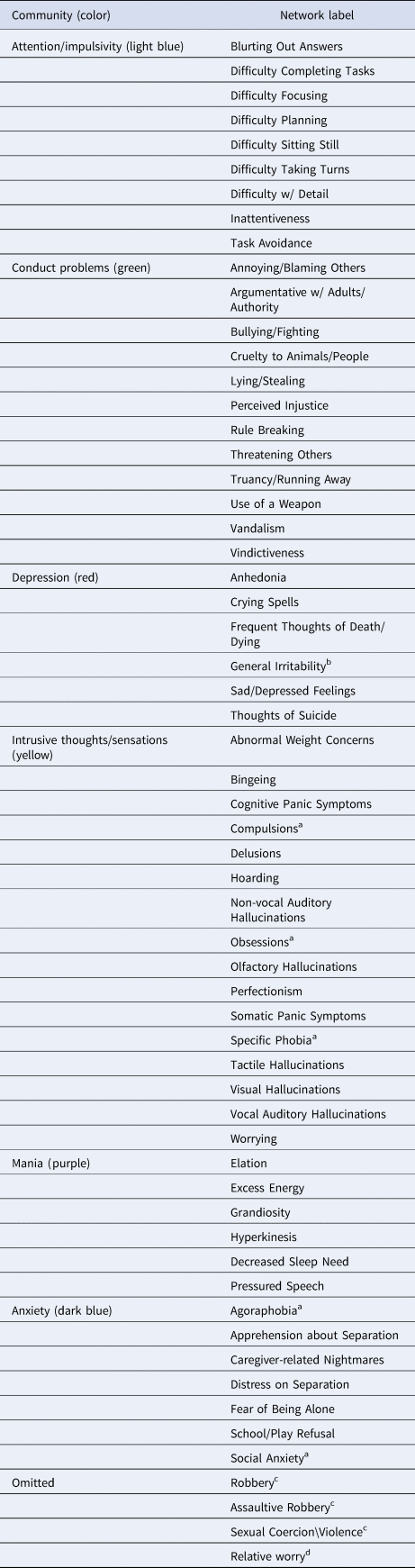
Psychopathology symptoms and diagnoses were obtained from PNC youth using GOASSESS, a computerized modification of the Kiddie-Schedule for Affective Disorders and Schizophrenia – Epidemiological version (Calkins et al., Reference Calkins, Merikangas, Moore, Burstein, Behr, Satterthwaite and Mentch2015; Kaufman et al., Reference Kaufman, Birmaher, Brent, Rao, Flynn, Moreci and Ryan1997; Merikangas, Avenevoli, Costello, Koretz, & Kessler, Reference Merikangas, Avenevoli, Costello, Koretz and Kessler2009). Though the K-SADS utilizes a skip-logic structure, the current analyses solely incorporated a universal set of screener items presented to all participants, regardless of response. Missingness in these data was minimal and unlikely to affect our analyses (Graham, Reference Graham2009), therefore listwise deletion was used as complete data are required by the IsingFit estimation package described below. Several GOASSESS items probe for different forms of a single symptom (e.g. specific phobia by type, social anxiety by situation). We anticipated that splitting an individual symptom into its different manifestations (i.e. separate items) might obscure the nature of its relationship with the broader network of psychopathology. Therefore, we collapsed these items into singular binary composites reflecting the presence or absence of a symptom generally (see Table 1).
Symptom screener items, with community membership, color, and label

a Composite of multiple items capturing different manifestations of this symptom.
b Higher value combination of two similarly worded items.
c Extremely low rate of endorsement.
d Item content did not capture a clinical symptom.
Diagnostic status
Epidemiological research demonstrates that stress-exposed youth are more likely to meet diagnostic criteria for one or more forms of psychopathology (Green et al., Reference Green, McLaughlin, Berglund, Gruber, Sampson, Zaslavsky and Kessler2010) and may therefore endorse a greater number of mental health symptoms during clinical assessment. Alternatively, some of these youth may exhibit resiliency to exposure, with limited symptomatology despite their history. As our analyses aimed to characterize IPV-related effects on symptom networks in youth with mental illness, we estimated symptom networks only in those youth who met diagnostic criteria for psychopathology. A flow diagram of study participants is provided in supplementary materials (online Supplementary eFig. 1).
Exposure to interpersonal violence
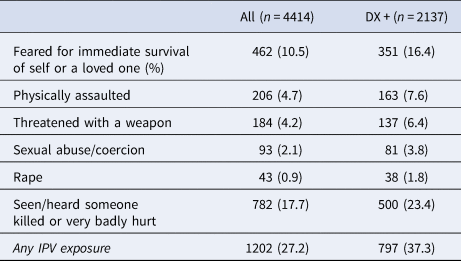
Six GOASSESS items ask about exposure to different forms of IPV (see Table 2 for content and frequency). From the sum of these items, we created a binary variable classifying participants who did (IPV ≥ 0) or did not (IPV = 0) report past exposure to IPV.
Interpersonal violence exposure by incident type
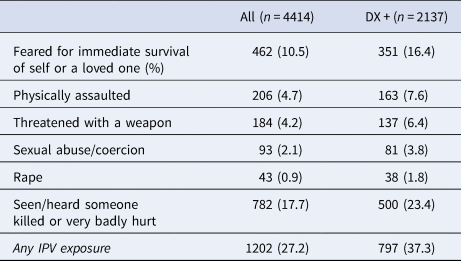
DX, diagnosis; IPV, interpersonal violence.
Statistical analyses
Network estimation
Conditional associations between psychopathology symptoms were estimated from pairwise complete responses to GOASSESS items using an iterative generalized linear modeling approach implemented in the R-package IsingFit (van Borkulo et al., Reference van Borkulo, Borsboom, Epskamp, Blanken, Boschloo, Schoevers and Waldorp2014) as appropriate for dichotomous items. Conceptually, this process is akin to calculating the LASSO-regularized partial correlation between each pair of symptoms, conditioned on all other symptoms in the network. Here, imposition of the L1-norm sets weak regression coefficients to zero, thereby inducing sparsity into the matrix and network. Notably, the severity of correction varies according to sample size, therefore, networks estimated from separate samples are comparable only when those sample sizes are roughly equivalent (Epskamp, Borsboom, & Fried, Reference Epskamp, Borsboom and Fried2018) which was not the case in these data. We addressed this issue using a previously validated bootstrapping procedure (Fonseca-Pedrero et al., Reference Fonseca-Pedrero, Ortuño, Debbané, Chan, Cicero, Zhang and Kwapil2018; Rhemtulla et al., Reference Rhemtulla, Fried, Aggen, Tuerlinckx, Kendler and Borsboom2016) described in supplementary materials (online Supplementary eMethods 1).
Community characteristics
Nodes within a network may form communities, or groups of nodes more interconnected with one another than with the network at large. Each community may be characterized by the magnitude and breadth of global connections to other communities and local connections within its members. Below, global and local strength refer to the mean absolute sum of edge weights between one community and all others, or within a community's members, while global and local connectivity describe the corresponding quantity of connections (as a proportion of those possible).
To allow comparisons across subgroups,Footnote †Footnote 1 we identified the community membership structure in a network constructed from the full sample of youth (n = 4437) and applied this to networks from each subsample. Communities were extracted through exploratory graph analysis, a technique which uses a random-walk algorithm to identify densely connected clusters of nodes (R-package EGA; Golino & Epskamp, Reference Golino and Epskamp2017).Footnote 2 Global and local strength of each community were compared across networks using Mann–Whitney U tests, while global and local community connectivity were contrasted using the N-1 χ2 test with p values estimated using Monte Carlo simulation (B = 100 000). Correction for multiple testing was performed using the Benjamini–Hochberg procedure (Benjamini & Hochberg, Reference Benjamini and Hochberg1995).
Node characteristics
The role of each symptom node in the broader network was primarily characterized using bridge strength, a metric reflecting the tendency for a symptom to show significant co-occurrence between communities (R-package networktools; Jones, Reference Jones2019). Theoretically, symptoms high in bridge strength may function as conduits for comorbidity and may be important targets for clinical intervention (Jones, Ma, & McNally, Reference Jones, Ma and McNally2019). We identified highly transdiagnostic symptoms in each network by ordering nodes in terms of descending bridge strength and thresholding using an elbow criterion across simulated window lengths (online Supplementary eMethods 2). Additional node-level characteristics strength (the absolute sum of connected edge weights) and clustering (tendency for a node to appear in a ‘cluster’ – a closed loop connecting at least two other nodes) are reported in supplementary materials (online Supplementary eMethods3, eTables 1–2, eFig. 5).
Network visualization
The network structure of psychopathology symptoms was visualized using the R-package qgraph (Epskamp, Cramer, Waldorp, Schmittmann, & Borsboom, Reference Epskamp, Cramer, Waldorp, Schmittmann and Borsboom2012). Symptom nodes in each network are presented as circles, with triangles used for transdiagnostic ‘bridge’ symptoms. Border colors indicate community membership, as identified during exploratory graph analysis. Edges between symptoms are shown as lines, with thickness corresponding to edge weight. Networks were plotted according to a common template: the average node placement across groups was identified after application of the Fruchterman–Reingold (FR) algorithm, which forces strongly associated nodes together and expels weakly connected nodes to the periphery.
Results
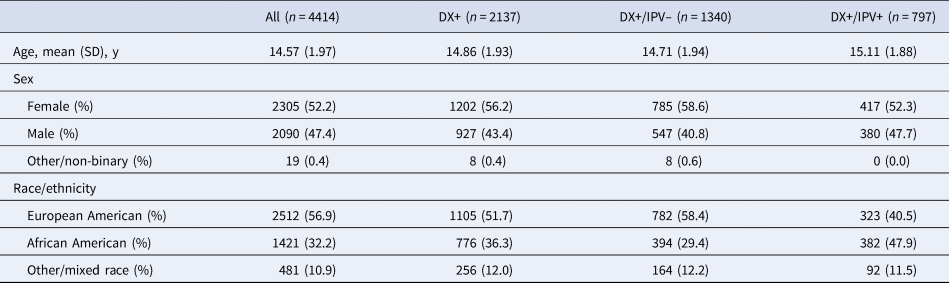
Demographic information for the full sample, IPV+, and IPV– groups is provided in Table 3 (see also online Supplementary eFig. 1), while the frequency of exposure to IPV in the full sample and diagnosed youth is shown in Table 2. When estimating networks, three items related to conduct disorder (engaging in robbery, physical, or sexual assault) were excluded from analyses due to very low rates of endorsement (n < 8) in one or both groups. Two items with extremely similar wording (i.e. unusual irritability) were combined by taking the larger value. One screener item was omitted that asked participants to compare their symptom severity with other youth. A full list of included and omitted symptoms is provided in Table 1. The network of symptoms derived from the complete sample is presented in supplementary materials (online Supplementary eFig. 2), and broadly reflects the underlying dynamics of psychopathology in a population-representative sample. Of 1540 possible edges in this network, 353 (22.9%) survived regularization. Sensitivity analyses examined the fluctuation in edge weight estimates across bootstraps and found no meaningful bias in distribution (see online Supplementary eFigs 6A,B) as well as acceptable edge-weight stability (online Supplementary eFigs 7A,B) across decreasing sample sizes. Exploratory graph analysis revealed that symptoms generally organized into six communities: Anxiety (eight symptoms), Intrusive Thoughts/Sensations (15), Conduct Problems (12), Attention/Impulsivity (9), Depression (6), and Mania (6) (see Table 1). Mania symptoms tended to exhibit the strongest local connectivity, while Intrusive Thoughts/Sensations community tended to show the lowest local connectivity (online Supplementary eFig. 3). No significant differences in global community characteristics were observed. Visually, Conduct Problems and Intrusive Thoughts/Sensations showed clear separation from the remaining communities in terms of global connectivity, though not from each other. Six transdiagnostic ‘bridge’ symptoms emerged from four communities: Obsessions, Worrying, Agoraphobia, Crying Spells, General Irritability, and Perceived Injustice.
Demographics across diagnosed youth with and without exposure to interpersonal violencea
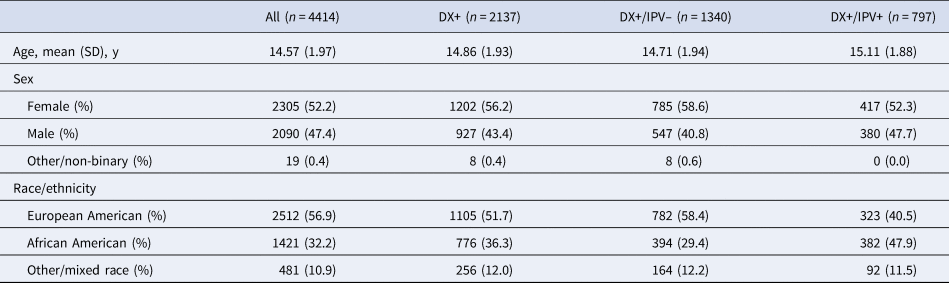
DX, diagnosis; IPV, interpersonal violence.
a Due to the sample size, all between-group differences reached significance.
Contrasts across IPV exposure
Network-level differences
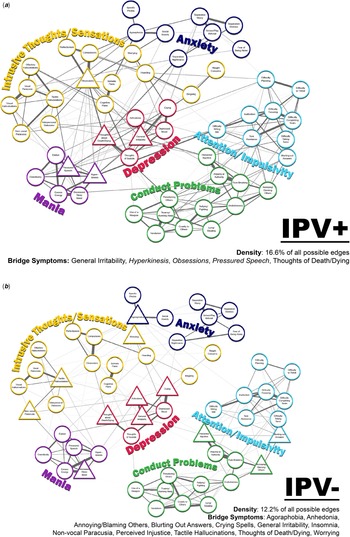
The networks of psychopathology symptoms in IPV+ and IPV– youth are shown in Figs 1a and 1b, respectively. There were considerably more edge connections between symptoms in the network constructed from IPV+ youth (16.3% of 3136 possible edges) as compared to IPV– youth [12.0%; χ2(1) = 23.60, p < 0.001, h = 0.12]. Conversely, connections were stronger on average in the IPV– network (W = 79 326, p < 0.001, r = 0.15). In terms of within-community connectedness, the IPV+ network showed greater mean local strength and local connectivity, suggesting tighter integration within symptom communities among IPV+ youth [W = 7821, p = 0.01, r = 0.15; χ2(1) = 4.00, p < 0.05, h = 0.17]. Analyses of connectedness between communities were nuanced. While the IPV+ network showed greater global connectivity [χ2(1) = 24.95, p < 0.001; h = 0.14], these connections were no stronger on average than in IPV– youth (online Supplementary eFigs 3–4).
(a–b). Networks of psychiatric symptoms in youth with and without a history of exposure to interpersonal violence. Positive edges between symptoms are shown above in gray (no negative edges were observed), with line thickness reflecting the strength of the association. Symptom communities are distinguished by color, while bridge symptoms are shown as triangular nodes.

Community-level differences
Global and local features of individual communities were compared within and between group networks. No community-level differences in local or global strength reached significance. Consistent with network-wide analyses, local strength was generally greater across communities in IPV+ youth. In terms of local connectivity, the proportion of within-community connections trended higher in IPV+ youth, with all communities displaying equal or greater frequency of same-community symptom connections. Global community connectivity was substantially impacted by IPV exposure, with IPV+ youth demonstrating more outward connections from the Intrusive Thoughts/Sensations, Conduct Problems, Attention/Impulsivity, and Mania communities (online Supplementary eFigs 3–4).
Node-level differences
Finally, the characteristics of each network node (symptom) were compared across IPV+ and IPV– networks. Two ‘transdiagnostic’ bridge symptoms emerged as common to both networks: Frequent Thoughts of Death/Dying, General Irritability. The IPV– network contained nine unique bridge symptoms drawn from all six communities, implying a less centralized symptom network. Conversely, just three unique bridge symptoms were present in the IPV+ network from three communities: Obsessions, Pressured Speech, and Hyperkinesis. Notably, while Obsessions did not demonstrate a strong tendency to bridge communities in IPV– youth, it was by far the most transdiagnostic symptom for IPV+ youth.
Discussion
By applying a network perspective to the breadth of psychopathology symptoms in youth, we elucidate several critical insights about the networked nature of mental illness, and the moderating influence of exposure to IPV. First, our analyses found that at the population-level, symptoms broadly organize into six communities, and that these communities varied in the degree to which they had reciprocal connections between their member symptoms, as well as outward connections to other communities in the larger network. Second, IPV exposure appeared to alter the broader network structure by increasing both the frequency and strength of connections. Third, differences in overall network connectivity could be traced to individual symptom communities, where IPV+ moderated the frequency of connections within and between networks. Finally, at the node-level, different transdiagnostic bridge symptoms were observed in each group, with a more concentrated and unique set of bridge symptoms among IPV-exposed youth. In total, these findings suggest that exposure to IPV may alter the foundational structure of how mental illness is expressed in youth, thereby leading to the specialized disorder manifestations previously reported in this population (Teicher & Samson, Reference Teicher and Samson2013).
At the broadest level, our analyses provide important insight into the networked structure of psychopathology symptoms in youth. To our knowledge, only a handful of studies have applied the network perspective to the full spectrum of psychiatric symptoms (Boschloo et al., Reference Boschloo, van Borkulo, Rhemtulla, Keyes, Borsboom and Schoevers2015) – fewer still in youth (Boschloo, Schoevers, van Borkulo, Borsboom, & Oldehinkel, Reference Boschloo, Schoevers, van Borkulo, Borsboom and Oldehinkel2016) – and no studies have attempted to elucidate a broader, global organization by extracting symptom communities. A network constructed from the full sample of youth was highly interconnected, supporting the perspective that mental health symptoms may interact in a systemic fashion. Symptoms coalesced into several communities conceptually consistent with current taxonomical approaches (e.g. ICD-10, DSM 5). Several insightful differences also emerged, such as the blend of obsessive-compulsive, psychotic, and panic symptoms in an ‘intrusive thoughts’ community. Ultimately, these results encourage the use of a community-based approach to understanding disorder, which may complement the factor analytic methods commonly used to better understand symptom co-expression.
When examining the effects of IPV exposure in youth, our analyses revealed notable differences in symptom networks underlying psychopathology. First, and consistent with our hypotheses, we found that IPV+ youth show greater interconnectivity (i.e. density) of symptom networks both within and between community clusters, suggesting greater transdiagnostic integration of psychiatric symptoms. At face value, these findings are consistent with literature pointing to more severe forms of psychopathology in IPV+, in particular increased rates of comorbidity among psychiatric illnesses (Kilpatrick et al., Reference Kilpatrick, Ruggiero, Acierno, Saunders, Resnick and Best2003). These findings also align with increasing data that IPV exposure during childhood may increase the risk for psychopathology more broadly, including attentional and conduct disorders, psychotic disorders, as well as more traditionally associated mood and anxiety disorders (Dvir, Ford, Hill, & Frazier, Reference Dvir, Ford, Hill and Frazier2014; Keyes et al., Reference Keyes, Eaton, Krueger, McLaughlin, Wall, Grant and Hasin2012). Notably, prior work suggests that childhood adversities account for up to 45% of the risk for any psychiatric disorder in adolescence (Green et al., Reference Green, McLaughlin, Berglund, Gruber, Sampson, Zaslavsky and Kessler2010). Our findings suggest that one potential mechanism behind this increased risk involves more densely connected networks of even seemingly disparate symptoms. While the temporal mechanisms remain unclear, it is possible that emerging symptoms, such as attentional impairment and anxiety, could further drive other symptom categories such as intrusive thoughts and depression in a way that becomes mutually reinforcing for the entire symptom network. Accordingly, these findings may also help to explain the greater incidence of treatment resistance in IPV-exposed youth (Agnew-Blais & Danese, Reference Agnew-Blais and Danese2016; Nanni, Uher, & Danese, Reference Nanni, Uher and Danese2012; Williams, Smith, An, & Hall, Reference Williams, Smith, An and Hall2008) given the more highly connected symptom network at large and the difficulty of resolving multiple symptom categories simultaneously.
Next, we found that IPV+ youth also showed a more focal and unique pattern of transdiagnostic bridge symptoms connecting different symptom communities. Bridge symptoms have potentially high value as therapeutic targets which could be utilized to optimally disrupt the symptom network as a whole (Jones et al., Reference Jones, Ma and McNally2019). The more concentrated set of bridge symptoms in IPV-exposed youth could therefore provide a window of opportunity by allowing clinicians to address specific symptoms relevant for the broader range of psychopathology these youth experience. While frequent thoughts of death and general irritability were common bridge symptoms in both groups, IPV+ youth showed unique bridge symptoms including obsessions, pressured speech, and hyperkinesis. For obsessions, it is notable that many of these items involved the potential for trauma-related intrusions such as thoughts of guilt and violent images. Future studies would be warranted to determine what pattern of obsessions induced by IPV may be influencing the broader symptom network, and whether these obsessions are in fact trauma-related (e.g. PTSD) or more traditional OCD symptoms.
The other unique bridge symptoms in IPV-exposed youth, pressured speech and hyperkinesis, were notable for both being in the mania category of symptoms. Childhood IPV exposure has also been associated with increased risk for bipolar disorder. Thus, early emergence of pressured speech and hyperkinesis as bridge symptoms may portend both the early manifestation of bipolar disorder (Agnew-Blais & Danese, Reference Agnew-Blais and Danese2016) as well as their influence on the emergence or exacerbation of other symptoms in the network. Alternatively, we note that pressured speech and hyperkinesis fall under the umbrella of hyperarousal – a central facet of PTSD. Therefore, it is also possible that their transdiagnostic nature in IPV+ youth reflects the unmodeled influence of traumatic stress symptoms. Regardless, these bridge symptoms could again represent potentially unique and fruitful targets for intervention in this vulnerable population of youth. However, future studies implementing longitudinal measures with intervention would be needed to test these hypotheses.
There are many strengths to this study including the large sample size, community representation, and transdiagnostic symptom approach to understanding the effects of IPV in youth. However, it is not without limitations. First, the sample is cross-sectional, and we therefore do not have the ability to determine temporal causality of symptoms, nor how IPV may alter early manifestations in symptom networks. Moreover, binarization of exposure to IPV masks the unique influence of specific experiences (e.g. sexual abuse v. domestic violence). Future studies using longitudinal designs with high-frequency symptom assessments, and sample size necessary to independently consider IPV types will be needed to further explore these dynamics over the course of development. Second, while graph theoretical approaches represent a powerful way to examine symptom networks, the current data were limited to the use of the KSADS screener items (present for all youth) as well as their binary nature (present/absent). Our models may therefore not capture the full extent of symptom relationships in youth with and without IPV exposure. Relatedly, selection biases (e.g. Berkson's bias; De Ron, Fried, & Epskamp, Reference De Ron, Fried and Epskamp2019) inherent to studying populations with clinical diagnoses may have significant effects on the covariance structure of symptom expression. Although the PNC as a whole was a community-representative sample, our stratification based on GOASSESS diagnosis may have introduced differences in symptom network structure not representative of the ‘typical’ nature of mental health in youth. Finally, when attributing symptom network differences putatively to IPV exposure, it is possible that other variables may be accounting for group differences in symptom network architecture such as parental mental illness, sex, race/ethnicity, genetic background, and access to social supports and treatments. Unfortunately, our dataset (obtained from a public repository) did not include data about many of the variables that may moderate important IPV-related differences in symptom architecture. For those variables available to us (e.g. sex, race), the interaction of IPV with such variables would require estimating separate networks for each subset of participants (e.g. IPV+ and female), which would be severely underpowered. Future studies would be warranted to examine these possibilities with the goal of identifying the most relevant factors driving the pronounced symptom network differences observed.
Conclusion
In summary, this is the first study, to our knowledge, to examine symptom network architecture in psychiatrically affected youth as a function of IPV exposure. Our findings of more densely connected, transdiagnostic symptom networks in IPV+ youth provide broader support of the literature indicating greater illness severity, comorbidity, and treatment resistance in this population. Furthermore, the more focal and unique set of bridge symptoms in youth exposed to IPV may offer new insights into the underlying mechanisms of psychopathology in this population and could represent key therapeutic targets to improve outcomes for affected youth.
Supplementary material
The supplementary material for this article can be found at https://doi.org/10.1017/S0033291720003712
Acknowledgements
The authors express their gratitude to Sara Heyn, William Wooten, Andrew Sheldon, and Erin Neill MSW for their valuable contributions to this manuscript.
Financial support
This work was supported by funding provided by the National Institute of Mental Health (5T32-MH018931, JDR; R01-MH115910, R01-MH117141, RJH) and the National Science Foundation (DGE-1747503, TJK). This work reports on data originally collected as part of the Philadelphia Neurodevelopmental Cohort, and obtained on application to the National Center for Biotechnology Information database of Genotypes and Phenotypes (dbGaP; Project #18812).
Conflict of interest
The authors declare no conflicts of interest.