Introduction
Trematodes of the genus Fasciola are the common liver flukes of a range of species of animals and have a global distribution (Spithill & Dalton, Reference Spithill and Dalton1998). A number of snail species serve as intermediate hosts. Mammals of various species serve as definitive hosts, with ruminants being the most important ones (Urquhart & Armour, Reference Urquhart and Armour1996). Animals become infected with Fasciola following the ingestion of contaminated infective metacercariae. The parasite penetrates the intestinal wall and moves to the liver, causing perforations in the capsule and extensive haemorrhage to the parenchyma. The adult trematodes reside in the bile ducts of infected animals (Urquhart & Armour, Reference Urquhart and Armour1996). The annual economic losses associated with fasciolosis stem from mortality (mild to heavy), cost of diagnosis and treatment, condemned livers, reduced milk yield, fertility disorders and reduced meat production (Rokni et al., Reference Rokni, Mirhendi, Mizani, Mohebali, Sharbatkhori, Kia, Abdoli and Izadi2010; Hossain et al., Reference Hossain, Paul, Rahman, Hossain, Hossain and Islam2011).
Fasciolosis is considered to be an important helminth infection of ruminants that causes significant economic losses (Spithill & Dalton, Reference Spithill and Dalton1998). Recognized as an emerging food-borne zoonosis in many parts of the world (Qureshi et al., Reference Qureshi, Tanveer, Qureshi, Maqbool, Gill and Ali2005; Freites et al., Reference Freites, Colmenares, Alarcon-Noya, Garcia and Diaz-Suarez2009; Karahocagil et al., Reference Karahocagil, Akdeniz, Sunnetcioglu, Cicek, Mete, Akman, Ceylan, Karsen and Yapici2011; Mera y Sierra et al., Reference Mera y Sierra, Agramunt, Cuervo and Mas-Coma2011), human fasciolosis has now been included among neglected tropical diseases described by the World Health Organization (WHO) in 2008 (press statement). It is estimated that 2.4 million people are infected and the number of people at risk is more than 180 million worldwide (Haseeb et al., Reference Haseeb, el-Shazly, Arafa and Morsy2002).
Several species have been described within the genus Fasciola, but only two species, F. hepatica and F. gigantica, are commonly recognized as taxonomically valid species occurring in domestic animals and humans (Itagaki et al., Reference Itagaki, Tsutsumi, Ito and Tsutsumi1998). Several studies have shown that F. hepatica occurs in temperate regions (Garippa, Reference Garippa2009; Ichikawa & Itagaki, Reference Ichikawa and Itagaki2010; Farjallah et al., Reference Farjallah, Ben Slimane, Piras, Amor, Garippa and Merella2013) and F. gigantica in tropical areas (Amor et al., Reference Amor, Farjallah, Salem, Lamine, Merella, Said and Ben Slimane2011a); however, both species overlap in subtropical areas, along with intermediate genotypes (Agatsuma et al., Reference Agatsuma, Arakawa, Iwagami, Honzako, Cahyaningsih, Kang and Hong2000; Marcilla et al., Reference Marcilla, Barques and Mas-Coma2002; Huang et al., Reference Huang, He, Wang and Zhu2004; Ichikawa & Itagaki, Reference Ichikawa and Itagaki2010; Rokni et al., Reference Rokni, Mirhendi, Mizani, Mohebali, Sharbatkhori, Kia, Abdoli and Izadi2010).
Pakistan has an agriculture-based economy, with livestock being an integral part. Fasciola infections have been reported in Pakistan. Several of these reports suggested that only F. hepatica is commonly found in small and large ruminants (Ijaz et al., Reference Ijaz, Kahn, Avais, Ashraf, Ali and Khan2007; Iqbal et al., Reference Iqbal, Sajid, Hussain and Khan2007; Gadahi et al., Reference Gadahi, Arshed, Ali, Javaid and Shah2009; Akhtar et al., Reference Akhtar, Arshad, Shakeebullah, Hidayatullah and Ameer2012; Shahzad et al., Reference Shahzad, Mehmood, Munir, Aslam, Ijaz, Ahmad, Khan and Sabir2012; Ashraf et al., Reference Ashraf, Iqbal, Ali, Chaudary, Sial, Ahsan, Ali and Asif2014) and three reports indicated the presence of both F. hepatica and F. gigantica species in small ruminants (Afshan et al., Reference Afshan, Valero, Qayyum, Peixoto, Magraner and Mas-Coma2013) and large ruminants (Ahmed, Reference Ahmed, Nawaz, Gul, Zakir and Razzaq2005; Kakar et al., Reference Kakar, Masood, Janbaz, Qadir, Masood and Kakarsulemankhel2011). However, all of these previous reports were based on egg and adult morphology, with no molecular confirmation of species identity. Sequences of the internal transcribed spacers (ITS-2) of ribosomal DNA provide reliable genetic markers to differentiate between F. hepatica and F. gigantica, and can detect proposed intermediate genotypes (Adlard et al., Reference Adlard, Barker, Blair and Cribb1993; Marcilla et al., Reference Marcilla, Barques and Mas-Coma2002; Huang et al., Reference Huang, He, Wang and Zhu2004; Ai et al., Reference Ai, Dong, Zhang, Elsheikha, Mahmmod, Lin, Yuan, Shi, Huang and Zhu2010; Ichikawa & Itagaki, Reference Ichikawa and Itagaki2010; Rokni et al., Reference Rokni, Mirhendi, Mizani, Mohebali, Sharbatkhori, Kia, Abdoli and Izadi2010; Amor et al., Reference Amor, Farjallah, Salem, Lamine, Merella, Said and Ben Slimane2011a; Le et al., Reference Le, Nguyen, Nguyen, Doan, Le, Hoang and De2012). The present study is the first to confirm species identity of Fasciola from ruminants in Pakistan using the ITS-2 genetic marker. Our results suggest, in contrast to previous morphologically based studies, that F. gigantica is the predominant species of Fasciola in the Punjab and Baluchistan provinces of Pakistan. No evidence for the presence of F. hepatica was found in this study.
Materials and methods
Fluke collection and the isolation of genomic DNA
We chose to study several different regions in Pakistan, where we anticipated Fasciola spp. to be prevalent. Adult flukes were harvested on necropsy from the liver of ruminants collected from five city abattoirs located in the Punjab province and two city abattoirs in the Baluchistan province. Fourteen infected livers from individual hosts were transported on ice from abattoirs to the laboratory, and the extraction was performed by dissection to reveal the flukes in the biliary ducts of the livers.
A minimum of one and maximum of eight flukes (46 in total) were collected from 14 infected livers, which were considered to be 14 separate populations. In the case of Baluchistan province, four populations (F23S, F22S, F21S and F19G) were obtained from the Quetta abattoir (30°N, 67°E) and one population (F20G) from Mastoung abattoir (30°N, 67°E). In the case of Punjab province, three populations (F13G, F12 and F11G) were obtained from Rawalpindi abattoir (33°N, 73°E), three populations (F14C, F16G and F17B) from Multan abattoir (30°N, 71°E), one population (F6C) from Sahiwal abattoir (31°N, 71°E), one population (F18G) from RY Khan abattoir (28°N, 70°E) and one population (F15B) from DG Khan abattoir (30°N, 71°E).
Individual flukes were washed extensively in phosphate-buffered solution (PBS) and preserved with 70% ethanol at − 80oC. For DNA extraction, a small piece of tissue (~2 mg) was removed from each fluke and rinsed in distilled water (dH2O) twice for 5 min each. Tissue sections were then lysed in lysis buffer and protinease K (10 mg/ml, New England BioLabs, Ipswich, Massachusetts, USA). Lysis buffer contained 50 mm KCl, 10 mm Tris (pH 8.3), 2.5 mm MgCl2, 0.045% Nonidet p-40, 0.45% Tween-20, 0.01% gelatin and dH2O in 50-ml volumes. Samples were lysed in 50 μl for 98 min at 60°C followed by 15 min at 94°C, then stored at − 20°C until the polymerase chain reactions (PCRs) were performed.
Molecular analysis of rDNA ITS-2 from Fasciola spp.
A 490–743 bp fragment of the ITS-2 rDNA region was amplified from individual adult fluke lysates using universal forward primers complementary to the 5.8S rDNA coding sequence (5′-GGTGGATCACTCGGCTCGTG-3′) and reverse primer complementary to the 28S rDNA coding sequence (5′-TTCCTCCGCTTAGTGATATGC-3′). These primers were designed by modifying previously reported primers (Adlard et al., Reference Adlard, Barker, Blair and Cribb1993). Reaction mixtures comprised a final volume of 25 μl, containing final concentrations of 1 × Thermopol reaction buffer (New England BioLabs), 2 mm MgSO4, 100 μm deoxynucleoside triphosphates (dNTPs), 0.1 μm forward primer and reverse primer, and 1.25 U Taq DNA polymerase at 5000 U/ml (New England BioLabs). Thermocycling conditions were 95°C for 5 min followed by 35 cycles of 95°C for 30 s, 56°C for 60 s and 72°C for 60 s, with a final extension of 72°C for 5 min.
PCR products were cleaned using Omega BioTek Micro Elute Cycle Pure Kit (D6293-02; Omega Bio-Tek, Norcross, Georgia, USA) and the same amplification primers were used to sequence both strands using an Applied Biosystems 3730Xl genetic analyser (Burlington, Ontario, Canada). Both strands of rDNA ITS-2 sequences from each individual fluke were assembled, aligned and edited to remove primers on both ends using Geneious Pro 5.4 software (Drummond et al., Reference Drummond, Buxton, Cheung, Cooper, Duran, Field, Heled, Kearse, Markowitz, Moir, Stones-Havas, Sturrock, Thierer and Wilson2012). Sequences showing 100% base pair similarity were grouped into haplotypes using the CD-HIT Suite software (Huang et al., Reference Huang, Niu, Gao, Fu and Li2010). These haplotypes were then aligned with F. hepatica, F. gigantica and reported intermediate Fasciola species rDNA ITS-2 genes previously used to determine inter- and intraspecific variation between and within Fasciola species, and this alignment was used in the following phylogenetic analysis.
Phylogenetic analysis of the rDNA ITS-2 from Fasciola spp.
Haplotype sequences and references were imported into MEGA 6 (Tamura et al., Reference Tamura, Stecher, Peterson, Filipski and Kumar2013) and used to determine the appropriate model of nucleotide substitution to be used for building the phylogeny. A phylogenetic tree of the haplotypes was reconstructed using maximum likelihood (ML) in MEGA 6 after determining the appropriate model of substitution (Tamura et al., Reference Tamura, Stecher, Peterson, Filipski and Kumar2013) from the rDNA ITS-2 sequence data. According to Bayesian information criterion, the best model was the Kimura 2 model (K2+G). This model of substitution was used with parameters estimated from data. Branch supports were obtained by 1000 bootstraps of the data. The most probable ancestral node was determined by rooting the networks to a closely related outgroup, in this case a Fascioloides magna (EF534994) sequence.
Results
Adult worms were collected from the livers of ruminant hosts from abattoirs across two provinces of Pakistan (3 sheep, 7 goats, 2 cattle and 2 buffalo). In all cases, the size and gross morphology of the worms were typical of Fasciola spp. Since it was previously confirmed that the rDNA ITS-2 genotype reliably distinguishes F. gigantica and F. hepatica (Adlard et al., Reference Adlard, Barker, Blair and Cribb1993), this was further used to determine the species of Fasciola present. Between 1 and 8 worms from each individual host were sequenced for the rDNA ITS-2 (46 worms sequenced in total) and aligned with 13 sequences from F. hepatica (accession nos: AB207148, AJ557568, EF612479, AJ557567, AB207150, AM900370, AM707030, AM709498, GQ231546, GQ231547, FJ467927, FJ593632, AB010974), ten from F. gigantica (accession nos: AJ853848, AJ557569, EF612482, AB010977, AB207151, EF612484, AM900371, EU260063, AB010975, AB010976) and seven intermediate sequences (AB207150, EU260064, EU260066, EU260067, EU260068, EU260069, EU260071). All sequences in the alignment were trimmed to 343 bp, the length of the shortest sequence available that still contained all the informative sites.
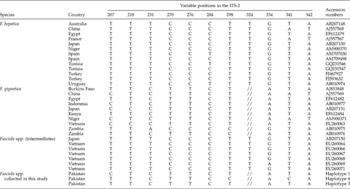
This alignment showed five interspecific variable nucleotide positions, which is consistent with the previously studied rDNA ITS-2 of F. hepatica and F. gigantica species. According to the alignment, four of these are nucleotide substitutions at positions 231, 270, 276 and 334, and the final mutation is an insertion in F. hepatica at position 324. Two sequences did not conform to this pattern. The first is from Zambia (accession no.: AB010975), which contained members of both F. gigantica and F. hepatica interspecific nucleotide positions (table 1). The second is from Vietnam and was identified as an intermediate species (accession no.: EU260069) and was consistent with all F. hepatica interspecific positions except for the inserted T at position 324 (table 1). In addition to confirming the five species-specific fixed single nucleotide polymorphisms (SNPs), these rDNA ITS-2 sequences identified six sites that showed intraspecific variation within F. hepatica and F. gigantica (positions 207, 218, 284, 298, 341 and 342), which is also consistent with the previously studied rDNA ITS-2 of F. hepatica and F. gigantica species (table 1).
The rDNA ITS-2 alignment of F. hepatica and F. gigantica sequences from GenBank along with the three haplotypes from the present study, showing variable positions and insertions.

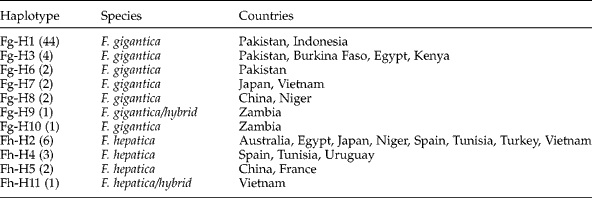
The ten rDNA ITS-2 sequences from F. gigantica selected from the public databases from different geographical regions had six unique haplotypes (Fg-H1, Fg-H3, Fg-H7, Fg-H8, Fg-H9 and Fg-H10). The 13 rDNA ITS-2 sequences from F. hepatica populations selected from the databases from different geographical regions had three haplotypes (Fh-H2, Fh-H4 and Fh-H5) (table 2). The seven intermediate sequences were split, with six belonging to F. hepatica haplotype Fh-H2 and one forming a unique haplotype of Fh-H11. From the 46 rDNA ITS-2 region sequences from Pakistan in the present study, there were just three haplotypes present (Fg-H1, Fg-H3 and Fg-H6) (accession nos: KM259915, KM259916 and KM259917) (table 1). The haplotype Fg-H1 was the most common and was represented by 44 sequences from 14 populations (F6C, F11G, F12G, F13G, F14C, F16G, F17B, F15B, F18G, F19G, F21S, F22S, F23S, F20G) of Fasciola sampled from Sahiwal, Rawalpindi, Multan, RY Khan and DG Khan abattoirs of Punjab province and Quetta and Mastoung abattoirs of Baluchistan province. This haplotype has been previously reported from F. gigantica from Indonesia (accession no.: AB010977). The haplotype Fg-H3 was represented by one sequence from a single population (F12G) sampled from the Rawalpindi abattoir of Punjab province. This haplotype has previously been reported from F. gigantica from Burkina Faso, Egypt and Kenya (accession nos.: AJ853848, EF612482, EF612484). The haplotype Fg-H6 was represented by two sequences from two populations (F16G, F23S) sampled from Multan and Quetta abattoirs of Punjab and Baluchistan provinces (table 2). This haplotype has not been previously reported in the literature.
Haplotypes of rDNA ITS-2 from F. hepatica and F. gigantica showing the number of sequences (in brackets) representing unique ITS-2 alleles, relative to country of origin.

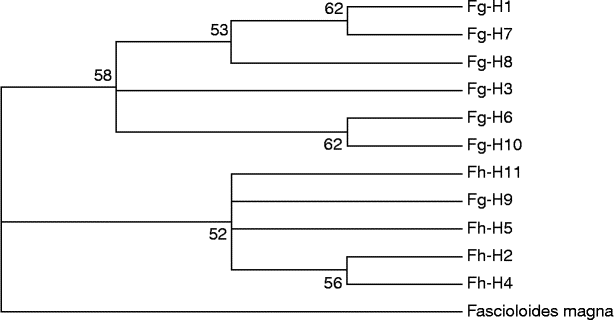
A maximum likelihood (ML) tree was constructed to examine the phylogenetic relationship between rDNA ITS-2 haplotypes. The six and three different haplotypes of F. gigantica and F. hepatica, respectively, fell into two distinct phylogenetic clades corresponding to the species of origin (fig. 1). Exceptions were Fg-H9 which was identified as F. gigantica but may also be a hybrid and grouped with Fh-H11, the other hybrid, in the F. hepatica clade (fig. 1). The unique Fg-H6 haplotype, identified for the first time in this study, clustered with the F. gigantica clade.
Phylogenetic analysis of six haplotypes obtained from F. gigantica rDNA ITS-2 sequences, and five haplotypes obtained from F. hepatica and Fasciola hybrid rDNA ITS-2 sequences, from different countries, including our region of study (Fg-H1, Fg-H3 and Fg-H6). Fasciola gigantica and F. hepatica haplotypes are identified with Fg or Fh respectively. The sequences were aligned by Geneious software and the tree obtained by maximum likelihood (ML) analysis using a Kimura 2 model (K2+G) of substitution. Branches with bootstrap support values above 50% (1000 replications) and posterior probability greater than 50, respectively, are represented at the base of the nodes. The phylogeny is rooted with the rDNA ITS-2 sequence of Fascioloides magna (GenBank accession number EF534994).

Discussion
Fasciola is very cosmopolitan in distribution, being found throughout all regions of the world, including temperate, tropical and subtropical regions. Fasciola hepatica infection is found in temperate and tropical areas where sheep and cattle are raised and in humans, typically where they consume raw watercress (Mas-Coma et al., Reference Mas-Coma, Valero and Bargues2009). Infection with F. gigantica, on the other hand, is found more commonly in tropical and subtropical regions of the world (Mas-Coma et al., Reference Mas-Coma, Valero and Bargues2014). The presence of both F. gigantica and F. hepatica, and the existence of intermediate forms, has been reported in livestock from Iran (Rokni et al., Reference Rokni, Mirhendi, Mizani, Mohebali, Sharbatkhori, Kia, Abdoli and Izadi2010; Amor et al., Reference Amor, Halajian, Farjallah, Merella, Said and Ben Slimane2011b), Egypt (Marcilla et al., Reference Marcilla, Barques and Mas-Coma2002; Dar et al., Reference Dar, Amer, Mercier, Courtioux and Dreyfuss2012; El-Rahimy et al., Reference El-Rahimy, Mahgoub, El-Gebaly, Mousa and Antably2012), Niger (Ali et al., Reference Ali, Ai, Song, Ali, Lin, Seyni, Issa and Zhu2008), Japan (Itagaki et al., Reference Itagaki, Tsutsumi, Ito and Tsutsumi1998, Reference Itagaki, Kikawa, Sakaguchi, Shimo, Terasaki, Shibahara and Fukuda2005; Ichikawa & Itagaki, Reference Ichikawa and Itagaki2010), Korea (Agatsuma et al., Reference Agatsuma, Arakawa, Iwagami, Honzako, Cahyaningsih, Kang and Hong2000), China (Huang et al., Reference Huang, He, Wang and Zhu2004; Liu et al., Reference Liu, Gasser, Young, Song, Ai and Zhu2014) and Vietnam (Le et al., Reference Le, De, Agatsuma, Thi Nguyen, Nguyen, McManus and Blair2008). A number of studies revealed single-species infections of F. hepatica, reported in Tunisia, Algeria and Italy (Garippa, Reference Garippa2009; Farjallah et al., Reference Farjallah, Ben Slimane, Piras, Amor, Garippa and Merella2013) and F. gigantica has been reported in India (Velusamy et al., Reference Velusamy, Singh, Ghosh, Chandra, Raina, Gupta and Jayraw2006; Prasad et al., Reference Prasad, Tandon, Biswal, Goswami and Chatterjee2008; Raina et al., Reference Raina, Jacob, Sankar, Bhattacharya, Bandyopadyay, Varghese, Chamuah and Lalrinkima2013) and Mauritania (Amor et al., Reference Amor, Farjallah, Salem, Lamine, Merella, Said and Ben Slimane2011a).
In Pakistan, the surveillance record of fascioliasis showed an estimated prevalence of 17.68% in Bahawalpur, 23.97% in Multan and 10.48% in Lahore from Punjab province (Khan et al., Reference Khan, Sajid, Khan, Iqbal and Iqbal2009), 4% prevalence in Hyderabad from Sindh province, 7.7–16.2% prevalence in Quetta from Baluchistan province and 5.9% prevalence in the northern Khadagzai area, Dir district and the Hindu Kush Range (Afshan et al., Reference Afshan, Fortes-Lima, Artigas, Valero, Qayyum and Mas-Coma2014).
In the present study, adult specimens of F. gigantica infecting small and large ruminants from seven localities of two provinces were characterized by sequencing rDNA ITS-2 regions. Previous studies have shown that these sequences provide reliable genetic markers for the accurate differentiation and identification of Fasciola spp. (Farjallah et al., Reference Farjallah, Ben Slimane, Piras, Amor, Garippa and Merella2013). We found three distinct haplotypes from rDNA ITS-2 sequences recovered from all individuals sequenced from Pakistan, Fg-H1, Fg-H3 and Fg-H6. The former two are identical to previously reported F. gigantica sequences and the latter was unique but clustered with F. gigantica haplotypes on the phylogenetic tree. The Fg-H1 haplotype has been found as the predominant form across widespread geographical areas of Pakistan and is shared with Indonesia with very low frequency (Itagaki & Tsutsumi, Reference Itagaki and Tsutsumi1998). The Fg-H3 haplotype was identified in Pakistan and shared with the most widespread geographical regions of the world, including Burkina Faso (Mas-Coma et al., Reference Mas-Coma, Bargues and Valero2005), Egypt and Kenya (Lotfy et al., Reference Lotfy, Brant, DeJong, Le, Demiaszkiewicz, Rajapakse, Perera, Laursen and Loker2008). In fact, the unique Fg-H6 haplotype was identified in Pakistan and is not shared with any other geographical regions of the world (table 2). The occurrence of the shared haplotypes (Fg-H1, Fg-H3) in a wide geographical area of Pakistan could be linked to on-going as well as historical activities related to animal migrations (Mas-Coma et al., Reference Mas-Coma, Valero and Bargues2009; Amor et al., Reference Amor, Farjallah, Salem, Lamine, Merella, Said and Ben Slimane2011a). Considering the proven usefulness of the rDNA ITS-2-based sequence analysis, both for the unequivocal differentiation between F. hepatica and F. gigantica and the demonstration of the existence of an intermediate genotype (Huang et al., Reference Huang, He, Wang and Zhu2004; Amor et al., Reference Amor, Farjallah, Salem, Lamine, Merella, Said and Ben Slimane2011a), of particular interest is the fact that none of the study isolates were found to be either F. hepatica or mixed infection of both or intermediate species. We found all the isolates to be F. gigantica, when matched with the other, previously reported, ITS-2 rDNA sequences of F. gigantica.
We have used previously published F. hepatica and F. gigantica isolates, along with the F. gigantica of the present study, to provide more information on the genetic variation of the ITS-2 rDNA locus. The SNPs at positions 231, 270, 324 and 334 all showed invariant fixed differences between the two species, even when the isolates were from diverse geographical origins. We also identified a number of intraspecific variable positions previously reported at position 207, 218, 284, 298, 341 and 342 in F. hepatica and F. gigantica (table 1). The fixed interspecific variation and distinct pattern of intraspecific variations in ITS-2 rDNA sequence between the two species provided strong evidence for the presence of a single species, F. gigantica, in the Pakistani region (table 1).
The results reported here contrast with previous publications, which have reported a predominantly single-species infection with F. hepatica or low-level mixed infections of both F. hepatica and F. gigantica (Ahmed et al., Reference Ahmed, Nawaz, Gul, Zakir and Razzaq2005; Ijaz et al., Reference Ijaz, Kahn, Avais, Ashraf, Ali and Khan2007; Iqbal et al., Reference Iqbal, Sajid, Hussain and Khan2007; Gadahi et al., Reference Gadahi, Arshed, Ali, Javaid and Shah2009; Kakar et al., Reference Kakar, Masood, Janbaz, Qadir, Masood and Kakarsulemankhel2011; Akhtar et al., Reference Akhtar, Arshad, Shakeebullah, Hidayatullah and Ameer2012; Shahzad et al., Reference Shahzad, Mehmood, Munir, Aslam, Ijaz, Ahmad, Khan and Sabir2012; Afshan et al., Reference Afshan, Valero, Qayyum, Peixoto, Magraner and Mas-Coma2013; Ashraf et al., Reference Ashraf, Iqbal, Ali, Chaudary, Sial, Ahsan, Ali and Asif2014). Further, in a more recent morphometric analysis of Fasciola isolates from buffalo originating from the districts of Punjab province, similar to some of those included in this study, Afshan et al. (Reference Afshan, Valero, Qayyum, Peixoto, Magraner and Mas-Coma2013) reported F. hepatica and F. gigantica, along with intermediates of both species. The difference between the results here and those of previous studies may be due to the fact that the previous identifications were based purely on morphological analysis. There are limitations associated with morphometric analysis, especially in terms of varying parameters with varying diagnostic value used in discriminating the two species and intermediates (Lotfy et al., Reference Lotfy, Brant, DeJong, Le, Demiaszkiewicz, Rajapakse, Perera, Laursen and Loker2008). Together with inconsistency in morphological features attributed to both species and poorly characterized intermediate Fasciola forms, it is difficult to discern accurately between isolates of the two species, either F. hepatica or F. gigantica (Itagaki et al., Reference Itagaki, Sakaguchi, Terasaki, Sasaki, Yoshihara and Van Dung2009; Ichikawa & Itagaki, Reference Ichikawa and Itagaki2010).
In conclusion, the molecular identification and the phylogenetic analysis of Fasciola from Pakistan confirm, for the first time, that all the specimens of liver flukes from small and large ruminants from different localities belong to the species F. gigantica. The present genetic analysis of F. gigantica has implications for the diagnosis and control of fascioliasis in the region. Showing the potential for mis-identification of Fasciola species, this article highlights the need for accurate species identification in order to understand parasite distributions and hybrid zones. Without reliable identification, it will be impossible to determine the differential disease outcomes and epidemiology of different species, or to assess the extent and impacts of hybridization. Therefore more studies using more polymorphic genetic markers are needed for further molecular analysis of a wide range of isolates from different host species and geographical areas, in order to better understand the genetic variability and population structure within Fasciola spp., and their transmission dynamics in Pakistan.
Acknowledgements
The authors would like to thank the field veterinarians and laboratory technician (Muhammad Tariq) for their assistance in sample collection and processing in Pakistan.
Financial support
We would also like to thank Natural Sciences and Engineering Research Council of Canada (NSERC) for funding support (grant number RGPIN/371529-2209) as well as the NSERC-CREATE Host Pathogen Interactions (HPI) graduate training program at the University of Calgary.
Conflict of interest
None.