Introduction
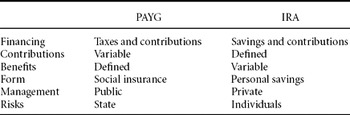
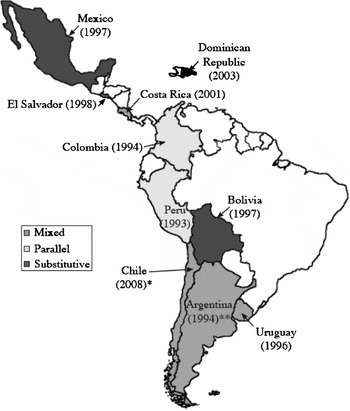
In 1981, Chile initiated old-age pension reforms that introduced mandatory funded individual retirement accounts (IRAs) and moved away from pay-as-you-go (PAYG) schemes. During the next one or two decades, nine other Latin American countries followed in Chile's wake: Argentina, Bolivia, Colombia, Costa Rica, Dominican Republic, El Salvador, Mexico, Peru and Uruguay. As illustrated in Table 1, this first round of reforms can be characterised as a full or partial shift from PAYG to IRAs schemes that involved a movement from: contributions and taxes to contributions and savings as the financing mechanism; variable to defined contributions; defined to variable benefits; social insurance to personal savings; public to private management; and state to individual risk-sharing. Figure 1 complements Table 1 and illustrates that pension reforms were more complex than a uniform movement between two extremes. The first round of pension reforms in Latin America can be divided in three different types: in ‘mixed’ reforms, IRAs complemented the PAYG scheme; in ‘parallel’ reforms, IRAs were created as an alternative to the PAYG scheme; and in ‘substitutive’ reforms, IRAs replaced the PAYG scheme (Mesa-Lago, Reference Mesa-Lago2004a).
Comparison of PAYG and IRAs old-age pension schemes

Source: Authors’ elaboration.
Structural reforms to old-age pension systems in Latin America.
Note: * Substitutive in 1981; ** Re-nationalised in 2008.
Source: Authors’ elaboration based on Mesa-Lago, Reference Mesa-Lago2004a; Gill et al., Reference Gill, Packard and Yermo2005; and US Social Security Administration, 2003–2008, 2008b.

In recent years, even before the onset of the financial crisis, a second round of pension reforms was initiated to strengthen the public component and address the problems created by individual accounts (Kay and Sinha, Reference Kay and Sinha2008). The most notorious case is Argentina, where IRAs have been recently eliminated and replaced by a full PAYG pension system (Poder Ejecutivo Nacional, 2008; Cottani, Reference Cottani2008; Economist, 2008).
Using a comparative historical approach and policy analysis techniques, this article reviews the two rounds of pension reforms to determine whether Latin American countries are moving away from individual pensions. We incorporate into our analysis the influence of the recent financial crisis, which is placing new challenges to pension systems worldwide. We base our analysis on ten countries that introduced some form of IRAs since 1981. Three other countries – Ecuador, Nicaragua and Panama – are not included because IRAs are not fully implemented or because no revisions have been introduced to the system. Countries such as Brazil are excluded from the analysis because they reformed their pension systems without moving towards IRAs. Brazil, however, has a long history with occupational plans managed by private companies and more recently allowed sub-national state governments to create supplementary occupational pension plans.
Many differences can be found among the Latin American countries that we analyse. However, even though Latin America is quite heterogeneous, its labour markets and social security systems share some common features such as a large informal economy and a variety of uncoordinated institutions providing old-age income protection (Gill et al., Reference Gill, Packard and Yermo2005; Kritzer, Reference Kritzer2000; Marier and Mayer, Reference Marier and Mayer2007). These features provide a common ground for pension reform in the region and allow us to compare two rounds of pension reforms, maintaining other aspects relatively constant.
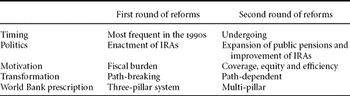
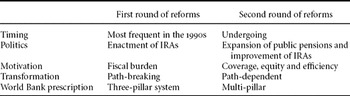
Table 2 includes a brief summary of some elements of the two rounds of pension reform that we have discussed above, but, more importantly, it incorporates other elements and serves as a guide to the analysis that follows.
Comparison of first and second round of old-age pension reforms in Latin America
Source: Authors’ elaboration.
First round of pension reforms: the politics of IRA enactment
During the late twentieth century, but particularly during the 1990s, the fear of large fiscal imbalances and mismanaged pay-as-you-go (PAYG) pension schemes prompted ten Latin American countries to enact IRAs (see Figure 1). Although the reforms improved long-term system sustainability, problems such as low coverage, a shrinking social safety net and imperfect regulatory frameworks, remained.
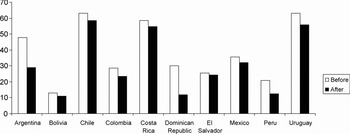
IRAs were intended to create a stronger link between benefits and contributions to get workers to view their contributions as personal savings rather than as a tax. This mindset would in turn encourage workers to contribute and increase coverage and compliance rates. However, the evidence from Latin America suggests that introducing IRAs did not improve coverage and compliance rates (ECLAC, 2006; Rofman and Lucchetti, Reference Rofman and Lucchetti2006; Mesa-Lago, Reference Mesa-Lago2008). Figure 2 shows that coverage rates, measured as the ratio of contributors to workers, actually declined after the reforms. This result clearly illustrates that structural features of labour markets are more relevant than pension system design in driving coverage.
Coverage rates in Latin America before and after first round of old-age pension reforms.
Note: Coverage is measured as contributors/economically active population at two time-points: the year before the reform, and in 2002.
Source: Adapted from Mesa-Lago, Reference Mesa-Lago2005; Rofman and Luccetti, Reference Rofman and Lucchetti2006.

Numerous other factors, including the type of benefits offered, funding mechanisms, administrative arrangements and incentives, explain the variations in coverage (Bertranou, Reference Bertranou and Bertranou2004; Calvo and Williamson, Reference Calvo and Williamson2008; FIAP, 2006). For example, the 1994 reform in Argentina raised retirement ages and vesting periods, creating stricter conditions to access benefits and thus reducing benefit coverage for the population aged 65 and over from 78 per cent in 1992 to about 65 per cent in the mid-2000s. In addition, unemployment, informal labour markets and cultural factors are strong determinants of compliance and coverage rates.
Besides their failure to expand pension coverage, IRAs also removed some solidarity or redistributive mechanisms of PAYG schemes (Mesa-Lago, Reference Mesa-Lago2004b). Although with important limitations, PAYG schemes involve not only intergenerational redistribution (contributions from active workers are used to pay the bill of retirees) but also redistribution between income groups (they aim to transfer income across different cohorts).Footnote 1 In contrast, IRAs are based on personal savings and leave the responsibility of income redistribution to social assistance and minimum pensions provided by state-run programmes. As contributory coverage declined or remained stagnant, social safety net and non-contributory programmes have grown in number of beneficiaries in several countries such as Argentina, Chile and Colombia, among others.
A third challenging area of IRA reforms relates to imperfect regulations, such as protection from political interference (Bertranou et al., Reference Bertranou, Rofman and Grushka2003; Calvo and Williamson, Reference Calvo and Williamson2008; Gill et al., Reference Gill, Packard and Yermo2005). Although PAYG may also suffer from weak regulations, IRAs were oversold in their capacity to prevent political manipulation. A driving reason for reform towards private administration was the intention to create pension systems highly insulated from political intervention; however, the evidence suggests that the reformed systems remain vulnerable to political manipulation. For example, loose regulation led to ambiguous approaches to transition rules in Bolivia and in the early 2000s allowed the government of Argentina to defer its debt by ‘selling’ bonds to fund management companies until a default occurred.
Because of low coverage rates and decreased solidarity, governments continue financing a substantial part of the pension bill and public institutions continue managing pension benefits, including defined benefit, minimum guaranteed benefits and social assistance pensions. Public institutions also work as guarantors of the private IRA scheme. In sum, although IRAs play an important role in reformed pension systems in Latin America, their enactment did not result in a full withdrawal of governments from the pension systems (Barr, Reference Barr2002; Kay and Sinha, Reference Kay and Sinha2008; Schulz, Reference Schulz, Kay and Sinha2009; Williamson, Reference Williamson2001). As has been pointed out previously, the line between private and public can be ‘fuzzy’ when states regulate, promote, finance and mandate private pension provision (Béland and Gran, Reference Béland and Gran2008).
Second round of pension reforms: the politics of expansion of public pensions and improvement of IRAs
During the last few years, Latin America has started a second round of pension reforms in response to the shortcomings of IRAs. The new political context is characterised by governments being less enthusiastic about privatisation. The reforms are resulting in a significant revival of public components in old-age income maintenance systems in an attempt to better balance social risks with individual savings. The case that best illustrates this trend is Chile, where a comprehensive pension bill was approved in 2008 (Barr and Diamond, Reference Barr and Diamond2008; Kritzer, Reference Kritzer2008; Vial and Melguizo, Reference Vial and Melguizo2008). The 2008–09 financial turmoil will probably reinforce the changes of the second round of reforms in Latin America. The most extreme case is Argentina, which re-nationalised IRAs, partly in response to the financial crisis.
The revival of public pensions
Public institutions have maintained an important role even after privatisation. In the second round of reforms, the direct involvement of public institutions in pension provision has been reinforced in three ways: (1) allowing workers to switch back to the PAYG scheme; (2) incorporating solidarity and income redistribution mechanisms; and (3) creating new public pension reserve funds.
Choice between IRAs and PAYG
The first round of reforms generally established that new workers were to join the IRAs, with no option to switch back to the PAYG scheme. Perhaps one of the more radical transformations of the second round of pension reforms has been allowing some workers to switch back to the PAYG scheme (US Social Security Administration, 2007–09, 2007–04, 2005–02, 2004–04). For example, in 2007 Peru permitted workers enrolled in IRAs to rejoin the PAYG scheme if they had contributed to the PAYG scheme before 1996 and met conditions to retire under that scheme. This law aimed to increase pensions for eligible workers who would have otherwise received a smaller pension in the IRA scheme. In 2008, Uruguay also enacted regulations that allowed some affiliates to leave IRAs and switch back to the defined benefit scheme. Argentina had taken the reforms one step further before the re-nationalisation in 2008. During 2007, the government changed the default affiliation to the PAYG scheme for workers entering the formal labour market and – for a six-month window – allowed individuals already in the IRA scheme to switch back to the PAYG scheme. Notably, of those eligible to switch, 80 per cent stayed in the IRA scheme. In addition, individuals within ten years of retirement with low IRA balances were automatically transferred to the PAYG scheme. Insured workers with low balances were defined as those that, at the normal age of retirement, would not be able to buy an annuity equivalent to the minimum pension paid by the defined benefit scheme. Furthermore, the variable percentage of the replacement rate paid by the PAYG scheme for each year of contribution increased from 0.85 per cent to 1.5 per cent of pre-retirement wages. This means that for a worker retiring with 30 years of contributions, the replacement rate would increase from 25.5 per cent (30*0.85) to 45 per cent (30*1.5). Note that this benefit is paid on top of the basic pension. This change considerably raised the rate of return on contributions made to the public defined benefit scheme. In 2008, Argentina decided to re-nationalise its IRA scheme (Cottani, Reference Cottani2008; Economist, 2008; The Wall Street Journal, 2008). The government justified this aggressive move as a reaction to the financial market crisis, but reducing its budget constraints was clearly a big incentive. The approved bill stated that by January 2009 IRA funds were to be absorbed by the public PAYG scheme.
Solidarity and income redistribution
The first round of pension reforms partially removed important solidarity and redistribution mechanisms. In response, several countries introduced cash transfer programmes and expanded their non-contributory pensions, financed by general tax revenue, to supplement contributory pensions and protect older people against poverty (Consejo Asesor Presidencial Para la Reforma Previsional, 2006; US Social Security Administration, 2008–02, 2007–01, 2006–07, 2003–12). Using the World Bank conceptual framework, the traditional three-pillar system prescription (including mandatory PAYG, mandatory IRAs and voluntary savings) has been superseded by a multi-pillar approach, including two new poverty prevention pillars: non-contributory pensions and non-financial informal support (Gill et al., Reference Gill, Packard and Yermo2005). For example, El Salvador created a subsidy for retirees receiving IRA benefits that are lower than they would have been under the old PAYG scheme. In early 2008, Chile approved a pension reform bill aiming to provide universal and more equitable benefits. The new system of ‘solidarity pensions’ gradually replaces the means-tested pensions and the guaranteed minimum pensions with two types of benefits: a non-contributory pension and a supplementary pension (top-up) benefit for those who have contributed to the private system. The supplementary monthly benefit starts at the level of the non-contributory solidarity pension and ends at about US$400. It also provides a tax credit for voluntary savings, which is targeted at low-income workers. Another interesting case is Colombia: in 2003, it introduced a solidarity pension fund, which pays non-contributory benefits and matches contributions for low-income workers. Although solidarity and income redistribution mechanisms have been enhanced elsewhere in the region, poverty reduction and gender equality are still considered missing or incomplete pieces of pension reform in Latin America (Barrientos, Reference Barrientos2006).
Reserve funds for public pensions
Latin American countries have also passed legislation creating separate reserve funds to provide greater financial stability and reduce the burden on general revenues of funding the government's pension obligations (US Social Security Administration, 2007–09, 2006–09). Chile has instituted two separate reserve funds (Pension Reserve Fund and Economic and Social Stabilisation Fund) in response to the large budget surpluses attributed to the country's record copper prices during recent years. Both funds are managed directly, not by the government but by the Central Bank (65 per cent of the funds) and third parties (35 per cent of the funds). In Argentina, a state-owned bank supervised by multiple institutions manages a Sustainability Fund, and a committee including members from different agencies oversees investment decisions.
Improvement of IRAs
Governments and private administrators have clearly acknowledged the shortcomings of IRAs and the need for intervention. However, this recognition does not necessarily imply the termination of IRAs, as happened in Argentina. The second round of pension reform in Latin America is also about revision and correction of the flaws of IRAs. Three examples of reforms aiming to improve IRAs are: (1) extending mandatory contributions to workers not currently covered; (2) lowering costs to account holders; and (3) changing the investment rules for pension assets.
Extend coverage. The first round of pension reforms typically made IRAs voluntary for self-employed workers. The second round extends mandatory participation to these workers (Consejo Asesor Presidencial Para la Reforma Previsional, 2006; US Social Security Administration, 2008–02, 2007–01, 2006–08, 2006–07, 2005–05). For example, following Costa Rica and Colombia, Chile will start requiring the self-employed to gradually join the IRA scheme by or before 2016. Mexico has enacted similar measures for the self-employed and has extended IRAs to federal public employees. Other countries, such as Peru, are also discussing compulsory savings for all categories of workers. In Chile, self-employed workers will be entitled to family allowances with the expectation that this will provide an incentive to join the system. Other countries are creating incentives by lowering the contribution rates, particularly for low-income self-employed workers. For instance, Argentina and Uruguay have created a small mono-tax instrument that simplifies the taxes and contributions levied, facilitating the administrative procedures and reducing its tax burden.
Lower IRAs costs. High administrative fees and premiums for survivors and disability insurance have lowered net rates of return for account holders and produced very large profits for many fund management and insurance companies (Centro de Estudios Públicos, 2006; Iglesias-Palau, Reference Iglesias-Palau2009). The problem has been aggravated by participants’ lack of awareness of the importance of fees (Holzman and Hinz, Reference Holzmann and Hinz2005; James et al., Reference James, Packard, Holzmann, Kay and Sinha2008). To lower costs for account holders, countries have implemented a number of measures (AIOS, 2007; US Social Security Administration, 2008–04, 2008–02, 2007–11, 2007–06, 2007–04, 2006–11, 2006–09, 2006–08, 2006–03, 2005–12, 2005–09, 2005–05, 2003–12). For example, in 2008 Mexico created an indicator to help account holders compare the net rate of return of pension fund management companies. New entrants to the labour force who do not choose a management company are assigned by default to the one with the highest rate of return. Transfers between companies are allowed once a year, but transfers to the company with the highest rate of return are now permitted without restrictions. In addition, companies are now allowed to charge a fee on account balances but not on monthly contributions. Countries such as El Salvador, Chile and Peru took a similar path. Even though these policies are expected to have a positive effect, it is difficult to predict their magnitude. Some of the instruments to induce lower costs rely on past performace and thus their actual effectiveness is uncertain.
Investment rules for pension assets
Portfolios have been heavily concentrated in government bonds, but new types of instruments and multi-fund strategies have been authorised during the second round of reforms. Numerous countries have implemented such changes, including Chile, Colombia, Mexico and Peru (AIOS, 2007; US Social Security Administration, 2008–04, 2007–08, 2006–12, 2006–08, 2006–01, 2005–03, 2004–06, 2003–12, 2003–10). Another way to cope with risks has been the implementation of multi-funds, where insured workers can choose among several risk-related portfolios. It is not clear that multi-funds have and would actually contribute to financial literacy and adequate returns for the average insured worker. Furthermore, the recent financial market turmoil resulted in serious declines in IRA saving assets, suggesting that they were too exposed to market risks. Numerous reasonable concerns have been raised on the limitations of letting workers choose high-risk portfolios.
Conclusion
This article addresses whether pension reforms in Latin America are moving away from IRAs. Although the idea is provocative, we conclude that the notion of ‘moving away from IRAs’ alone is insufficient to characterise the new politics and political economy of old-age pension reform. Table 2 summarises our argument. As opposed to what happened in the 1980s and 1990s, pension reforms in Latin America in recent years have combined a significant expansion of the public components of retirement income support with improvement of IRAs.
During the period of enactment, ten Latin American countries introduced mandatory funded IRAs as a full or partial replacement for the old PAYG public schemes. One remarkable aspect about this first round of pension reforms is that, even though it introduced substantial changes in funding and management, in most countries public institutions assumed a crucial role, not only as regulating agents, but also in managing and financing minimum guaranteed and social assistance pension benefits.
The second round of pension reforms, which began after 2005, has reinforced the involvement of public institutions in the pension system. In addition, numerous countries have introduced measures to improve IRAs. The driving force of the second round of reforms has been to increase coverage, equity and efficiency of the overall system. With the exception of Argentina, which has re-nationalised its pension system, the magnitude in the second round of reforms seems to be less radical compared to the path-breaking changes introduced by the first round. We characterise the recent transformations as path-dependent and shaped by policy feedbacks (Pierson, Reference Pierson2000); that is, constrained by the enduring impact of previously enacted IRAs.
The dominant policy prescriptions in vogue during the first round of reforms in Latin America – three pillars system – have been clearly re-evaluated (Kay and Sinha, Reference Kay and Sinha2008). As countries started to engage in a second round of reforms, the World Bank – and other international organisations that promoted IRA pension reforms – has acknowledged that more attention should be paid to mechanisms to reduce poverty in old-age, to expand coverage and equity and to protect participants from market risks. Non-contributory and universal pensions are recognised as playing a greater role. The experience and challenges faced by countries that introduced IRAs in their pension systems, the changes in policies by international financing institutions and the recent financial volatility and heavy losses experienced in financial markets may have tempered the enthusiasm of other countries from applying the same type of reforms. Scholars and policy-makers around the globe could benefit from looking closely at these changes in pension policy.
Acknowledgements
The authors would like to thank Ignacio Alvarez, Barbara E. Kritzer, James Schulz, John B. Williamson, and Center for Retirement Research colleagues for their comments and other forms of help in connection to this article. However, the authors should be held responsible for any remaining errors or inaccuracies.