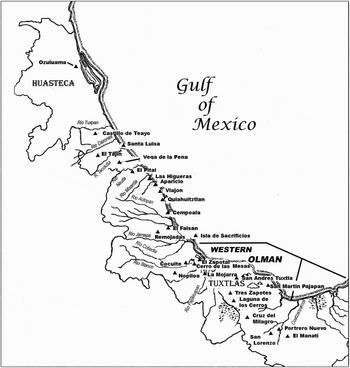
The Mixtequilla-Tuxtla region of south-central Veracruz lies at the northern extremity of the Gulf Olmec heartland (Figure 1). After the fall of Middle Formative centers further south, “Olmec” descendants continued to flourish in the Tuxtla Mountains and in the fertile zone of the Mixtequilla formed by the Río Blanco and Río Papaloapan (Pool Reference Pool2007:243–245, Reference Pool, Arnold III and Pool2008:121; Stark Reference Stark, Arnold III and Pool2008:85, 92–93, 95; Stark and Arnold Reference Stark, Arnold III, Stark and Arnold III1997:24–25). In the Late Formative period and throughout the Classic, people of this region produced an abundance of politico-religious art, known to us despite a paucity of archaeological excavation. Like their neighbors, the Maya, Veracruz sculptors created stelae with ruler portraits, hieroglyphic texts, and Long Count dates as evidenced at Tres Zapotes, La Mojarra, and Cerro de las Mesas (Coe and Koontz Reference Coe and Koontz2002:121; Justeson and Kaufman Reference Justeson, Kaufman, Arnold III and Pool2008:159–194; Miller Reference Miller and Stark1991), and they achieved an unsurpassed mastery in ceramic arts, especially in and around the Río Blanco. This river lends its name to fine paste bowls of porcelain-like consistency sculpted with narrative scenes. Clays were used to form pyramidal mounds; architectural features; wheeled toys; impish, dwarf-like figures, some with moving limbs; and life-sized terracotta figures from El Zapotal as individually magnificent as the Chinese ancient treasures from Xi'an.
Location of western Olman within Veracruz. Drawing by the author.

While images of El Zapotal sculpture have been widely published, comparatively little is known of the site's paintings. Narrative scenes from the funerary banquette of Mound 2 offer isolated examples of an all but lost tradition.
Mexican iconographer Sara Ladrón de Guevara believes that the Classic Veracruz paintings at El Tajin, Las Higueras, and El Zapotal represent three distinct traditions whose respective style, themes, and iconography are an outgrowth of semiautonomous regional developments (Ladrón de Guevara Reference Ladrón de Guevara2005:21–32). Classic Veracruz elites from these areas shared a vocabulary of gods and prestige items (Daneels Reference Daneels, Stark and Arnold III1997:243). Painting appears to be part of this exchange process, with murals predominately found on the so-called banquette or adoratorio form that consists of truncated walls arranged in a rectangular or modified U-configuration.
SITE SETTING AND HISTORY
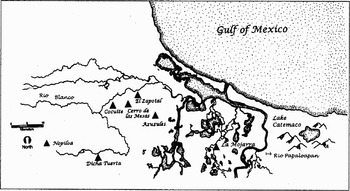
The archaeological site of El Zapotal (ca. a.d. 800–1000) is 40 km south of the modern city of Veracruz, but an hour and a half away as one ventures from the dune-lined coastal highway into a rural backwater of roads cratered with pot holes from ever-present rains. Despite a small on-site museum, there is no sign directing the visitor to the archaeological zone, yet names of small villages and geographic features within the municipalities of Tlalixcoyan and Ignacio de la Llave (including Cerro de las Mesas, Cocuite, Dicha Tuerta, and Nopiloa) have come to be associated with Classic Veracruz art (Figure 2).
Mixtequillia-Tuxtla region showing location of El Zapotal. Adapted from Stark (Reference Stark, Arnold III and Pool2008:89, Figure 3). Drawing by the author.

El Zapotal rewards the intrepid traveler with the context that activates the art beyond the aesthetic. Mound 2, preserved in situ within a concrete and metal roofed structure, forms a funerary complex combining architectural features, mural paintings, sculpture, ceramics, and human skeletal remains—working in concert to create a larger narrative program (Wyllie Reference Wyllie, Arnold III and Pool2008:234). The still larger context is the region itself—blanketed with mounds, most unexcavated. This includes the 30-m Cerro de Gallo, the highest structure at El Zapotal, first recorded by Matthew Stirling in 1943 (Coe Reference Coe, Willey and Wauchope1965; Stirling Reference Stirling1943:31–32). From its summit one can see the towering pyramids of Cerro de las Mesas through an expanse of green just three to four km away. The remoteness and vast untapped archaeological potential contributes to the region's mystery. The Mixtequilla has been a magnet for looters precisely because of this remoteness and archaeological wealth (Stark Reference Stark, Hall, Speaker, Yarborough and Stark2001:179, 186–187; Stirling Reference Stirling1943:32).
In 1971 authorities intercepted an international smuggling operation, recovering sculpture originating from El Zapotal outbound in the port of Veracruz (Sánchez Bonilla Reference Sánchez Bonilla2005:6). In response, the Instituto Nacional de Antropología e Historia (INAH) authorized archaeologist Manuel Torres Guzmán of Universidad Veracruzana to conduct archaeological excavations at El Zapotal in the area disturbed by looters, within an area known as Mound 2.
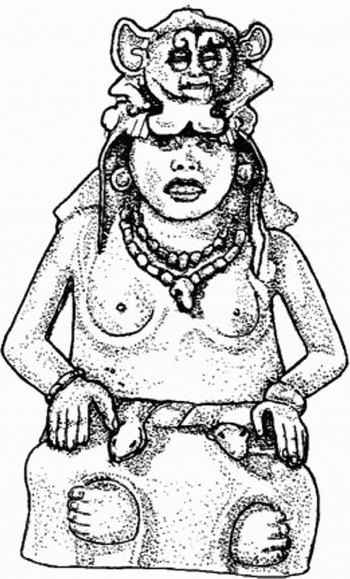
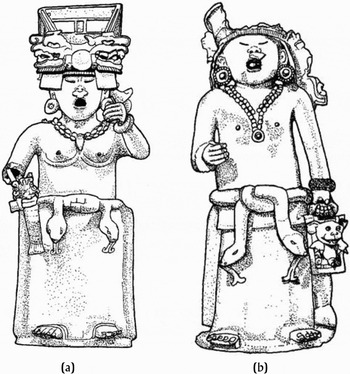
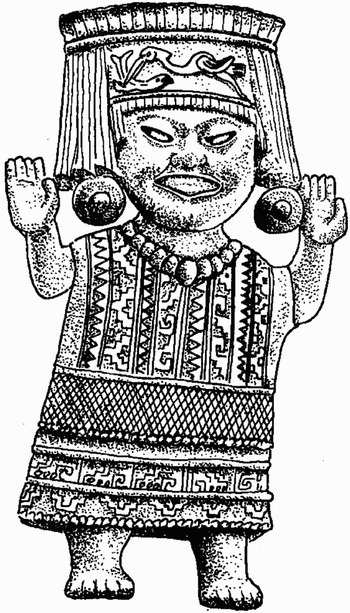
Torres Guzmán commenced fieldwork that same year, focusing on a platform area opened up by looters (Sánchez Bonilla Reference Sánchez Bonilla2005:7; Torres Guzmán et al. Reference Torres Guzmán, Reyes and Guevara1975). Following the direction of the looter's pit, he encountered four monumental terracotta figures of life-like women naked above the waist seated cross-legged in long skirts, and although attired similarly, each sculpture proved to be unique (Figure 3). Shortly thereafter, Torres Guzmán discovered 19 more life-sized female figures, garbed like the seated figures, but standing, ranging in height from 1–1.5 m, in varying states of preservation, some partially crushed by ground pressure, others perhaps ritually “killed” (Figure 4). The standing female figures, placed in two parallel rows, appeared to form a procession (Ladrón de Guevara Reference Ladrón de Guevara and Judith1997:128–129; Sánchez Bonilla Reference Sánchez Bonilla2005).
One of the seated life-sized terracotta female figure from El Zapotal Mound 2, believed to represent a midwife. Drawing by the author.

Standing life-sized terracotta female figures from El Zapotal Mound 2, representing women who died in childbirth. Drawing by the author.

Within this ossuary Torres Guzmán extracted 82 skulls from possible secondary burials, as well as primary burials of flexed skeletons with funerary offerings of Mayoide ceramic figures, sonrientes, and zoomorphic whistles, and a “column of human bones” (Sánchez Bonilla Reference Sánchez Bonilla2005:8). Small sculptured clay figures accompanied the human remains in the secondary burials: smiling face or “sonrientes,” marionette-like figures with moveable parts, and so-called Mayoide-type ceramic figures.
The next level was so crowded with offerings—this time with male clay figures (significantly smaller than their female counterparts), as well as anthropomorphic and zoomorphic whistles, wheeled toys, and ceramic vessels—that the team found it literally impossible to move within the space without knocking something over (Sánchez Bonilla Reference Sánchez Bonilla2005). In total the team discovered over 400 extraordinary offerings (Torres Guzmán Reference Torres Guzmán and Illescas2002:176, 178). All of these finds in and of themselves would have made El Zapotal a site of unprecedented importance within the region, but there was more to come.
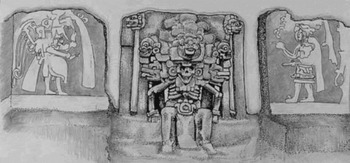
The following season Torres Guzmán and his team excavated new trenches, uncovering 40 more burials, including a multiple burial with three skulls accompanied by three Mayoide-type ceramic figures and four so-called “smiling faces,” as well as 23 primary burials, and eight secondary burials (Sánchez Bonilla Reference Sánchez Bonilla2005:8). Penetrating further into the structure Torres Guzmán came upon nine earthen steps leading toward the compact painted polychrome wall of the banquette and a larger-than-life skeletal figure—a masterwork of unbaked clay, 1.52 m high, still containing some of its original paint (Sánchez Bonilla Reference Sánchez Bonilla2005:8; Wyllie Reference Wyllie, Arnold III and Pool2008:236). This image of the Death God rests on a 60–70 cm high pyramidal platform, and forms the focal point of the U-shaped configuration of walls adorned with polychrome murals (Wyllie Reference Wyllie, Arnold III and Pool2008; Torres Guzmán Reference Torres Guzmán and Illescas2002:176–181) (Figure 5).
The banquette of El Zapotal Mound 2 showing location of the standing female sculpture. Adapted from Ladrón de Guevara (Reference Ladrón de Guevara and Judith1997:128, Figure 115). Drawing by the author.

Torres Guzmán recalled that during his six seasons at El Zapotal the team excavated more than 200 human burials, an assortment of yokes and hachas, sonrientes, medium sculpture of extraordinary quality, as well as monumental clay sculpture (Torres Guzmán Reference Torres Guzmán and Illescas2002:177, 181). Most of the remains of individuals accompanied by high-status offerings (95 persons or 41%) were discovered in the area close to the banquette and the Death God sculpture (Ortega Guevara Reference Ortega Guevara and Gorrochotegui2000:87).
Torres Guzmán (along with Antonio Reyes and Jaime Ortega Guevara) published a brief, preliminary report in 1975; however the much-anticipated site report never materialized before Torres Guzmán's death in 2007. During the past 30 years, short articles related to the excavations have sporadically appeared in Universidad Veracruzana and INAH, Veracruz, publications (Ortega Guevara Reference Ortega Guevara and Gorrochotegui2000:75–95; Sánchez Bonilla Reference Sánchez Bonilla2005; Torres Guzmán Reference Torres Guzmán1972, Reference Torres Guzmán1990, Reference Torres Guzmán1999:311–321; 2004).
Treatment of El Zapotal art has centered nearly exclusively on the sculpture. In 1977 Nelly Gutiérrez Solana and Susan K. Hamilton published Las Esculturas en Terracotta de El Zapotal, Veracruz, a catalogue of El Zapotal sculpture. Sara Ladrón de Guevara and her students at Universidad Veracruzana were the first to examine that sculpture within the context of a larger narrative program (Ladrón de Guevara Reference Ladrón de Guevara and Judith1997:127–129; 2005:21–32; Maldonado Vite Reference Maldonado Vite1995; Suzan Morales Reference Suzan Morales1997). Maria Eugenia Maldonado Vite produced preliminary drawings of the little–known murals, which accompanied her thesis. Ladrón de Guevara believes that Zapotal's painting tradition is a manifestation of themes and modes of depiction shared with nearby Cerro de las Mesas. Durdica Segota briefly described the murals in the edited volume Muros que hablan: Ensayos sobre la pintura mural prehispánica en México (2004:467–476). My own analysis of the works to date has focused on the paintings within the context of southern Veracruz narrative traditions (Wyllie Reference Wyllie, Arnold III and Pool2008).
Manuel Torres Guzmán drew on Aztec ethnohistory in his interpretation of El Zapotal's pictorial program. He suggested that the nine steps leading to the banquette represent the nine vertical levels leading to Mictlan, the Nahua Underworld, the realm ruled by the Death God, Mictlantecuhtli (Torres Guzmán et al. Reference Torres Guzmán, Reyes and Guevara1975) represented by the monumental skeletal figure rendered in clay. According to the later Mexicas or Aztecs, Mictlantecuhtli was joined in the afterlife by the Cihuateteo, revered women who died in the course of childbirth. Torres Guzmán reasoned that the life-sized terracotta female figures represent Cihuateteo, an interpretation that has been widely accepted. Maria Eugenia Maldonado interprets solar orbs painted on the eastern and western outer walls of the banquette as mapping the route taken by the Cihuateteo as they accompany the sun as it descends into the Underworld in the western sky, to be born anew each morning at sunrise (Maldonado Vite Reference Maldonado Vite1995). According to the Florentine Codex, “goddesses whom they named Ciuapipilti … were the women who died in first childbed. They said that they became goddesses and that they dwelt in the house of the sun.” (Sahagun Reference Sahagún, Anderson and Anderson1950–1982: Book 6:163). Torres Guzmán's credible analysis is further strengthened when we examine the analogous beliefs of Gulf Coast peoples, which permits greater regional, linguistic, and cultural specificity (see Bernal-Garcia Reference Bernal-Garcia, Robertson and Fields1994; Marcus Reference Marcus, Sharer and Grove1989:149; Tate Reference Tate1999).
No one knows the precise ethnic identity of El Zapotal's inhabitants, but candidates include Proto Mixe-Zoquean speaking Gulf Olmec descendants, Totonac speakers, and Nahuas. It is possible that these groups commingled in the Mixtequilla during the final phases of the Classic period (Aguirre Beltran Reference Aguirre Beltran1975; Arnold and Stark Reference Arnold III, Stark, Stark and Arnold III1997:324–325; Medellín Zenil Reference Medellín Zenil1960, Reference Medellín Zenil1971; Melgarejo Vivanco Reference Melgarejo Vivanco1947:28; Segota Reference Segota and de la Fuente2004:467; Stark Reference Stark, Arnold III and Pool2008:95; Stark and Arnold Reference Stark, Arnold III, Stark and Arnold III1997:29; Torres Guzmán Reference Torres Guzmán1970:11–12; Vargas Gonzáles Reference Vargas Gonzáles1998; Wyllie Reference Wyllie, Arnold III and Pool2008:232).
I have argued elsewhere that El Zapotal was probably the domain of Mixe-Zoquean speaking people, descendants of the Formative period Gulf Olmecs (Wyllie Reference Wyllie, Arnold III and Pool2008). Several scholars believe that the “Heartland Olmec” were proto Mixe-Zoquean speakers (Campbell and Kaufman Reference Campbell and Kaufman1976; Diehl Reference Diehl2004:13; Justeson and Kaufman Reference Justeson and Kaufman1993, Reference Justeson, Kaufman, Arnold III and Pool2008; Wichmann Reference Wichmann1995). Descendants of the Formative Olmecs divided into geographically isolated populations, with Mixe-Zoque separating into Mixe and Zoque language groups around a.d. 100 (Báez-Jorge Reference Báez-Jorge1973; Delgado Calderón Reference Delgado Calderón, Sandstrom and Valencia2005; Morales Fernandez Reference Morales Fernández1971; Münch Galindo Reference Münch Galindo1983). The Zoquean language (including Popoluca) was spoken throughout the Mixtequilla-Tuxtla region and southern Veracruz until sometime during the Classic period, when new groups, such as Nahuas and Totonacs, arrived on the scene (Aguirre Beltran Reference Aguirre Beltran1975; Arnold and Stark Reference Arnold III, Stark, Stark and Arnold III1997:324–325; Medellín Zenil Reference Medellín Zenil1960; Melgarejo Vivanco Reference Melgarejo Vivanco1947:28; Segota Reference Segota and de la Fuente2004:467; Stark Reference Stark, Arnold III and Pool2008:95; Stark and Arnold Reference Stark, Arnold III, Stark and Arnold III1997:29; Torres Guzmán Reference Torres Guzmán1970:11–12; Vargas Gonzáles Reference Vargas Gonzáles1998; Wyllie Reference Wyllie, Arnold III and Pool2008:232; also see Kaufman and Justeson Reference Kaufman, Justeson, Arnold III and Pool2008 and Justeson and Kauman 2008).
Settlement studies conducted by the Mixtequilla Archaeological Project by Barbara Stark and her colleagues observe patterns of continuity with change beginning in the Middle Preclassic period around 800 b.c. and continuing well into the Classic-Postclassic transition (ca. a.d. 1200) (Arnold and Stark Reference Arnold III, Stark, Stark and Arnold III1997:324–325). There is no evidence of a major shift in population. Stylistic traits along with evidence in architectural materials and planning, ceramic technology, glottochronology, hieroglyphic conventions, and physical anthropology collectively affirm a group identity forged during the Formative period and with credible lines of cultural continuity in the Mixtequilla-Papoloapan-Tuxtla region until the Late Classic period.
The Popoluca of southeastern Veracruz speak a Mixe-Zoquean language (Báez-Jorge and Báez Galván Reference Báez-Jorge, Galván, Sandstrom and Valencia2005:139–140). They are likely descendants of people who inhabited the Mixtequilla-Tuxtlas region for two thousand years, until around a.d. 1000 when they were gradually displaced by people from central Mexico. Torres Guzmán notes that he found it nearly impossible to differentiate “Totonac” and “Olmec” cultural material in the region (Torres Guzmán Reference Torres Guzmán1970:11–12). Iconography in the elite art of the Mixtequilla, viewed in connection with historic period Totonac religious practices, offers one line of evidence suggesting that during the final phases of the Classic period (ca. a.d. 750–1100) influence from these newcomers was being actively integrated into cosmology and ritual. Another possibility is that the newcomers themselves became the ruling elite, a hypothesis that might help to explain new costumes worn by rulers depicted on late-phase Cerro de las Mesas stelae (discussed below), along with the abandonment of Long Count dates and substantial hieroglyphic texts on these same monuments (Wyllie Reference Wyllie, Arnold III and Pool2008:228–234).
THE SKELETAL DEATH GOD
The Death God sculpture bears mentioning not only because of its commanding size, but also because of its fundamental relationship with the surrounding paintings. According to the Mixe-Zoquean speaking Popoluca of southern Veracruz, Chane or Chaneco is King of the Earth (Báez-Jorge and Báez Galván Reference Báez-Jorge, Galván, Sandstrom and Valencia2005:151), a duty clearly performed by the enthroned skeletal figure. Chane's Nahua counterpart is Mictlantecuhtli, the skeletal deity best known from Aztec mythology.
The Zapotal Death God wears a thick belt with a spouting maize symbol at the center. Rulers wear this symbol on La Mojarra and Cerro de las Mesas stelae. It is an unmistakable marker of kingship. This also links southern Veracruz rulers with the Maize God, who the Popoluca call Homshuk. According to Báez-Jorge and Báez Galván (Reference Báez-Jorge, Galván, Sandstrom and Valencia2005:151), Homshuk “occupies the center of Popoluca religious beliefs.” He is associated with death, resurrection, and the sun, principal themes in the pictorial program of Mound 2.
Homshuk has correlates in Chichini, the Totonac sun god and creator, the discoverer and provider of maize (Valderrama Rouy Reference Valderrama Rouy, Sandstrom and Valencia2005:204–205). Reigning beneath the earth in the Land of the Dead, which the Sierra Totonac call Nakatampin, is the storm god Aktsini or Old Thunder, Chinichi's rival (Harvey and Kelly Reference Harvey, Kelly and Vogt1969:671–672; Ichon Reference Ichon1973:48; Valderrama Rouy Reference Valderrama Rouy, Sandstrom and Valencia2005:204–205), and like the polarity between Homshuk and his nemesis Hurricane (Foster Reference Foster, Vogt and Wauchope1969:473), the contest between the sun-maize and water-storm god allows life-sustaining symbiosis. Sandstrom (Reference Sandstrom, Monaghan, Edmonson, Monaghan and Edmonson2000:83–87; Reference Sandstrom, Sandstrom and Valencia2005:15–16) notes fundamental similarities in the ideology and ritual symbolism of contemporary Gulf Coast cultures, which he believes maintain a unique regional identity within the context of Mesoamerica.
THE PAINTINGS
Visiting El Zapotal in 2003 and recognizing the important information the murals provide for understanding Veracruz art and ritual, I requested permission from INAH, Veracruz, to draw them. Permission was granted with the provisions that I (1) not use artificial lighting, (2) conduct my work under the supervision of the El Zapotal site museum staff, and (3) maintain a distance from the paintings and not touch them.
The funerary chamber is dimly lit; and the paintings are extremely worn. As my eyes adjusted, or light subtly shifted at certain times of the day, new details emerged. In the evenings I checked my drawings against those in Maldonado's thesis, which resulted in several stages of drawing and revision. The condition of the El Zapotal paintings and lack of color contrasts make them difficult to photograph. Given the physical constraints of the project, scale is approximate. Light/dark contrast is likewise amplified, highlighting iconographic details and pictorial narrative for the purpose of “reading” the paintings. Individual panels are reproduced here in gray-scale since poor preservation makes it nearly impossible to see the original colors without multispectral lighting and amplification.
The artist painted directly over the unbaked clay walls of the banquette in hues of black, white, ocher, yellow, red, green, and blue (Ségota 2004:472). Dúrdiga Ségota believes that the direct application of pigment on clay has accelerated the deterioration of the murals (Ségota 2004:476). The majority of the colors have disappeared (especially the blues, greens, yellows and ochers). Without special lighting, one sees deities and costumed figures rendered in cream-colored pigment over a now faded maroon-red background. Slightly darker beige or brown paint was used for details, although few of these details now remain. In a couple of instances, the artist highlighted prestige items in aqua blue. Most human and supernatural figures are rendered in profile and stand atop thick cream-colored ground-lines.
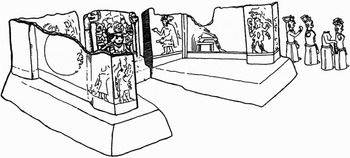
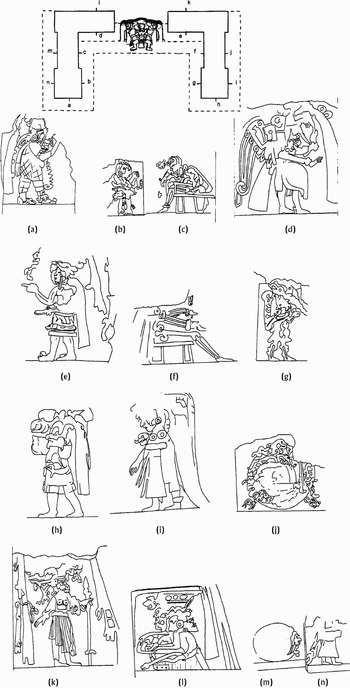
A thick earthen base supports both the Death God sculpture and painted walls (Figure 6). The clay walls, while not contiguous, are roughly the same height as the sculpture. Murals cover all available surfaces of the banquette walls, with paintings consisting of 12 anthropomorphic figures and two circular disks, the latter identified as solar symbols or suns (Ladrón de Guevara Reference Ladrón de Guevara and Judith1997; Maldonado Vite Reference Maldonado Vite1995; Torres Guzmán Reference Torres Guzmán1990, Reference Torres Guzmán, Lopez and Sánchez2004; Wyllie Reference Wyllie, Arnold III and Pool2008). I found no obvious narrative sequence connecting the paintings. What seems clearer is that the paintings are thematically related; consonant with ceramic sculpture, funerary offerings, and human skeletal remains to form a narrative program centered within the banquette sanctuary (Figure 7).
Veracruz Death God and adjacent mural paintings. El Zapotal Mound 2. Drawing by the author.

Diagram of the Mound 2 banquette showing the location of the paintings. Drawing by the author.

Death Gods and attendants: Interior East and West walls
The polychrome clay figure of the Death God forms the heart of the U-shaped banquette and associated sculpture, indicated by its central placement and grand scale. Nearly all of the painted profiled figures adorning the earthen walls direct their attentions toward this skeletal presence, even those located on the rear panels (oriented toward the Death God's back). The exceptions are the two inner panels running perpendicular to the “base” of the U-shaped configuration (Panels C and F). These scenes replicate the skeletal deity's lordly presence, emanating two-dimensionally from either side of the plane that consists of the Death God sculpture and adjacent panels (Wyllie Reference Wyllie, Arnold III and Pool2008:236–237).
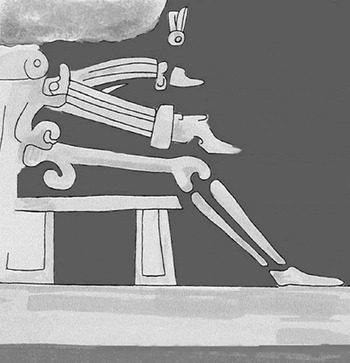
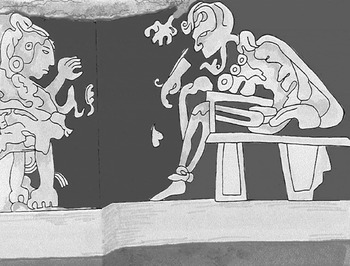
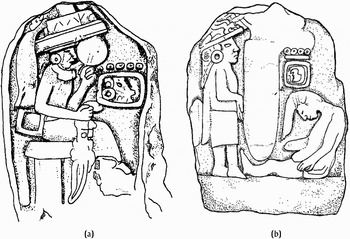
Like the large clay sculpture, these painted death lords rest atop slab-footed, backless thrones. Ladrón de Guevara (Reference Ladrón de Guevara2005:28–29) offers a compelling visual comparison between these Underworld thrones and those used by local Late Classic rulers, as seen on Cerro de las Mesas ST 4. The Death God on the west side of the banquette (Panel F) (Figure 8) is headless, owing to erosion on the upper portion of the wall. A rain or fertility symbol falls towards his bony, outstretched hand. His counterpart on the opposite wall to the east (Panel C) (Figure 9b) is more fully articulated. He leans forward, as though weighed down by his thick circular beaded necklace, or hunched by age, mouth open, his crooked figure pointing down toward a lobed droplet descending to the ground by his foot. In front of his head we see a bilobed shape, possibly a multi-petal flower.
Panel F, showing the El Zapotal Death God. Drawing by the author.

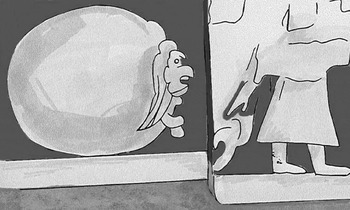
Panel B (left) showing dwarf-like attendant facing Panel C (right), the El Zapotal Death God. Drawing by the author.

The Death God of the east wall is clearly interacting with a small dwarf-like attendee (Figure 9a), most likely one of the chenneques, who the Mixe-Zoque speaking Popolulca of southern Veracruz believe serve Chane, lord of the Underworld (Báez-Jorge and Báez Galván Reference Báez-Jorge, Galván, Sandstrom and Valencia2005:151; Foster Reference Foster, Vogt and Wauchope1969:473). The small figure raises its hand (or hands) in homage. A heron adorns his headdress. His posture and costume identify him as one of the so-called smiling figures or sonrientes, the ubiquitous impish clay figures associated with the nearby Remojadas culture. Hermann Strebel first published images of these “smiling figures” from the region in 1899, attributing them to Cerro de las Mesas (Stirling Reference Stirling1943:32). Stirling (Reference Stirling1943:32) writes that this “laughing face type” occurred “abundantly at the nearby sites of Joaquin, Cerro de Gallo [Zapotal], and Cocuite”.
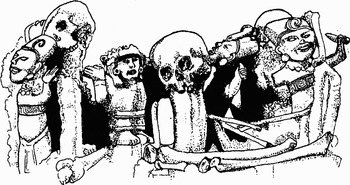
Herons, a common bird in the rivers and estuaries of the Mixtequilla, are one of the symbols found decorating the Cossack-shaped headdress worn by these figures (Figure 10). Several sonrientes were found in association with primary and secondary burials at El Zapotal (Figure 11), and so like the chenneque attending the Death God on the painted walls, similar enigmatic creatures serve as guardians or attendees to human skeletal remains. This suggests a fundamental interplay between painting, sculpture, architectural features, and human burial remains.
“Smiling face” or sonrientes figurine with heron headdress from Mound 2. Drawing by the author.

Ceramic sculpture and human skeletal remains from a secondary burial located next to the entrance to the inner sanctuary of Mound 2. Drawing by the author.

Harvey and Kelly (Reference Harvey, Kelly and Vogt1969:671) tell us that among the Totonac “the short ones” inhabit the domain “where the Sun rises and sets …. tiny people who take refuge underground each day.” The Owner of the Underworld and the Sprits of the Dead also reside beneath the earth along with the Mothers of the Hearthstones (spirits of diseased midwives) (Harvey and Kelly Reference Harvey, Kelly and Vogt1969:672; Wyllie Reference Wyllie, Arnold III and Pool2008:240–241).
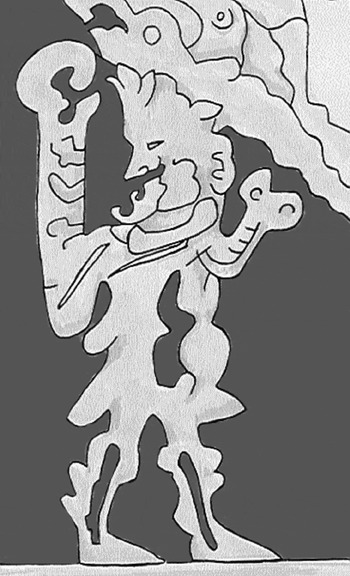
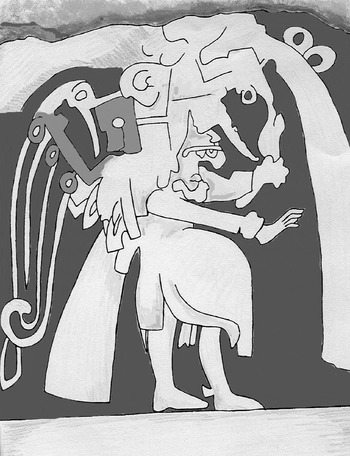
Curiously, the Death God painted on the west wall has no dwarf-like attendant. Instead, a queer composite being twists to face him (Panel G) (Figure 12). Its profiled feet point away from the seated skeleton, while his sharp-nosed and ragged-edged profile seems to acknowledge him. Among contemporary Popoluca the junchuch or cha'to are small, anthropophagous beings whose feet are backward, thus leaving behind a confusing trail of footprints (Báez-Jorge and Báez Galván Reference Báez-Jorge, Galván, Sandstrom and Valencia2005:152). It is interesting to note that both lobsters and crayfish propel themselves backward through the water.
Panel G. Twisted, lobster-clawed figure facing the Death God on Panel F. Drawing by the author.

The figure in the painting appears to be part crustacean. Crabs and crayfish abound in the mangroves separating the dune-lined coast from the fresh water lakes and rivers of the Mixtequilla, although the creature possesses two very differently sized claws that are more characteristic of a lobster. At Bonampak, Room 1, Maya artists painted a lobster-clawed performer taking part in rituals along with dancers and musicians. Some of the Bonampak musicians play maracas. The figure in Panel A of the El Zapotal paintings also plays maracas or rattles.
Panels flanking the entrance to the banquette's inner sanctuary
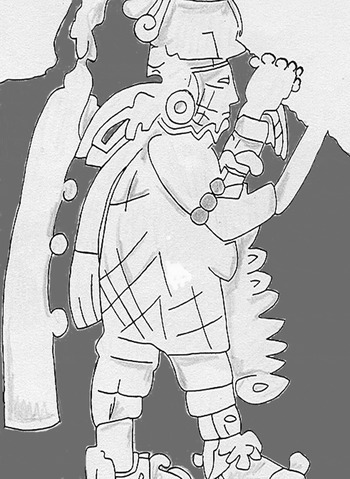
The El Zapotal musician in Panel A, wearing a feather-edged cape moves toward the inner sanctuary of the U-shaped enclosure (Figure 13). He (perhaps she) wears a quilted costume, towering headdress with long train, sandals, earspools, and an armband that consists of large turquoise or jade beads highlighted in pale blue. He takes a prominent place within the framework of the narrative.
Panel A showing a musician playing rattles. Drawing by the author.

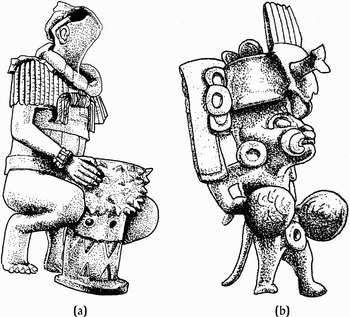
El Zapotal musicians play instruments beyond the two-dimensional constraints of the banquette, as seen in a crouching drummer and small figure in animal costume carrying a pair of gourd-shaped maracas, both rendered in terracotta (Figure 14a and 14b) (Gutiérrez Solana and Hamilton Reference Gutiérrez Solana and Hamilton1977:59–60, 67; Figures 26 and 33, Plates 21 and 30). Whether painted or sculpted, figures are depicted in motion, so that the movement of these ritual actors accompanied by their painted and clay percussionists evokes the synesthetic realm of sound. Within this tomb, the static is animated, depth punctures the flatland of the picture plane, and the dead emerge into the afterlife. It is little wonder that the Cihuateteo appear to be singing in procession as they “move” away from the banquette.
Terracotta sculpture depicting musicians from El Zapotal Mound 2: a drummer (a) and rodent playing rattles (b). After Gutierrez Solana and Hamilton 1977 Plates 21 and 30. Drawing by author.

Stark (Reference Stark and Stark2001:304) has uncovered Classic period deposits in the Mixtequilla containing figurine-shaped whistles, flutes, and ocarinas. Animated bird figures and musicians also adorn a Río Blanco bowl with figures wearing costumes associated with long-distance merchants. I have related these scenes to the cyclical reenactment of creation stories associated with the birth of a new Sun or epoch, born through sacrifice (Wyllie Reference Wyllie, Arnold III and Pool2008:247–251; also see Koontz Reference Koontz, Arnold III and Pool2008).
Throughout the Mexican Gulf Coast musical accompaniment formed a key part of Classic Veracruz ritual (Wyllie Reference Wyllie, Arnold III and Pool2008). On the Las Higueras murals trumpets blare. On a panel from the El Tajin South Ballcourt two musicians, one playing rattles, the other a small drum, flank a bird deity as he oversees the sacrifice of a ballplayer (Koontz Reference Koontz, Arnold III and Pool2008; Wyllie Reference Wyllie, Arnold III and Pool2008:249–250).
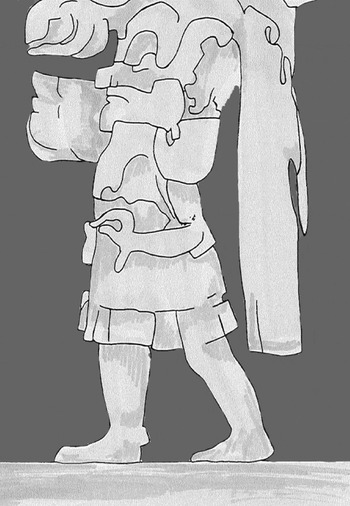
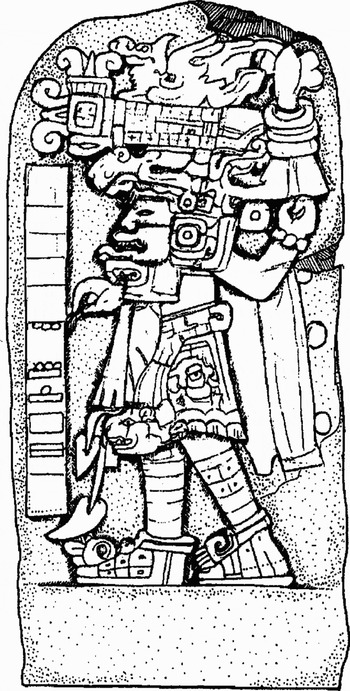
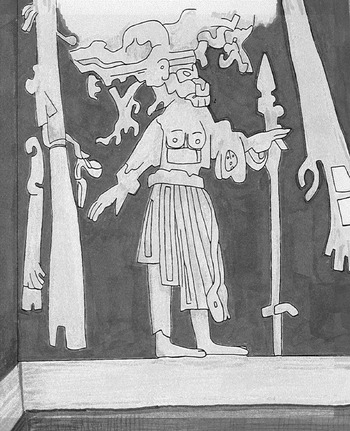
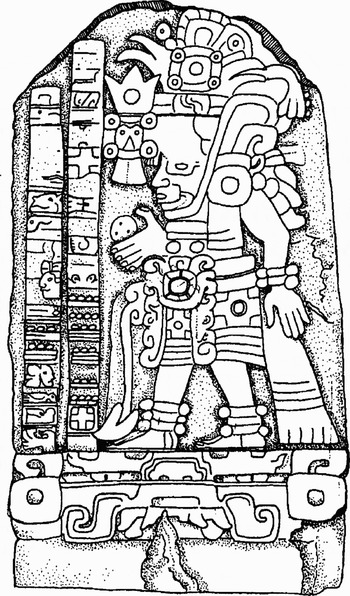
Opposite the musician, the masked figure in Panel H (Figure 15), depicted mid-stride, pinches thumb and forefinger together in a mudra-like gesture characteristic of rulers on Cerro de las Mesas stelae. He wears a kilt and elaborate flower-fronted headdress. Ladrón de Guevara (Reference Ladrón de Guevara2005) equates his costume and posture with rulers on Classic period stelae from nearby Cerro de las Mesas. On Stela 5, as on the El Zapotal panel, the character strides toward the left, right foot extended, his thumb and forefinger pressed together (Figure 16). Both have trains trailing just below the back of the knee. The El Zapotal Panel H figure is undoubtedly a ruler.
Panel H showing figure in a ruler's costume. Drawing by the author.

Cerro de las Mesas Stela 5. Drawing by the author.

The flower forming the central component found at the base of the ruler's headdress is found on several Cerro de las Mesas stelae as well as other figures portrayed on the El Zapotal paintings. The three-petal flower ornament may be a water lily, found abundantly in the lake, ponds, and rivers of the Mixtequilla.
I believe that three or more figures on the El Zapotal paintings represent kings. Water lilies or another type of simple-shaped flower protrude from the center of the headdresses on figures in Panels C, H, and L. On the earliest Cerro de las Mesas stelae, rulers wear a stylized version of the headdress flower commonly referred to as the Jester God head ornament. Although associated with Maya royalty, the tri-lobed feature, initially associated with sprouting maize, first appears at Formative period La Venta (Miller and Taube Reference Miller and Taube1993:104; Taube Reference Taube1996). As mentioned above, the Death God wears this classifier at the center of his waist. During the Late Classic period the aquatic flower is introduced. Possibly the two plants substitute for one another, while encoding different meanings. A full-frontal flower forms the central component in the jaguar headdress of the goggle-eyed figure in Late Classic Cerro de las Mesas Stela 15 (Figure 17). Both Cerro de las Mesas ST 15 and ruler figures on El Zapotal panels may have a correlate in Water Lily Jaguar one of the Maya denizens of the Underworld.
Cerro de las Mesas Stela 15. Adapted from Stirling (Reference Stirling1943:40, Figure 14a). Drawing by the author.

PANELS FACING THE DEATH GOD SCULPTURE: INNER SANCTUARY
Two figures flank the sculpture of the Death God in the innermost sanctuary of the enclosure—on Panel D (to the viewer's left) an obviously-pregnant skeletal figure in elaborate regalia, and on Panel E a warrior wearing a coyote pelt. These likely symbolize the “warriors” who die in battle, continuing on in the afterlife as part of the entourage of the Sun, who nightly descends into the Underworld, only to be resurrected each morning.
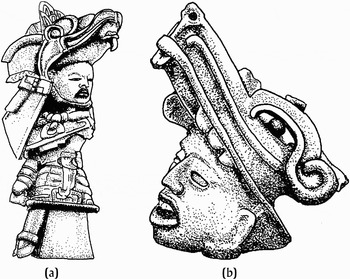
The Panel E figure (Figure 18) wears the animal's head and hide draped over his own head and shoulders, forming the impression of a hooded cape. The costume may symbolize a knightly order, not unlike the elite Eagle and Jaguar knights of the Postclassic Mexica. This costume is common in Classic period art from the Mixtequilla. Terracotta figures shown wearing coyote headdresses have been found at Dicha Tuerta (Gutiérrez Solana and Hamilton Reference Gutiérrez Solana and Hamilton1977:Plate 71) and El Zapotal (Figures 19a and 19b) (Gutiérrez Solana and Hamilton Reference Gutiérrez Solana and Hamilton1977:Plates 28 and 69), and there are several nonprovenienced examples.
Panel E. Figure wearing animal hide. Drawing by the author.

Terracotta figures wearing coyote headdresses from Dicha Tuerta (a) and El Zapotal Mound 2 (b). After Gutierrez Solana and Hamilton (1977:Plates 28 and 71). Drawing by the author.

A similar figure in coyote costume sits on a platform above human skeletal remains on a molded ceramic sherd from earlier Classic period contexts, suggesting a sustained association between ritual players in the cosmological drama of the Mixtequilla (Stark Reference Stark, Hall, Speaker, Yarborough and Stark2001:123, 129; Wyllie Reference Wyllie, Arnold III and Pool2008:242). In Mesoamerican mythology coyotes and canines unearth and protect skeletal remains. The Mixe believe that black dogs lead souls of the dead across water separating the living from the dead (Beals Reference Beals1945:58–63; Foster Reference Foster, Vogt and Wauchope1969:476; Wyllie Reference Wyllie, Arnold III and Pool2008:242), while the Aztec canine deity Xolotl, retrieves bones of the dead. Xolotl makes his home in the Underworld and, according to some versions of the Aztec creation story, takes part in the formation of the Fifth Sun at Teotihuacan. A canine-costumed figure has a seemingly analogous role in rituals taking place on panels from El Tajin's South Ballcourt (Koontz personal communication, 2003). While the South Ballcourt narrative sequence commences with affairs of state and legitimization, the central panels “structurally equate ballcourt sacrifice and the accession of the ruler with the creation of the cosmos and humans” (Koontz Reference Koontz2009:45, 62). Likewise, on a Río Blanco bowl (mentioned above), a dog is present in a scene depicting a merchant ritual in which participants reenact the creation of the sun through sacrificial fire (Wyllie Reference Wyllie, Arnold III and Pool2008:247–251).
Facing the Coyote Warrior, on the opposite side of the Death God sculpture, is one of the mothers who died in the battle of childbirth (Panel D) (Figure 20), a ubiquitous theme in the pictorial program at El Zapotal. The Mexicas called these women the Cihuateteo or Ciuapipiltin (Sahagún 1951, Book 2:37), yet unlike the youthful terracotta women mirrored in Panel L (discussed below), the skeletal countenance of the figure in Panel D is monstrous, the more so in contrast with her life-filled abdomen. This life and death juxtaposition creates a jarring anomaly. She reminds us more of the demonic tzitzimime, representing the precarious precipice of life that was hers for the taking.
Panel D. Pregnant, skeleton-faced figure carrying a torch. Drawing by author.

This figure wears the most lavish garments of any of the characters in the El Zapotal paintings. Cloth streams before her and behind her. Her weighty headdress covers her eyes, and she appears to grope ahead, stumbling in the darkness. The artist painted elements of her attire in a powdery turquoise blue, the same color used in the musician's beaded arm band in Panel A—a color used sparingly on the El Zapotal paintings.
BEHIND THE DEATH GOD: PAINTINGS ON THE NORTH OUTER WALLS OF THE BANQUETTE
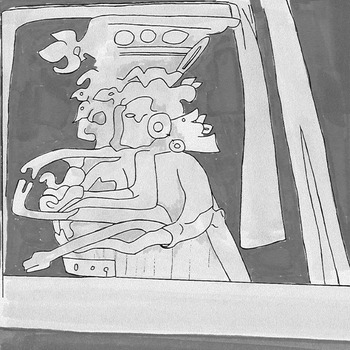
At the rear of the banquette, another set of characters faces the back of Death God on either side. The figure in Panel K (Figure 21) (to the viewer's left) represents one of the Cihuateteo. To the right (Panel L) we have a ruler seated in an enclosed throne—possibly a palanquin.
Panel K. One of the mothers who died in childbirth shown as a warrior. Drawing by the author.

The Cihuateteo on Panel K is naked above the waist. A double-headed serpent forms her cinched belt, the crossed heads dangling just below her waist. She is barefoot. In all respects she resembles the life-sized standing and seated terracotta figures believed to represent midwives, as well as mothers who died during the “battle” of childbirth (Gutiérrez Solana and Hamilton Reference Gutiérrez Solana and Hamilton1977; Ladrón de Guevara Reference Ladrón de Guevara and Judith1997:128–129; Suzan Morales Reference Suzan Morales1997; Wyllie Reference Wyllie, Arnold III and Pool2008:238–242).
Her role as warrior is underscored by the spear held before her. Like the Panel D figure, she is framed by two banner-like vertical bolts of cloth, cascading from either side of her. She dons an animal—possibly a jaguar—mask with a U-shaped nose ornament. Her broad, ornate headdress contains an unidentifiable element descending well above the band and crown, and an animal skull obtrudes from the back. Although the costume reveals her breasts, the arms are covered in loose kimono-style sleeves. The sleeve on the arm holding the spear bears an oval element reminiscent of the Maya day sign or lordly symbol Ajaw or the hieroglyphic logogram for the word nik, meaning flower. We find this symbol associated with rulers depicted on stelae from La Mojarra and Cerro de las Mesas, and the so-called Chapultepec Stela, frequently as part of the trilobed or Jester God element discussed above (Figure 22).
Cerro de las Mesas Stela 8. Drawing by the author.

Women who die in childbirth and murder victims are never reborn; they spend eternity with the Lord of the Underworld Aktisini or Old Thunder, according to Totonac mythology. The Totonacs believe in an afterlife located in the western extremity of the world inhabited by women who die in childbirth, spirits of deceased midwives, musicians, dancers, and victims of snakebite (Harvey and Kelly Reference Harvey, Kelly and Vogt1969:671; Wyllie Reference Wyllie, Arnold III and Pool2008:242). In Mound 2, depictions of musicians, serpents, possibly dancers, and sacrificed birthing mothers create a diorama of this otherworldly Totonac domain. The seated terracotta figures adopt a cross-legged posture generally reserved for males, an androgyny befitting their station as community elders, and midwives—the latter a category of shaman. “Curers and healers include both sexes but only old women are midwives” (Harvey and Kelly Reference Harvey, Kelly and Vogt1969:663; Sandstrom Reference Sandstrom, Sandstrom and Valencia2005:99).
The figure facing her—behind the Death God—sits in a throne-like enclosure, a tangle of sinewy limbs moving busily before him (Figure 23). These boneless protrusions are surely not human limbs. One of these rubbery, tubular appendages terminates in a serpent head, forming the character's foot. Both the Aztec and Maya had a serpent-footed god who was the patron of rulership—the Aztec deity Tezcatlipoca and the Maya Kawil or God K, respectively (Miller and Taube Reference Miller and Taube1993:164–165).
Panel K showing masked, seated figure with tubular limbs and a serpent foot. Drawing by author.

Serpents figure prominently in Popoluca underworld mythology who believe that “the subterranean world [is the] dwelling place of the Fire Serpent, which is associated with water and the river of blood that the dead must cross” (Báez Jorge and Báez Galván 2005:150). In other accounts the Fire Serpent is a water spirit connected with the east, birth, and fertility (Sandstrom Reference Sandstrom, Monaghan, Edmonson, Monaghan and Edmonson2000:109). Chane, Lord of the Underworld, administers punishment with serpents, who act as his guardians (Báez Jorge and Báez Galván 2005:151).
The seated figure has several accoutrements of rulership, including the flower element protruding from his crown. Life-sized terra-cotta women at El Zapotal wear this same trapezoidal crown, which appears as a marker of royalty or elite status during the Epiclassic period. At the Pyramid of the Feathered Serpent at Xochicalco the crown is worn by a series of cross-legged rulers with speech scrolls. In Veracruz it is worn by the kneeling queen on the Maltrata Monolith, who also has a speech scroll (Berlo Reference Berlo, Diehl and Berlo1989:42; Wyllie Reference Wyllie2009).
PAINTED PANELS ON THE BANQUETTE OUTSIDE WALLS (EAST AND WEST)
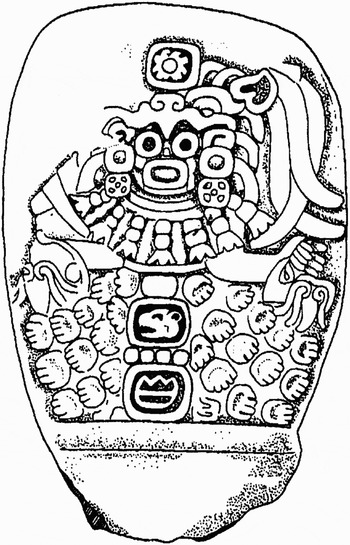
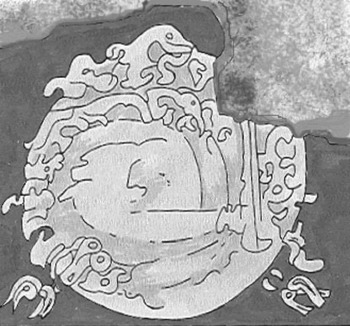
Solar disks cover panels on both east and west outside walls of the banquette. Zoomorphic and biomorphic shapes comprise the Eastern Underworld Sun found on Panel J (Figure 24). Atop the orb we see a bird's head with what looks like a serpent dangling from its beak. A beaked head protrudes from the right side of the Sun, located on the western side of the banquette (Panel M) (Figure 25). Details are difficult to make out since Panel M and Panel N, next to it, are extremely worn.
Panel J. Solar disk with bird image. Drawing by the author.

Panels M (left) and N (right) depicting a solar disk “led” by a female figure. Drawing by the author.

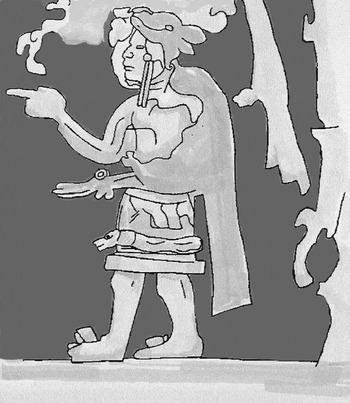
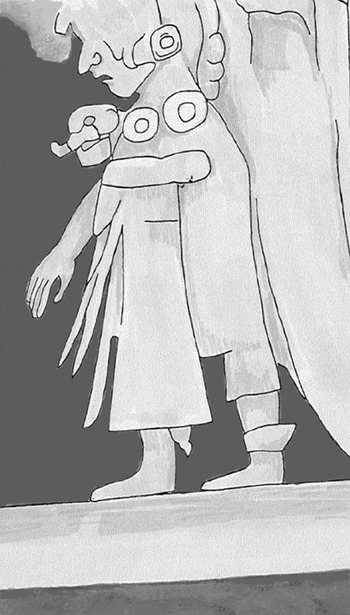
A skirted figure seems to lead the sun on the west side in Panel N, moving toward the front of the banquette. Like the Sun on the adjacent panel, specific features of this image are all but lost. We can, however, make out costume elements on the person in profile in Panel I (Figure 26) who, like the figure in Panel N, moves away from the Sun toward the front of the U-shaped banquette. She wears large earflares, a panel skirt, and a long train of cloth drags behind her. Her neck is adorned with a heavy necklace of large, circular beads and what appears to be a human skull.
Panel I. Female figure next to the solar symbol seen on Panel J. Drawing by the author.

SUMMARY
The entrance to the inner sanctuary of the banquette is framed by two panels: on the left (Panel A) a musician wearing a feathered costume plays maracas, and on the right (Panel H) we have a figure resembling the ruler on Cerro de las Mesas ST 5. Once inside the U-shaped enclosure, we are in the heart of the Death God's domain. A pregnant skeletal woman flanks the sculpture to our left (Panel D), and a warrior in coyote costume faces him to the right (Panel E). On the perpendicular interior panels we have painted Death Gods seated on thrones. The one on the wall to our left (Panel C) has a dwarf-like attendant that I have identified with the sonrientes (Panel B), while the Death God on the wall to our right (Panel F) is faced by a creature whose feet are pointed backward (Panel G).
On the exterior walls of the banquette we have two panels facing the rear of the Death God sculpture. Facing the sculpture we have a female warrior wearing the same costume as the Cihuateteo to the left (Panel K) and on the right is a seated creature in an enclosed throne with sinewy limbs and a serpent foot (Panel L). Solar symbols dominate the exterior walls on the east and west sides of the banquette, each accompanied by a female figure (Panels M, N, I, and J).
DISCUSSION: SOLAR SYMBOLISM
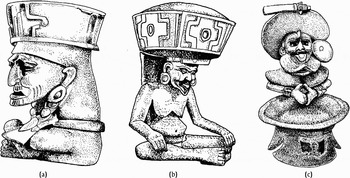
Again, clay sculpture emphasizes the thematic importance extant in the painted program. Mound 2 contains several large ceramic braziers. A terracotta figure of the Old Fire God further references the solar symbolism played out on the eastern and western walls of the banquette (Gutierrez Solana and Hamilton 1977:Plates 39 and 40, Figure 39, pp. 74–75). The Totonacs called the god Qolo Cisku, the Old Man, or Taqsjoyut, Lord of the Hearth (Ichon Reference Ichon1973:70, 151). In one of his manifestations he is a bird connected with the sun and fire. The later Mexicas called this deity Huehueteotl. At Zapotal he is cross-legged and bearded, rendered somewhat androgynous by age, hunched forward by the weight of the brazier balanced precariously atop his head (Figure 27a). He seems to wince, the puffy bags beneath his half-closed eyes droop down below his cheekbones.
Terracotta figures of the Veracruz Old Fire God from: (a) El Zapotal Mound 2; (b) Cerro de las Mesas; and (c) Laguna de los Cerros. Drawings by the author.

A bearded, brazier-topped figure from nearby Cerro de las Mesas, now in the Mexican National Museum of Anthropology, is one of the masterpieces of sculpture in this region (Figure 27b). Yet, a bearded, semi-toothless ceramic figure wearing a broad-brimmed hat, poised over a basin-like brazier from Late Olmec Laguna de los Cerros (Acayucan, Veracruz, 300 b.c.–a.d. 200) attests to the antiquity of this god on the Gulf Coast (Morante Lopez Reference Moranté Lopez2004:70–71) (Figure 27c).
I believe that the brazier-bearing old man represents a manifestation of Homshuk, the principal god of the Popolucas. Recall that Homshuk is the god of maize connected with death, resurrection, and the sun. At El Zapotal he oversees the sun's own rebirth and resurrection and takes part in the creation of the current Sun or epoch. In some accounts the stagnant world gains momentum when a god immolates himself by leaping into a burning caldron (perhaps a brazier), a sacrificial act that catapults him into the sky as the reborn sun (Wyllie Reference Wyllie, Arnold III and Pool2008).
During the Late Classic period sculptors portray Cerro de las Mesas rulers wearing the broad-brimmed hat of the Old Fire God, as seen on Stelas 4, 11, and Monument 2 (Figure 29). This is the same headdress worn by the Late Formative terracotta sculpture of “Huehueteotl” from Laguna de los Cerros discussed above. Mayanists will recognize the wrinkled hunched old man in his broad-brimmed hat as God L—the patron of merchants (Miller and Taube Reference Miller and Taube1993:112) and depicted on Classic Maya pots as the lecherous old Lord of the Underworld. Huehueteotl is absent in the Maya pantheon, while the only image of God L in central Mexico appears on a mural at Cacaxtla. Meanwhile in southern Veracruz identities of these two gods are inextricably fused.
Regional rulers appear to identify themselves with the Merchant Fire God at a time when new hieroglyphic conventions take hold; when lengthy texts are abandoned along with the use of Long Count dates, concurrent with a realignment of the regional political and economic landscape (Stark Reference Stark, Arnold III and Pool2008:87, 104–109; Wyllie Reference Wyllie, Arnold III and Pool2008). In the Mixtequilla the deity-impersonator in the wide-brimmed hat is often portrayed with the accoutrements of long-distance trade, including an ambassadorial fan, copal bag, backrack, and walking stick (Wyllie Reference Wyllie2002:321; Reference Wyllie, Arnold III and Pool2008:232, 246–251). On Cerro de las Mesas Late Classic stelae he (or she?) is shown beardless and youthful while on Río Blanco relief-carved bowls the figure wearing the broad-brimmed hat is short, bearded, and wrinkled (Wyllie Reference Wyllie2002:323–324; Reference Wyllie, Arnold III and Pool2008). Later Aztec merchants celebrated their feast day in honor of their patron gods Huehueteotl and Xiutecutli During this celebration god-impersonators were sacrificed by fire (Durán Reference Durán1971:204–209). Enacting this rite, merchants replicated the creation of the Sun. One of the scenes found on Río Blanco bowls appears to illustrate just such an event (Wyllie Reference Wyllie2002:324–331; Reference Wyllie, Arnold III and Pool2008:247–251).
Durán's (1971:212) account of the Aztec feast Huey Tecuilhuitl connects the Divine Brazier used in the Xocotl fire sacrifice with the goddess Cihuacoatl. Cihuacoatl (meaning “snake woman”) was the patron deity of childbirth and midwifery, by way of the “war of parturition when women were linked to warriors” (Klein Reference Klein, Josserand and Dakin1988:248; Miller and Taube Reference Miller and Taube1993:60–61; Townsend Reference Townsend2000:201). In advance of the feast a fire was prepared in a great hearth outside the goddess' chamber. A goddess-impersonator (representing Xilonen) took the place of honor overseeing the Teotlecuilli (or Divine Brazier) and its subsequent use in the fire sacrifice of her four attendants (Durán Reference Durán1971:212–214) The feast day was held in honor of midwives and healers (Durán Reference Durán1971:439). Midwives formed the ceremonial procession leading the soon to be sacrificed goddess-impersonator (Durán Reference Durán1971:439–440). This same ceremony, known as the Great Feast of the Lords, celebrated the arrival of young maize.
These scenes and tales are consonant with traditional Totonac beliefs: our present epoch began with the birth of the Sun, born of a mother who accidentally swallows a shimmering trinket found in the water. She dies giving birth, her son emerging from her navel. The Sun grows and sows maize. Then one day he builds a bonfire and hurls himself onto the coals, which thrusts him burning into the heavens as the Sun (Harvey and Kelly Reference Harvey, Kelly and Vogt1969:671). “Our Mother,” or Mother of the Sun, Natsi'itni, essential to all life, lives in the East where the sun rises (Ichon Reference Ichon1973:48).
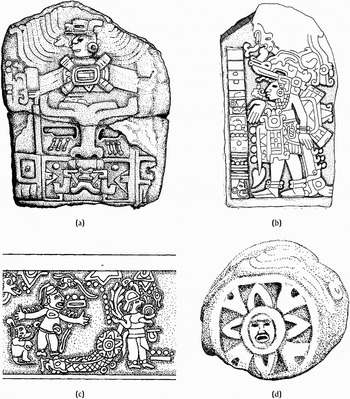
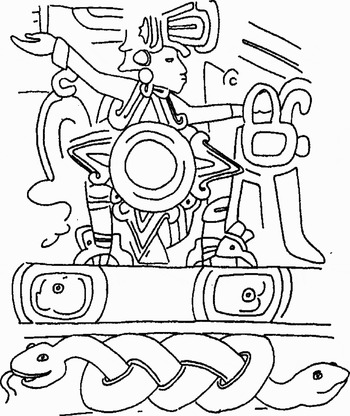
Veracruz art makes several references to the risen sun god and his relationship to rulership. On Tres Zapotes Stela C (Figure 28a) a ruler perched atop an anthropomorphic earth wears a solar symbol on his chest, rays emanating diagonally from each of the inter-cardinal points. Portions of this symbol form costume elements worn by rulers on Cerro de las Mesas Stelas 6 (a.d. 467) (Figure 28b) and 5 (a.d. 529), and the symbol forms the underside of Cerro de las Mesas Monument 1 where triangular cardinal points and fanning inter-cardinal rays exude from a round puffy face (Figure 28c). And on a scene from a Río Blanco bowl, one of the parading characters carries this symbol, a serpent trailing behind it (von Winning and Gutiérrez Solana Reference von Winning and Gutiérrez Solana1996:Figure V.3; Wyllie Reference Wyllie, Arnold III and Pool2008:248) (Figure 27d).
Solar images from: (a) Tres Zapotes Stela C; (b) Cerro de las Mesas Stela 6; (c) a Río Blanco bowl; and (d) Cerro de las Mesas Monument 1, adapted from Stirling (Reference Stirling1943: 39, Figure 13 and Plate 29). Drawings by the author.

Rulers in broad-brimmed hats from: (a) Cerro de las Mesas Stela 4; and (b) Cerro de las Mesas Monument 2. Drawings by the author.

Solar imagery spread beyond the Epi-Olmec heartland of the Mixtequilla-Tuxtla. Further north, paintings cover the banquette at Las Higueras in south central Veracruz, a Late Classic site more or less contemporary with El Zapotal. At Las Higueras two solar orbs flank the entry to the banquette's inner sanctuary, running perpendicular to the narrative processions on the outer walls. Another scene from the murals depicts a ruler balanced on a throne wearing a solar diadem radiating with triangular cardinal rays (Figure 30).
Detail from the Las Higueras murals showing figure wearing a solar symbol. Drawing by the author.

The birth, death, and resurrection of the sun god Homshuk is thus analogous to the death of a ruler and the installation of his successor. In Mound 2 the deceased ruler continues to reign in the Underworld. Born of fire from the burning brazier of the Old God, a new ruler will rise as the newborn sun. Totonac beliefs indicate that people of the region viewed this resurrection as autogenous.
In the sixteenth century, Fray Bernardino de Sahagún records Mexica metaphors connecting the rising and setting of the sun and the death of the ruler and the installation of his successor (see Umberger Reference Umberger and Boone1987:411–462). Sahagún devotes Addendum II, Book I, of the Florentine Codex, to multivalent solar adages. “Now the Sun Shineth; It is Light or A New Sun Emergeth” (Axcã Tona Tlatvi and Yanciuc Tonatiuh Valmomana) means “something new comes to pass. A new law begins. Or a ruler is installed, is selected.” (Sahagún 1951, Book I:81), while “Will perchance the turquoise shield appear shining?” (Cuix oc ceppa xiohchimaltonatimomanaz. Anoç cuix oc ceppa xiuhchimaltonatimomanquiuh) or “Now the Sun is Overturned” (Axcã Mixtlapachmana Y Tonatiuh) means “That which is good that which is righteous has vanished; it is forever vanished; it is forever corrupted. It is as [when] some great ruler has died has vanished, or has been disgraced. It is [when] a good law has disappeared or [when] wealth has vanished or a house” (Sahagún 1951, Book I:81–82) or “a ruler is dead or a city is destroyed; or a good custom disappears or a wise man dies” (Sahagún 1951, Book I:82).
CONCLUSIONS
Mound 2 replicates the Underworld domain of the Death God, his queens, and supernatural attendants, who accompany the Sun in its nocturnal journey from its symbolic nightly death to its daily rebirth and resurrection assisted by mothers and midwives (Ladrón de Guevara Reference Ladrón de Guevara and Judith1997:128–129; Maldonado Vite Reference Maldonado Vite1995; Suzan Morales Reference Suzan Morales1997; Wyllie Reference Wyllie, Arnold III and Pool2008). On the eastern and western outer walls of the banquette, painted women are shown leading the Sun on this journey. Elsewhere on the teocalli walls powerful women take part in rituals among myriad deities and mythological players.
Life-sized terracotta figures of deceased mothers martyred during the sacred battle of childbirth and the seated midwives who aid them in the struggle to bring forth life emphasize themes of cyclical birth and renewal. The importance of these women is underscored by their privileged position in the afterlife, as well as the use of hierarchical proportion. Moreover, the standing figures wear the same crowns as rulers depicted at Maltrata and Xochicalco. The life-sized female terracotta figures in most cases are three times the size of their male counterparts. Only the skeletal Lord of the Underworld is as grand or as prominent.
Río Blanco bowls, from the same region, share a similar visual program, with narrative scenes linked to women in childbirth, interaction among cosmological actors, and solar rituals connected with cyclical regeneration (Wyllie Reference Wyllie, Arnold III and Pool2008:243–251). In the latter case, deity impersonators reenact the birth of the Sun at the dawn of creation. Like the death and resurrection of the sun each day, Mesoamericans perceive the world as having been created and destroyed in a series of epochal creations and destructions (see Harvey and Kelly Reference Harvey, Kelly and Vogt1969:671). Thus, cycles of time, the life cycle of maize, the waxing and waning of the moon, conception, birth, aging, and death all provided analogues to an overarching cosmological worldview. In doing so, these observations of the natural world became conceptually linked, serving as a template for the unseen and supernatural.
These are funerary paintings, an Underworld royal court, to serve in the afterlife. Mound 2 contained over 200 human burials, hundreds of high prestige grave goods, including ceramics, toys, figurines, and ballgame paraphernalia. The terracotta sculpture shows technical and artistic proficiency unknown elsewhere in Mesoamerica.
Throughout Mesoamerica, rulers identified themselves with specific gods. These could be gods linked to the office or roles of kingship or regional patron deities. Rulers depicted on Cerro de las Mesas stelae wear costumes, headdresses, and masks reinforcing this notion. Several figures on the El Zapotal mural paintings are imbued with symbols of rulership cognate with those at Cerro de las Mesas, just a few kilometers away. And in many cases, as noted by Ladrón de Guevara (Reference Ladrón de Guevara2005), El Zapotal lords and ladies adopt the costumes, stances, and accessories of Cerro de las Mesas kings and queens.
Visiting the region in 1939, Matthew Stirling surmised that El Zapotal (or Cerro de Gallo) was one of five principal mound groups (along with Cerro de las Mesas, Santana, Pajaros, and Coyol) forming a 15-mile east-west corridor. Stirling (Reference Stirling1943:31) writes, “The spaces between the principal groups are dotted with lesser mounds to such an extent that it is practically impossible to tell where one group ends and another begins.” Cerro de las Mesas, roughly the geographic center, and grandest of the sites “was probably the ceremonial center for the region” (Stirling Reference Stirling1943:32; also see Stark Reference Stark, Arnold III and Pool2008:89). Forms and materials, along with symbols, motifs, cultural materials, and a distinct regional architectural style, suggest that the history of the neighboring sites overlapped during much of Cerro de las Mesas' long history (Drucker Reference Drucker1943:57, 79, 82, and Plates 47 and 48; Stirling Reference Stirling1943:31). Undoubtedly they were part of the same cultural complex, even beyond the apogee of Cerro de las Mesas political and economic hegemony (Stark Reference Stark, Arnold III and Pool2008).
Sumptuous grave goods and royal symbols offer compelling evidence that Mound 2 is a royal tomb or a mausoleum, a place of metamorphosis for the divine ruler. The Veracruz Death God, Lord of the Underworld, sits on his throne wearing the sprouting maize insignia of Mixtequilla rulership, surrounded by his courtly pantheon, to reign beneath the surface of the earth, continuing the cycles. The power of Mixtequilla royal dynasties is manifest in the quality and quantity of funerary objects discovered in Mound 2. Elite families and their earthly attendants were reinterred. Wheeled toys comforted small children. Rulers had access to artists able to transpose the chamber into animated afterlife with lively paintings and life-sized ceramic sculpture.
The abundant mounds noted by Stirling (Reference Stirling1943), Coe (Reference Coe, Willey and Wauchope1965), and others lie largely silent. Cerro de las Mesas provides the greatest number of stone stelae with ruler portraits and hieroglyphic inscriptions of any site outside the Maya region. El Zapotal Mound 2 bears witness to the caliber of artistic proficiency hidden in the post-Olmec earthworks of the Mixtequilla-Tuxtla. The mythological players gracing the banquette attest to royal personages and pantheons, who, though largely unknown, now germinate like reborn kings and queens, into another world—that of the present.
RESUMEN
A principios de 1970, el arqueólogo mexicano Manuel Torres Guzmán excavo el Montículo 2 en El Zapotal, un complejo funerario del clásico tardío en la región de Mixtequilla, en Veracruz Sur. El Montículo 2 contiene vestigios esqueléticos, figuras de terracotta de tamaño natural y una banquilla en forma de U cubierta con murales, con un monumental Dios de la Muerte de arcilla en el centro. El autor, con permiso de INAH-Veracruz, dibujo las pinturas en deterioro, reproducidas aquí.
La examinacion de las pinturas ofrece entendimiento de los rituales de creación promulgados por los imitadores de deidades en Veracruz clásico. Junto a las esculturas, entierros secundarios y diseño arquitectónico, los murales forman parte de un programa narrativo mas grande. El autor cree que el Montículo 2 es una tumba real. Las pinturas y esculturas relatan la muerte y resurrección del sol, asistida por madres y comadronas. El viaje solar es análogo a la muerte del gobernante, a quien le queda reinar en el mundo de los muertos, y el ascenso de su sucesor en el mundo de los vivos.
ACKNOWLEDGMENTS
I am indebted to the Instituto Nacional de Antropología e Historia, Veracruz, for allowing me to make drawings of the Zapotal paintings. I especially wish to thank archeologist David Morales Gómez, Coordinator of Museums for Conaculta-INAH in Veracruz, for facilitating access and on-site support, and INAH, Veracruz, Director Daniel Goerítz Rodriquez for his continued generosity. Despite the daunting task of overseeing my work for hours on end in a concrete and metal roofed building during the height of coastal Veracruz summer, the El Zapotal museum staff proved tenacious, helpful, and good-natured. I wish to express my heartfelt appreciation to Sara Ladrón de Guevara, museum director at the Museum of Anthropology, Xalapa, Veracruz (MAX). Dr. Ladrón de Guevara checked my drawings against the originals paintings and further permitted me access to El Zapotal collections and materials at the museum. I am grateful for her many insights on Classic Veracruz iconography in general and El Zapotal in particular. Art historians Rex Koontz and Emily Umberger kindly offered perceptive questions and comments to further strengthen my presentation of the material. Many thanks to Lynn Foster, Naomi Smith, Marko Beznosiuk, Diana Magaloni-Kerpel, and Constanza Gowen-Segovia for their support and feedback in the preparation of this article.