INTRODUCTION
The coast of El Salvador is part of the marine biogeographic region known as the Tropical Eastern Pacific (TEP) region which extends from the Pacific coast of Baja California, near Magdalena Bay (~25°N), to the southern shore of the Gulf of Guayaquil (~4°S), and includes the Galápagos Islands and four other isolated oceanic islands and archipelagos: the Revillagigedo group, Clipperton, Cocos and Malpelo (Briggs, Reference Briggs1974; Hastings, Reference Hastings2000; Robertson & Cramer, Reference Robertson and Cramer2009). The TEP is delimited by thermal gradients to the north and south, by a wide open ocean area (the East Pacific Barrier) to the west, and by the Central American land mass to the east (Hastings, Reference Hastings2000). It is one of the most dynamic coastal environments of any tropical region due to the frequent influence of El Niño events (Glynn & Ault, Reference Glynn and Ault2000).
The number and boundaries of biogeographic provinces in TEP have been widely discussed (e.g. Ekman, Reference Ekman1953; Walker, Reference Walker1960; Briggs, Reference Briggs1974; Boschi, Reference Boschi2000; Hastings, Reference Hastings2000; Spalding et al., Reference Spalding, Fox, Allen, Davidson, Ferdaña, Finlayson, Halpern, Jorge, Lombana, Lourie, Martin, McManus, Molnar, Recchia and Robertson2007; Robertson & Cramer, Reference Robertson and Cramer2009). Hastings (Reference Hastings2000) divided the TEP into four provinces (the Cortez, Mexican, Panamic and Galápagos Provinces), based on the distribution of rocky shore fishes. The stretches of sand and mud shorelines known as the Sinaloan Gap (370 km of shoreline in the SE Gulf of California) and the Central American Gap (~1000 km of shoreline from the Gulf of Tehuantepec, southern Mexico, to El Salvador) form natural breaks in the distribution of shoreline reef habitats between the mainland provinces (Cortez, Mexican and Panamic). The most recent subdivision of the TEP is based on the distribution of regional endemics and three functional groups of species (reef species, soft-bottom species and pelagic species) (Robertson & Cramer, Reference Robertson and Cramer2009). According to this subdivision, three provinces are established: the continental coast that contains the Cortez Province (Gulf of California and lower Pacific Baja California), the Panamic Province southward to Ecuador, and the Oceanic Islands Province (including five oceanic island and archipelagos). Robertson & Cramer (Reference Robertson and Cramer2009) noted that the two large gaps have had only small effects at the level of the entire regional fauna.
The TEP has a lower diversity of shorefish fauna compared with the Indo-Malayan global centre of diversity. However, the TEP has the highest rate of endemism (79.3% of the resident shorefishes) among any tropical regions of similar size (Robertson & Allen, Reference Robertson and Allen2006). Within the TEP, 1285 shallow-living fish species (found in less than 100 m depth) of coastal and near-shore pelagic habitats have been recorded (Robertson & Allen, Reference Robertson and Allen2008). Due to the overlap in ranges of different species, the area with the highest number of species (740–760 spp.) is off Costa Rica and Panama. From this area, the species richness decreases with increasing latitude (Mora & Robertson, Reference Mora and Robertson2005a, Reference Mora and Robertsonb).
The Salvadoran coast has a total length of 320 km and its continental shelf comprises a strip between 50 and 80 km wide (Marn & Vimivdu, 2002), with an area of about 17,100 km2. Its upper slope area (between 200 and 1000 m) is approximately 3400 km2 (Fischer et al., Reference Fischer, Krupp, Scheider, Sommer, Carpenter and Niem1995a). This zone is influenced by the Costa Rica Coastal Current, which flows northward along the western margin of Central America into the Gulf of Tehuantepec (México), where its surface current turns south to flow around the south side of the Tehuantepec Bowl (Kessler, Reference Kessler2006). Gierloff-Emdem (Reference Gierloff-Emdem1976) reported that branches of the California Current flow southeast, parallel to the Mexican coast, reaching the northwestern coast of El Salvador, however, even with modern data the interconnection of the southeastern branch of the California Current remains unknown (Kessler, Reference Kessler2006; Lavin et al., Reference Lavin, Fiedler, Amador, Balance, Färber-Lorda and Mestas-Nuñez2006).
The first available list of marine species of El Salvador was developed by Hildebrand (Reference Hildebrand1925). The study was aimed at investigating the freshwater fishes of El Salvador, but in his results the author includes a list of 13 families and 23 marine fish species obtained from one sampling conducted at Puerto El Triunfo and Puerto Cutuco, in the east of the country. At present, 412 species of marine fish are recorded in Salvadoran waters (Marn & Vimivdu, 2002). However, the knowledge about marine fishes is scarce and most of the information is included in governmental technical reports about artisanal and industrial fisheries. Thus, the studies have been focused on species lists and the determination of catch values of the most abundant marine fishes, captured mainly as bycatch in the shrimp fishery (Ramírez & Miller, Reference Ramírez and Miller1975; González et al., Reference González, Matal and Villatoro1983; Ulloa, Reference Ulloa1984a, Reference Ulloab; Villegas et al., Reference Villegas, Godínez and Ulloa1985; López, Reference López, Clucas and Teutscher1999). The aim of this study is to provide detailed information on geographic and bathymetric distribution patterns of fish and to describe the main species assemblages of the continental shelf and upper slope off El Salvador.
MATERIALS AND METHODS
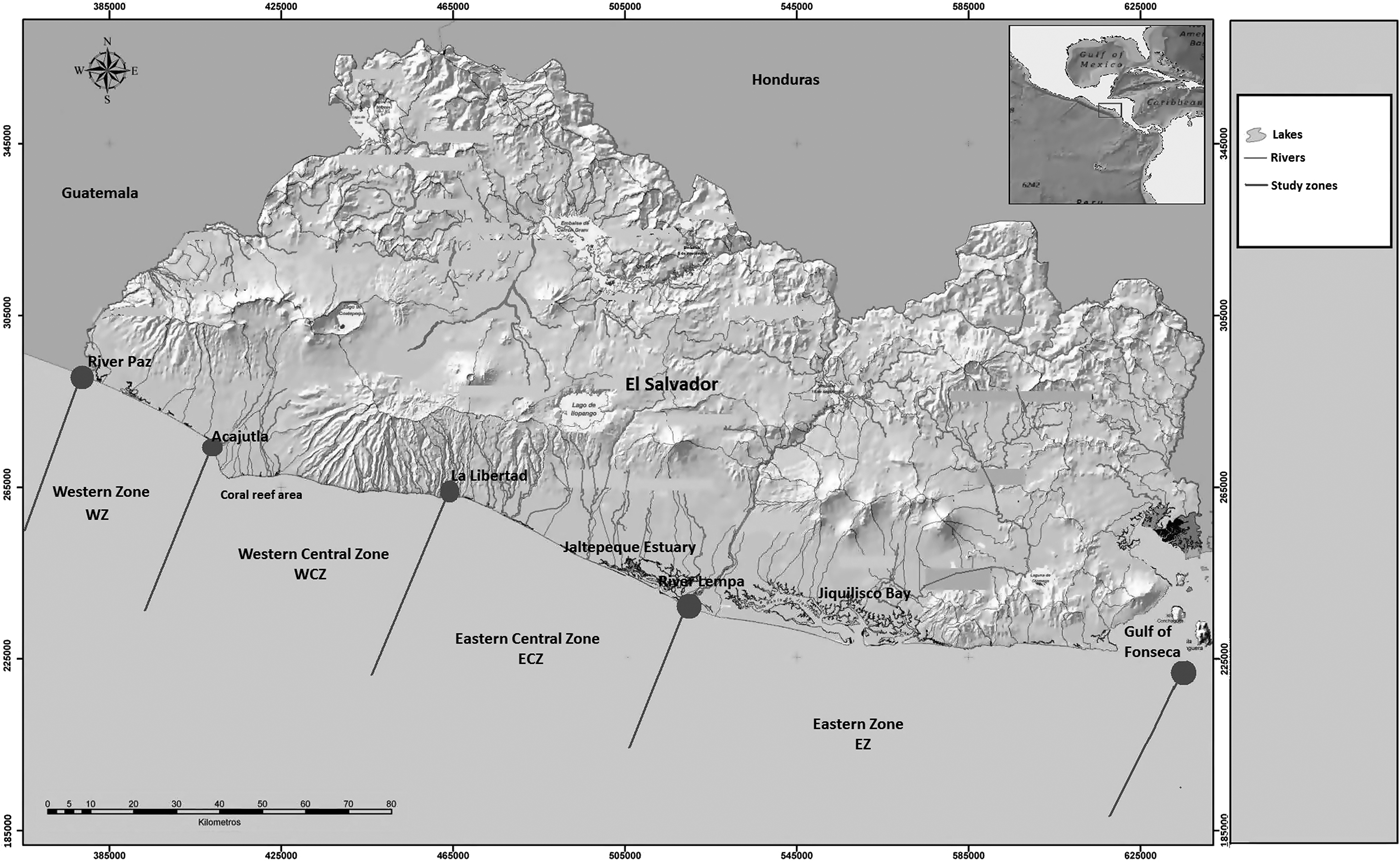
The area surveyed extends from the Paz River (Guatemalan border) to the Gulf of Fonseca (Nicaraguan border), bathymetrically limited by the 240 m isobath (Figure 1). The continental shelf has a maximum width of 80 km, widening progressively towards the Nicaraguan border. Ninety-one per cent of the total area has deposits of muddy sand, substratum type that further increases in proportion as the shelf approaches the continental slope. The continental slope begins at a depth of about 150 m and descends with a 3–5° angle over a maximum width of 20 km (Villegas et al., Reference Villegas, Godínez and Ulloa1985). Due to the geographic features present in the area (Gierloff-Emdem, Reference Gierloff-Emdem1976), four zones can be distinguished: (1) The Western Zone (WZ) from the Paz River (13°44′N 90°07′W) to Acajutla (13°34′N 89°50′W), characterized by muddy-sand bottoms with high river inputs (most of them temporary) and estuaries; (2) The Western Central Zone (WCZ) from Acajutla to La Libertad (13°29′N 89°19′W), characterized by rocky bottoms, few river inputs, no large-scale estuaries and a coral reef of approximately 157 km2 (Marn & Vimivdu, 2002); (3) The Eastern Central Zone (ECZ) from La Libertad to the Lempa River (13°15′N 88°49′W), characterized mostly by muddy-sand bottoms, high river runoff that provides a large amount of sediments and the Jaltepeque Estuary, the second largest estuary in the country; and (4) The Eastern Zone (EZ), from the Lempa River to the Gulf of Fonseca (13°10′N 87°41′W), which contains the largest estuarine system (Jiquilisco Bay) and a volcanic island system, located in the Gulf of Fonseca, and characterized by rocky, sandy and muddy bottoms (Marn & Vimivdu, 2002).
Map of the study area, with the subdivisions discussed in the text.

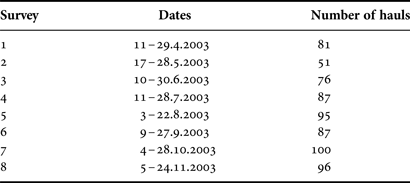
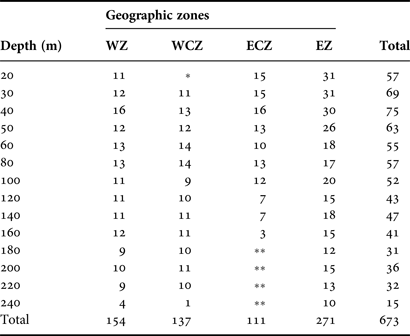
Data were collected from 673 bottom-trawl tows made monthly from April to November 2003 (Table 1). A stratified sampling was conducted in each of the zones described in Figure 1. Two transects perpendicular to the coast per zone were established, with the exception of the EZ, where four transects were established. At each transect hauls from 20 to 240 m depth were carried out. From 20 to 60 m the hauls were done at 10 m depth intervals and from 60 m onwards, hauls were done at 20 m depth intervals. The samples were obtained during daytime with cod-end twin otter trawls measuring 20.2 m total length with a 3 m vertical opening, approximately 13.4 m wing spread, and 5 cm mesh size. The trawls were performed at a speed of 2.5 knots and the estimated trawling time at depths less than 120 m was 30 min and those deeper were for 15 min. In each haul a random sample of fishes was sampled, ensuring that all species caught were included. The samples were placed in polyethylene bags and stored on ice. Later the samples were frozen at the Aquatic Laboratory of the School of Biology of the University of El Salvador. All fishes in the sample were identified to the lowest possible taxonomic level using the field guides by Chirichigno (Reference Chirichigno1974), Bussing & López (Reference Bussing and López1993), Fischer et al. (Reference Fischer, Krupp, Scheider, Sommer, Carpenter and Niem1995b, Reference Fischer, Krupp, Scheider, Sommer, Carpenter and Niemc), Amezcua-Linares (Reference Amezcua-Linares1996), Robertson & Allen (Reference Robertson and Allen2002) and Froese & Pauly (Reference Froese and Pauly2003). The scientific names used here are those listed in Robertson & Allen (Reference Robertson and Allen2006) and Eschmeyer (Reference Eschmeyer2013). Some sampled fishes were fixed in formalin and preserved in alcohol and catalogued in the fish collection of the School of Biology Museum of the University of El Salvador.
Dates and number of hauls performed during the eight surveys.
The fish species collected at 13 depth intervals and from the four geographic zones (Table 2) were used to determine similarities among bathymetric strata and geographic zones and thus to define fish assemblages. Species with one occurrence and/or one specimen were excluded from the analysis. The data analysis was based on presence-absence matrices and used PRIMER 6 software (Clarke & Gorley, Reference Clarke and Gorley2006) for hierarchical cluster analysis using Jaccard's coefficient as an index of similarity and for an Unweighted Pair Group Method analysis using the arithmetic averages aggregation algorithm (UPGMA). The significance of the cluster groups (P < 0.05) was tested with the similarity profile (SIMPROF) test included in PRIMER 6 software. The data were analysed in two steps following Macpherson et al. (Reference Macpherson, Richer de Forges, Schnabel, Samadi, Boisselier and Garcia-Rubies2010). First, a cluster analysis was performed to determine significant faunal similarities between depth intervals, then significant differences in depth assemblage groupings were identified by SIMPROF and these new areas were defined as bathymetric strata. Secondly, the data from each bathymetric stratum were used in a cluster analysis to determine similarities between geographic zones and to define species assemblages. In addition, multidimensional scaling (MDS) ordination analysis was performed using the same configuration as in cluster species analysis.
Number of hauls performed by depth and geographic zone.
WZ, Western Zone; WCZ, Western Central Zone; ECZ, Eastern Central Zone; EZ, Eastern Zone; (*) sea-bottom was not suitable for trawling; (**) longline fishery zone.
RESULTS
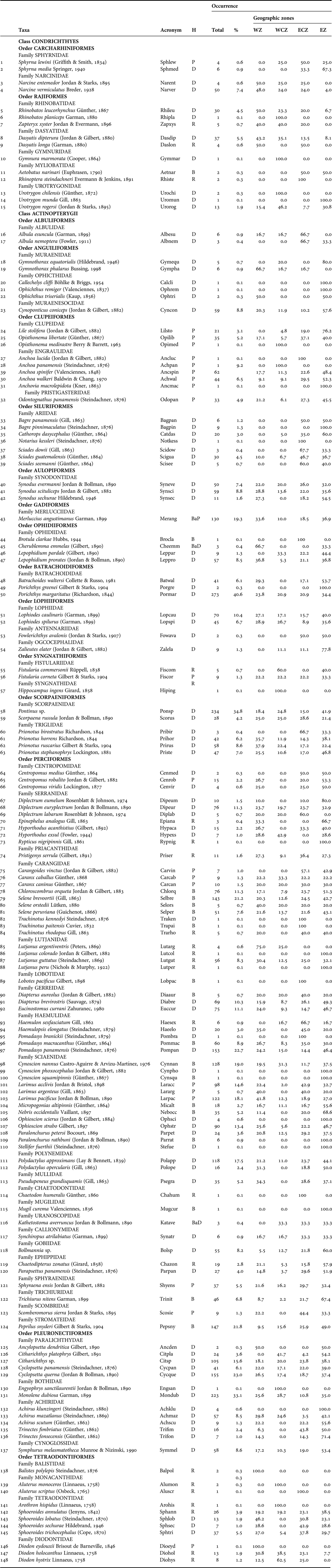
A total of 148 fish species, comprising 15 Chondrichthyes (9 genera of 7 families) and 133 Osteichthyes (79 genera of 47 families), were recorded. The families with the highest number of species were the chondrichthyan Family Urotrygonidae (3 species) and the osteichthyan families Sciaenidae (13 species) and Carangidae (10 species). Three bony fish species were identified only to the genus level (Pontinus sp., Citharichthys sp. and Bollmannia sp.). The highest percentages of occurrence were recorded for Porichthys margaritatus (40.6%), Pontinus sp. (34.8%) and Monolene dubiosa (33.1%) (Table 3). According to the habitat categories described by Froese & Pauly (Reference Froese and Pauly2003), most of the species captured were demersal fishes (83), followed by reef associated (23), pelagic (21), benthopelagic (18), bathydemersal (2) and bathypelagic (1) species.
Fish species captured on the shelf and upper slope off El Salvador during April to November 2003, including the habitat, the total number of occurrences, the percentage of total occurrence and geographic zones.
H, habitat; D, demersal; R, reef associated; P, pelagic; B, benthopelagic; BaD, bathydemersal; BaP, bathypelagic; DWZ, Western Zone; WCZ, Western Central Zone; ECZ, Eastern Central Zone; EZ, Eastern Zone.
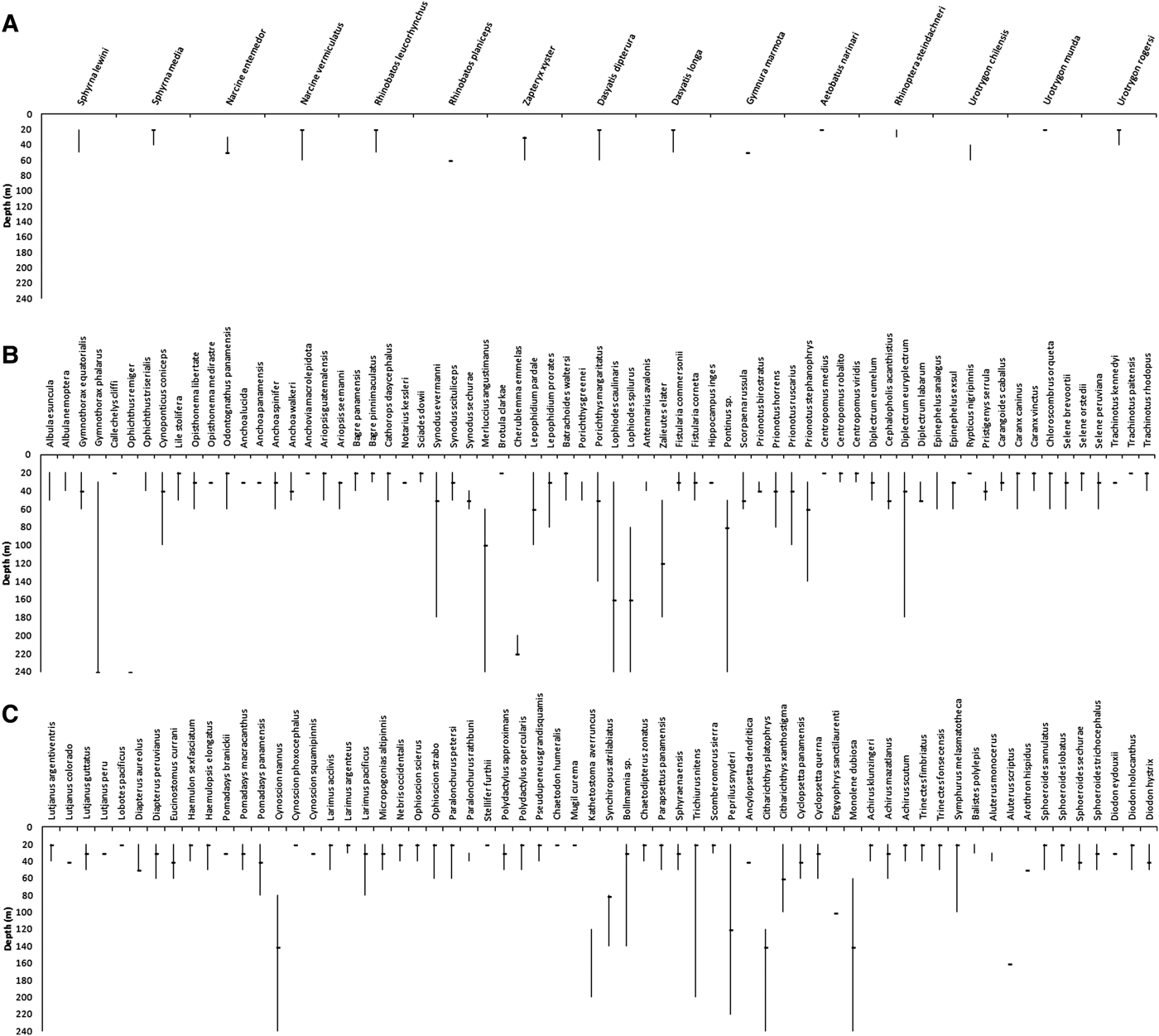
Most species showed higher occurrences at depths less than 60 m (Figure 2), but 15 species showed a wide distributional range: Gymnothorax phalarus, Synodus evermanni, Merluccius angustimanus, Porichthys margaritatus, Lophiodes caulinaris, Lophiodes spilurus, Zalieutes elater, Pontinus sp., Prionotus stephanophrys, Diplectrum euryplectrum, Cynoscion nannus, Bollmannia sp., Trichiurus nitens, Peprilus snyderi and Monolene dubiosa. Only 11 species exceeded the 200 m depth limit: Merluccius angustimanus, Cherublemma emmelas, Lophiodes caulinaris, Lophiodes spilurus, Pontinus sp., Cynoscion nannus, Kathetostoma averruncus, Trichiurus nitens, Peprilus snyderi, Citharichthys sp. and Monolene dubiosa.
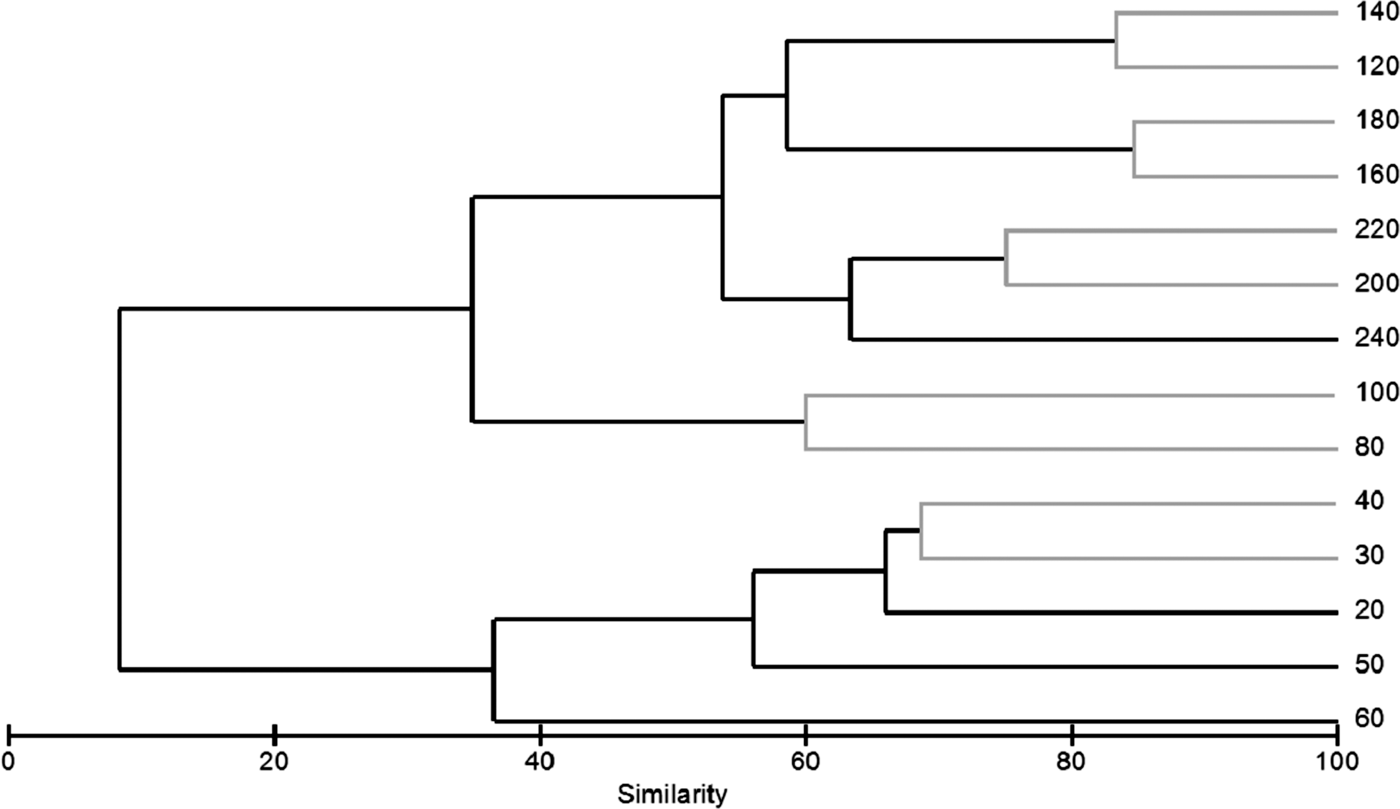
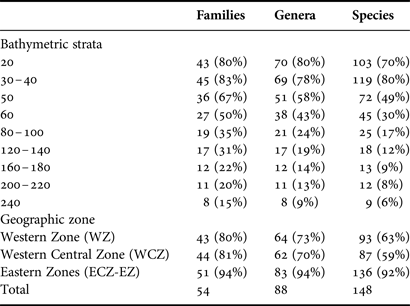
The cluster analysis among depth strata showed three faunistic associations: one on the inner and part of the mid continental shelf (20–60 m) containing 4 bathymetric strata, the second in a single bathymetric stratum on the mid continental shelf (80–100 m), and the third on the outer continental shelf and upper slope (120–240 m) comprising 4 bathymetric strata (SIMPROF, P < 0.05) (Figure 3). A decrease in species richness with increasing depth was observed below the 30–40 m bathymetric stratum (Table 4).
Bathymetric distribution of fish species recorded on the continental shelf and upper slope off El Salvador–Central America, April to November 2003. (A) Class CONDRICHTHYES, (B) Class ACTINOPTERYGII, Fam. ALBULIDAE-CARANGIDAE, (C) Class ACTINOPTERYGII, Fam. LUTJANIDAE-DIODONTIDAE.
Similarity dendrogram among depth using Jaccard's coefficient as similarity index and UPGMA analysis. The significance of the groups (P < 0.05) was tested with the similitary profile (SIMPROF); non-significant cells in grey.
Number and percentage of families, genera and species of fishes captured on the shelf and upper slope off El Salvador (by bathymetric strata and geographic zone), April to November 2003.
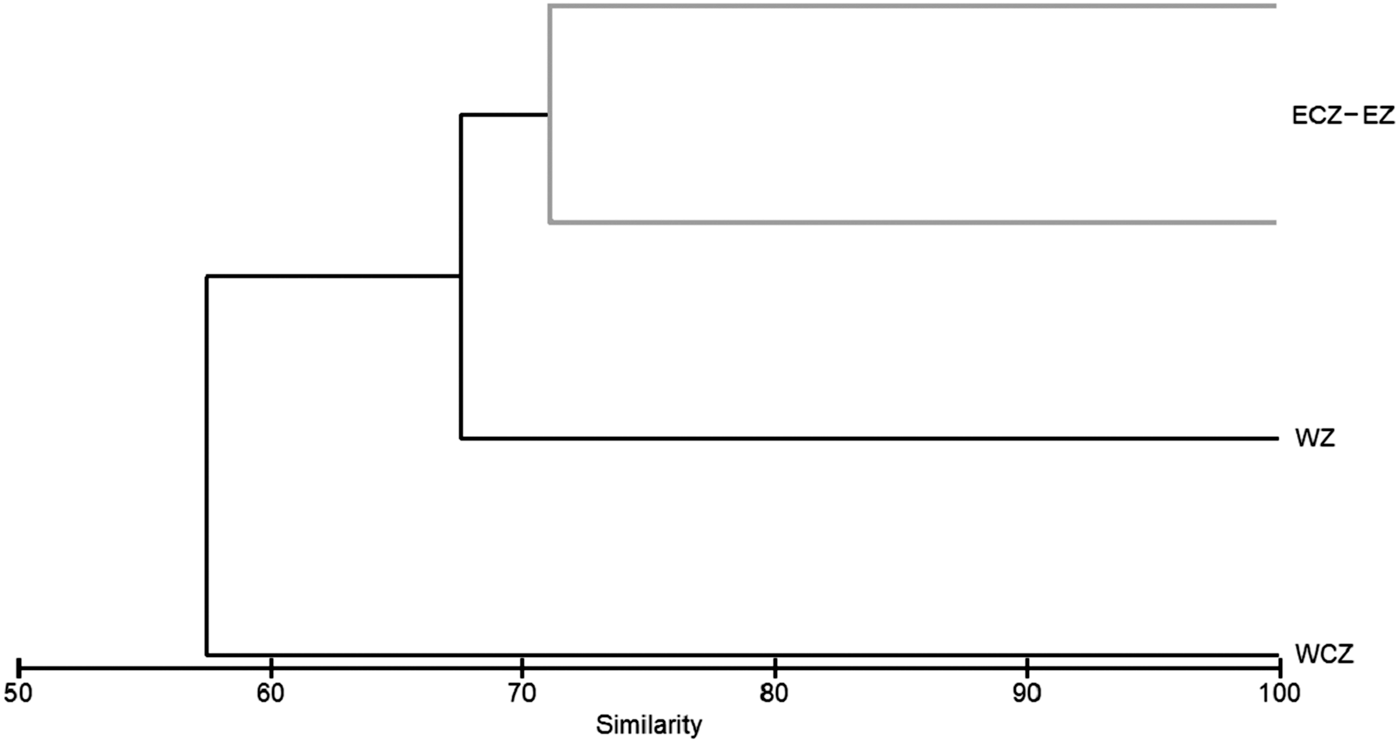
The cluster analysis among geographic zones showed separation between the WCZ and the other three zones. Within the three other zones, the WZ and the Eastern Zones (ECZ and EZ) clustered separately (P < 0.05) (Figure 4). The highest number of species was recorded in the Eastern Zones, with 136 species collected (Table 4).
Similarity dendrogram among geographic zones using Jaccard's coefficient as similarity index and UPGMA analysis. The significance of the groups (P < 0.05) was tested with the similitary profile (SIMPROF); non-significant cells in grey. WZ, Western Zone; WCZ, Western Central Zone; ECZ, Eastern Central Zone; EZ, Eastern Zone.
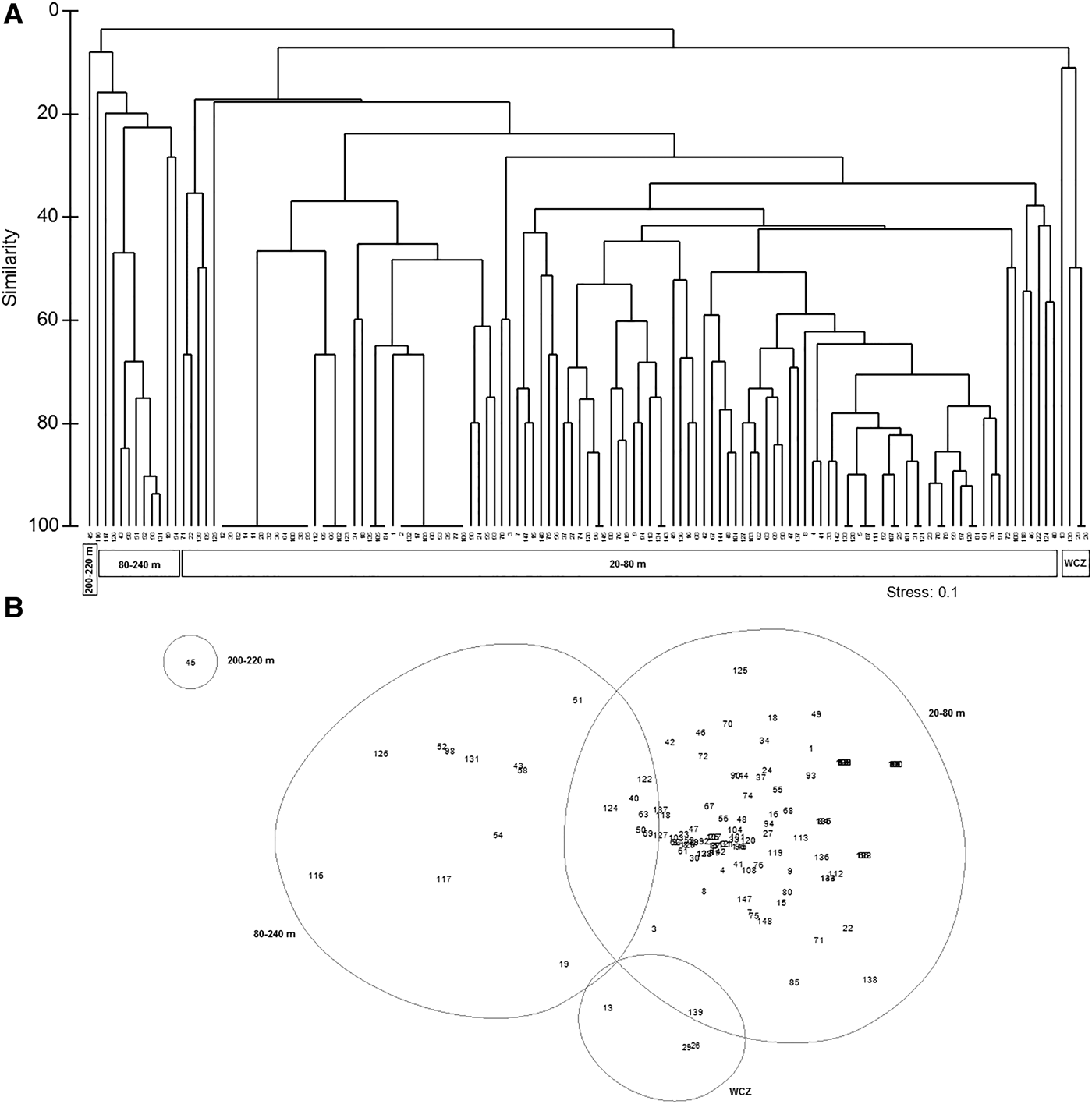
Classification and ordination of the fish fauna showed four main groupings (Figure 5), three of which were separated by depth: one represented a single species, Cherublemma emmelas, limited to 200–220 m; the second comprised a group associated with the depth range of 80–240 m, including Gymnothorax phalarus, Merluccius angustimanus, Lophiodes caulinaris, Lophiodes spilurus, Zalieutes elater, Pontinus sp., Cynoscion nannus, Kathetostoma averruncus, Synchiropus atrilabiatus, Citharichthys sp. and Monolene dubiosa; the third comprised a group of 132 species associated with the depth range of 20–80 m, some of which were also recorded over a wide bathymetric distribution (Synodus evermanni, Porichthys margaritatus, Prionotus stephanophrys, Diplectrum euryplectrum, Trichiurus nitens and Peprilus snyderi). The last group comprised species that were only found in the WCZ, i.e. Urotrygon chilensis, Opisthonema medirastre, Anchoa panamensis and Aluterus monoceros.
Classification (A) and ordination (B) of the continental and upper slope fishes off El Salvador, using Jaccard's coefficient as a similarity index.
DISCUSSION
The 148 species recorded in this study are fewer than previously reported for other latitudes of the TEP that used similar sampling gears. Northward, in the Central Pacific of Mexico (off Nayarit, Michoacán and Guerrero), 215 fish species have been recorded (Amezcua-Linares, Reference Amezcua-Linares1996) and off the coast of the Gulf of Tehuantepec (off Oaxaca and Chiapas) 166 species have been reported (Tapia-García et al., Reference Tapia-García, Macuitl, Cerdenares, Ayala, Gamboa and García1995). According to Robertson & Cramer (Reference Robertson and Cramer2009), species-richness peaks at the centre of the Panamic Province (Costa Rica and Panamá), but is fairly high throughout most of the mainland of the TEP, except in the northern part of the Gulf of California and in the Sinaloan and Central American Gap, including the coast of El Salvador, where species richness was significantly lower. Their study included all records of all shorefishes, and despite the fact that the Central American Gap contained fewer species than the adjacent Mexican and Panamic Provinces, their measure of the species richness included about 500–600 fish species. Our count of 148 species for the Salvadoran part of the province is primarily due to the sampling methodology, which is not directly comparable with other studies. Species of shallow, brackish, estuarine habitats and rocky or coral reef habitats could not be captured, since trawling did not sample the 0–10 m and 20 m depths and avoided underwater hazards (e.g. rocky outcrops). In addition, the 8-month duration and the relatively large mesh size (5 cm) of the sampling gear, which excluded smaller fish species, probably also led to the lower number of species recorded.
The dominance of the families Sciaenidae and Carangidae is consistent with studies in Mexico (Tapia-García et al., Reference Tapia-García, Macuitl, Cerdenares, Ayala, Gamboa and García1995; Amezcua-Linares, Reference Amezcua-Linares1996), which noted the dominance in diversity, frequency and abundance of these families. Nevertheless, the numerical dominance of Porichthys margaritatus, Pontinus sp. and Monolene dubiosa, was not reported in those studies. These three species are characterized by their presence in all four zones and their wide depth distribution, demersal habitat (Froese & Pauly, Reference Froese and Pauly2003) and carnivorous feeding habits (Robertson & Allen, Reference Robertson and Allen2006). Pontinus sp. has been reported as the third most abundant species off El Salvador, after Cynoscion nannus and Peprilus snyderi (Del Río, Reference Del Río2010).
Three species are recorded only to the genus level in this study: Pontinus sp., Bollmannia sp. and Citharichthys sp. Three Citharichthys species are presently documented to occur in Salvadoran waters, i.e. C. gilberti, C. platophrys and C. mariajorisae. Citharichthys gilberti is limited to shallow water habitats, thus the Citharichthys flatfishes sampled in this study likely include both C. platophrys and C. mariajorisae.
Faunal associations by depth may be determined by the effect of temperature. In El Salvador, sea surface temperature averages from 28 to 30°C throughout the year (JICA, 2002) and the thermocline is between 50 and 75 m (Strømme & Sætersdal, Reference Strømme and Sætersdal1988). Hence, the three main groupings of fish species found in this study may be a result of the sharp thermocline, although there are limited records of environmental parameters in the region.
Patterns in the depth distributions of marine species and the negative relationship between depth of occurrence and depth range have been pointed out by numerous authors working on marine biogeography (Macpherson, Reference Macpherson2003). Our findings, which show that most species have high occurrences at depths less than 60 m and only a few of those exceed 200 m, are consistent with Stevens (Reference Stevens1996), who documented that there are very few species with broad depth ranges at low latitude or near the surface of the ocean. Pineda (Reference Pineda1993) also shows that species subject to higher environmental fluctuations (coastal species) have smaller depth ranges, while species dwelling in less variable environments (slope/rise species) have larger depth ranges.
The decrease in species richness with increasing depth is consistent with the results reported by Bianchi (Reference Bianchi1991), who found the highest number of species in the upper zone of the continental shelf (to about 50 m depth), a considerable number of species in the intermediate zone (to about 100 m depth) and only few species in the deeper zone; this variation is attributed to changes in dissolved oxygen in the water column (>2 ml 1−1 on the upper zone and <1 ml 1−1 in deeper waters).
The boundaries between geographic provinces tend to coincide with upwelling areas, river discharges, main currents and oceanographic fronts where there are pronounced changes in the oceanographic features of the waters such as temperature, salinity and productivity (Macpherson, Reference Macpherson2003). This explains the separation of the eastern zones (ECZ and EZ) (Figure 4), where the Lempa River mouth (the largest in the country) is located, creating a barrier between the Eastern and Western zones. The Eastern Zones are characterized by the presence of the largest estuaries (Jaltepeque and Jiquilisco) and the Gulf of Fonseca, probably the most productive zone of El Salvador. However, the species richness found in this zone is likely a result of many factors.
Moreover, faunal associations by biogeographic zone show that the WCZ is distinct from the other three zones. This zone includes the Protected Natural Area Complejo Los Cóbanos, which contains volcanic rocky bottoms and coral formations at 0–30 m depth (Gierloff-Emdem, Reference Gierloff-Emdem1976; Orellana, Reference Orellana1985), making it quite different from the rest of the Salvadoran coast. At Los Cóbanos, 49 species of reef-associated fishes have been reported (Orellana, Reference Orellana1985), of which 37 were not recorded in this study.
The vast majority of the TEP shallow-water habitat occurs along the continental coastline, which has a very narrow continental shelf (Zapata & Robertson, Reference Zapata and Robertson2007). We observed that the fish assemblages were determined by depth rather than geographic areas; the three groups determined by depth are limited by the 20–80, 80–240 and 200–220 m depth strata. Macpherson (Reference Macpherson2003) mentioned that boundaries between depth provinces are usually related to environmental variations and these depth boundaries define a coastal domain (~< 100 m), a continental shelf and slope domain (~100–1000 m), typically with a boundary in the vicinity of the shelf break (~300 m) and a slope/rise domain (>1000 m); but the extent of these domains changes with latitude.