Introduction
Traumatic brain injury (TBI) is one of the leading causes of death and acquired disability in children and adolescents under the age of 15 (Andrews, Rose, & Johnson, Reference Andrews, Rose and Johnson1998; Walz, Yeates, Wade, & Mark, Reference Walz, Yeates, Wade and Mark2009). Children with TBI are at risk for a multitude of negative cognitive and behavioral outcomes (Janusz, Kirkwood, Yeates, & Taylor, Reference Janusz, Kirkwood, Yeates and Taylor2002; Walz et al., Reference Walz, Yeates, Wade and Mark2009). However, few studies have examined the social implications of childhood TBI (Walz et al., Reference Walz, Yeates, Wade and Mark2009; Yeates et al., Reference Yeates, Dennis, Rubin, Taylor, Bigler, Gerhardt and Vannatta2007). Deficiencies in peer relationships have consistently been found to be associated with social and emotional inadequacies (Rubin, Bukowski, & Parker, Reference Rubin, Bukowski and Parker2006). We examined: (a) the friendship quality of children with TBI and a comparison group of children with OI; (b) the relations between TBI, orthopedic injury (OI), and children’s interpersonal relationships; and (c) whether, for children with TBI and OI, friendships and peer rejection predicted psychosocial outcomes.
Existing TBI Research
Recent research has focused on the behavioral and social consequences of childhood TBI (e.g., Andrews et al., Reference Andrews, Rose and Johnson1998; Dennis et al., Reference Dennis, Simic, Taylor, Bigler, Rubin, Vannatta and Yeates2012; Muscara, Catroppa, Eren, & Anderson, Reference Muscara, Catroppa, Eren and Anderson2008), which may be different from those in adults with TBI (e.g., Anderson & Beauchamp, Reference Anderson and Beauchamp2012). Children with TBI are more likely to be characterized as impulsive, aggressive, and irritable (Janusz et al., Reference Janusz, Kirkwood, Yeates and Taylor2002); self-report higher levels of loneliness; are more depressed and anxious (Andrews et al., Reference Andrews, Rose and Johnson1998; Max et al., Reference Max, Keatley, Wilde, Bigler, Schachar, Saunders and Levin2012, Reference Max, Keatley, Wilde, Bigler, Levin, Schachar and Yang2011); and are often rated as being less socially competent (Andrews et al., Reference Andrews, Rose and Johnson1998) than are children without TBI. Deficits in behavioral and social skills often fail to resolve over time (Walz et al., Reference Walz, Yeates, Wade and Mark2009; Yeates et al., Reference Yeates, Wade, Stancin, Taylor, Drotar and Minich2002).
The behavioral and cognitive sequelae of childhood TBI may impact peer relationships, particularly during periods of development when peers are especially significant and influential. Peers are more likely to reject children who have difficulty regulating their emotions and who are characterized by behaviors that deviate from peer group norms (e.g., Ladd, Reference Ladd2006). The inability to develop adequate peer relationships, and with friends in particular, is associated with psychosocial difficulties (for relevant reviews, see Rubin, Bukowski, & Laursen, Reference Rubin, Bukowski and Laursen2009) and psychopathology (Max et al., Reference Max, Keatley, Wilde, Bigler, Levin, Schachar and Yang2011). These difficulties may have long-term personal implications.
Friendship
Friendships play significant roles in child development. Friends bolster feelings of self-worth and promote the growth of social skills and interpersonal sensitivity (e.g., Rubin, Fredstrom, & Bowker, Reference Rubin, Fredstrom and Bowker2008). During middle childhood, friendships provide opportunities for children to learn about behavioral and emotional norms, and offer emotional and social support (Newcomb & Bagwell, Reference Newcomb and Bagwell1995). Friendships provide opportunities for the expression and regulation of affect (Denton & Zarbatany, Reference Denton and Zarbatany1996). For non-injured youth, having at least one friend is important for positive adjustment (Kingery, Erdley, & Marshall, Reference Kingery, Erdley and Marshall2011; Wojslawowicz Bowker, Rubin, Booth-LaForce, & Rose-Krasnor, Reference Wojslawowicz Bowker, Rubin, Booth-LaForce and Rose-Krasnor2006).
The nature of the friendship is also important in understanding psychosocial adjustment. Friendships characterized by positive qualities (e.g., companionship, nurturance) have been associated with school involvement and adaptive school adjustment (Demir & Urberg, Reference Demir and Urberg2004; Waldrip, Malcolm, & Jensen-Campbell, Reference Waldrip, Malcolm and Jensen-Campbell2008). Studies have also shown that high quality friendships serve as a protective factor against peer victimization, peer rejection, and internalizing behaviors (McDonald et al., Reference McDonald, Bowker, Rubin, Laursen and Duchene2010; Peters, Riksen-Walraven, Cillissen, & de Weerth, Reference Peters, Riksen-Walraven, Cillissen and de Weerth2011; Wojslawowicz Bowker et al., Reference Wojslawowicz Bowker, Rubin, Booth-LaForce and Rose-Krasnor2006). Although the importance of friendship in development has been well studied, little information exists about the link between friendship support and psychological outcomes for children with TBI. Thus, it is unclear whether or not the benefits of friendship seen in normative populations extend to children who have experienced a TBI.
In an earlier study exploring the social adjustment and friendships of children with TBI, Bohnert, Parker and Warschausky (Reference Bohnert, Parker and Warschausky1997) found that children with severe TBI reported more conflict and betrayal in their friendships than children with mild/moderate TBI. Additionally, Bohnert and colleagues (1997) found children with severe TBI reported less intimacy and less companionship in their friendships compared to their mild/moderate TBI counterparts. What is unknown is how similar/dissimilar the friends’ perceptions of the relationship quality are; friends’ perceptions of relationship quality may provide a more accurate depiction of dyadic relationship quality. Large discrepancies between friends in their reporting of relationship quality may have ramifications for the stability of the friendship, and could compromise positive outcomes that can be gained from having a friendship.
Recently, Yeates and colleagues (2013) examined the nature of peer relationships for children with TBI. They drew participants from a larger project focused on social outcomes following childhood TBI and examined the relation between the presence of a mutual friendship and peer acceptance. Mutual friendships were identified during classroom visits via student nominations of their three best friends. Less than half of the children with severe TBI reported having a mutual friendship (Yeates et al., Reference Yeates, Gerhardt, Bigler, Abildskov, Dennis, Rubin and Vannatta2013). Children with TBI who lacked a mutual friendship in the classroom were rated by classmates as less sociable and less prosocial compared to counterparts who had a mutual friendship. The friendless group was also more likely to be rejected and victimized than children with TBI who had a mutual friendship.
While Yeates et al. (Reference Yeates, Gerhardt, Bigler, Abildskov, Dennis, Rubin and Vannatta2013) provided preliminary information about the relations between having a friend and several peer relationship constructs for children with TBI, some important research questions remain unaddressed. More study is needed of the quality of friendships among children with TBI, how friends of children with TBI perceive the quality of those friendships, and whether perceived friendship quality moderates the relation between social behaviors and the psychological adjustment of children with TBI. Furthermore, little is known about whether the experiences of friendship, social interactions, and psychosocial outcomes differ between children with TBI and children with other injuries. In the current study, which draws participants from the same overall sample as Yeates et al. (Reference Yeates, Gerhardt, Bigler, Abildskov, Dennis, Rubin and Vannatta2013), we aimed to extend extant research by exploring these questions.
Current Study
We compared ratings of friendship quality (i.e., support and satisfaction) between children with TBI and children with orthopedic injury (OI). Since friendship is a dyadic construct, we also examined whether the friends of children with TBI and children with OI rated the quality of their friendships similarly. In this case, friends were identified directly by the TBI and OI participants, rather than based on classroom sociometric data. Finally, we examined the links between social adjustment (i.e., peer rejection and friendship support) and psychosocial outcomes (i.e., internalizing and externalizing problems) for children with TBI and children with OI. In so doing, we explored whether the relations between peer rejection and psychosocial outcomes were moderated by perceived friendship quality of children with TBI and OI.
Method
Participants
Participants were drawn from a larger multi-site study, the Social Outcomes in Kids with Brain Injury (SOBIK) project, which focused on examining social outcomes following childhood traumatic brain injuries. The children were recruited from children’s hospitals at three metropolitan sites: Hospital for Sick Children in Toronto (Canada); Nationwide Children’s Hospital in Columbus (U.S.); and Rainbow Babies and Children’s Hospital and MetroHealth Medical Center in Cleveland (U.S.). Institutional Review Boards approved all study procedures before recruitment, and informed parental consent and child assent were obtained before participation. All human data were obtained in compliance with regulations of the associated institutions.
Eligible participants included children hospitalized for either TBI or OI who were 8 to 13 years of age at the time of their participation and injured between 12 and 63 months before participation. Researchers often use children with OI, such as a broken bone, as a comparison group for children with TBI because both groups experience trauma and hospitalization, and have similar premorbid functioning and background demographics (Janusz, et al., Reference Janusz, Kirkwood, Yeates and Taylor2002; Yeates et al., Reference Yeates, Gerhardt, Bigler, Abildskov, Dennis, Rubin and Vannatta2013). The OI comparison group was matched to the TBI sample by age and sex.
For both TBI and OI groups, we applied the following exclusion criteria: (a) history of more than one serious injury requiring medical treatment; (b) premorbid neurological disorder or mental retardation; (c) any injury resulting from child abuse or assault; (d) history of severe psychiatric disorder requiring hospitalization before the injury; (e) sensory or motor impairment that prevented valid administration of study measures; (f) primary language other than English; and (g) medical contraindication to MRI. Children in full-time special education classrooms were excluded because the reliability and validity of classroom data for such classrooms has not been established. Children with a history of premorbid learning or attention problems were not excluded.
Injury severity for TBI participants was assessed using the Glasgow Coma Scale (GCS; Teasdale & Jennett, Reference Teasdale and Jennett1974), and parents of the TBI youth were asked about the nature of the child’s injury and other demographic variables. The TBI group had a GCS score of 12 or less after resuscitation, or a 13–15 score with positive imaging for brain insult or depressed skull fracture. The children with TBI were grouped by injury severity: GCS scores 9–15 defined a Complicated Mild/Moderate TBI group, and GCS scores 3–8 defined a Severe TBI group.
The OI group was comprised of children who sustained fractures that involved hospital admission but were not associated with any loss of consciousness or other risks or indications of brain injury (e.g., skull or facial fractures). Parents of OI youth were asked about the nature of the child’s injury and other demographic variables.
Among children eligible to participate and approached about the study, 82 (47%) of those with TBI and 61 (26%) of those with OI agreed to enroll. For purposes of this report, these 143 participants will be referred to as the original sample. The original sample participation rate was significantly higher for TBI than OI participants. This is not surprising considering the focus of the larger study was TBI-related outcomes, therefore parents of OI children may have been less motivated to participate. Participants and non-participants in both groups did not significantly differ in age at injury, age at initial contact about the study, sex, race, or measures of socioeconomic status (SES). In addition, participants and non-participants did not differ on measures of injury severity (i.e., mean length of hospital stay, median GCS score; for more detailed comparisons of participants and non-participants (see Dennis et al., Reference Dennis, Simic, Taylor, Bigler, Rubin, Vannatta and Yeates2012; Yeates et al., Reference Yeates, Gerhardt, Bigler, Abildskov, Dennis, Rubin and Vannatta2013).
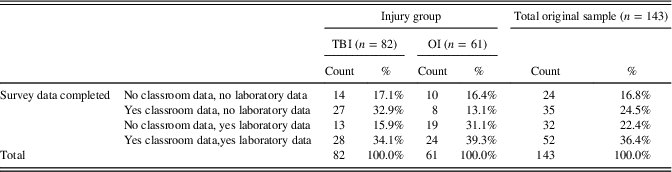
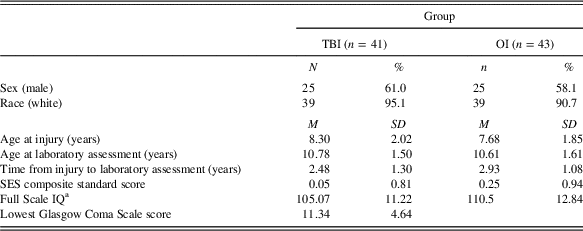
The current report was restricted to a final sample of 41 children with TBI and 43 children with OI from the larger sample who had completed laboratory measures with a mutual best friend. The subset of children who also had classroom data was included in analyses predicting psychosocial outcomes (TBI n=28; OI n=24). Table 1 summarizes these breakdowns from the original sample. Demographic and injury characteristics of the final sample (n=84) are presented in Table 2.
Cross-tabulated frequency counts and percentages: completed laboratory and classroom measures of original sample by injury group

Note. TBI=traumatic brain injury, OI=orthopedic injury.
Final sample demographics by injury group

Note. No significant differences between groups. TBI=traumatic brain injury, OI=orthopedic injury, SES=socioeconomic status.
a IQ measured using 2 subtest version of Wechsler Abbreviated Scale of Intelligence.
Procedure
Data were collected over the course of three visits. Children with TBI and with OI attended an initial laboratory visit during which they provided names of three same-age and same-sex best friends. Nominated best friends who had not sustained a TBI or OI were then recruited based on contact information provided by parents participating in the study. Best friends who agreed to participate were asked to attend a later laboratory visit with their friend who had sustained a TBI or OI. Additionally, parents of children with TBI and OI provided demographic information.
During a second laboratory visit, children with TBI, children with OI, and the best friend nominated during the initial laboratory visit provided information about the quality of their friendship. Parents of children with TBI and OI also completed a measure of their child’s post-injury emotional and behavioral problems. For both groups, the most common reasons for not completing the laboratory visit with a friend were due to: contact issues with the target TBI or OI child (e.g., unable to schedule visit); and the target child/family declining the subsequent laboratory visit.
Data about children with TBI and OI was also collected in the classroom. Following recruitment from hospitals, school principals of OI and TBI participants were contacted. Teachers distributed and collected parental consent forms from classmates of children with TBI and OI. To protect the confidentiality of participants, the work was described to students as a study of friendships without mentioning injury or identifying the participating child. Questionnaires were administered during a single group session. Teachers completed a measure of social adjustment specific to the child with TBI or OI.
Overall, classroom data were provided by 1598 children in 87 mainstream classrooms. On average, 18.4 students (SD=4.7; range=7–30) participated in each class. Parental consent was obtained for 82% of available classmates and 96% were present on the day of data collection; thus, 79% of classmates participated. Classroom data were not collected during the first 2 months of the school year, to ensure children and peers were familiar with each other. The average time between laboratory participation and classroom participation was approximately 5 months.
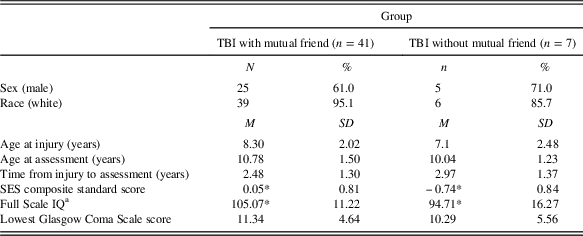
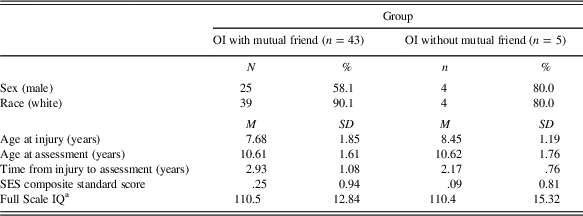
Demographic characteristics are provided for the final sample of TBI and OI participants who completed laboratory measures with a mutual friend and TBI and OI participants who did not have a mutual friend during completion of laboratory measures. TBI and OI participants who were unable to identify or bring in a mutual friend for the laboratory assessment were excluded from the current study (TBI: Table 3; OI: Table 4). Group differences were found for TBI participants with and without a mutual friend on demographic variables of IQ and SES. TBI participants with a mutual friend had higher IQ scores compared to TBI participants without a mutual friend. However, differences in IQ for both groups were within the average to high range. Differences in SES were similar to what has been found in previous research conducted with this data set (Yeates et al., Reference Yeates, Gerhardt, Bigler, Abildskov, Dennis, Rubin and Vannatta2013).
Demographics by mutual friend presence for laboratory visit: TBI

Note. TBI=traumatic brain injury, SES=socioeconomic status.
aIQ measured using the two-subtest version of Wechsler Abbreviated Scale of Intelligence. Levene’s test indicated equal variances between groups for both significant variables: IQ: F(1; 46)=.94, p=.34; SES: F(1; 46)=.38, p=.54.
*=p<.05.
Demographics by mutual friend presence for laboratory visit: OI

Note. No significant differences between groups. OI=orthopedic injury, SES=socioeconomic status.
a IQ measured using two subtest version of Wechsler Abbreviated Scale of Intelligence.
The final sample was likely to have a mutual friendship within their classroom (TBI=81% and OI=92%). These rates are higher when compared to the original sample of classroom data, which revealed that 69% of children with TBI and 87% of children with OI had a mutual friendship within their classroom. TBI participants were more likely than OI participants to have their classroom visit before the laboratory visit with their friend. The TBI and OI groups did not differ in the average number of months that passed during the school year before classroom data collection. Completion of classroom data collection did not differ significantly as a function of any demographic or injury characteristic.
Laboratory Measures
Friendship quality
Children with TBI and OI and their best friends completed the Network of Relationships Inventory (NRI; Furman & Buhrmester, Reference Furman and Buhrmester1985) to assess perceived levels of social support and satisfaction within their friendships. Participants rated items on a scale of 1 (“little or none”) to 5 (“the most”). Of interest in the present study was the friendship support factor, which included a mean score across 24 items that describe admiration, affection, companionship, instrumental aid, intimacy, nurturance, and reliable alliance (e.g., How much do you tell this person everything?). Item scores were averaged (α=.87) with higher scores indicating more positive perceptions of friendship support. We were also interested in perceived friendship satisfaction, which included three items that described a child’s enjoyment in their friendship (e.g., How satisfied are you with your relationship with this person?). Higher scores (α=.87) indicated greater friendship satisfaction.
Emotional and behavioral problems
Parents of children with TBI and OI completed the Behavioral Assessment for Children 2 (BASC-2; Reynolds & Kamphaus, Reference Reynolds and Kamphaus1992), which provides standardized scales to aid in clinical diagnoses of problem behaviors. Parents reported on four broadband indices of externalizing problems (α=.84), internalizing problems (α=.73), behavior symptoms (α=.76), and adaptive skills (α=.92). The BASC-2 has shown good internal consistency and test–retest reliability. The construct validity of the scales is well documented, as is its predictive validity and sensitivity to clinical disorders.
Classroom Measures
Peer-rated social adjustment
The Extended Class Play (ECP; Rubin, Wojslawowicz, Rose-Krasnor, Booth-LaForce, & Rose-Krasnor, 2006) is a revised and extended version of the Revised Class Play (Masten, Morison, & Pellegrini, Reference Masten, Morison and Pellegrini1985), which measures behavioral reputation based on classroom peer report. Children with TBI (n=28), OI (n=24) and their classmates were presented with a class roster and asked to pretend to be the directors of an imaginary class play and “cast” one boy and one girl from the class into 31 hypothetical “roles.” Popular-Sociable, Prosocial, Aggressive, Rejected-Victimized, and Shy-Withdrawn subscales have been identified through factor analysis (Wojslawowicz Bowker et al., Reference Wojslawowicz Bowker, Rubin, Booth-LaForce and Rose-Krasnor2006). Nominations for each role were standardized within sex in each class to adjust for unequal class size, participation rates, and then summed to create dimension scores. The current study focused on the dimension of Rejection/Victimization (e.g., someone who is often left out; someone who gets picked on by other kids), on which children with TBI have been shown to have the most pronounced differences when compared to children with OI (Yeates et al., Reference Yeates, Gerhardt, Bigler, Abildskov, Dennis, Rubin and Vannatta2013).
Teacher-rated social adjustment
Teachers completed the Teacher-Child Rating Scale (T-CRS; Hightower et al., Reference Hightower, Work, Cowen, Lotyczewski, Spinell, Guare and Rohrbeck1986), a measure of social adjustment for use with elementary school age children. Previous research (Hightower et al., Reference Hightower, Work, Cowen, Lotyczewski, Spinell, Guare and Rohrbeck1986; Rubin, Chen, & Hymel, Reference Rubin, Chen and Hymel1993) has demonstrated the reliability and validity of the scale. Following procedures outlined by Rubin et al. (Reference Rubin, Chen and Hymel1993), summary scores for teacher ratings for the following factors were computed for TBI (n=28) and OI (n=24) participants: Acting-out, shy-anxious behavior, frustration tolerance, and peer social skills. Higher scores were indicative of greater competence for frustration tolerance and peer social skills, and of greater difficulty for acting-out, shy-anxious behavior.
Results
Analyses comparing the two groups on perceptions of friendship support and friendship satisfaction were restricted to 41 children with TBI and 43 children with OI who completed the NRI for their best friend, and whose best friend also completed the NRI. Thereafter, in predicting maladaptive outcomes, the data were drawn from the 28 children with TBI and 24 with OI for whom we had complete data for self-reported friendship support and satisfaction, classroom peer rejection/victimization, and teacher- and parent-reported behaviors.
Aims 1 and 2: Comparing the Friendship Quality of Children with TBI and OI
Three ANOVAs were conducted to assess differences between the TBI and OI groups, and the friends of the children with TBI and OI, in their perceptions of friendship support and satisfaction. Group differences appeared for friendship support F(3,176)=4.41; p<.01; η 2=.07. The TBI group perceived their friendships as more supportive than did the OI group (TBI M=3.89; OI M=3.53; p<.01). Post hoc Tukey tests revealed no differences in reports of perceived friendship support between the friends of the TBI and the friends of the OI groups (TBI best friend M=3.99; OI best friend M=3.82; p=.59).
Group differences were observed for friendship satisfaction, F(3,176)=2.87; p=.04; η 2=.05. The children with TBI were more satisfied with their friendships than the children with OI (TBI M=4.56; OI M=4.34; p=.05). Additionally, the OI group was less satisfied with their friendships than were their best friends (OI M=4.34; OI best friend M=4.59; p=.03). The OI group also was less satisfied with their own friendships than were the best friends of the children with TBI (OI M=4.34; TBI best friend M=4.66; p=.01).
Aim 3: Similarity of Informant Report
Intraclass correlations (ICC) for reports of friendship support and friendship satisfaction were computed for the TBI group and their best friends as well as for the OI group and their best friends. The children with TBI and their best friends showed high correspondence in their ratings of friendship support (ICC: 0.70; 95% CI: 0.44–0.84), suggesting that the dyadic partners viewed their friendships as similarly positive. Children with TBI and their best friends also showed high correspondence in ratings of friendship satisfaction (ICC: 0.57; 95% CI: 0.19–0.77). Children with OI and their best friends did not show high correspondence in their respective ratings for friendship support (ICC:.075; 95% CI: -.70–.50) or friendship satisfaction (ICC: -.11; 95% CI: -1.0–.40).
Aim 4: Predicting Maladaptive Outcomes
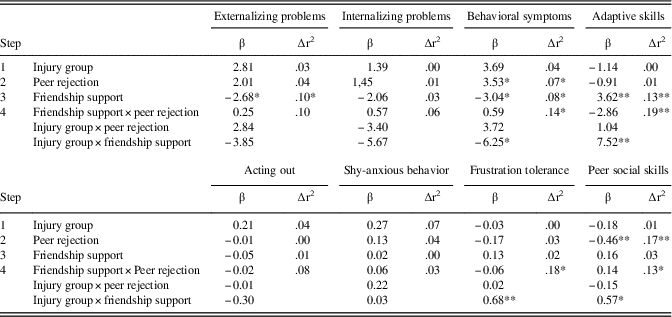
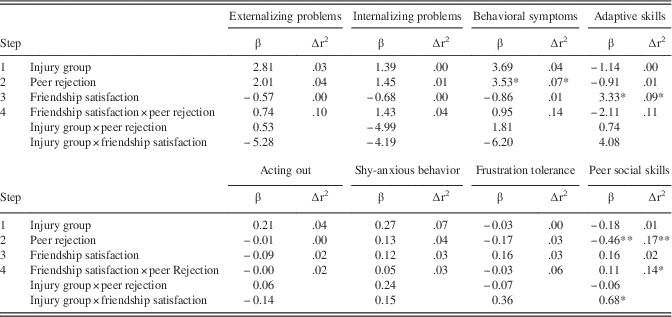
A subsequent series of hierarchical linear regressions predicting various child behaviors for both the TBI and OI groups was conducted using the following steps: (1) Injury Group (dummy coded as 0=OI and 1=TBI), (2) Peer Rejection, and (3) Friendship Quality (Support, or Satisfaction), (4) and two-way interactions of Injury Group and Peer Rejection, Injury Group and Friendship, and Peer Rejection and Friendship. For interactions involving Injury Group, simple slopes were conducted separately for children with TBI and OI. For the interactions between peer rejection and friendship quality, simple slopes were conducted at 1 SD above, 1 SD below, and at the mean for friendship quality (Aiken & West, Reference Aiken and West1991) using the MODPROBE add-on within SPSS 20 (Hayes & Matthes, Reference Hayes and Matthes2009).
Friendship support
At Step 1, Injury Group was non-significant in the prediction of all outcomes (Table 5). At Step 2, when controlling for Injury Group, the addition of Peer Rejection positively predicted parent-reported Behavior Symptoms and negatively predicted teacher-rated Peer Social Skills. At Step 3, the addition of Friendship Support to the model negatively predicted parent-reported Externalizing Problems and Behavior Symptoms and positively predicted parent-reported Adaptive Skills. At Step 4, the addition of the two-way interactions predicted parent-reported Behavioral Symptoms and Adaptive Skills, and teacher-reported Frustration Tolerance and Peer Social Skills. In all cases, the interaction of Injury Group and Friendship Support emerged as significant. Simple slopes were conducted for children with TBI and OI separately. For children with TBI, there was a negative relation between self-reported Friendship Support and parent-reported Behavioral Symptoms (b=-4.90; se=1.67; t=-2.94; p=.001), and positive relations with parent-reported Adaptive Skills (b=5.62; se=1.58; t=3.55; p=.001), and teacher-reported Frustration Tolerance (b=0.29; se=0.14; t=2.05; p=.05), and Peer Social Skills (b=0.36; se=0.14; t=2.53; p=.01). Controlling for peer rejection, friendship quality seems to be a protective factor for children with TBI. For children with OI, Friendship Support was unrelated to parent-reports of Behavioral Symptoms (b=0.72; se=1.97; t=0.37; p=.72) and Adaptive Skills (b=-0.27; se=1.85; t=-0.15; p=.88), and teacher-reported Frustration Tolerance (b=-0.18; se=0.16; t=-1.14; p=.26), and Peer Social Skills (b=-0.06; se=0.15; t=-0.38; p=.70).
Predicting maladaptive outcomes from peer rejection and friendship support

Note. N=52. Beta weights reported are unstandardized.
* p<.05; **p<.01; ***p<.001.
Friendship satisfaction
At Steps 1 and 2, similar results to those described above emerged for the regression analyses for Friendship Support (Table 6). At Step 3, the addition of Friendship Satisfaction to the model negatively predicted parent-reported Externalizing Problems and Behavioral Symptoms, and positively predicted parent-reported Adaptive Skills. At Step 4, the addition of the two-way interactions predicted parent-reported Behavioral Symptoms and Adaptive Skills, as well as teacher-reported Frustration Tolerance and Peer Social Skills. In all cases, the interaction of Injury Group and Friendship Satisfaction was significant. Simple slopes conducted separately for children with TBI and OI revealed that for both groups of children, Friendship Satisfaction was unrelated to teacher-reported Frustration Tolerance (TBI: b=0.19; se=0.17; t=1.14; p=.26; OI: b=-0.02; se=0.15; t=-0.16; p=.88). For children with TBI, Friendship Satisfaction positively predicted teacher reported Peer Social Skills (b=0.37; se=0.16; t=2.33; p=.02). Controlling for peer rejection, friendship satisfaction was a protective factor for children with TBI. For children with OI, Friendship Satisfaction was unrelated to Peer Social Skills (b=-0.07; se=0.14; t=-0.46; p=.65).
Predicting maladaptive outcomes from peer rejection and friendship satisfaction

Note. N=52. Beta weights reported are unstandardized.
* p<.05; ** p<.01; *** p<.001.
DISCUSSION
The findings convey an important narrative related to the friendships of children with TBI. Aims 1 and 2 provided insight into differences regarding perceptions of friendship quality, as reported by children with TBI, OI and their respective best friends. Group differences were found between the TBI and OI groups on perceived friendship support and friendship satisfaction. Specifically, the TBI group perceived their best friendships as more supportive and satisfying than the OI group. This new information regarding the friendship quality of children with TBI is encouraging, especially given findings from non-injured samples that show children with high quality friendships have fewer internalizing difficulties and are less likely to be bullied by peers (Kendrick, Jutengren, & Stattin, Reference Kendrick, Jutengren and Stattin2012; Kingery et al., Reference Kingery, Erdley and Marshall2011).
The OI group had the lowest ratings of friendship support, which was surprising considering that children with OI are commonly used as a control group in studies of pediatric TBI (Janusz et al., Reference Janusz, Kirkwood, Yeates and Taylor2002; Yeates et al., Reference Yeates, Gerhardt, Bigler, Abildskov, Dennis, Rubin and Vannatta2013). Because of their injuries, it may be the case that children with OI exhibit certain behavioral difficulties that adversely impact their social relationships (Brehaut, Miller, Raina, & McGail, Reference Brehaut, Miller, Raina and McGail2003). Moreover, in a study by Menzer et al. (Reference Menzer, McDonald, Rubin, Rose-Krasnor, Booth-LaForce and Schulz Begle2012), researchers found that non-injured fifth graders reported higher friendship quality ratings than those reported by children from either group in the present study. In the future, scholars should explore friendship experiences of TBI, OI, and non-injured children to put TBI and OI group differences into a broader developmental context and assess whether the OI or a non-injured group best represents the sample to be compared to children with TBI.
The third aim of the study was to examine how similarly each dyad perceived their friendship in terms of support and satisfaction. Children with TBI and their best friends perceived their relationships as similar in supportiveness and satisfaction. Friendship quality reports from only one member of the dyad could conceivably provide an over- or underestimate of the quality of the dyadic relationship (McDonald et al., Reference McDonald, Dashiell-Aje, Menzer, Rubin, Oh and Bowker2013). The discrepancies related to friendship support and satisfaction between the OI children and their best friends may help explain why this group had the lowest ratings of friendship satisfaction. Such discrepancies in perceptions could threaten the stability and long-term benefits of friendship (Rubin et al., Reference Rubin, Fredstrom and Bowker2008).
The fourth aim of the study was to examine associations between peer functioning and psychosocial outcomes in children with TBI. Positive friendship qualities have been predictively associated with positive psychosocial adjustment in childhood, likely because high-quality, positive friendships satisfy social needs and provide emotional and social support (e.g., Rubin et al., Reference Rubin, Wojslawowicz, Rose-Krasnor, Booth-LaForce and Burgess2006). Perceptions of friendship support and satisfaction were associated with a lower risk of a variety of maladaptive psychosocial outcomes for children with TBI, and associated with more competent skills. These findings coincide with literature on the effects of friendship quality in non-injured samples (Malcolm, Jensen-Campbell, Rex-Lear, & Waldrip, Reference Malcolm, Jensen-Campbell, Rex-Lear and Waldrip2006; Nangle, Erdley, Newman Mason, & Carpenter, Reference Nangle, Erdley, Newman, Mason and Carpenter2003). Furthermore, for children with TBI, there was some indication that positive perceptions of friendship served as a buffer against maladaptive outcomes, particularly for those rejected by their peers. For example, for children with TBI who were rejected by their classroom peers, perceptions of friendship support predicted higher teachers ratings of peer social skills. Similar findings emerged for friendship satisfaction.
These findings coincide with existing literature that has highlighted the importance of friendship support in buffering against negative psychosocial outcomes for victimized or rejected youth (Malcolm et al., Reference Malcolm, Jensen-Campbell, Rex-Lear and Waldrip2006; Waldrip et al., Reference Waldrip, Malcolm and Jensen-Campbell2008). For children with TBI, friendships perceived as positive and supportive may serve as a protective factor, especially if they experience difficulties in the peer group at large. These are promising findings that have remained unexplored in prior research, and suggest that the process and function of friendship in relation to psychosocial outcomes for children with TBI mirrors that of children without a medical disability.
Strengths
The current study provides an important picture regarding the social lives of children with TBI. This is the first study, to the authors’ knowledge, that has addressed friendship support of children with TBI and has included the perceptions of the best friend vis-à-vis friendship quality. Additionally, this study used a variety of informants to address children’s psychosocial functioning: self-reports of friendship support, peer-reports of peer rejection, and teacher- and parent reports of children’s behaviors and competencies. This multi-informant method is useful for analyzing reports of a child’s behavior across different contexts (e.g., school, home; Kerr, Lunkenheimer, & Olson, Reference Kerr, Lunkenheimer and Olson2007).
LIMITATIONS
This study is not without limitations. First, because we were unable to examine TBI severity due to the small sample size, the findings presented herein regarding psychosocial outcomes may not necessarily generalize to the entire population of children with TBI. Future studies should address whether severely injured children are at greater risk for maladaptive outcomes compared to moderately injured children when their friendships are qualitatively poor. The current study only focused on participants who could identify a best friend; thus, the results may not extend to the broader sample of children with TBI or OI. Furthermore, given that children with TBI with a friend in the classroom have been rated by peers as being more prosocial and popular than those without a friendship (Yeates et al., Reference Yeates, Gerhardt, Bigler, Abildskov, Dennis, Rubin and Vannatta2013), future research should examine whether it is the mere presence of a best friend that is related to psychosocial outcomes or whether it is the quality of that relationship that is more important (Rubin, Reference Rubin2004).
Clinical Implications and Future Directions
For children with TBI, friendship appears to confer several benefits. The current findings underscore the need to develop interventions designed to promote positive and appropriate social behaviors and relationships for children with TBI. This study suggests that children with TBI who perceive that their friendship is unsupportive and who are unaccepted by the peer group may be at higher risk for maladaptive psychological outcomes. Conversely, children with TBI who perceive their friendships positively may be buffered against such adverse outcomes. High quality friendships may be especially important for children with TBI who are rejected by their peers. Interventions aimed at fostering social skills in children with TBI could contribute to the development and maintenance of close friendships. Such friendships could lead to short-term improvements in psychological functioning and/or buffer children with TBI from long-term psychological maladjustment.
ACKNOWLEDGMENTS
This research was supported by grant R01HD048946 from the National Institute of Child Health and Human Development to Keith Owen Yeates. The authors have no conflicts of interest to declare.