Introduction
Currently, there are more than one million carers in England and Wales providing care for more than 50 hours per week (Office for National Statistics 2001). To help ensure that support is provided when needed, there have been a number of developments in policy relating to carers. For example, the 2004 Carers (Equal Opportunities) Act focused on ensuring that carers are informed about their rights to an assessment. The commitment to carers was reaffirmed in the 2006 White Paper Our Health, Our Care, Our Say by reporting the need for a service designed to meet the diverse needs and concerns of carers (Department of Health 2006). In 2008, the English National Strategy for carers emphasised the need to offer better outcomes for carers (HM Government 2008). In 2010, the strategy was refreshed by the Coalition government which incorporated key messages such as additional funding for carers (HM Government 2010b). However, despite the continued commitment in key government policy documents, carers are not always central within cash-for-care initiatives in England that aim to provide more personalised adult social care services.
One such cash-for-care scheme is the implementation of individual budgets (IBs) in social care, which can be traced back to the Cabinet Office Strategy Unit report Improving the Life Chances of Disabled People (Cabinet Office 2005). This initiative aimed to provide greater personalisation of social care support in England by increasing choice and control. Essentially, IBs build on the basic premise of co-production and the importance placed on actively involving people who use services (Leadbeater Reference Leadbetter2004; Needham and Carr Reference Needham and Carr2009; Parasuraman, Zeithami and Berry Reference Parasuraman, Zeithami and Berry1985; Parks et al. Reference Parks, Baker, Kiser, Oakerson, Ostrom, Ostrom, Percey, Vandivort, Whitaker and Wilson1981).
IBs also build on the experiences of both the direct payment initiative and the In Control approach within social care, both of which focused on promoting greater choice and control over support arrangements. The Community Care (Direct Payments) Act 1996 permitted local authorities to make cash payments to people with a disability in need of social care services. Direct payments were mainly spent on personal support and could not be used to purchase services provided by local authorities or to employ close co-resident relatives.
The White Paper Valuing People (Department of Health 2001) outlined how the Government would provide new opportunities for people with learning disabilities to live independently. Personalisation and person-centred planning sat at the heart of the White Paper as a vehicle to encourage more choice and control for people. Building on this, the social enterprise organisation In Control introduced the term self-directed support that brought together person-centred planning and direct payments (Needham Reference Needham2011). This approach focused on a greater role for self-assessment; the transparent allocation of resources to individuals according to relative levels of need; greater opportunity for users to define their needs and desired outcomes; and support for people to plan how best to use the resources available to meet their needs. The approach encourages greater flexibility and the use of a wide range of services and support rather than solely personal care (Duffy Reference Duffy2005).
Building on the In Control approach, IBs were piloted in 13 English local authorities between 2006 and 2008. A number of important principles underpinned IBs that distinguished them from both conventional services and direct payments. Service users' assessments were linked to a Resource Allocation System (RAS) which assigned levels of funding to specific levels of need. After service users were informed of the IB value, a personalised support plan was developed that covered the support or services that would meet their desired outcomes. The budget holder also had a choice of how they would like the resource to be deployed, such as through a direct payment or a managed budget via the local authority or a third-party arrangement. Furthermore, IBs combined a number of funding sources other than social care, including independent living fund, supporting people funds, disabled facilities grants, access to work and the local integrated community equipment services.
This aspiration of personalisation has continued to be stated in recent key policy documents, which includes the White Paper Building the National Care Service (HM Government 2010a) which anticipated that by the time the service is introduced, every eligible person will be offered a personal budget. Unlike individual budgets, personal budgets consist of only social care funds given to service users after an assessment to meet their social care needs. Budget holders are given a transparent allocation of money and they are given choice on how to manage the resource and what services are purchased. Budget holders can either opt to take the resource as a direct payment, ask the local authority to manage the budget, or choose a third party to manage the budget for them.
The piloting of IBs was accompanied by an independent evaluation commissioned by the Department of Health. In the main IBSEN evaluation, a randomised controlled trial (RCT) was used to compare people given a choice about how their care was to be commissioned and organised, and people who were not given this choice. People eligible for adult social care and who fell into one of the four groups of service users (older, people with mental health problems, people with a physical or learning disability) were considered suitable for the evaluation. A final sample of 959 people using social care services was included in the evaluation: 53 per cent (510) and 47 per cent (449) in the comparison and IB groups, respectively (for full details see Glendinning et al. Reference Glendinning, Challis, Fernandez, Jacobs, Jones, Knapp, Manthorpe, Moran, Netten, Stevens and Wilberforce2008). Building on the design of the main evaluation of the individual budget initiation, an additional study was conducted during 2007–2008 to explore the impact of IBs on carers. Specific questions addressed by the latter study were:
• What changes occur in the levels and types of support provided by informal carers following the award of an IB?
• Are any patterns identifiable in these changes for example, among particular groups of carers or among carers supporting particular groups of service users?
• Do IBs affect the wellbeing and quality of life of carers, compared with carers (and service users) who receive conventional services? If so, in what ways for which groups of carers?
This paper draws on the full report of the study (Glendinning et al. Reference Glendinning, Arksey, Jones, Moran, Netten and Rabiee2009) to describe the impact and outcomes of IBs on carers.
Method
We approached carers of people from nine of the 13 pilot sites involved in the main IBSEN evaluation who had been randomised to the IB group or comparison group to participate in a structured or semi-structured interview. Only nine pilot sites were involved in this follow-up study that focused on carers, for a number of reasons. Originally, the carer study restricted recruitment only to carers providing assistance to people with learning disabilities and older people. Due to problems with recruitment, the criteria were extended to include carers helping people with mental health problems and people with physical disabilities. It was too late in the study to begin new research governance procedures for one site which had concentrated in the main IBSEN evaluation on offering IBs only to people using mental health services. A second site was rolling out IBs to all its adult social care service users so that, by the time the interviews for the carers study were due to be conducted, it was expected that all the members of the former comparison group in that site would be in receipt of IBs. The third site not included in this study had focused its IB pilot project on people in transition between services and had therefore not been included in the randomisation process for the main IB evaluation. Finally, in the fourth site there were no carers registered as having given consent.
The interviews used the same or adapted outcome measures reflecting social care outcomes, wellbeing and quality of life as the main IBSEN evaluation, plus an additional measure used specifically to assess the impact of the care-giving role (Carers of Older People in Europe scale; McKee et al. Reference McKee, Philp, Lamura, Prouskas, Öberg, Krevers, Spazzafumo, Bień, Parker, Nolan and Szczerbinska2003). Carer demographic information was also collected during the interviews. The interviews with carers were conducted between December 2007 and May 2008, after data collection for the main IBSEN study had been completed.
Psychological wellbeing
The psychological wellbeing of service users was measured by the 12-item version of the General Health Questionnaire (GHQ; Goldberg Reference Goldberg1992) which examines whether respondents have experienced a particular symptom or behaviour over the past few weeks. Each item is rated on a four-point scale (e.g. less than usual, no more than usual, rather more than usual, or much more than usual). There are two scoring methods: the Likert scoring scale (0–3) which generates a total score ranging from 0 to 36, with higher scores indicating worse wellbeing; and the bi-modal (0 or 1) scoring style that indicates the likely presence of psychological distress according to a cut-off score of 4 or more.
Perceived quality of life
The quality of life item was developed as part of a project funded under the ESRC Growing Older Research Programme (Bowling et al. Reference Bowling, Banister, Sutton, Evans and Windsor2002). This measure is based on a seven-point scale, with categories ranging from ‘So good, it could not be better’ to ‘So bad, it could not be worse’ (Bowling Reference Bowling1995).
Social care outcomes
The Adult Social Care Outcomes Toolkit (ASCOT) is a developing tool aimed at measuring and monitoring outcomes that are addressed by social care interventions (Netten, Forder and Shapiro Reference Netten, Forder and Shapiro2006). The measure is applicable across all user groups and has seven domains ranging from basic areas of need such as personal care and food and nutrition to social participation and involvement and control over daily life. Some of the domains are not relevant for carers and therefore this study included only five of the seven: social participation; employment and occupation; control over daily life; personal safety; and carer support. The questions asked respondents to choose from a series of three deteriorating situations to capture no needs, low-level needs and high-level needs. The responses are weighted to reflect the relative importance of each domain and level of need, drawing on previous work on population preferences (Burge, Gallo and Netten Reference Burge, Gallo and Netten2006).
Carers of Older People in Europe scale
The Carers of Older People in Europe scale (COPE index) was used to explore carers' perceptions of their care-giving role. McKee et al. (Reference McKee, Philp, Lamura, Prouskas, Öberg, Krevers, Spazzafumo, Bień, Parker, Nolan and Szczerbinska2003) developed the COPE index to identify those carers who may be in need of supportive intervention and require a comprehensive assessment of their needs (Balducci et al. Reference Balducci, Mnich, McKee, Lamura, Beckmann, Krevers, Wojszel, Nolan, Provskas, Bien and Öberg2008). There are three components to the COPE index: negative impact of care-giving; the positive value of care-giving; and the quality of support (Balducci et al. Reference Balducci, Mnich, McKee, Lamura, Beckmann, Krevers, Wojszel, Nolan, Provskas, Bien and Öberg2008).
All quantitative data were analysed using SPSS 15 and Stata 10. A chi-square test of association was used to explore the relationship between two discrete variables (e.g. between the IB and comparison groups on the dichotomous GHQ-12 indicator). When the outcome measure was based on a Likert scale (e.g. running from one to seven), a t-test was used to explore mean differences between groups (e.g. quality of life and satisfaction). Finally, we used regression models to explore the implications of receiving an IB and to explore other potential influences on outcomes.
Results
Sample
We had baseline information on service users' demographic characteristics, household circumstances, service user group, service users' abilities in activities of daily living (ADLs) and instrumental ADLs (IADLs) from the main IBSEN evaluation for 129 carers who participated in the structured outcome interviews. Forty-seven per cent (N = 60) of carers who participated in the structured outcome interviews provided assistance to service users who had been randomly allocated to the IB group, and 54 per cent (N = 69) of carers assisted service users in the comparison group.
It was originally intended to focus the study on only carers of older people and people with learning disabilities, as it was anticipated that these carers were most likely to be affected by IBs, albeit in different ways. Therefore, by design, half (54%) of the carers were supporting service users with learning disabilities and about a quarter (26%) were supporting older service users. Lower proportions of the carer sample were caring for people with a physical disability (15%) or a mental health problem (5%).
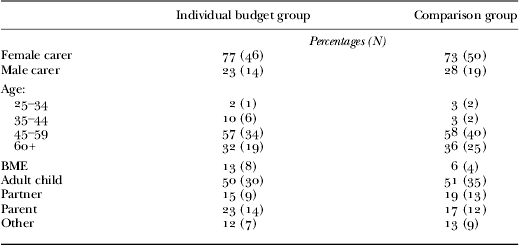
Table 1 shows the characteristics of the carers and the relationships between the carer and the person they were caring for in our structured interview samples. Of the carers participating in the structured outcome interviews, 74 per cent were female and 26 per cent were male. Carers from black and ethnic minority groups accounted for 9 per cent of the structured outcome interview sample. The largest single group of carers was those caring for an adult child, which is what we would expect, given the service user groups that people were caring for.
Carer characteristics
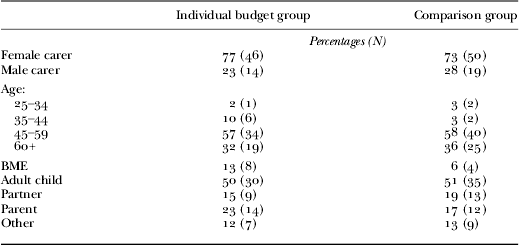
Note: BME: black or minority ethnic person.
As we would hope, Table 1 shows there was no statistically significant difference between the carers in the IB and the comparison group in this study. However, we did find some evidence to suggest that our sample may be caring for slightly more dependent people than those in the main IBSEN evaluation. In the carer sample, significantly higher dependency levels among service users for three ADLs were found for those in our sample compared with those with carers in the main IBSEN evaluation not included in the carer sample. These activities were getting out of doors (p < 0.001), washing their face and hands (p < 0.01) and washing their hair (p < 0.01). However, as we would hope, within the structured interview carer sample, similar dependency levels were found between service users in the IB and comparison group, with no statistically significant differences. Any differences in outcomes between carers in the IB and comparison groups could therefore be attributed to the IBs received by the service users whom the carers were supporting.
Progress through the IB process at the time of the interview
Fifty-eight per cent of carers (N = 33) in the IB group reported that the person they assisted received support and services paid for by the IB, although this low proportion needs to be interpreted with caution. We did not have information from local authorities about whether support plans were in place at the time of the carer interviews, and carers may have failed to report that IB-funded support was in place for a number of reasons: they may not have been involved in the care and support management process; there may have been insufficient difference from the previous situation for this to be clear (e.g. when ‘virtual budgets’ bought the same services that were in place before); or they may have not understood the question. Among the carers who reported that the person they provided assistance to had been receiving IB-funded services, 81 per cent reported that the services were being received for more than three months. A further 15 per cent reported that services paid for by the IB were in place between one and three months prior to the outcome interview.
A high level of satisfaction was reported among carers providing assistance to IB holders in the structured interviews: 83 per cent (33) of carers were satisfied with the value of the IB, 88 per cent (35) were satisfied with the way the IB was paid and 57 per cent (20) were satisfied with the amount of paperwork involved.
Carers' involvement in assessment and support planning for IBs
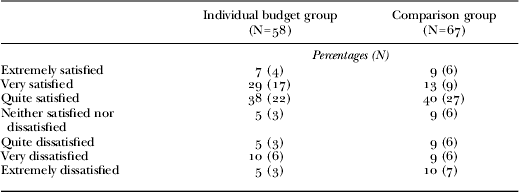
Carers in both the IB and comparison groups were asked about their experiences of the service user's support or care planning process, respectively. Table 2 shows that 36 per cent (N = 21) of carers supporting service users in the IB group were either extremely or very satisfied with the support planning process, compared with 22 per cent (N = 15) of those caring for service users in the comparison group. While clearly the experience was no worse for the IB group, we cannot be confident it was much better as the difference did not reach statistical significance. Moreover, in both groups, a substantial proportion of carers expressed some dissatisfaction and these views were noticeably stronger in the IB group, which could reflect problems with new pilot processes. Among carers of IB holders, there was lower satisfaction with the support planning process than with the amount of the IB or the financial arrangements. The user group of service users who had assistance from the carers in this study did not impact on the level of satisfaction expressed.
Overall satisfaction with the support planning process
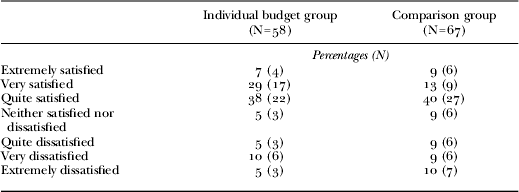
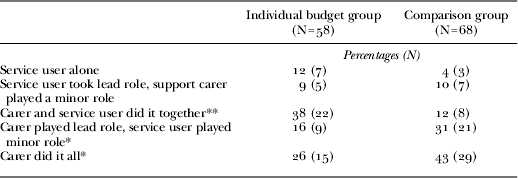
Table 3 shows that carers in the IB group were significantly more likely to report that they had planned the support together with the service user (38%; p < 0.01) compared with those in the comparison group. However, carers in the comparison group were significantly more likely to report that they themselves played a major role (31%; p < 0.05) or they actually did it all (43%; p < 0.05) compared with those in the IB group (16 and 36%, respectively). Carers providing assistance to service users with learning disabilities were significantly more likely to play a major role in the support planning process (31%; p < 0.05) compared with those caring for service users with either a mental health illness or physical disability, or an older person (16%).
Involvement in support planning
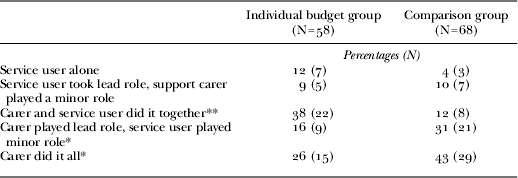
Significance levels:* p < 0.05
** p < 0.01.
Carers' receipt of support and services, care-giving activities and costs
In total, information on service use and costs was available from the main IBSEN evaluation for 70 service users who were assisted by the carers involved in this study. Information about mainstream service use was available for 30 service users in the comparison group from the six-month interviews conducted for the main IBSEN evaluation, and for 40 in the IB group from their support plan records and the six-month interviews. Overall, the costs of services received by the comparison group were higher than in the IB group, although the difference did not reach statistical significance. Within the carer subsample, the average value of IBs across all user groups was £270 per week (median £170; range £2.00 to £950) compared with £390 (median £350; range £3.00 to £1,190) in the comparison group. In the main IBSEN evaluation, the difference in overall weekly costs between the IB and comparison group was not as marked for those where an informal carer had been identified: mean £280 (median £190; range £2.00 to £1,640) and £320 (median £160; range £1.00 to £3,170, respectively). This result suggests that IBs for people with a carer tended to be lower than IBs for people without carers, although the difference did not reach statistical significance. However, due to the small sample size, any firm conclusions need to be made with caution.
Only six of the carer interviewees and five other family or friends providing assistance received payment from the care recipient's IB or other sources, either directly or in kind (e.g. in the form of a meal or gift). Over half (58%) of carer interviewees felt that it was not appropriate to pay family members for the care they provided. Among the carers that responded to the question, this view was slightly more prevalent in the comparison group (60%; N = 40) compared with the IB group (54%; N = 14), but the difference was not statistically significant.
The principal cost to the carer is the opportunity cost of the time spent on caring. A key question was whether this is affected by the use of an IB. Carers of IB holders spent 81 hours per week caring, compared with 72 hours among carers in the comparison group, although this was not statistically significant. In addition, in both groups, other informal carers were reported to spend on average over 21 hours per week on caring. A whole array of caring activities was reported, ranging from personal care to looking after pets, DIY and gardening. Unsurprisingly, there was very little difference between the two groups in patterns of care-giving activities.
The outcomes of IBs for carers
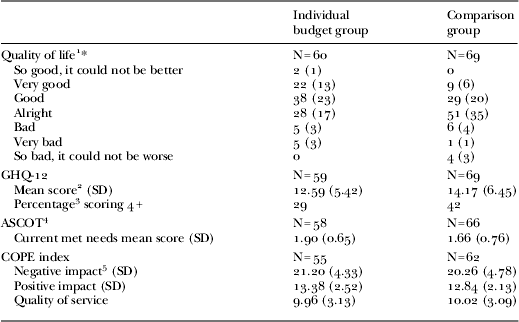
Table 4 brings together our findings using the measures of quality of life, wellbeing, social care outcomes and the COPE index for all carers who provided care to service users who had originally been randomised to either the IB or comparison group. Despite no significantly higher costs to the public purse, carers who provided assistance to service users in the IB group were significantly more likely to report better quality of life (mean 4.72; p < 0.05) compared with those in the comparison group (mean 4.25).
Quality of life, wellbeing and met needs

Notes: GHQ: General Health Questionnaire. ASCOT: Adult Social Care Outcomes Toolkit. COPE: Carers of Older People in Europe scale. SD: standard deviation.
1. Percentages with N in parentheses.
2. GHQ item scoring 0–3, higher GHQ scores indicate poorer outcomes.
3. Using GHQ item scoring 0–1.
4. Higher scores indicate lower levels of need.
5. Higher scores indicate fewer negative responses.
Significance level:* p < 0.05.
From the other measures, there was no evidence of poor outcomes for carers in the IB group compared with those in the comparison group. There was some indication of better outcomes but no statistical differences. The client group of service users who had assistance from the carers in this study was not associated with a significant impact on responses.
Social care outcome domains
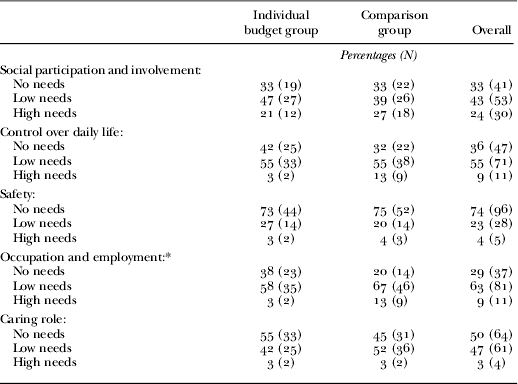
The ASCOT measure is designed to pick up on those aspects of life that are particularly the focus of social care interventions for service users. Five of the domains are relevant to carers and were therefore included in the structured interviews. Responses for each of the ASCOT domains are shown in Table 5.
Adult Social Care Outcomes Toolkit (ASCOT) outcome domains for all service user groups combined
Significance level:* p < 0.05.
Carers in the IB group were significantly more likely to report that they were fully occupied in activities of their choice (38%; p < 0.05) compared with those in the comparison group (20%). Carers in the IB group were also more likely to report that they were in control over their daily lives and that they provided the kind of support that they wanted to provide compared with those in the comparison group, although the difference was not statistically significant. There was no evidence of improved social participation and involvement or feelings of safety among carers in the IB group. Carers of older people (50%; N = 16; p < 0.05) were significantly more likely, compared with carers of the other user groups (27%; N = 25), to report that they had a social life (no needs for social participation and involvement). However, due to the small sample sizes, this result needs to be treated with caution.
Care-giving role
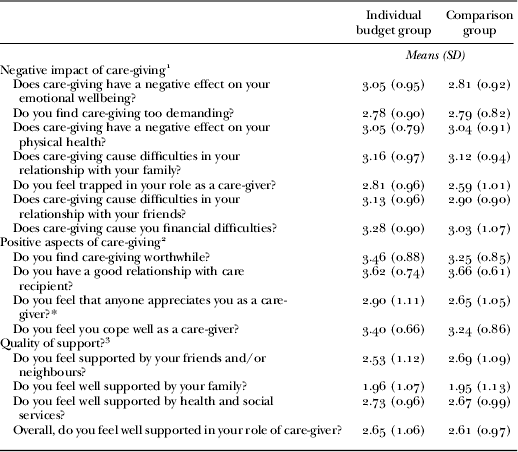
The COPE index, which measures the impact of the care-giving role, has three components reflecting the positive and negative aspects of care-giving and the level of support provided. Table 6 shows that although the differences for each item within the three components did not reach statistical significance, there was a trend to support the view that carers in the IB group were more likely to appraise the care-giving role positively, compared with those in the comparison group.
Carers of Older People in Europe (COPE) index
Notes:1. Lower scores represent a negative appraisal.
2. Higher scores represent a positive appraisal.
3. Lower scores represent higher perceptions of quality. SD: standard deviation.
Variations in outcomes
It is important to explore variations in outcome further, to allow for the fact that the comparisons reported above were between carers of service users who had been randomised into the IB and comparison groups as part of the main IBSEN evaluation, rather than between carers who had been randomised themselves. We used statistical models to explore the implications of receipt of an IB and to explore other potential influences on outcomes. Potential influences included measures of baseline needs; carer and service user characteristics; circumstances (such as age, gender and whether the carer was living with the service user); and operational measures, such as whether or not an IB holder had their support plan in place at the time of the structured interview with the carer. This type of analysis has two advantages when considering the impact of IBs. First, we can check whether, once we have allowed for other influences, any differences identified through straight comparisons still hold; secondly, differences that are not statistically significant because of the relatively small sample sizes can sometimes be identified.
The results are described below. The tables show the influence of each factor, after taking into account the effects of all other included variables. There was very little variation for the COPE index, as shown in Table 6. This meant that it was not possible to identify a satisfactory statistical model for this outcome measure. Tests of interaction were also conducted (e.g. IB effects by user group for each outcome domain), but none was found to be significant.
Quality of life
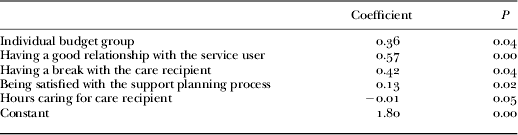
The positive relationship between carer-reported quality of life and receipt of IBs described above was maintained when other factors potentially associated with quality of life were allowed for (p < 0.05). Table 7 indicates that other support-related effects were having had a break with the service user in the previous six months, which improved carers' quality of life (p < 0.05) and being satisfied with the support planning process (p < 0.01). Other factors significantly associated with better quality of life were, unsurprisingly, having a good relationship with the service user (p < 0.001) and spending fewer hours caring for the service user (p < 0.05).
Predicting quality of life
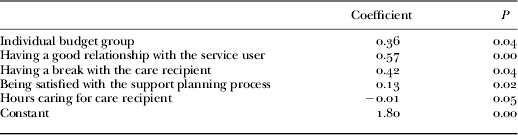
Notes: Model estimated using a linear multiple regression. Positive effects denote improvements in the outcome. R 2 = 0.28; N = 114. Prob > χ 2 0.80. RESET test 0.31.
Social care outcomes
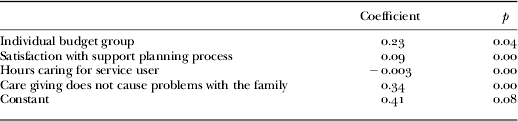
Although the overall ASCOT score was not significantly different when we compared the IB and comparison groups, we identified positive relationships between IBs and some domains of social care outcome, in particular with the occupation domain. When other factors were allowed for, Table 8 shows that IBs were significantly associated with higher overall ASCOT scores (p < 0.05). Other factors that had a positive impact on social care outcomes included being satisfied with the support planning process (p < 0.001) and, in terms of the care provided, spending fewer hours caring for the service user (p < 0.04) and care-giving not causing problems with the family (p < 0.001).
Predicting social care outcome (Adult Social Care Outcomes Toolkit (ASCOT))
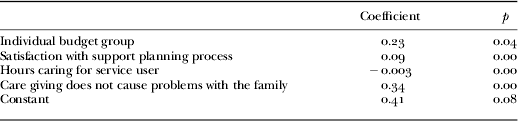
Notes: Model estimated using a linear multiple regression. R 2 = 0.40; N = 111. Prob > χ 2 0.40. RESET test 0.71.
Psychological wellbeing
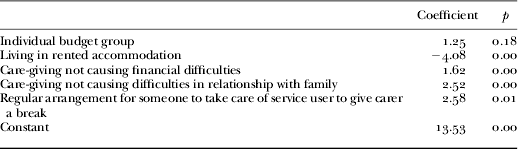
For ease of interpretation, we recoded GHQ-12 so that positive outcomes were associated with positive values. Table 9 shows that in terms of the support provided, even when other factors were allowed for, the service user receiving an IB did not have a statistically significant impact on carers' psychological wellbeing. However, psychological wellbeing was significantly associated with having a regular arrangement for someone to take care of the service user to enable the carer to have a break (p < 0.01). The overall cost of the service package for the carer and service user was also significantly associated with higher levels of wellbeing when included in the model (p < 0.05). Other factors significantly associated with better psychological wellbeing for carers were when carers were not living in rented accommodation and care-giving did not cause financial difficulties or difficulties in relationships between family members (p < 0.001).
Predicting psychological wellbeing (General Health Questionnaire (GHQ-12))
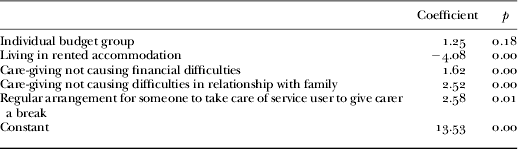
Notes: Model estimated using linear multiple regression. R 2 = 0.34; N = 120. Prob > χ 2 0.18. RESET test 0.19.
Discussion
The study identified important effects of IBs on carers from a cash-for-care scheme that predominantly focuses on the impact of support required by the service user. Overall, the multivariate analyses showed that IBs were associated with positive impacts on carers' quality of life, social care outcomes and psychological wellbeing. In relation to all these outcome measures, carers of IB users scored higher than carers of people using standard social care services; the difference between the two groups of carers was statistically significant in relation to carers' quality of life, indicating that IBs helped to keep them ‘mentally and physically well’. The finding that occupation was the social care outcome domain where most impact was identified suggests IBs could support carers having a ‘life of their own’. In addition, the evaluation process itself has pointed to indicators that could be used to monitor progress in these objectives. The quality of life indicator and ASCOT outcome indicator are all relatively low-burden measures that should reflect change where there are improvements in people's quality of life. In relation to the COPE index, which measures the impact of the care-giving role, carers of IB users were no more likely to view their role negatively than carers who were supporting people using standard social care services. The positive impact on the carers' quality of life, social care outcomes and psychological wellbeing could in part be due to the carers' involvement in assessment and support planning, and the impact of receiving a budget on the carer-related activities.
Carers' involvement in assessment and support planning for IBs
Carers supporting IB users were slightly more likely to be very satisfied with the support planning process, compared to carers of standard social care service users – but a substantial proportion of both groups also expressed some dissatisfaction. It would seem from the results that the nature, level and scope of carers' involvement in the support planning processes may all have contributed to carers' satisfaction levels. Carers of people offered an IB were significantly more likely than those in the comparison group to report that they and the service user had planned together how the IB would be used; comparison group carers were more likely to report that they played the major role or did all the planning of the service user's conventional social care services. On the face of it, this involvement would seem likely to lead to positive views of the process. However, while this result is positive, there is a potential that the role the carer took in the support planning process may have had a negative impact on the choice and control of the service user. For example, a carer may not be the most appropriate person to promote the independence of the budget holder. In supporting this view, interviews with project leads within the main evaluation also expressed concern about the involvement of carers in the support planning process (Glendinning et al. Reference Glendinning, Challis, Fernandez, Jacobs, Jones, Knapp, Manthorpe, Moran, Netten, Stevens and Wilberforce2008).
Carers' receipt of support and services, care-giving activities and costs
Among the service users whose carers were included in this study, the average cost of an IB was lower than the average costs of the standard social care services received by service users in the comparison group. In addition, carers in this study who were looking after an IB user appeared to spend more time on care-related tasks than carers supporting someone in the comparison group who continued to receive standard social care services. As a result, the opportunity costs for carers of IB users constituted a higher proportion of the overall costs of care for the IB group. Only a small minority of those carers received any payment from the service user's IB for either their care-related responsibilities – whether providing direct, hands-on care or managing the IB.
Together these findings suggest that the slightly lower costs of IBs compared with standard social care support may be offset by greater inputs of time – and the associated opportunity costs – on the part of informal carers. However, this conclusion needs to be treated with extreme caution; the difference in levels of formal resource inputs to the service users supported by carers in the IB and comparison group was not significant and sample numbers were relatively small. These results were achieved at no greater cost to the public purse, suggesting that for carers IBs may be cost-effective. The study draws attention to the importance of assessing and meeting the needs of disabled and older people and those who support them, and the interdependency of their respective outcomes.
The overall findings support the view that the participation of carers in the planning of social care services to be received by a service user can have a positive impact on carers' outcomes, which has clear resonance of the importance of co-production in transforming services. The results provide some evidence to support the suggestion made in the English National Strategy for carers that this new arrangement will offer better outcomes, as carers as well as service users will have more choice and control over services (HM Government 2008). However, there were distinctive features of this particular study that are likely to have influenced the findings which need to be acknowledged when interpreting the results. The sample size was smaller than had been planned due to problems in tracking down the carers of the original IBSEN study participants. We had originally intended to focus the study solely on carers of older people and people with learning disabilities, as it was anticipated that these carers were most likely to be affected by IBs, but potentially in different ways. Despite this caveat the study did show that IBs had a positive impact on the support planning process, the carer role and outcomes.
Conclusion
Despite the small number of carers involved and the fact that the IB pilots focused predominantly on the service user, this study has shown that IBs had a positive impact on the lives of informal carers. One helpful finding from the study was the association between the measure of satisfaction with the support planning process and outcomes for carers, whether or not the service user was receiving an IB. This would be a simple measure for local authorities to collect as an indicator of the impact of services on carers.