Introduction
Mild traumatic brain injury (mild TBI) is highly prevalent in the United States, accounting for 70–90% of the estimated 3.5 million TBIs occurring annually (Cassidy et al., Reference Cassidy, Carroll, Peloso, Borg, von Holst, Holm and Coronado2004; Coronado et al., Reference Coronado, McGuire, Sarmiento, Bell, Lionbarger, Jones and Xu2012). Symptoms such as dizziness, headache, fatigue, irritability, and difficulty concentrating are common during the acute phase of recovery from brain injury (Brenner et al., Reference Brenner, Terrio, Homaifar, Gutierrez, Staves, Harwood and Warden2010; Gouvier, Cubic, Jones, Brantley, & Cutlip, Reference Gouvier, Cubic, Jones, Brantley and Cutlip1992). Although symptoms resolve relatively quickly following a mild TBI for most individuals (Carroll et al., Reference Carroll, Cassidy, Peloso, Borg, von Holst, Holm and Pepin2004; Rohling et al., Reference Rohling, Binder, Demakis, Larrabee, Ploetz and Langhinrichsen-Rohling2011), a minority of those who sustain a mild TBI report clinically significant symptoms long after their head injury (Iverson, Reference Iverson2005; Iverson & Lange, Reference Iverson and Lange2003).
The terms “postconcussive symptoms” or “postconcussion syndrome” imply that the reported symptoms are caused by a brain injury event. However, many studies comparing university students with and without a history of mild TBI have not found a significant relationship between mild TBI history and severity of long-term symptoms (Gouvier et al., Reference Gouvier, Cubic, Jones, Brantley and Cutlip1992; Sawchyn, Brulot, & Strauss, Reference Sawchyn, Brulot and Strauss2000; Suhr & Gunstad, Reference Suhr and Gunstad2002). Additional studies comparing patients admitted to the emergency room with mild TBI to non-injured controls have found that mild TBI history does not predict long-term neurobehavioral symptoms (Kashluba, Casey, & Paniak, Reference Kashluba, Casey and Paniak2006; Paniak, Reynolds, Phillips, et al., Reference Paniak, Reynolds, Phillips, Toller-Lobe, Melnyk and Nagy2002; Ponsford et al., Reference Ponsford, Cameron, Fitzgerald, Grant, Mikocka-Walus and Schonberger2012). The causes of neurobehavioral symptoms after mild TBI, and the reasons that some people report them beyond a 90-day recovery window, remain unclear (McCrea, Reference McCrea2008).
To better understand the “postconcussive symptom” construct, our group recently reported results of a confirmatory factor analysis on a postconcussive symptom questionnaire completed by large sample of non-referred university studentsFootnote 1 (Ettenhofer & Barry, Reference Ettenhofer and Barry2012). We found that the factor structure of symptoms reported by the mild TBI group did not differ from uninjured and orthopedic-injured-only groups, a finding that is inconsistent with interpretation of these symptoms as a “syndrome” unique to mild TBI. Whereas results indicated that individuals with a self-reported history of mild TBI endorsed significantly greater symptoms compared to uninjured controls and those with only a history of orthopedic injury, the effect size was small (d = .19), and of limited clinical significance (Ettenhofer & Barry, Reference Ettenhofer and Barry2012). We concluded that the term “postconcussive symptoms” may be misleading, and recommended using a more appropriate term, such as “neurobehavioral symptoms.” The similarities in symptoms between mild TBI and control groups highlighted important questions about non-neurological factors that may be more closely related to neurobehavioral symptom expression.
In previous research, one of the factors most consistently linked to severity of neurobehavioral symptoms is psychiatric status. Both ICD-9 Postconcussive Syndrome and DSM-IV Postconcussional Disorder have been associated with increased rates of depressive disorders (Fann, Katon, Uomoto, & Esselman, Reference Fann, Katon, Uomoto and Esselman1995; McCauley, Boake, Levin, Contant, & Song, Reference McCauley, Boake, Levin, Contant and Song2001). Similarly, presence of depression or anxiety has been shown to predict poorer symptom recovery following injury (Mooney & Speed, Reference Mooney and Speed2001; Ponsford et al., Reference Ponsford, Cameron, Fitzgerald, Grant, Mikocka-Walus and Schonberger2012). In one controlled study of this issue, Suhr and Gunstad (Reference Suhr and Gunstad2002) found that depression was associated with significantly greater severity of neurobehavioral symptoms, but history of mild TBI was not. Several studies have found that symptoms of depression are strongly related to neurobehavioral symptom severity, even within non-injured groups (Iverson & Lange, Reference Iverson and Lange2003; Suhr & Gunstad, Reference Suhr and Gunstad2002; Trahan, Ross, & Trahan, Reference Trahan, Ross and Trahan2001).
The potential effects of secondary gain may also impact neurobehavioral symptom expression, particularly when a patient is involved in litigation. Evidence suggests that litigating patients with TBI report more symptoms and demonstrate worse neuropsychological functioning during clinical evaluations than their non-litigating counterparts (Binder & Rohling, Reference Binder and Rohling1996; Feinstein, Ouchterlony, Somerville, & Jardine, Reference Feinstein, Ouchterlony, Somerville and Jardine2001; Mooney, Speed, & Sheppard, Reference Mooney, Speed and Sheppard2005; Paniak, Reynolds, Toller-Lobe, et al., Reference Paniak, Reynolds, Phillips, Toller-Lobe, Melnyk and Nagy2002; Tsanadis et al., Reference Tsanadis, Montoya, Hanks, Millis, Fichtenberg and Axelrod2008).
Demographic factors have also been shown to be predictive of neurobehavioral symptoms. Luis, Vanderploeg, and Curtiss (Reference Luis, Vanderploeg and Curtiss2003) found that individual and psychosocial factors (psychiatric issues, social support, and premorbid intellectual ability) collectively represented the strongest predictor of neurobehavioral symptoms among both head-injured and non-head injured groups of male veterans. More specifically, factors such as age (Dikmen, Machamer, Fann, & Temkin, Reference Dikmen, Machamer, Fann and Temkin2010), education (Kesler, Adams, Blasey, & Bigler, Reference Kesler, Adams, Blasey and Bigler2003), and race (McCauley et al., Reference McCauley, Boake, Levin, Contant and Song2001) have been associated with reported symptoms after mild TBI. Gender effects have also received considerable attention. Whereas males are more likely to sustain a head injury (Faul, Xu, Wald, & Coronado, Reference Faul, Xu, Wald and Coronado2010), several studies have found that female gender is associated with greater rates of neurobehavioral symptoms (Bazarian, Blyth, Mookerjee, He, & McDermott, Reference Bazarian, Blyth, Mookerjee, He and McDermott2010; Bazarian et al., Reference Bazarian, Wong, Harris, Leahey, Mookerjee and Dombovy1999; McCauley et al., Reference McCauley, Boake, Levin, Contant and Song2001; Ponsford et al., Reference Ponsford, Willmott, Rothwell, Cameron, Kelly, Nelms and Ng2000; Preiss-Farzanegan, Chapman, Wong, Wu, & Bazarian, Reference Preiss-Farzanegan, Chapman, Wong, Wu and Bazarian2009). However, this gender effect has not been demonstrated universally. Recently, Ponsford et al. (Reference Ponsford, Cameron, Fitzgerald, Grant, Mikocka-Walus and Schonberger2012) found that females reported greater symptoms at 1 week post-injury, but not at 3 months.
Attention-deficit/hyperactivity disorder (ADHD; Gayton, Bailey, Wagner, & Hardesty, Reference Gayton, Bailey, Wagner and Hardesty1986; Miller, Marks, & Halperin, Reference Miller, Marks and Halperin2005) and substance/alcohol use (Bogner, Corrigan, Mysiw, Clinchot, & Fugate, Reference Bogner, Corrigan, Mysiw, Clinchot and Fugate2001; Corrigan, Reference Corrigan1995; Kreutzer, Witol, Sander, & Cifu, Reference Kreutzer, Witol, Sander and Cifu1996; Vickery et al., Reference Vickery, Sherer, Nick, Nakase-Richardson, Corrigan, Hammond and Sander2008) have also been associated with greater risk for sustaining a mild TBI. However, no known studies have examined the potential relationships between these factors and severity of postconcussive-type symptoms, either among individuals with a history of mild TBI or within the broader population.
Purpose of the Current Study
Several factors, including age, psychiatric conditions, demographics, and secondary gain, have been associated with severity of neurobehavioral symptoms (Bazarian et al., Reference Bazarian, Blyth, Mookerjee, He and McDermott2010, Reference Bazarian, Wong, Harris, Leahey, Mookerjee and Dombovy1999; Binder & Rohling, Reference Binder and Rohling1996; Iverson, Gaetz, Lovell, & Collins, Reference Iverson, Gaetz, Lovell and Collins2004; Luis et al., Reference Luis, Vanderploeg and Curtiss2003; Mooney & Speed, Reference Mooney and Speed2001; Mooney et al., Reference Mooney, Speed and Sheppard2005; Paniak, Reynolds, Toller-Lobe, et al., Reference Paniak, Reynolds, Toller-Lobe, Melnyk, Nagy and Schmidt2002; Ponsford et al., Reference Ponsford, Cameron, Fitzgerald, Grant, Mikocka-Walus and Schonberger2012; Suhr & Gunstad, Reference Suhr and Gunstad2002; Vanderploeg, Curtiss, Luis, & Salazar, Reference Vanderploeg, Curtiss, Luis and Salazar2007). However, many of these factors are likely to overlap within an individual, and as such, their relative importance remains unclear. Additionally, many previous studies selected participants based upon symptom presentation, a practice that may bias a sample toward those with more significant injuries and higher rates of healthcare usage (McCullagh & Feinstein, Reference McCullagh and Feinstein2003). A better understanding of factors that may increase a person's risk for persistent neurobehavioral symptoms is needed. Identifying factors that may predispose individuals with a history of brain injury to poor outcomes is essential to develop effective interventions for this group. Considering that “postconcussive-type” symptoms are not unique to individuals with a history of head injury (Ettenhofer & Barry, Reference Ettenhofer and Barry2012; Iverson & Lange, Reference Iverson and Lange2003), it is also necessary to examine factors that may be related to these symptoms within the broader population.
In the present study, neurobehavioral symptoms were examined in a large, non-referred sample of university students. We used a multivariate approach to determine the relative contribution of several predictors that may be relevant within this population, such as history of mild TBI, orthopedic injury, psychiatric history, history of ADHD or learning disabilities (LD), alcohol use, and gender. Additional analyses were conducted among the mild TBI subgroup to examine the potential contribution of head-injury-related factors, such as time since injury, cause of injury, duration of loss of consciousness, and involvement in litigation to neurobehavioral symptom expression.
Methods
Participants and Procedures
All study procedures were approved by institutional review boards at Michigan State University and the Uniformed Services University of the Health Sciences. Participant recruitment, inclusion/exclusion, and data collection procedures for this project have been described previously (Ettenhofer & Barry, Reference Ettenhofer and Barry2012). Briefly, participants completed a Web-based survey including demographic information, medical history, neurobehavioral symptoms, and a systematic history of concussion/TBI (in that order). After excluding individuals with a history of psychotic or neurological illness other than TBI (n = 28), moderate-to-severe TBI (n = 71), multiple TBIs (n = 125), mild TBI within the last 3 months (n = 61), and individuals who provided inconsistent or incomplete information regarding TBI severity (n = 18), the final analytic sample included a total of 3027 participants. Individuals with a history of single, mild TBI were included in the mild TBI subgroup (n = 256). Neurobehavioral symptoms within the last 2 months were assessed using the Post-Concussion Syndrome Checklist (PCSC; Gouvier et al., Reference Gouvier, Cubic, Jones, Brantley and Cutlip1992), a measure of the frequency, intensity, and duration (collectively: “severity”) of each of 10 symptoms (commonly referred to as “postconcussive symptoms”). PCSC total score and Cognitive, Somatic, Affective, and Sensory subtotals, as supported by the results of previous confirmatory factor analyses (Cicerone & Kalmar, Reference Cicerone and Kalmar1995; Ettenhofer & Barry, Reference Ettenhofer and Barry2012), were computed in the manner described previously. Additionally, information was collected regarding lifetime history of diagnosed psychiatric illnesses, attention-deficit/hyperactivity disorder (ADHD), and learning disability (LD). Multiple-choice responses to questions regarding time since injury (in years), length of loss of consciousness (in minutes), and frequency of alcohol use (in days per month within the last month) were converted to continuous variables using boundary midpoints (e.g., “8” for a response of “6–10 days”).
Data Analysis
Structural Equation Modeling (SEM) was conducted with AMOS 18 using Maximum Likelihood (ML) estimation. Missing values for symptom variables (1.1% of total PCSC data points) were imputed using expectation maximization. The following fit indices were reported for each SEM model: Root Mean Square Error of Approximation (RMSEA), for which values of .05 or less are considered good fit and values of .08 or less are considered acceptable, and the Comparative Fit Index (CFI), for which values of .95 or greater are considered good fit and values of .90 or greater are considered acceptable. Pearson chi-square was reported for comparisons of absolute fit between nested models. SPSS 16.0 was used for all other analyses. Multiple regression analyses were used to examine the multivariate relationships between predictors and neurobehavioral symptoms for analyses in the subgroup of participants with a history of mild TBI.
Predictors of interest were selected based upon theoretical and conceptual relationships to mild TBI and neurobehavioral symptoms, as well as statistical considerations. Due to a high degree of overlap between the psychiatric disorders of depression and anxiety as well as the developmental disorders of ADHD and LD, each respective diagnostic pair was combined into a dichotomous variable indicating presence versus absence of either condition. Age, education, and race/ethnicity were excluded from multivariate models due to multicollinearity between age and education and restricted range for these variables within this sample. However, all multivariate models were re-analyzed with age and race/ethnicity included, without any meaningful effect upon the results presented. Predictor variables demonstrated moderate-to-high levels of independence for regression analyses.
Results
Participant Characteristics
Full sample
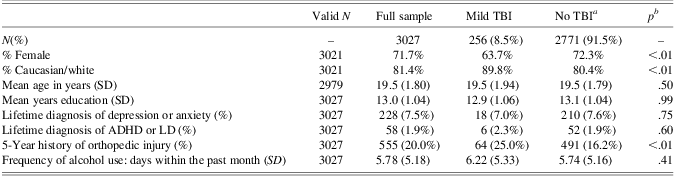
Demographics, neurobehavioral symptom reports, and injury characteristics of this sample have been described previously (Ettenhofer & Barry, Reference Ettenhofer and Barry2012). Information is presented in Table 1 for key variables examined in this study.
Selected participant characteristics

Note. TBI = traumatic brain injury; ADHD = attention-deficit/hyperactivity disorder; LD = learning disability.
a Note that the “No TBI” column is provided for illustration; primary analyses were conducted using the full sample and the mild TBI subgroup only.
b Statistical significance of independent-samples t-tests or chi-square, as appropriate.
Mild TBI subgroup
Orthopedic injury within the previous 5 years was reported at significantly higher rates among those with a history of mild TBI (25%) than those without (16.2%). As reported previously (Ettenhofer & Barry, Reference Ettenhofer and Barry2012), participants with a history of mild TBI within this sample were significantly more likely to be Caucasian and male. Most of these mild TBIs were relatively remote (M = 3.59 years previously; SD = 1.87), and caused by sports participation (46.5%) or accidental falls (19.5%) with brief loss of consciousness (M = 2.75 minutes, SD = 4.80). Surprisingly, relatively few mild TBI participants were involved in litigation (3.5%). Age, education, prevalence of psychiatric or developmental disorders, and frequency of alcohol use were not significantly different between participants with and without a history of mild TBI.
Predictors of Neurobehavioral Symptoms in the Full Sample
SEM was used to evaluate the relative value of multiple cross-sectional predictors of neurobehavioral symptoms in the full sample. Configuration of the symptom model was based upon the best-fitting factor model from a previous confirmatory factor analysis (CFA) of this dataset (Ettenhofer & Barry, Reference Ettenhofer and Barry2012), including four symptom factors (Somatic, Affective, Cognitive, and Sensory). Factor loadings were re-estimated within comprehensive structural models to enhance the accuracy of predictor estimates. Factor loadings within these structural models were very similar to those demonstrated within the previous CFA.
To evaluate factors related to neurobehavioral symptoms in a general university population, each of the predictors of interest (gender, lifetime diagnosis of either depression or anxiety, lifetime diagnosis of either ADHD or LD, history of mild TBI, history of orthopedic injuries within the last 5 years, and frequency of alcohol use) were added simultaneously to the model and permitted to correlate with one another. In the “Overall Symptoms” model, a latent variable representing overall self-report of symptoms on the PCSC was permitted to regress upon each predictor. In the “Four Symptom Clusters” model, each of the four latent variables representing self-report of Somatic, Affective, Cognitive, and Sensory symptoms on the PCSC were permitted to regress upon each predictor of interest. Fit was adequate for the Overall Symptoms model, χ2(85) = 773.06, p < .001, CFI = .87, RMSEA = .05, and good for the Four Symptom Clusters model, χ2(67) = 435.75, p < .001, CFI = .93, RMSEA = .04. The Four Symptom Clusters model accounted for significantly greater variance than the Overall Symptoms model, Δχ2[18] = 337.31, p < .001.
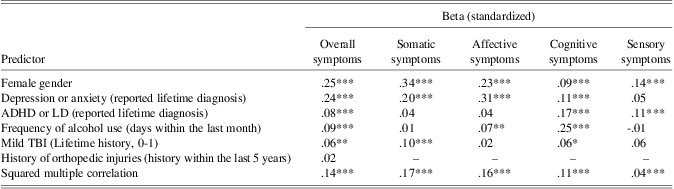
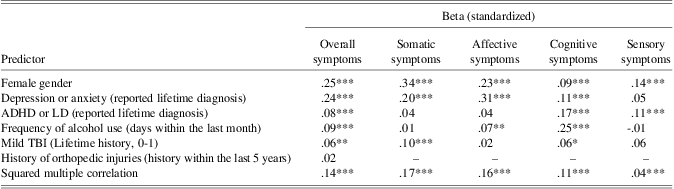
Standardized regression weights of individual predictors of overall self-reported symptoms and individual symptom clusters are presented in Table 2. R 2 values for the overall and symptom cluster models are included to show the total variance in symptoms accounted for by all predictors. As shown, female gender (β = .25; p < .001) and lifetime diagnosis of depression or anxiety (β = .24; p < .001) were the strongest predictors of overall symptoms. Frequency of alcohol use (β = .09; p < .001), lifetime diagnosis of ADHD or LD (β = .08; p < .001), and history of mild TBI (β = .06; p < .01) were significant but relatively weaker predictors of overall symptoms. Five-year incidence of orthopedic injuries was not a significant predictor of overall symptoms. An additional “Overall Symptoms” model was examined, excluding mild TBI as a predictor. Model fit was significantly reduced (Δχ2[9]=20.73, p = .01, Δr 2 = .003), indicating that mild TBI history predicted an incremental 0.3% of variance in overall PCSC score.
Predictors of PCSC symptoms in the full sample (N = 3027)
Note. PCSC = Post-Concussion Syndrome Checklist (PCSC); ADHD = attention-deficit/hyperactivity disorder; LD=learning disability; TBI = traumatic brain injury.
* p < .05.
** p < .01.
*** p < .001.
Among the Somatic, Affective, Cognitive and Sensory symptom subscales in the full sample, female gender was the strongest individual predictor for both Somatic (β = .34; p < .001) and Sensory (β = .14; p < .001) symptoms, and the second-strongest predictor of Affective symptoms (β = .23; p < .001). Lifetime diagnosis of depression or anxiety was the strongest predictor of Affective symptoms (β = .31; p < .001), and was the second-strongest predictor of Somatic symptoms (β = .20; p < .001). More frequent alcohol use was the strongest predictor of Cognitive symptoms (β = .25; p < .001), whereas lifetime diagnosis of ADHD or LD was the second strongest predictor of both Cognitive (β = .17; p < .001) and Sensory (β = .11; p < .001) symptoms. History of mild TBI was a significant but relatively weak predictor of Somatic (β = .10; p < .001) and Cognitive (β = .06; p < .05) symptoms, and was not significantly related to Affective or Sensory symptoms. History of orthopedic injury was not significantly related to overall neurobehavioral symptoms and therefore was not included in further analyses. To illustrate the magnitude of effects, follow-up univariate analyses were conducted comparing groups defined by significant predictors of interest (see Table 3). Univariate effect sizes for depression/anxiety (d = .80), ADHD (d = .71), and gender (d = .44) were medium-to-large, while effects for alcohol (d = .11) and mild TBI (d = .19) were small. Differences between these univariate effects and the multivariate effects described previously (including generally larger univariate effects) reflect relationships between predictors of interest that have been controlled in multivariate models (e.g., relationships between gender and depression/anxiety). Whereas univariate results may be more readily interpretable, multivariate results provide a more accurate representation of the unique influence of each predictor.
Univariate comparisons of PCSC symptoms by characteristics of interest in the full sample

Note. PCSC = Post-Concussion Syndrome Checklist; ADHD = attention-deficit/hyperactivity disorder; LD = learning disability; TBI = traumatic brain injury.
a“Low” = ⩽3 or fewer days per month; “High” => 3 days per month.
b Statistical significance of independent-samples t-test.
Predictors of Neurobehavioral Symptoms within the Mild TBI Sub-group
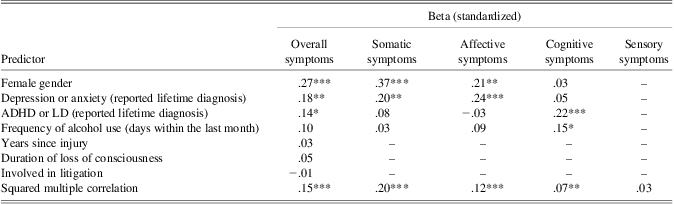
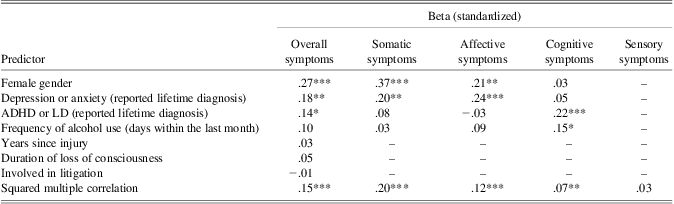
Multiple regression analyses were conducted to examine the relative value of multiple cross-sectional predictors of neurobehavioral symptoms within the subgroup of participants with a history of mild TBI (n = 256). In the Overall Symptoms model, total PCSC score was regressed upon seven predictors of interest: gender, lifetime diagnosis of depression or anxiety, lifetime diagnosis of ADHD or LD, frequency of alcohol use, time since injury, duration of loss of consciousness, and involvement in litigation. Independent effects of each predictor and model are presented in Table 4. This multiple regression model was significant, F(7,247) =6.17, p < .001, r 2 = .15, indicating that these predictors were collectively able to account for 15% of the variance in total PCSC score. Similar to the previous analyses within the full sample, female gender was the strongest predictor of total neurobehavioral symptoms in the mild TBI subgroup (β = .27; p < .001). Lifetime diagnosis of depression or anxiety (β = .18; p < .01) and lifetime diagnosis of ADHD or LD (β = .14; p < .05) were also associated with greater symptoms, whereas variables representing alcohol use (β = .10; p = .09), time since injury (β = .03; p = .57), duration of loss of consciousness (β = .05; p = .47), and litigation (β = −.01; p = .88) were non-significant predictors of overall symptoms in the mild TBI subgroup. An analysis of variance examining the univariate relationship between cause of mild TBI (coded as motor vehicle accident, sports injury, accidental fall, interpersonal violence, or other cause) and PCSC total was also non-significant, F(4,256) = .09, p = 0.99.
Predictors of PCSC symptoms in the mild TBI subgroup (N = 256)
Note. PCSC = Post-Concussion Syndrome Checklist; ADHD = attention-deficit/hyperactivity disorder; LD = learning disability; TBI = traumatic brain injury.
*p < .05.
**p < .01.
***p < .001.
Additional multiple regression analyses were conducted examining separate Symptom Cluster models whereby the PCSC Somatic, Affective, Cognitive, and Sensory subtotals were permitted to regress upon the following predictors of interest: gender, lifetime diagnosis of depression or anxiety, lifetime diagnosis of ADHD or LD, and frequency of alcohol use. Variables that were not significant predictors in the Overall Symptoms model for either the full sample or the mild TBI subgroup were excluded from Symptom Cluster models to control for Type I error. Models representing PCSC Somatic (F[4,250] = 15.89; p < .001; r 2 = .20), Affective (F[4,250] = 8.68; p < .001; r 2 = .12), and Cognitive (F[4,250] = 4.94; p = .001; r 2 = .07) symptom clusters were significant, whereas the Sensory (F[4,250] = 2.10; p = .08; r 2 = .03) model was only marginally significant; as such, statistics for individual Sensory predictors will not be reported.
The overall pattern of predictors for Symptom Cluster models within the mild TBI subgroup was very similar to the results from the larger university population, despite reduced statistical power within this smaller group. Both Somatic and Affective symptoms were again significantly predicted by female gender (Somatic β = .37; p < .001; Affective β = .21; p = .001) and lifetime diagnosis of depression or anxiety (Somatic β = .20; p = .001; Affective β = .24; p < .001). Lifetime diagnosis of ADHD or LD (β = .22; p < .001) and frequency of alcohol use (β = .15; p < .05) were the only significant predictors of Cognitive symptoms in the mild TBI subgroup.
Discussion
This study examined several factors believed to be related to postconcussive-type (neurobehavioral) symptoms within a non-referred sample of university students. The large sample size and multivariate methods used in this study confer several advantages in the investigation of complex, multi-determined phenomena such as neurobehavioral symptoms. By simultaneously examining multiple predictors of symptoms, this study compared the relative importance of several factors believed to be related to symptom expression while mitigating risk of Type I error. Separate examination of somatic, affective, cognitive, and sensory symptoms permitted examination of predictors relevant to each symptom cluster.
Consistent with previous research demonstrating that postconcussive-type symptoms are not specific to head injury (Ettenhofer & Barry, Reference Ettenhofer and Barry2012; Iverson & Lange, Reference Iverson and Lange2003; Suhr & Gunstad, Reference Suhr and Gunstad2002; Trahan et al., Reference Trahan, Ross and Trahan2001), our current findings demonstrated that similar factors were related to symptom expression, regardless of mild TBI history. As with several previous studies (Bazarian et al., Reference Bazarian, Blyth, Mookerjee, He and McDermott2010, Reference Bazarian, Wong, Harris, Leahey, Mookerjee and Dombovy1999; Dischinger, Ryb, Kufera, & Auman, Reference Dischinger, Ryb, Kufera and Auman2009; McCauley et al., Reference McCauley, Boake, Levin, Contant and Song2001; Ponsford et al., Reference Ponsford, Willmott, Rothwell, Cameron, Kelly, Nelms and Ng2000; Sawchyn et al., Reference Sawchyn, Brulot and Strauss2000), our findings also demonstrated higher levels of symptoms among females. Most prominently, female gender was associated with higher levels of somatic and affective symptoms. These findings were consistent within the overall sample and the mild TBI subgroup. While the underlying causes of these associations are unclear, future research may help better illuminate potential mechanisms for gender effects on neurobehavioral symptoms.
Similarly, lifetime diagnosis of depression or anxiety accounted for significant elevations in neurobehavioral symptoms among both head-injured and non-head injured participants. Psychiatric history was most strongly related to affective symptoms, but was significantly related to somatic and cognitive symptoms as well. These results are consistent with recent findings of Ponsford and colleagues (2012), who found that psychiatric history was the most robust predictor of symptoms at 3 months post-injury, and Spencer, Drag, Walker, and Bieliauskas (Reference Spencer, Drag, Walker and Bieliauskas2010), who reported that higher psychiatric symptoms were associated with higher self-reported cognitive impairment.
Greater frequency of alcohol use and positive lifetime history of ADHD or LD were also found to be associated with greater neurobehavioral symptoms. In both the full sample and the mild TBI subsample, each of these predictors was most strongly related to cognitive symptoms. However, in the full sample, history of ADHD/LD was also related to sensory symptoms, and alcohol use was related to affective symptoms. Frequent alcohol use and ADHD/LD among university students appear to represent risk factors for cognitive, affective, and/or sensory difficulties, regardless of whether an individual has sustained a mild TBI. These findings suggest that it may be valuable to consider ADHD/LD and alcohol use in the interpretation of neurobehavioral symptoms after mild TBI. Additional research is necessary to replicate these findings, determine whether these findings generalize outside of a university setting, and identify the mechanisms underlying each effect.
Compared to the factors described above, the relative importance of injury-specific predictors in this study was minimal. Whereas history of remote mild TBI was associated with greater neurobehavioral symptoms, this factor accounted for only a fraction of a percent of overall symptom reporting, and would likely be non-significant in a study with a smaller sample size. Additionally, history of orthopedic injuries was not significantly related to neurobehavioral symptoms, suggesting that general effects of injury do not play a substantial role in these symptoms. Within the mild TBI subgroup, examination of time since injury and loss of consciousness duration also yielded null findings. This is consistent with prior research demonstrating that clinically observed injury characteristics have a limited ability to predict outcomes after head injury, even in severe TBI (de Oliveira Thais et al., Reference de Oliveira Thais, Cavallazzi, Formolo, de Castro, Schmoeller, Guarnieri and Walz2012).
Of interest, investigation of individual somatic, affective, cognitive, and sensory symptom clusters demonstrated differential relationships to predictors of interest. Within both the full sample and the mild TBI subsample, somatic and affective symptoms were most strongly associated with gender and history of depression or anxiety. These findings most likely reflect overlap between the symptoms of psychiatric conditions and many of the symptoms included on “postconcussive” inventories such as the PCSC. Cognitive symptoms were most strongly related to history of ADHD/LD and frequency of alcohol use in both the full sample and the mild TBI subgroup. While sensory symptoms were associated with female gender and history of ADHD or LD in the full sample, they were not related to any predictors within the mild TBI subgroup. Together, these findings highlight the importance of considering psychiatric comorbidity, health behaviors, and demographic factors in the interpretation of neurobehavioral symptoms after mild TBI.
Involvement in litigation was not significantly associated with neurobehavioral symptoms in this study. Considering the robust body of evidence demonstrating substantial effects of litigation on cognitive performance and symptom reporting (Binder & Rohling, Reference Binder and Rohling1996; Carroll et al., Reference Carroll, Cassidy, Peloso, Borg, von Holst, Holm and Pepin2004; Feinstein et al., Reference Feinstein, Ouchterlony, Somerville and Jardine2001; Lees-Haley, Fox, & Courtney, Reference Lees-Haley, Fox and Courtney2001; Mooney et al., Reference Mooney, Speed and Sheppard2005; Paniak, Reynolds, Toller-Lobe, et al., Reference Paniak, Reynolds, Phillips, Toller-Lobe, Melnyk and Nagy2002; Tsanadis et al., Reference Tsanadis, Montoya, Hanks, Millis, Fichtenberg and Axelrod2008), this null finding suggests that our results are not influenced by secondary gain, and may therefore be more representative of actual symptom levels in a university population. Additionally, these findings suggest that the prevalence of litigation itself may be substantially lower in broad groups of individuals with a history of mild TBI (3.5% in this large university sample) than in the clinical samples often represented in the literature.
Limitations
Despite the many strengths of the study, such as large sample size, multivariate statistical methods, and a low rate of litigation, several limitations are relevant to the interpretation of results. First, this study's sample differs in important ways from many other studies of mild TBI. As a non-referred, non-clinical sample actively enrolled in a university, participants may have had higher overall levels of functioning and better clinical outcomes than individuals drawn from the broader population after sustaining an injury. University samples often have limited age ranges, and may have greater access to medical, social, financial, and educational resources than non-university samples. Although inclusion of age and race/ethnicity in analyses did not affect results, the restricted range of these demographic characteristics in our sample may still limit generalization to other populations. For example, prior research shows that children and elderly persons (key risk groups for sustaining a TBI) tend to have poorer outcomes following injury compared to other adult groups (Nelson, Reference Nelson1992; Thurman, Alverson, Dunn, Guerrero, & Sniezek, Reference Thurman, Alverson, Dunn, Guerrero and Sniezek1999). Therefore, additional research is necessary to determine whether our results generalize to other age groups. Moreover, to control for shorter-term impacts of mild TBI and any potential cumulative effects of multiple injuries, mild TBI in our sample was limited to single, remote incidents of mild TBI. The impact of multiple mild TBIs remains controversial, but prior studies suggest that injury-related factors are more strongly related to neurobehavioral symptoms in the acute stage of recovery relative to the longer term (Belanger & Vanderploeg, Reference Belanger and Vanderploeg2005; Ponsford et al., Reference Ponsford, Cameron, Fitzgerald, Grant, Mikocka-Walus and Schonberger2012).
As with other retrospective studies of injury, our results are subject to the limitations of participant self-report. Although our questionnaires were tailored to a lay audience, and individuals with inconsistent data were excluded, interpretations of our findings would have been strengthened by having independent methods for confirming mild TBI, such as medical records and/or collateral reports of injury. Additionally, self-reported injury data are subject to over-reporting or under-reporting biases. For example, somatically preoccupied individuals (including those with somatoform or “cogniform” conditions) may be likely to report more neurobehavioral symptoms or report having sustained an injury (Delis & Wetter, Reference Delis and Wetter2007). Similarly, some individuals with a history of mild TBI may exhibit “diagnosis threat,” in which treatment-related expectations of poor outcome after injury result in greater reporting of symptoms (Kit, Tuokko, & Mateer, Reference Kit, Tuokko and Mateer2008; Mittenberg, DiGiulio, Perrin, & Bass, Reference Mittenberg, DiGiulio, Perrin and Bass1992; Putnam & Millis, Reference Putnam and Millis1994). While it is possible that some of the effects demonstrated in this study may be related to more specific forms of reporting bias, the null relationship between orthopedic injury and neurobehavioral symptoms in this study suggests that over-reporting biases, if present, did not generalize to all forms of injury. Finally, it is important to note that the correlational, retrospective nature of the study prevents us from drawing causal inferences from these results. Research suggests that pre-injury and post-injury psychiatric illnesses may be differentially related to neurobehavioral symptoms (Ponsford et al., Reference Ponsford, Cameron, Fitzgerald, Grant, Mikocka-Walus and Schonberger2012). Some participants in this sample may have been diagnosed with depression, anxiety, ADHD, or LD before their injuries, whereas others may have been diagnosed afterward. Likewise, some participants’ patterns of alcohol use may have changed post-injury (Kreutzer et al., Reference Kreutzer, Witol, Sander and Cifu1996). Prospective research examining these factors will be important to identifying causes versus effects of symptoms after mild TBI.
Conclusions
Neurobehavioral symptoms within a university population appear to be multi-determined. Although additional research is needed to elucidate the mechanisms by which remote history of mild TBI may be related to neurobehavioral symptom presentation, it appears that non-injury factors often play a large role. Therefore, factors such as psychiatric comorbidity, health behaviors, and demographics should be considered in the interpretation of neurobehavioral symptoms after mild TBI.
This study suggests that measures of “postconcussive” symptoms should be interpreted cautiously when used to assess individuals with more remote injuries. Combined with previous findings (Ettenhofer & Barry, Reference Ettenhofer and Barry2012), these results suggest that “postconcussive” scales might be better characterized as measures of “neurobehavioral” symptoms to more accurately represent the broader range of known influences on symptom expression. Additionally, considering the substantial impact of gender on symptom reporting in this sample (independent of head injury), the use of gender-stratified normative data may also be useful in the interpretation of symptoms reported by university students with a history of mild TBI.
Our results also demonstrated that somatic, affective, cognitive, and sensory symptoms were differentially related to individual characteristics. Consideration of separate neurobehavioral symptom clusters may facilitate understanding of ways in which individual characteristics may relate to the symptoms reported by individuals with a history of remote mild TBI.
Acknowledgments
Institutional support for this research was provided by the Uniformed Services University of the Health Sciences. The authors report no conflicts of interest. The views expressed are those of the authors and do not necessarily reflect those of the Uniformed Services University of the Health Sciences or the Department of Defense.