

Citizens routinely fail to meet the expectations of “textbook” views of democracy (Delli Carpini and Keeter Reference Delli Carpini and Keeter1997), and most people are unaware of the details of (especially state) policy (Rogers Reference Rogers2023). Knowledge of existing public policies helps people to cast an informed vote, participate in policy debates, and punish elected officials for ignoring popular will. Thus, those with more knowledge can exert more influence over policy. Political inequality in the US follows enduring lines of race, gender, class, and age. The poor, women, and racial and ethnic minorities are less represented and less well served by government, while older and wealthier Americans are advantaged in participation and influence. These gaps stem largely from unequal resources: namely time, money, and education shape who can acquire and use political information (Brady, Verba, and Schlozman Reference Brady, Verba and Schlozman1995). Even controlling for these factors, gender, race, and age strongly predict who is best informed – older, white, and male citizens tend to know more about politics and policy (Delli Carpini and Keeter Reference Delli Carpini and Keeter1997). We examine inequalities in state-level policy knowledge and assess whether membership in “issue publics” – groups highly engaged with particular policy areas – can mitigate these gaps. Issue publics may help offset these inequalities by motivating people to stay informed and connecting them to networks that reduce information costs. For instance, LGBT individuals may be more knowledgeable about LGBT rights policy, and gun owners about gun policy.
We focus on the states because their policymaking is important for people’s lives and many policies important to issue publics are primarily settled at the state level. Yet, existing research on variation in state policy knowledge relies on nationally representative surveys. While such surveys are more affordable and available, federal policy typically only changes slowly over time. This limits the ability to study how aware people are of policy variation, and they are designed to gather respondents in ways that represent variation in national-level demographics. In contrast with most prior research, which relies on national samples, we use a 25,000-person survey with representative state samples and 10 questions on state policies to investigate knowledge disparities across demographic and political groups. Men, older adults, whites, and higher socioeconomic status individuals are consistently more informed. Members of some issue publics, such as women and LGBT people, show higher knowledge of policies affecting their groups, but advantaged members remain more informed overall. Ultimately, issue publics modestly narrow, but do not erase, the inequalities shaping who knows more about policy in the US.
Policy knowledge disparities and issue publics
American politics has long exhibited systematic inequalities. The wealthy, men, older adults, and white Americans are more likely to vote, contribute to candidates, and are also more likely to be knowledgeable about policy (Shineman Reference Shineman2018), though not necessarily other politically relevant facts (Abrajano Reference Abrajano2015; Cohen and Luttig Reference Cohen and Luttig2020; Weaver, Prowse, and Piston Reference Weaver, Prowse and Piston2019). This is problematic because lacking knowledge about particular policies also makes it harder to influence policy.
Issue publics are “groups who care a great deal about specific issues” (Bolsen and Leeper Reference Bolsen and Leeper2013, 330), typically because these individuals are disproportionately affected by certain policies. People in issue publics have an individual motivation to become familiar with those policies that affect them directly. But issue publics may also subsidize the acquisition of policy information through formal organizations and informal social networks. For gun owners, for example, there are groups like the NRA that provide easy-to-access information about policy and which many gun owners choose to join (Lacombe Reference Lacombe2019). Even when people are not in formal organizations, they are likely to be a part of social networks that include a disproportionately large number of people from their issue public. For example, Blacks are more likely to be victims of carceral violence and know others who are, and are also more knowledgeable about it (Cohen and Luttig Reference Cohen and Luttig2020; Weaver, Prowse, and Piston Reference Weaver, Prowse and Piston2019).
Bolsen and Leeper (Reference Bolsen and Leeper2013) find that groups like Blacks, women, and seniors, commonly recognized issue publics in America, are more likely to pay attention to issues that affect their group than others. Henderson (Reference Henderson2014) finds that seniors know more about issues affecting seniors. Rossiter and Harden (Reference Rossiter and Harden2025) find that membership in an issue public can lead to policy attitude change, but that this attitude change can be surprisingly narrow. This all suggests that being a part of an issue public will lead to more knowledge of policies relevant to that issue public, but probably not higher knowledge generally.
Furthermore, policy knowledge disparities along class, racial, age, and gender lines may also exist within issue publics. Strolovitch (Reference Strolovitch2006) finds that interest groups that represent the marginalized tend to represent the most advantaged segments thereof. One possible reason is that more knowledgeable individuals are more active and influential within organizations. This is problematic because issues affect members of issue publics differently: for instance, abortion restrictions burden lower class women more heavily. Thus, even if issue publics narrow some knowledge gaps, persistent disparities by class, race, gender, and age within issue publics may still limit their ability to equalize gaps in political knowledge. Documenting gaps in state-level policy knowledge and assessing whether membership in an issue public mitigates those gaps is the goal of this paper.
Data
Examining knowledge of state policies is important since these policies obviously have important consequences for liberty, quality of life, economic security, and so forth. Furthermore, there tends to be less knowledge about state politics and policy than national policy (Rogers Reference Rogers2023), and media coverage of subnational issues has probably declined considerably more than national issues (Abernathy Reference Abernathy2018; Hayes and Lawless Reference Hayes and Lawless2021). In addition, the natural variation in policy outcomes in the states provides useful leverage to understand disparities in policy knowledge.
Previous investigations of citizens’ knowledge about state politics and policy focus mainly on national-level survey data or single-state studies (e.g., Rogers Reference Rogers2023). Both present severe drawbacks. National-level surveys are composed disproportionately of residents of large states. Inasmuch as these larger states have more professionalized legislatures, larger numbers of journalists who cover state politics, and denser information environments, these surveys might actually overstate state policy knowledge because they contain comparatively few respondents from places where learning about state policies is harder.
Furthermore, existing surveys with conventional sample sizes do not allow us to understand much about variation in policy knowledge across relatively small subgroups, particularly those often targeted or affected by rights restrictions (e.g. racial, ethnic and gender minorities, LGBT individuals, gun owners, etc.). For instance, LGBT people are a small minority, and perhaps particularly so in the states that are likely to restrict their rights.
We, by contrast, take advantage of a uniquely large survey, with representative samples of respondents from all 50 states (median = 440 per state; range = 334 in Vermont to 1,381 in California) to document state-level policy knowledge and assess whether membership in an issue public can mitigate disparities in that knowledge. We asked 25,939 respondents 10 policy questions about salient social and economic state policies in a summer 2024 Civic Health and Institutions Project (CHIP50) survey. Information on the survey, including the policies in each state at the time of the survey are available in the Supplementary Material.
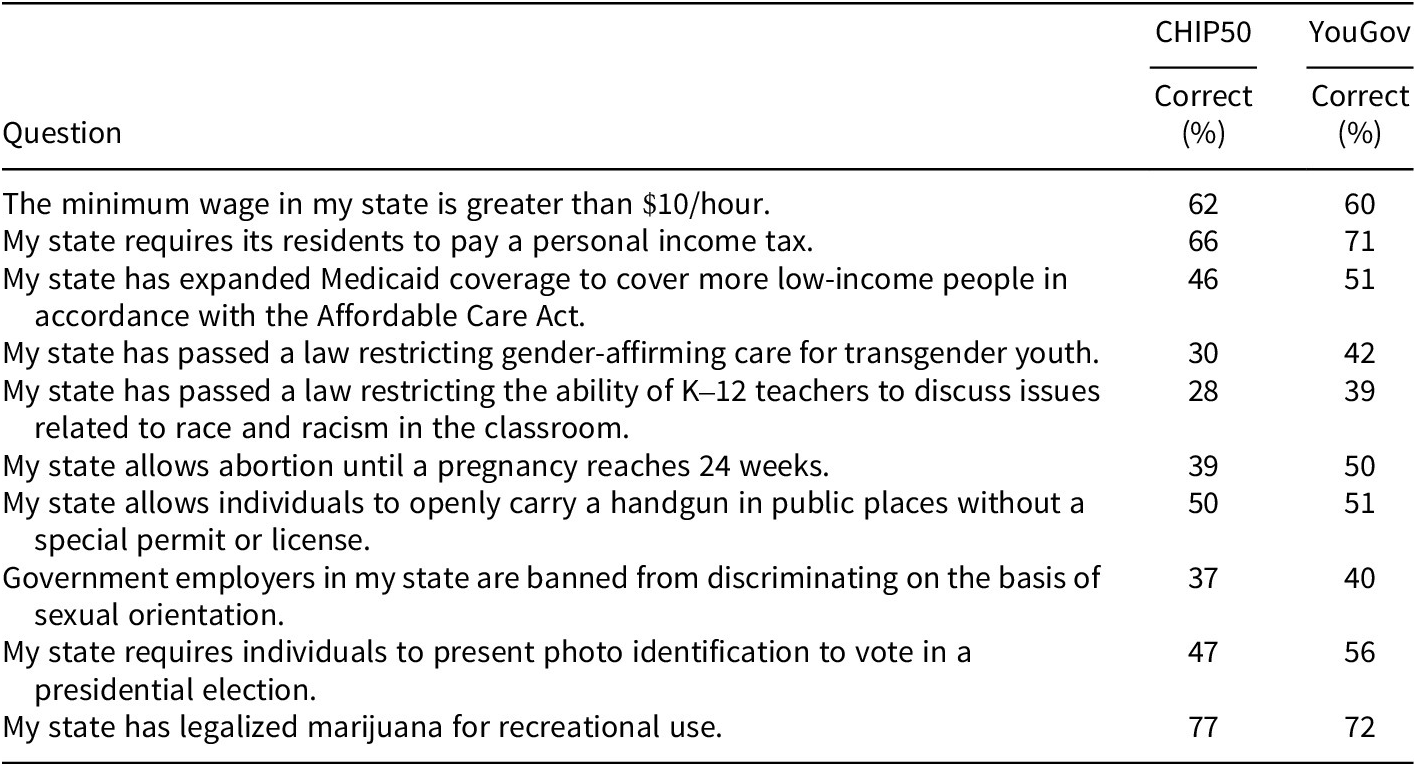
Respondents indicated “yes,” “no,” or “don’t know” to each policy statement. As Table 1 shows, accuracy was highest on recreational marijuana laws, state income taxes, and minimum wage policies. Questions about open carry, voter ID, Medicaid expansion, and abortion laws proved more challenging, reflecting the complexity and variation of those regulations. Knowledge was lowest on newer, rapidly evolving policies, such as sexual orientation discrimination, youth gender affirming care, and classroom discussions of race and racism, where fast-moving policymaking likely made policies less clear.
Question wordings and percentage of correct responses

Table 1. Long description
The table consists of three columns: Question, C H I P Correct percentage, and YouGov Correct percentage.
* The minimum wage in my state is greater than $10/hour: C H I P 62 percent, YouGov 60 percent.
* My state requires its residents to pay a personal income tax: C H I P 66 percent, YouGov 71 percent.
* My state has expanded Medicaid coverage to cover more low-income people in accordance with the Affordable Care Act: C H I P 46 percent, YouGov 51 percent.
* My state has passed a law restricting gender-affirming care for transgender youth: C H I P 30 percent, YouGov 42 percent.
* My state has passed a law restricting the ability of K-12 teachers to discuss issues related to race and racism in the classroom: C H I P 28 percent, YouGov 39 percent.
* My state allows abortion until a pregnancy reaches 24 weeks: C H I P 39 percent, YouGov 50 percent.
* My state allows individuals to openly carry a handgun in public places without a special permit or license: C H I P 50 percent, YouGov 51 percent.
* Government employers in my state are banned from discriminating on the basis of sexual orientation: C H I P 37 percent, YouGov 40 percent.
* My state requires individuals to present photo identification to vote in a presidential election: C H I P 47 percent, YouGov 56 percent.
* My state has legalized marijuana for recreational use: C H I P 77 percent, YouGov 72 percent.
Figure 1 shows the average percentage of correct answers, by state. Overall, knowledge is higher in the Northeast, the upper Midwest, and the West Coast; Southern states tend to have lower levels of policy knowledge.
Average percentage of correct answers, by state. Data are weighted at the state level.

Figure 1. Long description
A grid-based map titled Total Correct displays U S states as rounded squares. A color scale at the bottom indicates percentage correct, ranging from light green at 40, teal at 45 to 50, blue at 55, and dark purple to black at 60.
* Western Region: A K and W A are teal. O R and C A are dark purple. I D, N V, U T, and A Z range from blue to teal. H I is blue.
* Mountain and Central Region: M T, W Y, and N D are light green, indicating the lowest percentages near 40. S D, N E, K S, O K, and T X are teal. M N, I A, M O, A R, and L A range from dark purple to teal.
* Great Lakes and South: W I, I L, M I, I N, O H, K Y, T N, M S, and A L show a mix of dark purple for I L and M I, with teal and blue for the others. G A and F L are teal.
* Eastern Seaboard: M E, V T, N H, M A, R I, C T, N Y, N J, P A, D E, M D, D C, V A, W V, N C, and S C. The highest percentages, shown in dark purple or black, are concentrated in the Northeast including M E, V T, N H, M A, R I, C T, N Y, N J, and D C. P A, D E, V A, and the Carolinas are teal to light green.
To highlight the benefits of this type of survey for understanding state policy knowledge, we contrast the CHIP50 data with a YouGov survey fielded contemporaneously with the CHIP50 survey in July 2024 (the second column in Table 1). This survey of 1,500 US adults, selected to be representative of the US national population, contained the same demographic and political knowledge questions, enabling direct comparison between national- and state-level samples, while also providing us with information about how high-quality survey sampling conducted at the national level might result in different results than a state-level sample.
Comparing the responses from the two samples, the estimated level of political knowledge is within 5% for 6 of the 10 questions. Respondents in the CHIP50 sample were substantially more knowledgeable about their state’s marijuana policy. YouGov respondents were much more likely to know about their state’s policies regarding the teaching of race in schools, gender-affirming care, abortion, and voter ID laws.
These differences are partly attributable to sampling variation, but there are also key differences in the representation of different communities, especially relatively small ones, in national and state samples. Consider the representation of Black and LGBT respondents. In the YouGov dataset, 16 states have no Black respondents, and more than half of the states – 29 states – have 0 or 1 Black respondents. Similarly, a majority of states – 30 – have either 0 or 1 LGBT respondents (18 states have no LGBT respondents). The median state in the YouGov dataset has 1 Black person and 1 LGBT person; the median state in the CHIP50 data has 38 Black respondents and 41 LGBT people (the lowest number of LGBT respondents in a state-level sample in the CHIP50 data is 23 [South Carolina]).
This paucity of representation of Black and LGBT respondents in the majority of states in a national survey raises obvious problems for the ability to estimate the knowledge of members of those groups about the policies that affect them at the state level: if you have no members of an issue public in that state, it is difficult to construct a valid estimate. But the issue is larger when we look to the presence of members of communities of interest in states with particular policies. The YouGov dataset, for example, contains only 136 LGBT respondents. Of those, only 49 (20%) live in states that have restricted trans health care. The CHIP50 data, by contrast, have 2,332 people that identify as LGBT. Of those, 45% live in a state that has restricted trans health care. Or, as another example, the YouGov dataset contains 182 African American respondents. Only 71 of them live in a state that has passed a law restricting the ability of teachers to discuss race in class. In the CHIP50 data, we have 1,273 African American respondents living in a state with that policy.
Thus, the CHIP50 data allow us to understand knowledge of policies affecting issue publics in states where policies target them and states where they do not, which is very difficult with nationally representative samples. In addition, because of the large samples of issue public members, we are able to examine knowledge disparities within issue publics.
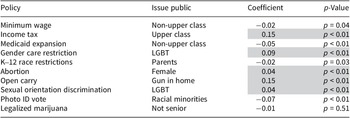
There are two main ways to identify issue publics: ask people which issues they care most about (Krosnick Reference Krosnick1990; Ryan and Ehlinger Reference Ryan and Ehlinger2023), and identify them based on demographic or personal characteristics (Bolsen and Leeper Reference Bolsen and Leeper2013; Henderson Reference Henderson2014; Sides and Karch Reference Sides and Karch2008). We use the latter approach since these policies have a clear demographic target or beneficiary. The policy-issue public pairings are shown in the second column of Table 2; more information is provided in Supplementary Table S2. For each of these publics, we create a dichotomous variable. People over 65 are considered seniors, and those with a college degree and above the median income are considered upper class. We also include indicators for white respondents, LGBT individuals, and men. We also created dichotomous variables for parents and gun owners depending on whether the respondent indicated they had a child under 18 or a gun in their home. While dichotomizing concepts like age reduces some information, the benefit is ease of presentation and interpretation. Note that for some of these issue publics one could argue that the “opposite” group is most relevant. For example, people who are not upper class may have a greater interest in the income tax because it can affect their consumption more, or Whites may have a greater preference for voter identification. Note that our approach to measuring issue publics allows us to determine if this is the case (if we were to find negative coefficients, we can conclude that the omitted category is more knowledgeable).
Effect of membership in issue public on correct answer

Table 2. Long description
The table consists of four columns: Policy, Issue public, Coefficient, and p-Value. The data rows are as follows:
* Minimum wage: Non-upper class, Coefficient minus 0.02, p equals 0.04.
* Income tax: Upper class, Coefficient 0.15, p is less than 0.01.
* Medicaid expansion: Non-upper class, Coefficient minus 0.05, p is less than 0.01.
* Gender care restriction: L G B T, Coefficient 0.09, p is less than 0.01.
* K through 12 race restrictions: Parents, Coefficient minus 0.02, p equals 0.03.
* Abortion: Female, Coefficient 0.04, p is less than 0.01.
* Open carry: Gun in home, Coefficient 0.15, p is less than 0.01.
* Sexual orientation discrimination: L G B T, Coefficient 0.04, p is less than 0.01.
* Photo I D vote: Racial minorities, Coefficient minus 0.07, p is less than 0.01.
* Legalized marijuana: Not senior, Coefficient minus 0.01, p equals 0.51.
The outcome variable in each model is the policy question; N ≈ 25,837 in each model. Each independent variable is scaled from 0 to 1 so the estimated coefficient indicates the effect of affiliation with the noted issue public on the probability of correctly answering the knowledge question, controlling for the respondent’s demographic factors and partisan identity. Full regression results are provided in Supplementary Table S4. Shaded cells indicate p < 0.05 in the expected direction.
We also control for respondents’ 7-point party identification in the models to account for respondents’ more general political commitments. Overall, 39% of respondents identified as Democrats (including leaners), 21% identified as pure Independents, and 41% identified as Republicans. Supplementary Table S1 provides summary statistics for the variables in our model.
Disparities in policy knowledge
We began with a multivariate analysis of the association between respondents’ demographic and political characteristics and the sum of their correct answers (Supplementary Table S3). We estimate a linear regression with random effects for state. There is a strong association between nearly all of the demographic and political characteristics we include and increased political knowledge. Gun ownership, race, age, and social class are each associated with about a one-half or greater question increase in the number of correct answers.
To determine whether people who are directly affected by policies are more likely to know about those policies, we turn to Table 2. This table summarizes the results of individual linear probability models that use the dichotomous correct-or-not answer to each individual policy question as the outcome. For the income tax, gender care restrictions, abortion, sexual orientation discrimination, and open carry questions, being part of the relevant issue public is associated with better knowledge of state policies. For the minimum wage, Medicaid expansion, K-12 race restrictions, photo ID, and marijuana, being part of the issue public does not help one have better knowledge. In fact, for the minimum wage and Medicaid expansion issues, people who are not upper class have less knowledge of these policies. Similarly, racial minorities have less knowledge of voter ID, while parents are less likely to know their state’s policy on teaching racial issues.
These findings show that disadvantaged or marginalized groups do not necessarily know more about policies that disproportionately affect their group. Upper class individuals and gun owners do know more about policies that affect them (and we mentioned above that they know more about policies generally). In terms of historically marginalized groups with fewer resources (on some dimensions, at least), LGBT people and women do seem to know more about policies that affect them. Specifically, women are about 4% more likely to know their state’s abortion policy than men. For gender care restrictions, LGBT people are about 9% more likely to know their state’s policy, and they are about 4% more likely to know their state’s policy related to sexual orientation discrimination. The fact that these issue publics do not overcome policy knowledge gaps reflects that being White, a senior (who would not generally have children at home) and, especially, being upper class are the largest determinants of general policy knowledge (see Supplementary Table S3).
Two important caveats are in order. First, respondents were able to indicate that they did not know the answer to each of the knowledge questions, limiting the amount of guessing which could artificially inflate knowledge. Second, these coefficients come from multivariate models that account for respondents’ other demographic and political characteristics (Supplementary Table S4). As a result, these effects indicate the additional effect of membership in an issue public accounting for a host of other variables that are also (as mentioned above) very strong predictors of political knowledge. Thus, even though these effect sizes are not overwhelming, they are substantively important inasmuch as they indicate an additional effect of issue public membership beyond other demographic and political characteristics.
Disparities within issue publics?
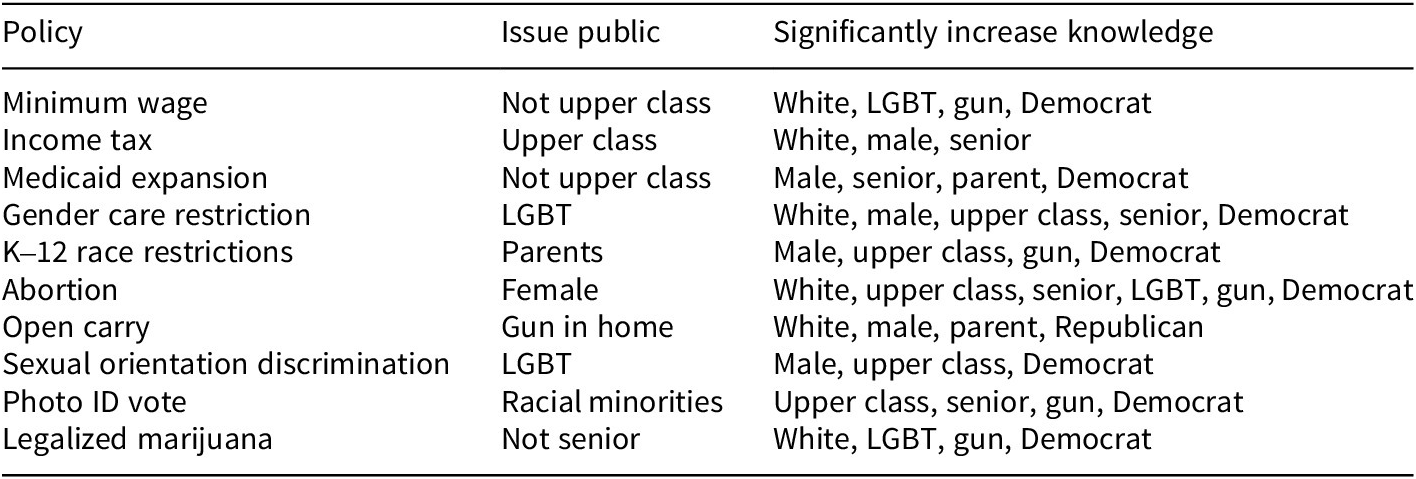
So far, we find familiar knowledge gaps by age, class, gender, and race that are sometimes reduced by issue publics. But inequalities may persist within issue publics. To assess this, we reestimated the individual policy regression models, limiting the sample to those respondents who are members of the relevant issue public (Supplementary Table S5). Table 3 summarizes the results.
Knowledge disparities within issue publics

Table 3. Long description
The table consists of three columns: Policy, Issue public, and Significantly increase knowledge.
* Minimum wage: Issue public is Not upper class. Groups with significantly increased knowledge are White, L G B T, gun, and Democrat.
* Income tax: Issue public is Upper class. Groups are White, male, and senior.
* Medicaid expansion: Issue public is Not upper class. Groups are male, senior, parent, and Democrat.
* Gender care restriction: Issue public is L G B T. Groups are White, male, upper class, senior, and Democrat.
* K through 12 race restrictions: Issue public is Parents. Groups are male, upper class, gun, and Democrat.
* Abortion: Issue public is Female. Groups are White, upper class, senior, L G B T, gun, and Democrat.
* Open carry: Issue public is Gun in home. Groups are White, male, parent, and Republican.
* Sexual orientation discrimination: Issue public is L G B T. Groups are male, upper class, and Democrat.
* Photo I D vote: Issue public is Racial minorities. Groups are upper class, senior, gun, and Democrat.
* Legalized marijuana: Issue public is Not senior. Groups are White, L G B T, gun, and Democrat.
This table summarizes the results of multilevel linear regressions presented in Supplementary Table S5. The models are estimated on subsets of respondents from the issue public associated with the political knowledge question.
Across most issues, the groups with higher levels of general policy knowledge are also more likely to be knowledgeable about policies that directly affect their issue publics. This pattern holds for both advantaged and disadvantaged issue publics. For instance, upper-class whites, LGBT whites, white women, and white gun owners are more knowledgeable than their nonwhite counterparts about income taxes, transgender rights, abortion, and open-carry laws. On the minimum wage, where the analysis is limited to individuals who are not upper class, we find that parents tend to know less, while LGBT people know more, but the usual demographic disparities are largely absent. Being male, upper class, or a senior citizen is also a significant predictor of higher knowledge on at least five of the issues. Taken together, these findings suggest that while some issue publics help narrow knowledge gaps across class, race, age, and gender, such disparities nevertheless persist within issue publics. Put differently, groups that are generally advantaged in terms of policy knowledge remain advantaged even when the topic concerns issues most relevant to their own issue public.
Conclusion
Political knowledge is essential for democratic participation and influence but remains unequally distributed. Using a new state-representative survey of over 25,000 respondents across all 50 states, we conduct the largest analysis to date of knowledge of state policies and group disparities. Across 10 economic and social policy questions, white, upper-class, male, and older respondents consistently demonstrate higher knowledge, mirroring long-standing inequalities in political power and influence. Some research shows that less advantaged issue publics have more knowledge about some political facts disproportionately affecting them, but not necessarily general policies (Cohen and Luttig Reference Cohen and Luttig2020; Weaver, Prowse, and Piston Reference Weaver, Prowse and Piston2019). We find that membership in an issue public can help to increase policy knowledge on some relevant issues, but advantaged subgroups within these publics – white, wealthier, older members – remain better informed. Thus, issue publics seem able to reduce, but not eliminate, structural policy knowledge disparities.
These findings carry important implications for understanding the relationship between group identity, information, and political inequality. If members of issue publics – already advantaged in terms of resources, education, or social status – are also more knowledgeable about state policies that affect them, these information advantages may compound broader inequalities in political behavior and engagement. Even when groups mobilize around issues important to them, disparities in political knowledge persist along familiar lines. As a result, efforts to increase political and policy knowledge or engagement through issue-based appeals to targeted communities may merely amplify the voices of those who are already politically advantaged instead of closing existing well-known informational gaps.
Our study has a number of strengths. First, many critical policies and especially fundamental rights are being determined at the state level, so it is important to understand knowledge of state policies. Aside from knowledge making it possible to effectively participate in politics and policy debates, one potential benefit of federalism is that people can potentially move to states that align with their policy preferences (Nelson and Witko Reference Nelson and Witko2022; Reference Nelson and Witko2026a), but this is unlikely if people do not understand their own state’s policies. Second, because we have large, representative samples at the state level, we are able to understand how knowledge varies by issue publics, including those comprising a relatively small share of the population, like LGBT people. Large subsamples also allow us to examine disparities within issue publics. Third, we ask about policy knowledge on various issues so that we can consider whether issue knowledge is general or limited to policies that most directly affect issue publics.
A weakness of our study is that we do not ask people how strongly they identify with their issue public, whether they are active in organizations representing their issue public, and so forth. This is something that should be considered further in future research. Another question is why some issue publics appear to be mobilized to be knowledgable about a range of policies, while members of other groups seem to be more narrowly focused on issues that affect them. Members of a third category of issue publics appear to lack knowledge of even those issues that implicate them directly. In particular, people with guns in the home are an interesting issue public because they know more about gun policy, but also about most other policies. This is obviously a quite heavily politicized issue public, and they are actually advantaged in terms of things like income and education. But having a gun in the home is still associated with higher levels of knowledge even after controlling for these factors. Understanding the variation in why some issue publics become so heavily politicized and knowledgeable, while others remain less so, is an important direction for future research.
Supplementary material
The supplementary material for this article can be found at http://doi.org/10.1017/spq.2026.10031.
Data availability statement
Replication materials are available on SPPQ Dataverse at https://doi.org/10.7910/DVN/HW1QMT (Nelson and Witko Reference Nelson and Witko2026b).
Acknowledgments
Thanks to the Department of Political Science and McCourtney Institute for Democracy at Penn State for research support and Danielle Beavers and Morrgan Herlihy for research assistance. We also appreciate feedback from Jack Santucci, Ray La Raja, and participants at the 2025 State Politics and Policy Conference.
Funding statement
We are extremely thankful to the Civic Health and Institutions Project, a 50 States Survey (CHIP50) (NSF Grants SES-2241884, SES-2241885, and SES-2241886; Matthew Baum, James Druckman, David Lazer, and Katherine Ognyanova, Principal Investigators), for fielding the survey.
Competing interests
The authors declared no potential conflicts of interest with respect to the research, authorship, and/or publication of this article.
Author biographies
Michael J. Nelson is Professor of Political Science and Affiliate Law Faculty at the Pennsylvania State University.
Christopher Witko is Executive Director of the University of California Center Sacramento (UCCS) and Professor of Political Science at UC Davis.



 Open access

