1. Introduction
Cupules represent the most common form of petroglyphs in the world. They are roughly semi-hemispherical features that were pounded into horizontal, inclined or vertical rock surfaces (Bednarik, Reference Bednarik2008). Their purpose is essentially unknown, despite a few ethnographic glimpses of their significance (Bednarik, Reference Bednarik, Lewis and Bednarik2010), and they can be found in their millions. They occur in the exogram traditions of most human societies of the Quaternary Period, from some of the earliest cultures right up to the twentieth century. The aspects of cupules that are of particular relevance here are that they are generally the oldest surviving rock art known, and that replication has shown that an almost incredible amount of energy has been expended in their creation on particularly hard rock (Bednarik et al. Reference Bednarik, Kumar, Watchman and Roberts2005; Kumar & Krishna, Reference Kumar and Krishna2014). It takes 30000 to 40000 blows with a number of hammerstones to create a standard-size cupule on well-metamorphosed, unweathered quartzite.
The earliest currently known rock art are Lower Palaeolithic petroglyphs in two quartzite caves of central India, Auditorium Cave at Bhimbetka (Bednarik, Reference Bednarik1993) and Daraki-Chattan Cave (Kumar, Reference Kumar1996; Bednarik et al. Reference Bednarik, Kumar, Watchman and Roberts2005), besides those of a few southern African sites (see below). They consist mostly of cupules in both cases and, based on the Mode 1 stone tools deposited with stratified rock art, are thought to be hundreds of thousands of years old. Daraki-Chattan is in a Proterozoic quartzite hill named Indragarh. On the plateau above the cave, only a few hundred metres from it, are more recently made cupules at an open site, on horizontal surfaces. It was here that the unexplained phenomenon that is the subject of this paper was first observed: “At one of the cupule panels we have examined a light-coloured crust-like feature, about one millimetre thick, now exfoliating, which comprises the same grain sizes as the rock but presents the visual appearance of an accretionary deposit. We could not determine its nature, but, having observed a similar phenomenon on some of the ancient river polish just mentioned, consider the possibility that the energy applied in the making of the cupule created a cutaneous zone that was more resistant to the weathering processes.” (Bednarik et al. Reference Bednarik, Kumar, Watchman and Roberts2005, p. 186)
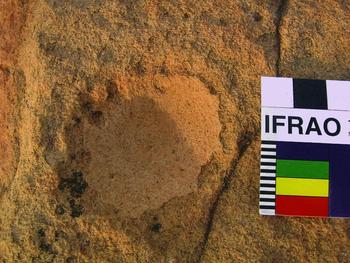
There is a geometric arrangement of about 20 cupules (some are very faint), forming a double row and thought to be of Holocene age on the basis of their preservation. Many of these cupules bear a remarkable surface feature, resembling an accretionary deposit of some kind. However, examination by binocular microscope revealed that this lamina, which varies in thickness between 1 and 2 mm and is visually quite distinctive, is of the same quartzite as the rock matrix, but apparently more stable. This very light-coloured, almost white lamina is not a remnant of some mineral accretion, but is the original floor of the cupule (Fig. 1). The layer is limited to the cupules’ interior and it is evidently much more resistant to weathering than the protolith rock. It has become exfoliated from the rim of each cupule, but remains intact and protects the less-resistant rock beneath it in the central areas of each cupule.
One of the Indragarh Hill cupules in central India bearing non-accretionary surface layer of re-metamorphosed quartzite.

This poses a considerable problem to interpreting these laminae. Sandstones and quartzites may contain laminar zones of more metamorphosed, denser fabric, but it is virtually impossible that the floor of a cupule would follow such a zone, particularly in several instances. Therefore, this phenomenon cannot be related to any inherent structural feature of the rock; rather, it must somehow be connected with the production of the cupule. The cupule was made by direct percussion with hammerstones, which progressively fractured and removed quartz crystals and silica cement. This process resulted in a semi-hemispherical depression in the rock's substrate, the near-surface rock of which has by some process been converted to a more erosion-resistant condition. While the surrounding rock has been subjected to extensive granular exfoliation and is gradually receding, the floor of each cupule remains intact. It has been suggested that the sustained application of kinetic energy during cupule production has somehow created a cutaneous zone that was more resistant to weathering than the unmodified surface (Bednarik, Reference Bednarik2008, p. 88).
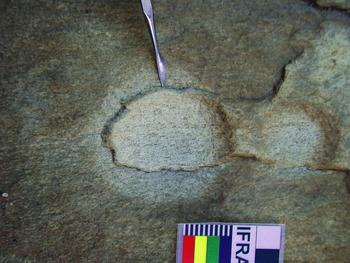
This impression was reinforced by the discovery nearby, on top of the plateau of Indragarh Hill, of a palaeo-riverbed that millions of years ago would have consisted of rapids. Here, the bedrock and boulders were heavily polished by intensive fluvial action on the oncoming surfaces, exhibiting the same surface lamina that is more resistant than the quartzite rock. It appears to derive from intense battering by clasts in turbulent water. Subsequent to these observations, similar occurrences emerged in various parts of the world. At Jabal al-Raat at the Shuwaymis petroglyph complex in northern Saudi Arabia, a sandstone panel of cupules and other petroglyphs has been denuded by granular exfoliation of surficial rock mass, of several millimetres thickness, but in some of the cupules the original surface has remained intact within them (Bednarik & Khan, Reference Bednarik and Khan2005, fig. 14). It also has somehow become consolidated as a result of the production process. Similarly, Francaviglia's (Reference Francaviglia2005) photographs of cupules on sandstone from Umm Singid and particularly from Jebel as-Suqur (Sudan) seem to illustrate the very same phenomenon (Francaviglia, Reference Francaviglia2005, figs 2, 7, and especially the close-up in fig. 5). A classic example of this phenomenon was then observed at one of the oldest-known rock art sites in Africa, Nchwaneng in the southern Kalahari Desert (Beaumont & Bednarik, Reference Beaumont and Bednarik2013, pp. 41–2). The earliest petroglyphs at this major site on a glacial quartzite pavement are all cupules, occurring next to the largest of several waterholes that were created by glacial plucking some 300 million years ago. The cupules are thought to be either of the Middle Stone Age or the Middle Fauresmith tradition, i.e. somewhere between 50 and 500 ka old and their most likely age is in the order of 410 ka (Beaumont & Bednarik, in press). The lamina formed in them and even on adjacent surfaces is 2–3 mm thick and has very effectively retarded erosion of the rock beneath it (Fig. 2).
Re-metamorphosed lamina on two cupules at Nchwaneng, South Africa.

All of these examples refer to sandstone, quartzite or intermediate forms, but the same effect has also been observed on metamorphosed mudstone facies, i.e. on schistose rock types. Some of the sites of the Santivañez site complex near Cochabamba in central Bolivia are of schist, and a few of the cupules at Condor Mayu 2 show the same kind of hardening on their floors. Schists retreat relatively rapidly, up to 10 mm per millennium (Bednarik, Reference Bednarik2007, p. 61), but here cupules have retained their floors while the rock around them has retreated several millimetres.
2. The Inca Huasi specimen
One of the most closely examined cupules with this kind of surface lamina is also in Bolivia, on the quartzite of Inca Huasi, near Mizque (Bednarik, Reference Bednarik2000). This petroglyph site comprises a sandstone mass preserved by part of a several kilometre long quartzite dyke from the eroding power of the Uyuchama River. Of the two different petroglyph traditions present, the earlier, featuring only randomly distributed cupules, seems limited to the quartzite surfaces, while the more recent rock art occurs on the sandstone slope. The latter features cupules often arranged linearly, circles, circles with a central pit, a wave line and linear grooves. Some of these elements seem to form more complex geometric groupings. Just above the site occurs a sloping sandstone pavement featuring numerous horizontal polished grinding dishes, each around 50 or 60 cm long. These are better preserved than the petroglyphs on the same type of rock, and are spatially separate from them. One of them has yielded a microerosion date of E1028±300 years (Bednarik, Reference Bednarik2000), by reference to the Grosio calibration value (Bednarik, Reference Bednarik1997). On the basis that the cement retreat of the recent petroglyphs is more than three times that in the polished surfaces, it has been suggested that they may be in the order of two to three times as old (the solution of the cement is thought to increase with progressing recession) and should be between 1500 and 4000 years old. The old cupules on the quartzite dyke are assumed to be of early Holocene age (Bednarik, Reference Bednarik2000).
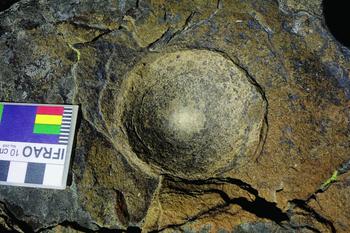
One of the highest-situated of these early cupules could be regarded as the best manifestation of the phenomenon considered here (Fig. 3). Occurring almost 10 m above the river, on a small horizontal surface as the largest in a group of five cupules, it measures 70×75 mm across and 15 mm in depth. It exhibits the most extensive surface consolidation of this kind so far reported. The panel has experienced extensive laminar exfoliation around the cupule and on its margin. Therefore, the cupule must have been larger and deeper in the past. As far as can be established without sectioning it, the re-metamorphosed zone ranges in thickness between 4.5 and 6.5 mm, exceeding that seen anywhere else. Visually, the stabilized material differs from the background, in that it is much lighter than the brown-coloured rock matrix and of a different morphology. Most importantly, it exhibits a vague internal lamination that follows the curvature of the cupule. The modified lamina has survived best in the cupule's interior, suggesting that the effectiveness of the metamorphosis was related to the depth of the petroglyph (i.e. to the cumulative amount of energy that impacted on the rock). Consequently, the peripheral parts of the lamina have exfoliated, except on the NNE side where a 30 mm wide remnant of the otherwise eroded surface material remains. It is here up to 12 mm thick, which provides an idea of the amount of retreat of the rock since the cupule was made. Effectively, the cupule may have been in the order of 25 mm deep originally, and only its central 60–70% has been preserved. Detailed microscopic examination of the lamina confirms that its surface represents the cupule's original floor, in which cracked quartz grains can still be seen. Most of the surface is quite smooth, with very little retreat of the cement evident and remaining mechanically stable. There are patches of recesses that seem to indicate where damaged grains or cement eroded. The largest grain measured is 212 microns long, but the average size of the detrital grains is in the order of 70 microns. On the sides of the cupule and near its margin, the grains are significantly more exposed, i.e. the cement has retreated greatly. Other than that, there is no microscopically detectable morphological difference between the lamina and the adjacent protolith rock.
Large cupule at Inca Huasi, central Bolivia, with well-developed re-metamorphosed surface lamina.

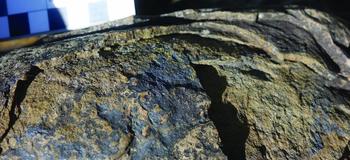
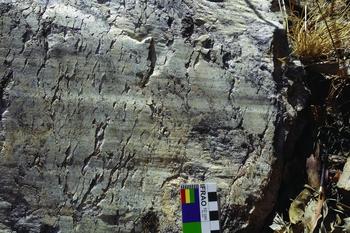
The quartzite block on which this cupule occurs features extensive further evidence of laminar exfoliation parallel to the surface, most particularly on its western end, which is where the Uyuchama River has in the distant past, when it was at a level almost 10 m higher than now, bombarded this stubborn vertical dyke with the clasts rafted past. The laminar layering is so distinctive here, and on other blocks exposed to the river's onslaught, that it seems to have been caused by the same factor, kinetic energy (Fig. 4). The effects of the river on the uppermost blocks of the quartzite are evident all along the exposure at this level, while a few minor potholes have developed downslope on the softer sandstone. It is clear that the river used to be blocked by the dyke before it was eventually breached, and that the structure's most exposed aspects were subjected to great impact by kinetic energy. There is no internal lamination evident in the rock that could account for this phenomenon. The rock has vertical cleavage lines running roughly E–W and N–S, but there are no horizontal cleavage planes evident. It could be argued that the surface laminae are the result of weathering processes, but this does not explain why they are more resistant than the parent rock. In both cases, in the large cupule and on the rounded upper edge of the block, there is no possible explanation of these stabilized zones expressing pre-existing features. Certainly in the case of the cupule, this is directly related to its manufacture.
Exfoliating laminar surface layers attributed to fluvial kinetic energy.

Since the essential property that seems responsible for the significantly greater resistance to erosion in the lamina is the ‘hardened’ cement, it is essential to determine what has modified that component, and by what process.
3. Solid-state metamorphosis of sandstone
The above examples are not the only ones of highly localized solid-state metamorphosis of sandstone, and it may be profitable to examine and consider other phenomena of this kind. Of particular interest are the modifications commonly seen at shear zones in sandstone which are unrelated to inherent bedding planes. They may be tabular to sheet-like, planar or curvi-planar zones composed of rocks that have been strained more highly than the protolith (parent rock). They can be randomly orientated in a single rock mass, presenting conspicuous directional texture. Typically, these platy laminae consist of whitish, dense sheets that may feature characteristics of schistosity, such as foliation grooves and even tear marks (Fig. 5). They reflect a considerable intensity of metamorphism, changes resulting from deformation at high temperatures and pressures occurring under kilometres of overlying rocks.
Characteristic metamorphosed lamina of a ductile shear zone on sandstone, showing distinctive foliation grooves and tear marks.

The formation of schistosity in shear zones results from the local recrystallization of the rock along zones of ductility, where kinetic energy deriving from external stresses was released and caused the internal deformation or movement. These ductile shear zones or tectonites are chemically similar to the protolith, but differ from it morphologically (Pereira & de Freitas, Reference Pereira and de Freitas1993). Tectonites are rocks with minerals that have been affected by natural forces of the Earth, which allowed their orientations to change. The foliation formation involves an anisotropic recrystallization of one of the components, in the case of sandstone the binding cement. The cement of silica sandstones not only binds the grains: it reduces porosity and permeability as it fills the voids between the detrital clasts (Macaulay, Reference Macaulay2003). The source of the syntaxial quartz overgrowths on quartz grains can be biogenic (δ30Si ~ −1–2‰) or detrital silica (δ30Si ~ 0‰) and remains controversial. It is thought to derive largely from overlying shale and sandstone beds. Sandstones can be separated vertically from potential silica sources by a kilometre or more, requiring silica transport over long distances to form. Mineral coatings on detrital quartz grains, such as clays, and entrapment of hydrocarbons in pores retard or prevent cementation by quartz, whereas highly permeable sands tend to sequester the greatest amounts of quartz cement (McBride, Reference McBride1989). The voids between quartz clasts are usually not fully occupied by cement; in fact sandstones with more than 10% imported quartz cement pose the problems of fluid flux and silica transport. If the silica forming the cement is transported entirely as H4SiO4, convective recycling of formation water has been suggested to explain the volume of cement present in most sandstones. Most cementation by quartz takes place when sandstone beds were in the silica mobility window specific to a particular sedimentary basin.
Therefore, the cement in silica sandstones is usually discontinuous, containing remaining pores that provide the opportunity, under adequate temperature, pressure and tensile stresses, for ductile deformation, compressive stress and consolidation, in the form of highly localized metamorphosis. The tectonites of the resulting shear zones retain the chemical properties of the sandstone, as does sandstone undergoing metamorphosis to quartzite, but they are significantly more resistant to erosion, appearing dense, whitish and free of granulate texture before weathering.
4. Tribochemistry
In short, the process of localized metamorphosis of silica sandstone by energy released in such shear zones is not new: it is part of the changes that occur in rock masses under conditions involving great ductile stresses. Essentially, this subject belongs to tribology, the science and technology of interacting surfaces in relative motion and of related subjects and practices (Bhushan, Reference Bhushan2013). The concept of ‘tribology’ was introduced by Peter Jost half a century ago (Jost, Reference Jost1966). As the science of interacting surfaces in relative motion, tribology certainly has specific applications in the geology of metamorphic rocks that have hitherto been neglected. In rock art science, the relevance of tribology has never been considered, an omission that is being corrected here. Nevertheless, the idea that the hardened laminae considered here have resulted from the application of kinetic energy to the silica cement has been fleetingly expressed before: “Closer examination of these features is warranted and their origins need to be established. They seem to differ from case hardening in that the resistant skin is very thin, and the phenomenon may be relevant to issues of dating. One possible explanation would be that the great kinetic energy brought to bear on a cupule has somehow converted (slightly metamorphosed?) the silica cement. I cannot cite a process by which this could have occurred, but as it seems the most reasonable explanation. I place the possibility before the reader and perhaps someone may care to comment.” (Bednarik, Reference Bednarik2008, p. 88)
Here it is explored further. Tribochemistry is a branch of science dealing with the chemical and physico-chemical changes of solids due to the influence of mechanical energy (Kajdas, Reference Kajdas and Pihtili2013). Mechano-chemical reactions can result in compounds or microstructures that differ from the products of ‘ordinary’ reactions. It is the highly localized impact of energy, well above kT (product of Boltzmann constant and temperature), that is the key feature of mechano-chemical reactions. Reactions that cannot occur thermally become possible, just as those the energy of photons induces in photochemistry. Of importance is the direction of the mechanical stress relative to the orientation of crystallographic axes in solids.
In the described conversion processes occurring in shear zones of sandstone, the kinetic energy effecting the metamorphosis to tectonites exceeds the shear strength, i.e. the resistance to the forces that cause two adjacent parts of a body to slide relative to each other. Energy is dissipated through the deformation between the two sliding masses and the asperities involved. If one of them is harder than the other, the asperities of the harder surface may penetrate and plough into the softer surface and produce grooves if shear strength is exceeded (Bhushan, Reference Bhushan2013). Such grooves can sometimes be observed in the shear zones described above. The term stick-slip is relevant in this context, having been coined by Bowden & Leben (Reference Bowden and Leben1939). During the stick phase the friction force builds up to a certain value, and once a large enough force has been applied to overcome the static friction force, slip occurs at the interface (Bhushan, Reference Bhushan2013). The scale such phenomena can sometimes assume may be appreciated by considering the mechanics of earthquakes.
Of importance in understanding such phenomena are a few specific observations, such as the appreciation that the metamorphosis products are not limited to sandstones; as noted above, they can also occur on schistose facies. Schists that are devoid of a significant content of non-micaceous minerals weather readily (Anderson & Hawkes, Reference Anderson and Hawkes1958; Fahey, Reference Fahey1983; Wells et al. Reference Wells, Binning, Willgoose and Hancock2006), as they hydrate to their previous phases and thus ultimately revert to mud, forming again the clayey soils from which they originate (Chigira, Reference Chigira1990). For instance the chlorite of quartz-chlorite schist weathers via vermiculite to kaolinite (Murakami et al. Reference Murakami, Isobe, Sato and Ohnuki1996; Wells, Binning & Willgoose, Reference Wells, Binning and Willgoose2005). The weathering front is abrupt, and pedoplasmation follows geological structures, forming a clay-rich soil material (Zauyah & Stoops, Reference Zauyah and Stoops1990). The metamorphosis of schists by anthropogenic kinetic energy seems to be limited to those rocks that contain adequate silica, probably in the form of cement.
Another significant observation relates to the complete absence of such metamorphic laminae in very heavily worked and large cupules on pure white crystalline quartz at Moda Bhata, India (Bednarik et al. Reference Bednarik, Kumar, Watchman and Roberts2005, p. 181–2). The best example of this is the largest cupule of the site, with a diameter ranging from 28 cm to 35 cm, and a depth of 10 cm. This rock would be harder to have an impact on than quartzite, yet the volume of material removed is many times that of an average-size cupule. Despite the very significantly greater kinetic energy impact, neither this cupule nor any other on pure crystalline alpha quartz shows any sign of surface conversion. Therefore, it needs to be assumed that the alteration in the quartzite is limited to metamorphosis of the silica cement.
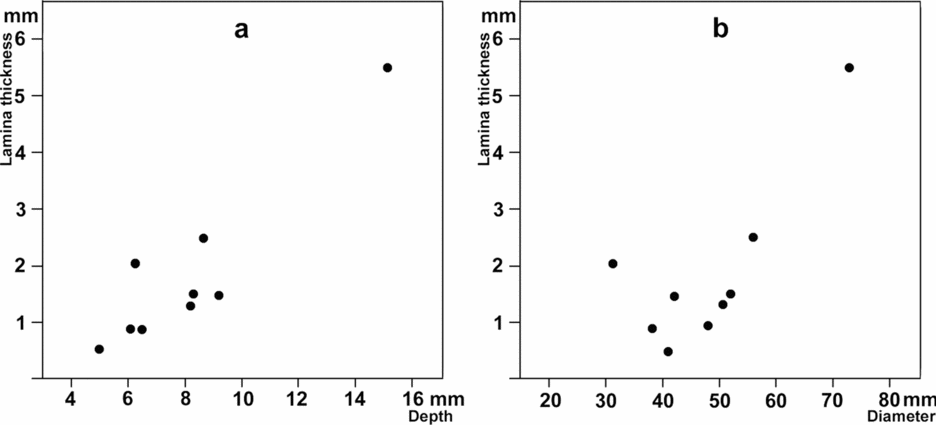
Of particular relevance seems to be the statistical distribution of lamina thickness relative to cupule diameter or cupule depth (Fig. 6). Although a strong trend is not evident from the very small sample (n = 9) currently available, the patterning, especially in the distribution of cupule depth versus metamorphosed lamina thickness, does imply a useful correlation. Greater size and depth of a cupule, which under otherwise identical conditions would correlate directly with applied total cumulative impact energy, are apparently related to greater thickness of the modified lamina. The volume of cupules can be estimated by
 \begin{equation}
V\; = \;\frac{{\pi d}}{6}\left( {3r^2 \; + \;d^2 } \right)\end{equation}
in which r = radius at rim, d = cupule depth and V = cupule volume. The cupule volume, in turn, is directly correlated with rock hardness, the influence of which can be determined by replication experiment. The production coefficient resulting from linking cupule volume to relative rock hardness is directly translatable into total energy applied to create the cupule. It is predicted that the thickness of the metamorphosed laminar formations found in cupules will consistently be shown to be a function of that production coefficient.
Metamorphosed lamina thickness plotted against (a) cupule depth and (b) cupule diameter (n = 9).

5. Kinetic energy metamorphosis (KEM)
What remains to be clarified is the precise process of the localized metamorphosis of certain sedimentary rocks attributed here to the application of kinetic energy. Essentially, three possible explanations have been considered to date. The first of them is the piezoelectric hypothesis. Quartz is one of the most piezoelectric substances. A 1 cm3 cube of quartz with 2 kN (500 lbf) of correctly applied force can produce a voltage of 12.5 kV (Repas, Reference Repas2008). Although the actual process is not defined, it seems plausible that the very considerable force applied to a cupule made on very hard quartzite could have yielded an electric charge adequate to modify the crystal structure of the quartz grains. It needs to be appreciated and bears repeating that replication experiments have shown that to create an average-size cupule on well-metamorphosed, unweathered quartzite involves about 30000 to 40000 blows with a hand-held hammerstone. With each stroke being, say, 0.4 N, the total force to bear on a cupule would have been in the order of 16 kN. Some of that energy caused the fracture of rock, and a minor component was dissipated as heat. A significant portion came to bear directly on the fabric of the rock. However, the complete absence of modification in cupules of much greater production coefficients on pure crystalline quartz speaks against the piezoelectric hypothesis. It demonstrates that the quartzite's component affected is the cement rather than the quartz grains.
A second interpretation proposed is that the impact of the hammerstone will result in microfracture of the silica rock and therefore the formation of nanoparticles with a very high surface to volume ratio. These particles will react faster than the original surface, i.e. they will dissolve easily, forming reactive fluids with atmospheric CO2 and other chemical species, thus developing a coating, a film that may be more resistant to further dissolution (J. M. Garcia Ruiz, pers. comm. 2013). This is negated by the observation that the laminar formation is not a precipitate: it is the original cupule surface and can bear evidence from the process of its manufacture (such as fractured or bruised grains, including conchoidal scars).
By far the most parsimonious explanation is that these features are attributable to tribochemical reactions, and most likely they indicate metamorphism of the silica matrix occupying much of the volume between the quartzite's grains. It is proposed that the considerable cumulative application of force releasing the kinetic energy of impact converts the cement in the same way as it is metamorphosed in the above described ductile shear zones of sandstone that has been subjected to significant tectonic stresses. Therefore, the modified cement of the re-metamorphosed quartzite forming the laminar phenomena described here can be defined as a tectonite.
6. Summary
This paper has described a relatively rare phenomenon not previously explained, but observed at a series of sites in various continents. In most cases it is found on well-metamorphosed quartzites, and in one instance it has been reported from silica-rich schist. It presents itself as a thin lamina occurring on the surface of cupules that resembles an accretionary deposit, but it is in fact the floor of the original cupule that has become more resistant to erosion by a structural modification. This change involves crystallization of the syntaxial quartz overgrowths on quartz grains that constitute the cement component to form tectonite. The process is attributed to the aggregate application of kinetic energy that attends the tens of thousands of hammerstone blows that were required to produce the cupule. This tribological metamorphosis resembles that involved in the formation of similar tectonite in shear zones of sandstone, where tribochemical conversion takes place and also results in denser, more erosion-resistant zones. In the case of cupules, these zones facilitate the preservation of the original pounded cupule surface. It is noted that the process is most effective in the central part of the cupule. Indeed, thickness of the resultant tectonite lamina is a function of the amount of energy that has been brought to bear on the rock surface. It is proposed that the process of conversion of the rock cement be defined as kinetic energy metamorphosis or KEM.
Acknowledgements
Guidance in the field by Professors Giriraj Kumar (India), Majeed Khan (Saudi Arabia), Roy Querejazu Lewis (Bolivia), Peter Beaumont (South Africa), and Messrs R. G. (ben) Gunn and Ryan Duffy (Australia) is gratefully acknowledged. The advice of crystallographer Juan Manuel Garcia Ruiz is also much appreciated. This project was entirely funded by the author.