Introduction
Tinnitus can be described as the perception of sound without external acoustic stimulation.Reference Chan1, Reference Henry, Dennis and Schechter2 About 10–15 per cent of adults report tinnitus, and about 1–3 per cent state that this condition severely impairs quality of life.Reference Chan1–Reference Dobie3 Tinnitus can result in insomnia and anxiety, interfere with work and social interaction, and decrease overall health.Reference Folmer and Griest4–Reference Scott and Lindberg6 However, the mechanism of tinnitus has not been fully elucidated, leading to a lack of satisfactory therapies.
Current treatments for chronic tinnitus include pharmacotherapy, retraining therapy and psychological counselling.Reference Jastreboff7, Reference Jastreboff and Hazell8 After a period of such treatment, the majority of patients with chronic tinnitus psychologically accept the symptoms of this condition. However, some patients experience the sudden aggravation of symptoms, defined as acutely exacerbated chronic tinnitus. Such aggravation and/or the interruption of adaptation to tinnitus during the course of treatment greatly reduces patients' confidence in and compliance with therapy, resulting in the recurrence of effects such as anxiety, irritability and insomnia. Thus, clinicians' ability to implement appropriate interventions by clarifying the mechanism underlying acutely exacerbated chronic tinnitus is important. Unfortunately, studies investigating this process have been rare.
The Tinnitus Handicap Inventory is a self-reported measure that quantifies the impact of tinnitus on daily life.Reference Meng, Zheng, Liu, Wang, Kong and Tao9–Reference Zeman, Koller, Schecklmann, Langguth and Landgrebe11 It contains 25 items grouped into 3 subscales: (1) a functional subscale, which assesses limitations as a result of tinnitus, (2) an emotional subscale, which focuses on emotional attitudes toward the condition, and (3) a catastrophic subscale, which assesses catastrophic thoughts about tinnitus. The global score provides an overall assessment of the extent to which tinnitus impacts a patient's daily life.Reference Bauch, Lynn, Williams, Mellon and Weaver12 A high catastrophic subscale score may indicate the need for referral to a psychologist or psychiatrist.Reference Newman, Sandridge and Bolek13 However, the potential contributions of emotional and functional subscale scores to the assessment of acutely exacerbated chronic tinnitus have not been investigated. In this study, we administered the Tinnitus Handicap Inventory to a sample of Chinese patients with acutely exacerbated chronic tinnitus during treatment at our hospital with the aim of increasing our understanding of the mechanism underlying this condition.
Materials and methods
Patients
Out-patients with acutely exacerbated chronic tinnitus were recruited at the Third Affiliated Hospital of Sun Yat-sen University, Guangzhou, China, between July 2005 and June 2012. The inclusion criteria were: (1) chief complaint of tinnitus with a disease course of six months or more, (2) completion of comprehensive audiological assessment and Tinnitus Handicap Inventory, (3) continuous treatment and follow up at our hospital and (4) acutely exacerbated chronic tinnitus during treatment. Patients were excluded from the study if they had: retrocochlear lesions, undergone middle-ear surgery, and/or been diagnosed by psychiatrists with an anxiety or depression disorder during treatment or follow up.
The Ethics Committee of the Third Affiliated Hospital of Sun Yat-sen University approved this study. All patients voluntarily participated in the study and provided informed consent.
Patient examination and classification
A detailed medical history was taken from each patient. Patients were also asked to provide information about possible triggers of tinnitus, including overwork, noisy environments, insomnia, negative events such as adverse work-related events (e.g. business failure, unsuccessful pursuit of a raise or promotion, difficult interpersonal relationships) and adverse events in family life (e.g. worry about a spouse's infidelity, critical illness or death of a family member).
All patients underwent routine examinations of the external auditory canal, tympanic membrane, nasal cavity and nasopharynx. In addition, half-octave pure tone audiometry (including expanded high frequency testing) and acoustic impedance audiometry were performed. Patients with suspicious retrocochlear lesions underwent thin-section computed tomography of the temporal bone and enhanced magnetic resonance imaging of the internal auditory canal. On the basis of examination results, 60 patients were included in the study.
The patients were divided into two groups (n = 30 (15 males and 15 females) in each group), depending on whether hearing loss was aggravated or stable (remaining at previous hearing levels) during acutely exacerbated chronic tinnitus. Major treatments for patients with acutely exacerbated chronic tinnitus and aggravated hearing loss included the improvement of cochlear microcirculation, the administration of neurotrophic factors and complete rest. Major treatments for patients with acutely exacerbated chronic tinnitus and stable hearing loss were psychological guidance and the prescription of anti-anxiety medications, which aimed to improve patients' interpersonal relationships and social support systems, to help them understand and evaluate stressors correctly, and to improve patients' ability to manage stress and tolerate frustration.
The severity of hearing loss was measured by pure tone threshold testingReference Buckey, Fellows, Jastrzembski, Maro, Moshi and Turk14 at the first visit and at the visit just after acutely exacerbated chronic tinnitus onset, using the pure tone average at frequencies of 0.5, 1, 2 and 4 kHz. Aggravation of hearing loss was defined as an increase of 15 dB or more in the threshold of at least one frequency, in line with a previous study.Reference Conlin and Parnes15
Tinnitus Handicap Inventory
Tinnitus severity was evaluated using the Chinese (Mandarin) version of the Tinnitus Handicap Inventory, which has shown high test-retest reliability (Pearson correlation coefficient = 0.98) and internal reliability (Cronbach's α = 0.93) in Mandarin populations.Reference Meng, Zheng, Liu, Wang, Kong and Tao9
The 25 items of the Tinnitus Handicap Inventory are distributed among the catastrophic (n = 6), emotional (n = 8) and functional (n = 11) subscales. Newman et al. reported four degrees of tinnitus severity based on overall Tinnitus Handicap Inventory scores: 0–16 = no handicap, 18–36 = mild handicap, 38–56 = moderate handicap and 58–100 = severe handicap.Reference Newman, Jacobson and Spitzer10 Subscale scores contribute differentially to the total score and are not directly comparable. Thus, the calculation of mean subscale scores for each group in this study was weighted according to the number of items in each subscale.
Statistical analysis
Data are expressed as means ± standard deviations. Student's t-test was used to assess differences in continuous variables between groups and the chi-square statistic was used for categorical variables. Differences in the measured variables before and after acutely exacerbated chronic tinnitus development were determined by two-tailed paired Student's t-tests. All statistical analyses were performed using SPSS software (version 13.0 for Windows; SPSS, Chicago, Illinois, USA), with a significance level of p < 0.05.
Results
Clinical data
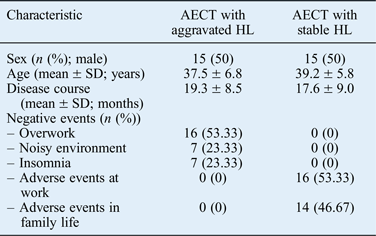
Clinical data for the acutely exacerbated chronic tinnitus patients with aggravated or stable hearing loss are provided in Table I. No difference in age, sex or disease course was observed between the groups. All patients with stable hearing loss had experienced major negative events in life or at work within the three months before tinnitus aggravation. In the aggravated hearing loss group, 16 patients experienced overwork and 7 patients worked in a highly noisy environment for several hours each day. Another 7 patients suffered from insomnia for more than 3 days.
Clinical characteristics of acutely exacerbated chronic tinnitus patients

AECT = acutely exacerbated chronic tinnitus; HL = hearing loss; SD = standard deviation
Tinnitus Handicap Inventory scores
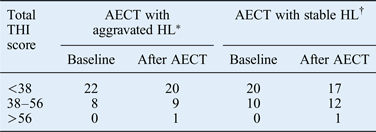
No significant difference in total Tinnitus Handicap Inventory score was observed between groups at baseline or after tinnitus aggravation (Table II). The total Tinnitus Handicap Inventory score did not change after tinnitus aggravation in either group.
Total tinnitus handicap inventory scores for each study group
Data represent numbers of patients. *n = 30; †n = 30. THI = Tinnitus Handicap Inventory; AECT = acutely exacerbated chronic tinnitus; HL = hearing loss
In the patients with aggravated hearing loss, functional subscale scores were significantly higher after tinnitus aggravation than at baseline (44 ± 11.96 vs 40 ± 11.89; p < 0.01), but catastrophic and emotional subscale scores did not change (Table III). In the patients with stable hearing loss, emotional subscale scores were significantly higher after tinnitus aggravation than at baseline (56 ± 23.03 vs 52 ± 22.45; p < 0.01), but catastrophic and functional subscale scores did not change (Table III).
Tinnitus handicap inventory subscale scores for each study group
Data represent means ± standard deviations. *n = 30; †n = 30. ‡p < 0.01 versus baseline. THI = Tinnitus Handicap Inventory; AECT = acutely exacerbated chronic tinnitus; HL = hearing loss
Discussion
Tinnitus is a common distressing condition that affects a broad range of patients.Reference Chan1, Reference Henry, Dennis and Schechter2, Reference Levine16 However, the mechanism underlying tinnitus (especially acutely exacerbated chronic tinnitus) is incompletely understood. In the present study, we used the Tinnitus Handicap Inventory to assess the severity of tinnitus and factors potentially contributing to acutely exacerbated chronic tinnitus initiation. The lack of significant difference in total Tinnitus Handicap Inventory score between patients with aggravated and stable hearing loss, and between scores obtained at baseline and after tinnitus aggravation in each group, suggests that the total Tinnitus Handicap Inventory score is not related to hearing loss aggravation in patients with acutely exacerbated chronic tinnitus. This finding is in line with previous studies, which have reported no difference in overall Tinnitus Handicap Inventory score according to sex, presence of hearing loss, or unilateral versus bilateral tinnitus.Reference Lim, Lu, Koh and Eng17, Reference Pinto, Sanchez and Tomita18 However, these studies were conducted in small samples with limited geographical regions. Further multicentre and large-sample randomised, controlled trials are needed to determine the exact role of the Tinnitus Handicap Inventory in the evaluation of chronic tinnitus severity.
In the present study, all patients with stable hearing loss had experienced major negative events in life or at work within the three months before tinnitus aggravation. These findings show that psychosocial factors, rather than hearing deterioration alone, contribute substantially to tinnitus aggravation. In the aggravated hearing loss group, precipitating factors included overwork, working in a noisy environment for several hours each day and suffering from insomnia for more than 3 days. Gomaa et al. reported a direct correlation between the duration of tinnitus and severity of stress.Reference Gomaa, Elmagd, Elbadry and Kader19 Annoyance due to tinnitus has also been correlated positively with anxiety and depression in patients with normal hearing.Reference Granjeiro, Kehrle, de Oliveira, Sampaio and de Oliveira20 These results suggest that negative events in daily life or at work play important roles in the development of acutely exacerbated chronic tinnitus. Thus, the availability of a simple method for evaluation of the effects of negative events on chronic tinnitus severity would help clinicians implement appropriate interventions.
• Clarification of the mechanism underlying acutely exacerbated chronic tinnitus is important
• Psychosocial factors, rather than hearing deterioration alone, contribute substantially to tinnitus aggravation
• In acutely exacerbated chronic tinnitus patients, elevated Tinnitus Handicap Inventory functional subscale scores may indicate further hearing loss
• Elevated emotional subscale scores may be associated with negative life or work events
• Analysis of Tinnitus Handicap Inventory subscale scores may facilitate timely and effective treatment for acutely exacerbated chronic tinnitus patients
The Tinnitus Handicap Inventory enables overall assessment of the extent to which tinnitus impacts on a patient's life.Reference Bauch, Lynn, Williams, Mellon and Weaver12 It has also been used to assess therapeutic effects and indicate the need for psychiatric treatment.Reference Salviati, Macri, Terlizzi, Melcore, Provenzano and Capparelli21 To our knowledge, the present study is the first to use Tinnitus Handicap Inventory subscale scores to identify factors affecting acutely exacerbated chronic tinnitus. The functional and emotional subscale scores were increased after tinnitus aggravation in patients with aggravated and stable hearing loss, respectively. This suggests that functional limitations due to tinnitus are associated with further hearing loss in acutely exacerbated chronic tinnitus patients, and that emotional attitudes toward tinnitus are related to negative life or work events.
Conclusion
The total Tinnitus Handicap Inventory scores were not related to hearing loss aggravation in this sample of Chinese patients with acutely exacerbated chronic tinnitus. An elevated Tinnitus Handicap Inventory functional subscale score might indicate further hearing loss, whereas an elevated emotional subscale score might be connected with negative life or work events, rather than with further hearing loss. The analysis of Tinnitus Handicap Inventory subscale scores may facilitate the provision of timely and effective treatment to patients in the future. However, further studies of acutely exacerbated chronic tinnitus should be conducted using other questionnaires.
Acknowledgement
This study was supported by the Science and Technology Program of Guangdong Province (2012B06170073).