1. Overview and Issues
1.1. A Monogenetic or Polygenetic Shift?
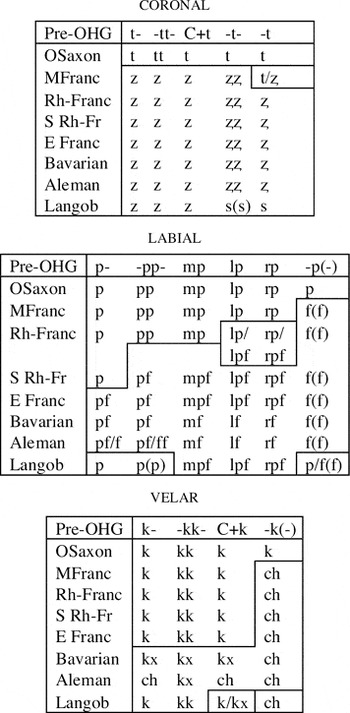
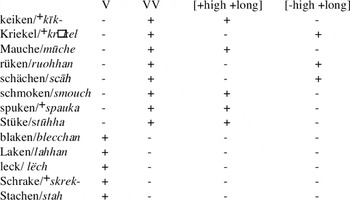
While the facts regarding the history of pre-Old High German t, p, k under conditions of the OHG consonant shift (Tenuesverschiebung) are well known, traditional accounts struggle to explain both the mechanisms of the shift as well as the asymmetry of its distribution (see table 1). The outcome of the shift can be sketched as follows: Pre-OHG t, p, k in word-initial position became the voiceless affricates ts, pf, kx (as in +tiohan, +plegan, +korn > OHG ziohan ‘to pull’—here the grapheme <z> presumably stands for /ts/—pflëgan ‘to tend’, chorn ‘grain’). Only the southern dialects of Old High German were affected by the shift of +k > kx, however, and the more northerly dialects also were generally exempt from the shift of +p > pf, particularly in word-initial position. The outcome of the shift after the sonorant consonants -l-, -r-, -m-, -n-, as well as in gemination, was generally the same as in word-initial position, at least in the Upper German dialects (pre-OHG +swart > OHG swarz ‘black’, +helpan > OHG hëlfan ‘to help’, +dorp > OHG dorpf ‘village’, +skalk > Old Upper German scalch ‘servant’, and +skeppian > OHG +sce(p)phen ‘to create’). However, after vowels the shift resulted in geminate fricatives rather than in affricates; for example, pre-OHG +opan > OHG offan ‘open’, +etan > ëzzan ‘to eat’, +makōn > mahhōn ‘to make’ (-hh- presumably indicated /xx/). Later, these geminate fricatives tended to reduce to single segments when the preceding vowel was long (slāffan > slāfan ‘to sleep’) (see Davis & Iverson Reference Davis and Iverson1995:111–112, also Sonderegger Reference Sonderegger2003:259–263).
Overview of the OHG Consonant Shift (after Sonderegger Reference Sonderegger2003:263).

The conventional monogenetic view of the shift holds that there was only a single shift event that spread geographically. Since the shift occurs in its most developed form in Old Alemannian, traditional scholarship postulates that the shift began there before gradually spreading both north (to the Franconian dialects) and south (to Langobardian) (Sonderegger Reference Sonderegger2003:267), losing some of its force and generality as it went.Footnote 1 The complete absence of the shift of word-initial pre-OHG k- (to kx-) in the Franconian dialects, and a corresponding lack of the shift of initial p- to pf- in South Rhine Franconian and dialects to the north, is often cited as an example of this gradual ebbing of the shift's force (Rhenish fan) as it traveled north from its epicenter.
The monogenetic theory, however, lacks both a motivation for the origin of the shift—beyond pointing to the general effects of the aspiration of +t, +p, +k—as well as a plausible explanation for its spread from Upper German to Franconian, a directionality that seems strange given the dominant position of the Franks at that time vis à vis the Bavarians and Alemannians.Footnote 2 In addition, the assumption that the shift was fueled by heavy aspiration of +t, +p, +k (Prokosch Reference Prokosch1917:16, Braune/Eggers 1987:84, Lerchner Reference Lerchner1971:32, and Zhirmunskii Reference Zhirmunskii1962:350ff) would predict the most extensive shift to occur in word-initial position, given that allophonic aspiration is generally strongest in that position. However, the shift advanced geographically further in word-internal position than elsewhere. This result—and the much more limited shift of initial +k- (> kx) in comparison to initial +t- (ts-) (despite the fact that both are more aspirated than p)—forces us to refine our notions of how aspiration influenced the shift (Davis, Iverson, & Salmons 1999:189). Questions regarding the relative ease of shift also pertain to long consonants (geminates), since the geminate +-tt- (> /ts/, often spelled <tz>) shifted over the entire OHG speech area, while the shift of the geminates +-pp- and +-kk- is geographically more limited, analogous to the shift of +p- and +k- in initial position.
1.2. Polygenetic Origin, External Influence, and Diastratic Variation
Clearly, the tidy scenario of a monogenetic origin of the shift is muddled by the existence of forms of an early age in the Rhineland that attest shifted +t, +p, +k in postvocalic position. Schützeichel (1964:22, 1976:337) found evidence of shifted forms of early vintage in Middle Franconian in various sources including the Maihinger Evangeliar (Echtner, late eight century), the Bible Glossary of Paris (ninth century), the Cologne Glosses (ninth century), and the Lex Ribuaria (circa 800 AD). The Lex Ribuaria manuscript attests staffulus, staf(f)ulum ‘stone steps (upon which the royal court holds forth)’ (German, ‘Steinaufbau des Königsgerichts’), and similar forms with shifted postvocalic +-p from Latin; compare Old English stapol, OHG staffal, staphal (Schützeichel Reference Schützeichel1976:370ff). The oldest glosses such as the Maihinger Evangeliar attest forms such as hase ‘hate’ and gan:os: ‘comrade’ (< +-t). Place names containing the suffix -affa (< -apa-) that pre-date 800 AD are well known (Schützeichel Reference Schützeichel1976:309), and the general shift of word-initial +t- in the Rhineland is recognized (Schützeichel Reference Schützeichel1964, 1968, Bruch Reference Bruch1953:129). Schützeichel's findings have been confirmed by others (for example, Bergmann Reference Bergmann1977:318), and most researchers now concur that a critical mass of evidence indicates that the shift was underway in the Rhineland at an early time (Schwerdt Reference Schwerdt2000:311). The shift of initial +t- is especially problematic to those who advocate an authochthonous shift in the Rhineland, however, because it is difficult to explain why an autochthonous Rhenish shift would resemble the Upper German shift with respect to the shift of initial +t (> ts-) but not with respect to the shift of initial +p and +k. For some, the solution is to posit the shift of +t in the Rhineland as an independent development via assibilation or one influenced by similar developments in Romance (Schützeichel Reference Schützeichel1976: 239–240), or a combination of both (Heinrichs Reference Heinrichs1967). Finally, Venema (Reference Venema1997) and Pitz (1999:392) specifically emphasize the chronological plausibility of a connection between the shift of +t in the Rhineland and the advent of the Romance assibilation in the sixth to the seventh centuries.
Another line of research emphasizes possible diastratric (sociolinguistic) influences on the shift in the Rhineland. Heinrichs (Reference Heinrichs1967), for example, reconciles the claim of an autochthonous Rhenish consonant shift with the parallel existence of shifted and unshifted forms by suggesting that the shift may have in fact been in place in the Franconian upper social strata during the Middle Ages, while unshifted forms were still in use by the lower social strata (unverschobene Grundschicht). This supposes that the speech of both groups was to some extent represented in the written documents of the time. (See Meineke & Schwerdt Reference Meineke and Schwerdt2001:224 for an opposing view.) Lerchner (Reference Lerchner1971) documented the large number of unshifted relic forms in the Rhineland and developed a now popular view that the OHG shift was adopted into the Rhineland and West Middle German areas from the south based on shifted forms introduced by the Franconian upper classes. According to this view, the shift took place via the process of sound substitution (Lautersatz), but the lower socioeconomic classes were more resistant to the adoption of these new sounds, which Venema (Reference Venema1997) contends would explain, in part, the many unshifted relic forms in the Rhineland. After examining relic forms in the Rhineland with unshifted +t, Venema (1997:462–465) concludes that the large number of instances of sound substitution that occurred from Upper German models must have brought about the extrapolation of a shift rule in the Franconian dialects that, again, varied according to social stratum. In Venema's model, shifted and unshifted forms could exist parallel at differing diastratic levels for long periods of time, and unshifted forms would sometimes eventually win out over their shifted counterparts, thereby (re)emerging as the dominant form in dialect use even at a comparatively late date.
Finally, Schwerdt (2000:346, 385–387) contends that the consonant shift in the Rhineland is not the same consonant shift that took place in the Old Upper German dialects, and that the two shifts did not result from a common trigger or via an analogous process, the similar outputs of both shifts being thus purely coincidental. As Schwerdt (p. 346) notes, this assumption is actually a retreat to a position once articulated as a theoretical possibility by Lerchner, but subsequently rejected by him. Lerchner (1971:193) wrote:
Gesetzt also den Fall, die Verschiebungserscheinungen des Mittel-fränkisch-Mitteldeutschen wären […] bodenständig, so läge auf Grund völlig anderer Systemverhältnisse ein Lautwandel vor, der mit der II. LV […] ganz und gar nichts gemein hätte als allenfalls eine phonetische Ähnlichkeit des geringeren Teils seiner Ergebnisse.
[In the event the shift in Middle Franconian-Middle German turns out to be autochthonous, the sound change involved would be due to entirely different internal causes that would have nothing in common with the 2nd sound shift other than the phonetic similarity of a subset of its outputs.]
As for a possible motivation for the shift, Lerchner leaves the general impression that the shift (at least in the Old Upper German dialects) might have been triggered by prosodic (stress) conditions, but no evidence is provided in support of this view.
2. Progression Theory: Assumptions, Claims, and Predictions
The theory presented here assumes the pre-OHG segments t, p, k had a distribution of allophones not unlike modern German, English, and most Low German dialects. That is, pre-OHG t, p, k would have occurred as [th, ph, kh] word-initially but with somewhat less aspiration [t, p, k] in consonant clusters and in medial and final position (Braune/Eggers 1987:84). According to this scenario, the unshifted (Low German) varieties with this allophonic distribution represent a retention of the original pre-OHG state of affairs, while Dutch and some Ripuarian dialects with unaspirated +t, +p, +k represent a more recent loss of aspiration (Iverson & Salmons Reference Iverson and Salmons2003).
This progression theory assumes that the shift began when Germanic stress triggered the shift (affrication) of +t, +p, +k after short vowels as a way of making these stressed syllables bimoraic (see section 3), a result that was achieved in other dialects by the process of open syllable lengthening (OSL). The nature of this change dictated that it occur in word-medial position, a phase that we call the “core shift.” The terms “to progress” and “progression” are used here to refer to the extension of the shift from this original environment to other positions. Gradually the shift progressed to postvocalic position after long vowels (pre-OHG +slāpan ‘sleep’ > +slāpfan) and in some dialects spread to post-consonantal position (pre-OHG +hërta, +dorp, +wërk > OHG hërza ‘heart’, dorpf ‘village’, wërcch/wërch ‘work’, see section 3.3), to the geminates, and, finally, to word-initial position.Footnote 3 I intend to show that the progression of the shift was at first motivated by paradigmatic analogy that later extended to a general rule whereby +t, +p, +k were replaced by +-ts-, +-pf-, +-kx- in postvocalic position even after long vowels (see section 4). This early stage of the shift is known as the intermediate affricate phase (Affrikatenstufe) and is part of the shift process reconstructed in traditional accounts (see, for example, Penzl Reference Penzl1975). The affricates of this phase were presumably disegmental. That is, they consisted of a single stop segment followed by a single homorganic continuant segment not unlike the affricates found in modern German dialects. When these affricates occurred in postvocalic position, however, they generally weakened to geminate fricatives (pre-OHG +etan > +etsan > OHG ezzan ‘to eat’). Before this weakening was complete, the pre-OHG geminate (long) stops -tt-, -pp-, -kk- shifted to trisegmental (long) affricates; +settian, +skeppian, +wekkian > +settsian−, +skeppfian-, +wekkxian > OHG sezzan ‘to set’, skep(p)fen ‘to create’, wecchen ‘to wake’ (Braune/Eggers 1987:87). At a later point, these trisegmental newcomers shortened and merged with the surviving affricates of the intermediate affricate phase that were preserved in postconsonantal position (+hërta, dorp, wërk > OHG hërza ‘heart’, dorpf ‘village’, wërcch/wërch ‘work’) and in postvocalic position in isolated relic forms, as discussed below.
In section 4.1, I argue that kraits-forms in the Rhineland (relic forms such as nɛtst ‘moisture’, ʃwe:ts ‘sweat’, ʃots ‘shot’, etc., named after the frequently occurring dialect word kraits ‘circle’) preserve the affricate +−ts of the intermediate affricate phase. As such, I claim they are analogous to relic forms in Southern Alemannian dialects (such as bits ‘(small) bit’, rits ‘tear’, sœipfe ‘soap’, ʃla:pfə ‘to sleep’, blɛikxə ‘to bleach’, and wæikxə ‘to yield’ (German weichen), discussed most recently by Goblirsch (2005:185), which appear to preserve the affricates of the intermediate affricate phase at all three places of articulation. My contention is that relic forms with postvocalic affricates at all three places of articulation could only be preserved in dialects where the shift progressed through to the labial and velar geminates (+-pp- > +-ppf- > −pf-; +-kk- > +-kkx- > -kx-). I argue further that relic forms attested in Langobardian and West Franconian (section 4.2) likewise preserve the intermediate affricate phase of the shift and attest the progression of the shift through the various stages reconstructed in section 3.
Relic forms in Rhenish varieties also suggest that the shift in those dialects could be delayed or blocked after [-high] long vowels, which had a long, falling tone accent (section 5). In the Rhineland, the blocking effects of the tone accents worked to limit the shift in comparison to the remaining dialects of Old High German. Place bias (section 6)—the tendency for the “lighter” coronal stop to undergo shift more extensively than the “heavier” labial and velar stops (see Davis, Iverson, & Salmons 1999; Iverson & Salmons Reference Iverson and Salmons2006:48)—caused an asymmetry in the shift generally and in the Rhenish dialects in particular. There, the shift failed to affect the labial and velar geminates (+-pp-, +-kk-) which, in turn, I contend, meant that the shift of initial +p- and +k- (> pf-, kx-) would not progress to word-initial position in Rhenish dialects.
I argue further that markedness reduction, or the weakening of the cross-linguistically more marked labial and velar affricates (section 7), interfaced with the blocking effects of the tone accents and place bias in the Rhenish dialects in the following way: the failure of the labial and velar geminates (+-pp-, +-kk-) to shift in the Rhineland meant that the labial and velar affricates (+-pf- and +-kx-) of the intermediate affricate phase in the Rhenish dialects were left isolated and were destined to weaken (undergo spirantization) while the affricate -ts- was able to survive intact in a small number of kraits-forms (relics). This is because in Rhenish varieties there were no new sources of labial and velar affricates in postvocalic position with which isolated relics that contained these affricates could merge and thus escape weakening. In Upper German varieties, by contrast, affricates at all three places of articulation survived because of the eventual influx of new instances of the postvocalic affricates -pf- and -kx- that arose via the shift of pre-OHG geminates -pp- and -kk-. The loss of the labial and velar affricates in Rhenish varieties and the survival of the coronal affricate -ts- in relic forms there are thus consistent with the expected pattern of markedness reduction whereby cross-linguistically more marked affricates are expected to weaken more readily than cross-linguistically less marked ones. This observation is commensurate with the attested reduction of the more marked affricates in relic forms and is consistent with Melikischwili's (1970:section 7.1) observation that languages with more marked (“peripheral”) affricates also have less marked (“medial”) affricates, but the reverse implication is not necessarily the case.
Finally, the progression theory explains the extension of the shift to word-initial position (section 8) in terms of a new model of sound change called “evolutionary phonology” that was pioneered by Blevins (Reference Blevins2004). Building on the analysis of Iverson & Salmons (2006:64–65), who attribute certain key developments in the core shift to examples of what Blevins calls change and chance, I argue in section 8 that the pro-gression of the shift to word-initial position is itself an example of yet another kind of change that Blevins has called choice. I claim that it was the progression of the shift to word-medial position (via the shift post-consonantally and in gemination) that created the necessary pre-conditions for affricated allophones of pre-OHG /t, p, k/ (that is, [th, ph, kh] > [ts, pf, kx]) to be “chosen” as the best exemplars or tokens of the initial voiceless stops, thereby resulting in a restructuring of the representation of these segments in the listener's grammar as affricates (+tiohan, +plegan, +korn > OHG ziohan ‘to pull’ pflègan ‘to tend’, chorn ‘grain’). However, place bias is evident here, too, favoring the progression of the coronal affricate to initial position in all dialects with the labial and velar affricates emerging in word-initial position only in some of the dialects.
The progression theory thus provides a unified framework within which the shift could unfold in all dialects of pre-Old High German in an autochthonous but largely parallel fashion. This theory stands in contrast to various other approaches (summarized in section 1.2) that view the shift in the Rhineland as an entirely different phenomenon than in the Upper German dialects (Schwerdt Reference Schwerdt2000). According to that view, the shift in the Rhineland was probably influenced by external factors such as the borrowing of an assibilation rule from Romance, which is thought to have triggered the shift of postvocalic and word-initial +t (Pitz Reference Pitz1999). And the shift of postvocalic +-p or +-k in Rhenish dialects is thought to have developed via a shift rule that was extrapolated based on loan borrowings from Upper German dialects, one possibly fueled by diastratic (sociolinguistic) factors (Venema Reference Venema1997). The claims implicit in these approaches are difficult to evaluate based on the available linguistic evidence, whereas the progression theory, by contrast, assumes a relative chronology of the shift that implies an asymmetrical distribution of unshifted relics. Specifically, we would expect to find more relic forms with an unshifted initial consonant than with unshifted consonants in other positions in a word, since we posit that the shift spread to word-initial position as a chronological last step. The progression theory's prediction that the cross-linguistically more marked affricates (pf, kx), once in existence, would tend to weaken more readily than would the cross-linguistically less marked affricate ts likewise lends itself to evaluation based on observable cases of markedness reduction. At the conclusion of this paper, I examine the extent to which the progression theory's predictions are borne out by the available data.
3. The “Core Shift” and Later Progressions
3.1. The Triggers: Stress, Bimoraicity, and Segment (Re-)Structuring.Footnote 4
The progression theory presented here maintains that the inherited system of stressing the root syllable of Germanic words steered monomoraic syllables in the pre-OHG dialects (indicated in our short-hand as (C)V) toward a preference for bimoraicity definied as either a long vowel ((C)VV) or as a short vowel followed by a tautosyllabic consonant ((C)VC). Syllable bimoraicity could thus be introduced in monomoraic syllables by invoking open syllable lengthening (OSL, (C)V) > (C)VV), as exemplified by pre-OHG +o.pan ‘open’ > +ō.pan where a dot (.) indicates a posited syllable boundary. While dialects in some regions would evolve in this way, the dialects that were to become Old High German selected an alternative form of syllable restructuring to achieve the needed bimoraicity in stressed syllables while simultaneously maintaining good syllable contacts. It was this syllable restructuring that set in motion the shift of +t, +p, +k after short vowels, which was, in turn, the trigger for the rest of the shift to follow. (Following Davis, Iverson, & Salmons (1999), I refer to this development as the core shift.) It is thus no coincidence that non-shifting dialects such as Low Franconian developed OSL early (Paul Reference Paul, Wiehl and Grosse1998:58), since the operation of OSL by definition bleeds the environment in which the shift would otherwise operate (that is, in stressed, monomoraic syllables). It is thus to be expected that the isogloss between dialects that developed OSL early and dialects that developed it late frequently corresponds to the boundary between shifting and non-shifting dialects, a correlation that has been noted along the Benrath line (Hasenclever Reference Hasenclever1905, Bubner Reference Bubner1935) without recognition of its significance.Footnote 5
3.2. Core Shift
Following Davis & Iverson (Reference Davis and Iverson1995), the primary motivation for the restructuring that triggered the shift resides in a familiar prosodic generalization known as the Syllable Weight Law (or Prokosch's Law, Prokosch Reference Prokosch1938:140)—itself an outgrowth of the Germanic stress placement on the root syllable of a word. Vennemann (1988a:30) expresses this as the syllable structure preference given in 1, noting that it often interacts crucially with the Head Law defined in 2, again following Vennemann (1988a:13f).
(1) Syllable Weight Law
In stress accent languages an accented syllable is the more preferred the closer its syllable weight is to two moras, and an unaccented syllable is the more preferred the closer its weight is to one mora.
(2) Head Law
A syllable is the more preferred: (a) the closer the number of speech sounds in the head is to one, (b) the greater the Consonantal Strength value of the onset, and (c) the more sharply the Consonantal Strength drops from the onset toward the Consonantal Strength of the following syllable nucleus.
A preferred stressed syllable is thus one whose weight is two moras, that is, which includes either a short vowel followed by a consonant (VC) or a long vowel followed by no consonant (VV). As we posit voiceless stops in pre-Old High German to have been aspirated, parallel to most Germanic languages today, we reconstruct the phonetics of pre-OHG +opan ‘open’ as [‘o.phan] (where a raised tick, ‘, indicates stress). That is, the initial stressed syllable would have contained a short vowel with no following consonant and the syllable head of the following syllable would have contained a voiceless, aspirated stop. Pursuing a suggestion first put forth by Braune (1874:1) (see also Braune/Eggers 1987:87), such configurations can be brought into conformity with syllable structure preferences via segmentalization of the allophonically aspirated stop ([ph]), that is, by converting it into a phonetically equivalent cluster of stop plus /h/ ([ph]). This interpretation of the phonetics would have been specifically favored, or triggered, by the prosodic considerations of syllable structure identified in 1 and 2 above. Coupled with the Head Law's preference for onsets containing precisely one consonant, the Syllable Weight Law's call for bimoraicity in stressed syllables then may be construed as the initial motivation for the range of obstruent changes that ultimately took place in Old High German, because the restructuring of words like [e.than], [o.phan], [ma.khōn] > [et.han], [op.han], [mak.hōn] accords bimoraic status to the stressed syllable while retaining a consonant onset in the head of the following syllable. Subsequently, the place of articulation features of the preceding stop spread forward into the /h/, strengthening it to a fricative ([et.han], [op.han], [mak.hōn] > [et.san], [op.fan], [mak.xōn]. This is because the oral closure duration of postvocalic stops tends to be shorter than when they are in word-initial position, and the coda stop is thus susceptible to weakening (> [eʒ.ʒan], [of.fan], [max.xōn]).
3.3. How the Core Shift “Progressed.”
The claim that the core OHG shift originated only in postvocalic position after short vowels finds support in an analysis of the dialect of Wermelskirchen known primarily from an early dissertation by Hasenclever (Reference Hasenclever1905) and a more recent dictionary of the dialect compiled by Joest (Reference Joest2003). An analysis of Joest's dictionary by Davis (Reference Davis2005) confirms Hasenclever's original description of a partial consonant shift in the dialect, in which pre-OHG t, p, k are shifted only after originally short vowels. Thus, modern Wermelskirchen dialect has shifted consonants after original short vowels as in äs  n ‘to eat’, Nos ‘nut’, Jus ‘spout’, Päf r ‘pepper’, Jref ‘grip’, h
 fn ‘to hope’, Lo
 fl ‘spoon’, Bäch ‘stream’, Seche l ‘sickle’, Joch ‘yoke’, Bruchschteen ‘quarry-stone’ versus unshifted consonants in forms with old long vowels such as heet ‘hot’, Schtr t ‘street’, Foot ‘foot’, jruut ‘great, big’, riip ‘ripe’, Sch p ‘sheep’, Hoope n ‘pile’, roope n ‘to call’; Diik ‘pond’, week ‘soft’, Hals-dook ‘scarf’, and ruuke n ‘to smell, reek’. The alternation between shifted and unshifted consonants is starkest among the strong verbs where vowel length sometimes alternates according to apophony as in riite n, res, je resn ‘tear, tore, torn’ and äse n t, je jäsn ‘eat, ate, eaten’. The age of the Wermelskirchen shift is apparent from forms that contain originally stressed long vowels that underwent shortening in the post-Middle High German period. Consonants that follow recently shortened vowels do not undergo the shift but instead retain +t, +p, +k (vit ‘white’, zupe n ‘to drink, booze’, ripe n ‘to ripen, mature’ kike n ‘to look’ < +viit, +riipe n, +zuupe n, +kiike n (Davis Reference Davis2005:266ff).Footnote 6
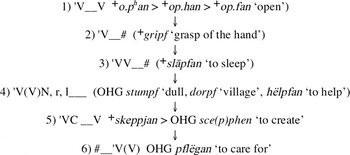
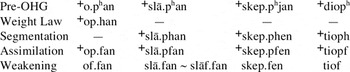
The present claim, therefore, is that the core shift originated in the above manner after short vowels in all dialects of Old High German and that Wermelskirchen merely retains much more than any other dialect the original state of affairs. Even in Wermelskirchen, the shift progressed somewhat beyond the core shift, however. I note that, in order to trigger the shift, the aspirated consonant [th, ph, kh] would have been in medial position so that the effects of the Head Law would be felt and thus trigger a reanalysis of the allophonic aspiration to a phonetically equivalent segment /h/ (as in ophan > op.han > op.fan > of.fan). In any case, word-final consonants would originally have remained unshifted—even in the paradigms of words with stressed short vowels.Footnote 7 Later, via paradigmatic analogy, the shifted consonants would have spread to word-final position after short vowels, as is preserved in Wermelskirchen forms such as res ‘torn’ (1st/3rd person preterite, riite n ‘to tear’) and Jus ‘spout, (German Guss)’ (< jiite n ‘to pour’). Thereafter, /ts ∼ t/, /pf ∼ p/, and /kx ∼ k/ would have continued to alternate in complementary distribution depending on the length of the preceding vowel. The tendency to level in favor of the affricates would have been particularly strong among the apophonically alternating strong verbs. Compare the affricate phase we reconstruct for pre-OHG +rītan ‘to tear’: +rit (1st sg. pret.) (> +rits, after extension of shift to final position), +ritsan (1st pl. pret.), +garitsan ‘torn’ (pret. adjective).Footnote 8 As the leveling process gradually also replaced more and more voiceless stops after short vowels with the corresponding affricate, the process of replacement may have extended to operate after [+high] long vowels as well, since [ī] and [ū] are phonetically somewhat shorter than [-high] long vowels (Lehiste Reference Lehiste1977:18–27, Laver Reference Laver1994:435, Davis Reference Davis2008). The replacement rule could have later generalized to apply after all long vowels and then extended to postconsonantal position and to the geminate stops. The progression of the shift to word-initial position came as a chronological last step in the shift process of each of the affected stops. Thus, the shift of +t, +p, and +k in initial position was contingent upon the earlier extension of the shift to the corresponding geminate, because the presence of a pre-existing affricate in word-medial position aided in the emergence of the same affricate in initial position (section 8).
Progression sequence of pre-OHG t, p, k (illustrated here only with the labial). Stress placement is indicated by a raised tick (‘).

4. Evidence of an Intermediate Affricate Phase
4.1. Kraits-forms in Rhenish Dialects
As noted above, traditional reconstructions assume that postvocalic pre-OHG t, p, k shifted to affricates during the intermediate affricate phase. A number of researchers, particularly Bruch (Reference Bruch1953), have cited forms from modern Rhenish dialects that evince the word-final affricate −ts, the so-called kraits-forms, such as kre:ts/kre:s ‘circle’, mɛts(ər) ‘knife’, nɛtst ‘moisture’, ʃots ‘shot’, ʃwe:ts ‘sweat’ (see Goblirsch Reference Goblirsch2005:192), as relics of the intermediate affricate phase in the OHG shift.Footnote 9 Analogous forms with -ts in postvocalic position are not rare and occur along the Benrath line (Schützeichel Reference Schützeichel1976:249–256) and even along the shift line in Thuringia (jätze ‘alley’, NHG Gasse), as noted by Liesenberg (1890:60). I contend that most kraits-forms arose in isolated incidences when the postvocalic affricate +-ts (< +-t) resisted weakening to -ʒʒ-, or when -ts was perhaps confused with sequences of -t + -s that occurred across morpheme boundaries in pre-Old High German (compare the adverbial form OHG hīnahts ‘of this night, tonight’; hīnaht ‘this night’). Winteler (1876:46) records a number of kraits-like forms in the Swiss German dialect of Kerenz including grüətsə ‘to greet’, etsə ‘to feed’, wats ‘zeal’, guts ‘spout’, ruts ‘outbreak of anger’, and others.Footnote 10 Furthermore, Kögel (1887:111–112) argued for the reconstruction for early Old High German of a paradigmatic alternation of the word-final alveolar affricate +-ts with its spirantized word-medial counterpart -ʒʒ-. Kögel claimed that this development left remnants in the form of doublets, such as OHG hiruz (with <z> spelling an affricate) and hiruʒ ‘stag’ (with <ʒ> spelling a fricative) that descended from the earlier paradigmatic alternation of hiruz with hiruʒʒes, comparable to the sort of mixed paradigms I recon-struct for an early stage of the shift in section 3. According to Kögel, forms with final labial or velar affricates were generally more prone to weakening than the coronal affricate.
4.2. Putative Evidence of an Intermediate Affricate Phase
Interestingly, an affricate stage in the progression of the shift was reconstructed for Langobardian by Bruckner (1895:146–147, 166) for both word-final postvocalic -p and -t. While acknowledging that post-vocalic -p in Langobardian generally shifted to -ff-, Bruckner maintained (pp. 146–147, note 2) that the variation in spelling of the extant examples of +-p in Langobardian (anagrip, anagriph, and anagrif ‘attack’) may indicate that the word-final -p in these forms was an unshifted stop or an affricate and not a fricative (Bruckner Reference Bruckner1895:146–147):
Immerhin steht so viel fest, dass auslautendes, einfaches p wenigstens anfänglich nicht wie inlautendes p hinter Vokalen behandelt wurde. Vielmehr scheint dasselbe, da ihm offenbar im Auslaut eine schärfere Aussprache zukam, entweder, wie geminiertes pp, gar nicht, oder doch nur bis zur Affricata verschoben worden zu sein. Im ersten Fall sind anagrip, Clep u.s.w. die lautgesetzlich richtigen Formen: anagrif, Cleph u.s.w. sind dann erst durch Angleichung an die flektierten Formen entstanden; im zweiten Falle können angrip und -grif, Clep und Cleph gleicherweise Versuche sein, die Affricata darzustellen.
[It is certain that final, singleton p at least originally was not treated like postvocalic medial p. More likely it was either not shifted at all like geminate pp or only shifted to an affricate because in final-position it obviously had a more fortis pronunciation. In the first instance, anagrip, Clep etc. are the forms to be expected according to phono-logical rule: anagrif, Cleph etc. developed later via analogy with the inflected forms; in the second case, anagrip and -grif, Clep and Cleph can all be attempts to represent affricates.]
Bruckner (1895:166, note 1) also made an analogous claim for unshifted -t in Langobardian:
Auch bei t, dessen Verschiebung doch am frühesten und voll-ständigsten durchgeführt worden ist, finden sich noch Spuren davon, dass der Auslaut ursprünglich nur zur Affricata verschoben wurde.
[Likewise in the case of t, whose shift was carried out earliest and most completely, there are still traces that it was originally shifted only to an affricate in final position.]
Supporting evidence for the postvocalic extension of the shift to post-long vowel position and beyond comes from the West Franconian dialect via the OHG Pariser Gespräche (PaG) manuscript. Although it is traditionally claimed that the unusual postvocalic consonant graphemes found in the Pariser Gespräche result purely from the use of Romance graphemic traditions (Schützeichel Reference Schützeichel1976:122), Gusmani (Reference Gusmani1996) contends that the Pariser Gespräche may have originated in an area where the western dialect of the Franks had not yet totally died out and where ties still existed to cloisters in the OHG speech territory.
Gusmani thus argues that the graphemic representations in the Pariser Gespräche manuscript attest the shift of postvocalic +t, +p, +k to affricates in West Franconian.Footnote 11 Thus, PaG <ze> ‘to’, <zeni> ‘teeth’, <cit> ‘time’ (OHG zi, zeni; zīt,) attest the graphemes <z> and <c> in word-initial position for the affricate /ts/. <z> also occurs in postvocalic position in PaG <quaz> ‘what’ (64), with its affricate pronunciation being confirmed by the parallel occurrence of the spellings PaG <quats> (104) for the same form. Further examples of postvocalic shifted +-t > -ts include forms with an original long vowel (the stage of the shift that I believe would have followed the stage attested in Langobardian), as in PaG <hutz> (40), <uthz> (46) ‘out’ (OHG ūʒ), PaG <atz> (97), <atst> (98), <ads> (103) ‘ate’ (OHG āʒ), and PaG <latz> (101) ‘let’, OHG lāʒ. The affricate -ts is even attested with the grapheme <z> in post-consonantal position in PaG <cherize> (58) ‘candle’ (OHG kerza/ cherza).
The occurrence of pre-OHG p is relatively rare in the Pariser Gespräche manuscript, and there appears to be not a single form attested that continues pre-OHG p- in initial position. Examples of postvocalic pre-OHG -p after long vowels occur, however, in PaG <sclaphen> (49) ‘to sleep’ and <ensclephen> (62, 63) (2nd pl. pret.) ‘slept’, (OHG slāfen). In the Pariser Gespräche, the pre-OHG clusters -rp and -lp appear to be in a state of flux. The labial stop appears to have already weakened to a fricative: PaG <durf> (102) ‘town’ (OHG dorpf, dorf ‘village’), PaG <elfe> (48) (3rd sg. pres. optative) ‘to help’, but the form <elpe> (13) (imperative) ‘to help’ without affricate is also attested. The shift of pre-OHG k > kx appears plausible in PaG <esprachen> (43) (pret. pl.) ‘to speak’ (OHG sprehhan), and in <roche> (47) ‘I care’ (OHG ruohhu ‘care, concern’). PaG <trenchen> (71) ‘to drink’ (OHG trinkan ‘to drink’) appears to attest the same velar affricate postconsonantally.Footnote 12 Examples of pre-OHG geminates are rare in the PaG manuscript but, to the extent they occur, they are written in a fashion identical to the putative postvocalic affricates: PaG <luzzil> (pre-OHG luttil ‘little’) and PaG <trophen> (48, 74) ‘drop’ (OHG tropfo).
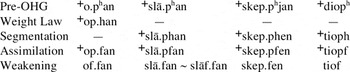
Although the spellings in the Pariser Gespräche must be approached with caution, it appears plausible that they attest the progression of the shift in West Franconian to the position after long vowels, to the position after sonorant consonants and perhaps even to the coronal and labial geminates, +-tt- and +-pp-. Table 3, slightly modified from Davis & Iverson Reference Davis and Iverson1995:119), provides an overview of the stages of the shift we reconstructed based on relic evidence.
Overview of the posited stages of the shift.
5. Tone Accent: A Blocking Effect Limited to Rhenish Varieties
5.1. Rhenish Unshifted +-t, +-p, +-k After Long Vowels
The progression of shifted consonants after long vowels is least con-sistent in the Rhineland. Lerchner (Reference Lerchner1971) lists scores of putatively unshifted Rhenish forms in all positions. The etymological background of many of the words listed is uncertain, however. Tables 4, 5, and 6, below, make use of only the etymologically most reliable forms from Lerchner's data, which were culled by selecting only those words that occur (according to Lerchner) throughout the entire Rhenish and West Middle German area and have a reliable Old High German or old Germanic etymology as confirmed by standard etymological sources.Footnote 13
Unshifted +-t- in Lerchner's data.

Unshifted +-p- in Lerchner's data.

Unshifted postvocalic +-k- in Lerchner's data.

Lerchner records 73 relic words with unshifted postvocalic +-t, of which only 9 are etymologically certain and occur throughout the Rhenish-West Middle German area.
Lerchner records 45 cases of relic words with postvocalic unshifted +-p. Of these, only four cases are etymologically certain and simultaneously occur throughout the entire Rhenish-West Middle German area.
Lerchner records 124 putative relic words with postvocalic unshifted +−k. Of these, however, only 13 are etymologically certain and occur throughout the entire Rhenish-West Middle German area.
In this etymologically reliable subset of Lerchner's data, the majority of cases of unshifted +t, +p, +k (19 out of 26 cases, approximately 70%) occur after originally long vowels (Davis Reference Davis2008).Footnote 14 This result supports the prediction made by the progression theory that there would be more relic forms with unshifted +t, +p, +k after long vowels, because the shift progressed to that environment only secondarily. The more tenacious retention of unshifted +t, +p, +k after long vowels in the Rhineland vis à vis the apparently seamless extension of the shift to that position in other OHG varieties requires explanation. In Davis Reference Davis2008, I suggested that the pretonemic (that is, not yet phonemicized) Rhenish tone accents—as reconstructed by Schmidt (2002:220)—played a role in delaying the phonological extension of the shift after [-high +long] vowels.
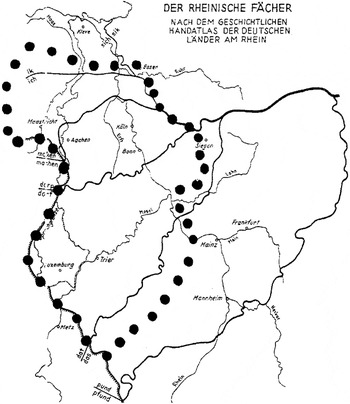
In early work, Frings (1916:22) described the geographic extent of the tone accent traditionally known as Schärfung as following a line from Saarhölzbach southwest of Trier to Vianden in Luxemburg, then to Birkenfeld in the south of the Rhine Province, on to the Netherlands-Limburg area, and then east to Wermelskirchen and Mühlheim-Ruhr, thus encompassing Rhine, Middle, and Low Franconian territory. This area thus includes unshifted dialects above the Benrath line and in the Netherlands. The rest of the tone accent area overlaps in large measure with the Rhenish fan, including Wermelskirchen, where the consonant shift is known to have developed in a more limited fashion than in other HG dialects.
Map of the Rhenish fan (Schützeichel Reference Schützeichel1976:184). The superimposed dotted line circles the approximate original area of the Rhenish tone accents according to Schmidt (2002:208).

5.2. Mixed Blocking Effects
In pre-Old High German, the tone accents were pretonemic or non-distinctive accents. Sometime after the Middle High German period, however, two accents, both of which occurred mostly in bimoraic syllables, were phonemicized in the more northerly Rhenish dialects. In modern parlance, these are referred to as TA (tone accent) 1, traditionally called Schärfung, and TA 2, traditionally known as as Zweigipfeligkeit. The pretonemic tone accents that Schmidt reconstructs for the OHG period do not correspond in tone contour to the phonemicized TA 1 and TA 2 accents that now operate in most modern Rhenish dialects, how-ever. Crucially, Schmidt finds good reasons to reconstruct pretonemic TA 1 as having been associated with [−high +long] vowels during the pretonemic stage, and he believes this accent to have had a long, falling tone contour.
Following Schmidt's reconstructions, Davis (Reference Davis2008) contends that pretonemic TA 1 with its long, falling tone contour would have emphasized the length of the (already long) vowels in question. A long, falling tone accent on a long vowel that preceded +-t, +-p, +- k might have delayed the extension of the shifted consonants in these forms and may thus account for the high number of unshifted relic forms in the Rhenish fan, particularly in the more northerly areas where the effects of the tone accents were apparently more robust.
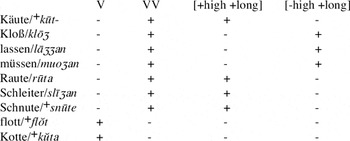
Tentative confirmation comes via Venema's (1997:275–301) study of a set of frequently occurring Rhenish words with unshifted +t, including the Rhenish forms corresponding to OHG grōʒ ‘large’, klōʒ ‘clod’, lāʒʒan ‘to allow, let’, and muoʒan ‘to have to, must’. These forms would have had an originally [-high +long] vowel with Schmidt's pretonemic TA 1 when they occurred in words that were under tone accent. However, as Frings noted early on, vowels that are capable of exhibiting the effects of tone accent do not do so at all times. Instead, only a word in a sentence that is emphasized (“hervorgehoben”) exhibits tone accent (Frings Reference Frings1916:13), as in Frings’ examples: dat øs diχ mār en  štī:f ‘that's a stiff/formal one’ (person), with tone accent on the em-phasized word štī:f, versus a sentence such as doə štēt en šot l štīv rīs ‘there's a bowl of stiff rice pudding’ where the emphasis is on rīs, not štīv .Footnote 15
The effects of sentence-level or phrase-level intonation on the occur-rence of the tone accents in some modern Dutch dialects have been studied recently by Gussenhoven & van der Vliet (1999) and Fournier et al. (Reference Fournier, Verhoeven, Swerts and Gussenhoven2006). In the Roermond dialect, for example, Fournier et al. (p. 32) showed that the contrast between TA 1 and TA 2 is neutralized in minimal pairs of words if the words occur in a nonfocused or syntactically nonfinal context.Footnote 16 To the extent that this system reflects earlier stages of the tone accent dialects, it seems reasonable to expect the effects of the tone accents on the shift of +t, +p, +k after [-high +long] vowels to be inconsistent, resulting in doublets and mixed paradigms that contain both shifted and unshifted consonants that would need to be sorted out by subsequent generations of language learners, leading to the mixture of forms now extant in the Rhenish Franconian dialects.Footnote 17 Thus, I contend, the less consistent consonant shift in the Rhenish fan was likely caused by the interplay of an autochthonous shift with the effects of tone accent, not the gradual weakening of a south to north geographic spread of the shift.
6. Place Bias
6.1. Place Bias and Post-Consonantal Shifts
As shown, evidence indicates that the shift progressed first to the position after long vowels, then to postconsonantal position (see table 2). This is supported by the status of the shift in the dialect of Wermelskirchen, which had neither a shift after long vowels nor one after consonants, and by the situation in the Middle Franconian dialects where shifted consonants occur after vowels (except in the relics noted above with unshifted +t, +p, +k after long vowel), but where the shift after sonorant consonants is limited largely to +-t. The relative chrono-logy of the shift after consonants is established by the fact that in South Rhine Franconian the shift of +-p occurs both in gemination and post-consonantally (OHG skep(p)fen ‘to create’, dorpf ‘village’), but in Rhine Franconian where there is an incipient shift of the clusters +-lp, +−rp > −lpf, -rpf, there is no shift of geminate +-pp- (see table 1 above). From the standpoint of the naturalness of the extension, it is obvious that the consonants -m, -n, -l, and -r are highly sonorous and thus rank close to vowels in sonority value, as in 3 (adapted from Vennemann Reference Vennemann1986:36).
(3) Sonority Hierarchy


In addition, a sequence of short vowel (V) + sonorant consonant (C) would count as bimoraic (VC) in the same way that a long vowel (VV) would. Thus, the progression of the shift from V + +-ts, -pf, -kx (pre-OHG rits ‘torn’ 1st/3rd sg. pret.) to VV + +-ts, +-pf, +-kx (pre-OHG slāpfan ‘to sleep’) created a template for shifted stops to occur in the sequence V + l, r, n, m + +-pf, +-ts, +-kx (OHG hërza ‘heart’, dorpf ‘village’, wërcch/wërch ‘work’). Important for the analysis presented here is that in the dialects of the Rhineland +-t shifts postconsonantally most extensively, while the postconsonantal shift of +-p is graduated with shifted -lpf and -rpf occurring only incipiently in Rhine Franconian, with a full postconsonantal shift of -Cp > -Cpf (including -mpf) occurring only on the cusp of the primary tone accent area in the southern part of the Rhenish fan.
6.2. Place Bias and the Distribution of Affricates
Near the Benrath isogloss we note both the greater incidence of unshifted +t, +p, +k after long vowels and especially the greater prevalence of unshifted +-k in that environment. As Schützeichel (1976:268) noted, individual lexemes containing +-k after long vowels sometimes have isoglosses that run far south of the Benrath line (such as reiken ‘to reach’ and s  ken ‘to seek’).Footnote 18 Hasenclever (1905:44) records that +-k is the only consonant in the dialect of Wermelskirchen that escapes shift on a sporadic basis after originally short vowels (māk n ‘to make, do’, dāk ‘roof’, ʃvāk ‘weak’), which begs the question whether -k is more resistant to shift in general, whether triggered by phonological rule or by analogical tendencies.
Evidence from many quarters suggests that place hierarchies operate in language. This is certainly the case for the position of articulation (PoA) hierarchies posited for many languages. Such hierarchies hold that dorsals (velars and uvulars) are more marked than are labials, which are, in turn, more marked than coronals (with glottals being still less marked than coronals, at least in some hierarchies that have been proposed) (De Lacy Reference De Lacy2006:34ff.). In a PoA hierarchy, a dominance relation would presumably operate that could be observed in synchronic alternations in the language. Thus, in Kelantan Malay, /k/, /p/, and /t/ all become [ ] in codas, establishing the greater markedness of non-glottals over glottals. As De Lacy (pp. 424, 42–43) notes, furthermore, /k/, /p/ appear as [t] in a Taiwanese secret language, showing the relation of dorsals and labials to coronals.
Assimilation in various languages also supports the dominance of velars over labials. Iverson & Kim (Reference Iverson and Kim1987) note this bias in the phonology of Korean where, under conditions of regressive place assimilation, coronals assimilate to labials and velars, and labials assimilate to velars; but velars do not assimilate to labials, and neither labials nor velars assimilate to coronals.Footnote 19 With reference again specifically to assimilatory sound change, Rice (Reference Rice1994) likewise observed that increased place structure content corresponds to resistance to such change. She concludes that velars are the most specified as to content and are simultaneously the most resistant to assimilatory change. Labials are somewhat less resistant to such change, and coronals are the least marked and simultaneously the least resistant to change. Rice accordingly posits a model of feature geometry that assigns both labials and velars the feature peripheral subordinate to place, while coronals are unspecified for all place nodes. Labials are marked just for peripheral, and velars contain peripheral along with the subordinate articulator dorsal.
Building on Rice's generalizations about the connection between place content and the resistance to assimilatory change, Davis, Iverson, & Salmons (1999:191) argued that the segments p and k have a “heavier” feature geometry or place content that resists a non-assimilatory change like the shift more robustly than does a coronal stop such as t. Under this assumption, then, t would tend to shift more readily than either p or k, thus providing a theoretical framework for the traditional assumption that the shift of +t in Old High German predates the shift of +p and +k (Sonderegger Reference Sonderegger2003:261–262).Footnote 20
Viewed another way, the present paper claims that the greater resistance to shift exhibited by the heavier segments +p and +k cor-responds to the synchronic dominance relations observed in PoA hierarchies in many languages. Following Davis, Iverson, & Salmons (1999), then, the present paper contends that the geographic extent of the shift of +t, +p, +k falls out in part from the place content of the segments involved. I also contend that analogous predictions of place bias hold for the same consonant segments when geminate so that place bias also favored the earlier shift of the coronal geminate, before the labial and the velar. I thus speculate that the shift of postconsonantal +-t progressed to geminate +-tt- even before the shift of postconsonantal +-Cp and +-Ck occurred and that geminate +-tt- shifted earlier and more completely than the corresponding labial or the velar geminates. In fact, the coronal was so susceptible to shift that geminate +-tt- in the Rhenish dialects appears to have begun to shift before the completion of the shift of +-p and +-k after long vowels (where tone accents delayed this progression, see section 5). This would explain how the shift of geminate +-tt- (settian ‘to set’ > +-tts-) could occur, while the shift of geminate +-pp- (skeppian ‘to create’) > +-ppf- and +-kk- (wecckan ‘to wake’) > +-kkx-) never developed in the Rhineland, thereby producing a particularly asym-metrical shift of the geminate affricates in the Rhenish dialects.
7. The Typology of Affricates and Markedness Reduction
7.1. Cross-Linguistic Markedness
As noted in the previous section, heavier place content correlates with greater resistance to the shift, predicting—as a general proposition—that p and k will shift later and less robustly than t. However, place bias predicts nothing about the diachronic viability of the affricates ts, pf, and kx after they emerge. The greater susceptibility of +-t- to shift compared to its labial and velar counterparts appears to correlate to the statistical frequency of the affricate ts across languages. In a study of a repre-sentative sample of the world's languages, Maddieson (1984:38) showed that /tʃ/ and /ts/ (palato-alveolar and dental/alveolar sibilants) are the affricates that occur most widely. In fact, /tʃ/ or /ts/ (or their aspirated counterparts /tʃ / and /ts/) occur in an overwhelming 311 of the 317 languages in Maddieson's database of languages. Maddieson also notes (p. 39):
Affricates at other places of articulation [that is, positions other than palato-alveolar and dental/alveolar, GWD] are relatively rare. It is clear that the great majority of affricates are sibilants, and affrication rarely occurs without assibilation. Of the grand total of 544 affricate segments considered here [in his database], 485 are sibilants, that is, 92.9%.Footnote 21
The rarity of the affricates /pf/ and /kx/ in his database is pronounced. Besides Standard German, Maddieson (Reference Maddieson1984) records only Beembe and Teke as having the affricate /pf/ or /pf/.Footnote 22 Tavgy, Chipewyan, Nama, Tlingit, and Zulu are recorded with the velar affricate /k / or /k/, and Maddieson lists only three languages with postvelar affricates: Wolof /qχ/, Nez Percé /qχ/, and Cabardinian (see Luschützky Reference Luschützky1992:154.) Furthermore, as Luschützky (p. 161) shows in a further analysis of Maddieson's data, languages in his database that have either a labiodental or velar (including postvelar) affricate also have an affricate that falls somewhere within the dental to postalveolar range. This distri-bution lends support to Melikischwili's claim (1970:71), based on an analysis of a number of Caucasian languages, of an implicational hier-archy among affricates whereby languages with a “peripheral” affricate must also have a “medial” one but not necessarily the reverse (with “peripheral” corresponding to both labial and velar and “medial” corresponding to the alveolar and alveopalatal range). Thus, place bias favored the shift of +t > ts (more than the shift of the labial and the velar stops) and the cross-linguistic frequency of the alveolar affricate, coupled with the implicational hierarchy suggested by Melikischwili, predicted its survival in all varieties of Old High German.
Relevant to the present discussion is the position in which affricates occur. Unfortunately, Maddieson (Reference Maddieson1984) and Luschützky (1992:161) fail to reference this information for the affricates pf and kx in the languages they analyze. Lavoie's (2001:23, 45–46) study of consonant strength, however, based on data presented in the scholarly literature on some 147 languages, records this information for each language in her database that exhibits velar or labial affricates. In most cases (in Burushaski, Island Carib, Turkana, and Maori), the velar and labial affricates in question occur only in initial position (word-initial or syllable-initial). Of these languages, only Maori has an entire series of affricates at the coronal, labial, and velar places of articulation, although these affricates appear to be allophones of aspirated /t, p, k/ (Bauer Reference Bauer1993:530). Most of the other systems have only non-velar affricates.Footnote 23 Interestingly, Lavoie ponders whether affrication is best considered a form of consonant strengthening or weakening (pp. 45–46). She notes that if affrication represents the addition of phonological specification or structure, such addition of structure can indicate greater consonantal strength. However, she adds that in historical change affricates often “represent a step on the way from stop to fricative so in that sense it [affrication] could be [considered a form of consonant] weakening.” Since the examples of affrication she cites from her database occur primarily in initial position, she decides to take them to be instances of consonantal strengthening. The present paper interprets these findings to mean that aspirated stops can sometimes give rise to affricates, especially in initial position, and that affricates in the palato-alveolar and dental/alevolar range are the cross-linguistically most common type of affricates to arise in this fashion, with labiodental and velar affricates lagging far behind. An affricate in postvocalic position might be expected to weaken more readily than the same affricate in initial- or postconsonantal position given the shorter closure duration of postvocalic stops in general (Ohala Reference Ohala, Kingston and Beckman1990:438), but the pattern of weakening would be the same in either case.
As claimed above, cases in which aspirated (initial) stops are reanalyzed as affricates may result when affricated allophones of highly aspirated initial voiceless stops are perceived by speakers as the best exemplars of these segments. This is even more likely to occur, I would claim, if the affricate in question happens to already exist in word-internal position in the language because speakers could easily identify the affricated allophone of the initial consonant with the preexisting affricate (see section 8).
7.2. Markedness Reduction and the Trisegmental Affricates
Lavoie's observation that affricates often weaken to fricatives raises the question of why affrication of the pre-OHG postvocalic singletons +-t, +-p, +-k (that is, the intermediate affricate phase) usually resulted in weakening (except in isolated relic forms), while the affricates that arose from the geminate consonants remained mostly intact into the modern dialects. Furthermore, we must address the question of why the OHG shift occurred more widely in medial rather than word-initial position (readily visible in South Rhine Franconian which has the shift of geminate +-pp- (> +-ppf- > -pf-) but no shift of word-initial +p-). This point is of interest since most of the languages in Lavoie's database exhibited the affrication of voiceless stops in initial rather than in medial position.
The weakening of the postvocalic affricates of the intermediate affricate phase fits well into the framework of cross-linguistic marked-ness sketched in section 7.1, because the general paucity of labial and velar affricates among the languages catalogued by Maddieson suggests that such affricates—once they emerge—may be more susceptible to weakening than the cross-linguistically less marked ones. Within the context of the OHG shift of +t, +p, +k, this predicts that once the affricates pf and kx emerged they would be more susceptible to markedness reduction than would ts, because the weakening (spirantization) of the affricates +-pf- and +-kx- > -ff- and -xx- amounts to a reduction of markedness in the phonological system in line with the prediction that the more marked affricates will be lost first and the less marked -ts- will be lost least (or not at all). As noted above, this outcome is also reflected in the wider survival in the dialects of the affricate -ts- from the intermediate affricate phase.Footnote 24 But the development of word-internal long affricates from +-tt-, +-pp-, +-kk- in the OHG shift differed from the earlier affrication of the singletons +t, +p, +k cited above, because the geminates were long (disegmental) consonants (see table 3 above) that had developed via WGmc. consonant gemination (Denton Reference Denton1998). The long consonants in this environment gave rise to the corre-sponding long (trisegmental) affricates +-tts-, +-ppf-, +-kkx-. In Lavoie's terms, the affrication of the geminate consonant added phonological structure (making it trisegmental), and it is this heavier structure that presumably allowed them to survive as affricates in postvocalic position by weakening only to disegmental affricates (-ts-, −pf-, -kx-) rather than to fricatives.
The assumption that forms in the Rhenish dialects such as kraits ‘circle’ are indeed frozen relics of the intermediate affricate phase of +-t begs the question of why we fail to find analogous relic forms with +-pf and +-kx in modern Rhenish dialects that go back to the postvocalic singletons +-p and +-k. The answer is, I would contend, linked to the general place bias (section 6) evident in the shift's progression and to the greater susceptibility of the affricates pf and kx to reduction. Thus, relics of the affricate phase of +-p (> +-pf) and +-k (> +-kx) are lacking in Rhenish varieties because the geminate stops +-pp- and +-kk- failed to shift to long (trisegmental) affricates there. In Rhenish dialects, then, there were no long affricates (+-ppf-, +-kkx) to shorten to disegmental ones (+-pp-, +-kk- > +-ppf-, +-kkx- > -pf-, -kx-) with which any postvocalic labial and velar relics of the intermediate affricate phase could merge and thus survive.Footnote 25 Deprived of the opportunity to gravitate into the orbit of the new affricates, any isolated relics of +-pf- and +-kx- from the intermediate affricate phase would have likely succumbed to the general tendency to weaken to -ff- and -ʒʒ- without leaving any frozen relic forms behind that contain these affricates in postvocalic position. Thus, isolated relic forms with the postvocalic affricate -ts- (that failed to weaken to the fricative -ʒʒ-) can exist in all OHG dialects because geminate +-tt- underwent shift (+-tt- > +-tts- > -ts-) in all dialects but the affricates +-pf- or +-kx- could only be preserved in those dialects where the velar and labial geminate affricates also shifted (as in a number of forms in South Alemannian varieties cited by Goblirsch (1997:273, 2005:185). Examples include ʃots ‘shot’, gryətsə ‘to greet’, flø:tsə ‘to float’, flo:ts ‘raft’, bœitsə ‘to bite’, byətsə ‘to atone’, ʃmŒtsə ‘to throw’, ʃwɛitsə ‘to weld’ gots ‘spout’, b  ts ‘(small) bit’, r ts ‘rip’; sœipfe ‘soap’, ʃlœ pfə ‘to grind’, hɛpfe ‘yeast’, ʃla:pfə ‘to sleep’, ʃtɛipfə ‘line’, ʃtrapfœl ‘step (German Staffel)’, riepfu ‘to call’, ripf ‘call’, xaupfe ‘to buy’, reipfu ‘to mature, ripen’; blɛikxə ‘to bleach’, and wæ kxə ‘to yield (German weichen)’.Footnote 26
To summarize, in the Rhineland, place bias and tone accents delayed the shift of +-p and +-k after long vowels and blocked the shift of geminate +-pp- and +-kk- entirely. Only the relics with -ts- survived into modern Rhenish dialects, while the remaining OHG dialects underwent a more general shift. The same pattern of weakening that reduced the postvocalic affricates of the intermediate affricate phase to fricatives (−ʒʒ-, -ff-, -xx-) is likewise observable at later stages in the dialects outside the Rhineland. Weakening occurs in the case of the initial affri-cate kx- > x- in southern Alemannian as in xalt ‘cold’, xįnd ‘child’, xraŋkx ‘sick’, etc. (Zhirmunskii Reference Zhirmunskii1962:297), as does weakening of initial pf- > f- in East Middle German varieties (fund ‘pound’, fennig ‘penny’, flaumə ‘plum’, fęf r ‘pepper’) and in sporadic weakening in Swabian (flõm ∼ pflõm ‘plum’) (see table 1 above and Kauffmann Reference Kauffmann1890:220–225 and Zhirmunskii Reference Zhirmunskii1962:273). By contrast, the weakening of the affricate ts- > s- in the German dialects is limited (Zhirmunskii, p. 293).
8. The Progression of the Shift to Word-Initial Position
The progression theory predicts that the shift extended to word-initial position after—and only after—word-medial affricates had arisen through the shift of the geminate stops. Thus, the extent of the spread of the affricates -ts-, -pf-, -kx- to word-initial position was linked to their prior existence in medial position in a given dialect. Place bias had favored the geminate coronal (+-tt-) to shift word-medially in all OHG dialects, while the affricate -pf- obtained only in a subset of these dialects, and -kx- arose in a still smaller subset of those that also had -pf-. Accordingly, only dialects with the medial affricate -pf- could develop it word-initially, and only the smaller number of dialects that had the medial affricate -kx- would likewise be in a position to extend this affricate to initial position.
The allophonic aspiration of the voiceless stops /t, p, k/ would have produced variation in the output of these stops, presumably rendering allophones such as aspirated [th, ph,, kh] in slow and careful speech (Blevins’ “hyperarticulation”) and slightly affricated ones [ts, pf, kx] in fast or casual speech (Blevins’ “hypoarticulation”), as presumably is the case, too, in other languages that have developed affricates from these stops.Footnote 27 Blevins’ model explains synchronic phonological structuring as the direct result of natural sound change rather than due to the interaction of variably ranked markedness constraints, as in optimality theory, or to the primary operation of quasi-innate phonological rules, as in derivational theory. Rather, patterns are discerned based on the learner's ambient input. Extant sound patterns thus emerge in the dynamic of sound change, which itself is often grounded in misperception, ambiguity, and variation. Within Blevins’ model, three perceptual mechanisms of sound change are posited: change, chance, and choice. For Blevins, misperception gives rise to change, when listeners misperceive what a speaker actually says, as illustrated by the production of [anpa], with alveolar nasal, being misheard as [ampa], with bilabial nasal, due to the “intrinsic weakness of place cues for the nasal in contrast to those of the following pre-vocalic stop” (Blevins Reference Blevins2004:33). Chance occurs when “the phonetic signal is accurately perceived by the listener, but is intrinsically phonologically ambiguous, and the listener associates a phonological form with the utterance which differs from the phonological form in the speaker's grammar” (Blevins, p. 32). Finally, choice arises out of the variation in speech output between “hypo-articulation” (fast or casual speech) and “hyperarticulation” (slow or careful speech). Within this band of variation, different phonetic manifestations of the same phonological structure occur. In such cases, listeners can form a phonemic representation of an utterance that deviates substantially from the phonemic representation of the speaker. This allophonic distribution and the pre-existence of /ts/, /pf/, or /kx/ in medial position would allow the type of change to occur that Blevins’ refers to as “choice.” That is, listeners perceive accurately the multiple phonetic signals that represent the variations of a single, phonological form (such as [ph pf p] as variants of /p/ in initial position) whereby the listener (a) acquires a prototype or best exemplar of a phonetic category which differs from that of the speaker; and/or (b) associates a phonological form with the set of variants that differs from the phonological form in the speaker's grammar (Blevins Reference Blevins2004:33). The reanalysis of affricated allophones [ts, pf, kx] as the best exemplars of the aspirated stops /t, p, k/ when in initial position was presumably comparable to cases such as the emergence of [pf] in Beembe (Jacquot Reference Jacquot1962) or [kx] in Hottentot.Footnote 28 A similar case of an aspirated [ph-] being reanalyzed as an affricate even occurred in modern Bavarian dialects in a few forms such as pfiat (< +phüet) ‘keep (well)’, parallel to NHG (Gott) behüte dich ‘(may God) protect you’ and Pfalter ‘fish pond’ (a common onomastic form parallel to NHG Behälter ‘container’). In these forms, initial /b-/ was devoiced to /p-/ under terms of the later Medienverschiebung and, once allo-phonically aspirated as [ph], was apparently reanalyzed as initial pf- (Schwarz Reference Schwarz1950:57). The reanalysis of the affricated allophones [ts, pf, kx] as belonging to the existing medial affricates /ts, pf, kx/ in Old High German was further favored by the fact that the remaining allophones of /t, p, k/ occurred only in weakly aspirated form in the clusters tr-, -ht, -ft, st-, sp-, sk-.
My claim that the allophones [th, ph,, kh] in initial position ultimately yielded the affricates /ts, pf, kx/ is thus similar to traditional accounts of the shift that posit the same change due to heavy aspiration (Braune/ Eggers 1987:84–85), but without benefit of the realization that the shift in initial position took place chronologically later and as a consequence of the prior shift in other positions. The case of South Rhine Franconian may be illustrative of how the two approaches differ. The traditional monogenetic school of thought predicts that the lack of shift of initial +p- in that dialect must be due to the gradual ebbing of the phonological shift rule as it spread north. The progression theory holds by contrast that East Franconian “chose” the affricate pf- in initial position, while South Rhine Franconian did not. East Franconian's “choice” of initial pf- could simply be a coincidence, but we note that East Franconian abuts Upper German territory, which has a full shift of all three consonants. Evidence also suggests that there was a significant population mixture of Upper German and Franconian speakers in East Franconian linguistic territory with Alemannian speakers perhaps even in the majority (Mitzka Reference Mitzka1951, 1951–1952). We must therefore acknowledge the possibility of some Upper German influence on neighboring dialects that may have worked hand in glove with “choice” to trigger the shift of word-initial +p- > pf- in East Franconian or the incipient shift of post-consonantal +-k > -kx in Langobarian (Lang. -uuerc ‘work’ versus march ‘march, border country (German Mark)), changes that otherwise might have hung in the balance. This limited geographic “spread” of the shift likely occurred through population mixture or direct speaker contact as in the case of East Franconian where the Franks conquered and settled territories already partially populated by speakers of Upper German varieties.
9. Summary and Conclusions
I conclude that the original shift of +t, +p, +k after short vowels was triggered independently in the pre-OHG dialects by the need to make all stressed syllables bimoraic (Syllable Weight Law), a need that non-shifting dialects met in alternative fashion by open syllable lengthening. Since stress conditions (inherited from earlier Germanic) were com-parable in the pre-OHG dialects, the shift was able to arise in each of them autochthonously and to progress in roughly the same sequence. The shift progressed first in medial position, initially driven by paradigmatic analogy, and later by a more generalized extension of a rule to replace the affected stops with the corresponding affricates, yielding a post-vocalic affricate phase (+t, +p, +k > +-ts, +-pf, +-kx) attested in Old High German and by relic affricates in some modern dialects. While the postvocalic shift in Upper German dialects could progress largely unimpeded, the effects of tone accents, coupled with the interplay of place bias, caused the postvocalic shift of +-p and +-k after long vowels in certain Rhenish dialects to be delayed and sometimes blocked, resulting in an aymmetry of the labial and velar segments +-p and +-k and +-pp and +-kk throughout the dialects (place bias) and a corre-sponding asymmetry in the distribution of relic forms. However, the shift of the coronals +-t and geminate +-tt- in the Rhenish dialects progressed apace. The shift of geminate +-tt- (> +-tts-) paved the way for +t- to shift to ts- later in initial position in all dialects of Old High German when speakers “chose” the affricate-like allophone [ts] as the best exemplar of initial /t-/. This reanalysis was primed by the preexistence of the affricate -ts- (< +-tt-) in medial position and was further favored wherever +t- was followed by a front vowel where it would have had a more turbulent, affricate-like articulation (Iverson & Salmons Reference Iverson and Salmons2006:64).Footnote 29
The same sort of extension of the labial and velar affricate to word-initial position was more problematic. The postvocalic affricates +-pf- and +-kx- that arose from pre-OHG +-p and +-k during the intermediate affricate phase were slower to establish themselves in the Rhenish dialects due to the blocking effects of the tone accents after [-high] long vowels. The delay in their development in postvocalic position caused many unshifted relics (section 5) and precluded the progression of the shift to the geminate labials and velars in dialects with tone accents. In this way, optimal preconditions for the “choice” of the labial and velar affricates in initial position obtained only in the non-tone accent dialects of Old High German with their full shift of -pf and -kx word-medially. Of the three affricates in question (ts, pf, kx), the coronal is the one most likely to extend to word-initial position and the most likely affricate to survive in that position given its cross-linguistically unmarked status. The possible existence of strong word-initial aspiration of voiceless stops in Upper German—as suggested by sporadic instances of late affrication in Bavarian pfiat and in a few other forms cited above—could have further favored the progression of the shift to word-initial possition in those dialects.
Key predictions made by the progression theory thus appear to be confirmed by data gleaned from unshifted relic forms. Specifically, the progression theory holds that the shift extended to stops after long vowels only secondarily and therefore predicts that more unshifted relic stops would be found in that environment. Given the effects of place bias, the progression theory further predicts that the affricate +t (> ts) would shift at least as widely, or more widely, than +p (> pf), and +p, in turn, should shift at least as widely, or more widely, than +k (> kx) in the OHG dialects—an asymmetrical distribution long recognized as a hall-mark of the shift. This implies that there could be fewer cases of unshifted postvocalic +-t than unshifted postvocalic +-p or +-k in relic forms due to the earlier and more complete shift predicted for +t. The progression theory predicts likewise that the shift of +t- will be less consistent in word-initial position than in other positions (since the word-initial shift is the final step in the shift's progression), and predicts that there would be (relatively) more unshifted geminate +-tt's than instances of unshifted postvocalic -t given the sequence of the shift I posit here.
Data presented in section 5 confirm that unshifted consonants in the Rhineland occur more frequently after long vowels. Data on the relative frequency of unshifted postvocalic -t's , -p's and -k's show only that unshifted velars outnumber unshifted coronals.Footnote 30 Support for the pre-dicted asymmetry of the shift according to its position in a word comes from Venema's (1997) study of unshifted +t- in the Rhineland. Venema records the largest number of words with unshifted +t- in word initial position (30), followed by post-consonantal unshifted +-t's (6), then unshifted +-t in postvocalic position (5), and finally by unshifted geminate +-tt- (3). The predominance of unshifted +t- in initial position in the data is clear. The smaller number of unshifted geminate +-tt- (as compared to unshifted +-t in postvocalic position) may well be the result of the lower relative frequency of geminate +-tt- in the lexicon in com-parison to postconsonantal +-t.Footnote 31 Predictions made by the progression theory thus appear to be by and large consistent with an analysis of the available relic forms.
The progression theory identifies major tendencies that allowed an autochthonous shift to develop along parallel lines in all OHG dialects (syllable restructuring, tone accent, place bias, markedness reduction, and “choice”) and identifies other factors that may have played a secondary role in the shift's progression (such as the spread of some shift features from Upper German to East Franconian and the possible supporting influence of the assibilation of +t before front vowels for the spread of shifted +t). The progression theory suggests that it is un-necessary to posit an overarching south-to-north geographic spread of the shift, which lacks credibility given the politically dominant role the Franks played during the historical period in question.
 s < ʃot ‘s/he shot’), as noted by Hasenclever (1905:42).
 tər, jr