INTRODUCTION
Raccoons (Procyon lotor) are small to medium sized carnivores that are endemic in most of North America, Central America, and feral populations exist in Japan and Russia (Long, Reference Long2003). They are highly adaptable and thrive in urban and suburban environments. Raccoons are known to be reservoirs for several zoonotic pathogens including rabies virus, Baylisascaris procyonis, and Ehrlichia spp. A Babesia microti-like parasite has recently been identified in raccoons in North America and Japan (Goethert and Telford, Reference Goethert and Telford2003; Kawabuchi et al. Reference Kawabuchi, Tsuji, Sado, Matoba, Asakawa and Ishihara2005).
Piroplasma were first reported in raccoons in 1926 (Wenyon and Scott, Reference Wenyon and Scott1926) and have since been found as common haemoparasites of North American raccoons (Procyon lotor) (Anderson et al. Reference Anderson, Magnarelli and Sulzer1981; Telford and Forrester, Reference Telford and Forrester1991; Frerichs and Holbrook, Reference Frerichs and Holbrook1970). The nomenclature used to describe the piroplasms identified in North American raccoons has been confusing due to similarities with the names proposed for other Babesia species. A large piroplasm (>3 μm) identified in a Eurasian raccoon dog (Nyctereutes procyonoides) was named Babesia procyoni. Likewise, early reports describing a small piroplasm (<3 μm) of North American raccoons referred to this parasite as B. procyoni and B. procyonis (Anderson et al. Reference Anderson, Magnarelli, Donner, Spielman and Piesman1979; Frerichs and Holbrook, Reference Frerichs and Holbrook1970; Ristic et al. Reference Ristic, Lewis, Kreier and Kreier1977). In 1981, Anderson and coworkers differentiated the piroplasms of North American raccoons from the piroplasms of the Eurasian raccoon dogs and proposed that the name Babesia lotori should be used for the small piroplasms of North American raccoons and that the large piroplasms of the Eurasian raccoon dogs retain the name Babesia procyonis. Further adding to the confusion, several molecular studies have presented 18S ribosomal ribonucleic acid (rRNA) gene sequences obtained from small piroplasms infecting raccoons in North America and Japan (Goethert and Telford, Reference Goethert and Telford2003; Kawabuchi et al. Reference Kawabuchi, Tsuji, Sado, Matoba, Asakawa and Ishihara2005), and found the sequences to be similar to B. microti, the most common agent of human babesiosis. We recently described a small piroplasm in a raccoon from North America that belonged to the Babesia sensu stricto clade based on 18S rRNA gene sequencing (Birkenheuer et al. Reference Birkenheuer, Whittington, Neel, Large, Barger, Levy and Breitschwerdt2006). However, this report was limited to a single raccoon from the mid-western region of the United States (USA) (Birkenheuer et al. Reference Birkenheuer, Whittington, Neel, Large, Barger, Levy and Breitschwerdt2006) and the B. microti-like organism has been characterized at the molecular level from just 3 raccoons, 1 from the northeastern USA and 2 from Japan (Goethert and Telford, Reference Goethert and Telford2003; Kawabuchi et al. Reference Kawabuchi, Tsuji, Sado, Matoba, Asakawa and Ishihara2005).
Microscopy studies have shown that the piroplasmosis is prevalent in some raccoon populations in the United States and reaches as high as 96% (Frerichs and Holbrook, Reference Frerichs and Holbrook1970; Telford and Forrester, Reference Telford and Forrester1991). The purpose of this study was to perform a molecular survey of raccoons from eastern North Carolina and determine the prevalence of the two genotypes of piroplasma infecting raccoons in this study population.
MATERIALS AND METHODS
Source of samples
Blood was collected post-mortem via cardiac puncture from 41 wild raccoons that were trapped by licensed hunters in eastern North Carolina during the 2004–2006 trapping seasons. The raccoons were trapped in the following North Carolina counties: Hyde (n=25), Pender (n=3), Sampson (n=8) and Tyrrell (n=5). The carcasses were stored at −20°C until the samples were obtained, then the blood was stored at −80°C until the deoxyribonucleic acid (DNA) was extracted.
Nucleic acid isolation, polymerase chain reaction assays and DNA sequencing
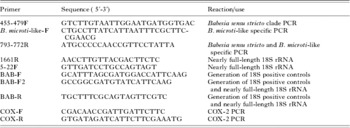
Total DNA was extracted from approximately 100 μg of clotted heart blood using a commercially available kit (QIAamp DNA Blood Mini Kit, Qiagen Inc, Valencia, CA). Each sample was tested by at least 2 independent PCR assays. The oligonucleotide primers used in this study are listed in Table 1. The first assay used primers (455-479F and 793-772R) designed to amplify across the V4 region of the 18S ribosomal ribonucleic acid (rRNA) gene from most organisms in the Babesia sensu stricto clade and was performed as described previously without modifications (Birkenheuer et al. Reference Birkenheuer, Levy and Breitschwerdt2003). Based on published sequences, the Babesia sensu stricto PCR assay was predicted to produce a 341 base pair amplicon from the raccoon Babesia sensu stricto sp. Since the sequence of the B. microti-like organisms from raccoons shared 100% sequence identity in the primer-binding regions with B. conradae (Kjemtrup et al. Reference Kjemtrup, Wainwright, Miller, Penzhorn and Carreno2006) and another B. microti-like piroplasm from dogs in northwest Spain (Zahler et al. Reference Zahler, Rinder, Schein and Gothe2000), it was predicted that the assay might produce a 371 base pair amplicon when this target was present in high concentrations despite a 4 base pair mismatch on the 3′ end of one of the primers (Birkenheuer et al. Reference Birkenheuer, Levy and Breitschwerdt2003).
Oligonucleotide primers used in this study

The second assay was designed for the purpose of this study and used primers (B. microti-like F and 793-772R) to amplify a fragment of the V4 region of the 18S rRNA gene from the B. microti-like organism from carnivores including those from raccoons from Japan and North America and to exclude amplification of the Babesia sensu stricto species of raccoons and were predicted to produce a 229 base pair amplicon from the B. microti-like sp. of raccoons. Reactions were carried out using a 50 μl total reaction volume and each reaction contained a 1X concentration of PCR Buffer II (Applied Biosystems, Foster City, CA), 1·25 U of Taq polymerase, 5 μl of DNA template, 1·5 mm MgCl2, 25 pmol of each primer, and 200 μm of each dNTP. The optimized thermal cycling conditions consisted of an initial denaturation at 95°C for 5 min, followed by 50 amplification cycles (95°C for 30 s, 66°C for 30 s, and 72°C for 30 s), and a final extension step at 72°C for 5 min (Techne Inc, Princeton, NJ). All amplicons were visualized by ethidium bromide staining and ultraviolet light transillumination after electrophoresis in a 2% agarose gel. Randomly selected amplicons (n=7) from each assay were purified using a commercially available kit (QIAquick PCR purification kit, Qiagen Inc, Valencia, CA) and sequenced directly (Davis Sequencing, Davis, CA).
Partial 18S rRNA gene sequences of each genotype were amplified, cloned into a plasmid vector (TOPO TA, Invitrogen, Carlsbad, CA) and sequenced (Davis Sequencing, Davis, CA) to confirm their identity for use as positive controls for the PCR assays. These amplicons were produced using a combination of 2 forward primers (BAB-F and BAB-2F) and 1 reverse primer (BAB-R) that produced a 600 bp amplicon that flanks the entire amplified regions for both PCR assays used in this study. These reactions were carried out using a 50 μl total reaction volume and each reaction contained a 1X concentration of PCR Buffer II (Applied Biosystems, Foster City, CA), 1·25 U of Taq polymerase, 5 μl of DNA template, 1·5 mm MgCl2, 25 pmol of each primer, and 200 μm of each dNTP. The thermal cycling conditions consisted of an initial denaturation at 95°C for 5 min, followed by 50 amplification cycles (95°C for 45 s, 58°C for 45 s, and 72°C for 45 s), and a final extension step at 72°C for 5 min.
In order to further rule-out possible co-infection in a raccoon that only tested positive for the B. microti-like organism a nearly full-length 18S rRNA gene was amplified and sequenced directly. Reactions were carried out using a 50 μl total reaction volume and each reaction contained a 1X concentration of PCR Buffer II (Applied Biosystems, Foster City, CA), 1·25 U of Taq polymerase, 5 μl of DNA template, 1·5 mm MgCl2, 25 pmol of each primer (5-22F paired with BAB-R, and BAB-2F paired with 1661R), and 200 μm of each dNTP. The optimized thermal cycling conditions consisted of an initial denaturation at 95°C for 5 min, followed by 50 amplification cycles (95°C for 45 s, 56°C for 45 s, and 72°C for 90 s), and a final extension step at 72°C for 5 min (Techne Inc, Princeton, NJ). A contig of the resulting sequences was assembled using a computer programme (Bioedit, http://www.mbio.ncsu.edu/BioEdit/bioedit.html).
Samples that tested negative for the presence of piroplasm DNA were tested with primers (COX-F and COX-R) designed to amplify the cyclooxygenase-2 (COX-2) gene from raccoons to ensure the absence of PCR inhibitors and demonstrate that the DNA in the sample was able to be amplified by PCR. These were also carried out in 50 μl reaction volumes and each reaction contained a 1X concentration of PCR Buffer II (Applied Biosystems, Foster City, CA), 1·25 U of Taq polymerase, 1 μl of DNA template, 1·5 mm MgCl2, 25 pmol of each primer, and 200 μm of each dNTP. The optimized thermal cycling conditions for this reaction consisted of an initial denaturation at 92°C for 2 min, followed by 35 amplification cycles (92°C for 30 s, 46°C for 3 s, and 72°C for 90 s), and a final extension step at 72°C for 5 min.
Typical precautions to prevent amplicon and cross-contamination of samples were followed, including the use of disposable gloves and a ‘clean’ to ‘dirty’ work flow. Sample preparation and PCR setup were performed in ‘clean’ areas and amplicon detection was performed in a separate ‘dirty’ area. Positive and negative controls were used in all processing steps, including the DNA extraction.
RESULTS
The overall molecular prevalence of piroplasma DNA in the raccoon samples was 95% (90% Confidence interval: 89–100% prevalence) with piroplasma DNA detected in 39/41 samples. Amplicons were not detected in any of the negative control (no DNA) reactions. Ninety percent (37/41) of the samples yielded the expected 341 base pair amplicon when tested with the primers designed to amplify organisms in the Babesia sensu stricto clade. As predicted a 371 base pair amplicon was detected from the B. microti-like plasmid control sample that contained high copy numbers as well as from 1 raccoon sample that did not yield the expected 341 base pair amplicon but tested positive for B. microti-like DNA using the B. microti-like specific assay. Eighty-three percent (34/41) of samples yielded the expected 229 base pair amplicon when tested with the PCR assay designed to detect Babesia microti-like DNA. No amplification products were detected from the Babesia sensu stricto genotype plasmid control with the assay designed to detect B. microti-like DNA. Seventy-six percent (31/41) of the samples tested positive for both genotypes.
The DNA sequences of the 14 (7 from each assay) randomly selected amplicons shared ⩾99·9% identity with their expected targets (GenBank Accession nos. DQ028958 and AY144701). The DNA sequence of the nearly full-length 18S rRNA gene from the raccoon that only tested positive for the B. microti-like piroplasma, shared 99·9% (1631/1633 identical bases) sequence identity with the previously reported sequences from raccoons infected with the B. microti-like piroplasma (GenBank Accession nos. AY144701 and AB197940) and there was no evidence of the Babesia sensu stricto species sequence in the chromatograms. The 2 samples from which no piroplasm DNA was detected yielded the expected 260 base pair amplicon when tested with the raccoon-specific COX-2 PCR demonstrating the integrity of these samples and their lack of PCR inhibitors.
DISCUSSION
This study confirms the high prevalence of piroplasma in wild raccoons that has been described in earlier microscopy studies. Based on the results of this study, both recognized genotypes of piroplasma are prevalent in raccoons and often present within the same animal. In contrast to piroplasmosis of ungulates, co-infection in individual animals with multiple species of piroplasma has not been as well documented in carnivores and further highlights the need for molecular assays to accurately identify piroplasma (Penzhorn, Reference Penzhorn2006; Bosman et al. Reference Bosman, Venter and Penzhorn2007; Yabsley et al. Reference Yabsley, Murphy and Cunningham2006).
We suspect that the morphological description of Babesia lotori may have actually been based on both genotypes. Since publicly available reference strains for the B. microti-like parasite of raccoons do not exist, it would have been ideal to evaluate genetic material from some of the earlier manuscripts describing piroplasma in raccoons. However, when we attempted to obtain samples from one of these studies (Telford and Forrester, Reference Telford and Forrester1991) we were informed by one of the authors (S.T.) that materials were no longer available. We propose that the piroplasma from raccoons in the Babesia sensu stricto clade retain the name Babesia lotori. This proposition appears sound as there is currently a recommendation that those organisms in the same group as B. microti (i.e. the B. microti-like piroplasma of raccoons) be reclassified as a completely separate genus from Babesia (Allsopp and Allsopp, Reference Allsopp and Allsopp2006).
It is interesting to note the apparent prevalence of infection in the feral raccoons in Japan is substantially lower than the prevalence typically reported in North America. The authors only detected B. microti-like DNA in 8% (2/24) of the samples tested (Kawabuchi et al. Reference Kawabuchi, Tsuji, Sado, Matoba, Asakawa and Ishihara2005) compared with the 90% prevalence B. microti-like DNA detected in this study. They did not detect any Babesia sensu stricto sp. DNA from raccoons in Japan. It is possible that this discrepancy is due to differences in the assays used or the timing of sample collection; however, it may represent a true difference in the prevalence in these two populations. The tick vector or vectors of the piroplasma that infect raccoons have not been identified and therefore it is unknown if there are competent vectors for these organisms in Japan. As it is possible for some species of piroplasma to be maintained in vertebrate hosts in the absence of tick vectors through transplacental (Fukumoto et al. Reference Fukumoto, Suzuki, Igarashi and Xuan2005) or direct transmission (Birkenheuer et al. Reference Birkenheuer, Correa, Levy and Breitschwerdt2005; Inokuma et al. Reference Inokuma, Okuda, Yoshizaki, Hiraoka, Miyama, Itamoto, Une, Nakaichi and Taura2005), this may explain the maintenance of infection in raccoons in a region such as Japan that may not have competent tick vectors. It is presumed that these non-tick associated methods of transmission are not as efficient as tick-transmission which could account for a lower prevalence.
The high prevalence of piroplasma detected in this study and others suggests that these organisms are unlikely to be highly pathogenic in raccoons (Anderson et al. Reference Anderson, Magnarelli and Sulzer1981; Telford and Forrester, Reference Telford and Forrester1991; Frerichs and Holbrook, Reference Frerichs and Holbrook1970). However, their zoonotic potential or ability to infect domestic animals is unknown and warrants further study. It has been hypothesized that the pathogenic B. microti-like piroplasma of dogs in Spain is a dog-adapted variant of the B. microti-like piroplasma of raccoons (Kawabuchi et al. Reference Kawabuchi, Tsuji, Sado, Matoba, Asakawa and Ishihara2005). Since raccoons are a common urban wildlife species and are hosts for several species of ticks that are also known to feed on humans and domestic animals, future studies should focus on identifying the tick vectors of the piroplasma of raccoons and the potential for piroplasma of raccoons to infect other species.