INTRODUCTION
There has been a general renaissance in the epidemiological investigation of polyparasitism, with a particular focus on multiple helminth species (Drake and Bundy, Reference Drake and Bundy2001) and more recently, on Plasmodium-helminth co-infection (Hartgers and Yazdanbakhsh, Reference Hartgers and Yazdanbakhsh2006; Mwangi, Bethony and Brooker, Reference Mwangi, Bethony and Brooker2006; Brooker et al. Reference Brooker, Akhwale, Pullan, Estambale, Clarke and Hotez2007). Building on Buck's seminal studies of polyparasitism (Buck, Anderson and MacRae, Reference Buck, Anderson and Macrae1978), studies across multiple epidemiological settings have shown recently that polyparasitism is the norm rather than the exception and occurs at different frequencies than would be expected under assumptions of independence (Booth and Bundy, Reference Booth and Bundy1995; Booth et al. Reference Booth, Mayombana and Kilima1998b; Howard, Donnelly and Chan, Reference Howard, Donnelly and Chan2001; Howard et al. Reference Howard, Donnelly, Kabatereine, Ratard and Brooker2002; Keiser et al. Reference Keiser, N'goran, Singer, Lengeler, Tanner and Utzinger2002; Tchuem Tchuente et al. Reference Tchuem Tchuente, Behnke, Gilbert, Southgate and Vercruysse2003; Fleming et al. Reference Fleming, Brooker, Geiger, Caldas, Correa-Oliveira, Hotez and Bethony2006). Interactions between parasites in humans can be synergistic or antagonistic. For example, studies have demonstrated a positive association between intensity and concurrent infection of helminth species, suggesting that individuals harbouring multiple helminth species also harbour the most intense infections (Haswell-Elkins, Anderson and Elkins, Reference Haswell-Elkins, Elkins and Anderson1987; Holland et al. Reference Holland, Asaolu, Crompton, Stoddart, MacDonald and Torimiro1989; Chamone et al. Reference Chamone, Marques, Atuncar, Pereira and Pereira1990; Ferreira, Ferreira and Nogueira, Reference Ferreira, Ferreira and Nogueira1994; Kightlinger Seed and Kightlinger, Reference Kightlinger, Seed and Kightlinger1995; Booth et al. Reference Booth, Bundy, Albonico, Chwaya, Alawi and Savioli1998a; Needham et al. Reference Needham, Kim, Hoa, Cong, Michael, Drake, Hall and Bundy1998; Brooker et al. Reference Brooker, Miguel, Moulin, Luoba, Bundy and Kremer2000; Faulkner et al. Reference Faulkner, Turner, Behnke, Kamgno, Rowlinson, Bradley and Boussinesq2005). It is conceivable therefore that polyparasitism may have a greater impact on morbidity than single species infections since morbidity is typically related to infection intensity for most parasite species. Multiple species infections may also increase susceptibility to other infections (Nacher, Reference Nacher2004; Druilhe, Tall and Sokhna, Reference Druilhe, Tall and Sokhna2005; Mwangi et al. Reference Mwangi, Bethony and Brooker2006). However, the health impacts of polyparasitism have not been studied sufficiently despite their potential significance for public health.
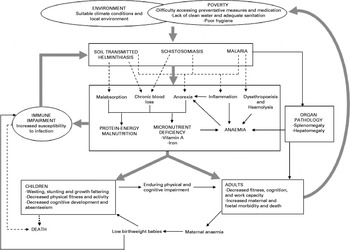
This paper provides a brief review of recent field studies on the nutritional and pathological consequences of polyparasitism in humans and, in doing so, hopes to encourage a reassessment of the disease burden caused by polyparasitism. Our focus is on soil-transmitted helminth infections (STH: Ascaris lumbricoides, Trichuris trichiura and hookworm) schistosomiasis (Schistosoma haematobium, S. mansoni and S. japonicum) and Plasmodium spp. infections since these species are ubiquitous throughout much of the developing world and frequently result in common morbidities. Fig. 1 presents a conceptual framework which summarizes these insults and highlights the complex and self-perpetuating relationships and potential mechanisms between polyparasitism and morbidity.
Conceptual framework: the negative cycle between polyparasitism, malnutrition and cognitive and physical development. Helminth and malaria infections impact upon host nutrition through a number of mechanisms, which may have additive or multiplicative impacts, especially in childhood. Helminth infections cause and/or aggravate malnutrition through worm-induced gastrointestinal tract physiopathology and reduced food intake (Crompton and Nesheim, Reference Crompton and Nesheim2002), chronic blood-loss (Hotez et al. Reference Hotez, Brooker, Bethony, Bottazzi, Loukas and Xiao2004) and intestinal inflammation (Stephenson et al. Reference Stephenson, Latham and Ottesen2000b). Malaria may contribute to protein-energy malnutrition (PEM) through a number of mechanisms triggered by augmented levels of inflammatory cytokines, including anorexia and the induction of a catabolic response (Tracey and Cerami, Reference Tracey and Cerami1992; Nyakeriga et al. Reference Nyakeriga, Troye-Blomberg, Chemtai, Marsh and Williams2004), and to reduced haemoglobin levels through increased rates of destruction and removal of RBCs and anaemia of inflammation. Sequestration of red blood cells in those with P.falciparum- and schistosome-associated splenomegaly can also contribute to anaemia (Friedman et al. Reference Friedman, Kanzaria and McGarvey2005). Associations may also be due to the effect of undernourishment on the immune response, leading to an increased susceptibility to infection (Koski and Scott, Reference Koski and Scott2001). PEM and anaemia associated with parasitic infection can result in decreased physical fitness, cognitive development and school achievement in children (Boivin and Giordani, Reference Boivin and Giordani1993; Boivin et al. Reference Boivin, Giordani, Ndanga, Maky, Manzeki, Ngunu and Muamba1993; Bundy and Guyatt, Reference Bundy and Guyatt1996), and in decreased cognition and work capacity in adults (Guyatt, Reference Guyatt2000; Haas and Brownlie, Reference Haas and Brownlie2001); factors which are in turn associated with poor socio-economic status, in itself a risk factor for infection.

WHO IS AT RISK OF POLYPARASITISM?
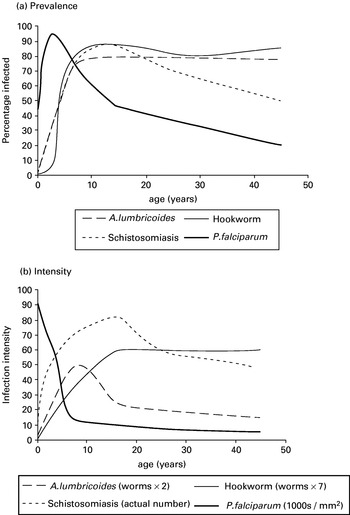
An examination of age-infection profiles of different parasite species helps identify those individuals at greatest risk of polyparasitism. For most helminth species, intensity of infection rises dramatically with age, with the age of maximum intensity varying for each helminth species (Fig. 2). Age-profiles of Plasmodium spp. suggest that blood stage infection is most prevalent in school-aged children, and it is among this age group that co-infections are most likely therefore to occur. Pregnant women (particularly primigravidae) are also at risk. However, adults remain at considerable risk of harbouring multiple STH species, although at reduced intensity, and are often neglected in the helminthological literature. Understanding the age patterns of infection can provide insight into who is most at risk of the health consequences of polyparasitism, but the underlying age-specific susceptibilities to morbidity are also important.
Age-associated prevalence and intensity profiles of STH, schistosome and malaria infections: typical age profiles for (a) prevalence and (b) intensity of infection with A. lumbricoides, schistosomiasis, hookworm and P. falciparum malaria; adapted from Bundy (Reference Booth and Bundy1995) and Anderson and May (Reference Anderson and May2001).

IMPACT ON NUTRIENT DEFICIENCY
Undernutrition, whether characterized in terms of growth impairment or micronutrient malnutrition, is a pervasive problem in the developing world, contributing substantially to both child morbidity and mortality (WHO, 2002a), and to poor cognitive and motor performance (Walker et al. Reference Walker, Wachs, Gardner, Lozoff, Wasserman, Pollitt and Carter2006). As important contributors to undernutrition, helminth and malaria infections impact upon host nutrition through a number of mechanisms including anorexia, chronic blood loss and malabsorption. In light of the nutritional insults arising from single species infection, multiple species infections may have an additive or multiplicative impact on nutrition, especially in childhood.
Growth impairment
Chronic growth stunting is estimated to affect a third of children under five in developing countries (UNICEF, 2004). Infection with STH species contributes significantly to stunting and impaired growth in children living where infection is endemic (Stephenson et al. Reference Stephenson, Latham and Ottesen2000b). Although the nutritional consequences of infection are generally most pronounced in those who harbour the heaviest infections, relatively light worm burdens may also contribute to growth deficits in nutritional vulnerable populations (Stephenson et al. Reference Stephenson, Latham and Ottesen2000b; Crompton and Nesheim, Reference Crompton and Nesheim2002). Schistosome infection is also associated with malnutrition and stunting in children, particularly in nutritionally vulnerable populations (Mott, Reference Mott, Murray, Lopez and Mathers2004; King, Dickman and Tisch, Reference King, Dickman and Tisch2005). Helminth infections are considered to cause and/or aggravate malnutrition through two processes: worm-induced gastrointestinal tract physiopathology and reduced food intake (Crompton and Nesheim, Reference Crompton and Nesheim2002). For example, A. lumbricoides infection causes physiological abnormalities in the small intestine (Tripathy et al. Reference Tripathy, Duque, Bolanos, Lotero and Mayoral1972), resulting in malabsorption, nutritional deficiency and growth failure (Hlaing, Reference Hlaing1993). T. trichiura does not directly affect dietary nutrient absorption, but can result in chronic colitis and impaired growth (Bundy and Cooper, Reference Bundy and Cooper1989). In contrast, the involvement of malaria in undernutrition remains unclear, although some role appears likely from observations made during malaria control programmes (McGregor et al. Reference McGregor, Gilles, Walters, Davies and Pearson1956; Bradley-Moore et al. Reference Bradley-Moore, Greenwood, Bradley, Kirkwood and Gilles1985; Snow et al. Reference Snow, Molyneux, Njeru, Et Al Omumbo, Nevill, Muniu and Marsh1997; ter Kuile et al. Reference Ter Kuile, Terlouw and Kariuki2003). Malaria may contribute to malnutrition through a number of mechanisms triggered by augmented levels of inflammatory cytokines, including anorexia and the induction of a catabolic response (Tracey and Cerami, Reference Tracey and Cerami1992; Nyakeriga et al. Reference Nyakeriga, Troye-Blomberg, Chemtai, Marsh and Williams2004). Intestinal inflammation is also suggested to be a mechanism contributing to poor growth in hookworm and schistosome infections (Stephenson et al. Reference Stephenson, Latham and Ottesen2000b).
Studies investigating the nutritional consequences of multiple helminth species are noticeably lacking. An early study conducted in Tanzania identified significant correlation between malnutrition and multiple infection with A. lumbricoides, hookworm and S. haematobium (Meakins, Harland and Carswell, Reference Meakins, Harland and Carswell1981), although no appropriate adjustment for potentially confounding factors was undertaken. A more recent study of Tanzanian school children, which adjusted for age and sex but included no measures of socioeconomic status or nutritional intake, found no evidence that individuals with multiple species infections were at increased risk of morbidity compared to individuals with single species infections (Booth et al. Reference Booth, Mayombana and Kilima1998b). This may be attributable to an observed low prevalence of co-infection, with very few individuals harbouring heavier infections typically associated with increased morbidity. In Brazil, a cross-sectional study, which appropriately adjusted for calorific intake, socio-economic status and demographic factors, revealed that whilst no significant association existed for each species individually, children harbouring concomitant infection with A. lumbricoides and T. trichiura were at increased risk of stunting (Saldiva et al. Reference Saldiva, Silveira, Philippi, Torres, Mangini, Dias, Da Silva, Buratini and Massad1999).
A major limitation of cross-sectional studies is that associations can operate in both directions and it is difficult to determine whether polyparasitism precedes or determines nutritional deficits (Koski and Scott, Reference Koski and Scott2001). Importantly, chronic and acute undernutrition is a common cause of secondary immune deficiency (Koski, Su and Scott, Reference Koski, Su and Scott1999; Ing et al. Reference Ing, Su, Scott and Koski2000; Schaible and Kaufman, Reference Schaible and Kaufman2007). For example, altered architecture of the gut mucosa can result in compromised immune defence at the epithelial barrier (Beisel, Reference Beisel1996; Koski et al. Reference Koski, Su and Scott1999) which could theoretically increase susceptibility to intestinal helminth infection. Similarly, in murine models of nematode infection protein malnutrition subdues the Th2 cytokine response important in control of helminth infection (Ing et al. Reference Ing, Su, Scott and Koski2000). Although there is some evidence from experimental studies in livestock and rodent models that well-nourished animals resist intestinal parasitism better than those less adequately fed, no evidence of a cause-effect relationship between malnutrition and intestinal helminth infections has emerged from epidemiological controlled intervention studies in humans (see Koski and Scott, Reference Koski and Scott2001 for a review).
Surprisingly, no studies have investigated directly the nutritional impacts of Plasmodium-helminth co-infections. The effects of malaria on nutritional status are generally greater among children under two years (McGregor et al. Reference McGregor, Gilles, Walters, Davies and Pearson1956; Friedman et al. Reference Friedman, Phillips-Howard, Hawley, Terlouw, Kolczak, Barber, Okello, Vulule, Duggan, Nahlen and Ter Kuile2003; Nyakeriga et al. Reference Nyakeriga, Troye-Blomberg, Chemtai, Marsh and Williams2004). As incidence of malaria is often still rising in children over two years, this is unlikely to simply reflect lower burden of malaria in older children and may reflect age-specific differences in immune responsiveness profiles or the fact that linear growth is maximal in younger children (Nyakeriga et al. Reference Nyakeriga, Troye-Blomberg, Chemtai, Marsh and Williams2004). Levels of helminth infections are generally low in young children, resulting in few Plasmodium-helminth co-infections, such that even if nutritional insults arsing from Plasmodium-helminth co-infection occur they are likely to be of less public health importance.
Micronutrient deficiencies
The high iron demands of infant growth and pregnancy means that anaemia is most common and severe among children and pregnant women. These are also the individuals most likely to harbour multiple parasite infections. Malaria, hookworm, schistosomiasis and, to a lesser extent, T. trichiura are associated with iron loss and imbalances predisposing to anaemia among nutritionally vulnerable populations, with risk being closely correlated with infection intensity (Stephenson et al. Reference Stephenson, Latham, Kurz, Kinoti, Oduori and Crompton1985; Stoltzfus et al. Reference Stoltzfus, Chwaya, Tielsch, Schulze, Albonico and Savioli1997b; Menendez, Fleming and Alonso, Reference Menendez, Fleming and Alonso2000; Stephenson et al. Reference Stephenson, Holland and Cooper2000a; Hotez et al. Reference Hotez, Brooker, Bethony, Bottazzi, Loukas and Xiao2004; Friedman, Kanzaria and McGarvey, Reference Friedman, Kanzaria and McGarvey2005). Malaria contributes to reduced haemoglobin levels though a number of mechanisms, principally by increasing rates of destruction and removal of red blood cells (RBCs) and through ‘anaemia of inflammation’, in which pro-inflammatory mediators disrupt RBC production and longevity, and affect iron absorption and metabolism (Menendez et al. Reference Menendez, Fleming and Alonso2000; McDevitt et al. Reference McDevitt, Xie, Gordeuk and Bucala2004). By contrast, hookworm primarily causes anaemia through the process of intestinal blood loss (Hotez et al. Reference Hotez, Brooker, Bethony, Bottazzi, Loukas and Xiao2004). Several mechanisms have been proposed for schistosome-induced anaemia, including chronic blood-loss as a result of egg migration, sequestration of red blood cells in those with splenomegaly and anaemia of inflammation (Friedman et al. Reference Friedman, Kanzaria and McGarvey2005). Although only a feature of very heavy T. trichiura infection, Trichuris dysentery syndrome (TDS) can also cause considerable blood-loss, thus contributing to iron loss and subsequent anaemia.(Stephenson et al. Reference Stephenson, Holland and Cooper2000a) Most studies in school-aged children have typically found that hookworm contributes more to anaemia than schistosomiasis or malaria (Stephenson et al. Reference Stephenson, Latham, Kurz, Kinoti, Oduori and Crompton1985; Stoltzfus et al. Reference Stoltzfus, Dreyfuss, Chwaya and Albonico1997c).
Given the distinct mechanisms by which P. falciparum, soil-transmitted helminths and schistosomes reduce haemoglobin levels, it is probable that these parasites would be additive in their ability to cause anaemia. Although the impact of single species helminth infection on the risk of anaemia are well documented, few studies have to date investigated the effect of multiple helminth infection on anaemia. A recent study among Filipino school children showed that even low-intensity concurrent infections were associated with an increased risk of anaemia relative to children with no infection, although significance was only marginal after adjusting for age, sex, socioeconomic status and anthropometric indices (Ezeamama et al. Reference Ezeamama, Friedman, Olveda, Acosta, Kurtis, Mor and McGarvey2005). In particular, S. japonicum and hookworm (Necator americanus) were observed to play a significant and intensity-dependent role in the association between multiple infection and anaemia (Ezeamama et al. Reference Ezeamama, Friedman, Olveda, Acosta, Kurtis, Mor and McGarvey2005). A similar study among rural Brazilian school children found the risk of anaemia among children infected with S. mansoni and two or three STH infections was significantly higher that those harbouring single STH species, although those with multiple STH infection in absence of S. mansoni were not at increased risk (Brito et al. Reference Brito, Barreto, Silva, Assis, Reis, Parraga and Blanton2006). This study also collected data on calorific intake, revealing infection status to be important only in those with inadequate iron intake, thus emphasising that the consequences of infection are greatest in nutritionally vulnerable populations. There is a limitation in analyses of this type since they were secondary analyses of previously collected data and substantially over-sampled those with schistosome infections. In particular, the Brazilian study did not include individuals singly infected with schistosomiasis; therefore, although those with schistosomiasis co-infection did have increased risk of anaemia it cannot be ruled out that this is simply a result of S. mansoni mono-infection. Another limitation in such cross-sectional studies, as highlighted above, is uncertainty in the directionality of causality.
It is conceivable that the combined presence of P. falciparum and helminth species might interact to further increase the risk of anaemia. In particular, although malarial anaemia is more typically associated with the acute clinical state, there is evidence to suggest that asymptomatic malaria (typically observed in older children who are also at higher risk of helminth infection) may contribute substantially to anaemia in endemic regions (Kurtzhals et al. Reference Kurtzhals, Addae, Akanmori, Dunyo, Koram, Appawu, Nkrumah and Hviid1999; Korenromp et al. Reference Korenromp, Armstrong-Schellenberg, Williams, Nahlen and Snow2004). A hospital-based study in Nigeria revealed that pregnant women infected with both malaria and STH infection had lower haemoglobin concentration than women with Plasmodium infection alone, although this result was not statistically significant (Egwunyenga et al. Reference Egwunyenga, Ajayi, Nmorsi and Duhlinska-Popova2001). In Cameroon, school children infected exclusively with P. falciparum had greater levels of anaemia compared with children uninfected, those with co-infections, and those harbouring only helminths (Nkuo-Akenji et al. Reference Nkuo-Akenji, Chi, Cho, Ndamukong and Sumbele2006). Re-analysing available data from Kenya, Brooker et al. (Reference Brooker, Akhwale, Pullan, Estambale, Clarke and Hotez2007) found no significant difference amongst mono- and co-infected pregnant women, but found statistical evidence of an additive impact of Plasmodium-hookworm co-infection on anaemia in pre-school and school-aged children. Although these initial results are suggestive of an additive impact of P. falciparum-helminth co-infection on anaemia in certain age groups, there is substantial potential for confounding by socio-economic, genetic and nutritional factors.
A. lumbricoides has been associated with vitamin A and C deficiency (Hlaing, Reference Hlaing1993), possibly by inhibiting intestinal absorption (Tripathy et al. Reference Tripathy, Duque, Bolanos, Lotero and Mayoral1972; Mahalanabis et al. Reference Mahalanabis, Simpson, Chakraborty, Ganguli, Bhattacharjee and Mukherjee1979). Vitamin A is essential for maintaining eye health, growth and immune function (Sommer and West, Reference Sommer and West1996), and its deficiency is estimated to contribute substantially to the worldwide burden of malaria and diarrhoeal diseases, poor birth outcomes and maternal and infant mortality (WHO, 2002a). In addition, there is clear evidence of an association between serum levels of vitamin A and anaemia (Hodges, Sauberlich and Canham, Reference Hodges, Sauberlich and Canham1978; Suharno et al. Reference Suharno, West, Muhilal Karyadi and Hautvast1993); although the precise mechanism has yet to be confirmed, it has been suggested that vitamin A plays a role in the haemoglobin synthetic pathway (Bloem et al. Reference Bloem, Wedel, Van Agtmaal, Speek, Soawakontha and Schreurs1990). It is therefore possible that A. lumbricoides-associated vitamin A deficiency may further increase the risk of anaemia in those co-infected with malaria and other helminth species. Few studies have addressed this hypothesis, but a cross-sectional survey of Bangladeshi school children found no evidence of such an interaction (Persson et al. Reference Persson, Ahmed, Gebre-Medhin and Greiner2000).
A major limitation of parasite-haematological studies is the use of a single iron status indicator, namely haemoglobin, which is often measured for practical reasons but is confounded by a number of factors including biological variation and other micronutrient deficiencies (Gibson, Reference Gibson2005). Given the complexity of mechanisms through which mild and asymptomatic malaria infection are thought to contribute to anaemia, the validity of alternative iron status indicators such as serum ferritin, serum transferrin receptor and erythrocyte protoporphyrin in individuals with asymptomatic malaria remains uncertain (Das, Thurman and Das, Reference Das, Thurnham and Das1997; Stoltzfus et al. Reference Stoltzfus, Chwaya, Albonico, Schulze, Savioli and Tielsch1997a; Odunukwe et al. Reference Odunukwe, Salako, Okany and Ibrahim2000; Asobayire et al. Reference Asobayire, Adou, Davidsson, Cook and Hurrell2001; Menendez et al. Reference Menendez, Quinto, Kahigwa, Alvarez, Fernandez, Gimenez, Schellenberg, Aponte, Tanner and Alonso2001;Verhoef et al. Reference Verhoef, West, Ndeto, Burema and Kok2001). Stoltzfus et al. (Reference Stoltzfus, Chwaya, Montresor, Albonico, Savioli and Tielsch2000) suggested that both hookworm infection and asymptomatic malaria infection may modify the relationship of iron indicators with haemoglobin levels. If we wish to quantify better the impact of polyparasitism on anaemia and iron deficiency, we need to clarify our understanding of the reliability of iron status indicators for children living in areas endemic for multiple parasitic species.
IMPACT ON ORGAN PATHOLOGY
Childhood infection with S. mansoni and S. japonicum is commonly associated with hepatomegaly and splenomegaly, a result of eosinophilic inflammatory and granulomatous reactions against parasite eggs trapped in host tissues (Vennervald and Dunne, Reference Vennervald and Dunne2004; Gryseels et al. Reference Gryseels, Polman, Clerinx and Kestens2006). Aberrant immune response to repeated or chronic P. falciparum malarial infection is also an important cause of hepatomegaly and splenomegaly in the tropics (Grobusch and Kremsner, Reference Grobusch and Kremsner2005). As well as acting as an antecedent of severe disease in young and middle-aged adults with long-standing intense schistosome infection (Gryseels et al. Reference Gryseels, Polman, Clerinx and Kestens2006), splenomegaly is associated with anaemia, possibly because sequestration of RBCs in the spleen reduces the effective circulating mass of RBCs (Abdel-Salam et al. Reference Abdel-Salam, Abdel Khalik, Abdel-Meguid, Barakat and Mahmoud1986; Kloos et al. Reference Kloos, Fulford, Butterworth, Sturrock, Ouma, Kariuki, Thiongo, Dalton and Klumpp1997).
It is possible therefore that co-infections with Schistosoma and Plasmodium species may have synergistic effects on organ pathology. Early epidemiological studies suggest that chronic exposure to malaria and infection with schistosomes may interact in childhood hepatosplenomegaly (Whittle et al. Reference Whittle, Gelfand, Sampson, Purvis and Weber1969; Fulford et al. Reference Fulford, Mbugua, Ouma, Kariuki, Sturrock and Butterworth1991). In a later study in Kenya, children with the highest levels of anti-P. falciparum immunoglobulin (Ig)G3 and highest S. mansoni egg counts were significantly more likely to present with splenomegaly (Booth et al. Reference Booth, Vennervald, Kenty, Butterworth, Kariuki, Kadzo, Ireri, Amaganga, Kimani, Mwatha, Otedo, Ouma, Muchiri and Dunne2004b). After regular mollusciciding of the source of infection and praziquantel treatment for schistosomiasis, children living in areas with highest exposure to malaria showed the slowest rates of both splenomegaly and hepatomegaly regression, further suggesting that malaria co-infection exacerbates schistosomiasis-associated hepatosplenomegaly; although it should be noted that it was not possible to control for self-treatment for malaria during the follow-up period (Booth et al. Reference Booth, Vennervald, Butterworth, Kariuki, Amaganga, Kimani, Mwatha, Otedo, Ouma and Dunne2004a). Due to the seasonality of malaria transmission in the region, these studies had to rely on IgG3 responses to P. falciparum schizont antigen as a proxy for exposure to malaria infection as very few cohort members presented with blood-smear detectable parasitaemia. Another Kenyan study noted that hepatosplenic children had significantly higher levels of anti-S. mansoni and anti-P. falciparum antibodies when compared with non-hepatosplenic children, suggesting that past or chronic exposure to malaria may influence the development of hepatosplenomegaly in S. mansoni-infected children (Mwatha et al. Reference Mwatha, Jones, Mohamed, Naus, Riley, Butterworth, Kimani, Kariuki, Ouma, Koech and Dunne2003). Likewise, a cross-sectional study of children living in this region revealed that whilst children chronically exposed to malaria (again measured using Pfs-IgG3 levels) but without S. mansoni infection can have hepatosplenomegaly, even light S. mansoni infections can exacerbate in an intensity-dependent manner. Although the authors do note that poor model fit suggests some other environmental agent in the study area to be contributing to hepatosplenomegaly in these children, the results do suggest that concurrent chronic exposure to both infections can have an additive or synergistic effect on childhood morbidity (Wilson et al. Reference Wilson, Vennervald, Kadzo, Ireri, Amaganga, Booth, Kariuki, Mwatha, Kimani, Ouma, Muchiri and Dunne2007). However, the possibility that hepatosplenomegaly, or the genetic propensity to develop this condition, may in some way influence immune responses to infection cannot be excluded.
S. haematobium is not usually associated with hepatosplenomegaly. It has been postulated however that it may play a role in the causality of organ pathology (Friis et al. Reference Friis, Ndhlovu, Kaondera, Franke, Vennervald, Christensen and Doehring1996). For example, in a study among schoolchildren in Zimbabwe although neither S. mansoni nor S. haematobium were associated with spleen size, S. mansoni had an effect on liver size only in the presence, but not in the absence, of S. haematobium co-infection (Friis et al. Reference Friis, Ndhlovu, Kaondera, Franke, Vennervald, Christensen and Doehring1996). By contrast, in a study in western Sudan, children with S. haematobium appeared to be protected from malarial splenomegaly (Friis et al. Reference Friis, El Karib, Sulaiman, Rahama, Magnussen and Mascie-Taylor2000). The precise mechanisms of the impact of such co-infection on organ pathology remains speculative since no relevant studies have been undertaken to date.
QUANTIFYING THE DISEASE BURDEN OF POLYPARASITISM
Clearly polyparasitism is widespread throughout the tropics and sub-tropics, although accurately estimating the magnitude of the problem remains a major epidemiological challenge. Recent analysis combining climate-based risk maps and demographic surfaces suggest that in sub-Saharan Africa alone, between 25 and 45 million school-aged children live in areas of co-endemicity of P. falciparum and different STH species (Brooker et al. Reference Brooker, Akhwale, Pullan, Estambale, Clarke and Hotez2007). This type of analysis is obviously crude since it involves estimating only co-distribution and not co-infection. It nonetheless is based on objective and quantitative assessment. The potential burden of polyparasitism with other species and in different regions of the world remains unknown.
A recent approach to assessing the global burden of disease has been adopted by the Global Burden of Disease (GBD) study which employs the metric of disability-adjusted life years (DALYs) (Murray and Lopez, Reference Murray and Lopez1994, Reference Murray and Lopez1996; Mathers, Lopez and Murray, Reference Mathers, Lopez and Murray2006). This is a summary measure of both mortality and morbidity which combines in a single indicator, years of life lost due to premature death and years of life lived with a disability, using a disability weighting scheme in which normal functioning has a weight of 0 and 1 corresponds to death. Globally, malaria is estimated to cause 46 million DALYs, STH species 2.9 million, and schistosomiasis 1.7 million (WHO, 2004); although several researchers have questioned the accuracy of disease burden estimates due to chronic parasitic infections (King et al. Reference King, Dickman and Tisch2005; Engels and Savioli, Reference Engels and Savioli2006; Hotez et al. Reference Hotez, Bundy, Beegle, Brooker, Drake, De Silva, Montresor, Engels, Jukes, Chitsulo, Chow, Laxminarayan, Michaud, Bethony, Oliveira, Xiao, Fenwick, Savioli, Jamison, Breman, Measham, Alleyne, Claeson, Evans, Jha, Mills and Musgrove2006). The estimation of DALYs adopts a ‘one death, one disease approach’, in which mortality and loss of health is disaggregated into specific diseases as defined by the diagnostic categories of the International Classification of Diseases (ICD). Owing to the estimation methods employed, disability states in DALYs cannot take into account co-morbid conditions, and there is no provision to consider all conditions simultaneously occurring within the same individual or population (Gold, Stevenson and Fryback, Reference Gold, Stevenson and Fryback2002). For example, GBD analysis separates specific causes of disease from their associated morbidities, such as anaemia and undernutrition (Mathers et al. Reference Mathers, Lopez and Murray2006). The current disease burden framework is therefore unable to assess the health impact of polyparasitism and this is a particular weakness of current DALY estimates. We suggest therefore that the public health impact of polyparasitism is currently underestimated.
There is a number of reasons why the burden of polyparasitism may not be adequately captured by the current disease burden calculations. First, as our review highlights, there are few direct estimates of the nutritional and pathological sequelae of polyparasitism. It is therefore both surprising and unsatisfactory that the health consequences of polyparasitism have to date received so little research effort. Second, because of the interacting complexity of contributing factors (Fig. 1), it is difficult to disentangle adequately the effects of single and multiple species infections. Though plausible mechanisms exist, confounding by socio-economic, demographic and immunological variables in observed associations remains a major challenge in research studies. Third, there is a lack of systematic and comparable information on the impact of polyparasitisim among different age groups and in different epidemiological and nutritional settings. Available data indicate that the impact of polyparasitism may be substantially greater in certain populations than in others. Finally, much of the morbidity of parasitic infections remains insidious and indirect, for example, societal consequences of cognitive impairment arising from helminth infections and malaria (Drake and Bundy, Reference Drake and Bundy2001; Kihara, Carter and Newton, Reference Kihara, Carter and Newton2006). Such non-health consequences of polyparasitism may have greater public health relevance than the direct nutritional and pathological sequelae in individuals.
A FUTURE RESEARCH AGENDA
While it has been convenient for researchers to investigate the epidemiology and health consequences of parasite species in isolation, the majority of infections in the complex and invariably messy reality of the developing world typically involves multiple species. Despite considerable recent advances in our epidemiological understanding of polyparasitism, the present review highlights that our scientific understanding of the public health significance of polyparasitism is currently inadequate. Available evidence is typically based on retrospective, secondary analyses of previously collected data, which therefore lack sufficient statistical power and are invariably subject to confounding due to socio-economic or dietary intake factors. Purposively designed studies of the health impact of polyparasitism are clearly necessary.
The clearest evidence of the health impacts of polyparasitism can be provided by well-designed intervention studies. Because the most intense helminth infections occur at school age (Bundy, Reference Bundy1988; Bundy and Medley, Reference Bundy and Medley1992), and infection can have adverse consequences for health and development (Hotez et al. Reference Hotez, Bundy, Beegle, Brooker, Drake, De Silva, Montresor, Engels, Jukes, Chitsulo, Chow, Laxminarayan, Michaud, Bethony, Oliveira, Xiao, Fenwick, Savioli, Jamison, Breman, Measham, Alleyne, Claeson, Evans, Jha, Mills and Musgrove2006), school-age children are a natural target for such studies. The most robust evidence can be provided by factorial, randomised controlled trials, whereby different interventions are randomised between study populations. However, given that the public health case for de-worming is already well established, withholding treatment from control groups raises ethical issues. The recently launched studies of intermittent preventative treatment (IPT) for malaria in school-aged children (in which curative treatment doses of sulphadoxine-pyrimethamine (SP) are delivered to children every term during the school year, regardless of infection status) can potentially be combined with de-worming to provide an alternative platform to examine the consequences of co-infection on child health (Brooker et al. Reference Brooker, Akhwale, Pullan, Estambale, Clarke and Hotez2007). Another opportunity would be therefore to assess whether combined de-worming and malaria control has a greater health impact than programmes providing de-worming alone.
A limitation of such intervention studies is that, given the possibly irreparable damage of undernutrition on children's cognitive and physical development, there is a risk that they underestimate the impact of polyparasitism. Additional insight can be ascertained from the application of attributable-fraction methods (Booth, Reference Booth1998). For example, chronic morbidity such as bladder lesions and hepatosplenomegaly may take weeks or months to resolve after treatment, during which time some individuals are inevitably being reinfected. In this scenario, detailed cross-sectional surveys in different epidemiological settings and estimation of attributable fractions may prove informative. Given the problems of proving directionality in such study designs, adequate control for socioeconomic, nutritional and genetic confounding is essential.
But why should we study the health impact of polyparasitism, given that we know already that helminths and Plasmodium spp. contribute to malnutrition and ill health, and that cost-effective interventions already exist? We argue that in a world of limited resources for disease control programmes, determining the health impact of polyparasitism is vital to the rational design of control programmes (for a discussion of the issues see review by Brooker et al. Reference Brooker, Akhwale, Pullan, Estambale, Clarke and Hotez2007). In particular, it is important to prioritise the most cost-effective interventions in areas where interventions are most needed and will produce the greatest benefits. For example, in order to reduce rates of maternal anaemia (Shulman et al. Reference Shulman, Dorman, Cutts, Kawuondo, Bulmer, Peshu and Marsh1999) and malaria morbidity (Rogerson et al. Reference Rogerson, Chaluluka, Kanjala, Mkundika, Mhango and Molyneux2000; Newman et al. Reference Newman, Parise, Slutsker, Nahlen and Steketee2003) IPT with SP is currently recommended for control of malaria in pregnancy (WHO, 2002b). In hookworm or schistosomiasis endemic areas, it will be important to co-administer anthelmintics (Brooker et al. Reference Brooker, Akhwale, Pullan, Estambale, Clarke and Hotez2007). We suggest that different interventions are likely to have health impacts and cost-effectiveness balances that may vary under different conditions of polyparasitism and this represents an important public health reason to investigate further the consequences of polyparasitism.
CONCLUSIONS
The health consequences of polyparasitism in humans are poorly understood at present. Unravelling the complexity of the processes involved in the messy reality of human polyparasitism is extremely challenging and considerable effort is required to improve our basic knowledge. This will necessitate the systematic investigation of the relative impact of single and multiple species infection, and a very considerable research effort evaluating integrated disease control programmes. Such effort will not be straightforward and will require careful study design, especially in our rapidly changing world in the face of widespread up-scaling of available interventions. As such interventions reduce the intensity of parasite infections it is likely that the health consequences of multiple low-grade infections will become more important, especially among vulnerable populations. We hope that the parasitological research community will grasp the current opportunity to investigate the complexity of human polyparasitism further.
ACKNOWLEDGEMENTS
RP is supported by a Medical Research Council DTA-funded studentship and SB is supported by a Wellcome Trust Career Development Fellowship (081673).