Introduction
The tendency to have uncontrolled angry outbursts accompanied by aggressive behaviors is an important feature of various anxiety and stress-related disorders and most notably in post-traumatic stress disorder (PTSD; Olatunji et al. Reference Olatunji, Ciesielski and Tolin2010; American Psychiatric Association, 2013). Research suggests that patients with traumatic and chronic stress-related symptoms suffer from a profound difficulty in regulating their anger (Chemtob et al. Reference Chemtob, Hamada, Roitblat and Muraoka1994; Novaco & Chemtob, Reference Novaco and Chemtob2002), especially when interacting with other people (Carroll et al. Reference Carroll, Rueger, Foy and Donahoe1985; Jordan et al. Reference Jordan, Marmar, Fairbank and Schlenger1992; Beckham et al. Reference Beckham, Moore and Reynolds2000; Miles et al. Reference Miles, Menefee, Wanner, Teten Tharp and Kent2016), during which even little provocation has shown to lead these patients to behave violently towards others (Beckham et al. Reference Beckham, Feldman, Kirby, Hertzberg and Moore1997; McFall et al. Reference McFall, Fontana, Raskind and Rosenheck1999; Jakupcak & Tull, Reference Jakupcak and Tull2005; MacManus et al. Reference MacManus, Rona, Dickson, Somaini, Fear and Wessely2015). Since anger is a major precursor to aggression and violence (Davidson et al. Reference Davidson, Putnam and Larson2000; Siever, Reference Siever2008; Gilam & Hendler, Reference Gilam, Hendler, Wöhr and Krach2015), it is possible that these patients are prone for such aberrant behaviors because of their poor capability to cope with anger-provoking interpersonal situations.
We recently created an interactive and realistic anger-provoking paradigm based on a modified version of the Ultimatum Game (UG; Sanfey et al. Reference Sanfey, Rilling, Aronson, Nystrom and Cohen2003), a social decision-making paradigm in which two players need to agree on how to split a sum of money between them. Our modification induced genuine interpersonal anger by incorporating repeated verbal negotiations infused with angering provocations by an obnoxious competitor (Gilam et al. Reference Gilam, Lin, Raz, Azrielant, Fruchter, Ariely and Hendler2015). We showed that when confronted with such provocations during functional magnetic resonance imaging (fMRI), individuals with a tendency for aggressive reactions (i.e. rejecting angering unfair offers thus gaining less money throughout the game) were angry and had greater activation in a region of the brainstem (BS) corresponding to the locus coeruleus (LC) and less activation in a region of the ventromedial prefrontal cortex (vmPFC), while individuals with a tendency for conciliatory reactions (i.e. accepting angering unfair offers thus gaining more money throughout the game) had an emotionally balanced response and the reverse pattern of brain activation – greater vmPFC and less BS/LC activation. The brain activations were specifically enhanced for unfair compared with fair offers. This reverse pattern of activation led us to suggest that the vmPFC is involved in regulating LC-related arousal and aggressive reactions towards anger provocations.
Indeed, the LC is the major source for noradrenaline (NA) secretion in the forebrain, critically involved in autonomic arousal and stress response (Berridge, Reference Berridge2008; Valentino & Van Bockstaele, Reference Valentino and Van Bockstaele2008), and has been shown to have a specific role in propagating aggression (Haller et al. Reference Haller, Makara and Kruk1997; Haden & Scarpa, Reference Haden and Scarpa2007). It was suggested that the LC-NA system represents a reorienting/alarm system in charge of averting attention towards and modifying behavior in view of salient, mostly threatening stimuli in the environment (Berridge & Waterhouse, Reference Berridge and Waterhouse2003; Liddell et al. Reference Liddell, Brown, Kemp, Barton, Das, Peduto, Gordon and Williams2005; Corbetta et al. Reference Corbetta, Patel and Shulman2008; Sara & Bouret, Reference Sara and Bouret2012). Consistently, dysfunction in the LC-NA system has been associated with prototypical stress symptoms such as hyperarousal, hypervigilance and aggression, which are common in PTSD (Aston-Jones et al. Reference Aston-Jones, Valentino, Van Bockstaele, Meyerson and Murburg1994; Southwick et al. Reference Southwick, Bremner, Rasmusson, Morgan, Arnsten and Charney1999; Berridge & Waterhouse, Reference Berridge and Waterhouse2003; Arnsten et al. Reference Arnsten, Raskind, Taylor and Connor2015).
The vmPFC has been generally implicated in emotion regulation (Quirk & Beer, Reference Quirk and Beer2006; Phillips et al. Reference Phillips, Ladouceur and Drevets2008; Etkin et al. Reference Etkin, Egner and Kalisch2011), including regulating anger and aggressive reactions (Davidson et al. Reference Davidson, Putnam and Larson2000; Siever, Reference Siever2008; Gilam & Hendler, Reference Gilam, Hendler, Wöhr and Krach2015), and was shown to be an important region displaying structural and functional abnormalities associated with increased stress symptoms (Pitman et al. Reference Pitman, Rasmusson, Koenen, Shin, Orr, Gilbertson, Milad and Liberzon2012; Admon et al. Reference Admon, Milad and Hendler2013b ). Moreover, vmPFC dysfunctionality in PTSD patients was associated with abnormal processing of emotions, especially fear (Etkin & Wager, Reference Etkin and Wager2007; Milad et al. Reference Milad, Pitman, Ellis, Gold, Shin, Lasko, Zeidan, Handwerger, Orr and Rauch2009). Congruently, a leading psycho-biological model for the development and maintenance of stress symptoms has postulated an underlying dysfunctionality in the neural circuit subserving emotion and arousal regulation (Frewen & Lanius, Reference Frewen and Lanius2006; Pitman et al. Reference Pitman, Rasmusson, Koenen, Shin, Orr, Gilbertson, Milad and Liberzon2012; Seligowski et al. Reference Seligowski, Lee, Bardeen and Orcutt2015), with the vmPFC playing a key role in such a circuit.
Although there seems to be a correspondence between the neural circuits involved in processing anger and those which are dysfunctional among patients with stress symptoms, studies to date have not yet investigated the neural trajectory of anger in relation to the development and manifestation of such symptoms. Further, since the development of stress symptoms is dependent on exposure to an acute or chronic stressful experience, such an investigation coincides with the opportunity to disentangle predisposing (pre-exposure) from acquired (post-exposure) neural abnormalities. Indeed, prospective studies on populations at risk of stress exposure have suggested that unbalanced levels of pre-exposure anger and aggressive tendencies are not only a consequence of, but may also causally contribute to, the development of stress symptoms (Heinrichs et al. Reference Heinrichs, Wagner, Schoch, Soravia, Hellhammer and Ehlert2005; Meffert et al. Reference Meffert, Metzler, Henn-Haase, McCaslin, Inslicht, Chemtob, Neylan and Marmar2008; van Zuiden et al. Reference van Zuiden, Kavelaars, Rademaker, Vermetten, Heijnen and Geuze2011; Lommen et al. Reference Lommen, Engelhard, van de Schoot and van den Hout2014). However, these few prospective studies assessed anger using self-reported questionnaires and not actual behavior during a provoking interpersonal situation. Therefore, the relationship between stress symptoms and individual differences in coping with anger, and specifically the neural correlates associated with reactivity towards and regulation of angering provocations, remains largely overlooked.
To directly investigate the relationship between the neural and behavioral indicators of interpersonal anger and the development and manifestation of stress symptoms, we conducted a prospective brain imaging study comparing these neurobehavioral indicators before and after military combat training. Combat training is a highly intense period of chronic stress (Bernton et al. Reference Bernton, Hoover, Galloway and Popp1995; Day & Livingstone, Reference Day and Livingstone2001) that makes an impact on the development of stress-related symptoms (Taylor et al. Reference Taylor, Sausen, Potterat, Mujica-Parodi, Reis, Markham, Padilla and Taylor2007; Lin et al. Reference Lin, Vaisvaser, Fruchter, Admon, Wald, Pine, Bar-Haim and Hendler2015). Moreover, severe anger has been mostly though not solely associated with military personnel and veterans (see McHugh et al. Reference McHugh, Forbes, Bates, Hopwood and Creamer2012). Therefore, measuring brain activation related to conciliatory or aggressive behavior during an interpersonal angering situation as well as stress symptoms before and after combat training, and examining the relationship between them, may reveal neurobehavioral indicators of anger that predict the development of stress symptoms and/or change following exposure to combat training-related chronic stress. This may consequently shed some light on the functional role of anger in post-traumatic stress and may thus provide a neural basis for the development of therapeutic tools focused on coping with anger.
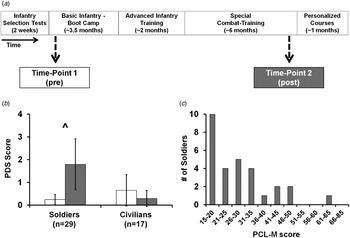
In the current prospective study, participants were a priori healthy soldiers recruited to a combat unit in the Israeli Defense Forces (IDF), whose behavioral and neural responses were measured at two time points: during the first 2 weeks of boot camp (pre-exposure) and approximately 1 year later at which they were about to complete their training program (post-exposure; Fig. 1a ). An age-matched group of civilians recruited from Israeli civil service programs was used to control for non-specific time effects. At each time point participants undergoing fMRI performed our anger-provoking modified UG. Pre-exposure results (extensively reported in Gilam et al. Reference Gilam, Lin, Raz, Azrielant, Fruchter, Ariely and Hendler2015) indicated no differences between soldiers and civilians in any of the measurements, including total gain accumulated throughout the modified UG, the associated emotional experience, as well as vmPFC and BS/LC activation during angering unfair offers. Here we report on post-exposure results in light of these pre-exposure findings. We generally expected to replicate findings from the pre-exposure time point indicating that all participants accepted fewer unfair offers than fair offers, reported on angry feelings as the predominant emotional experience throughout the modified UG, especially for unfair offers, and that there was a relationship between the reported emotional experience and total gain. Specifically for the soldiers, we expected to find an increase in stress symptoms post-exposure to combat training and that the neurobehavioral measures of anger revealed pre-exposure (namely total gain, emotional experience and vmPFC and BS/LC activation during unfair offers) and the change in these measures between pre- and post-exposure, will correlate with stress symptoms measured post-exposure.
Combat training timeline and groups’ distributions of stress symptoms. (a) Combat training timeline and the two time points at which participants were sampled to take part in this prospective study. (b) Differences in stress symptoms scores as measured with the Post-Traumatic Stress Diagnostic Scale (PDS), between the two time points for the soldiers and civilians. White bars indicate the first time point and gray bars indicate the second time point. Soldiers showed a marginal increase in stress symptoms (^ p = 0.063) while no change was apparent for civilians (p = 0.180). Values are means, with standard errors represented by vertical bars. (c) Distribution of stress symptom scores as measured with the Post-Traumatic Stress Disorder Check-List – Military (PCL-M), only among the soldiers at the second time point.

Method
Participants
A total of 29 soldiers (mean age 19.86, s.d. = 1.06 years) and 17 civilians (mean age 19.24, s.d. = 0.44 years) volunteered to take part in both time points of this prospective study. Soldiers were recruited from an infantry unit in the IDF and civilians from various pre-army civil service programs (Shnat Sherut). Combat training in this specific unit, which includes various psychological and physical practices such as strictly enforced discipline, food and sleep restrictions and survival challenges, has been shown to induce elevated stress symptoms among soldiers (Lin et al. Reference Lin, Vaisvaser, Fruchter, Admon, Wald, Pine, Bar-Haim and Hendler2015). Pre-army civil service includes assisting disadvantaged communities, youth at risk, and other civic projects and conscription rates among graduates are almost 100% and many continue to infantry units. Approximately 1 year passed in between the time points, at which soldiers were about to complete their combat training but were not yet actively deployed and civilians were about to complete their civil service programs. The study was approved by the Institutional Ethics Committee of the Tel Aviv Sourasky Medical Center and of the IDF Medical Corps. All participants provided written informed consent, had completed secondary education, had no reported history of psychiatric or neurological disorders, and had normal or corrected-to-normal vision. To note, the first time point included an additional nine soldiers and five civilians who did not return at the second time point (online Supplementary Table S1). We previously showed that within the 60 participants at the first time point (38 soldiers and 22 civilians) there were no differences in any of the anger measures including behavior, emotional reports and brain activations (Gilam et al. Reference Gilam, Lin, Raz, Azrielant, Fruchter, Ariely and Hendler2015).
Interpersonal anger induction and emotional rating
Anger was induced using a modified version of the UG and a post-scan emotional report was used to measure the induced emotional experience, both of which have been described elsewhere (Gilam et al. Reference Gilam, Lin, Raz, Azrielant, Fruchter, Ariely and Hendler2015; also see online Supplementary material). Participants in the scanner played the responder in a 10-round repeated UG in which they had 30-s spontaneous verbal negotiations with a confederate proposer at the end of each round (online Supplementary Fig. S1 and Movie S1). Unknown to participants, the proposer was a professional actor who during negotiations improvised with scripted provocations in concert with predefined sequences of both fair (10:10, 11:9, 12:8) and unfair (2 × 15:5, 16:4, 17:3, 18:2, 2 × 19:1) offers allotted from a pot of 20 Israeli New Shekels (ILS; online Supplementary Table S2). Rejecting an offer was associated with an aggressive reaction while accepting an offer was associated with a conciliatory reaction. The emotional report consisted of a round-by-round measurement of the Geneva Emotion Wheel (GEW; Scherer, Reference Scherer2005), which includes 16 emotions divided into two axes – valence (positive/negative) and potency (high/low).
Stress symptom questionnaires
Post-Traumatic Stress Diagnostic Scale (PDS; Foa et al. Reference Foa, Cashman, Jaycox and Perry1997)
The PDS assesses stress symptoms following specific traumatic events. After reporting on such an event respondents rate 17 stress symptom items experienced in the past month in relation to this event, on a four-point frequency scale from 1 (not at all) to 4 (almost always).
Post-Traumatic Stress Disorder Check-List – Military (PCL-M; Weathers et al. Reference Weathers, Huska and Keane1991; Forbes et al. Reference Forbes, Creamer and Biddle2001)
The PCL-M assesses stress symptoms experienced specifically in relation to military experiences. Respondents rate each of 17 stress symptoms items on a five-point frequency scale from 1 (not at all) to 5 (extremely), indicating the extent to which they have experienced a specific symptom during the past month of military service. This measure was evaluated only for the soldiers after combat training.
fMRI acquisition and preprocessing
Brain imaging was done by a GE 3 T Signa Excite scanner using an eight-channel head coil at the Wohl Institute for Advanced Imaging, Tel Aviv Sourasky Medical Center. Functional whole-brain scans were performed with a gradient echo-planar imaging (EPI) sequence of functional T2*-weighted images [repetition time/echo time (TR/TE) = 3000/35 ms; flip angle = 90°; field of view (FOV) = 200 × 200 mm; slice thickness = 3 mm; no gap; 39 interleaved top-to-bottom axial slices per volume]. Anatomical T1-weighted three-dimensional axial spoiled gradient (SPGR) echo sequences (TR/TE = 7.92/2.98 ms; flip angle = 15°; FOV = 256 × 256 mm; slice thickness = 1 mm) were acquired to provide high-resolution structural images. To note, our modified UG was divided into two seamless fMRI scans to reduce head-movement artifacts.
Preprocessing and statistical analyses were conducted using BrainVoyager QX version 2.4 (Brain Innovation, The Netherlands). Each scan began with 10 volumes (30 s) of blank screen which were removed to allow for signal equilibrium. Subsequently, slice scan time correction was performed using cubic-spline interpolation. Head motions were corrected by rigid body transformations, using three translation and three rotation parameters and the first image served as a reference volume. Trilinear interpolation was applied to detect head motions and sinc interpolation was used to correct them. Five soldiers and one civilian were discarded from subsequent brain analyses due to excessive head movements (4 mm/4°) at the first time point, as previously reported (Gilam et al. Reference Gilam, Lin, Raz, Azrielant, Fruchter, Ariely and Hendler2015), and for the same reason an additional four soldiers and one civilian were discarded from analyses at the second time point (online Supplementary Table S1). The temporal smoothing process included linear trend removal and usage of a high-pass filter of 1/128 Hz. Functional maps were manually co-registered to corresponding structural maps and together they were incorporated into three-dimensional datasets through trilinear interpolation. The complete dataset was transformed into Talairach space and spatially smoothed with an isotropic 6 mm full width at half maximum (FWHM) Gaussian kernel.
Region-of-interest (ROI) analysis
Using a random-effects general linear model (GLM), we extracted β values (mean parameter estimates) for all the voxels in two ROIs identified at the first time point (Gilam et al. Reference Gilam, Lin, Raz, Azrielant, Fruchter, Ariely and Hendler2015): a cluster in the vmPFC which consisted of 554 contiguous anatomical voxels (1 mm3) with the peak voxel located at the Talairach coordinate x = 14, y = 49, z = −12; and a cluster in the BS which consisted of 409 contiguous anatomical voxels (1 mm3) with the peak voxel located at the Talairach coordinate x = −7, y = −35, z = −18. This BS cluster overlaps with the anatomical location of the LC (Keren et al. Reference Keren, Lozar, Harris, Morgan and Eckert2009). Localizing the LC from blood oxygen level-dependent brain activity measured with fMRI has been debated (Astafiev et al. Reference Astafiev, Snyder, Shulman and Corbetta2010; Minzenberg et al. Reference Minzenberg, Watrous, Yoon, La, Ursu and Carter2010; Schmidt et al. Reference Schmidt, Peigneux, Maquet and Phillips2010), yet the specific location of this cluster, and that activation before combat training correlated with skin-conductance sympathetic arousal and with aggressive behavior, together support that the cluster indeed corresponds to the LC.
Data for the first time point were based on a GLM in which eight regressors were used for each period of the game (offer, decision, result, negotiation; see online Supplementary Fig. S1), repeated twice to differentiate between fair and unfair rounds. These regressors were convolved with a canonical hemodynamic response function. Additional nuisance regressors included the head movement realignment parameters and the time course of averaged activity in cortical white matter. The fixation period was used as baseline. Data for comparison of the two time points were based on a separate GLM which included an additional duplication of the eight task regressors representing the second time point. In both GLMs, β values were averaged across the entire ROI voxels and for each experimental condition separately. Statistical analysis was conducted on the unfair offer periods which were associated with enhanced activation of vmPFC and BS/LC as well as with more anger compared with fair offers (Gilam et al. Reference Gilam, Lin, Raz, Azrielant, Fruchter, Ariely and Hendler2015).
Data analysis
Since stress symptoms measures did not distribute normally we used the Wilcoxon signed-rank test to examine the difference between time points in each group and Spearman's ρ to test for correlations between soldiers’ stress symptoms and their behavioral, emotional and brain indices of anger. A mixed-model repeated-measures analysis of variance was used to examine differences between soldiers and civilians across time points in the anger induction-related behavior and emotional reports. Tukey's test was used for follow-up comparisons. All tests were two-tailed.
Ethical standards
All procedures contributing to this work comply with the ethical standards of the relevant national and institutional committees on human experimentation and with the Helsinki Declaration of 1975, as revised in 2008.
Results
Symptomatic effects of combat training
In line with our expectation, based on the PDS symptoms score we observed a marginally significant increase in symptoms in the soldiers group when comparing pre- (0.24, s.d. = 0.83) and post- (1.79, s .d. = 4.35) exposure to combat training (Z = 1.86, p = 0.063) (Fig. 1b ). There was no such change in the civilian group between pre- (0.65, s.d. = 1.54) and post- (0.29, s.d. = 1.21) exposure to civil service (Z = 1.34, p = 0.180]. Based on the PCL-M questionnaire, soldiers showed an average symptoms score of 28.38 (s.d. = 11.55), ranging from asymptomatic to moderate stress symptoms levels (Fig. 1c ).
Anger induction-related behavior and emotional report
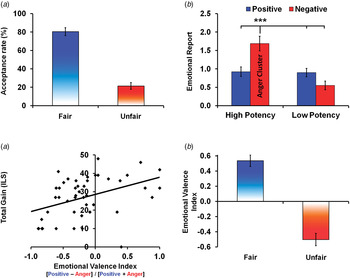
To assess behavior in the modified UG we averaged acceptance rates (in percentage) for each fairness category (fair/unfair). In line with standard UG results and similar to the pre-exposure time point, we found that fair offers (80.43, s.d. = 28.61) were accepted more than unfair offers (21.43, s.d. = 24.60), as noted by a main effect of fairness (F
1,44 = 217.29, p < 0.001,
 $\eta _p^2 $
= 0.83; Fig. 2a
). This result did not differ between soldiers and civilians (F
1,44 = 1.11, p = 0.300,
 $\eta _p^2 $
= 0.03) and for both groups this result did not change when comparing these participants between time points (F
1,44 = 0.43, p = 0.518,
 $\eta _p^2 $
= 0.01). Next, we calculated the total gain accumulated throughout the entire game and used that as an objective measure of individual differences reflecting the final outcome of the modified UG. Though total gain and overall acceptance rates highly correlated (r = 0.949, p < 0.001), total gain is a more accurate measure for individual differences (e.g. one who accepted 10:10 and 4:16 offers has a different gain but equal acceptance rate compared with one who accepted 9:11 and 8:12 offers).
Anger induction-related behavior and emotional report at the second time point. (a) Participants playing the anger-infused modified Ultimatum Game accepted fair offers more than unfair offers (p < 0.001). (b) A significant interaction (p < 0.001) indicated that participants’ emotional experience was mostly associated with angry feelings (*** p < 0.001 for each comparison with the other clusters). (c) As participants reported a more positive and less angered emotional experience in the game, calculated as the Emotional Valence Index (EVI), so they had a higher total gain (Pearson's r = 0.412, p = 0.004), indicating more gain accumulated throughout the game. ILS, Israeli New Shekels. (d) Based on the EVI, fair offers were associated with more positive and fewer angry feelings while unfair offers were associated with more angry and fewer positive feelings (p < 0.001). None of these results differed between soldiers and civilians, neither at the first time point nor across time points. In all results presented here, sample size n = 46. Values are means, with standard errors represented by vertical bars. For a color figure, see the online article.

To revalidate the overall anger induction of our modified UG we examined the average reported emotions for all UG rounds based on the two GEW axes of potency (high/low) and valence (positive/negative) and found a significant potency × valence interaction (F
1,44 = 32.44, p < 0.001,
 $\eta _p^2 $
= 0.42; Fig. 2b
). Follow-up analyses indicated that the negative high-potency cluster, which includes anger, hostility, contempt and disgust (hereby named the anger cluster), was the most reported category of emotions (1.69, s.d. = 1.34), compared with all other categories (p’s < 0.001). In addition, there was no difference between the two positive clusters (high potency = 0.92 , s.d. = 0.88; low potency = 0.90, s.d. = 0.77; p = 0.998). This result did not differ between soldiers and civilians (F
1,44 = 0.01, p = 0.914,
 $\eta _p^2 $
= 0.00) and for both groups this result did not change when comparing participants between time points (F
1,44 = 0.45, p = 0.507,
 $\eta _p^2 $
= 0.01).
We previously showed that creating an index of the anger v. positive clusters of emotions better explained variability in total gain (Gilam et al. Reference Gilam, Lin, Raz, Azrielant, Fruchter, Ariely and Hendler2015). We thus calculated for each participant a standardized Emotional Valence Index (EVI): (positive cluster – anger cluster)/(positive cluster + anger cluster). A positive EVI indicated that more positive and fewer anger emotions were reported while a negative EVI indicated the reverse. To assess the relationship between the behavior and the emotional experience induced by the modified UG we looked at the correlation between EVI and total gain. We found that for all participants, a more positive EVI correlated with greater total gain (r = 0.412, p = 0.004; Fig. 2c ). In addition we found a significant difference (t 45 = 12.59, p < 0.001, Cohen's d = 1.02; Fig. 2d ) between average EVI of fair (0.54, s.d. = 0.51) and unfair (−0.50, s.d. = 0.54) offers, indicating that unfair offers elicited more angry and fewer positive feelings and the opposite pattern for fair offers. Taken together, results indicated that similar to the pre-exposure time point and in line with our expectation, at the post-exposure time point there was a relationship between behavior in the game and the corresponding emotional experience that validated the anger induction and did not differ between soldiers and civilians.
The relationship between soldiers’ stress symptoms and their behavioral, emotional and brain indices of anger
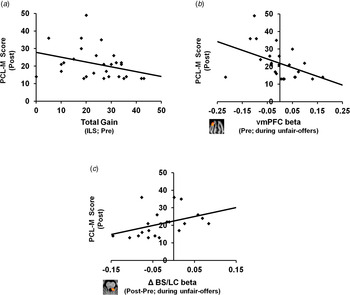
A potential methodological confound may exist in correlations between anger and stress symptoms measures since physical reactions, anger, hypervigilance and startleness are all anger and aggression concomitants as well as being symptoms of post-traumatic stress (Novaco & Chemtob, Reference Novaco and Chemtob2002; Jakupcak et al. Reference Jakupcak, Conybeare, Phelps, Hunt, Holmes, Felker, Klevens and McFall2007). To avoid circularity between measures and refute this possible confound we removed these symptoms’ items (#5, #14, #16 and #17) from the PCL-M score. We first assessed whether behavioral, emotional and brain indices of anger pre-exposure as measured by total gain, EVI, vmPFC and BS/LC activation during unfair offers predict soldiers’ stress symptoms post-exposure as measured by PCL-M score. We found that higher PCL-M score post-exposure was predicted by lower total gain (ρ = −0.450, p = 0.014, n = 29) (Fig. 3a ) and lower vmPFC activation during unfair offers (ρ = −0.524, p = 0.009, n = 24) (Fig. 3b ), as measured pre-exposure. To assess whether the change in the same anger indices between post- and pre-exposure had a relationship with soldiers’ stress symptoms post-exposure we calculated a difference score for each index between post- and pre-exposure and then tested the correlation with PCL-M score post-exposure. We found that higher PCL-M score post-exposure related to a greater increase in BS/LC activation during unfair offers between post- and pre-exposure (ρ = 0.495, p = 0.027, n = 20) (Fig. 3c ). To note, these three significant correlations were significant also when considering all items of the PCL (p gain = 0.011; p vmPFC = 0.012; p ΔBS/LC = 0.049). No other significant results were found, also when considering brain activation during fair offers (p’s > 0.445).
Relationship between soldiers’ stress symptoms and their behavioral, emotional and brain indices of anger. (a) and (b) show that lower Post-Traumatic Stress Disorder Check-List – Military (PCL-M) scores post-combat training were predicted by pre-combat training higher total gain (Spearman's ρ = −0.450, p = 0.014, n = 29) and higher ventromedial prefrontal cortex (vmPFC) activation during unfair offers (ρ = −0.524, p = 0.009, n = 24), respectively. ILS, Israeli New Shekels. (c) Higher increase in brainstem (BS)/locus coeruleus (LC) activation during unfair offers between pre- and post-combat training (calculated as post – pre) was related to higher PCL-M scores post-combat training (ρ = 0.495, p = 0.027, n = 20).

Discussion
Embedding dynamic social interactions to infuse naturalistic anger within the classic UG paradigm we were able to induce anger, especially during the unfair offers, in both civilians and soldiers across two time points. Moreover, as shown at the first time point, participants gaining more money along the game reported less anger as well as more positive feelings, suggestive of the idiosyncratic link between the subjective emotional experience and the tendency to accept or reject anger-infused UG offers. In line with our hypothesis, we found an increase, though marginal, in stress symptoms among a priori healthy soldiers over a 1-year period of combat training assumed to induce chronic stress, whereas a similar period of civil service did not have such an influence on a matched group of civilians. Importantly, and confirming our hypothesis, we found that game-related behavior and brain activation correlated with the degree of stress symptoms among soldiers following combat training. Specifically, as soldiers gained more money throughout the game and had more vmPFC activation during unfair offers pre-exposure, so they reported fewer symptoms following combat training. In addition, more symptoms among soldiers correlated with a larger increase in BS/LC activation during unfair offers over time (between pre- and post-combat training). These findings provide unique causal evidence that the vmPFC and BS/LC, two major nodes in emotion and arousal regulation, respectively, contribute to the overall vulnerability of individuals to combat training stress symptoms. Critically, the trajectory of this vulnerability is portrayed in a specific context of interpersonal anger, a critical symptom in anxiety and stress-related disorders, thus providing an ecological framework for possible therapeutic intervention.
The findings of our prospective neuroimaging study support the suggestion that stress symptoms are characterized by an underlying dysfunctionality in the neural circuit subserving emotion and arousal regulation (Frewen & Lanius, Reference Frewen and Lanius2006; Pitman et al. Reference Pitman, Rasmusson, Koenen, Shin, Orr, Gilbertson, Milad and Liberzon2012; Seligowski et al. Reference Seligowski, Lee, Bardeen and Orcutt2015). However, they also extend the understanding of the neural mechanisms that mediate the development and manifestation of stress symptoms in several novel aspects. First, since vmPFC activation predicted stress symptoms, in addition to the commonly demonstrated acquired neural abnormality of vmPFC following PTSD (Admon et al. Reference Admon, Milad and Hendler2013b ), it is possible to claim that vmPFC functionality may also serve as a predisposing risk factor for the development of stress symptoms among soldiers exposed to combat training. Strikingly, this predictive sensitivity of the vmPFC is demonstrated in a context of an angering interpersonal situation rather than the commonly studied context of fear (e.g. Etkin & Wager, Reference Etkin and Wager2007), which might explain why such a finding is currently absent from predictive models of PTSD development (Admon et al. Reference Admon, Milad and Hendler2013b ). This also suggests that enhanced vmPFC activation which here may possibly reflect anger-regulation capabilities might buffer the accumulating influence of stress on the development of related symptoms. This is consistent with previous more general findings indicating that emotion dysregulation is predictive of the development of post-traumatic stress symptoms (Kumpula et al. Reference Kumpula, Orcutt, Bardeen and Varkovitzky2011; Bardeen et al. Reference Bardeen, Kumpula and Orcutt2013).
Second, we found that when comparing the two time points, BS/LC activation, which here seems to reflect arousal and aggression induced by angering provocations, increased following exposure proportionately to the level of stress symptoms following combat training. Assuming that BS activation indeed corresponds to the LC, this to our knowledge is the first indication in humans of a causal relationship between alterations in the LC-NA system following chronic stress and the development of stress symptoms among a priori healthy individuals. This result is congruent with previous findings showing enhanced reactivity of the LC-NA system in a validated rat model of PTSD (George et al. Reference George, Knox, Curtis, Aldridge, Valentino and Liberzon2013) and supports the suggestion that prototypical stress symptoms such as increased arousal, vigilance and aggression are attributed to an acquired neural dysfunction and specifically heightened reactivity in the LC-NA system (e.g. Berridge & Waterhouse, Reference Berridge and Waterhouse2003).
Taken together, our result seems to support the proposition that angry outbursts as a stress symptom might represent a failure to regulate low-level reactivity to threat, and this reactivity in itself might be excessive due to a lowered threshold of threat detection (Chemtob et al. Reference Chemtob, Novaco, Hamada and Gross1997a , Reference Chemtob, Novaco, Hamada, Gross and Smith b ). Within such a framework, the LC-NA system, which is involved in averting attention and modifying behavior in view of threatening stimuli, would be in charge of executing aggressive reactions and following a stress-related perturbation would be more sensitive to threat and thus more prone to such reactions. In parallel, the vmPFC which is involved in regulating angry and aggressive reactions, would possibly have more difficulty in successfully regulating these reactions due to their stress-related excess, and especially if such a regulatory role appears to be a priori flawed. Further investigations are needed to solidify this proposition, while taking into account the underlying molecular interaction between the PFC and the LC-NA system (Arnsten et al. Reference Arnsten, Raskind, Taylor and Connor2015) under stressful conditions, and especially in clinical populations.
Furthermore, it is important to consider that several neurobiological systems interact and are involved in response to stress (Pitman et al. Reference Pitman, Rasmusson, Koenen, Shin, Orr, Gilbertson, Milad and Liberzon2012) as in anger (Gilam & Hendler, Reference Gilam, Hendler, Wöhr and Krach2015). The LC-NA system, for example, governs autonomic arousal which is an important component in the physiological response of anger and aggression (Stemmler, Reference Stemmler, Potegal, Stemmler and Spielberger2010). Pharmacological interventions increasing NA in the brain have been shown to have anxiolytic effects in PTSD patients (Southwick et al. Reference Southwick, Bremner, Rasmusson, Morgan, Arnsten and Charney1999). Evidence suggests a differential pattern of autonomic responsivity to traumatic stimuli between PTSD patients and controls, but not during rest or in response to non-traumatic stimuli (Bremner et al. Reference Bremner, Krystal, Southwick and Charney1996; Vedantham et al. Reference Vedantham, Brunet, Neylan, Weiss and Mannar2000). This may indicate that LC-NA alterations in PTSD are context dependent, and in view of the engagement of this system in anger and aggression, may thus be especially exposed during anger-prone instances. Interestingly, it is suggested that high levels of NA during stress may weaken PFC functionality (Arnsten et al. Reference Arnsten, Raskind, Taylor and Connor2015). The serotonergic system, on the other hand, has inhibitory effects on the LC and has been shown to be involved in anxiety, anger, impulsive aggression and emotion regulation (Young & Leyton, Reference Young and Leyton2002; Canli & Lesch, Reference Canli and Lesch2007; Yoon et al. Reference Yoon, Lee, Kim, Lee and Ham2012), as well as with behavior in the UG (Crockett et al. Reference Crockett, Clark, Tabibnia, Lieberman and Robbins2008; Emanuele et al. Reference Emanuele, Brondino, Bertona, Re and Geroldi2008). This may offer an interesting avenue for future investigations, especially in view of anxiety treatments based on dual-reuptake inhibitors of both serotonin and NA (Baldwin, Reference Baldwin2006).
We recently proposed a model which aimed to disentangle predisposing from acquired neural abnormalities of PTSD (Admon et al. Reference Admon, Milad and Hendler2013b ), highlighting hyperactivity of the amygdala and dorsal anterior cingulate cortex as predisposing factors and vmPFC–hippocampus hypoconnectivity as an acquired factor, with the insula, dorsomedial PFC and nucleus accumbens (NAcc) suggested as possible mediators. The model was based on several research approaches, most of which implemented paradigms such as viewing neutral and emotional faces or pictures. As far as we know, only one prospective study implemented an interactive game, though tapping into individuals’ sensitivity to risk and reward, not to anger, and revealing that an acquired imbalanced relation between the amygdala and NAcc best predicted traumatic stress symptoms following exposure to combat (Admon et al. Reference Admon, Lubin, Rosenblatt, Stern, Kahn, Assaf and Hendler2013a ). Our current study introduces yet another interactive paradigm, further emphasizing the importance of social interactions in emotional experiences (Gilam & Hendler, Reference Gilam and Hendler2016), and especially for inducing genuine anger and aggressive retributions. Hence, we may test for predisposing and acquired neural factors in a demanding and anger-provoking dynamic interpersonal situation that imitates real-life occurrences in which PTSD patients are prone for emotion dysregulation and maladaptive behavior. We pertain that to fully untangle the circular relation between trauma/stress and related psychopathologies, one should deconstruct psychological manifestations by their process domain and examine brain functionality in the relevant context (e.g. risk and reward, interpersonal anger). Such a context-dependent neurobehavioral approach may advance the characterization of trauma-induced psychopathology and assist in tailoring personalized interventions in psychiatry, for example by using neurofeedback (Keynan et al. Reference Keynan, Meir-Hasson, Gilam, Cohen, Jackont, Kinreich, Ikar, Or-Borichev, Etkin, Gyurak, Klovatch, Intrator and Hendler2016).
This study's results support previous findings based on self-report questionnaires (Heinrichs et al. Reference Heinrichs, Wagner, Schoch, Soravia, Hellhammer and Ehlert2005; Meffert et al. Reference Meffert, Metzler, Henn-Haase, McCaslin, Inslicht, Chemtob, Neylan and Marmar2008; van Zuiden et al. Reference van Zuiden, Kavelaars, Rademaker, Vermetten, Heijnen and Geuze2011; Lommen et al. Reference Lommen, Engelhard, van de Schoot and van den Hout2014) that anger dysregulation has a specific contribution to stress symptoms, not only as a consequence of but also as a possible cause for their development. We expanded on these results by inducing interpersonal anger using a dynamic social-interactive paradigm and measuring its behavioral and neural concomitants, showing specific anger-related brain activations sensitive to the development and manifestation of stress symptoms. Notwithstanding, several important limitations must be considered. The neurobehavioral indices of anger explained only about a third of the variability in combat training stress symptoms, leaving a proportion of variability to factors such as previous possible stressful experiences that were not assessed. Additionally, the specific characteristics of the current sample, being small in size, all of male gender from a military cohort and reflecting stress symptoms following combat training and not actual traumatic events, may limit the generalizability of these findings to clinical conditions and should be addressed in future studies. Nevertheless, this study reveals the importance of understanding functional impairment in subclinical symptomatic populations (Grubaugh et al. Reference Grubaugh, Magruder, Waldrop, Elhai, Knapp and Frueh2005; Jakupcak et al. Reference Jakupcak, Conybeare, Phelps, Hunt, Holmes, Felker, Klevens and McFall2007; Cukor et al. Reference Cukor, Wyka, Jayasinghe and Difede2010). This is especially crucial in populations with high risk of traumatic stress exposure, as in the current sample of to-be-deployed combat soldiers. In conclusion, from a therapeutic perspective, since anger restricts and impedes treatment efficacy of PTSD (Forbes et al. Reference Forbes, Parslow, Creamer, Allen, McHugh and Hopwood2008), treating anger is of high priority as it may ultimately improve also other PTSD-related symptoms. We thus hope that this study may provide a springboard for the development of both pre-exposure inoculation treatment for at-risk populations and post-exposure process-targeted interventions for patients with acquired deficits, based on the idiosyncratic behavioral and neural indicators of maladaptive interpersonal anger.
Supplementary material
The supplementary material for this article can be found at https://doi.org/10.1017/S0033291716003354
Acknowledgements
We thank J. Ne'eman and G. Raz for conceptual insights, R. Admon and R. Abend for providing comments on an earlier draft of the manuscript, the Sagol Network for Neuroscience and all the volunteers who agreed to participate in this project. G.G. thanks G. Gilam Sr. and S. Gilam.
This work was financially supported by the University of Chicago's Arete Initiative – A New Science of Virtues Program (39174-07; awarded to T.H., Rakefet Sela-Sheffy and Judd Ne'eman); a US Department of Defense award (W81XWH-11-2-0008; T.H.); the I-CORE Program of the Planning and Budgeting Committee (51/11; T.H.); the Israeli Ministry of Science, Technology and Space (3-11170; T.H.); and the Levy Edersheim Gitter Institute for Neuroimaging and the Adams Super Center for Brain Studies, Tel Aviv University (G.G.).
Declaration of Interest
None.