Significant outcomes
• Tamil version of Beck Cognitive Insight Scale is an internally consistent and valid instrument to assess cognitive insight of the patients with schizophrenia
• Cognitive insight is significantly associated with treatment compliance after adjusting for the effects of gender and psychopathology
• The conventional two component model of cognitive insight is not replicated in cross-cultural settings
Limitations
• Cross-sectional study design.
• As Beck Cognitive Insight Scale (BCIS-T) is a self-report inventory, this study has excluded severely ill patients who could not participate in any assessment.
• BCIS-T was employed only for the patients who could read and write Tamil.
Introduction
Insight is defined as the correct attitude to morbid change in oneself and the realisation that the illness is psychological (Reference Lewis1). Lack of insight has been considered as the hallmark of schizophrenia and other psychotic disorders (Reference Jablensky, Sartorius, Ernberg, Anker, Koften and Cooper2). However, insight is better conceptualised as a dimensional continuum than as arbitrary categories. Current multidimensional view on insight presents three inter-related components (Reference David, Amador and David3), namely awareness of mental illness, relabelling psychotic experiences as abnormal and medical help-seeking (Reference David4).
Studies from Vellore, India, on explanatory models of schizophrenia have documented that people may simultaneously hold multiple contradictory beliefs about their illnesses and many people may simultaneously seek medical and non-medical treatments (Reference Saravanan, Jacob, Prince, Bhugra and David5,Reference Saravanan, David, Bhugra, Prince and Jacob6). Hence, the awareness and help-seeking dimensions of insight need cross-cultural adaptations to incorporate local cultural explanations of illness and culturally sanctioned non-medical help-seeking behaviours. The relabelling dimension is relatively culture free because the impairment of self-reflection in patients with psychosis has been documented across cultures (Reference Saravanan, Jacob, Johnson, Prince, Bhugra and David7).
The cognitive insight has its foundation on the relabelling dimension of the clinical insight. The ability of the psychotic patients to reflect rationally on their anomalous experiences and to recognise that their conclusions are incorrect is called as cognitive insight (Reference Beck, Baruch, Balter, Steer and Warman8). Beck Cognitive Insight Scale (BCIS) has so far been the most validated and widely used scale to evaluate cognitive insight (Reference Beck, Baruch, Balter, Steer and Warman8,Reference Pedrelli, McQuaid and Granholm9). Cognitive insight has two inversely related components, namely self-reflection and self-certainty (Reference Engh, Friis and Birkenaes10). Low self-reflection and high self-certainty are associated with delusion proneness (Reference Engh, Friis and Birkenaes11). The neurobiology underlying cognitive insight (Reference Buchy, Czechowska and Chochol12) as well as the relationship between cognitive insight and verbal memory (Reference Lepage, Buchy, Bodnar, Bertrand, Joober and Malla13) has been the focus of recent research.
Scales on clinical insight, which have been validated in non-Western populations, are rare (Reference Saravanan, David, Bhugra, Prince and Jacob6). Studies from the non-Western populations validating assessment of cognitive insight are rarer (Reference Kao and Liu14). Moreover, available studies have not directly investigated the important relationship between cognitive insight and treatment compliance (Reference Kao and Liu14–Reference Favrod, Zimmermann, Raffard, Pomini and Khazaal16). Hence, we aimed to evaluate the validity of Tamil version of Beck Cognitive Insight Scale (BCIS-T) among the patients with schizophrenia, against a reference standard which assessed both clinical insight and treatment compliance.
Materials and methods
Study design
A study of diagnostic accuracy to evaluate the validity of Tamil version of Beck Cognitive Insight Scale (BCIS-T) assessing cognitive insight.
Setting
The department of Psychiatry, Christian Medical College, Vellore, India, is a tertiary care psychiatric facility for the State of Tamilnadu and for South India. This 122-bed hospital has a daily outpatient clinic and provides short-term inpatient care for the patients with a wide variety of psychiatric disorders including schizophrenia. The emphasis is on a multidisciplinary approach and eclectic care using a wide repertoire of pharmacological and non-pharmacological interventions.
Sample size estimation
We estimated the prerequisite sample size with ‘Medcalc' statistical software (Reference Schoonjans, Zalata, Depuydt and Comhaire17). With an α error of 0.05, a beta error of 0.2, a priori power of 80% and critical value of two-tailed correlation coefficient at 0.25, the sample size requirement was estimated to be 123 to establish the convergent validity between BCIS-T and the reference standard.
Participants
All consecutive inpatients as well as outpatients of the Department of Psychiatry, Christian Medical College, Vellore, between February and March 2010, were considered for possible inclusion in this study, if they satisfied the following criteria: (a) International Classification Diseases-10 Diagnostic criteria for Research (ICD-10 DCR) diagnosis of schizophrenia (F 20) (18), (b) age above 18 years, (c) ability to read and write Tamil and (d) patients and their first-degree relatives should be willing to provide written informed consent to participate in the study. The patients were excluded if they had severe psychopathology, medical illnesses or sensory impairment precluding the assessments. They were excluded if they were mute or too agitated to participate in any assessment.
Instruments
We used the following instruments for all participants:
1 BCIS (Reference Beck, Baruch, Balter, Steer and Warman8): It is a self-report inventory with 15 items which are divided into two subscales, namely self-reflection and self-certainty. It can be completed within 5–10 min. Each item is scored on a Likert scale ranging from 0 to 3. Sum of scores on self-certainty subscale items is subtracted from the sum of scores on self-reflection subscale items to derive the BCIS composite index (Reference Beck, Baruch, Balter, Steer and Warman8,Reference Pedrelli, McQuaid and Granholm9). It has been shown to have good internal consistency such as Cronbach's α ranging between 0.60 and 0.68. It also has good convergent validity with Positive and Negative Symptoms Scale (PANSS) insight item (Reference Engh, Friis and Birkenaes10,Reference Favrod, Zimmermann, Raffard, Pomini and Khazaal16), Scale to assess Unawareness of Mental Disorder (SUMD) (Reference Beck, Baruch, Balter, Steer and Warman8,Reference Lepage, Buchy, Bodnar, Bertrand, Joober and Malla13) and Birchwood Insight Scale (Reference Pedrelli, McQuaid and Granholm9). BCIS has so far been translated and validated in Taiwanese (Reference Kao and Liu14) and Japanese (Reference Uchida, Matsumoto and Kikuchi15) languages. We translated BCIS into Tamil for this study. BCIS-T was the index or experimental instrument in this study.
2 SAI-E (Reference Sanz, Constable, Lopez-Ibor, Kemp and David19,Reference Kemp, David and Blackwell20): It has been applied widely in Western and non-Western countries (Reference Saravanan, Jacob, Johnson, Prince, Bhugra and David7) for the assessment of insight. It comprises questions to assess three dimensions of insight: awareness, relabelling of symptoms and treatment adherence, plus labelling a ‘hypothetical contradiction' item added to evaluate the person's capacity to consider others' perspective. This expanded version also includes items on awareness of change, difficulties resulting from the psychotic condition and insight into key symptoms. Each dimension comprises two or three questions which are scored on a 3-point Likert scale from 0 (no insight) to 2 (good insight), with a total score of 24. The supplementary question is scored from 0 to 4 and this is added to the SAI-E total score, which makes the maximum total score as 28. Higher scores indicate better clinical insight. SAI-E is a comprehensive assessment system rated by a multidisciplinary team. A therapist rates all insight items and nursing staffs rate the items on treatment compliance. SAI-E has a separate summary score on treatment compliance ranging from 1 to 7, which is not added to other SAI-E total scores. The SAI-E has been shown to have high convergent validity with other measures of insight, namely the insight question of the PANSS (ρ = 0.895) and the Insight and Treatment Attitudes Questionnaire (ρ = 0.845) (Reference Sanz, Constable, Lopez-Ibor, Kemp and David19). We chose SAI-E as the reference standard for this study because of its earlier use in our population (Reference Saravanan, Jacob, Prince, Bhugra and David5–Reference Saravanan, Jacob, Johnson, Prince, Bhugra and David7) and of its provision of separate rating on treatment compliance.
3 BPRS (Reference Overall and Gorham21): BPRS was developed by Overall and Gorham as a short scale for measuring the severity of psychopathology. It covers a broad range of areas including thought disturbance, emotional withdrawal, anxiety, depression, hostility and suspiciousness. It is a clinician-rated scale, which can be administered within 30 min, including patient interview and observation. It has 18, 19, 20 and 24 item versions. Its 24 items are rated on a 7-point item-specific Likert scale from 1 to 7 with a total score ranging from 24 to 168. BPRS has a good inter-rater reliability of 0.72–0.87. Validity of BPRS is measured by correlations with other measures of severity of psychopathology. As cognitive insight is conceptually distinct from psychopathology (Reference Lepage, Buchy, Bodnar, Bertrand, Joober and Malla13,Reference Favrod, Zimmermann, Raffard, Pomini and Khazaal16), we chose BPRS to evaluate the discriminant validity of BCIS-T.
Translation of BCIS-T
The translation and back translation process for BCIS-T followed the standard procedures by a team of six bilingual health professionals. First, two bilingual health professionals independently translated the English version of BCIS into Tamil. Two more bilingual health professionals, who had not seen the English version of BCIS, independently translated these Tamil versions back to English. Then, these four translators met with two of the bilingual investigators (A. P. R. and M. T. J.) to discuss the discrepancies between the original version of BCIS and the back-translated versions. The final version of BCIS-T was formed by a consensus agreement on the most appropriate translations with emphasis on content and conceptual, semantic and technical equivalence.
Data collection
The principal investigator (M. T. J.) provided a fact sheet and explained the details of the study to each patient and his/her first-degree relatives. She obtained written informed consent from the patients and from their first-degree relatives. She recorded relevant socio-demographic details and provided BCIS-T to all participants. On the same day, an independent investigator (R. S.) used the SAI-E. A psychiatric nurse from the treating team (V. S.) rated the participants on the SAI-E summary score on treatment compliance. A qualified psychiatrist (T. S.) independently assessed their psychopathology with BPRS. SAI-E summary score on treatment compliance and the BPRS were also assessed on the same day. All four investigators remained masked to others' findings till the end of data analysis to minimise observer bias. An independent investigator (A. P. R.) compiled their data and analysed them.
Ethical considerations
The fact sheet about this study included the nature and purpose of this study, explanation of the involved procedures, expected duration of involvement, possible benefits of the study, limits of confidentiality, the voluntary nature of participation and the participants' right to withdraw from the study without prior notice. The principal investigator ensured that the participants and their first-degree relatives understood all the details provided in the fact sheet and provided their written informed consent voluntarily without any coercion. The protocol of this study was approved by the Institutional Review Board of Christian Medical College, Vellore, India.
Data analysis
We initially analysed the socio-demographic data and the clinical profile using descriptive statistics. We used one sample Kolmogorov Smirnov Test to check whether all continuous variables were normally distributed. We assessed the internal consistency of BCIS-T by Cronbach's α coefficient and by Guttman's split-half coefficient. We documented the convergent validity of BCIS-T with SAI-E using Spearman rank-order correlation statistics. We calculated the discriminant validity of BCIS-T with BPRS using bivariate Pearson correlation statistics. We checked the suitability of our data for factor analysis by Kaiser–Meyer–Olkin (KMO) measure of sampling adequacy and by Bartlett's test of sphericity. We performed the data structuring and factor analysis of BCIS-T with principal axis factoring, followed by Varimax rotation with Kaiser normalisation. We extracted all factors which had Eigen values above 1. We studied the relationship between BCIS-T composite index, clinical insight and treatment compliance by appropriate multiple linear regression statistics. Most, if not all, of insight assessment scales adopt dimensional approach and do not claim any arbitrary cut-off values to dichotomously categorise the presence or the absence of insight. Hence, unlike most studies on diagnostic accuracy, we desisted calculating the sensitivity, specificity, predictive values and receiver operating characteristic curve statistics with debatable cut-off values. We analysed our data with the statistical software package, SPSS 16.0.
Results
Participant characteristics
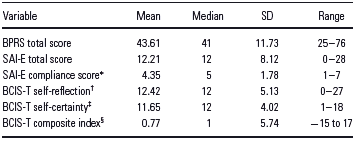
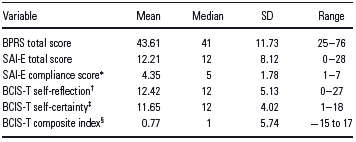
We assessed 158 consecutive patients with schizophrenia attending the Department of Psychiatry, Christian Medical College, Vellore, during the study period. Five patients (3.2%) refused consent because of personal reasons and lack of interest in the study objectives. We excluded three patients (1.9%) because of the presence of severe psychopathology precluding assessments. We recruited the remaining 150 (94.9%) who provided written informed consent to participate in the study. Eighty-six (57.3%) men and 64 (42.3%) women constituted our sample. Participants (n = 150) and those who were excluded (n = 8) did not differ significantly on their gender (Fisher exact p = 0.73). We have presented the psychopathology, insight, cognitive insight and treatment compliance of the participants in Table 1.
Clinical profile of the participants (N = 150)
* Summary score of compliance to treatment not combined with other SAI-E scores.
† BCIS-T subscale items 1, 3, 4, 5, 6, 8, 12, 14 and 15.
‡ BCIS-T subscale items 2, 7, 9, 10, 11 and 13.
§ Self-certainty subscale score subtracted from self-reflectiveness subscale score.
Internal consistency
BCIS-T was internally consistent with a Cronbach's α of 0.67 and a Guttman's split-half coefficient of 0.63. BCIS-T self-reflection and self-certainty subscales were also internally consistent with Cronbach's α values of 0.61 and 0.65, respectively.
Construct validity
We presented the correlation matrix between BCIS-T subscale scores, BCIS-T composite index, SAI-E total insight as well as treatment compliance scores and BPRS total scores in Table 2. As the distribution of SAI-E scores was non-parametric in our sample, we used Spearman rank-order correlation statistics. We analysed other correlations with parametric Pearson correlation coefficients. BCIS-T composite index showed convergent validity with significant positive correlation with SAI-E total insight scores. We supported its discriminant validity by lack of significant association with BPRS. Both BCIS-T subscales did not have significant correlation with BPRS. BCIS-T self-reflection subscale was significantly correlated with SAI-E insight score but not with compliance score. BCIS-T self-certainty subscale had significant negative correlation with SAI-E compliance score but not with insight score. There was significant negative correlation between the BPRS and the SAI-E insight as well as compliance scores.
Correlation matrix between BPRS, SAI-E and BCIS-T (N = 150)

* Spearman correlation coefficient.
† Summary score of compliance to treatment not combined with other SAI-E scores.
‡ BCIS-T subscale items 1, 3, 4, 5, 6, 8, 12, 14 and 15.
§ BCIS-T subscale items 2, 7, 9, 10, 11 and 13.
|| Self-certainty subscale score subtracted from self-reflectiveness subscale score.
¶ Significant p value <0.05 (shown as bold values).
** Significant p value <0.01 (shown as bold values).
We also tested the construct validity of BCIS-T by using another scoring method. We scored the self-certainty subscale items in reverse (do not agree at all = 3; agree completely = 0) and then add scores of all items to get the BCIS-T total score. Such BCIS-T total score ranged between the minimum of 3 and maximum of 35 in our sample (mean = 18.80; median = 19; SD = 5.74). It showed convergent validity with significant positive correlation with SAI-E total insight scores (ρ = 0.37; p < 0.001). It also had significant positive correlation with SAI-E compliance score (ρ = 0.31; p < 0.001). We also supported the discriminant validity of this method of scoring by lack of significant association with BPRS (ρ = −0.01; p = 0.90).
Factor structure
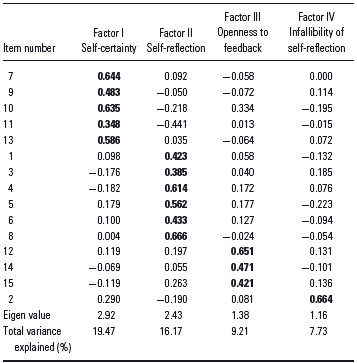
KMO measure of sampling adequacy was 0.683. Bartlett's test of sphericity rejected the hypothesis that our correlation matrix was an identity matrix (X 2 = 419.96; p < 0.001). Both these tests confirmed that our data were suitable for further factor analysis. After principal axis factoring, there were four factors with Eigen values 1 and above. The factor loadings for the individual items of BCIS-T were presented in Table 3. The nine items of the original version of BCIS (Reference Beck, Baruch, Balter, Steer and Warman8) self-reflection subscale segregated into two factors of BCIS-T: Factor II and Factor III. Six items (1, 3, 4, 5, 6 and 8) loaded on Factor II, namely ‘self-reflection'. Items 12, 14 and 15 loaded on Factor III called ‘openness to external feedback'. The remaining six items of the original version of BCIS (Reference Beck, Baruch, Balter, Steer and Warman8) self-certainty subscale segregated into two factors of BCIS-T, Factor I and Factor IV. Five items (7, 9, 10, 11 and 13) heavily loaded on Factor I, namely ‘self-certainty'. Another one item (2: ‘My interpretations of my experiences are definitively right') stood out as Factor IV called ‘Infallibility of self-reflection'.
Factor loadings for the items of BCIS-T (N = 150)Footnote *
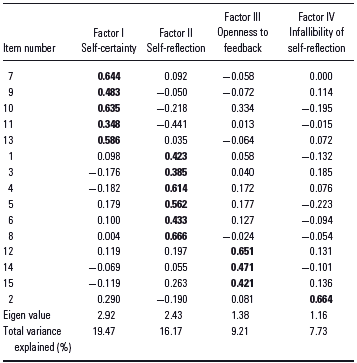
* The bold values indicate the factors on which the BCIS-T items were heavily loaded.
* Extraction with principal axis factoring; Varimax rotation with Kaiser normalisation.
BCIS-T and compliance
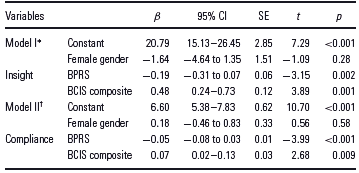
We presented the relationship between BCIS-T composite index and SAI-E total insight as well as compliance scores after accounting for the effects of gender and psychopathology in Table 4. As men (mean = 1.92; SD = 5.36) had significantly better cognitive insight (F = 8.52, p = 0.004) than women (mean = −0.78; SD = 5.92) in our sample, we adjusted for the confounding effects of gender during multivariate analyses. BCIS-T composite index had significant linear relationship with SAI-E insight as well as compliance scores. We also assessed the relationship between alternatively scored BCIS-T total score and SAI-E total insight as well as compliance scores after accounting for the effects of gender and psychopathology. Such BCIS-T total score also had significant linear relationship with SAI-E insight (β = 0.47; SE = 0.12; t = 3.82; p < 0.001) as well as compliance (β = 0.07; SE = 0.02; t = 3.26; p < 0.001) scores.
Multivariate analysis of relationship among insight, treatment compliance and BCIS-T composite index adjusted for the effects of gender and psychopathology (N = 150)
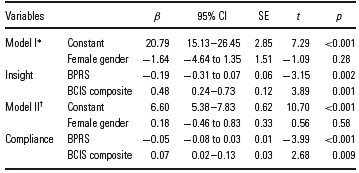
* CI, confidence interval.
* Dependant variable is SAI-E total score.
† Dependant variable is SAI-E summary score of compliance to treatment not combined with other SAI-E scores.
Discussion
Our findings support that the BCIS-T is an internally consistent and valid instrument to assess cognitive insight of the patients with schizophrenia. This study is the largest in terms of number of participants with schizophrenia, to systematically evaluate the validity of BCIS in non-Western (Reference Kao and Liu14,Reference Uchida, Matsumoto and Kikuchi15) as well as Western (Reference Engh, Friis and Birkenaes10,Reference Favrod, Zimmermann, Raffard, Pomini and Khazaal16) populations. The strengths of this study include minimal refusal rate, consecutive sampling to minimise selection bias, assessment by four independent masked investigators to minimise observer bias, assessment of treatment compliance and the choice of an appropriate reference standard. Its limitations are the exclusion of severely ill patients, its cross-sectional nature and lack of non-psychotic controls. As BCIS-T is a self-report inventory, we did not consider inter-rater agreement statistics. We also did not attempt to assess test–retest reliability statistics because insight and cognitive insight are dynamic as well as state-dependent phenomena.
Internal consistency estimates of BCIS-T in our population were consistent with the previous studies (Reference Beck, Baruch, Balter, Steer and Warman8). Construct validity of BCIS with good convergent and discriminant validity has also been replicated with another reference standard, SAI-E (Reference Beck, Baruch, Balter, Steer and Warman8,Reference Pedrelli, McQuaid and Granholm9,Reference Lepage, Buchy, Bodnar, Bertrand, Joober and Malla13–Reference Favrod, Zimmermann, Raffard, Pomini and Khazaal16). However, our study yields two new findings hitherto not reported. They are (a) the four-factor structure of BCIS-T in our population and (b) the significant linear relationship between cognitive insight and treatment compliance after adjusting for the effects of gender and psychopathology.
The inadequacies of traditional two-component model (self-reflection and self-certainty) of cognitive insight have already been discussed in the earlier studies. A previous study (Reference Warman and Martin22) contradicted the traditional relationship between cognitive insight and delusion proneness and documented that patients who were high on delusion proneness had higher scores on both self-reflection and self-certainty subscales of BCIS. Openness to external feedback and willingness to acknowledge fallibility also influenced delusion formation (Reference Warman and Martin22). Another non-Western study had to limit itself, by extracting only two factors and not all factors with Eigen values above 1, to adhere with the traditional two-factor model of BCIS (Reference Kao and Liu14). Those two factors had Eigen values of 4.24 and 2.66 and explained only 46.03% variation observed in their data. More than half of the variance was unexplained by the traditional two-factor solution and the factor loadings of individual items were not consistent with original subscales (Reference Kao and Liu14). The association between verbal learning as well as memory and self-reflection subscale has also been documented (Reference Buchy, Czechowska and Chochol12). This may lead the self-reflection domain vulnerable to the influences of culture and linguistics.
We believe that the self-reflection and self-certainty domains do not share a stable inverse relationship across all cultures. We suggest that their relationship is complex, dynamic and bidirectional. Factors such as ‘openness to external feedback' and ‘infallibility of self-reflection' may also contribute towards cognitive insight. We support an alternate scoring system in which the self-certainty subscale items are scored in reverse and then scores of all items are added to get the BCIS-T total score. Our data confirmed the construct validity of this scoring system and proved the significant linear relationship between BCIS-T total score and SAI-E insight as well as compliance scores. Such scoring system may entice the future investigators to question the boundaries of the traditional two subscales.
Our findings argue that cognitive insight significantly influences treatment compliance. Gender differences in the help-seeking behaviours and in the prognosis of schizophrenia are known in India (Reference Thara and Rajkumar23). Our data support that cognitive insight is significantly associated with treatment compliance after adjusting for the effects of gender and psychopathology. As better treatment compliance heralds good prognosis of schizophrenia, assessment of cognitive insight and treatment strategies to enhance cognitive insight of patients with schizophrenia invite further attention. We suggest the need for future longitudinal cross-cultural studies on the relationship between cognitive insight, clinical insight and psychopathology. We also suggest the need for further intervention trials investigating the efficacy of cognitive strategies to enhance long-term treatment compliance in cross-cultural settings.
Acknowledgements
This study was funded by the Christian Medical College, Vellore, India (Fluid research grant no: 22 × 319). M. T. J., A. P. R. and K. S. J. conceived this study and wrote the study protocol. M. T. J., T. S., R. S. and V. S. carried out the data collection. A. P. R. and K. S. J. analysed the data and wrote the manuscript. Other authors were involved in further editing and revision of the manuscript. We are grateful for the kind support of Professor A. Kuruvilla, Dr P. Thangadurai, Dr Sathya Shankar and Dr Simpson, department of Psychiatry, Christian Medical College, Vellore, all participants and their relatives. All authors declare that they have no competing interests.