

1. Introduction
Kaufman (Reference Kaufman1994) argued that the consequences for the community from contagion in the US banking system justified regulation different to that for the non-financial system. In support of specialist regulation for the banking system, Kaufman argued that
the evidence also suggests that, compared to nonbanks, bank failure contagion appears faster, is more likely to spread to a larger proportion of the industry, is likely to lead to a larger percentage of failures, although runs do not appear to drive solvent banks into insolvency, and is more likely to spill over to other sectors (Reference Kaufman1994).
Almost 20 years later, Kenourgios & Dimitriou (Reference Kenourgios and Dimitriou2015) similarly concluded in relation to the Global Financial Crisis (GFC) that “it seems that the GFC was mainly spread across regions through domestic/regional financial sectors to other domestic, non-financial sectors”, indicating that banking crises have a greater effect than just within the banking system. Regulation of the banking systems should then recognise the economy wide contagion effects (Kaufman Reference Kaufman1996). The current type of banking regulation involving capital requirements for individual banks, and usually some form of insurance for depositors has been criticised for some time as being ineffective, or at least inefficient. Boyer & Kempf (Reference Boyer and Kempf2017) recognised an inefficient aspect of this current regulatory structure as being that
it is common to consider that international financial integration weakens the efficiency of banking regulation as national regulatory authorities are involved in a race to the bottom, leading them to relax their requirements compared to those which would be set if their economy were closed…. what is involved is not so much a weakening of regulatory standards as the inability to efficiently regulate the risk-taking by banks when they are freely able to direct their investment flows worldwide.
In this paper, we will demonstrate that the banking system is a Complex Adaptive System (CAS), globally integrated, and then suggest the appropriate regulation given that state. We will argue that systemic risk, which we define as the risk that a crisis occurs in sufficient banks that the provision of credit to the wider domestic and international community is materially affected, is a critical risk that needs to be identified and managed in the banking system. We will suggest a regulatory regime borrowed from the system set up by World Health Organisation (WHO) to identify and manage pandemics whose characteristics and architecture parallel those of the banking system is appropriate. It should be noted the paper is concerned with the principles of an efficient regulatory system for banks, and not with detailed methodology to implement the efficient system.
2. CASs
Complexity theory has been widely applied in both the natural science and the social science areas in recent years to better understand likely system outcomes. Several recent papers have discussed complexity implications of economic systems (Li et al., Reference Li, Shi, Allan and Evans2018; Shi et al., Reference Li, Shi, Allan and Evans2018), languages (Ellis and Larsen-Freeman, Reference Ellis and Larsen‐Freeman2010), cities (Batty, Reference Batty2007; Bettencourt and West, Reference Bettencourt and West2010), ecosystems and the World Wide Web (Albert et al., Reference Barabasi and Albert1999; Park and Williger, Reference Park and Williger2005). Whilst there is no formal definition of a CAS, numerous papers have discussed the common characteristics of a CAS. Mitchell (Reference Mitchell2006) developed a simple definition of a CAS as being
a large network of relatively simple components with no central control, in which emergent complex behaviour is exhibited.
This simple definition encompasses three important features of a CAS, namely, there are a large number of components, there is no central control and there is emergent behaviour. Freedman (Reference Freedman2006) also added “observability”, which was described as the ability of components to influence the system, as a necessary characteristic of a CAS. The behaviour of the components may be able to be simply described when the number of components in the CAS is small, however, when the components become numerous enough, conventional means will become impractical (Cilliers, Reference Cilliers1998). Vemuri argued:
The number of attributes necessary to describe or characterise a system are too many. Not all these attributes are necessarily observable. Very often these problems defy definition as to objective, philosophy, and scope. Stated differently, the structure or configuration of the system is rarely self-evident. In large systems involving, say, people, plants, computers, and communication links, there is scope for many possible configurations and selection of one out of several possibilities has far-reaching repercussions (Reference Vemuri1978).
One distinguishing feature of a CAS is that the components must have the ability to interact meaningfully (Giddens, Reference Giddens1984), and allow the system to adapt as a result of such interactions. It is not necessary for all the agents to be directly connected, but as Cilliers (Reference Cilliers1998), Levin (Reference Levin1998) and Miller & Page (Reference Miller and Page2007) argue, there are connections between the agents in aggregate within the network, and localised interactions proceed through these connections. Complexity emerges from the interaction and interconnectivity of agents within and between a system and the environment it exists in (Mitleton-Kelly, Reference Mitleton-Kelly2003a). These connections could be relatively simple and stable, such as co-authorship between researchers, or complex and changing, such as the trading behaviour in financial stock markets. Interactions themselves in the CAS have several important characteristics. First, these interactions are non-linear, i.e. the agents interact in non-additive ways (Holland, Reference Holland2002). The non-linearity brings two results, first, there is no direct proportionality between the input and output, and second, the state of the system is not the sum of the action of individual agents (Andriani, Reference Andriani2003). Consequently, small input changes can result in large effects on the stability of the system. Second, the interactions usually have a fairly short range (Cilliers, Reference Cilliers1998). The short range allows the influence of events to spread quickly along interconnected paths in a system. Another feature that is important for the interactions is recurrence. Marwan et al. wrote:
experience allows remembering similar situations, making predictions and, hence, helps to survive. But remembering similar situations, e.g., the hot and humid air in summer which might eventually lead to a thunderstorm, is only helpful if a system (such as the atmospheric system) returns or recurs to former states. Such a recurrence is a fundamental characteristic of many dynamical systems (Reference Marwan, Carmen Romano, Thiel and Kurths2007).
Importantly, the loops in the interactions allow a feedback process to occur, both positively and negatively (Mitleton-Kelly, Reference Mitleton-Kelly2003b). CAS can then reach a far-from-equilibrium condition and the system becomes “inordinately sensitive to external influences. Small inputs yield huge, startling effects” (Toffler, Reference Toffler1984). Another characteristic of CAS is that there is no central control, i.e., there is no component in the CAS that can “order” other components to react in a particular manner. Arthur et al. (Reference Arthur, Durlauf and Lane1997) argued in a CAS such as the economy, there is no global control for interactions, but the mechanisms of competition and coordination provide a control function among agents. Mitleton-Kelly (Reference Mitleton-Kelly2003a) suggested that in a bank the agent interactions are neither managed nor controlled from the top, but communication provides the connectivity. Johnson (Reference Johnson2004) argued that CAS rely on feedback for growth and self-organisation. Feedback provides the system with a way of adapting to the changing environment and the system can then adapt to an emerging environment and survive. Emergence is also a distinguishing characteristic of CAS. Emergence is best defined as the process of interdependent agents acting and creating a new order with self-organisation following simple rules (Dooley, Reference Dooley1997). Emergence is a macro-level phenomenon as a result of the local-level interaction, which results in the system as a whole having larger reactions than would be predicted from the sum of its agents individual reactions. Kauffman (Reference Kauffman1993) recognised that the emergent property in a CAS creates spontaneous order from self-organisation by the interaction of agents and emergence due to adaption and evolution over time. Another feature of CAS is co-evolution which occurs where the evolution of one agent is partly dependent on the evolution of other agents (Ehrlich & Raven, Reference Ehrlich and Raven1964; Kauffman, Reference Kauffman1993). Mitleton-Kelly (Reference Mitleton-Kelly2003b) argued the notion of co-evolution in a CAS will change the perspective and assumptions of traditional theories as under such co-evolution conditions, the behaviour (i.e. decisions, strategies, action) is not a simple response to the changing environment, but it will influence the environment as well as other agents that connect to it. This notion, therefore, implies that the actions and decisions will affect the whole system and reflects the observability characteristic suggested by Freedman (Reference Freedman2006). In summary, a CAS is a system with a large number of agents, where these agents have no central control and interact with others, and this interaction results in the emergence of the system. A CAS is then an integrated group of agents, that will react to stimuli and reorganise to a position of stability which may well be a new state or a previous state. This ability to reorganise to a new or old state of stability is known as phase transition and self-organised criticality and is an important characteristic of CAS when considering appropriate regulation.
3. System of Systems (SoS) and Federation of Systems (FoS)
SoS and FoS are closely related concepts and have been discussed more in relation to engineering and defence systems than social and biological systems, but the concepts and consequences have particular relevance to the global banking system. Both SoS and FoS relate to very large systems that consist of sub systems that exist in their own right. Just as there is no widely accepted definition of a CAS, there is no widely accepted definition of a SoS and a FoS (Krygiel, Reference Krygiel1999), but the features of a SoS are given by Krygiel (Reference Krygiel1999) as:
∙ Each sub system is capable of independent action.
∙ The individual sub systems are managed individually.
∙ The SoS exhibits emergent behaviour.
∙ The SoS is evolutionary and sub systems change.
Freedman (Reference Freedman2014) went further and added the concept of “belonging” to the characteristics of a SoS, where “belonging” entails some level of rules that the sub systems must abide by. Freedman in an earlier publication (Freedman, Reference Freedman2006) also asserted that SoS were CAS. Whilst a SoS may well reflect most of the characteristics of a CAS, the characteristic of “belonging” would seem to be at odds with the “no central control” characteristic usually attributed to CAS. We accept that the “belonging” concept can vary considerably from a loose agreement amongst the sub-systems to an enforceable agreement such as exists in military arrangements like NATO (Krygiel, Reference Krygiel1999) and whilst a SoS may not meet all the criteria to be a CAS, it could be considered as “CAS like”. A FoS is similar to a SoS but without central control (Krygiel, Reference Krygiel1999), and would then be a CAS. The current Basel regime is an example of a FoS as the Basel requirements are not enforceable at the global level and consequently allow country regulators to adopt the components of the Basel regime that suit their economic and political situation.
4. Phase Transition and Self-Organised Criticality in CAS
A phase transition is the transformation of a system from one state to another (Ivancevic & Ivancevic, Reference Ivancevic and Ivancevic2008; Nishimori & Ortiz, Reference Nishimori and Ortiz2011). CAS all display the phase transition phenomena (Solé, 2011). Johansen & Sornette (Reference Johansen and Sornette1999) suggested that a capital market crash can be seen as a phase transition with the traders in the stock market having only three possible actions, i.e. selling, buying or waiting, and the traders interact with a limited number of other traders to estimate the response of the market as a whole in terms of an increase or decrease in stock value.
5. Networks, Central System Control and Emergence in the Banking System
Networks in the financial system of which banks are a component have been discussed for some time with Schweizer et al. (Reference Schweizer, Fagiolo, Sornette, Vega-Redondo, Vespignani and White2009) and Billio et al. (Reference Billio, Getmansky, Gray, Lo, Merton and Pelizzon2013) describing the high connectivity in the financial system. Freedman (Reference Freedman2014) described the financial system as a SoS to reflect the complexity of the overall financial system as being made up of interacting sub-systems that exist as systems in their own right. The connectivity in the banking system is often referred to as a “small world network” which is found frequently in the real world and is one in which most nodes in the network can reach other nodes by a small number of steps. Boss et al. (Reference Boss, Elsinger, Summer and Thurner2004) examined the network structure of the Austrian interbank market using data from Oesterreichische Nationalbank from 2000 to 2003 and concluded that the Austrian interbank network was a small world network with only a small number of steps between each node. Similarly, Kanno (Reference Kanno2015) assessed the network structure of the Japanese interbank market and found it had the characteristics of a small world network and a scale-free network. Baum et al. (Reference Baum, Shipilov and Rowley2003) showed the Canadian investment bank syndicate network from 1952 to 1990 exhibited small world network properties. Another network model is the Barabási–Albert model (Barabási & Albert, Reference Barabasi and Albert1999; Albert et al., Reference Barabasi and Albert1999) which grow through the joining of new nodes that connect to the existing nodes in the system, and these new nodes have a higher probability to connect to nodes with a large number of existing connections in the system. This type of network can be seen in banking systems where new entrants tend to connect to the larger banks as illustrated by the connections to Lehmans that unfolded in the GFC, and this characteristic is important when considering regulation of the banking system. Battiston et al. (Reference Battiston, Gatti, Gallegati, Greenwald and Stiglitz2012a) found that the 22 institutions that received the most financial support from the US FED in the GFC were heavily connected with 99% having just one or two steps between each institution. In the banking system there is no global control for the activities of participants with regulators concerned only with specific geographic areas. It is relatively easy to observe the emergent property of a CAS in the banking system as it is impossible to predict the market change by observing one or two institutions. The activities in the banking system are influenced by other agents and the co-evolution with other agents (ul-Haq, Reference Ul‐Haq2005; Song & Thakor, Reference Song and Thakor2010). It is reasonable then to conclude that the banking system presents the essential characteristics of a CAS, i.e. numerous agents, interactions among agents but with very few steps between connected agents, no central control and emergence and this conclusion is supported by Leonetti & Triulzi (Reference Leonetti and Triulzi2016). The global banking system would also appear to be a FoS in that it is a large interconnected system but where the regulatory system applies only to specific economies and not globally.
6. Spread and Impact of Bank Crises
The two characteristics of bank failures that are important are the ability of a crisis in a few banks to spread to other banks and then the impact on the economy once the crisis has spread. The propensity for banking crises to spread globally has been modelled by Garas et al. (Reference Garas, Argyrakis, Rozenblat, Tomassini and Havlin2010) where they used a “susceptible–infected–recovered (SIR)-type model” to ascertain the ability of different sized banks to “infect” other banks. The SIR model was derived to study impacts of pandemics, and is a relatively simple model in concept that involves setting just a few variables within the following equations in a limited population N with constant rate of infection k and the rate of removal l (Kermack & McKendrick, Reference Kermack and McKendrick1927):
 $${{dx} \over {dt}}{\equals}{\rm }{\minus}kxy$$
 $${{dy} \over {dt}}{\equals}kxy{\minus}ly$$
 $${{dz} \over {dt}}{\equals}ly$$
where x+y+z=N.
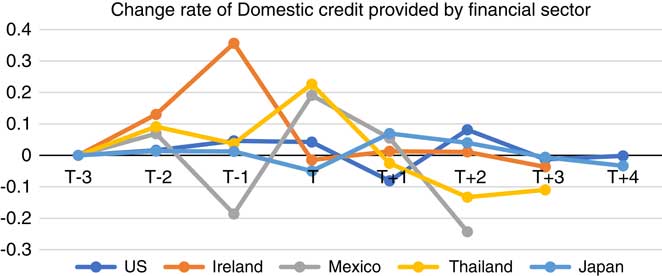
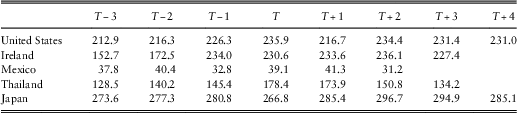
Garas found that as would be expected, economies like the United States with significant interconnections with other economies can spread bank crises quickly, but also there is a possibility of even less connected economies spreading a global banking crisis. Given that banking crises have the propensity to spread globally, then the impact of the crises becomes important. The cost of banking failures can be evaluated by the impact on the real economy. The impact of systemic banking failures has been modelled by Bougheas et al. (Reference Bougheas, Harvey and Kirman2018) who reached the conclusion that macroeconomic crises were preceded by banking crises and in the absence of a stabilising mechanism, allowing for “fire sale” of assets, at the limit the whole banking system ran out of credit facilities. We have quantified the effect of banking crises on credit facilities using the gross domestic product (GDP) growth deviation methodology developed by Laeven & Valencia (Reference Laeven and Valencia2010) for financial crises in the United States, Ireland, Mexico, Thailand and Japan. We have analysed the domestic credit provided to the private sector by banks for the three years before the beginning of the crises to the end of crises (or 3 years if shorter). The crisis periods are taken from the Global Financial Development database of the World BankFootnote 1 . The initial years of the United States, Ireland, Mexico, Thailand and Japan financial crises that we have analysed are 2007, 2008, 1994, 1997 and 2007, respectively. We have chosen domestic credit as the indicator of the impact of banking failures as the supply of credit by the banking system enhances economic growth, and therefore when the banking industry is relatively weak, the economy is also affected. Table 1 shows the domestic credit provided by the banking sector from 3 years before the crises (Year T) to the end of crises and Figure 1 shows the change in the supply of domestic credit.
Change rate of domestic credit provided by financial sector.

Domestic credit provided by financial sector as a share of gross domestic product (%) in the crises periods.

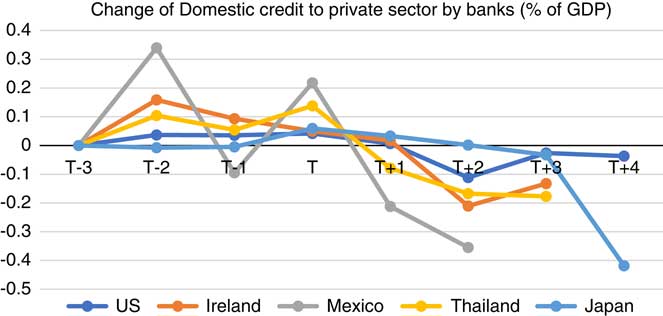
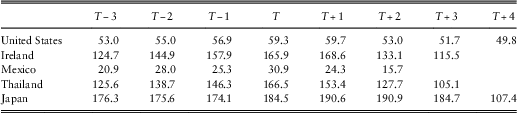
Table 1 and Figure 1 indicate that the banking failures had an impact on the supply of domestic credit and by implication, on economic growth. Schich & Kim (Reference Schich and Kim2010) indicated that the gross fiscal costs as a result of a financial crisis amongst the OECD’s Committee on Financial Markets participants have been between 20% and 40% of annual GDP. Comparison of the relative impact of “normal” bank failures or “business as usual” losses against systemic failure impacts is difficult to undertake due to data availability, but as an estimate, in Table 2 and Figure 2 we have shown for the same crises in Table 1 the domestic credit being supplied by the banks before and after the crises. We would argue that the periods prior to the systemic crises include by default the “business as usual” losses and the analysis provides an indication of relative costs to the economy of “normal” costs and systemic failure costs to the economies. Such an analysis indicates the systemic costs are significantly greater than the normal costs from “business as usual” losses in the banks.
Change of domestic credit to private sector by banks.

Domestic credit to private sector by banks as a share of gross domestic product (%) in the crises periods.

To minimise economic loss, efficient regulation of the banking system should then include identification and management of systemic failures as these clearly have significant economic impact.
7. A Review of the Basel Regime
The Basel Committee on Banking Supervision (1988) published its first International Convergence of Capital Measurement and Capital Standards (known as Basel I) which was aimed at governing the capital adequacy of banks through four pillars of Risk Weights, A Target Standard Ratio and Transitional and Implementing Agreements. In response to the evolution of the banking industry, to enhance the financial stability of the banking system, the Basel Committee on Banking Supervision (2006) proposed Basel II which addressed the shortfalls of Basel I through strengthening capital adequacy requirements and introducing supervisory review and disclosure of banking practices. Basel II was widely criticised after the GFC. Lall (Reference Lall2012) went so far as to argue Basel II was an underlying cause of the GFC. Freedman (Reference Freedman2014) commented that outsourcing of credit risk models by the banks also lead to “groupthink” and lack of real diversification as the models were all calibrated the same and used the same data. Consequently, the Basel Committee on Banking Supervision (2011) published Basel III aimed at improving the ability of banks to withstand future financial crises, through enhancing the risk management as well as strengthening transparency, governance and disclosure practices of the banks. Basel III limited the use of internal models, and significantly increased the capital requirement for banks. McKinsey (2010) pointed out the revised approach would result in higher capital for nearly all European banks, including banks with good profit margins and low loss records, with an estimated capital increase of 60%. It was also shown that Basel 111 failed to establish links between capital requirements and management (Mignola et al., Reference Mignola, Ugoccioni and Cope2016), and it was argued that as a result management might discard internal models, which challenged the maintenance of sound risk management practices. Pillar 2 of Basel 111 is designed to ensure supervisory review. Pillar 2 requires all risks (other than the three risks in Pillar 1) to be quantified and stress tested, with the assessment reported through an internal capital adequacy assessment process document to the board of directors, the relevant regulator and to the market. Pillar 3 of Basel 111 effectively relies on market participants to monitor the banks (Balthazar, Reference Balthazar2006). It was intended as a complement to the minimum capital requirements and supervisory review process by developing a set of disclosure requirements that would allow market participants to assess key pieces of information on the capital, risk exposures, risk assessment processes and hence the capital adequacy of the institution (Basel Committee on Banking Supervision, 2006). The market assessment concept is supported by Baumann & Nier (Reference Baumann and Nier2004) who investigated the cross-sectional association between banks’ long turn average stock price volatility and long-term average disclosure level and found banks that disclose more information showed lower stock price volatility than banks that disclose less information, which would appear to indicate that the market disclosure requirements could have some positive effect. Whilst Basel 111 was a significant improvement on Basel 11, Basel 111 is still based upon regulation of individual banks in order to achieve financial stability, and this approach was criticised by Morris & Shin (Reference Morris and Shin2008) who indicated the need to understand the systemic importance of assets and the need for capital to stabilise liabilities in an interrelated financial system. Whilst Morris & Shin (Reference Morris and Shin2008) considered the system issues of regulation, their analysis was not based on a regulatory system that is derived from the assumption that the banking system is a CAS. Similarly, whilst Hanson et al. recognised
In the aftermath of the (GFC) crisis, there seems to be agreement among both academics and policymakers that financial regulation needs to move in a macroprudential direction (Reference Hanson, Kashyap and Stein2011).
Their analysis assumed that what they termed macroprudential regulation was “an effort to control the social costs associated with excessive balance sheet shrinkage on the part of multiple financial institutions hit with a common shock”, which again fails to recognise that in a CAS it is not necessary for a phase transition to occur from a common shock, as it may occur from multiple unrelated shocks. A further aspect of the Basel regime is that it is aimed at producing a level playing field amongst banks to avoid arbitrage across regulators (Boyer & Kempf, Reference Boyer and Kempf2017). This has been criticised by Morrison & White (Reference Morrison and White2009) who argued that a level global playing field actually reinforces a “race to the bottom” as country-specific regulators compete to attract banks, and this is obviously a consequence of the Basel regime not being enforceable in any particular country. Most tellingly, a consequence of banking systems being a CAS is that whilst individual banks may appear stable, the system may be unstable (Battiston et al., Reference Battiston, Gatti, Gallegati, Greenwald and Stiglitz2012). Gualandri et al. (Reference Gualandri, Landi and Venturelli2008) argued that the prudential regulation and supervision had been proved inadequate to cope with the GFC and concluded a wider rethink of the design of regulation and supervision at the national and international level, was required in order to build adequate supervision and regulations to mitigate crises such as GFC. What is important to appreciate, which has not been specifically acknowledged previously, is that the Basel system of regulation is a FoS with the regulatory approaches suggested being applied at the discretion of specific countries and there is no mandatory requirement for implementation.
8. Implications of the Banking System being a CAS for Regulation
We would argue that whilst it may appear that there are two types of institutional default, namely, default of an individual institution and a systemic default of several institutions, given that the banking system is a CAS with highly interconnected institutions, these defaults are the same, i.e. all defaults are, or have the capacity to be systemic defaults. What differs is the extent of the systemic default and this is a function of the interconnectedness relating to the driver of the default as recognised by Battiston et al. (Reference Battiston, Farmer, Flache, Garlaschelli, Haldane, Heesterbeek and Scheffer2016). The effect of shocks on a banking system assumed to be a CAS was simulated by Acemoglu et al. (Reference Acemoglu, Ozdaglar and Tahbaz-Salehi2015) who found that the banking networks were both robust and fragile as suggested by Haldane (Reference Haldane2009) in that the interconnectedness actually enhances stability to a point and then flips to instability. Given that all or most banking defaults then have the potential to be systemic, and as shown, systemic failures have much greater economic costs than “business as usual” losses, regulation should have as an aim the containment of systemic defaults, in exactly the same way that risk management of pandemics is aimed at containing the spread of the particular disease. There are a lot of parallels between pandemic management and systemic financial system management, including the definition of a pandemic being
an epidemic occurring worldwide, or over a very wide area, crossing international boundaries and usually affecting a large number of people (McCloskey et al., Reference McCloskey, Dar, Zumla and Heymann2014).
In the same paper, the authors commented
action is still focused on detection and response, not prevention. Most of the activity in global pandemic preparedness will be of benefit only after the infection has emerged; this is essential to global security, as preventive efforts cannot be entirely effective. However, the biggest gains might come from preventing infections from emerging or from jumping to human beings rather than from managing them after they have done so.
The prevention, followed by containment of pandemics has significant parallels with financial system crises. The essential components of regulation related to pandemic management are, first, that there is a global legal agreement that binds members, and within that agreement, the following is in place:
Some functional components of hazard-specific preparedness and response systems are common to all hazards and can therefore be consolidated into a comprehensive system of emergency risk management for health (ERMH). The objectives of ERMH are to:
∙ Strengthen country and community capacities to manage the health risks from all types of hazards.
∙ Ensure that the essential components required in a comprehensive emergency risk management programme are in place in the health sector.
∙ Link and integrate these components into (1) health systems, (2) multisectoral disaster management systems and (3) other mechanisms across the whole of society, including relevant risk management within non-health sectors.
∙ Enable the health sector to advocate for and strengthen the health aspects of national and international policies and frameworks related to emergency and disaster risk management, particularly in the reduction of risk and health impact from all hazards (WHO, Reference Albert, Jeong and Barabási2017).
The ERMH objectives are then linked to prevention at the country level followed by responses at the international level. It is suggested this approach should be included in the regulation of financial systems. Specifically, it is suggested that there should be:
∙ prevention at the country level;
∙ containment of systemic failures;
∙ a global legal agreement to cooperate once the systemic issue is likely to spread outside a specific area.
This high-level regulatory regime recognises that the banking system operates as a CAS with a concentrated network and will exhibit phase transitions from time to time, and whilst a CAS will stabilise itself, the regulation is intended to make this occur as quickly as possible and with least damage to the global economy as possible. The major differences between this suggested regime and the current Basel regime are that it involves a globally enforceable agreement for countries to act to prevent financial crises spreading outside specific countries. This suggestion would then transform the global banking system from a FoS to a SoS. Prevention of global systemic risk at the country level would be quite different to the current Basel regime which effectively concentrates on risks to each institution and assumes no interconnection. The proposed regulation would specifically concentrate on identifying the interconnectivity of the institutions both locally and globally and creating a database of these to assist with containment if a crisis occurs or looks like it might occur and parallels that in place by the WHO for management of pandemics. It is also suggested that containment must involve the broader community as it was quite clear from the GFC that the effects of the potential bank failures spread to businesses as well. This prevention and containment process in each country will require a rethink of the regulatory structure in place as most financial regulatory structures have no responsibility for monitoring the wider effects of banking systemic failures outside the financial sector. A further aspect of this suggested regulatory regime is that, like the management of pandemics, as suggested by Battiston et al. (Reference Battiston, Farmer, Flache, Garlaschelli, Haldane, Heesterbeek and Scheffer2016), it must operate in real time as the interdependencies both within the banking system and across the wider community are dynamic and changing over time. The work of Acemoglu et al. (Reference Acemoglu, Ozdaglar and Tahbaz-Salehi2015) clearly illustrated that historical assumptions as to stability/instability of financial systems need to be challenged and they found that contrary to opinion, “that as long as the magnitude (or the number) of negative shocks is below a critical threshold, a more diversified pattern of interbank liabilities leads to less fragility. In particular, all else equal, the sparsely connected ring financial network (corresponding to a credit chain) is the most fragile of all configurations, whereas the highly interconnected complete financial network is the configuration least prone to contagion… however, when negative shocks are larger than a certain threshold, completeness is no longer a guarantee for stability”. Governments could well look to the structure established to manage pandemics to manage systemic risks in the financial system.
9. Conclusion
We have shown that the banking system is a CAS and that losses in terms of reduced GDP arising from systemic failures are more significant than “business as usual” losses. As a result, we would suggest that a regulatory regime similar to that developed by the WHO for the management of pandemics should be considered, and the current FoS should move towards a SoS, at least so far as containment of global crises is concerned. The benefit of a regulatory system that specifically has a global legal structure and concentrates on systemic exposure by banks in a similar manner to the WHO pandemic management system should have benefits in reducing the economic costs of banking crises. We are not suggesting that a regulatory system similar to the Basel process should not be adopted at the country level for internal management of banks, but that such a system should be supplemented at the global level by a SoS approach reflecting the WHO approach to pandemic detection and management.
Acknowledgement
The authors would like to acknowledge the suggestions of an anonymous reviewer that have improved the paper.