Introduction
Otitis media with effusion (OME) is one of the commonest causes of acquired hearing loss in children.Reference Daniel, Chessman, Al-Zahid, Richards, Rahman and Ashraf1 The aetiology is not well understood, but OME is characterised by the presence of middle-ear effusion behind an intact tympanic membrane in the absence of signs or symptoms of acute infection.Reference van Zon, van der Heijden, van Dongen, Burton and Schilder2 As some individuals can remain asymptomatic, the true prevalence is uncertain. However, it is estimated that within the first year of life, 50 per cent of children will experience one episode of OME, followed by 60 per cent by the age of two years.Reference van Zon, van der Heijden, van Dongen, Burton and Schilder2 Otitis media with effusion spontaneously resolves after three months in 28 per cent of children, with higher rates following an episode of acute otitis media.Reference van Zon, van der Heijden, van Dongen, Burton and Schilder2, Reference Rosenfeld, Kay, Rosenfeld and Bluestone3 Recurrence of the condition is common and is estimated at 50 per cent within 24 months.Reference Teele, Klein and Rosner4
Often OME requires no treatment as the fluid clears itself and hearing is restored. However, when it is bilateral and persistent, it can result in behavioural, language and educational problems.5 Current UK (National Institute for Health and Care Excellence) guidelines recommend a three-month ‘watch and wait’ period, with accurate audiometry and assessment of the impact on a child's development, before determining the need for treatment.5
For the majority of children with OME-associated hearing loss, national guidelines either recommend surgery, in the form of ventilation tubes (grommets), or hearing aids. Other forms of treatment have been trialled, including antibiotics, antihistamines and steroids, but these are no longer recommended.5
The parents of most patients opt for grommets; in fact, grommet insertion is one of the most frequently performed surgical procedures in children. However, the procedure is associated with significant risks. Vlastarakos et al. reported the following grommet insertion related complications: purulent otorrhoea (10–26 per cent), myringosclerosis (39–65 per cent) and persistent tympanic membrane perforations (3 per cent, although this figure rose to 24 per cent when T-tubes were used).Reference Vlastarakos, Nikolopoulos, Korres, Tavoulari, Tzagaroulakis and Ferekidis6 In addition, most grommets extrude after six to nine months, with 20–25 per cent of children requiring a second set of grommets within two years.Reference Daniel, Chessman, Al-Zahid, Richards, Rahman and Ashraf1
Conversely, hearing aids have minimal physical complications. However, parents of children often express concerns relating to their psychosocial impact in terms of bullying and low self-esteem. These perceived negative associations often preclude parents from choosing hearing aids for the treatment of OME in their children, although there may be other confounding factors e.g. child compliance or dexterity.
This study aimed to assess the psychosocial impact of wearing hearing aids for the treatment of OME in children, and compare the perceptions of non hearing aid users with the experience of those wearing hearing aids.
Materials and methods
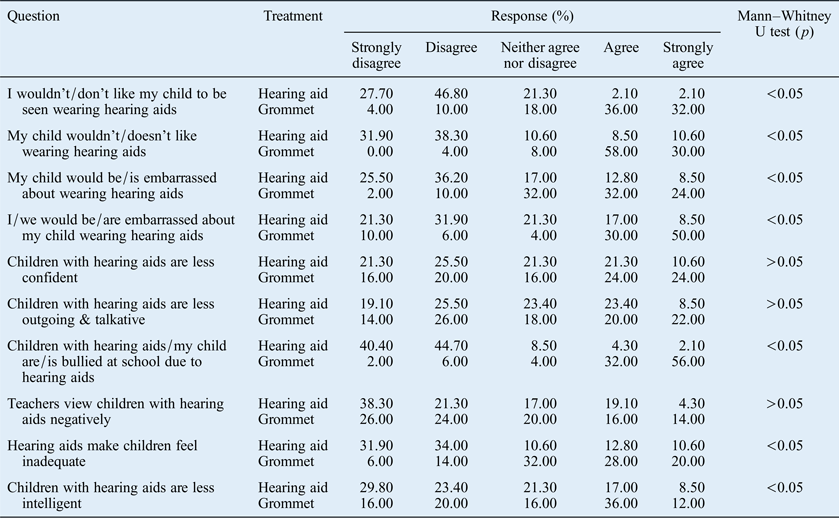
In the absence of a validated paediatric survey, a new survey was designed based on a validated questionnaire that is used to assess the psychosocial impact of hearing aids in adults.Reference Saunders, Cienkowski, Forsline and Fausti7 Nine hearing aid related questions addressing negative associations, negative coping strategies and self-esteem were included. The questionnaire was designed to assess the perceived psychosocial impact of hearing aids in children treated with grommets and compare them to the impact in children treated with hearing aids. Parents were asked to answer questions by indicating their level of agreement or disagreement with each statement on a five-point Likert scale (Table I). These questions were answered by parents when they attended paediatric out-patient appointments or via telephone interview.
Questionnaire results*

* Based on responses of parents with children diagnosed with otitis media with effusion, treated either with hearing aids or grommets.
All participants gave clear informed consent before participating. The parents of children with glue ear were either offered hearing aids or grommets. Fifty children were randomly selected from each treatment (hearing aid or grommet) group; this was achieved by assigning a number to each patient and using a computerised random number generator to select 50 from each group. Those staff members who collected data were blinded to the aims of the study; in addition, they utilised a pre-determined script to limit inter-operator variability and other potential biases.
All children (under 16 years of age), attending mainstream school, who were diagnosed with OME (with no other disabilities), and treated between January and October 2012 using hearing aids or grommets, were eligible for inclusion in the study.
Of 50 children selected from the hearing aid group, there were 47 responses. These responses were compared with 50 randomly selected responses from parents of children treated with grommets. The study was conducted in December 2012; therefore, each child had at least two months’ post-intervention experience.
Results
A total of 97 children were included in the study: 47 in the hearing aid group (mean age of 7.05 years) and 50 in the non hearing aid group (mean age of 6.78 years). The groups had a similar sex distribution; 53.2 per cent of patients in the hearing aid group were male versus 52 per cent in the non hearing aid group.
Following data collection, statistical analysis was performed using the Mann–Whitney U test (Table I). An ‘intention-to-treat’ analysis was employed; therefore, if a parent decided to cross groups (switching from the grommet to hearing aid group, or vice versa), their data were still analysed according to their original group assignment. Parents were allowed to freely cross over if they desired; however, there were no cross-overs during this time period.
Statistically significant differences (p < 0.05) were noted in the majority of categories when the answers from parents of non hearing aid users were compared with those of children wearing hearing aids. These categories included embarrassment (Figure 1), bullying (Figure 2) and inadequacy (Figure 3). The overall negative perceptions of non hearing aid users were not experienced by hearing aid users in the majority of cases.
Responses to the statement ‘My child would be/is embarrassed about wearing hearing aids’. HA = hearing aid
Responses to the statement ‘Children with hearing aids/my child are/is bullied at school due to hearing aids’. HA = hearing aid
Responses to the statement ‘Hearing aids make children feel inadequate’. HA = hearing aid
Discussion
This survey demonstrated a statistically significant difference between the perceived psychosocial impact of hearing aid use and the actual experience of children using hearing aids for the treatment of OME. These findings have not been previously reported in the literature. For the majority of parents choosing grommets as a treatment for OME, there is a clear perception that hearing aids have many negative associations. However, the hearing aid group responses indicate that such perceptions are no longer valid. In this study, children with hearing aids were not negatively discriminated against by peers and teachers.
The difference in opinion between the two groups may relate to the ‘hearing aid effect’. This effect relates to the negative stigma attributed to wearing hearing aids, which was widely reported during the late 1970s and early 1980s.Reference Johnson, Danhauer, Gavin, Karns, Reith and Lopez8 Studies at this time compared the opinions of adults and children viewing photographs of children wearing hearing aids to determine the overall impression perceived. The majority of individuals formed a negative opinion when viewing these children.Reference Johnson, Danhauer, Gavin, Karns, Reith and Lopez8 It may be that this opinion continues to be held by the parents who were raised at this time and is now having an influence on the healthcare choices they make for their own children.
It is of interest that some children did not wish to return their hearing aids once the OME had resolved. As a result, one can postulate that hearing aids can also act as a ‘comfort blanket’ for those children. The literature supporting this is currently limited. The follow-up period of the current study (which had a different aim) was too short to be able to assess the presence of such an effect. This could potentially represent a topic for future research, in which children are followed up for longer time periods to allow for the natural resolution of OME and the associated hearing loss, in order to evaluate their dependence on hearing aids at this stage.
Limitations of this study include the relatively small sample size, the regional nature of data collection, the lack of assessment of potential parental expectation bias and the lack of a validated paediatric questionnaire (although there is currently no validated paediatric questionnaire). With regard to this latter point, a literature review was conducted to identify validated questionnaires that have been administered in similar settings which capture variables of interest. The closest match for these requirements was a validated adult questionnaire.Reference Saunders, Cienkowski, Forsline and Fausti7 This questionnaire was appropriately modified to make it suitable for use in a paediatric population. The modified questionnaire used in the current study was based on the principles applied to the validated adult questionnaire. Larger patient numbers and geographical variation may alter the results reported. Regional experiences nonetheless are valuable as they help to inform the decisions of patients within a local population. The authors also accept that individuals opting for hearing aids as treatment for their children may have a bias favouring their use. A subsequent survey of the attitudes of the subjects’ peers towards hearing aid use would also be of interest, as would be a comparative analysis of the associated costs between the two treatment modalities for children with OME.
• Otitis media with effusion (OME) is the commonest cause of acquired hearing loss in children
• For persistent OME, current UK guidelines recommend myringotomy and grommet insertion, or hearing aids
• Grommets are associated with short- and long-term risks (e.g. infection and persistent perforation), whilst hearing aids have few
• Most children are treated with grommets as parents often have negative perceptions about the psychosocial impact of hearing aid use (e.g. bullying)
• This study suggests that negative perceptions associated with hearing aids are not realised in contemporary society; the ‘hearing aid effect’ may no longer be as prevalent
• The findings may influence future parental choice of treatment for children with OME
We believe that the results of the current study are important and could help to better inform parents of the treatment choices for children with OME in the future. Clearly, if patients can be treated for OME with hearing aids and thereby avoid the risks of surgery, without any negative psychosocial impact, this may lead to fewer children having grommets and more receiving hearing aids, the latter of which are non-invasive and equally effective as a treatment.Reference Ahmmed, Curley, Newton and Mukherjee9 We encourage other ENT departments to conduct similar surveys and document the experiences of their patient population, to further inform patients (and parents) regarding their options.
Acknowledgements
The authors would like to thank Nektarios Mazarakis (Specialist Registrar in Neurosurgery at Queens Medical Centre, Nottingham) for statistical support, Matthew Warrilow (Clinical Audiologist, Royal Derby Hospital) and the Newborn Screening Team at the Royal Derby Hospital for data collection.