Implications
This study demonstrates, that rapeseed meal (RSM) is a good source of rumen undegradable protein (RUP), however, considerable variation of RUP among meals was observed mainly because of different process technologies in the oil plants. Equations for prediction of degradation of CP and amino acids have been developed that help farmers and feed manufactures estimate protein and amino acid degradation and improving precision of formulation of diets and compound feeds. It was demonstrated, that digestibility of RSM–RUP is lower compared with the meal which may lead to an overestimation of the contribution of RUP to amino acid supply.
Introduction
In the European Union, the production of RSM has continuously increased during the last decade from 6.3 million tonnes in the year 2000 to 12.9 million tonnes in 2010 (Foreign Agricultural Service/United States Department of Agriculture (FAS/USDA), 2011). The same trend can be observed for Germany, where, because of an extension of both growing area and yield per hectare, the production of RSM increased up to 4.4 million tonnes in 2009, of which 2.9 million tonnes were used in the country (Union zur Förderung von Oel- und Proteinpflanzen (UFOP), 2011). The high fibre content and the presence of residual amounts of secondary plant metabolites such as glucosinolates and sinapine limit the use of RSM in diets for monogastric animals (Tripathi and Mishra, Reference Tripathi and Mishra2007) and favours its use as a protein source for ruminants, especially when its protein degradability in the rumen is low. High yielding cows require great quantities of rumen undegradable crude protein (RUP) because of their high protein requirement that cannot be met by microbial protein synthesis. Hristov et al. (Reference Hristov, Price and Shafii2005) denoted RUP intake as a dominant factor for milk protein yield.
During the production process in the oil plant, great changes in the nutritional properties of RSM occur. On one hand, during the severe heat and pressure treatment (toasting) the total contents of glucosinolates decrease considerably (Schöne et al., Reference Schöne, Rudolph, Kirchheim and Knapp1997), which generally extends the potential use of RSM in animal feeding. On the other hand, energy input in form of heat and pressure renders the CP less degradable in the rumen (Moshtagi Nia and Ingalls, Reference Moshtagi Nia and Ingalls1995) resulting in higher quantities of RUP. However, excess heat treatment may cause heat damage of CP leading to decreased intestinal digestibility of RUP and amino acids (AA) as demonstrated by Dakowski et al. (Reference Dakowski, Weisbjerg and Hvelplund1996) for temperatures higher than 130°C.
Compared with soya bean protein, AA composition of RSM is characterised by a favourable content of sulphur-bearing AA and a lower lysine content (Tan et al., Reference Tan, Mailer, Blanchard and Agboola2011). For many dairy cow rations, there are strong indications that methionine deficiency may limit milk production (Rulquin et al., Reference Rulquin, Vérité and Guinard-Flament2001). Although the AA profile of RUP may change during rumen incubation (Weisbjerg et al., Reference Weisbjerg, Hvelplund, Hellberg, Olsson and Sanne1996), Lardy et al. (Reference Lardy, Catlett, Kerley and Paterson1993) stated the potential of feeding RSM to increase duodenal flow of sulphur-bearing AA, such as methionine.
The concept of intestinally digestible AA derived from the flow of microbial protein plus RUP to the duodenum is not yet established in most of the presently used protein systems for ruminants. Future systems based on intestinally digestible AA require the knowledge of both, microbial AA flow and its precaecal digestibility as well as the quantitative changes of feed protein because of rumen degradation which will probably also affect AA composition and digestibility of RUP.
The objectives of the present study using RSM were (i) to investigate the variation in rumen protein degradability, (ii) to quantify changes of AA composition and digestibility of CP during rumen fermentation, (iii) to identify relationships between animal-based and chemically analysed fractions in order to develop prediction equations for the estimation of protein and AA degradation.
Material and methods
RSM samples
A sample of solvent extracted RSM from each of 10 industrial oil plants was collected in 2008. As 10 industrial oil plants exist in Germany, the sample collection was considered as representative for the quality of RSM produced at that time. The samples were kept frozen at −20°C until the commencement of experiments. Before analyses, samples were ground to pass 0.5 mm screen except for the in situ procedure, where the original material was used.
In situ rumen incubations
For the incubation in situ, three non-lactating Holstein cows fitted with large rumen cannulas were used. The cows were fed twice a day at about 8:00 and 16:00 h and received a daily quantity of 8 kg hay and 2 kg of a dairy concentrate. 1.5 g of RSM samples were incubated in ANKOM concentrate bags (5 × 10 cm, 50 μm pore size; ANKOM technology, Macedon, NY, USA) for 0, 1, 2, 4, 8, 16, 32 and 72 h in duplicate for each cow and time point. Additional bags were incubated for 8 and 16 h to obtain larger quantities of undegraded residues required for the analysis of AA and in vitro protein digestion. 8 and 16 h were chosen to simulate short and medium rumen residence time probably representative for small particles such as RSM. After rumen incubation, bags were rinsed with cold tap water and frozen at −20°C until machine washing (three cycles of 12 min with cold water, three times water exchange, no spinning). Residual DM of bag contents was determined by oven drying at 80°C over night. The residues incubated for 8 and 16 h were freeze dried after washing. Water insoluble N was measured by filtration of an aqueous suspension of RSM using filter paper MN 615 1/4 (Macherey-Nagel, Düren, Germany) and subsequent N-analysis of the retained material. Small particle loss was calculated from total washing loss (0 h incubation) minus water-soluble fraction. Degradation was corrected for the small particle fraction according to Weisbjerg et al. (Reference Weisbjerg, Bhargava, Hvelplund and Madsen1990).
Analytical procedures
Analyses of proximate nutrients and fibre fractions in samples of RSM were performed as outlined by Verband Deutscher Landwirtschaftlicher Untersuchungs- und Forschungsanstalten (VDLUFA), 2006). The samples were analysed for DM (method 3.1), ash (method 8.1), CP (method 4.1.1, N multiplied by 6.25), ether extract (EE) (extraction after hydrolysis with HCl; method 5.1.1), and crude fibre (method 6.1.1). NDF assayed with a heat stable amylase, and ADF were analysed according to methods 6.5.1 and 6.5.2 and expressed exclusive of residual ash. NDF insoluble N (NDiN) and ADF insoluble N (ADiN) was determined by analysis of N (method 4.1.1) of respective detergent residues. Amino acid contents in the RSM and in the 8 and 16 h in situ incubation residues were measured with an amino acid analyser L8900 (VWR/Hitachi). After oxidation with performic acid, samples were hydrolysed with 6 M HCl for 24 h at 110°C (Rodehutscord et al., Reference Rodehutscord, Kapocius, Timmler and Dieckmann2004). The AA were separated with ion-exchange chromatography and quantified by post-column derivatisation with ninhydrin using photometric detection at 570 nm (440 nm for proline). Owing to this sample preparation, analysis of histidine, tyrosine and tryptophan was not possible. Diaminopimelic acid (DAP) was determined in the 16 h in situ incubation residue after direct HCl-hydrolysis without oxidation step to identify the extent of microbial contamination.
In vitro intestinal protein digestibility (IPD) of RSM and of the in situ incubation residues was performed according to the method of Boisen and Fernández (Reference Boisen and Fernández1995) which includes a pepsin digestion for 6 h at pH 2.0 followed by a 16 h pancreatin incubation at pH 6.8. After precipitation with sulphosalicylic acid, the undigested residues were filtered, dried overnight at 80°C, and residual N was determined according to VDLUFA (2006) method 4.1.1. Glucosinolates were determined by a HPLC method (European Commission (EC), 1990).
Calculations and statistical analysis
Degradation kinetics
The rate and extent of CP degradation was calculated with the model of Ørskov and McDonald (Reference Ørskov and McDonald1979) using the equation: p = a + b(1 − e)−ct where ‘p’ is the disappearance at time ‘t’, ‘a’ the soluble fraction, ‘b’ the potentially degradable fraction and ‘c’ the rate of degradation of fraction ‘b’. Lag time was not considered, as it was statistically not different from 0. Effective degradability (ED) was calculated according to Ørskov and McDonald (Reference Ørskov and McDonald1979): ED = a + (b × c)/(c + k) for ‘k’ as rumen outflow rate of 2, 5 and 8%/h. Replications within cow for each time point were pooled resulting in three observations of the above-mentioned degradation characteristics for each sample.
Statistical analysis
For statistical analysis, the program package SAS 9.2 (SAS Institute, Cary, NC, USA) was used. ANOVA was performed with the procedure ‘MIXED’. For in situ degradation of CP, ‘animal’ and ‘sample’ were regarded as fixed effects. For IPD, ‘sample’ at time 0 and ‘sample’ and ‘animal’ at times 8 and 16 h were included as fixed effects. Additionally, ANOVA was carried out for a comparison of incubation time over all samples with ‘sample’ and ‘incubation time’ as fixed effects. LS means were calculated and differences were analysed with option PDIFF using t-test and level of significance was defined as α = 0.05. For the comparison of individual AA degradation with CP degradation, first an ANOVA was carried out with ‘AA’ and ‘animal’ as fixed effects. Degradation of AA was compared with CP degradation using the Dunnett-test (PDIFF − option adjust = Dunnett). Linear regression equations for prediction of CP and AA degradation were estimated using REG procedure. In advance, the choice of variables for prediction of CP degradation was defined by RSQUARE option and the number of variables was restricted to three. As parameters for the goodness of fit, R 2 and sy.x will be presented. The sy.x values are the standard deviations of the residuals, which are the distances between the individual points from the calculated line.
Results
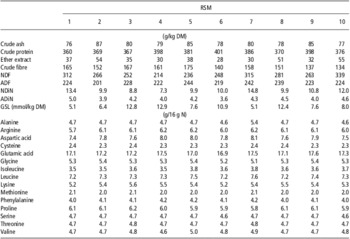
The chemical composition of the RSM is shown in Table 1. Average contents of ash, CP and EE were 81, 381 and 39 g/kg DM. RSM contained on average 265 g NDF and 227 g ADF/kg DM. Considerable variations between samples were found for EE, NDF and GSL, the latter ranging between 5.1 and 12.9 mmol/kg DM. On the other hand, AA composition when expressed as g/16 g N was very similar among samples.
Chemical composition of RSM

RSM = rapeseed meal; NDF = neutral detergent fibre; ADF = acid detergent fibre, both expressed without residual ash; NDiN = neutral detergent insoluble N; ADiN = acid detergent insoluble N; GSL = total glucosinolates.
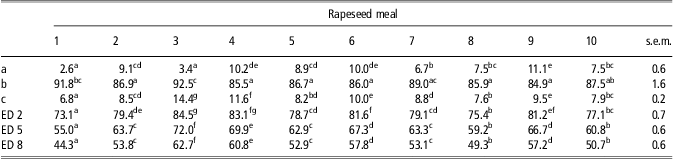
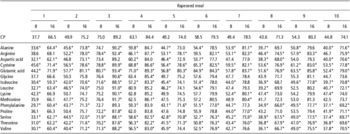
In situ degradation of CP of RSM was characterised by a small soluble fraction averaging 7.7%, a high potentially degradable fraction (87.7%) and a moderate degradation rate of 9.3%/h (Table 2). Effective CP degradation was relatively low with an average of 79.3%, 64.1% and 54.3% at outflow rates of 2, 5 and 8%/h (ED 2, 5, 8) with a considerable variation between samples ranging from 44.3% to 62.7% for ED 8. Table 3 shows the degradation of individual AA after 8 and 16 h of incubation in comparison with degradation of the CP fraction. Degradation increased from 8 to 16 h for CP and all AA. Variation between samples at these distinct incubation times were even higher compared with effective CP degradation (Table 2). Degradation of cysteine was significantly higher than CP in eight samples after 8 and 16 h. A similar deviation occurred for several non-essential AA such as glutamic acid and arginine. Degradation of threonine and valine was consistently lower than CP degradation. Degradation of isoleucine and phenylalanine was also significantly lower than CP degradation in most samples. For lysine and methionine as the most relevant AA in RSM, in only six and four, respectively, cases out of 20, significant differences from CP degradation were found.
Characteristics of rumen CP degradation based on in situ measurements
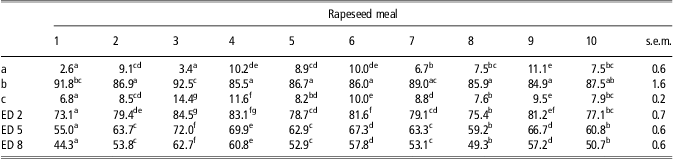
a = soluble fraction (% of CP); b = potentially degradable fraction (% of CP); c = rate of degradation of b (%/h); ED 2, 5, 8 = effective CP degradation at outflow rates of 2, 5, 8%/h (%).
Different superscripts indicate significant differences between samples (P < 0.05)
In situ degradation of CP and amino acids (%) after 8 and 16 h of incubation

*Significant difference (P < 0.05) between degradation of CP and individual amino acids (within the same column).
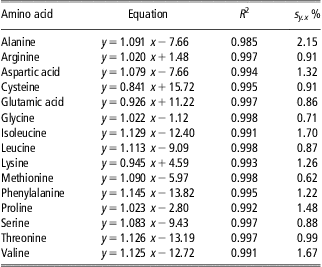
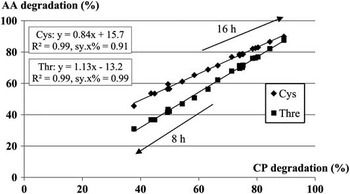
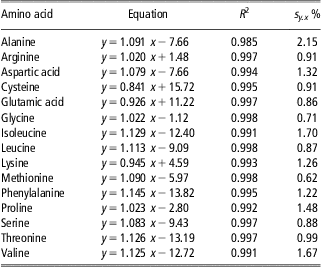
To predict individual AA degradation from CP degradation, linear regression equations were calculated between AA degradation (y) and CP degradation. For this, all 10 samples and both incubation times of 8 and 16 h were used, resulting in 20 observations for each equation (Table 4). This procedure is demonstrated in Figure 1 for cysteine and threonine as an example. The linear prediction equations all had R 2 values higher than 0.98 and residual standard errors below 2.2%, which indicates that they allow for an accurate and specific prediction of AA degradation from degradation of CP.
Linear regression equations for the prediction of amino acid degradation (y, %) from degradation of CP (x, %)
Calculation of degradation of cysteine and threonine from degradation of CP of 10 samples of RSM incubated for 8 and 16 h.

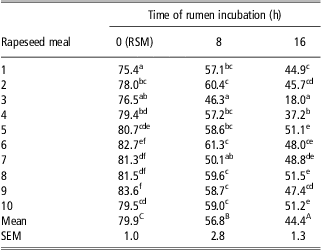
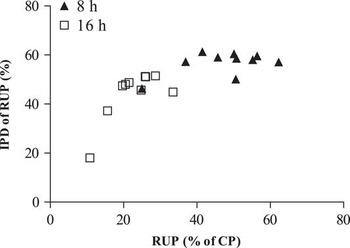
Results of in vitro IPD of the RSM and of the incubation residues after 8 and 16 h of incubation are shown in Table 5. For the RSM, average IPD was 79.8%. IPD was significantly lower in the incubation residues and decreased with incubation time (56.8% and 44.4% after 8 and 16 h of incubation, respectively). Figure 2 shows the relationship between RUP and IPD. While IPD of the residues after 8 h of incubation was not related to the percentage of RUP, it was demonstrated for the 16 h incubations that % IPD decreased when % RUP decreased.
Pepsin–pancreatin digestibility of CP (IPD) of rapeseed meals and their residues after 8 and 16 h of rumen incubation in situ (% of CP)
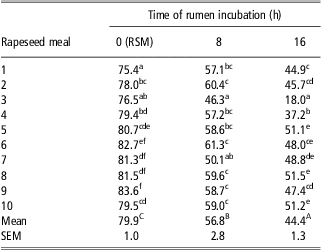
a,bDifferent lower case superscripts indicate significant differences between samples within column (P < 0.05).
A,BDifferent upper case superscripts indicate significant differences between incubation times (P < 0.05).
Relation between RUP and in vitro pepsin–pancreatin digestibility (IPD) of RUP. RUP = rumen undegradable protein.

Discussion
Chemical composition
Crude nutrient composition (ash, CP, EE and crude fibre) of the 10 RSM agrees well with standard values for this feedstuff (e.g. Centraal veevoederbureau (CVB), 2000; Sauvant, Reference Sauvant2004). While variation between samples in the contents of crude fibre was only small, contents of NDF varied considerably. NDF was correlated with NDiN (R = 0.89, P < 0.01) and GSL (R = −0.64, P < 0.05), and NDiN showed also a correlation with GSL (R = 0.80, P < 0.01). These relationships probably indicate the effects of varying heat intensity applied during the production process as N firmly binds to fibre with increased heating intensity, thus being recovered in the NDF fraction (Licitra et al., Reference Licitra, Hernandez and Van Soest1996), while GSL are reduced (Schöne et al. Reference Schöne, Rudolph, Kirchheim and Knapp1997). The variation of AA content between samples was small when related to CP (g/16 g N) and concentrations are typical for RSM (CVB, 2000).
Ruminal CP degradation
Ruminal CP degradation of the meals varied in the present study, which could be caused by variation both in the quality of the seed and the production technology in the individual processing plants. Details of raw materials used and process technology applied were not available for the samples. Newkirk et al. (Reference Newkirk, Classen, Scott and Edney2003) studied precaecal AA digestibility of 26 non-toasted and 31 toasted meals from different processing plants in broiler chicken and found much less variation of lysine digestibility in non-toasted meals (87% to 92%) compared with toasted ones (66% to 86%). From this it might also be deduced, that ruminal CP degradation is more affected by process technology than by quality of raw material. Owing to intensive energy input in form of heat and pressure during the production process, especially in the step called ‘toasting’ which is applied after extraction to remove the solvent, ruminal degradation of CP is reduced considerably in comparison with native seed protein or rapeseed expeller (Homolka et al., Reference Homolka, Harazim and Třináctý2007). Effective CP degradation in the present study was 54.3% and 64.1% for rumen outflow rates 8 and 5%/h, respectively. These values agree well with results of Woods et al. (Reference Woods, Moloney and O'Mara2003a) and Zebrowska et al. (Reference Zebrowska, Długołęcka, Pajak and Korczyński1997). In the latter study a similar range of variation between 62% and 70% for effective CP degradation at 5% outflow rate was found in six samples from different commercial oil plants. Kendall et al. (Reference Kendall, Ingalls and Boila1991) who studied CP degradation of five RSM samples from five processing plants also demonstrated a large variation among samples and a generally low level of degradability (effective CP degradation at 5%/h rumen outflow rate: 44.3% to 59.0%). On the other hand, Moss and Givens (Reference Moss and Givens1994) and Prestløkken (Reference Prestløkken1999) reported higher effective CP degradation for RSM (effective CP degradation at 5%/h rumen outflow rate: 80% and 69%, respectively). Different ways of processing rapeseed for oil production as well as the use of different modifications and calculations of the in situ procedure may explain the variation among studies.
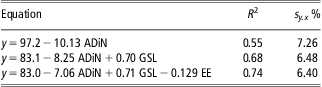
Obviously, the heating process is carried out in different ways in the oil mills, causing considerable variation among samples. Details of the toasting process concerning temperature, time and pressure were not made available to us. Therefore, results of CP degradation cannot be related to any of these traits. Based on the variation in protein degradation found in the present study, the current approach of using a constant value for CP degradability or RUP percentage in ration formulation will lead to a less correct protein supply to the animal. Therefore, multiple regression equations were calculated in an attempt to predict protein degradation of RSM from chemical constituents that can be easily determined avoiding the elaborate in situ procedure (Table 6). Owing to the limited number of samples (n = 10), the number of independent variables was restricted to three.
Regression equations to predict effective rumen protein degradation in rapeseed meals for rumen outflow rate of 8%/h
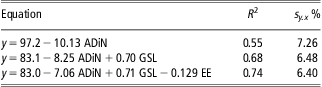
y = effective CP degradation (outflow rate 8%/h) (%); ADiN = acid detergent insoluble N (g/kg DM); GSL = total glucosinolates (mmol/kg DM); EE = petroleum ether extract (g/kg DM).
The most significant x-variable for the prediction of CP degradation was ADiN, followed by GSL and EE. Increasing intensity of processing reduces CP degradability as shown by Dakowski et al. (Reference Dakowski, Weisbjerg and Hvelplund1996) where effective CP degradability of RSM was reduced from 73% to 56% for a moderate heat treatment (130°C) and decreased to 15% to 23% for 140°C and 150°C treatments. Krishnamoorthy et al. (Reference Krishnamoorthy, Muscato, Sniffen and Van Soest1982) reported an increase of ADiN and NDiN in heat treated feedstuffs such as brewers dried grains and corn gluten meal. Licitra et al. (Reference Licitra, Hernandez and Van Soest1996) stated that heating denatures protein of the fraction B2 according to the Cornell net carbohydrate and protein system (CNCPS) and may render it insoluble, thus increasing the B3 fraction (NDiN–ADiN) as well as the C fraction obtained as the ADiN. As GSL are partly destroyed by heat (Schöne et al., Reference Schöne, Rudolph, Kirchheim and Knapp1997), GSL can also be taken as a measure for the intensity of heating the RSM, provided that native GSL contents of 00-type rape genotypes used in the oil plants are on a comparable level. Finally, the negative relationship between CP degradation and EE, which means a lower CP degradability with increasing EE is difficult to interpret. Normally one would expect that higher processing intensity with concomitantly higher energy input yields more oil, that is lowers EE and renders CP less degradable. As the technology applied in the different oil plant is unknown, the reason for the negative relation between CP degradability and EE remains unexplained.
Amino acid degradation
Degradability of several individual AA differed significantly from CP degradability. For example, degradation of cysteine, arginine and glutamic acid exceeded that of CP, particularly after 8 h of incubation. On the other hand, degradability of essential AA such as isoleucine, phenylalanine, threonine and valine were lower in most samples compared with CP (Table 3). This confirms results from Weisbjerg et al. (Reference Weisbjerg, Hvelplund, Hellberg, Olsson and Sanne1996), who used 15 concentrates including rapeseed products and found a higher effective degradability of arginine, cystine and glutamic acid, whereas isoleucine, threonine and valine were less degradable. In a study of Čerešňáková et al. (Reference Čerešňáková, Sommer, Chrenková and Dolešová2002) using seven different oilseed residues, a lower degradability of branched chain AA was found, whereas glutamic acid, histidine, lysine and proline were more degradable than total AA. An important finding of the present study is that degradation of lysine and methionine, as the most important AA in RSM, was on the same level as degradation of the whole CP. This implies that concentrations of these AA in the protein of incubated residues correspond with those in the protein of the entire RSM and that degradation characteristics of CP can be taken also for these AA.
AA contents of the incubation residues and, hence, AA degradation may be affected by microbial contamination. Although samples were washed in a washing machine after incubation, bacteria tightly adhering to the substrate might not be removed completely. To assess a potential microbial contamination, DAP was determined in the 16 h residues, assuming that if a potential contamination takes places, it is highest after longer incubation times. Average DAP concentration in the 16 h residues was 0.05 ± 0.004 g/16 g N. Taking a value of 1.45% DAP-N in total bacterial N (Sadik et al., Reference Sadik, Huber, King, Wanderley, DeYoung, Al-Dehneh and Dudas1990), the contribution of bacterial N in the residues averaged 3.4 ± 0.3% of total N (n = 10). Owing to these small values, AA composition of the residues was not corrected for bacterial contamination. In protein requirement systems based on intestinally absorbable AA such as in France (Rulquin et al., Reference Rulquin, Vérité and Guinard-Flament2001) and in Scandinavia (Madsen et al., Reference Madsen, Hvelplund, Weisbjerg, Bertilsson, Olsson, Spörndly, Harstad, Volden, Tuori, Varvikko, Huhtanen and Olafsson1995), the contribution of AA from RUP to AA supply is a prerequisite in addition to AA from microbial CP. In these systems, however, the AA composition of the original feedstuff is used, rather than that of RUP (Tuori et al., Reference Tuori, Kaustell and Huhtanen1998). This is because of the laborious procedure of analysing both RUP and its AA profile. As we could demonstrate a specific rumen degradation of individual AA, which is for a series of AA different from CP degradation, the assumption of a constant AA composition in the feed and in the RUP will lead to errors in predicting available AA in the intestine from RUP. In Table 4, linear regression equations for the calculation of AA degradation from CP degradation are listed. All equations predict AA degradation with high accuracy. This finding agrees well with results of Boila and Ingalls (Reference Boila and Ingalls1995), who derived linear regression equations for the prediction of individual AA disappearance in the rumen from disappearance of DM or N where all these equations, except for cysteine and methionine, had R 2 higher than 0.9. Yet the application of these prediction equations is specific for RSM. Thus, assessing such relations between degradation of CP and essential AA for other important protein supplements can help to introduce new protein evaluation systems or to improve systems based on intestinally digestible AA.
In vitro protein digestibility of RSM and of incubation residues
To estimate IPD, the pepsin–pancreatin method following Boisen and Fernández (Reference Boisen and Fernández1995) was used in the present study. Woods et al. (Reference Woods, Moloney, Calsamiglia and O'Mara2003b) have compared an in vitro pepsin–pancreatin method with the mobile bag method for determination of IPD and stated, that although the in vitro technique gives lower digestibility values compared with the mobile bag method, it offers a quick and reliable method for small intestinal digestibility of feeds to be screened on a regular basis.
Average IPD of RSM was 79.8% and ranged between 75.4% and 83.6% and was not correlated with in situ effective rumen degradation (R = 0.19 for ED8). Correlations with other chemical constituents relevant for the prediction of ruminal CP degradation (see Table 6) were also not significant (R = −0.53 for ADiN, R = 0.10 for GSL). In all samples IPD decreased with progressing incubation time. As rumen protein degradation simultaneously increased or escape protein decreased, respectively, it can be deduced, that protein resistant to ruminal breakdown is also less digestible in the intestine, or in other words, that microbial and animal proteases are degrading protein fractions with similar properties. Kendall et al. (Reference Kendall, Ingalls and Boila1991) confirmed that post ruminal digestion of RSM–RUP decreased with prolonged rumen incubation times. This finding is highly relevant for protein evaluation systems for ruminants. For example, in the German ‘utilizable crude protein’ system (Gesellschaft für Ernährungsphysiologie (GfE), 2001), true digestibility of AA in RUP is not differentiated between feeds and from that of microbial protein figuring generally 85% for both protein sources. In the present study reasonably lower digestibility was found for RUP. Although in vitro results must be interpreted with caution, there is an indication that the contribution of RUP to duodenal protein supply is overestimated in the currently used ruminant protein evaluation systems. It is probable, that such an overestimation as postulated for RSM in the present study is also relevant to a certain degree for other protein sources used in ruminant nutrition as indicated by Woods et al. (Reference Woods, Moloney, Calsamiglia and O'Mara2003b) when screening different protein and energy feeds for IPD.
Conclusions
The present study has demonstrated that RSM–RUP produced in German oil mills is generally high averaging 46% and 36% of CP for rumen outflow rates of 8 and 5%/h, but variability between samples is considerable. In ration formulation, the variation in RUP should be taken into account rather than using constant values. The equations based on chemical fractions allow the prediction of protein degradation of RSM with an acceptable accuracy. However, because all samples originated from oil plants in Germany, suitability of prediction equations should to be validated using a wider transnational sample pool. The AA composition of RUP is different from that of RSM. As essential AA are degraded to a lesser extent than CP, AA composition of RUP in terms of supply to the animal is not adversely affected through rumen exposure. In fact it is actually improved. Intestinal digestibility of RUP from RSM is lower than that of original RSM, which is before rumen exposure. Although this finding results from in vitro studies, there is an indication that contribution of RUP to the animal's AA supply might be overestimated and that this is not specific for RSM only. In comparison with other protein sources, protein value of RSM for ruminants is comparatively well described. If protein evaluation and requirement systems should be improved towards digestible and available AA, there is a high need to describe the extent and variation of protein degradation as well as intestinal protein and AA digestibility of RUP of the relevant feedstuffs used in ruminant nutrition with adequate methods and the present study can be considered as an example.
Acknowledgement
Glucosinolate measurements were performed by the Institut für Acker- und Pflanzenbau der Landesanstalt für Landwirtschaft und Fischerei Mecklenburg-Vorpommern in Gülzow. This study was financially supported by Union zur Förderung von Oel- und Proteinpflanzen e.V., Berlin (UFOP) which is gratefully acknowledged.