1 Introduction
While coda nasal place assimilation to the following consonant is a well-known phenomenon cross-linguistically, articulatory studies have shown that languages may differ in the extent of this process, with the degree of overlap being modulated by factors such as speech characteristics (e.g. speech rate; Barry Reference Barry1991), the place and manner of the following consonant (Farnetani & Busà Reference Farnetani and Busà1994, Honorof Reference Honorof1999, Kochetov & Colantoni Reference Kochetov and Colantoni2011), position of the segments in the word, lexical status (Jaeger & Hoole Reference Jaeger and Hoole2011), and nasal inventory size (see Manuel Reference Manuel1990 on vowels). In the case of this final variable, further study is warranted since languages with similarly large coda nasal inventories (e.g. Catalan and English) are situated at different points along the assimilation continuum, possibly reflecting language-particular patterns of gestural coordination (Keating Reference Keating and Fromkin1985, Gafos Reference Gafos2002). For example, whereas assimilation is categorical in Catalan nasal+velar sequences (Recasens & Mira Reference Recasens and Mira2015), it has been found to be mostly gradient and variable in English (Barry Reference Barry1991, Ellis & Hardcastle Reference Ellis and Hardcastle2002, Stephenson & Harrington Reference Stephenson and Harrington2002).Footnote 1
French is an interesting case that allows for further exploration of the role played by nasal inventory in conditioning assimilation. Similar to Catalan or English, it has a three-way coda nasal contrast (e.g. sème /sɛm/ ‘sow (1/2/3sg&3pl)’, scène /sɛn/ ‘scene, stage’, saigne(nt) /sɛɲ/ ‘bleed (1/2/3sg&3pl)’).
In contrast to Catalan and English, French has been described as having no nasal place assimilation. The lack of cross-word nasal-place assimilation might be surprising given the well documented patterns of French voicing and place assimilation attested within consonant clusters more generally (see Section 2.1 below for details). Articulatory studies of the type that have demonstrated the range of assimilation in other languages including Catalan and English are lacking for French. Thus, our main goal here is to determine, using articulatory (EPG) data, whether or not word-final nasals in French assimilate to a following velar consonant and, if assimilation occurs, whether it is categorical or rather gradient. To this end, we will analyze the production of European and Quebecois French speakers’ reading of /n/+stop sequences where the stop is controlled for place [dental/alveolar, velar] and voicing [voiced, voiceless].
The remainder of this paper is structured as follows. In Section 2, we provide the necessary background for understanding our EPG study. This includes an overview of French nasal codas including discussion of the ways in which the purported absence of nasal place assimilation with following consonants contrasts starkly with a variety of other types of assimilation in the language. We then review a series of previous articulatory/EPG studies of coda nasal assimilation in Romance. This is followed by a presentation of the experiment, data preparation and analysis (Section 3), and results (Section 4). In Section 5, we review the results, relating them to the general patterns of final-nasal assimilation attested across Romance languages and explaining how the typology observed can be understood as representing different stages in the evolution of nasal+stop sequences. We conclude briefly in Section 6.
2 Background
2.1 Coda nasals in French
As outlined in the Introduction, French patterns with languages like English and Catalan in terms of having a three-way word-final place contrast in coda nasals, namely /m n ɲ/. The nasal /ŋ/ also occurs word-finally but is restricted to borrowings (e.g. camping /kɑ̃piŋ/, ginseng /ʒinsɛŋ/, rieslinɡ /ʁisliŋ/) and onomatopoeia (bing /biŋ/, ding /diŋ/). In terms of the relative type frequency of the three nasal consonants in this position, the palatal is by far the least frequent. For example, among the lexical entries of the Petit Robert dictionary (Le Petit Robert de la langue française (electronic version); Paris: Les dictionnaires Le Robert, 2016), there are 148 words with /ɲ/ versus 2357 for /m/ and 3250 for /n/.Footnote 2
French nasal codas are characterized by a certain instability both diachronically and synchronically. As concerns the former, the language's phonemic nasal vowels resulted from the deletion of the nasal consonants that followed the strongly nasalized vowels of Old French (e.g. Old French [bõn] ‘good’, [bõnte] ‘goodness’; Middle and Modern French [bõ], [bõte]; Tranel Reference Tranel1987: 74; Alkire & Rosen Reference Alkire and Rosen2010: 92). The diachronic pattern of nasal coda deletion resulting in phonemic nasal vowels has a mirror synchronic phenomenon of liaison in which the nasal vowel is realized as a (nasal or oral) vowel followed by a nasal consonant when followed by a word-initial vowel within the same accentual phrase (e.g. mon /mɔ̃/, [mɔ̃] ‘my (sg.masc)’; mon ami /mɔ̃/ + /ami/, [mɔ̃nami] ‘my friend’, where the underlined [n] indicates the liaison consonant).
Given the historical change that resulted in modern French nasal vowels, it is perhaps not surprising that word-internal nasal+stop sequences are extremely rare in monomorphemic words, being restricted to borrowings (e.g. input /input/ ‘input’, jumping /dʒœmpiŋ/ ‘(horse) jumping’) or, infrequently, to words in which the schwa of a nasal–schwa–consonant sequence has been deleted (e.g. cimetière /simtjɛʁ/ ‘cemetery’). Nasal+stop sequences are more frequent across morpheme boundaries, both in derived forms (e.g. citoyenne /sitwajɛn/ ‘citizen (sg.fem)’ + -té /te/ ‘-ship’ = citoyenneté /sitwajɛnte/ ‘citizenship’, graine /ɡʁɛn/ ‘seed’ + -tier /tje/ ‘one who makes/sells X’ = grainetier /ɡʁɛntje/ ‘seed merchant’) and compounds (e.g. pomme de terre /pɔmdətɛʁ/ ‘potato’, gagne-pain /ɡaɲpɛ̃/ ‘livelihood’). These latter clusters parallel the multimorphemic cross-word nasal+stop clusters to be studied here. The relative paucity of word-internal nasal+stop sequences contrasts with the large variety of such clusters attested across word boundaries (e.g. une coutume bizarre /ynkutymbizaʁ/ ‘a strange custom’, une bonne dame /ynbɔndam/ ‘a good lady’, une consigne claire /ynkɔ̃siɲklɛʁ/ ‘a clear instruction’).
The assumed lack of place assimilation in consonant+consonant sequences except those involving two sibilants (see below) contrasts starkly with the variety of both gradient and categorical assimilatory processes attested elsewhere in French consonant+consonant sequences more generally (e.g. Tranel Reference Tranel1987, Dell Reference Dell1995). In the particular case of cross-word consonant clusters, one attests (primarily) regressive voicing assimilation in both obstruent+obstruent and obstruent+sonorant sequences (robe sale /ʁɔbsal/, [ʁɔpsal] ‘dirty dress’; e.g. Dell Reference Dell1995; Snoeren, Hallé & Segui Reference Snoeren, Hallé and Segui2006; Abdelli-Beruh Reference Abdelli-Beruh2012a, Reference Abdelli-Beruhb) and place assimilation in sibilant sequences (trousse chargée /tʁusʃaʁʒe/, [tʁuʃːaʁʒe] ‘full bag’; Niebuhr & Meunier Reference Niebuhr and Meunier2011,Footnote 3 Niebuhr et al. Reference Niebuhr, Clayards, Meunier and Lancia2011). As such, that French would lack nasal coda place assimilation would be surprising given that cross-word assimilation appears to be possible or even common for other features. It is for this reason that the articulatory study to be presented in Sections 3 and 4 was run. However, before presenting this study, we first compare patterns of coda nasal assimilation in French versus other Romance languages.
2.2 Coda nasals in French: A comparison with other Romance languages
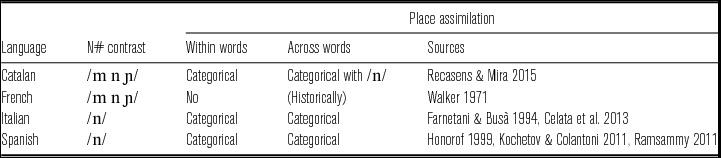
As shown in Table 1, within Romance languages, French is most like Catalan in terms of the number of word-final nasal contrasts observed. In many other Romance varieties, such contrasts are reduced word-finally. For example, while the same three-way /m n ɲ/ opposition observed in Catalan and French is possible in Spanish word-initially (e.g. /mata/ ‘kill (3sg.pres)’, /nata/ ‘cream’, /ɲata/ ‘flat-nosed person’) and word-medially (e.g. /kama/ ‘bed’, /kana/ ‘grey hair’, /kaɲa/ ‘reed’; Harris Reference Harris, Aronoff, Oehrle, Kelley and Stephens1984 cited in Ramsammy Reference Ramsammy2013), this contrast is neutralized word-finally to either /n/ or /ŋ/ depending on the variety.
Word-final nasal (N#) contrasts and typology of word-internal and word-final nasal place assimilation in Romance languages.

Where French appears to differ from other Romance languages is in terms of its assimilatory patterns. In most Romance languages, syllable-final nasals assimilate in place to the following obstruent both word-medially and word-finally (e.g. Spanish [impɾuðente] imprudente ‘imprudent’, [intakto] intacto ‘untouched’, [iŋɡɾato] ingrato ‘ungrateful’; [kombos] con vos ‘with you’, [kontos] con tos ‘with cough’, [koŋɡanas] con ganas ‘with desire’). In contrast, French is typically described as lacking place assimilation both word-medially (e.g. samedi [samdi], *[sandi] ‘Saturday’; canneberge [kanbɛʁʒ], *[kambɛʁʒ] ‘cranberry’; cognement [kɔɲmɑ̃], *[kɔmːɑ̃] ‘knocking’) and word-finally (e.g. une bonne baguette [ynbɔnbaɡɛt], *[ynbɔmbaɡɛt] ‘a good baguette’). The lack of assimilation may be related to a general characteristic of French. Compared to most other Romance languages, it permits a (much) wider range of word-final consonants including consonant clusters. For example, whereas Spanish allows a small subset of its consonant inventory in this position – mainly, the coronals /d s n l ɾ/ – in French, all consonants with the exception of /j ɥ w/Footnote 4 may occur word-finally. One might imagine that the lesser degree of word-final consonant assimilation is related to an attempt to preserve the larger range of phonemic oppositions in a language like French. Phonetic evidence for this hypothesis comes from Snoeren et al.’s (Reference Snoeren, Hallé and Segui2006) study of voicing assimilation in word-final stops. Indeed, these researchers found final stop voicing assimilation to be weaker in words in which stop voicing resulted in minimal pairs in the stimuli set (e.g. rate /ʁat/ ‘spleen’, rade /ʁad/ ‘harbour’).
Having compared the ways in which French nasals are similar/differ from other Romance languages, we now turn to a discussion of articulatory studies of nasal assimilation with particular reference to Romance and Germanic languages.
2.3 Articulatory/EPG studies of nasal assimilation
Whereas most previous descriptions of Romance coda-nasal place assimilation have relied on auditory impressions, phoneticians interested in a more fine-grained examination of assimilatory patterns have turned to electropalatography (EPG; e.g. Recasens & Mira Reference Recasens and Mira2015 for Catalan; Farnetani & Busà Reference Farnetani and Busà1994, Celata et al. Reference Celata, Calamai, Ricci and Bertini2013 for Italian; Kochetov & Colantoni Reference Kochetov and Colantoni2011, Ramsammy Reference Ramsammy2011, Reference Ramsammy2013 for Spanish; see also Honorof Reference Honorof1999 for an investigation of nasal assimilation using fleshpoint-tracking technic electromagnetic articulography, EMA). This articulatory method tracks contact between the tongue and the roof of the mouth over time and allows for precise measurement of gradient coarticulation. To date, no similar studies have been undertaken for French.Footnote 5
The potential contribution of EPG to the study of nasal place assimilation can be quickly demonstrated via a comparison of data from languages with categorical versus gradient assimilation. Figure 1 provides such a comparison between Spanish data taken from Kochetov & Colantoni (Reference Kochetov and Colantoni2011) and English data from our CLAD database (Kochetov, Colantoni & Steele Reference Kochetov, Colantoni and Steele2017). The linguopalatal contact profiles in (Ai) illustrate the alveolar realization of /n/ in Spanish digan ‘say’ (left) versus the velar realization of /k/ in Spanish caja ‘box’ (right). In these and the other profiles to be discussed in Section 4, the top three rows are activated with alveolar articulations, rows 4 and 5 with palatal articulations, and the bottom three rows with velar articulations. The darkness of the shading as well as the values given in each cell indicate the mean degree of contact with the electrode located at that position along the palate during the production of the consonant (see Section 4.2 for further details). Whereas the alveolar /n/ of digan ‘say (2pl)’ in (Ai) primarily involves contact in the first two or three rows, the realization of the velar /k/ of caja ‘box’ results in contact with the electrodes in the periphery of the final rows. In (Aii), a series of 14 linguopalatal contact profiles taken at 10 ms intervals during the nasal+stop interval is provided for the word-final /n/ in the Spanish phrase digan caja ‘say box’. The contrast between the articulation of /n/ here versus in digan in (Ai) is clear: in the sequence in (Aii), the nasal has completely assimilated in place to the following velar stop and is realized as [ŋk] as indicated by the activation of electrodes only in the periphery of the final rows. In terms of place of articulation, this /n/ resembles the velar /k/ of Spanish caja ‘box’ in (Ai). We will refer to this pattern, with no anterior contact during the nasal interval, as ‘categorical place assimilation’.
Sample EPG displays of word-final nasal place assimilation in Spanish (A; Kochetov & Colantoni Reference Kochetov and Colantoni2011) and English (B; Kochetov et al. Reference Kochetov, Colantoni and Steele2017).

The profiles in (Bi–iii) illustrate the variable patterns of nasal place assimilation typical of Germanic languages like English. All three series of profiles are for the /nk/ sequence produced in the phrase in Guelph /ɪnɡwɛlf/ as produced by three Canadian English speakers (Kochetov et al. Reference Kochetov, Colantoni and Steele2017). The images in (Bi) and (Bii) reveal patterns of gradient assimilation. In the realization [nn͡ŋɡ] in (Bi), the speaker begins with a primarily alveolar nasal that later becomes doubly articulated, with the alveolar and velar constrictions being co-produced. The [n̞ŋɡ] realization in (Bii) differs in that it has a velar constriction throughout, while barely showing any alveolar contact (the so-called ‘residual alveolar’; Ellis & Hardcastle Reference Ellis and Hardcastle2002). The realization in (Biii) involves complete place assimilation to the following velar and resembles strongly the categorical assimilation attested in Spanish (Aii).
As mentioned earlier, there have been no EPG studies of French word-final nasal place assimilation to date. While descriptions of French are consistent in failing to mention the presence of assimilation in such contexts, we have already reviewed two main reasons to anticipate that some degree of phonetic assimilation may actually occur. As discussed in Section 2.1 above, in the case of French, previous phonetic studies have observed cross-word assimilation targeting voicing in obstruent–obstruent and obstruent–sonorant sequences and place in sibilant sequences. It would be surprising that a language that permits assimilation with voice and place would prohibit assimilation with place in nasals, particularly given that, cross-linguistically, nasals are arguably the consonants most commonly observed to participate exactly in this process (Jun Reference Jun1995). As concerns the patterns observed in Romance languages of which French is a main member, we reviewed in Section 2.2 above several recent articulatory studies that have shown cross-linguistic variation in the implementation of nasal-to-velar assimilatory patterns with languages differing both in the categorical versus gradient phonetic implementation of assimilation and the factors conditioning this variation. Coda contrast typology may account for some of these between-language differences: in languages like English with larger inventories, assimilation may be variable (complete or gradient; e.g. Ellis & Hardcastle Reference Ellis and Hardcastle2002). However, Catalan, a language with an equal number of coda contrasts to English only allows categorical assimilation (see Table 1). Recasens & Mira (Reference Recasens and Mira2015) hypothesize that Catalan patterns with Italian and Spanish in having categorical cross-word assimilation because assimilation is categorical within words. Thus, not only coda inventory but also language-specific coarticulatory patterns seem to shape assimilation. These latter researchers’ results confirm that nasals in Catalan do not assimilate gradiently to the following consonant. Indeed, they only found cases of complete or lack of assimilation. While the former was conditioned by the lexical status of the word with the nasal – specifically, categorical assimilation occurred with function words – the latter was conditioned by stress (e.g. no assimilation with primary stress) and by speaker (one of the three participants showed no assimilation in words with primary and secondary stress).
In summary, given the existence of assimilation involving voicing and place in French, and that, like Catalan and English, French allows a large number of nasal consonant place contrasts but, unlike Catalan, categorical assimilation has not previously been observed to occur word-medially, we hypothesize that gradient place assimilation should occur in French. In the following section, we describe an EPG study designed to test this hypothesis.
3 Method
3.1 Participants
Four native female speakers – two born in Cherbourg and Clermont-Ferrand, France (FC1, FC2), the other two in Chicoutimi and St-Jean-sur-Richelieu, Quebec, Canada (FQ1, FQ2) – participated in the study. They ranged in age from 26 to 29 years, had post-secondary education, and low intermediate to advanced knowledge of English.
3.2 Task and stimuli
The study reported here was part of a larger study involving a series of reading tasks. In the case of the data for the present study, participants were required to read carrier sentences (C'est une [STIMULUS] ‘That's a [STIMULUS]’).
Stimuli included 17 feminine nouns, each beginning with one of the French consonants /p t k b d ɡ f s ʃ v z ʒ ʁ m n l/ or the vowel /a/. Each noun was preceded by each of the adjectives bonne /bɔn/ ‘good (fem)’ and grande /ɡʁɑ̃d/ ‘big (fem)’, resulting in a total of 34 carrier phrases. The analysis presented in Section 4 focuses on the sequences /n#k/ and /n#ɡ/ (targets) as well as /n#t/ and /n#d/ (controls) in the phrases bonne casquette /bɔnkasˈkɛt/ ‘good cap’, bonne galette /bɔnɡaˈlɛt/ ‘good tart/cookie’, bonne tablette /bɔntaˈblɛt/ ‘good tablet/shelf’, and bonne dentiste /bɔndɑ̃ˈtist/ ‘good dentist’. As EPG is restricted to measuring articulations involving the roof of the mouth, no labial targets were included. While previous research has shown that assimilation may be conditioned by the manner (Ruhlen Reference Ruhlen1973, Hajek Reference Hajek1997; see also Solé Reference Solé, Prieto, Mascaró and Solé2007) and voicing of the following consonant (Hajek Reference Hajek1997, Abdelli-Beruh 2011a; but see Recasens & Mira Reference Recasens and Mira2015 for lack of voicing asymmetries for nasals in Catalan) as well as by position in the word and stress (Hajek Reference Hajek1997), voicing alone was manipulated here. Note that, given that stress is phrase-final in French and that all clusters appeared in the same medial position in the accentual phrase, stress was effectively controlled for as well. In some analyses of Quebecois French (e.g. that adopted in Tremblay & Owens Reference Tremblay and Owens2010), the pre-nominal adjective would be prosodified in a separate phonological phrase. As we will see in Section 4.3 where we test this possibility empirically, no such between-dialect difference was found in the present data. The 34 carrier phrase stimuli were randomized and read six times by each speaker (except for FQ1, who read the stimuli nine times).
3.3 Experimental protocol
Participants were tested individually. Given the physical demands of speaking with an artificial palate and the number of stimuli and tasks for the larger study, each speaker participated in five or six one-and-a-half hour sessions until all data had been collected. The data for the present study were collected over two sessions (three rounds per session for all speakers). Each session began with a short conversation with the speaker followed by multiple readings of the ‘North Wind and the Sun’ text that also served as a warm-up. For all tasks, participants were left to speak at their self-set normal speech rate (Mean FC1: 0.203, FC2: 0.180, FQ1: 0.188, FQ2: 0.220 syllables per second calculated by dividing the number of syllables by the duration of the carrier phrase for each utterance). When obvious production errors unrelated to nasal place assimilation occurred, participants were asked to repeat the item in question. All sessions were conducted exclusively in French in the Linguistics Department Phonetics Lab at the University of Toronto, Canada.
3.4 Data collection, preparation, and analysis
3.4.1 EPG measurements
Each participant wore a custom Articulate Instruments acrylic 62-electrode palate (Wrench Reference Wrench2006). The Articulatory Assistant software (Wrench et al. Reference Wrench, Gibbon, McNeill, Wood, Hansen and Pellom2002) was used to record, segment, and analyze the data. All recordings were made at a 100Hz sampling rate.
3.4.2 Data preparation and analysis
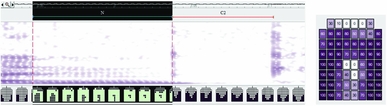
Each of the productions of the target phrases bonne casquette ‘good cap’, bonne galette ‘good tart/cookie’, bonne tablette ‘good tablet/shelf’, and bonne dentiste ‘good dentist’ was annotated indicating the nasal /n/ and the following stop. Segmentation was based on the waveform and the spectrogram, with the onset of the nasal corresponding to a drop in intensity and the onset of nasal murmur, its offset corresponding to the offset of nasal murmur; stop closures were identified as intervals of silence (with possible voicing) following the nasal interval. An example of such annotation is shown in Figure 2 (left panel). For each sequence, linguopalatal contact averages were taken over the entire nasal interval for all six/nine (FQ1 alone) repetitions. The right panel of Figure 2 shows an average profile for a single token of an /n/ preceding /k/. Assimilatory patterns were evaluated both qualitatively and quantitatively. As concerns the former, for each nasal+stop sequence, the presence or absence of coronal (rows 1–4 of the palate) and velar closures (last 2 rows) were measured during the nasal interval. All nasals were classified as ‘unassimilated’ (coronal-only closure, [n]), ‘categorically assimilated’ (velar-only closure, [ŋ]) or ‘gradiently assimilated’ (coronal closure overlapped by a temporally delayed velar closure, [nn͡ŋ]). For example, the nasal shown in Figure 2 is a gradiently assimilated [nn͡ŋ] sequence with the first five palate frames (50 ms) showing an alveolar-only closure ([n], although with increasing posterior side contact), whereas the remaining four frames show overlapped alveolar-velar closures ([n͡ŋ]).
A sample annotation of the nasal (N) + stop (C2) interval (left) for a token of bonne casquette ‘good cap’ (speaker FC2) and the corresponding linguopalatal contact profile for the nasal (right). The colours for the nasal interval at the bottom are reversed, with white cells indicating contact.

The quantitative measurement of nasal place assimilation involved the calculation of two indices. The first, the Centre of Gravity of Contact (CoG; Gibbon & Nicolaidis Reference Gibbon, Nicolaidis, Hardcastle and Hewlett1999), measures the location of the highest concentration of activated electrodes: CoG values decrease progressively from coronal-only to double coronal-velar to velar-only constrictions. This measurement thus effectively allows us to capture any changes in place of articulation between assimilated and non-assimilated realizations. The second, the Q(uotient of activation of electrodes; Fontdevila, Pallarès & Recasens Reference Fontdevila, Pallarès and Recasens1994), is calculated by dividing the number of activated electrodes over the entire palate by the total number of electrodes (here, 62). This measure is relatively low for single-place closures (coronal or velar) but high for doubly-articulated nasals such as the gradiently assimilated [nn͡ŋk] in Figure 2 (see also Figure 1Bi for an English example). Both ratios were calculated one-third and two-thirds of the way through the nasal interval. These two time points were selected because our preliminary examination of the data suggested that /n/ tended to have coronal-only constrictions earlier on, and overlapped coronal-velar constrictions further on in the nasal interval. Statistical analysis of the data (CoG and Q values at two time points) was performed using linear mixed effects regression models employing the nlme package (Pinheiro et al. Reference Pinheiro, Bates, DebRoy, Sarkar and Core Team2016) for R (version 3.3.3; R Core Team 2014). The fixed effects were Context Place (coronal, velar), Context Voicing (voiceless, voiced), and Dialect (European, Quebec); Participant was a random effect.
4 Results
We first report here general patterns observed in the data then quantitative measures at the one-third and two-thirds points in the nasal interval. Given the small sample size, we note a general need for caution when extrapolating the results found here to the larger population of French speakers of both European and Quebecois French.
4.1 Realization of nasal+stop sequences: General patterns
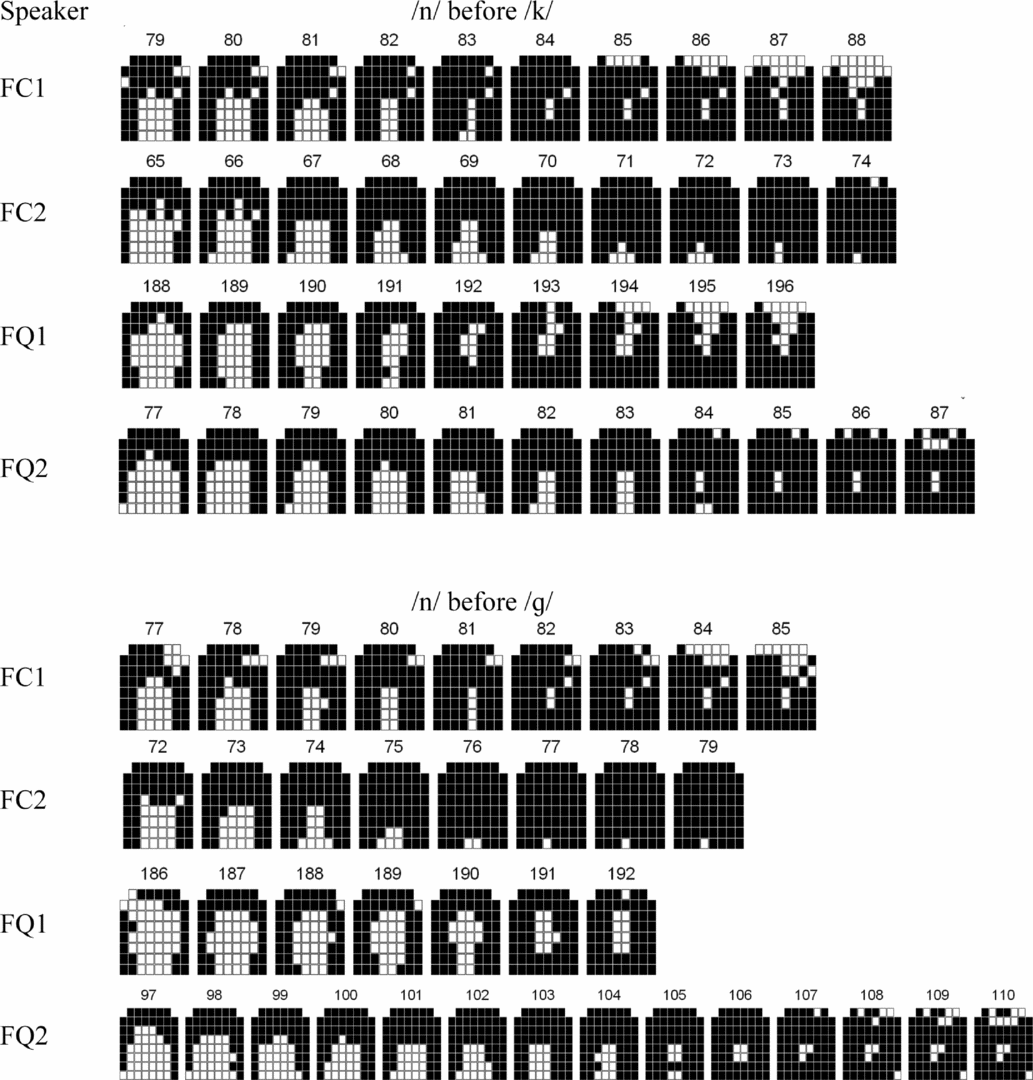
In this section, we summarize the results for the nasal+stop coarticulatory patterns observed in the speech of our four European and Quebecois French speakers. If there is categorical assimilation in /n#k/ or /n#ɡ/ clusters, there should be no traces of tongue-palate contact in rows 1–4 of the artificial palate at the two points measured (at one-third and two-thirds of the duration of the sequence). On the contrary, if there is no assimilation, we should expect to see contact in the alveolar region (rows 1–4), followed by contact in the velar region (rows 5–8). The patterns observed, however, are consistent with gradient assimilation of /n/ in the nasal+velar stop sequences. Specifically, all speakers realized all /n#k/ or /n#ɡ/ clusters as [nn͡ŋk]; there were no traces of epenthetic vowels separating the sequence (i.e. [nək]) nor instances of unassimilated sequences (i.e. [nk]) nor patterns consistent with categorical assimilation (i.e. [ŋk]). To exemplify typical temporal patterns, Figure 3 shows frame-by-frame palates for the nasal interval in the second repetition of the utterances bonne casquette ‘good cap’ and bonne galette ‘good tart/cookie’ produced by each speaker. Note that all speakers begin the nasal with a coronal-only closure in the first 4 rows of the palate and end it with a doubly-articulated coronal-velar, or in some cases (both FC1’s and FQ1’s /n#k/), with velar-only closure.
Frame-by-frame palates for the nasal interval in the second repetition of the utterances bonne casquette ‘good cap’ (/n#k/ sequence; top) and bonne galette ‘good tart/cookie’ (/n#ɡ/ sequence; bottom) produced by each speaker.

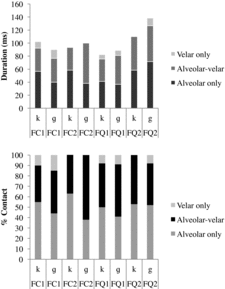
As can be seen above, the participants showed some variation in the precise timing of the onset of the velar contact. On average, the latter ranged from 35% to 62% of the entire duration of the sequence (see Figure 4 (bottom) for further detail). Intra-speaker variability was also conditioned by the voicing of the following consonant. When the nasal was followed by /k/, the coronal-only contact was longer and constituted a larger proportion of the sequence than the coronal-velar contact. In contrast, when the nasal was followed by /ɡ/, a greater degree of inter-speaker variability was observed. For speakers FQ1 and FC2, the coronal-velar contact formed a larger proportion of the sequence, which is exactly the opposite pattern displayed by FQ2. FC1’s realizations fell somewhere in between those of the other speakers with an almost equal proportion of the sequence showing coronal-only and coronal-velar contact. Velar-only portions of the nasal were relatively short and less common, yet observed for three out of the four speakers (for our purposes, sequences ending in velar-only closures ([nn͡ŋŋ]) were grouped together with [nn͡ŋ] sequences). FC1 and FQ1, in particular, tended to release the alveolar closure soon after the velar closure was formed. In contrast, FC2 and FQ2 tended to maintain the alveolar closure considerably longer after the onset of the velar closure. Overall, the results show that although the speakers consistently produce overlapped /n/+velar sequences, they varied somewhat in the degree of the alveolar-velar overlap including the degree of the effect of voicing, possibly reflecting individual phonetic implementation strategies.
Timing of the alveolar-only, alveolar-velar, and velar-only contact by speaker (European FC1 and FC2; Quebecois FQ1 and FQ2) and by voicing of the following consonant (/k/ versus /ɡ/). Top: Mean duration across repetitions in milliseconds of each type of contact pattern (Alveolar-only, Alveolar-Velar, Velar-only). Bottom: Percent of the sequence with each contact pattern.

These results show that participants consistently articulated these sequences with variable degrees of gradient overlap. No cases of epenthesis nor of categorical assimilation were found. Participants, however, varied in the degree to which they velarized the nasal in the nasal+velar stop sequences or in the degree of contact over the entire palate.
Having looked at the general assimilatory patterns in the production of the four speakers, we now turn to a quantitative analysis of the same patterns using the measures of Centre of Gravity and Q(uotient of activation).
4.2 Realization of nasal+stop sequences: Place of articulation and degree of contact
4.2.1 Centre of Gravity (CoG)
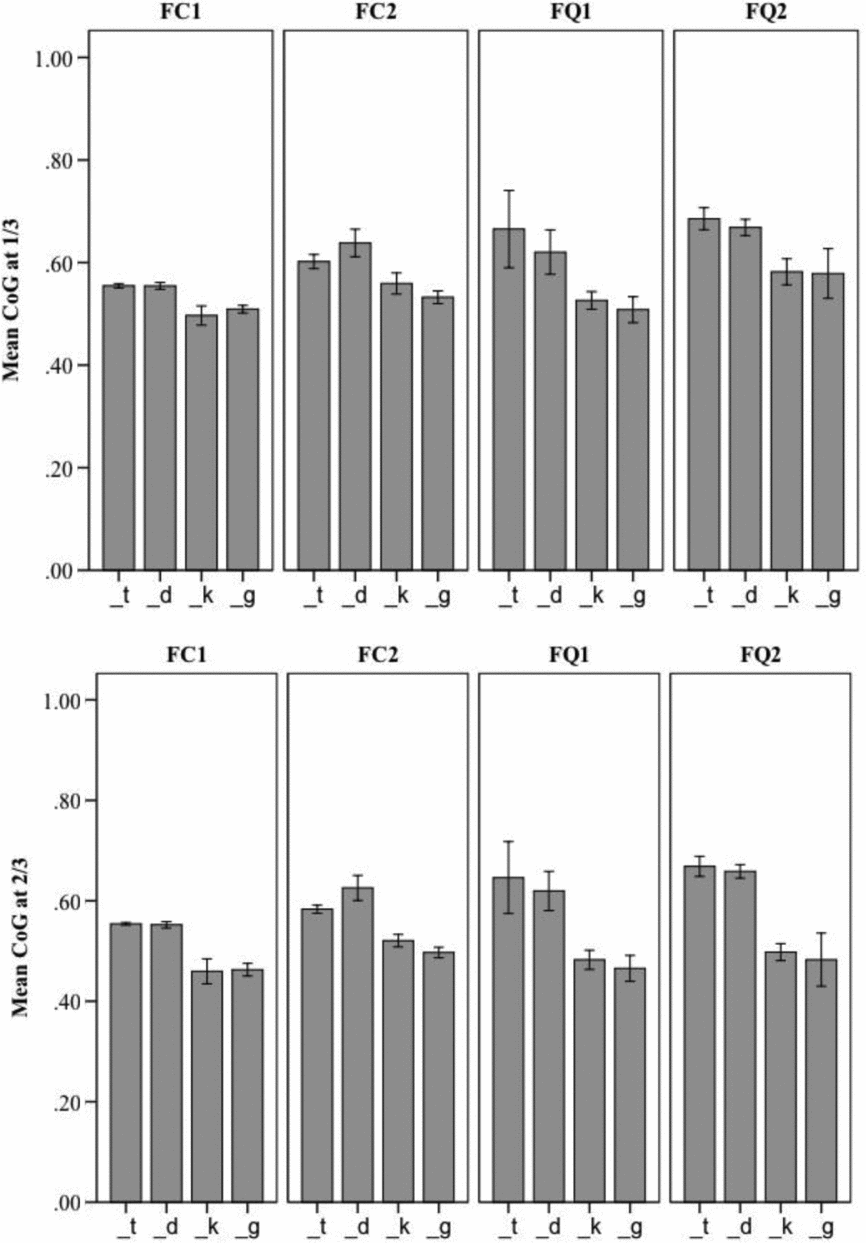
Recall that the CoG is expected to be higher with more fronted articulations and lower with more retracted articulations. Thus, if the nasal assimilates to the following velar consonant, we expect to find a lower CoG. Figure 5 displays the CoG results obtained at both the one-third and two-thirds points in the nasal interval for each of the four speakers. On average, nasals were more retracted before velar than before coronal stops, regardless of their voicing. The degree of retraction was also greater at the second point measured in the interval.
Center of Gravity (CoG) for word-final /n/ of French bonne ‘good (fem)’ by speaker (European FC1 and FC2; Quebecois FQ1 and FQ2) and following consonant (/t d k ɡ/) one-third (top) and two-thirds (bottom) into the nasal interval. Error bars indicate the 95% confidence interval.

To confirm these observations, we performed linear mixed effects regression models for CoG in the entire dataset. The results showed a significant effect of Context Place (t = −5.588, p < .0001): nasals were more posterior before velars. Point of Measurement was not significant (t = −0.153, p = .879), however, there was a significant interaction between Point of Measurement and Context Place (CoG: t = −3.995, p < .001). GoG was lower further within the nasal interval before velars.
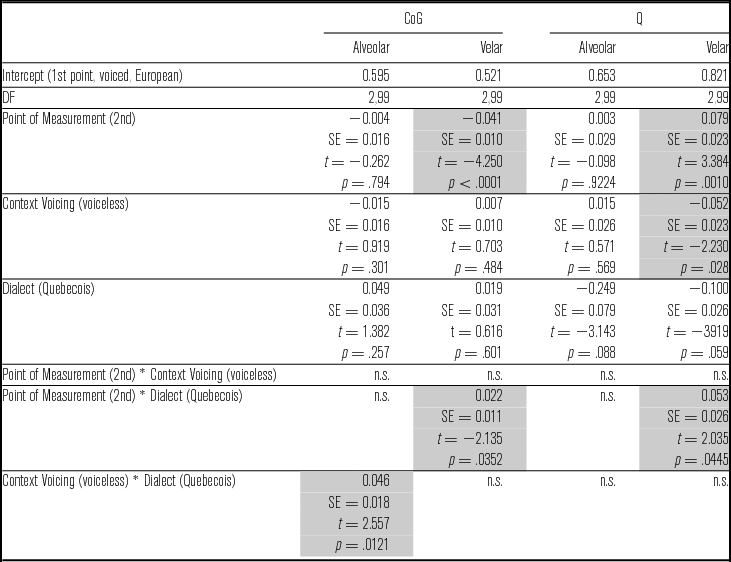
To further investigate differences in CoG within places of articulation, we performed separate analyses for the alveolar and velar contexts. These results are presented in Table 2 (leftmost columns). It can be seen that no significant effects or interactions were observed for the context before alveolars, except for a Context Voicing * Dialect interaction. This interaction was due to the higher CoG for Quebecois speakers in the voiceless context only. In the context of velars, there was a significant effect of Point of Measurement, confirming that CoG was lower further within the nasal interval. The significant Point of Measurement * Dialect interaction was related to the Quebecois speakers showing higher CoG than the European speakers, but only earlier within the nasal. These differences, therefore, appear to reflect somewhat different realizations of unassimilated nasals (more fronted for Quebecois speakers), rather than differences in place assimilation. We remind the reader once again that the absence of the latter effects might be related to the small sample size. Results obtained for the CoG values indicate that, although the nasal does not categorically assimilate to the following stop consonant, it does significantly vary in its place of articulation, which reveals a gradual overlap of coronal and velar gestures in both /n#k/ and in /n#ɡ/ sequences.
Results from linear mixed effects regression analyses for Center of Gravity (CoG) and Quotient of Activation (Q) separately for the alveolar and velar contexts. The reference intercept and slope values are for the first (one-third) measurement point during /n/ before voiced stops as produced by the European speakers (FC1 and FC2); subsequent comparisons are with the second (two-thirds) point, voiceless stops, and Quebecois speakers. Significant effects and interactions are shaded; n.s. = non-significant interactions.

4.2.2 Quotient of Activation (Q)
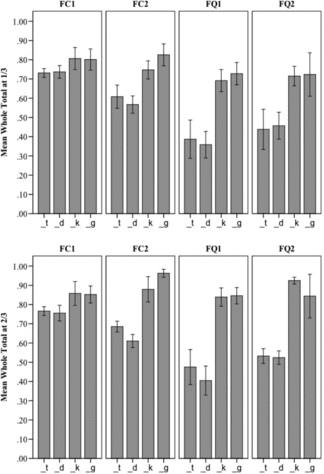
In order to determine the degree of overlap between coronal and velar gestures, we calculated the Quotient of Activation (Q). As discussed in Section 3.4.2, a higher Q value indicates more contact over the entire palate indicating a doubly articulated sequence. Figure 6 displays the Q values one-third (left) and two-thirds (right) into the nasal interval for each of the four speakers. On average, word-final /n/ in French bonne ‘good (FEM)’ was characterized by more contact before velars than before coronals, regardless of the stop's voicing. The magnitude of this difference was greater at the two-thirds point. These observations were confirmed by linear mixed effects regression models.
Quotient of Activation (Q) for word-final /n/ of French bonne ‘good (fem)’ by speaker (European FC1 and FC2; Quebecois FQ1 and FQ2) and following consonant (/t d k ɡ/) one-third (top) and two-thirds (bottom) into the nasal interval. Error bars indicate the 95% confidence interval.

The model for the entire dataset showed a significant effect of Context Place for Q (t = 7.057, p < .0001), indicating that nasals before velars had more contact. Point of Measurement was not significant (t = 1.043, p = .298), however, there was a significant interaction between Point of Measurement and Context Place (t = 3.026, p < .01), indicative of the higher Q further within the nasal interval before velars.
The effect of Dialect was significant for Q (t = −6.435, p < .05), with European speakers showing overall more contact than Quebecois speakers. However, a significant interaction between Dialect and Context Place (t = −9.079, p < .0001) pointed to these dialect differences being limited to the pre-alveolar context. Context Voicing was not significant but interacted significantly with Context Place (t = −2.164, p < .05). This was due to higher contact before voiceless than voiced stops, but only for alveolars.
Differences in Q were further explored separately for the alveolar and velar contexts. These results are presented in Table 2 (rightmost columns). No significant differences or interactions were observed before alveolars. In contrast, before velars, there was a significant effect of Point of Measurement, indicating greater contact further within the nasal interval. There was also a significant effect of Context Voicing, with the nasal before voiced stops showing more contact. The factor Dialect did not reach significance but showed a tendency towards somewhat greater contact for the European French speakers. This appears to be due to these speakers’ more fronted or less laminal /t/ and /d/ articulations. Finally, there was also a significant Point of Measurement * Dialect interaction; the European–Quebecois differences were limited to the first measurement point.
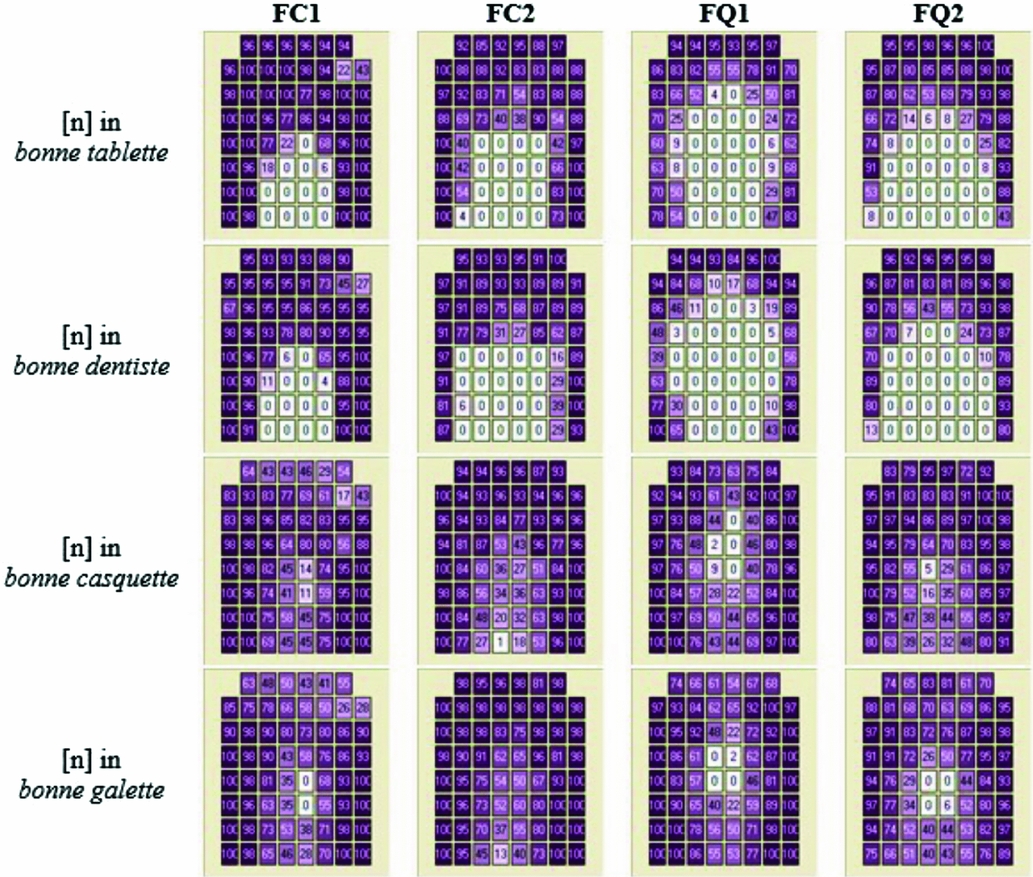
Taken together, the measures of CoG and Q indicate that, for all of the participants in our study, the nasal was more retracted and displayed more contact before velar than coronal stops, which constitutes evidence of gradient assimilation. Participants, however, differed slightly both in the degree of fronting of the nasal before coronals and of laminal contact. Figure 7 provides the linguopalatal contact profiles for /n/ before coronal versus velar stops for each of the speakers. These profiles suggest a difference between European and Quebecois speakers in the realization of the nasal before /t d/: the formers’ realizations involve a more posterior and laminal articulation. Cross-dialectal differences in the realization of /t d/, however, have not been reported. Indeed, the coronal stops have been described as apico-laminal denti-alveolar in both varieties (e.g. Clairet Reference Clairet2004, Darcy et al. Reference Darcy, Ramus, Christophe, Kinzler, Dupoux, Kügler, Féry and van de Vijver2009, Brajot et al. Reference Brajot, Mollaei, Callahan, Klein, Baum and Gracco2013) although there is some degree of inter-speaker variation (Dart Reference Dart1998). Given the size of our sample size, however, any dialectal differences should be interpreted with caution.
Linguopalatal contact profiles for the full nasal interval for each of the speakers (European FC1 and FC2; Quebecois FQ1 and FQ2) by following stop (/t/ in bonne tablette ‘good tablet/shelf’, /d/ in bonne dentist ‘good dentist’, /k/ in bonne casquette ‘good cap’, /ɡ/ in bonne galette ‘good tart/cookie’). Average of six/nine (FQ1 only) repetitions.

As mentioned in Section 3.2, following certain previous analyses, one might expect a different prosodification of the adjective+noun sequences in European and Quebecois French that could potentially have consequences for differences in terms of the realization of the nasal+stop sequence by speakers of these two varieties. To verify that the patterns reported here reflect coarticulation rather than differences in the prosodification of adjective+nouns sequences, we conducted a subsequent analysis in which we explored potential between-dialect differences in prosodic phrasing and the duration of the vowel–nasal interval that is reported next.
4.3 Prosodification of the adjective+noun sequences
To test whether the European and Quebecois French speakers potentially prosodified the adjective+noun sequences differently, that is, in one versus two accentual phrases respectively, a phonological (ToBI) analysis and acoustic measurement of the vowel+nasal (VN) interval of the adjective were undertaken.
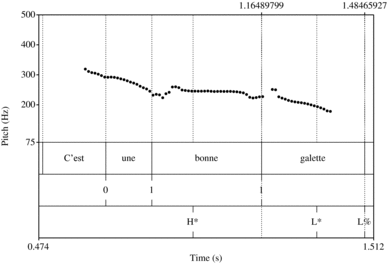
As concerns the former, participants of both dialects realized these noun phrases in a very consistent way. First, all nouns and adjectives were prosodified as part of a single accentual phrase. Second, the pitch patterns were consistent across participants, namely, HL-, where the H tone was associated with last syllable of the adjective, the L tone with the first syllable of the noun. Some variation was observed in the realization of the last syllable of the noun, which could either be L or H. Figure 8 illustrates both the typical pitch contour associated with these sequences as well as the fact that the adjective+noun sequence was part of a single accentual phrase.
f0 contour of the adjective+noun sequence in C'est une bonne galette ‘That's a good tart/cookie’ as realized by speaker FQ1.

Further evidence for the similar prosodification of the adjective+noun sequences in the two dialects comes from an acoustic analysis of the duration of the final VN sequence in the adjective bonne /bɔn/ ‘good’. Were the adjective to be prosodified independently of the noun in Quebecois French and consequently fall at the end of the accentual phrase, phrase-final prominence should fall on the syllable containing the VN sequence in Quebecois but not European French. As duration is the primary cue to such phrase-final prominence in French (e.g. Astésano Reference Astésano2001 Léon Reference Léon2001, Jun & Fougeron Reference Jun and Fougeron2002), one would expect that, on average, the VN sequence of the adjectives would be longer in the Quebecois speakers’ productions. Accordingly, the vowel and nasal consonant in all such sequences were segmented in Praat (Boersma & Weenink Reference Boersma and Weenink2017) based on the waveforms and spectrograms. Once segmented, the VN interval duration was measured and compared across the speakers. A linear mixed effects regression model with the VN interval duration as the dependent variable found no significant effect for dialect (t = 0.335110, p = .7694). Differences did exist, however, at the level of the individual speakers. Whereas the speakers were comparable in terms of the amount of variation observed in the duration of the VN interval as indicated by the standard deviation (FC1: .020, FC2: .020, FQ1: .017, FQ2: .030 seconds), there were differences in the total duration of the interval (FC1: .228, FC2: .158, FQ1: .187, FQ2: .225 seconds). These differences parallel the differences in speech rate reported in Section 3.3 and could tentatively be attributed to the latter.
In summary, while the potential existence of a dialect-based effect in the larger population cannot be discounted completely given the small sample size (two speakers per dialect), neither the phonological nor phonetic analysis undertaken provided evidence for a dialect-based difference in the prosodification of the noun+adjective sequences studied.
5 Discussion
5.1 Realization of nasal+velar stop sequences
Our main goal in this paper was to increase our understanding of assimilatory cross-linguistic patterns by analyzing cross-word nasal+velar stop realizations in a language like French, which has a relatively large coda-nasal inventory but where nasal place assimilation has not been observed previously. Based on the fact that both voicing and place assimilation are attested in cross-word consonant+consonant sequences in the language, we hypothesized that French should allow for gradient place assimilation in nasal+stop sequences. Our results have confirmed this hypothesis. As shown at both the general level as well as using quantitative measures, all participants in this study displayed gradient patterns of nasal-to-velar stop assimilation across words. Although participants differed somewhat in the timing of the alveolar and nasal gesture overlap, they did not vary in the overall assimilation patterns displayed. Thus, on the one hand, French patterns with English in displaying gradient patterns of assimilation. On the other hand, it differs from English in which there is variability between gradient and categorical assimilation (Barry Reference Barry1991, Ellis & Hardcastle Reference Ellis and Hardcastle2002, Stephenson & Harrington Reference Stephenson and Harrington2002; see also Figure 1B).
Based on our results, French differs from the other previously studied Romance languages, namely, Catalan, Italian, and Spanish in which categorical assimilation is the norm. The comparison with Catalan is particularly interesting given the similarity in coda nasal inventories already highlighted between the two languages. Whereas both Catalan and French have a three-way place contrast in codas, word-internal nasal place assimilation has previously been observed in the former but not the latter. Following Recasens & Mira's (Reference Recasens and Mira2015) hypothesis that word-internal assimilatory patterns are a predictor of cross-word patterns, we should predict gradient nasal place assimilation in French. That this has not been previously observed is likely due to the paucity of forms involving such clusters. However, it is still important to try to understand why languages that are closely related and have similar segmental inventories differ in their coarticulatory preferences. We turn to this next.
5.2 Factors conditioning assimilation
Our results have shown that there is cross-word nasal place assimilation in French, that such assimilation is gradient, and that patterns are consistent across speakers, which is clearly different from what has been reported previously for both English and Catalan. Indeed, in the case of Catalan, Recasens & Mira (Reference Recasens and Mira2015) observed variability across speakers with one of their three participants showing no assimilation in sequences when primary stress fell on the following word (i.e. where the nasal occurred at a strong phonological boundary). Similarly, stress was found to inhibit nasal place assimilation for some of the Spanish speakers in Kochetov & Colantoni (Reference Kochetov and Colantoni2011). Specifically, this happened when the word-final nasal occurred in a stressed syllable followed by a word-initial stressed syllable (e.g. dirán caja [diˈɾaŋˈkaxa] ‘they say box’ as opposed to digan caja [ˈdiɣaŋˈkaxa] ‘they will say box’). Since French is a fixed-stress language and we found no between-dialect differences in the prosodification of the adjective+noun sequences (Section 4.3), we can speculate that the stability found in coarticulatory patterns among the European and Quebecois speakers may be partly related to the prosodic characteristics of the language (although subject to some cross-dialect variation) and of the stimuli in the present study. Given that all of our stimuli consisted of an adjective+noun sequence which is normally prosodified within the same accentual phrase (e.g. Jun & Fougeron Reference Jun and Fougeron2002), the cross-word patterns described here should closely resemble the within-words patterns reported for French. Indeed, we predict that gradient assimilation should also occur in word-medial nasal+stop clusters. That assimilation is typically described to be absent from such sequences may be related to their limited frequency as described in Section 2.1 – researchers may have simply failed to notice what would be a relatively rare phenomenon. We leave the testing of this hypothesis for future research.
We have also shown here that gradient assimilation is not affected by the voicing of the following stop but that inter-speaker variation did exist. The measures of CoG and Q revealed no significant differences in the degree of backing of the nasal or overall contact, respectively, as conditioned by the voicing of the following consonant. We did observe, however, some variability in the timing of the gestures when we compared /n#k/ versus /n#ɡ/ sequences. In particular, participants in the present study did not vary in the realization of the former but showed different timings of the gestures in the realization of the latter. Thus, if we take into account the overall patterns of assimilation as well as the results obtained for CoG and Q, we can conclude that, as in Catalan, assimilatory patterns are not conditioned by voicing of the following consonant (Recasens & Mira Reference Recasens and Mira2015). The analysis of the timing of the articulatory gestures, though, suggests that /n#k/ sequences are more stable across speakers than /n#ɡ/ sequences. In particular, we observed that in the former sequences, the coronal contact occupies a larger proportion of the sequence than the coronal-velar overlap. This synchronic pattern, though, differs from the diachronic patterns observed for vowel nasalization and vowel deletion in French, both of which took place first before voiceless consonants (e.g. Hajek Reference Hajek1997). These patterns are also different from those reported for American English in which nasal consonants are shorter before voiceless than before voiced consonants (e.g. Beddor Reference Beddor2009).
5.3 The typology of nasal assimilation in Romance
The differences in the realization of cross-word /n/+velar sequences in French as well as in Romance more generally can be modeled in terms of the temporal sequencing of the alveolar and velar gestures as schematized in Figure 9a–d (see Browman & Goldstein Reference Browman and Goldstein1992 and Gafos Reference Gafos2002 on gestural representations). Figure 9a represents the case of absence of overlap between the nasal and the stop in the presence of cluster-medial vowel epenthesis; this would be typical of dialects such as those of Southern France where word-final epenthesis is common (e.g. Durand, Slater & Wise Reference Durand, Slater and Wise1987, Durand Reference Durand1995). Figure 9b illustrates a diachronic stage no longer observed in Romance in which the vocalic gesture is eliminated but where the degree of gestural coordination is insufficient to allow for assimilation. In contrast, Figure 9c represents modern French varieties where gradient assimilation occurs. Finally, Figure 9d formalizes the categorical assimilation observed in other Romance languages such as Catalan, Italian, and Spanish.
Formalization of the typology of nasal place assimilation within Romance languages using Articulatory Phonology (Browman & Goldstein Reference Browman and Goldstein1992) gestural representations; T. Tip = tongue tip, T. Dorsum = tongue dorsum; the tongue gestures are assumed to be specified for complete closures (i.e. [alveolar, closed] and [velar, closed]); laryngeal gestures are not shown.

Our results may therefore shed light not only on the typology of nasal assimilation within Romance as well as vis-à-vis other languages families including Germanic but also on the diachronic path that languages may take beginning with vowel deletion in nasal–vowel–stop sequences to complete overlap. It is not completely clear, however, why French differs so radically from the other Romance languages under study, especially from a language like Catalan that has the same three-way nasal coda inventory. We speculate that French may be more like Catalan than might be observed superficially. Specifically, building on the hypothesis made in Section 5.2 that French also has gradient word-medial nasal+stop place assimilation that is not readily observed given the limited number of such sequences, the two languages are alike in having parallel prosodic word-medial and word-final assimilation but differ in the degree (partial in French, complete in Catalan). If this hypothesis is correct, what remains to be explained is why French is at an earlier stage of evolution (9c above) than Catalan (9d).
Consistent gradient assimilation across participants (albeit somewhat variable in its implementation) is another characteristic of the patterns observed, which makes French depart from languages like English. We argue that this rather homogenous behaviour of French speakers could be accounted for by the specific prosodic characteristics of the language; namely, French is a fixed-stress language and the prominence-lending unit is the accentual phrase rather than the prosodic word. Given that, in the stimuli used in this experiment, both the nasal and the following consonant were consistently within the same prosodic unit, participants are expected to display similar patterns across conditions. This differs from Catalan and Spanish in which the position of stress can be manipulated (see the discussion in Section 5.2 above).
6 Conclusion
Our study has presented new empirical evidence concerning the articulation of nasal+velar stop sequences in French. We have shown that place assimilation does occur and that this assimilation is gradient, although variable across speakers. No asymmetries conditioned by the voicing of the following consonant were observed, which differed from reports on the diachronic evolution of these sequences.
This work represents an initial step in the articulatory study of cross-word assimilatory patterns in French. Our results, however, reveal interesting patterns of cross-linguistic variation in the typology of nasal assimilation, and further our understanding of the conditioning factors. In particular, we have seen that patterns of assimilation across words are constrained not only by the nasal place inventory in the language and by word-internal coarticulatory patterns but also by the frequency and distribution of coda nasals in the language.
Acknowledgements
We wish to acknowledge our native speaker participants, the University of Toronto Faculty of Arts & Science Advancing Teaching and Learning in Arts and Science (ATLAS) program, the Social Sciences and Humanities Research Council of Canada (Insight Grant #435-2015-2013 to Alexei Kochetov), and Isabel Garriga for assistance with data annotation. This study has benefited from feedback received at the 2016 Montreal–Ottawa–Laval–Toronto (MOLT) Phonetics/Phonology Workshop and the 46th Linguistic Symposium on Romance Languages.