Introduction
When Paul Walden published his pioneering paper in 1914 on the molecular size and electric conductivity of some molten salts,Reference Walden1 he observed that some of these liquid molten salts, which he made by acid/base reactions, had melting points below 20°C. He concluded from the physiochemical data that these organic salts with melting points of 100°C and below behave similarly to molten salts having much higher melting points of between 300°C and 600°C. At that time, electric cars, which were introduced to the market around 1900, were still en vogue and regarded as the future of transportation, as they were clean and safe.2 Of course, there was no relation to ionic liquids. Powered by lead acid batteries with energy densities of around 0.01–0.015 kWh/kg, cruising ranges of about 50 km could be achieved, and even hybrid cars (the Lohner Porsche)3 were invented at that time.
As we know now, electric cars did not make it. As soon as it was possible to start internal combustion engines (ICEs) with a battery powered electric starter, the automobile industry concentrated on the development of ICE-driven cars. Hydrocarbons have an energy density of 12 kWh/kg, and even a very inefficient combustion engine could still transform 0.6 kWh/kg of this into mechanical energy, which was 60 times better than the energy density of a battery. Furthermore, fossil fuels were relatively cheap so that attractive cruising ranges could be achieved. At the end of the 1930s, electric cars were consequently no longer of interest.
The late 20th century saw two oil crises,4,5 and the development of electric cars was reinitiated around 1990. Today, this can be termed the “first renaissance of electric cars.” Some reasons why electric cars did not make it again were insufficient reliability of the cars and batteries, as well as high cost. Furthermore, battery energy densities did not exceed 0.1 kWh/kg at that time. In the following 15 years, ICEs were improved, and the “second renaissance of electric cars” occurred around 2008. This was spurred by concerns about “global warming” and the apparent need to reduce CO2 emissions, combined with predictions of “peak oil,” which would make fossil energy extremely expensive within just a few years.
Today, doubts regarding “peak oil” are justified, bearing in mind the enormous amounts of shale gas, shale oil, and oil sands found recently.6 This time, Li-ion batteries are regarded as suitable, and indeed cars such as the “Tesla Roadster” were put on the market. Today’s electric cars again suffer from low cruising ranges and/or high costs. Li-ion batteries have energy densities of only 0.1–0.15 kWh/kg and are rather expensive, whereas modern diesel engines have efficiencies of 40%, thus transforming up to 5 kWh of the 12 kWh/kg of hydrocarbons into mechanical energy.
The almost fatal recent event in a Dreamliner Boeing 787 aircraft, which experienced thermal runaway of a Li-ion battery when the aircraft was on the ground, undoubtedly showed that such batteries still have some problems. At least in Germany, the electric car hype is almost over, and the author expects a “third renaissance of electric cars” in 15–20 years from now, depending on international politics.
There are two reasons why electric cars have not made it to the, broader market: ICEs have been significantly improved in recent years, making them much more efficient. Second, there are no affordable electric cars on the market with cruising ranges comparable to ICE driven cars. The main problem is the low energy density of Li-ion batteries, which currently does not exceed 0.15 kWh/kg (see Reference 7). Thus, even with an efficient electric motor, a cruising range of 500 km will require a Li-ion battery weighing around 1000 kg. Such a battery will cost maybe USD∼$60,000. Li-ion batteries will probably continue to be used in hybrid electric cars until better batteries come on the market.
Potential replacement candidates include lithium/sulfur, lithium/air, and zinc/air batteries, which can have energy densities between 0.5 and 2 kWh/kg. There are concepts available to improve the energy density of batteries, and metallic lithium would be an ideal candidate for an anode material—from a thermodynamic point of view. Metallic lithium would deliver roughly 3800 mAh/g capacity, in contrast to just about 380 mAh/g for lithium/graphite. Thus, there is a factor of 10 difference between LiCx and Li. However, the electrodeposition of lithium upon charging usually leads to dendritic growth both in organic solventsReference Wen, Yu and Chen8 and also in ionic liquids, which can destroy a battery by a short circuit. In this context, other host materials were discussed recently to improve the charge density.Reference Scrosati and Garche7
Apart from rather exotic materials such as graphene,Reference Han, Lu and Li9 metals such as aluminum and semiconductors such as germanium and especially silicon have been suggested.Reference Szczech and Jin10 With Al and Si as hosts for Li, charge densities of ∼2200 and 4000 mAh/g, respectively, were discussed. However, there is also a shortcoming. As there is a large volume change during lithiation/delithiation, these materials rapidly disintegrate, and the charge density rapidly decreases during cycling. In the following, we discuss and demonstrate that ionic liquids (Walden implicitly reported the first one in 1914) are well suited to make macroporous aluminum and aluminum nanowires, which withstand mechanical stress better during lithiation/delithiation than other metallurgical materials. Furthermore, it is shown that macroporous germanium and macroporous silicon are feasible host materials for Li-ion batteries.
Macroporous aluminum
In order to circumvent the problem of large volume expansion during lithiation/delithiation of aluminum in Li-ion batteries, macroporous Al was made by an electrodeposition routine with a polystyrene spherical opal structure. Such an approach has been used by several groups in aqueous electrochemistry in the past, as summarized in the literature.Reference Stein and Schroden11 Based on our resultsReference Meng, Al-Salman, Zhao, Borissenko, Li and Endres12 on the electrochemical synthesis of three-dimensional ordered macroporous (3DOM) germanium (discussed later), we applied polystyrene (PS) spheres with a diameter of around 600 nm on a polished copper supporting electrode. The electrodeposition of Al is performed with an “old-fashioned” AlCl3-based ionic liquid. Around 1950, this type of ionic liquid was investigated in more detail for the first time.Reference Hurley and Wier13 If there is a molar excess of AlCl3, Al can be easily deposited, even inside the interstitials of a PS sphere opal structure,Reference Gasparotto, Prowald, Borisenko, El Abedin, Garsuch and Endres14 if the deposition is done inside of an inert gas glove box. After removal of the PS spheres with an organic solvent, an ordered macroporous structure of Al remains on the copper surface. The structure of the Al in Figure 1Reference Gasparotto, Prowald, Borisenko, El Abedin, Garsuch and Endres14 is not as nicely ordered as the 3DOM germanium,Reference Meng, Al-Salman, Zhao, Borissenko, Li and Endres12 but this is due to the roughness of the substrate.
Macroporous aluminum made by electrodeposition of Al from an AlCl3-based ionic liquid with the help of polystyrene sphere opal structures. Reprinted with permission from Reference 14. © 2011, Elsevier.

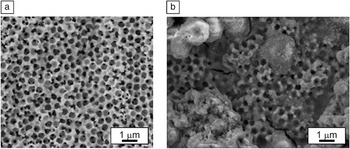
Subsequently, we investigated the cycling behavior of lithium in macroporous Al and decided on an ionic liquid as the electrolyte.Reference Gasparotto, Prowald, Borisenko, El Abedin, Garsuch and Endres14 We believe that ionic liquids have potential in batteries, because they have an unbeatable advantage: it is extremely difficult to ignite ionic liquids, as they have a negligible vapor pressure. Thus, they do not typically burn, and the risk of thermal runaway is strongly reduced even if it cannot be entirely excluded. We investigated the cycling behavior of Li with 1-butyl-1-methylpyrrolidinium bis(trifluoromethylsulfonyl)amide/lithium bis(trifluoromethylsulfonyl)amide ([Py1,4]TFSA/LiTFSA)Reference Gasparotto, Prowald, Borisenko, El Abedin, Garsuch and Endres14 and found reversible electrochemical behavior together with hints of alloying. Furthermore, the Al macroporous structure “survived” at least 10 charge/discharge cycles, carried out by cyclic voltammetry. Figure 2 shows the macroporous structure, after one and 10 cycles.Reference Gasparotto, Prowald, Borisenko, El Abedin, Garsuch and Endres14
Delithiated macroporous Al after (a) 1 and (b) 10 cycles; electrolyte: ionic liquid [Py1,4]TFSA/LiTFSA. Reprinted with permission from Reference 14. © 2011, Elsevier.

From our point of view, the results showed that, in principle, macroporous Al can cope with the volume change during Li cycling. We estimated that the gravimetric capacity of our material would be anywhere between the value for LiAl (790 mAh/g) and that for pure Li (3862 mAh/g),Reference Gasparotto, Prowald, Borisenko, El Abedin, Garsuch and Endres14 thus we could demonstrate that such open structures can be made electrochemically, and Al is a potential host material.
Although the international battery scene currently focuses on silicon nanowires, the electrodeposition routine for Al has one important advantage: once the electrolyte is made, Al electrodeposition with an Al counter electrode is 100% reversible. We estimated the costs for the deposition of 1 kg of Al to be less than 1 kWh of electricity under these conditions. Furthermore, the grain size of Al can be varied from micro- to nanocrystalline, and we have had success in fabricating a less ordered macroporous Al by just varying the liquid, the composition, and the electrochemical parameters. So far, we have not had hints of dendritic growth of Li from the ionic liquid electrolyte, therefore the potential of electrochemically made Al might currently be underestimated. As a side result, such macroporous Al would be a good candidate for use in a primary Al/air battery, as it can be expected that the open structure delivers a high current density in a short time.
Freestanding Al nanowires
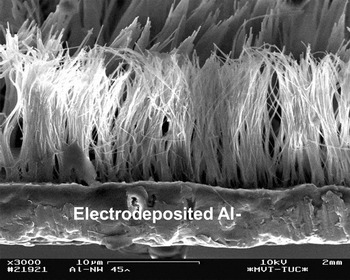
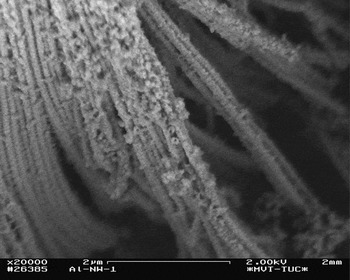
Motivated by the promising results with macroporous Al, we considered the possibility of synthesizing, by electrochemical means, freestanding Al nanowires for lithiation/delithiation. There are some reports in literature showing that Al nanorods are suited for such a purpose, but in the available reports, the Al rods were reported to rapidly lose contact with the supporting electrode, thus the gravimetric charge density decreased rapidly with cycling.Reference Au, McWhorter, Ajo, Adams, Zhao and Gibbs15 Our approach was simple: We used a commercially available “nanoporous” track etched polycarbonate membrane and sputtered a thin gold film (copper would also be suitable) on one side. With a special electrochemical setup,Reference El Abedin and Endres16 we grew both a several-micrometer-thick Al supporting layer on the one side and several-micrometer-long Al nanowires with a diameter of approximately 100 nm inside of the membrane. When the membrane is dissolved by an organic solvent, a compact electrode with an Al supporting layer is formed on one side and the nanowires on the other (see Figure 3).Reference El Abedin and Endres16,Reference El Abedin, Garsuch and Endres17
Al nanowire electrode. The Al nanowires were made electrochemically from an AlCl3-based ionic liquid with a nanoporous track-etched membrane. Reprinted with permission from Reference 17. © 2012, CSIRO Publishing.

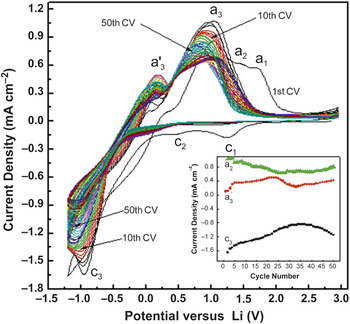
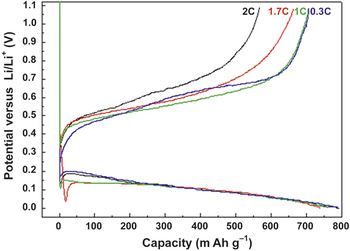
In a recent paper,Reference El Abedin and Endres16 we concentrated on the electrochemical synthesis of such an electrode material. In subsequent studies,Reference El Abedin, Garsuch and Endres17 we also investigated the lithiation/delithiation with this electrode material in the same ionic liquid as described previously (i.e., in [Py1,4]TFSA/LiTFSA). The cyclic voltammetry behavior yields much information, and we could show that there is reversible lithiation/delithiation without any significant disintegration, see Figure 4.Reference El Abedin, Garsuch and Endres17 For further characterization, we used a Swagelok cell and carried out typical characterization with the previously mentioned ionic liquid electrolyte. Figure 5 shows the key results.Reference El Abedin, Garsuch and Endres17
Cyclic voltammograms of Li cycling in the Al nanowire electrode. The electrochemical behavior is reversible, and the peak currents do not change dramatically with ongoing cycling. The inset plot shows that the peak currents do not change much, proving that the material is not degraded during cycling. Note: a1, a2, a3, a3′, anodic processes; c1, c2, c3, cathodic processes; 1st, 10th, 50th, number of cycles; CV, cyclic voltammogram. Reprinted with permission from Reference 17. © 2012, CSIRO Publishing.

Charge/discharge curves of Li in the Al nanowire electrode. With increasing current density (C-rate), the available charge reduces slightly. Reprinted with permission from Reference 17. © 2012, CSIRO Publishing.

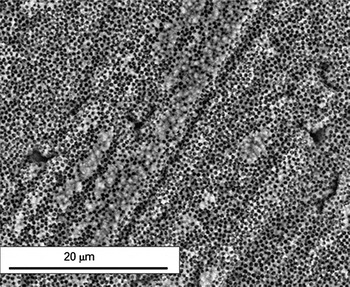
The lithiation/delithiation is reversible, and even with a high discharge rate of 2C, there is not a tremendous Ohmic drop with a gravimetric charge density of more than 500 mAh/g. If the rate is reduced to 0.3C, we get a charge density value between 700 and 800 mAh/g in the few cycles we carried out. From these data, we could conclude that LiAl was primarily formed. With this promising result, we also determined that the nanowire electrode did NOT decompose and survived at least 100 lithiation/delithiation cycles. Figure 6 shows an SEM (scanning electron microscopy) image after 50 cycles.Reference El Abedin, Garsuch and Endres17
Scanning electron microscopy image of an Al nanowire electrode after 50 lithiation/delithiation cycles. Reprinted with permission from Reference 17. © 2012, CSIRO Publishing.

In future studies, we plan to analyze the performance of our battery material with typical battery electrolytes and their mixtures with ionic liquids. Schubert et al. (at IOLITEC18) have shown that the flammability of battery electrolytes is strongly reduced if they are mixed with ionic liquids.Reference Taige, Hilbert and Schubert19 The almost fatal event in the “Dreamliner” Boeing 787 aircraft and other incidents that occurred in China with electric cars show that at a minimum, organic electrolytes have some risks, and improvements are needed. Furthermore, the energy density has to be improved, and our results show undoubtedly that both macroporous Al and Al nanowires have considerable potential to increase the energy density of Li-ion batteries, especially as Al electrodeposition from ionic liquids is relatively cheap, once the electrolyte has been made and the setup has been established.
Macroporous semiconductor structures
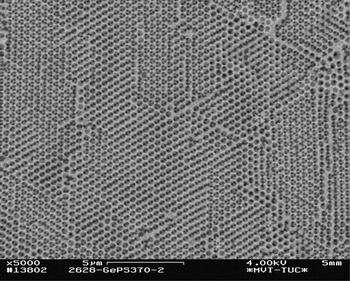
In the last part of this article, we briefly discuss the possibility of forming macroporous semiconductor structures and also—in principle—semiconductor nanowires using ionic liquids and by electrochemical means. Silicon nanowires have been regarded as a highly promising material, as they can deliver, as the host for lithium, 10 times the gravimetric density of LiCx, and Si nanowires can cope with volume change during lithiation/delithiation. We refer to a recent paper from Aurbach who showed that Si nanowires as a host material indeed deliver a high gravimetric charge density.Reference Etacheri, Geiger, Gofer, Roberts, Stefan, Fasching and Aurbach20 Despite these promising results, there is one shortcoming: it is not trivial to make Si nanowires, since they are subject to surface oxidation, and the connection to the supporting electrode is not optimal. Based on our experience with the deposition of nanowires, we deposited 3DOM germanium in a collaborative effort with the Harbin Institute of Technology.Reference Meng, Al-Salman, Zhao, Borissenko, Li and Endres12 As discussed previously, a PS spherical opal structure is made, and Ge is deposited in the interstices of the opal structure. GeCl4 is a good precursor, and the deposition can be done with various ionic liquids under inert gas glove box conditions. Figure 7 shows the result.
Three-dimensional ordered macroporous germanium made electrochemically from an ionic liquid. Reprinted with permission from Reference 12. © 2009, Wiley.

We obtained an almost perfect 3DOM structure, which ensures good infiltration by the electrolyte as well as good electrical conductivity. Macroporous germanium has been discussed as a possible material for Li-ion batteries,Reference Song, Jeon, Samal, Han, Park, Ha, Yi, Choi, Chang, Choi and Paik21 but there are concerns, as it is a relatively rare and a relatively expensive material. Nevertheless, the high electron conductivity of Ge (in contrast to Si) makes it interesting, particularly for special applications wherein a reliable, high energy density battery is needed. Silicon is abundant and therefore an inexpensive material for Li-ion battery anodes, however, at the same time it is much more reactive than Ge. One more disadvantage is its much lower electronic conductivity as compared to Ge or Al. This is not only a disadvantage for the final battery material, but it also leads to some difficulties if an electrodeposition routine is pursued to make silicon.
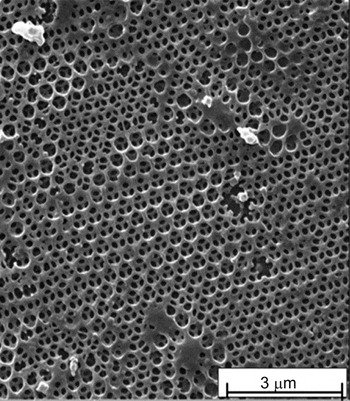
We briefly describe the deposition of 3DOM silicon. Together with colleagues at Harbin, we applied our established method and covered a supporting electrode with a PS sphere opal. Although silicon can be deposited from SiCl4 in [Py1,4]TFSA,Reference Borisenko, El Abedin and Endres22 we were not successful in the beginning in forming 3DOM Si. The parameters we used for the deposition of Ge failed, and the opal structure disintegrated during Si deposition. Consequently, we only obtained fragments of a 3DOM structure.Reference Al-Salman, Meng, Zhao, Li, Kynast, Lezhnina and Endres23 After much detailed work on the experimental parameters, we succeeded in making 3DOM Si; Figure 8 shows an example.Reference Liu, Zhang, Ge, Zhao, Li and Endres24
Three-dimensional ordered macroporous silicon made electrochemically from an ionic liquid. Reproduced with permission from Reference 24. © 2012, PCCP Owner Societies.

The material has a well-ordered 3DOM structure, but we also learned that such an electrochemically formed (amorphous) silicon is quite reactive, even reacting with trace amounts of oxygen in the inert gas glove box. At first glance, this might appear to be a shortcoming. However, we note that the amorphous structure of Si might facilitate Li diffusion in the electrode, and materials for Li-ion batteries are in any case handled under an inert gas atmosphere. How such materials behave under real battery-like conditions remains to be tested. With the help of nanoporous track-etched polycarbonate membranes, it is possible to make Si-, Ge-, and SixGe1–x nanowires by electrodeposition from ionic liquids.Reference Al-Salman, Mallet, Molinari, Fricoteaux, Martineau, Troyon, El Abedin and Endres25,Reference Al-Salman and Endres26
Summary
In this article, the potential of ionic liquids for the electrochemical synthesis of battery materials has been discussed. They allow fabrication of macroporous metal structures such as aluminum and of semiconductors such as Si and Ge. Furthermore, they allow formation of freestanding nanowires. Al nanowires are shown to be a promising battery material.