Introduction
Sales of organic food have soared over the past decade, from $3.6 billion in 1997 to $15.7 billion in 2006. It is estimated that organic foods now make up 2.5% of all food sales1, 2. This dramatic growth has inspired much talk about the organic market's transition from niche to mainstream, and it is true that organic products seem ubiquitous; most conventional supermarkets now carry organic food and many have their own organic store brands. The potential for profits has not gone unnoticed by big business, and even Walmart has tried to capitalize on the market, albeit with limited success.
Growth in the organic sector has provided numerous opportunities for all agents along the supply chain, from organic producers and handlers, to retailers. In some circumstances, agents work at multiple levels of the supply chain. For example, organic farmers add value to their products, acting as both producers and intermediaries. These entities may be trying to capture part of the downstream value of their agricultural commodity, or maintain a certain part of the growing market through product differentiation, by (for example) providing locally grown organic food or organic milk from pasture fed cows.
Although nearly all organic commodities pass through the hands of at least one intermediary on the way from the farmer to the consumer, there is a dearth of literature examining organic food marketing, especially for the middle section of the supply chain. To gain insights into organic supply chain dynamics, a nationwide survey of organic processors, manufacturers and distributors (called organic handlers) was undertaken in 2005 by the US Department of Agriculture's Economic Research Service (ERS). The survey population included all facilities certified to handle organic products in 2004.
A subpopulation of those surveyed includes firms that are also certified as organic producers, or organic producer–handlers. These handlers, because of their direct link to the production level, have the potential to shed light on value-added activities in the organic sector. This paper uses new data to characterize firms that are certified organic producer–handlers, examining their operations and marketing and procurement practices. A logistic regression is estimated in order to identify characteristics that make it more likely that a firm would be both a certified organic handler and a certified organic producer. Survey results also describe some of the main challenges these producer–handlers face in handling their products.
Background
Organic handlers are certified to handle organic products in accordance with the National Organic Standards. These intermediaries are packing and shipping, manufacturing and processing, and distributing, wholesaling, and brokering organic products, playing a central role in the organic industry. Their functions are similar to those of their conventional counterparts, with the added requirement that organic integrity of all products must be maintained as the products move along the supply chain, as specified by the National Organic Standards.
The National Organic Standards define organic handling practices to include mechanical or biological methods, including but not limited to cooking, baking, curing, heating, drying, mixing, grinding, churning, separating, distilling, extracting, slaughtering, cutting, fermenting, eviscerating, preserving, dehydrating, freezing, chilling, or otherwise manufacturing, and the packaging, canning, jarring, or otherwise enclosing food in a container that may be used to process an organically produced agricultural product for the purpose of retarding spoilage or otherwise preparing the agricultural product for market. Entities that handle organic products are exempted from organic certification if they have gross organic sales under $5000.
The population of interest for this study—organic handlers that are also certified to produce organic products—is diverse, and includes, for example, farmers that might be selling jams and jellies at a farmers' market, manufacturing cheese from milk, or processing meat from animals raised on the farm. It also includes maple syrup producers in the Northeast, large produce packers and shippers on the Pacific Coast, grain elevators in the Midwest, various producer cooperatives, as well as wineries and organic bakeries. These organic handlers may be handling products from only their own farm, or procuring from other farms and handlers as well. In other words, the group is not merely organic growers adding value to products from their own farm, but also includes handlers that are procuring products from many suppliers with their farm as only one source.
Both conventional and organic producers add value to farm products to capture more of the downstream value for agricultural commodities. Others may use value-added agriculture as a way to diversify farm sales and marketing outlets. In the organic sector, adding value to products may also be a way for organic producer–handlers to maintain a certain part of the growing market through differentiation. In addition, they may be trying to meet some of the consumer preferences for aspects that are not captured in the organic label, such as supporting small farms, or local production and manufacturing. Consumer polls indicate that consumers are increasingly interested in products that are locally producedReference Pirog3, Reference Halweil4 because of perceived product freshness and support for local agriculture. Consumer awareness of the energy costs involved in transporting food long distances to supermarkets is also growing.
While the size of value-added agriculture is difficult to measure due to the range of activities it encompasses, anecdotal information suggests an increase in these activities in the United States. A portion of value-added activities can be measured through the Census of Agriculture's reporting of the value of agricultural products sold direct to individuals; these numbers have increased substantially over the 15 years ending with the 2002 Census, from $404 million in 1982 with 86,500 farms selling direct, to $812 million in 2002 with almost 117,000 farms.
Although it represents just a portion of value-added activities, direct sales are important in the organic sector in that a higher proportion of total organic sales are made through direct markets, such as farmers' markets, roadside stands and mail order sales, than for conventional salesReference Kremen, Greene and Hanson5. A 2001 survey of organic producers by Organic Farming Research FoundationReference Walz6 indicated high use of direct markets, although it varied by commodity. For instance, 80% of respondents that produced vegetable, herb, floriculture, mushroom and honey products used some type of direct markets as a marketing avenue, with an estimated volume of 13% of products sold this way. Direct marketing was used for about 28% of grain and field crop sales (11% of volume), 58% of fruit, nut and tree products sales (11% of volume) and 54% of livestock product sales (26% of volume).
Information on organic producer–handlers has been unavailable until now, requiring researchers to examine handlers and producers separately. While data on organic handlers is scarce, preventing systematic studies of trends in the organic marketing supply chain, growth in the number of organic handlers is apparent. Estimates in the early to mid-1990s showed substantial growth (20–39% a year) in the handling sector and the number of certified handlers was placed at 694 in 1995Reference Dimitri and Richman7. By 2004, approximately 2790 facilities were certified as organic handlers.
More is known about the organic production sector, although actual production data are unavailable. Certified organic acreage, used to approximate production potential of US organic farms, quadrupled from almost 1 million acres in 1992 to 4 million in 20058, and the number of certified operations increased from 3587 to 8493. In 2005, certified organic cropland and pasture accounted for 0.5% of the total US cropland and pasture, although the share is much higher in some crops, such as vegetables at nearly 5% and fruit at about 2.5%.
A handful of studies has focused on organic producers who add value to their products, although these studies are based on surveys with a narrow scope. Austin and ChaseReference Austin and Chase9 surveyed organic growers, ‘value-added organic growers’ and organic processors in Florida. Their study, based on a small sample, found that value-added organic growers in Florida were most likely to be packers and shippers of the farm's own products, selling primarily to local markets within 60 miles of the farm or to the Florida market. The processors in the study were most likely processors of citrus juice selling nationally and internationally. Bingen et al.Reference Bingen, Osborne and Reardon10 surveyed organic processors in Michigan on 2006 practices, and (with 39 respondents) found that most vegetable processors sell primarily in local and state markets, while livestock processors sell equally in local, state, regional and national markets. They also found that processors use direct-to-consumer and wholesale markets almost equally.
Data from the 2001 OFRF survey of organic producersReference Walz6 show that 29% of respondents (305 farmers) reported gross sales derived from value-added products processed by their farm or for their farm prior to product sale. In the product categories (herbs, vegetables, fruit and tree nuts, grains and livestock products including milk), the products with the highest number of reports for value-added products from the farm included dried herb, ornamentals and greenhouse products, salad mixes, preserves, cleaned, dried and/or bagged grains and fresh and frozen meats. Unpublished data from a recent 2005 survey of 141 organic producers in the Four Corner States (Arizona, Colorado, New Mexico and Utah) showed a similar percentage of organic producers (34%) reporting some organic sales (an average of 20% of all organic sales) through processed or value-added products. Contrasting these numbers, unpublished data from a 2007 survey of 195 Minnesota organic producers found that only 8% of producers had sales of value-added products, with most of it going through direct sales at the farm or to retail stores, or through other outlets.
Data and Methods
A unique, new dataset underlies this analysis: the results of a nationwide survey of organic processors, manufacturers and distributors (called organic handlers) of 2004 practices, by USDA's ERS. The project was funded by USDA's Risk Management Agency, and carried out with collaborators from the University of Georgia and Pennsylvania State University.
The survey was drafted with input from stakeholders in the organic sector, including certifiers, farmers, processors, academics and representatives from non-profit organic organizations. The final survey instrument was developed by ERS in consultation with Washington State University's Social and Economic Science's Research Center (SESRC), and consisted of 59 questions covering: (1) operational and business practices (e.g., facility function, products produced and labels used); (2) basic characteristics of handling facilities (e.g., gross sales, size of facility and years certified organic); (3) relationships with customers (e.g., marketing outlets used and distance to markets); and (4) relationships with suppliers, including types of suppliers, purchase arrangements (contract versus spot market), as well as assistance provided to suppliers and attributes and requirements of suppliers.
The survey was sent to the population of all certified organic handling facilities in 2004. Because of the way in which most handlers hold their organic certificates (at the facility level), each facility, whether it belonged to a larger company (30% reported multiple locations in the company) or was independent, was counted separately. SESRC administered the survey in late 2005 and early 2006, using the Tailored Design Method (TDM)Reference Dillman11. All firms were pre-notified by postcard of the survey. The survey was sent by first class mail, with a $5 incentive, and was followed by multiple carefully timed contacts, including two postcards, a subsequent questionnaire mailing and phone contacts. Of the total population, 1393 organic handlers completed a 16-page mail survey, representing a 63% return rate. Of these, 347 (25% of survey respondents) reported that they held dual certification as an organic producer and handler.
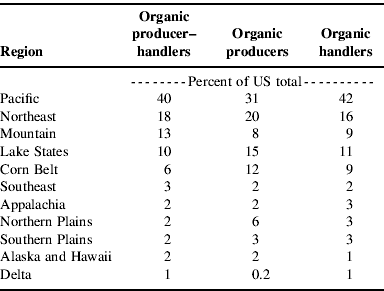
Like all organic handlers, organic producer–handlers are concentrated in the Pacific region (Table 1)8, 12. The Northeast, Mountain, and Lake States also have a significant number of producer–handlers as well, and for the most part these concentrations mirror those of all organic handlers. Not surprising given the dominance of produce in the organic industry, fruits and vegetables were the top two commodities sold by organic producer–handlers in 2004, followed by spices and herbs, grains and feed, and beans/legumes/peas.
Regional characteristics of organic producer–handlers and all organic producer and handlers, 2004.
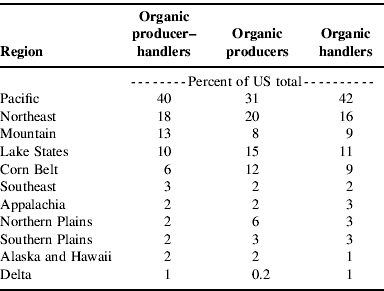
As with handlers, the Pacific and Northeast are the top regions with certified organic producers, and the overall regional ranking is also very similar. The Northeast has a slightly higher percentage of producers than handlers, perhaps reflecting the presence of fewer national produce distributors in this region than in the Pacific. The Mountain, Corn Belt and Plains regions also have a relatively smaller percentage of handlers. Fewer handlers may be needed to process the grains and dairy that predominate in these regions.
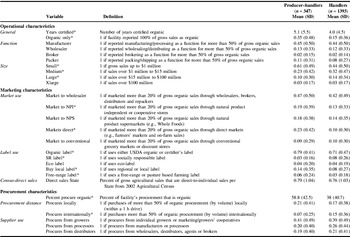
Summary statistics for the variables used in this study are shown in Table 2. The operational variables include facility size, the number of years certified organic, function of the facility and percent of gross sales as organic. The smallest organic handlers are likely excluded from the dataset because handling operations that have under $5000 in gross annual income from organic sales are exempted from certification. The number of years certified organic is a continuous variable. Discrete variables include whether a facility was 100% organic or a mixed facility; the vast majority of facilities are mixed facilities, handling both conventional and organic products. The function of a facility (e.g., manufacturer, wholesaler or distributor, broker, or packer–shipper) was divided into four dummy variables; at least 50% of the facility's function had to be in one of these categories to be included. Manufacturing/processing was the most widely reported function by all handlers. Finally, firm size was divided into four categories based on gross sales (both organic and non-organic), with most facilities having up to $15 million in sales, although organic producer–handlers reported gross sales up to only $1 million at a higher rate than all handlers.
Descriptive statistics of variables used in the logistic regression: organic producer–handlers and handlers.

* Indicates differences in means that are statistically significant; t-values with significance at α=0.05 level.
Marketing characteristics include the use of different market outlets and labeling practices. The possible marketing outlets are: wholesaler and distributor, manufacturer or processor, natural product supermarkets, independent natural product stores, direct markets and conventional supermarkets. In the survey, handlers reported the percent of their product marketed in those five markets. For the econometric analysis, we developed five discrete variables based on whether a facility uses the outlet for more than 20% of gross organic sales (thus, the analysis allows for the fact that handlers may market to more than one outlet). Five labels for organic products were also included, and were coded as dummy variables. The first is an organic label (e.g., USDA logo or certifier's logo), as well as four other types of labels commonly used on alternative agricultural products: socially responsible (such as fair trade), eco-label, local label and a free-range or pasture label.
Data on procurement practices were also included in the analysis, where procurement refers to the purchase of raw materials, agricultural commodities and other products by handlers, who either manufacture, process, or distribute the products. The variables included are the percent of the facility's procurement that was organic (continuous variable), two dummy variables approximating the distance for procuring organic products (more than 50% of their procurement from local or international markets), as well as three dummy variables for the use of different types of suppliers (i.e., growers and grower cooperatives, manufacturers/processors and distributors).
The descriptive statistics show that organic producer–handlers differ from the overall handler population in a few striking ways: they have been certified organic, on average, for 1 more year; they have a higher share of firms that are 100% organic; have a greater percent of small firms; make greater use of direct markets and procure a greater share of organic products.
Results and Discussion of Research Findings
Two tracks were taken in analyzing the survey data. First, the survey data were used to determine which factors certified organic producer–handlers viewed as obstacles to growth, with a comparison to previous studies. A logistic regression model estimated which factors influenced the likelihood of certified organic handlers choosing to be certified as producers as well.
Primary barriers to growth faced by organic producer–handlers
Although organic handlers have benefited from the overall growth of the organic industry, they have faced a number of constraints to growth since the late 1990s. A few studies illustrate the main concerns. One of the top challenges for the industry has been procuring ingredients, which includes the spectrum of issues relating to ingredient procurement, such as ingredient costs, quality consistency, shortage of ingredients and other supply problems1, 13. Distributors similarly report difficulty finding large enough quantities of organic products to distribute to retailers, as well as locating organic producers as sources for products they deliverReference Dimitri and Richman7. Distribution channels also present a challenge for manufacturers; in the past, transportation and the high cost of distribution have been cited as impeding growth of the sector.
The survey included an open-ended question about the primary challenges faced in handling certified organic products. The answers fell into a number of categories, many similar to those made by all organic handlers, but some addressing production areas as well. Not surprising given previous research, the number one area of concern raised was procurement. Five percent of the producer–handlers noted that there are challenges with the availability of organic ingredients or growers, while 3% noted problems with the cost of supply. Eight producer–handlers reported challenges with procuring a consistent quality of supply, two reported problems with obtaining year-round supply, and one reported problems with buying in large quantity.
Consistent with previous industry reports on supply shortages in the organic sector, a fairly large number of organic producer handlers—17%—reported critical shortages of supply, with many reporting more than one product they need in short supply. However, only 6% of the population of organic producer–handlers reported critical oversupply of organic products to their customers in 2004.
Among the organic producer–handlers who experienced product shortages, short supplies were reported across all major food categories. Leading the list of shortage products were fruit, grains, feeds, soybeans, cheese and milk/milk products, vegetables and meat/meat products. Twenty-eight percent of organic producer–handlers also reported difficulty in securing organic ingredients at some point in 2004. Those ingredients reported the most included fruit, seeds, grains, feed and soybeans for feed, vegetables, milk and milk products, herbs, spices and extracts. Another indication of limited supply was whether the producer–handler was granted a commercial non-availability allowance in 2004, allowing for the use of a non-organic ingredient in an organic product if the ingredient was not commercially available in organic form. While 6% of organic producer–handlers reported that they had an allowance, this was a lower rate than the 9% for all handlers.
Another top challenge for organic producer handlers was international trade, both imports and exports, as well as the restrictions, costs and paperwork of trade; this was raised by 5% of the population. Five percent of producer–handlers also reported that the organic certification process and the paperwork involved in certification are too burdensome or costly, or it is too difficult to keep up with the organic standards. A couple of producer–handlers felt that there was pressure from large-scale growers to lower the standards, while three reported that they thought there was a need for stricter enforcement of the rules and regulations.
Financial issues also ranked high among the challenges of producer–handlers: 4% reported that overall financial challenges, including financing, were a problem; while facilities also reported problems with cash flow, high labor costs and high transportation costs. Finally, production challenges are unique to this set of handlers because they also undertake production activities. Three percent reported overall production limitations or problems with weather, and several suggested that the price of production was too high for the return. These concerns echo the ones mentioned in focus groups with organic producers across the countryReference Hanson, Dismukes, Chambers, Greene and Kremen14.
Factors influencing choice of dual certification
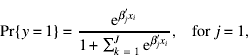
The decision to be certified as both an organic producer and handler can be modeled as a discrete choice where the dependent variable, y i, takes on the value of 0 if the intermediary is certified just as a handler or the value of 1 if the handler is certified as a producer as well. Based on the logistic distribution, the probability of being certified as a producer and a handler is:
while the probability for being certified as just a handler is:
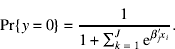
Either probabilities (P) or the odds ratio, P/(1−P), can be estimated in the logistic model. The odds ratio was chosen rather than probabilities for ease of exposition. When estimating odds ratios, the estimated coefficient of an explanatory variable provides the odds that a producer–handler markets to wholesalers, for example, relative to a handler. An estimated odds ratio greater than 1 indicates producer–handlers are more likely to market to wholesalers, while an estimated odds ratio less than 1 indicates that producer–handlers would be less likely to market to wholesalers. An estimated odds ratio of 1 indicates that both groups are equally likely to market to wholesalers.
The variables that were thought to influence the decision to both handle and produce organic products include operational characteristics of the facility, marketing behaviors and procurement practices; these data were from the ERS survey of organic handlers. Other data were also used in the analysis, including 2002 Agricultural Census data on direct marketing, as well as production data on organic agriculture.
A priori, it was expected that facilities certified organic for a longer period of time or dedicated organic facilities (in contrast to mixed facilities) would be more likely to be organic producer–handlers. In addition, the descriptive statistics and presumptions about the population pointed to other potentially important factors: firm size and the function of packer–shipper.
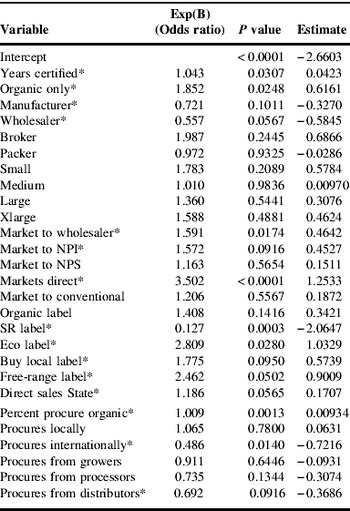
The results of the econometric model (Table 3) confirm some assumptions. Firms that were more likely to be certified as a producer–handler were certified organic longer, had dedicated organic facilities (100% organic sales), marketed to wholesalers, direct marketed, or marketed to independent natural food stores. While use of an organic label by an organic handler, either the USDA logo or a certifier's logo, does not influence the likelihood that a handler would also raise organic products, use of an eco-label, a ‘buy local’ or ‘buy regional’ label, or free-range label increases the likelihood of being an organic producer–handler. The final explanatory variable that had an impact on the probability of being a producer–handler was the share of organic products procured; the higher this share, the greater the odds of being a producer–handler.
Logistical regression analysis of organic producer–handlers' characteristics.

N=909.
* Indicates statistical significance (P<0.10).
Note: An odds ratio of 1 indicates that the variable is equally likely in both groups. An odds ratio greater than 1 indicates that the variable is more likely in the producer–handler group than the overall handler population, while an odds ratio less than 1 indicates that the variable is less likely in the producer–handler group.
Classification table
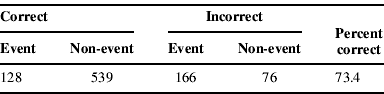
Probability level=0.24; sensitivity=62.7%; specificity=76.5%; false positive=56.5%; false negative=12.4%.
The use of direct markets (e.g., farmers' markets, CSAs and on-farm sales) for more than 20% of organic sales was a strong predictor, with those in this population being 250% more likely to be an organic producer–handler. Agricultural Census data from 2002 confirmed other relationships with direct marketing. Using direct-to-individual sales (a proxy for direct marketing sales) as a percentage of all agricultural sales in a State, each increase in percent increases the likelihood that the handler will be an organic producer–handler by almost 20%. Thus, New Jersey's organic handlers are 41% more likely to be an organic producer–handler (based on 2.6% of the State's all agricultural sales consisting of direct marketing sales) than are Utah's organic handlers (0.6%).
A higher percentage of total procurement as organic influences the likelihood of being a producer–handler. Although the change per percentage point is small (<1%), the likelihood of being an organic producer–handler is slightly greater at higher percentages of organic procurement. For example, if a facility obtains 75% of total procurement as organic, that facility is 96% more likely to be an organic producer–handler. This result is not surprising given that dedicated organic facilities are also a significant factor in the model.
Firms that were less likely to be certified as both a handler and producer were manufacturers or wholesalers, used the socially responsible label, and procured from international markets. Further, the use of distributors for procurement purposes made the facility less likely to be an organic producer–handler.
The a priori notion that packers and shippers were more likely to be producer–handlers did not bear out in the analysis. Another assumption, that small firms would be more likely to be organic producer–handlers, was also not supported by the analysis. The use of total gross sales—conventional and organic—instead of organic sales only (which was not available in this survey), may be a complicating factor, masking some causality. In addition, some of the smaller certified organic producers that sell value-added products, such as jams and jellies, may opt not to certify and label those products as organic because of the additional expense and paperwork involved, particularly if they are selling in direct markets where they may have personal communication with their customers.
It was expected that variables approximating organic production would be significant predictors. These data consist of 2005 organic acreage and farm numbers8, which were translated into State averages for organic farm size and the percentage of farms and farmland that are organic per State. All were found to be insignificant and thus excluded from the model.
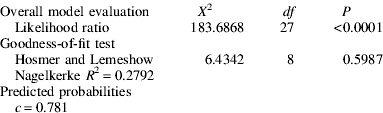
The model was evaluated using a likelihood ratio test, which was significant at P<0.001, and Hosmer and Lemeshow's goodness-of-fit test, which was insignificant. Both of these tests suggest that the model has a fairly good fit to the data. The c statistic (which varies from 0.5, the model's predictions are no better than chance, to 1.0 and is the percent of all possible pairs of cases in which the model assigns a higher probability to a correct case than to an incorrect case) of 0.781 and the percent correctly classified (73.4%) indicate that the predicted probabilities of the logistic regression fairly consistently agree with the actual outcomes.
Conclusion
Since 1990, growth in retail sales of organic products and certified organic farmland has been remarkable. Hidden behind the expansion of organic farmland and retail sales is the handler of organic products. This agent plays a crucial role in maintaining the integrity of organic products as they move along the supply chain from farm to consumer, from local, national and international locations. How well they have fared is not apparent to the casual (or even not-so-casual) observer of the organic sector. This paper is one of the first attempts to examine the challenges faced by handlers, specifically one type of handler—facilities that hold dual certificates to produce and handle organic products. The producer–handler has the potential to provide insight into value-added activities in the organic sector, through their direct link to the production level; thus, we examined which characteristics made it more likely that a firm would choose to certify as both a handler and producer.
To date, the middle segment of the organic supply chain has been little studied. New data from a survey of all certified organic handlers indicate that organic producer–handlers face barriers to growth similar to the overall organic handler population and corresponding to past research. Procurement of ingredients and supply ranked as a top concern, as well as international trade issues.
Similar to the population of organic handlers, organic producer–handlers are a diverse group handling the entire range of agricultural commodities. With few exceptions, many of their operational and procurement characteristics are comparable to the entire organic handling population. Operationally, facilities dedicated solely to organic handling and those certified longer are more likely to be organic producer–handlers. The converse is true of handlers that undertake manufacturing or wholesaling functions. Most producer–handlers are using suppliers in some way to procure products and ingredients. However, the only significant relationships found were those related to the percentage of procurement that is organic, and procurement through imports or distributors.
The types of outlets producer–handlers market in differ from those used by the overall population of handlers. Use of direct markets by organic handlers has the most robust relationship, with Agricultural Census data also revealing relationships between the use of direct markets by all farmers in a State and the likelihood that a handler in that State would be a producer–handler. Marketing to natural products independent retailers and wholesalers is also important to the population. Labeling practices play a role as well. Although the use of organic labels by producer–handlers differs little from the general handler population, some notable exceptions were the use of ‘buy local’ and eco labels. Thus, organic producer–handlers seem to be touting the locally grown and environmental characteristics of their products significantly more than all handlers. Certified organic producers who also have handler certification and are embedded in organic farm communities may be poised to provide products that are both local and organic when that market takes off.
Value-added agriculture has traditionally made it possible for farmers to differentiate their products in a competitive market, presumably increasing their profits. As the organic industry grows and questions arise as to whether organic firms will need to grow larger to remain viable, more organic farmers and handlers may decide to gain certification to produce and handle. The results of our research point to the challenges these producer–handlers might face concerning procurement. Maintaining a dedicated organic facility and marketing direct to consumers, to natural product independent retailers and to wholesalers may be the best long run strategy for these firms.