One of the main goals of most developed countries in the last decade has been the increase of prevention and health promotion. Most prevention campaigns are aimed at teenagers, young adults and their families. An increasing number of studies are aimed to investigate the role of family dynamics on health. One of the most widely used approach is the systemic approach, that looks at the factors which bear some relation to the reported symptoms, such as the child’s relationship with his/her family, the structure (e.g. hierarchies and coalitions) of the family system (Minuchin, Reference Minuchin1974; Minuchin et al., Reference Minuchin, Baker, Rosman, Liebman, Milman and Todd1975; Minuchin & Fishman, Reference Minuchin and Fishman2004; Minuchin, Rosman, & Baker, Reference Minuchin, Rosman and Baker1978) and the dynamics (e.g. the communication patterns) of the family (Haley, Reference Haley1973; Palazzoli Selvini, Reference Palazzoli Selvini1986).
In the literature there are a number of inventories for assessing family structure and dynamics (Family Assessment Device, FAD, Epstein, Baldwin, & Bishop, Reference Epstein, Baldwin and Bishop1983; Self-Report Family Inventory, SFI, Hampson & Beavers, Reference Hampson and Beavers1996; Family Satisfaction Scale, FSS, Olson, Reference Olson1995), but the most widely used in the clinical practice is the Family Adaptability and Cohesion Evaluation Scale (FACES, Olson, Reference Olson1986). This scale is based on a circumplex model of family functioning, and is aimed to assess two dimensions (or axes) of a given relational system at work: cohesion and adaptability. Cohesion is defined as the emotional ties each member of a family develops towards the other members; adaptability is defined as the conjugal or family system’s ability to change its power structure and relational rules and roles in response to a stressful situation or development. The FACES classifies families into sixteen typologies based on the combination of scores in the two dimensions. The main assumption of the circumplex model is that balanced levels of cohesion and flexibility are most conducive to healthy family functioning, that are located around the median point of both axes (see Figure 1). Conversely, unbalanced levels of cohesion and flexibility (very low or very high levels) are associated with problematic family functioning.
Circumplex model of family systems (adapted from Olson, Russel & Sprenjkle, Reference Olson, Sprenkle and Russell1979, p. 42).

Balanced levels of family cohesion and adaptability were found to play a significant role in sustaining psychological adjustment and well-being of families and their members. It has been found, for instance, that individuals who perceive their families as extremely adaptive and cohesive (as occur in chaotically engaged and chaotically enmeshed families) are more likely to manifest delinquent behaviors in adolescence (Huey, Henggeler, Brondino, & Pickrel, Reference Huey, Henggeler, Brondino and Pickrel2000), depressive symptoms (Cumsille & Epstein, Reference Cumsille and Epstein1994), dysfunctional dynamics within the family, poorer family functioning, and higher levels of violence within the family (Bischof, Stith, & Whitney, Reference Bischof, Stith and Whitney1995; Dreman & Ronen-Elia, Reference Dreman and Ronen-Eliav1997; Kim & Kim, Reference Kim and Kim2008).
Most importantly for our purposes, an inadequate family functioning, characterized by low levels of support and independence within the family, were found to be associated with the development of eating disorders in adolescence, such as anorexia and bulimia (Birch & Fisher, Reference Birch and Fisher2000; Eddy et al., Reference Eddy, Tanofsky-Kraff, Thompson-Brenner, Herzog, Brown and Ludwig2007; Gillett, Harper, Larson, Berrett, & Hardman, Reference Gillett, Harper, Larson, Berrett and Hardman2009; Kluck, Reference Kluck2008; Olson, Reference Olson1986; Taylor et al., Reference Taylor, Bryson, Luce, Cunning, Doyle, Abascal and Wilfley2006; Vidovic, Juresa, Begovac, Mahnik, & Tocilj, Reference Vidovic, Juresa, Begovac, Mahnik and Tocilj2005; Waller, Slade, & Calam, Reference Waller, Slade and Calam1990). In contrast, children show little concerns with respect to their weight and are therefore less likely to develop dysfunctional eating behaviors in families that express emotional support, positive affect, and behaviors aimed at promoting the autonomy of their members (Barker & Galambos, Reference Barker and Galambos2003; Bastiani, Archibald, Graber, & Brooks-Gunn, Reference Bastiani Archibald, Graber and Brooks-Gunn1999; Kenny & Hart, Reference Kenny and Hart1992).
Likewise important, members of disengaged families, in which is present a rigidity that imposes a poor communication between the components and a lack of interest in the problems of others, are likely to perceive themselves as distant from each other. The lack of clear references within the family may produce insecurity in children who may experience negative emotions, such as fears, worries and anxiety. Conversely, enmeshed families, due to their lack of clear boundaries, tend to hinder the development of personal autonomy and freedom of action. Relationships in these families are characterized by hyper-control and overprotection, such that parents may transfer their anxiety to the children, who might growth by experiencing anxiety and fear of not succeeding (Ginsburg & Schlossberg, Reference Ginsburg and Schlossberg2002).
Although these findings documented the critical role of family functioning as a protective factor against a range of negative outcomes, most studies were based on samples of adolescents. Few studies, by contrast, have investigated these links at early ages. The current research aims to fill this gap in the literature.
The present study was aimed to investigate the difference in family functioning (measured through the FACES III) between family with clinical subjects in pediatric age and participants taken from the Italian population. Footnote 1
First, a comparison was performed on the whole sample, by aggregating clinical subjects with different psychopathologies. We hypothesized that families in the non-pathological group would have more balanced levels of cohesion and adaptability, given that family functioning tends to be more dysfunctional in families with psychological disorders, regardless of the specific manifestation.
Next, we focused the comparison on eating and anxiety disorders, two psychopathologies that are particularly studied in literature. Participants in the non-pathological sample were compared with those who were diagnosed with eating and anxiety disorders. These were also the only two groups that include a sufficient number of cases for the analyses. A focus on other kinds of disorders was precluded by the small number of participants that were diagnosed in the respective group. We expect significant differences between groups in levels of cohesion and adaptability. Children from family with extreme scores on these dimensions, indeed, are at risk to develop eating and/or anxiety disorders.
Methods
Participants and procedures
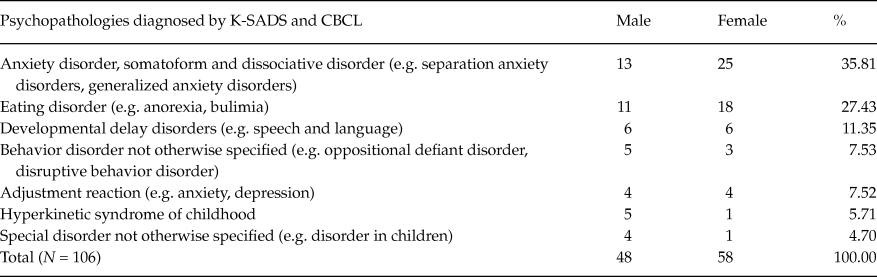
Participants were children diagnosed with a psychiatric disorder, recruited into the Psychiatry Department from 2008 to 2010 at the Pediatric Hospital “Bambino Gesù” of Rome. A total of 106 families participated in the study. The children affected by psychiatric diseases (45.3% males, 54.7% females), one for each family, ranged in age from 2 and 18 years (M = 11.31, SD = 4.52). Diagnosis was performed by using the Child Behavior Check List (CBCL, Achenbach & Rescorla, Reference Achenbach and Rescorla2000) or the Schedule for Affective Disorders and Schizophrenia (K-SADS; Kaufman et al., Reference Kaufman, Birmaher, Brent, Rao, Flynn, Moreci and Ryan1997). The symptoms were codified as present or absent. Participating parents were 50% fathers (mean age = 45.72 years; SD = 7.09) and 50% mothers (mean age = 42.48 years; SD = 6.35). Most of parents (73.6%) live together, and have a high school diploma (35.8%). Children’s psychopathologies were shown in Table 1.
Children’s psychopathologies diagnosed with K-SADS and CBCL

The non-pathological sample used in this study is the Italian normative sample (Galimberti & Farina, Reference Galimberti and Farina1992), composed by 2,543 parents (50% males) in different age periods of the life-cycle.
Measures
Family Adaptability and Cohesion Scale
The family functioning was assessed with the FACES III (Olson, Portner, & Lavee, Reference Olson, Portner and Lavee1985). This instrument was developed to evaluate the adaptability and cohesion dimensions in family interactions. It contains 20 items on a 5-point likert scale, ranging from 1 = Very rarely, to 5 = Very often. The ten odd-numbered items measure Cohesion (for example: “Family members feel closer to people outside the family than to other family members”) and the 10 even-numbered items measure Adaptability (for example: “In solving problems, the children’s suggestions are followed”). The instrument was administered to children’s fathers and mothers. The version used here is the Italian adaptation, that has been validated on a large Italian sample by Galimberti and Farina (Reference Galimberti and Farina1992).
Child Behavior Check List (CBCL, Achenbach & Rescorla, Reference Achenbach and Rescorla2000)
Diagnosis on children aged from 18 months to 5 years was performed using the CBCL. This is a widely used method for identifying problem behavior in children. It is a component in the Achenbach System of Empirically Based Assessment developed by Achenbach and Rescorla (Reference Achenbach and Rescorla2000). Problems were identified by the parents.
The checklists consists of a number of statements about the child's behavior, e.g. Acts too young for his/her age. Responses are recorded on a Likert scale: 0 = Not True, 1 = Somewhat or Sometimes True, 2 = Very True or Often True. The preschool checklist contains 100 questions. The present study used the Italian version of the instrument (details on the properties of the scales are reported by Frigerio, 2000).
Schedule for Affective Disorders and Schizophrenia (K-SADS; Kaufman et al., Reference Kaufman, Birmaher, Brent, Rao, Flynn, Moreci and Ryan1997)
The K-SASD was used to perform a diagnosis on children aged from 6 to 18 years of age. This is a semi-structured diagnostic interview to record information about the mental state of children and adolescents based on DSM-IV diagnostic criteria. The K-SADS was administered to children by an interviewer, specifically trained in using the instrument to form diagnostic classification and make differential diagnosis. Details on the Italian version, used in the present study, are reported by Sogos (Reference Sogos2004).
Results
Preliminary analyses revealed a significant association between age of the children and type of pathology, F(6) = 3.72, p < .05. In particular, eating disorders increased with age, whereas developmental delay disorders showed a negative relationship with children’s age.
Family cohesion and adaptability in a group of patients in pediatric age: A comparison with a non-pathological group
As a first analysis, we compared clinical subjects and participants taken from the general population on the means of the cohesion and adaptability dimensions, using a t-test for independent samples. Cohen’s d was used to evaluate the size of the difference.
Table 2 presents the results of the comparisons. As can be observed, subjects from the pathological sample scored significantly higher than subjects from the non-pathological sample on both cohesion and adaptability. Cohen’s d was .46 for cohesion and .79 for adaptability, indicating moderate to strong differences between groups.
Means and standard deviation of cohesion and adaptability in a pathological and non-pathological sample

In order to better characterize the scores of both groups, we calculated their location in the circumplex model, using Olson et al.’s (Reference Olson, Portner and Lavee1985) distance from the center (DFC) index. We found that, on average, non-pathological families are located near the center, in the balanced region, which describes optimal functioning of the family. The average scores in this group on both cohesion and adaptability correspond to the normative scores reported in the Italian manual (Galimberti & Farina, Reference Galimberti and Farina1992). The pathological sample, by contrast, is located in the mid-range region. As it has been argued (Beavers & Hampson, Reference Beavers and Hampson2000), families in this region “contain functional but vulnerable children, and both parents and children are susceptible to psychological problems” (p. 128).
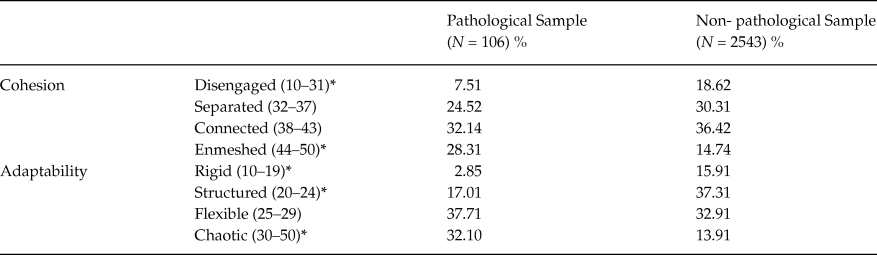
The above analysis focuses on the average or typical family within each group. It does not take into account the variability around the average score. In order to have more information on the two groups, we compared the distribution of cases within the four categories derived from the FACES-III (Olson, Reference Olson1986, Reference Olson2000) with respect to either adaptability (rigid, structured, flexible, chaotic) and cohesion (disengaged, separated, connected, enmeshed). To this aim, we used the Chi-square goodness of fit test.
As for the cohesion dimension, a lower proportion of disengaged families and a higher proportion of enmeshed families (with high levels of cohesion) were found in the pathological sample compared to the non-pathological sample, χ2(3) = 23.157, p < .001 (see the upper panel of table 3).
As for the adaptability dimension, a lower proportion of rigid and structured families, and a higher proportion of chaotic families (with high levels of adaptability) were found among patients compared to the controls, χ2(3) = 53.474, p < .001 (see the lower panel of table 3).
Percentages of cases in the four categories of the cohesion and adaptability dimensions of the FACES III

Notes: range of scores defining each dimension are in parenthesis (Galimberti & Farina, Reference Galimberti and Farina1992). Significant differences between the samples are marked with asterisks.
To further increase our understanding of the functional and dysfunctional aspects of family functioning, two additional sets of more detailed comparisons were performed, that were focused either on more specific regions of the circumplex model (the sixteen typologies described in Figure 1), or on specific pathologies (i.e. eating disorders and anxiety disorders) that are particularly studied in literature.
Pathological and non-pathological families in the sixteen typologies of Olson’s circumplex model
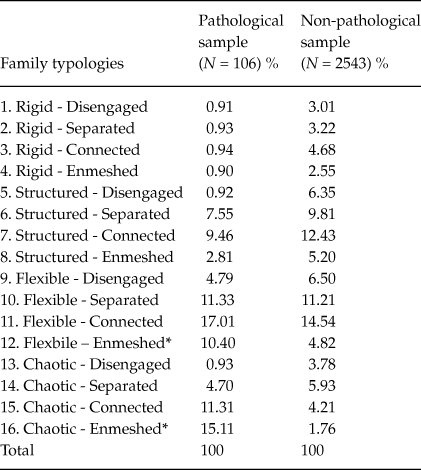
Significant differences between pathological and non-pathological samples emerged in the proportion of cases found in the sixteen categories that are located around the three regions of the circumplex model, namely balanced, intermediate, and non-balanced, χ2(15) = 143.609, p < .001. Standardized residuals were examined to determine which cells contributed most to a significant chi-square value (Newman & Waters, Reference Newman and Waters1984). Due to high number of tests being conducted (one for each of the sixteen categories), we applied a Bonferroni correction to control for the experiment-wise type I error. After correction, the cut-off level was set to 2.95. Two standardized residuals resulted significant. In the pathological sample, a higher proportion of families with respect to the non-pathological sample were located in the extreme “chaotic-enmeshed” region and in the intermediate “flexible-enmeshed” region (see Table 4).
Percentages of cases in the sixteen sub-categories of the cohesion and adaptability dimensions of the FACES III

Note: Significant differences between the samples are marked with asterisks.
A magnifying glass focusing on families with eating and anxiety disorders
Analyses were then focused on two specific pathologies, namely eating disorders and anxiety disorders, that were compared with the non-pathological Italian sample (Galimberti & Farina, Reference Galimberti and Farina1992). This allows one to enlarge our understanding of the role of family functioning in the etiology of these two pathologies.
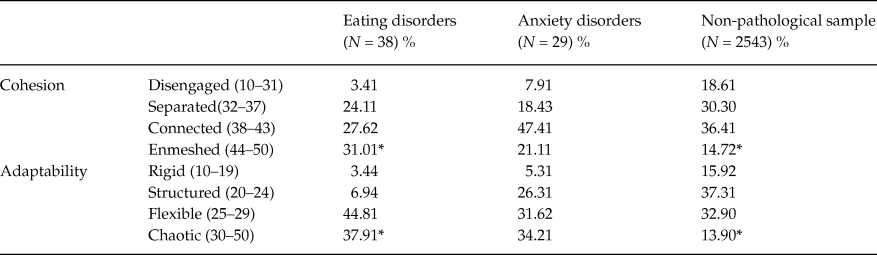
Due to the reduced number of cases that present anxiety and eating disorders, in this comparison we considered the four Olson’s categories. Table 5 shown, for both cohesion and adaptability, the percentages of subjects that in each sample were classified in each category, based on the individual scores on the FACES III.
Percentages of cases in pathological samples with eating disorders and anxiety disorders and in the non- pathological sample

Note: Range of scores defining each dimension are in parenthesis (Galimberti & Farina, Reference Galimberti and Farina1992).
No significant differences were found between families with members who have been diagnosed an anxiety disorder and families from the non-pathological sample, χ2(3) = 6.655, p = .084. On the contrary, a significant difference was found between family whose members are patients with an eating disorder and family taken from the general population. In particular, for the dimension of adaptability, a higher proportion of chaotic families was found in the subsample with eating disorder compared to the non-pathological sample, χ2(3) = 15.615, p < .001. Moreover, with regard to the cohesion dimension, a higher proportion of enmeshed families have been found in the subsample with eating disorder compared to the non-pathological sample, χ2(3) = 10.76, p < .05.
Discussion
The current study was aimed to investigate differences in family functioning (measured through the third version of the FACES) between families with and without clinical subjects in paediatric age. Results had shown that pathological sample presented higher mean scores on the dimensions of adaptability and cohesion with respect to the non-pathological sample.
Results from current study had also shown that pathological families are more frequently located in the extreme and intermediate regions of the circumplex model, respectively in the chaotic-enmeshed and flexible-enmeshed typologies, in comparison with non-pathological families.
Extremely high scores on the dimensions of adaptability and cohesion give rise respectively to the so-called “chaotic” families (characterized by a lack of leadership, dramatic role shifts, inconsistent negotiation), and “enmeshed” families (characterized by an extreme sense of closeness that make difficult for children to develop a sense of autonomy and individuality) in which eating disorder are more likely. As it is well-known, this kind of disorder is significantly associated with the primary mother-child relationship. Appropriate responses from the mother, that are neither ambiguous or chaotic, can therefore promote an healthy affective and emotional development of the child. Parents would be encouraged to adopt more flexible and cohesive health-related attitudes with their adolescent children rather than rigid and poorly structured ones.
From the results of this study, some considerations can be made that can be useful in the therapeutic work with families in a clinical setting. Pathologies can sometimes be a way to bring in significant members within the family. Alternatively, they can be an expression of a lack of differentiation. In particular, Minuchin, Rosman, and Baker (Reference Minuchin, Rosman and Baker1978) argued that families with eating disorders are characterized by dysfunctional relations, an excessive enmeshment, over-protectiveness, and control. Structural (Minuchin, Reference Minuchin1974) and strategic (Haley, Reference Haley1973) interventions are recommended within a systemic approach. The most effective intervention in these cases should be directed to the parental couple, to have an indirect therapeutic effect on their children (Sherman & Fredman, Reference Sherman and Fredman1987).
This suggests the importance to intervene in order to change the perception of a family as cohesive and able to express their thoughts and feelings, by reducing the risk to develop inappropriate and pathological eating behaviors (Field et al., Reference Field, Javaras, Aneja, Kitos, Camargo, Barr Taylor and Laird2008; Neumark-Sztainer, Wall, Story, & Sherwood, Reference Neumark-Sztainer, Wall, Story and Sherwood2009). The most appropriate intervention in these families is thus the family therapy (Palazzoli Selvini, Reference Palazzoli Selvini1986).
The relatively small sample of the pathological sample used in this study represents a limit to the generalizability of findings. Moreover, due to design of the study (cross-sectional) we cannot establish a definite cause-effect relationship. In other words, we don’t know whether family functioning is a cause of, or contributes to, psychopathology, or whether the psychopathology causes distortion of the structure of the family.
Longitudinal studies would show whether the FACES-III can capture changes in families over time as children and their families navigate through stressful experiences, such as medical diagnoses and treatment processes. As argued by Olson (Reference Olson1986; Reference Olson2000), family disfunctioning occur when extreme scores in cohesion and adaptability are permanent over extended period of time as a reflex of the incapacity of the family system to change their own characteristics in response to the requests of the environment.