INTRODUCTION
The family Lophiidae consists of four genera: Lophiodes, Lophiomus, Lophius and Sladenia (Nelson, Reference Nelson2006; Eschmeyer & Fricke, Reference Eschmeyer and Fricke2012). Eschmeyer & Fricke (Reference Eschmeyer and Fricke2012), report 27 valid species with only three of them described in the past 10 years. They are found in all oceans except the Southern Ocean. Sladenia is considered the least derived of the four genera and can be distinguished from the rest by the following features: head and body rounded, not depressed, the absence of humeral, articular, quadrate and subopercular spines, and the absent third cephalic dorsal-fin spine (Caruso, Reference Caruso1985). The archibenthic fish Sladenia shaefersi Caruso & Bullis, Reference Caruso and Bullis1976 was described using the only two specimens known at the time. These were collected in 1970 and 1973 in the Caribbean Sea off Colombia and Venezuela (Caruso & Bullis, Reference Caruso and Bullis1976). The third specimen of S. shaefersi was found on the Corner Rise Seamount in 1977 and was mentioned in the annotated list of fishes of Angular Rise (Kukuev, Reference Kukuev1982). For more than 25 years these remained as the only three specimens known. Caruso et al. (Reference Caruso, Ross, Sulak and Sedberry2007) reported a fourth specimen of S. shaefersi collected from US waters off South Carolina in 2004. Based on the records of Kukuev (Reference Kukuev1982), Caruso et al. (Reference Caruso, Ross, Sulak and Sedberry2007) and the current paper, an extended geographical distribution for the species is presented.
MATERIALS AND METHODS
The specimen of S. shaefersi reported herein was captured on 25 August 2009 at a depth of 1150 m using a 12 m long, 9 m wide and 1.5 m tall semi-balloon otter trawl with a 6.35 cm mesh in a transect conducted by the RV ‘Justo Sierra' during the COBERPES III project, over the continental slope in the Gulf of Mexico; the trawl ran from 19°26.104′N 93°50.8′W to 19°24.643′N 93°49.668′W. The specimen was catalogued in the Colección Nacional de Peces of the Instituto de Biología, Universidad Nacional Autónoma de México (CNPE-IBUNAM) (Sabaj Pérez, Reference Sabaj Pérez2012). The identification of the specimen followed the keys in Caruso & Bullis (Reference Caruso and Bullis1976) and Caruso (Reference Caruso1985, Reference Caruso and Carpenter2002). The counts and measurements of the specific structures reported here followed those described in Caruso & Bullis (Reference Caruso and Bullis1976) and all the lengths are reported as a percentage of the standard length (SL). The vertebrae and fin elements were counted from two radiographs with dorsal and sagittal views. Subsequently, a sample of tissue was taken in order to conduct future molecular analysis.
RESULTS
SYSTEMATICS
Order LOPHIIFORMES
Suborder LOPHIIOIDEI
Family LOPHIIDAE
Genus Sladenia Regan, 1908
Sladenia shaefersi Caruso & Bullis, Reference Caruso and Bullis1976
COMMON NAME
Shaefer's anglerfish (North America, USA), rape leopardo (México).
MATERIAL EXAMINED
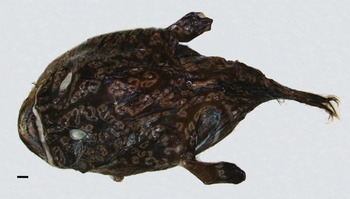
CNPE-IBUNAM 16607 (228 mm SL), México, Gulf of México, COBERPES III, RV ‘Justo Sierra', depth 1144 m–1152 m, August 2009 (Figure 1).
Sladenia shaefersi Caruso & Bullis Reference Caruso and Bullis1976, CNPE-IBUNAM16607, 260 mm standard length, 10 mm scale.

SPECIES ACCOUNT
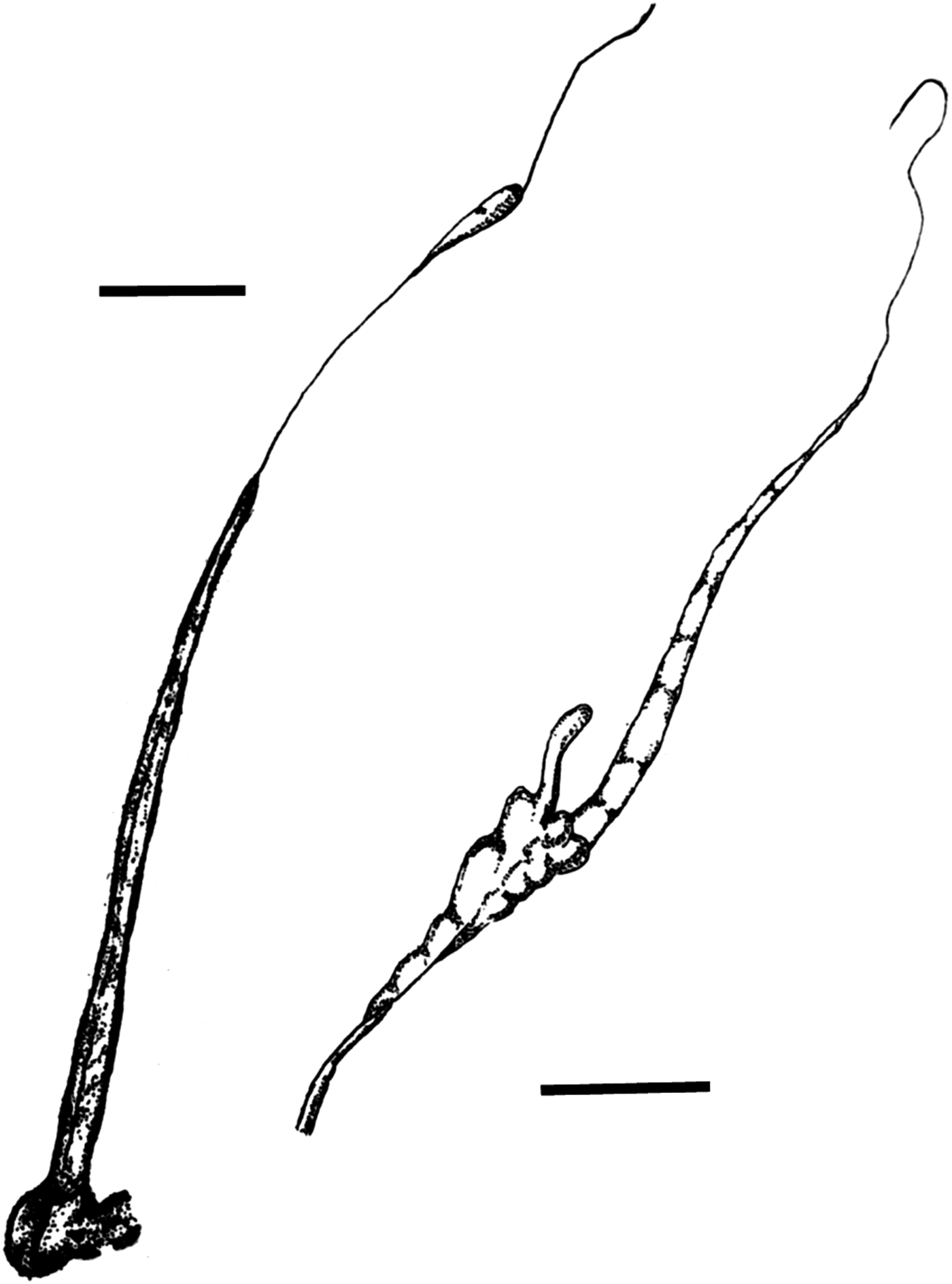
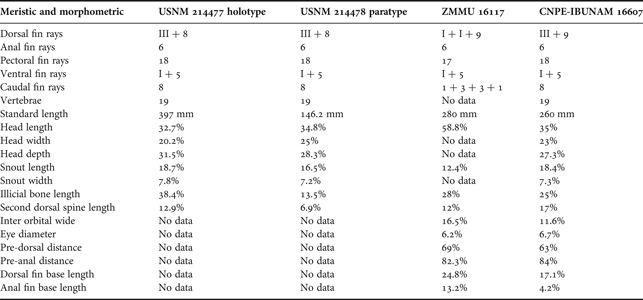
The characters used herein, follow those described in Caruso & Bullis (Reference Caruso and Bullis1976) and Caruso (Reference Caruso1985) (see also Table 1). This species has a rounded head; smooth frontal ridge; eyes and mouth on the dorsal surface; two rows of well-developed and randomly-distributed canine teeth in both jaws; spinous dorsal fin consisting of three spines: two cephalic, first bearing an esca (Figure 2), and one post-cepahlic, the latter embedded in subcutaneous tissue; number of cranial spines reduced or absent in the subopercular, quadrate and anterior articular bone; the interopercular spines are low and rounded.
Illicium (left, scale = 10 mm) and esca (right, scale = 1 mm) of Sladenia shaefersi, CNPE-IBUNAM16607.

Meristic and morphometric comparison of the reported Sladenia shaefersi (Caruso & Bullis, Reference Caruso and Bullis1976; Prokofiev & Kukuev, Reference Prokofiev and Kukuev2009).

The skin is scaleless and the body shape is robust and compressed, with several flaps of skin arranged in irregular rows on the head, lower jaw and pectoral and caudal fins; large gill openings, covered with skin, located anterior to the pectoral fin and extending behind and below it; all fins covered with a thick layer of connective tissue; pelvic fin inserted anterior to the pectoral fin; pelvic and pectoral fins paddle-like. Colour pattern in the ethanol preserved specimens consists of dark brown background with irregular light vermiculations, covering the dorsal and lateral surface of head and body, anterior portion of the lower jaw and bases of the dorsal, caudal and pectoral fins; ventral surface lighter.
DISTRIBUTION
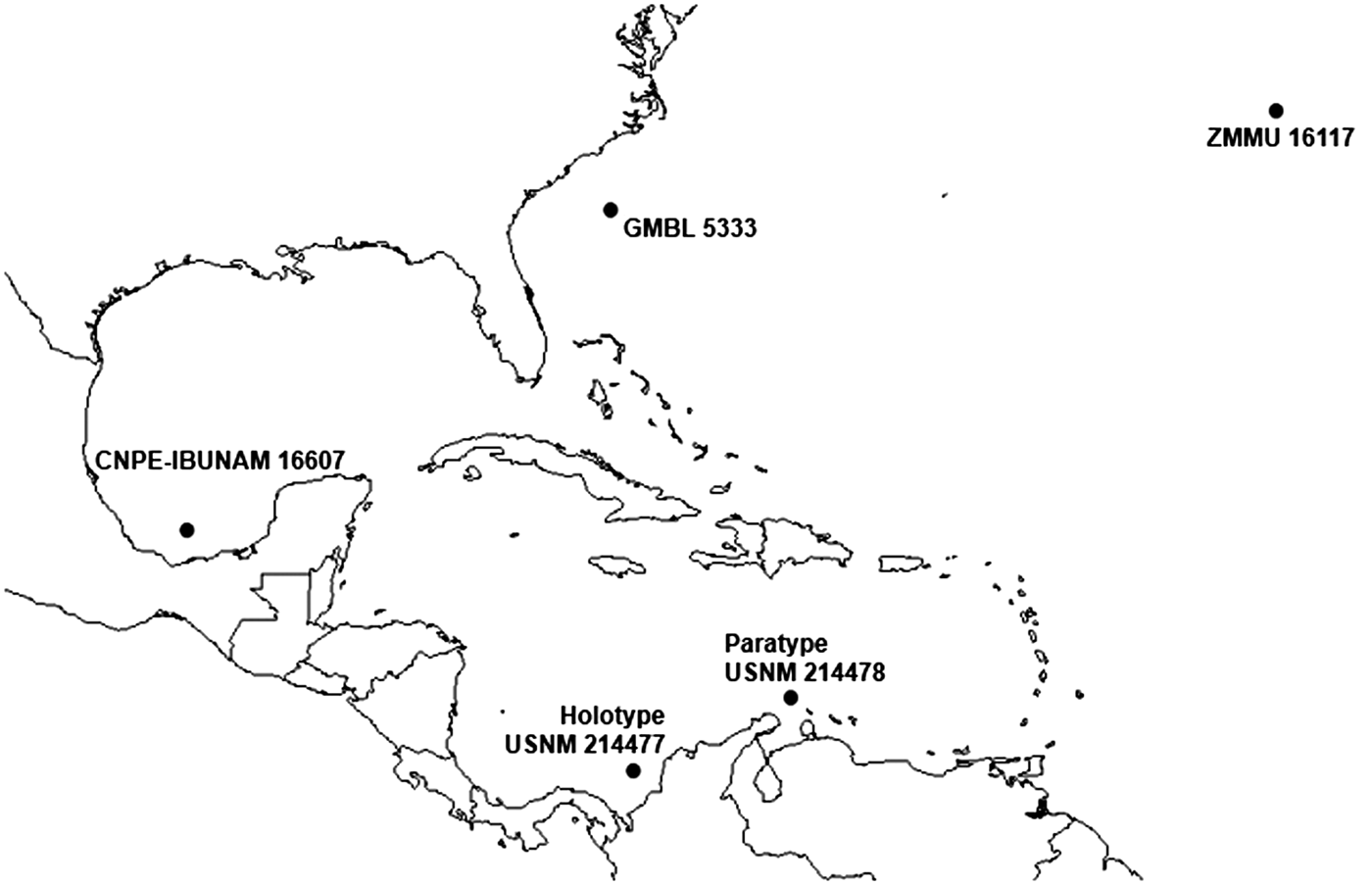
Sladenia shaefersi inhabits deep waters of the western Atlantic Ocean at depths ranging from 850 to 1200 m. Specimens of this species have been collected from the waters of the Caribbean Sea off the north coast of South America (Colombia and Venezuela), the southern Gulf of Mexico, the Blake Plateau off the south-east coast of the United States, and the Corner Rise Seamounts (Table 2; Figure 3).
Distribution of known specimens of Sladenia shaefersi Caruso & Bullis Reference Caruso and Bullis1976 (see Table 2 for citations, catalogue numbers and locality data).

Record points of Sladenia shaefersi in the Atlantic Ocean.

DISCUSSION
We hypothesize that the limit for the southern distribution of S. shaefersi is the Amazon River delta in Brazil, whose massive freshwater and sediment discharges represent a barrier for most of the fishes associated with depth and coral reefs, both larvae and adults (Floeter & Gasparini, Reference Floeter and Gasparini2000; Muss et al., Reference Muss, Robertson, Stepien, Wirtz and Bowen2001; Rocha et al., Reference Rocha, Bass, Robertson and Bowen2002). Several members of the family Lophiidae have similar distributions, except for L. gastrophysus, which has been reported in Brazilian waters (Caruso, Reference Caruso1983; Menezes et al., Reference Menezes, Buckup, Figueiredo and Moura2003), although Caruso (Reference Caruso1983) reported differences between the northern and southern populations, the scarcity of specimens from the south complicates the clear recognition of two separate species.
ACKNOWLEDGEMENTS
The authors thank A.R. Vázquez B. and A. Gracia G., of the ICMyL, UNAM for the invitation to the COBERPES campaign in the UNAM RV ‘Justo Sierra'. We also thank L. Huidobro C., N.L. Vazquez T. and Alaide Hinojosa Villalba for help in handling material both at sea and in the laboratory, and Kate Boersma for a thorough revision of the unpublished manuscript.