Introduction
Insect pollination is both an ecosystem service and a production practice extensively used by farmers all over the world for crop production (Klein et al., Reference Klein, Vaissière, Cane, Steffan-Dewenter, Cunnigham, Kremen and Tscharntke2007; Gallai et al., Reference Gallai, Salles, Settele and Vaissière2009). It is an ecosystem service in that wild pollinators, in particular, wild bees, contribute significantly to the pollination of a large array of crops (Greenleaf and Kremen, Reference Greenleaf and Kremen2006; Winfree et al., Reference Winfree, Williams, Gaines, Ascher and Kremen2008). It is also a management tool in that honey bees, bumble bees and a few other bee species are purchased or rented by farmers in many countries to supplement the local pollinator fauna (Roubik, Reference Roubik1995; Dag et al., Reference Dag, Zipori and Pleser2006). Thus, the economic benefit of insect pollination is clear to farmers, and the market for colony rental is now well developed and organized for honey bees in the USA and Europe (Carreck et al., Reference Carreck, Williams and Little1997) as well as for carpenter bees all over the world (Velthuis and van Doorn, Reference Velthuis and van Doorn2006).
Pigeonpea is one of the major grain legume crops grown in the tropics and subtropics (Saxena et al., Reference Saxena, Kumar and Rao2002). It contains more minerals, ten times more fat, five times more vitamin A and three times more vitamin C than ordinary peas (Madeley, Reference Madeley1995). The green pods and seeds are the most utilized forms in Africa, though dry seeds are increasingly gaining popularity (Damaris, 2007). Currently, major efforts are being made to promote the introduction of dehulling methods used in India to increase the diversity of pigeonpea use in Africa (Changaya, Reference Changaya2007). Some potential uses of pigeonpea for human consumption in Africa include the production of noodles (Singh et al., Reference Singh, Voraputhaporn, Rao and Jambunathan1989), tempeh (Mugula and Lyimo, Reference Mugula and Lyimo2000) and other fermented products (Onofiok et al., Reference Onofiok, Nnanyelugo and Ukwondi1996).
Elsewhere, pigeonpea flour is used as an additive in other foods such as soups and with rice (Gupta et al., Reference Gupta, Parab, Mehta and Goyal2001). Pigeonpea flour is an excellent component in the snack industry and has been recommended as an ingredient to increase the nutritional value of pasta without affecting its sensory properties (Torres et al., Reference Torres, Frias, Granito and Vidal-Valverde2007). Millet/pigeonpea biscuits are nutritious and provide a cheaper alternative to wheat imports in Nigeria (Eneche, Reference Eneche1999).
Pigeonpea is also widely used as fodder and feed for livestock (Rao et al., Reference Rao, Coleman and Mayeux2002). Its foliage is an excellent fodder with high nutritional value (Changaya, Reference Changaya2007). The seeds are used as animal feed (Shiying et al., Reference Shiying, Pang, Zong, Li, Zhou, Saxena and Liang2001), and its fodder has been demonstrated to increase the intake of low-quality herbage, resulting in high animal live weight (Karachi and Zengo, Reference Karachi and Zengo1998). The by-products of split and shrivelled seeds are used as livestock feed and as inexpensive alternatives to high-cost animal feed sources such as bone meal and fish meal (Changaya, Reference Changaya2007).
The flower is a protogynous hermaphrodite (Choudhary et al., Reference Choudhary, Iquebal and Nadarajan2012), which opens early in the morning and closes before noon (Songok et al., Reference Songok, Ferguson, Muigai and Silim2010) and produces nectar and pollen that attract insects (Reddy et al., Reference Reddy, Chandra, Pooni, Bramel and Bramel2004; Martins, Reference Martins2008; Pando et al., Reference Pando, Tchuenguem Fohouo and Tamesse2011a). In Cameroon, the quantity of Cajanus cajan available to consumers is very low, the demand for pigeonpea pods and seeds is high, and its pod and seed yields are low. Therefore, it is important to investigate how the production of this plant could be increased in the country. The relationships between C. cajan and anthophilous insects have not been well studied in Cameroon. In other countries of sub-Saharan Africa such as Tanzania and Kenya, Martins (Reference Martins2007, Reference Martins, Sodhi, Gibson and Raven2013), Otieno et al. (Reference Otieno, Woodcock, Wilby, Vogiatzakis, Mauchline, Gikungu and Potts2011) and Otieno (Reference Otieno2013) reported that carpenter and leaf-cutter bees manipulate the flower by landing on the keel and grappling with it in the process of seeking nectar and pollen. The studies carried out by Pando et al. (Reference Pando, Tchuenguem Fohouo and Tamesse2011a) have shown that Chalicodoma cincta cincta visits C. cajan flowers to harvest both nectar and pollen and increases its pollination possibilities. There has been no previous research reported on the pollination efficiency of Xylocopa olivacea on C. cajan flowers. The present study was carried out to assess the foraging activity of X. olivacea foragers on C. cajan flowers during a dry season and the effects of pollination efficiency of X. olivacea on the yields of this Fabaceae plant. During preliminary investigations on flower–insect relationships in Yaoundé before 2008 (J. B. Pando, unpublished), X. olivacea has been seen intensively visiting C. cajan flowers. The size of X. olivacea (Mensah and Kudom, Reference Mensah and Kudom2011) has been reported to play a positive role in crop pollination. According to Pando et al. (Reference Pando, Tchuenguem Fohouo and Tamesse2011b, Reference Pando, Tchuenguem Fohouo and Tamesse2013), when collecting nectar and/or pollen, X. olivacea shakes flowers and this movement could facilitate the liberation of pollen by anthers for the optimal occupation of the stigma. This bee can be managed for pollination (Roubik, Reference Roubik1995). Also, Martins (Reference Martins2008) reported that pollen loads on the X. olivacea are abundant, and the ability of this bee to disperse swiftly across large areas suggests that it can cross-pollinate the pigeonpea flowers regularly and efficiently.
Materials and methods
Study site, experimental plot and biological material
The experiment was carried out twice, from 20 December 2008 to 27 January 2009 and from 3 November 2009 to 16 December 2009 at Nkolbisson (3°51.800′N, 11°27.450′E, and 726 m above sea level), Yaoundé, central Cameroon. This region belongs to the forest agroecological zone, with a bimodal rainfall pattern.
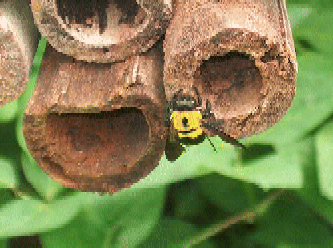
The climate is of the Guinea type, characterized by four seasons: a brief rainy season (March to June), a short dry season (July to August), a longer rainy season (September to November) and a more extended dry season (November to March). The annual rainfall varies from 1500 to 2000 mm. The annual average temperature is 25 °C, while the annual mean relative humidity is 75%. The experimental plot was 26 × 16 m, wherein seeds of C. cajan purchased from the local seed outlets were planted. The bee X. olivacea digs its nest in the trunks of trees under natural conditions. Thirty artificial nests were constructed with 15 bamboo stalks and three pieces of sugarcane that were 30 cm long with closed ends. The nests so constructed were hung by straps on trees nearest the experimental site (Fig. 1). They were orientated horizontally. In contrast to natural nests that contain only one individual of X. olivacea, the artificial nests contained two to seven individuals. The vegetation near the C. cajan field had various unmanaged and cultivated species.
(colour online) Xylocopa olivacea going into a nest

Sowing and weeding
On 21 July 2008 and 8 June 2009, the experimental plot was divided into four subplots (10 × 5 m each). Sowing was done in ten lines per subplot, with each line having ten holes, and three seeds were placed in each hole. The space was 1 m between the holes and 1 m between the lines. Weeding was carried out manually as necessary to maintain a weed-free plot.
Estimation of frequency of Xylocopa olivacea visits on Cajanus cajan flowers
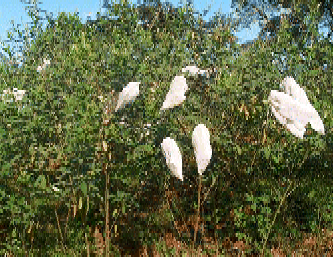
On 17 December 2008, 50 C. cajan plants that had started to bloom were labelled at Yaoundé. In these plants, 200 inflorescences with flowers at the bud stage were labelled; of these, 100 were left unprotected (treatment 1) and 100 were bagged (treatment 2) (Fig. 2) to prevent access to visitors (Roubik, Reference Roubik1995). There were two unprotected inflorescences and two bagged inflorescences per plant. On 12 November 2009, 100 inflorescences of C. cajan with flowers at the bud stage were labelled; of these, 100 were left unprotected for unlimited visits (treatment 3) and 100 were bagged (treatment 4). The frequency of X. olivacea visits on the flowers of C. cajan was determined based on observations made during treatments 1 and 3 every 2 out of 3 days from 20 December 2008 to 27 January 2009 and from 13 November to 28 December 2009 at 07.00–08.00, 09.00–10.00, 11.00–12.00, 13.00–14.00 and 15.00–16.00 h. Flowers typically completely opened at 07.00 h and closed before 16.00 h. During a slow walk along the experimental plot, the identity of all the insects that visited the flowers of C. cajan in all the labelled inflorescences subjected to treatments 1 and 3 was recorded. Specimens of all the insect taxa visiting unlabelled flowers were caught with an insect net and conserved in 70% ethanol for subsequent taxonomy determination. Information on all the insects encountered on flowers was recorded, and the cumulated results were expressed as the number of visits to determine the relative frequency of visits made by X. olivacea among the anthophilous entomofauna of C. cajan (Tchuenguem Fohouo et al., Reference Tchuenguem Fohouo, Messi, Brückner, Bouba, Mbofung and Hentchoya Hemo2004).
(colour online) Bagged inflorescences of Cajanus cajan
Detailed observations of the foraging activity/behaviour of insects visiting flowers were made. Floral products (nectar or pollen) harvested by X. olivacea during each floral visit were recorded. Nectar foragers were seen extending their proboscises to the base of the corolla, while pollen gatherers were seen combing anthers. This parameter was measured to determine whether X. olivacea was strictly gathering pollen, nectar or both, as this has implications for its efficacy as a pollinator. In the morning of each sampling day, the number of open flowers carried by each labelled inflorescence was counted.
On the same days that the frequency of visits was recorded, the duration of individual floral visits was recorded (using a stopwatch) at least three times during each of the following daily time periods: 08.00–09.00, 10.00–11.00, 12.00–13.00 and 14.00–15.00 h. Moreover, the number of pollinating visits (the bee coming into contact with the stigma: Jacob-Remacle, Reference Jacob-Remacle1989; Tchuenguem Fohouo et al., Reference Tchuenguem Fohouo, Messi, Brückner, Bouba, Mbofung and Hentchoya Hemo2004), the abundance of foragers (highest number of individuals foraging simultaneously on a flower or on 1000 flowers: Tchuenguem Fohouo et al., Reference Tchuenguem Fohouo, Messi, Brückner, Bouba, Mbofung and Hentchoya Hemo2004) and the foraging speed (number of flowers visited by a bee per minute: Jacob-Remacle, Reference Jacob-Remacle1989) were determined. Abundance per flower was recorded by direct counting on the same dates and during the same daily periods as for the recording of the duration of visits. For determining the abundance per 1000 flowers (A 1000), some foragers were counted on a known number of flowers. The following formula was used to calculate A 1000:
 $$Fr_{i} = (((Fr_{X} - Fr_{Y})/Fr_{X})\times 100), $$
where F x and A x are the number of open flowers and the number of foragers effectively counted on these flowers at time x (Tchuenguem Fohouo et al., Reference Tchuenguem Fohouo, Messi, Brückner, Bouba, Mbofung and Hentchoya Hemo2004). The disruption of the activity of foragers by competitors or predators and the attractiveness of other plant species to X. olivacea were assessed. During each daily period of investigation, a mobile thermohygrometer was used to record the temperature and relative humidity at the station.
Evaluation of the effect of Xylocopa olivacea and other insects on Cajanus cajan yields
The evaluation of the effect of X. olivacea and other insects on C. cajan yields was based on the impact of insects visiting flowers on pollination, the impact of pollination on the fructification of C. cajan and the comparison of yields (fruiting rate (Fr), mean number of seeds per pod and percentage of normal seeds) in treatment X (unprotected inflorescences) and treatment Y (protected inflorescences). The Fr due to the influence of foraging insects (Fr i) was calculated using the following formula:
 $$\begin{eqnarray} \end{eqnarray}$$
where FrX and FrY are the Frs in treatment X and treatment Y. The Fr in a treatment (Fr) is as follows:
 $$\begin{eqnarray} \end{eqnarray}$$
where F 2 is the number of pods formed and F 1 the number of viable flowers initially set. At maturity, pods were harvested from each lot and the number of seeds per pod counted. The mean number of seeds per pod and the percentage of normal seeds (well-developed seeds) were then calculated for each lot. The impact of flowering insects on seed yields was evaluated using the method described above for the Fr (Tchuenguem Fohouo et al., Reference Tchuenguem Fohouo, Messi, Brückner, Bouba, Mbofung and Hentchoya Hemo2004).
Assessment of the pollination efficiency of Xylocopa olivacea in Cajanus cajan
Parallel to treatments 1 and 2, 80 inflorescences were isolated (treatment 5) as in treatment 2 (Roubik, Reference Roubik1995). Parallel to treatments 3 and 4, 80 inflorescences were isolated (treatment 6) as in treatment 4. Between 09.00 and 11.00 h on each observation date, the gauze bag was delicately removed from each inflorescence carrying new open flowers, and this inflorescence was observed for up to 20 min. The inflorescence was bagged once again.
The contribution (Frx) of X. olivacea to the Fr was calculated using the following formula:
 $$\begin{eqnarray} \end{eqnarray}$$
where FrZ and FrY are the Frs in treatment Z (protected flowers and flowers exclusively visited by X. olivacea) and treatment Y (protected inflorescences). At maturity, pods were harvested from flowers subjected to treatments 5 and 6 and the number of seeds per pod counted. The mean number of seeds per pod and the percentage of normal seeds were then calculated for each treatment. The impact of X. olivacea on seed yields was evaluated using the method described above for the Fr (Tchuenguem Fohouo et al., Reference Tchuenguem Fohouo, Messi, Brückner, Bouba, Mbofung and Hentchoya Hemo2004).
Data analysis
Data were analysed using descriptive statistics, Student's t test was used for the comparison of means of the two samples paired, correlation coefficient (r) was used for the study of the association between two variables, and χ2 test was used for the comparison of two percentages using SPSS statistical software (version 19.0; SPSS, Inc., Chicago, Illinois, USA) and Microsoft Excel 2010.
Results
Frequency of the floral visitors of Cajanus cajan
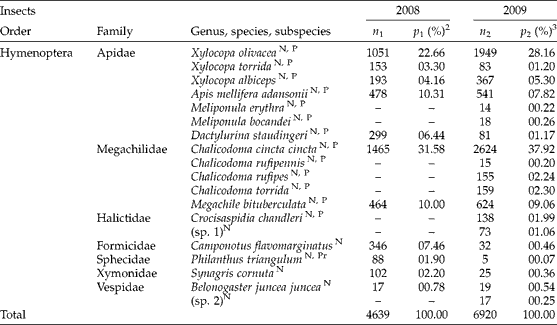
Among the 10 and 18 insect species that made 4639 and 6920 visits on C. cajan flowers in 2008 and 2009, respectively, X. olivacea was the second most frequent visitor with 1051 visits (22.66%) in 2008 and 1949 visits in 2009 (28.16%) (Table 1). The difference between these two percentages was highly significant (χ2= 43.86 (df = 1; P< 0.001)).
Diversity of floral insects visiting Cajanus cajan inflorescences in 2008 and 2009 and number and percentage of visits by different insects1
n 1, Number of visits on 100 inflorescences in 26 days; n 2, number of visits on 100 inflorescences in 30 days; p 1 and p 2, percentages of visits; N, P, visitor-collected nectar and pollen; sp., undetermined species; N, visitor-collected nectar; N, Pr, visitor-collected nectar or predation.
1 Comparison of visit percentages of Xylocopa olivacea for the two study years: χ2= 0.28 (df = 1; P>0.05).
2 p 1= (n 1/4639) × 100.
3 p 2= (n 2/6920) × 100.
In 2008, the highest mean numbers of X. olivacea with simultaneous activity were 1 per flower (n= 50; s= 0) and 130.74 per 1000 flowers (n= 120; s= 53.29; max = 273). In 2009, the corresponding values were 1 per flower (n= 50; s= 0) and 159.85 per 1000 flowers (n= 136 s= 49.56; max = 289). The difference between the mean number of foragers per 1000 flowers in 2008 and that in 2009 was not significant (t= − 4.52 (df = 254; P>0.05)).
The flowers of C. cajan were visited by Apidae (X. olivacea, Xylocopa torrida, Xylocopa albiceps, Apis mellifera adansonii, Dactylurina staudingeri, Meliponula erythra and Meliponula bocandei), Megachilidae (C. cincta cincta, Megachile bituberculata, Megachile rufipes, Chalicodoma torrida and Chalicodoma rufipennis) and Halictidae (Crocisaspidia chandleri) to collect both nectar and pollen. Halictidae (sp. 1), Formicidae (Camponotus flavomarginatus), Xymonidae (Synagris cornuta) and Vespidae (Belonogaster juncea juncea and sp. 4) appeared to collect only nectar and Sphecidae (Philanthus triangulum) visited flowers to collect nectar or to capture honey bees and the stingless bee D. staudingeri.
Activity of Xylocopa olivacea on Cajanus cajan flowers
Floral products harvested
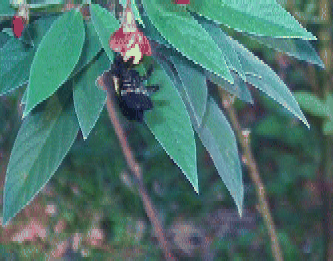
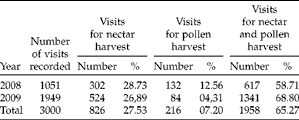
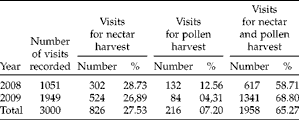
From field observations, it was found that X. olivacea foragers collected nectar and pollen from C. cajan flowers (Fig. 3). Table 2 summarizes the main details regarding the floral products harvested.
(colour online) Xylocopa olivacea foraging a Cajanus cajan flower
Products harvested by Xylocopa olivacea from the inflorescences of Cajanus cajan in 2008 and 2009
Frequency of visits according to the flowering stages
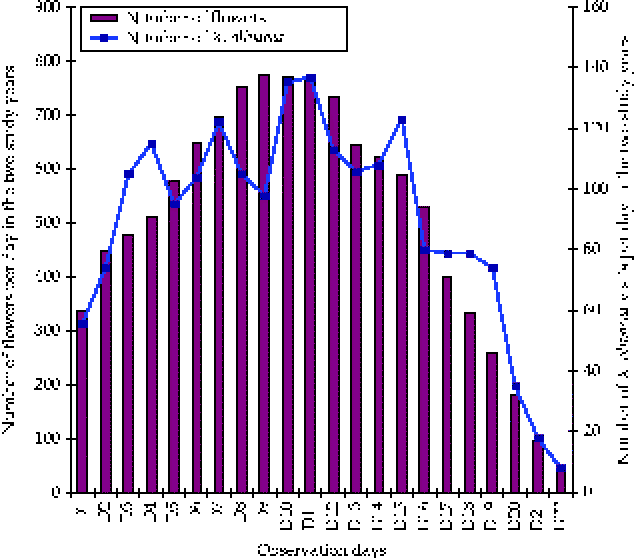
The number of visits made was highest when the number of open flowers was highest (Fig. 4). Furthermore, a positive and significant correlation was found between the number of C. cajan open flowers and the number of X. olivacea visits in 2008 (r= 0.87 (df = 24; P< 0.05)) as well as in 2009 (r= 0.49 (df = 28; P< 0.001)).
(colour online) Seasonal distribution of the number of Cajanus cajan open flowers and the number of Xylocopa olivacea visits in 2008 and 2009 (averages)
Daily frequency of visits
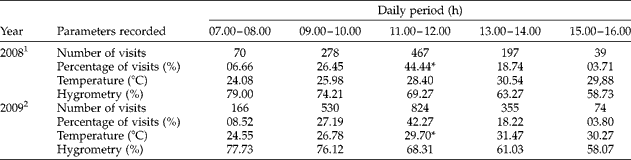
Xylocopa olivacea foraged C. cajan flowers throughout the blooming period, with a peak in activity being observed between 11.00 and 12.00 h daily (Table 3). Climatic conditions influenced the activity of X. olivacea. The correlation between the number of X. olivacea visits on C. cajan flowers and temperature was positive and non-significant (2008: r= 0.08 (df = 3; P>0.05); 2009: r= 0.15 (df = 3; P>0.05)), and that between the number of visits and relative humidity was also positive and non-significant (2008: r= 0.15 (df = 3; P>0.05); 2009: r= 0.23 (df = 3; P>0.05)).
Daily distribution of Xylocopa olivacea visits on 100 Cajanus cajan inflorescences over 26 days in 2008 and 30 days in 2009, respectively, and mean temperature and mean humidity of the study site
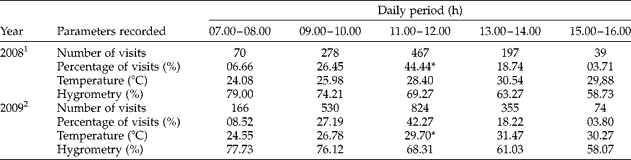
1 For temperature and hygrometry recorded in 2008, each value represents the means of 52 observations.
2 For temperature and hygrometry recorded in 2009, each value represents the means of 60 observations.
*Peak of activity of X. olivacea visits.
Duration of visits per flower
The mean duration of X. olivacea visits per C. cajan flower varied significantly according to the type of floral product harvested. In 2008, the mean duration of a visit was 8.60 s (n= 160; s= 2.67), with a maximum of 21 s for nectar harvest, against 3.92 s (n= 160; s= 1.28), and with a maximum of 10 s for pollen harvest. In 2009, the corresponding values were 7.42 s (n= 200; s= 1.55), with a maximum of 12 s for nectar harvest, against 3.23 s (n= 200; s= 0.94), and with a maximum of 5 s for pollen harvest. The difference between the duration of a visit to harvest nectar and that to harvest pollen was highly significant (t 2008= − 19.89 (df = 318; P< 0.001); t 2009= − 32.82 (df = 398; P< 0.001)). Furthermore, the difference between the duration of a visit to harvest nectar in 2008 and that in 2009 was highly significant (t= 5.25 (df = 358; P< 0.001)), and the difference between the duration of a visit to harvest pollen in 2008 and that in 2009 was also highly significant (t= 5.92 (df = 358; P< 0.001)).
Foraging speed of Xylocopa olivacea on Cajanus cajan flowers
Xylocopa olivacea visited between 2 and 24 flowers/min in 2008 and between 3 and 25 flowers/min in 2009 in C. cajan plants. The mean foraging speed was 10.92 flowers/min (n= 160; s= 5.21) in 2008 and 12.57 flowers/min (n= 200; s= 4.47) in 2009. These mean values were significantly different (t= − 3.21 (df = 358; P< 0.001)).
Influence of neighbouring flora
During the observation period, flowers of many other plant species growing near C. cajan plants were visited by X. olivacea for nectar (n) and/or pollen (p). Among these plants were Tithonia diversifolia, Bidens pilosa and Aspilia africana (Asteraceae, n and p); Mimosa invisa (Mimosaceae, n and p); Pueraria javanica, Vigna unguiculata, Senna javanica and Phaseolus coccineus (Fabaceae, n and p); Ipomoea involucrata (Convolvulaceae, n); Psidium guajava (Myrtaceae, p); Citrullus lanatus (Cucurbitaceae, n and p); and Mangifera indica (Anacardiaceae, n and p). During one foraging visit, all individual bees foraging C. cajan were not seen to be visiting the neighbouring plant and vice versa.
Impact of insect activity on the pollination and pollination efficiency of Xylocopa olivacea yields of Cajanus cajan
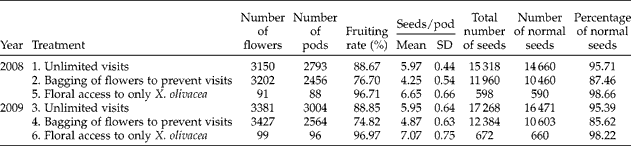
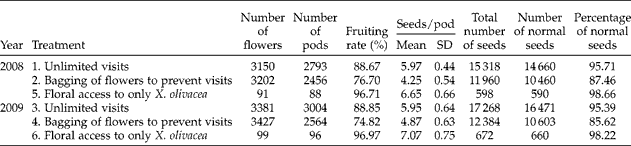
During nectar and/or pollen harvest from C. cajan, foraging insects always shook flowers and regularly made contact with the anthers and stigma, increasing the possibility of C. cajan cross-pollination. The comparison of the Frs (Table 4) revealed that the differences observed were highly significant between treatment 1 and treatment 2 (χ2= 158.41 (df = 1; P< 0.001)) and treatment 3 and treatment 4 (χ2= 224.95 (df = 1; P< 0.001)). In all the visited flowers, X. olivacea made contact with the anthers and stigma and carried pollen. Carrying this pollen, the carpenter bee flew frequently from flower to flower of the same species. Xylocopa olivacea came into contact with the stigma and anthers of the visited flowers during 100% of the visits (Tables 5 and 6). Thus, this bee highly increased the pollination possibilities of C. cajan flowers. The comparison of the Frs (Table 4) revealed that the differences observed were highly significant between treatment 2 and treatment 5 (χ2= 20.15 (df = 1; P< 0.001)) and treatment 4 and treatment 6 (χ2= 25.42 (df = 1; P< 0.001)).
Fruiting rate, mean number of seeds per pod and percentage of normal seeds according to the treatments of Cajanus cajan
Number and frequency of contacts between Xylocopa olivacea and the stigma during floral visits on Cajanus cajan

Number and frequency of contacts between Xylocopa olivacea and anthers during floral visits on Cajanus cajan

From Table 4, we documented the following:
(1) The Fr or pod formation was higher in flowers left unprotected for unlimited visits (where high diversity of insects was observed) than in the bagged flowers. The percentage of Fr attributed to insect activity was 14.64%.
(2) The Fr was higher in X. olivacea-visited flowers than in flowers left unprotected for unlimited visits. This suggests a high pollination deficit in the crop, indicating the need for X. olivacea management to increase fruiting. The percentage of Fr due to X. olivacea activity was 22.26%.
(3) The mean number of seeds per pod was higher in flowers left unprotected for unlimited visits than in the bagged flowers. The comparison of the mean numbers of seeds per pod revealed that the differences observed were highly significant between treatment 1 and treatment 2 (t= 35.49 (df = 998; P< 0.001)) and treatment 3 and treatment 4 (t= 26.63 (df = 998; P< 0.001)). The percentage of seeds per pod due to insect activity was 23.48%.
(4) The number of seeds per pod was also higher in X. olivacea-visited flowers than in the bagged flowers, demonstrating that although C. cajan has a high autogamous tendency, allogamy would increase yields significantly. The comparison of the mean numbers of seeds per pod revealed that the differences observed were highly significant between treatment 2 and treatment 5 (t= 25.81 (df = 584; P< 0.001)) and treatment 4 and treatment 6 (t= 31.45 (df = 593; P< 0.001)). The percentage of seeds per pod attributable to X. olivacea activity was 34.98%.
(5) Normal seed yield in flowers left unprotected for unlimited visits was higher than that in the bagged flowers. The comparison of the percentages of normal seeds revealed that the differences observed were highly significant between treatment 1 and treatment 2 (χ2= 626.88 (df = 1; P< 0.001)) and treatment 3 and treatment 4 (χ2= 866.47 (df = 1; P< 0.001)). The percentage of normal seeds attributed to the influence of insects was 09.43%.
(6) Normal seed yield in X. olivacea-visited flowers was higher than that in flowers left unprotected for unlimited visits. This reveals a high pollination deficit in the crop, indicating the need for X. olivacea management to increase the yield of developed seeds. The comparison of the percentages of normal seeds revealed that the differences observed were highly significant between treatment 2 and treatment 5 (χ2= 67.66 (df = 1; P< 0.001)) and treatment 4 and treatment 6 (χ2= 85.36 (df = 1; P< 0.001)). The percentage of normal seeds attributed to X. olivacea activity was 12.09%.
In short, the impact of X. olivacea on fruit and seed yields was positive and significant. A positive and highly significant correlation was found between the number of fruits and the number of X. olivacea visits on C. cajan inflorescences in 2008 (r= 0.24 (df = 98; P= 0.01)) as well as in 2009 (r= 0.52 (df = 98; P< 0.001)).
Discussion
The present study demonstrates that X. olivacea is an important and efficient pollinator of pigeonpea in Cameroon. Previous work carried out in this region revealed that X. olivacea ranks second among the floral insects visiting this plant (Pando et al., Reference Pando, Tchuenguem Fohouo and Tamesse2011a). In other parts of the world such as in Kenya (Otieno et al., Reference Otieno, Woodcock, Wilby, Vogiatzakis, Mauchline, Gikungu and Potts2011; Otieno, Reference Otieno2010, Reference Otieno2013), Indonesia (Heard, Reference Heard1999) and Tanzania (Martins, Reference Martins2007, Reference Martins2008), other species of Xylocopa have been reported as the main floral visitors of this crop. Xylocopa olivacea has been shown to be the most abundant floral visitor of Ananas comosus (Kudom and Kwapong, Reference Kudom and Kwapong2010) and Luffa aegyptiaca (Mensah and Kudom, Reference Mensah and Kudom2011) in Ghana and V. unguiculata (Pando et al., Reference Pando, Tchuenguem Fohouo and Tamesse2013) in Yaoundé, Cameroon.
The peak in X. olivacea activity on C. cajan in the morning is correlated with the availability of nectar and/or pollen in C. cajan flowers, as reported by Saxena and Kumar (Reference Saxena and Kumar2010). Similarly, this is the period during which the stigma of C. cajan flowers has optimal receptivity for pollen or the weather conditions. The high abundance of X. olivacea on C. cajan flowers underscores the attractiveness of C. cajan floral products to this bee. The attractiveness of C. cajan nectar could be partially explained by its reported high production and total sugar concentration (51–53%: Pando, Reference Pando2013), compared with the range of 15–75% present in most of the plant species (Proctor et al., Reference Proctor, Yeo, Lack, Corbet, Walters, Richard and Streeter1996). According to Bramel et al. (Reference Bramel, Kiran, Reddy, Ford-Lloyd, Chancra and Bramel2004) and Otieno et al. (Reference Otieno, Woodcock, Wilby, Vogiatzakis, Mauchline, Gikungu and Potts2011), nectar produced by C. cajan attracts various insects in natural conditions. In fact, weather during bloom has been demonstrated to affect the abundance and foraging activity of pollinator insects (Bramel et al., Reference Bramel, Kiran, Reddy, Ford-Lloyd, Chancra and Bramel2004). Among the 19 insect species visiting C. cajan flowers, C. cincta cincta was the most abundant (35.37%), followed by X. olivacea (25.95%), M. bituberculata (09.41%), A. mellifera adansonii (08.82%) and other insects with a frequency of less than 5%.
The significant difference observed between the duration of pollen harvest visits and that of nectar harvest visits could be explained by the accessibility of each of these floral products. The floral morphology of this crop ensures high protection of the nectary such that the keel is forcefully opened and this ensures tripping of the flowers, resulting in pollen release. The size of X. olivacea (Mensah and Kudom, Reference Mensah and Kudom2011) plays a positive role: when collecting nectar and/or pollen, X. olivacea shakes flowers and this movement could facilitate the liberation of pollen by anthers for the optimal occupation of the stigma. The results of the present study confirm those of the studies carried out by Mensah and Kudom (Reference Mensah and Kudom2011) on L. aegyptiaca flowers and Kingha et al. (Reference Kingha, Tchuenguem Fohouo, Ngakou and Brückner2012) on Phaseolus vulgaris flowers. This phenomenon was also reported by Vanderborght and Rasmont (Reference Vanderborght and Rasmont1987) for X. bariwal, an efficient P. coccineus pollinator. Under these conditions, an individual bee must spend much more time on flowers to obtain its nectar load than to obtain pollen load. Similar results were obtained for the flowers of P. coccineus (Pando et al., Reference Pando, Tchuenguem Fohouo and Tamesse2011b) and V. unguiculata (Pando et al., Reference Pando, Tchuenguem Fohouo and Tamesse2013). The present study demonstrates that during one foraging trip, an individual bee foraging a given plant species scarcely visits another plant species. This finding indicates that X. olivacea exhibited flower constancy (Basualdo et al., Reference Basualdo, Bedascarrasbure and De Jong2000) for the flowers of each of the plant species studied. Xylocopa olivacea has previously been reported to be a regular visitor and so is an effective pollinator (Pauly et al., Reference Pauly, Breat, Tchibozo, Aikpe and Boeve2009; Kudom and Kwapong, Reference Kudom and Kwapong2010; Mensah and Kudom, Reference Mensah and Kudom2011; Pando et al., Reference Pando, Tchuenguem Fohouo and Tamesse2013). Flower constancy is an important aspect in the management of pollination, and this feature exhibited by X. olivacea can be advantageous for the pollination management of C. cajan. Investment in X. olivacea management may yield high returns on investment for this crop.
During the collection of nectar and pollen from each flower, X. olivacea regularly comes into contact with the stigma. This could enhance auto-pollination, which has been demonstrated in the past (Pauly et al., Reference Pauly, Breat, Tchibozo, Aikpe and Boeve2009; Kudom and Kwapong, Reference Kudom and Kwapong2010). Xylocopa olivacea would facilitate allogamous pollination by carrying pollen within its silks, legs, mouth accessories and thorax, which is consequently deposited on another flower belonging to a different plant of the same species. This has also been observed in other studies (Mensah and Kudom, Reference Mensah and Kudom2011; Pando et al., Reference Pando, Tchuenguem Fohouo and Tamesse2013). The impact of X. olivacea foragers on the pollination of C. cajan is significantly high, as their density per 1000 flowers and their foraging speed are high. In addition, their daily period of intense activity on C. cajan flowers, occurring in the morning, coincides with the period of optimal receptivity of the stigma of this plant species (Saxena and Kumar, Reference Saxena and Kumar2010).
The positive and significant contribution of X. olivacea to the pod and seed yields of C. cajan is justified by the action of this forager bee on self-pollination and cross-pollination (Martins, Reference Martins2007). Nevertheless, the morphology of C. cajan flowers seems to prevent auto-pollination and favour cross-pollination (Reddy et al., Reference Reddy, Chandra, Pooni, Bramel and Bramel2004; Martins, Reference Martins2008; Pando et al., Reference Pando, Tchuenguem Fohouo and Tamesse2011a). Pollen grains of pigeonpea are heavy and sticky and are not readily transferred by wind; therefore, insects are responsible for the transfer of pollen grains and consequently cross-pollination in the pigeonpea plant. Xylocopa olivacea has previously been reported to be a good pollen collector and so is an effective pollinator (Pauly et al., Reference Pauly, Breat, Tchibozo, Aikpe and Boeve2009; Mensah and Kudom, Reference Mensah and Kudom2011; Pando et al., Reference Pando, Tchuenguem Fohouo and Tamesse2013).
The most significant yields (pods, seeds, and percentage of normal seeds in pods) recorded during unlimited visits can be attributed to the important role played by the pollinating insects. A similar result has been reported by Pando et al. (Reference Pando, Tchuenguem Fohouo and Tamesse2011b). The flowers that were exposed to pollinators produced more pods per inflorescence, more seeds per pod, heavier seeds and seeds having better shape compared with the bagged flowers, in agreement with previous results reported for P. coccineus (Pando et al., Reference Pando, Tchuenguem Fohouo and Tamesse2011b), P. vulgaris (Kingha et al., Reference Kingha, Tchuenguem Fohouo, Ngakou and Brückner2012) and V. unguiculata (Pando et al., Reference Pando, Tchuenguem Fohouo and Tamesse2013). That the higher productivity of flowers left unprotected for unlimited visits compared with that of the bagged flowers indicates that insects' visits were effective at increasing cross-pollination. The results of the present study confirm those of the studies carried out by Martins (Reference Martins2007, Reference Martins2008) in Tanzania and Otieno (Reference Otieno2010, Reference Otieno2013) in Kenya and that C. cajan flowers set few pods in the absence of insect pollinators (Table 4). Reddy et al. (Reference Reddy, Chandra, Pooni, Bramel and Bramel2004) and Pando et al. (Reference Pando, Tchuenguem Fohouo and Tamesse2011a) demonstrated that the self-pollination of C. cajan flowers resulted in fewer set pods than cross-pollination. Higher productivity of flowers exposed to visits by X. olivacea may be compared with those flowers under unlimited visits by all kinds of visitors, and this shows that this bee is the main pollinator of C. cajan and thus can be targeted for the managed pollination of this crop (Roubik, Reference Roubik1995). This result confirms other findings reported by Mensah and Kudom (Reference Mensah and Kudom2011) in Ghana and Pando et al. (Reference Pando, Tchuenguem Fohouo and Tamesse2013) in Cameroon, the multiplicity of insect pollinator visits on L. aegyptiaca and V. unguiculata, respectively, did not ameliorate the production of pods.
Conclusion
In Yaoundé, C. cajan benefits highly from pollination facilitated by insects, among which X. olivacea is the second most important pollinator. The comparison of pod and seed yields of unprotected inflorescences with those of inflorescences exclusively visited by X. olivacea underscores the value of this bee in increasing pod and seed yields as well as seed quality. This study thus demonstrates that investment in the management of X. olivacea in terms of nest placement close to C. cajan fields is worthwhile for growers. The conservation and/or the placement of X. olivacea nests near C. cajan plots is recommended for Cameroonian farmers and horticulturists to increase pod and seed yields.
Acknowledgements
The authors thank the Institute of Agronomic Research for Development of Nkolbisson (Yaoundé) for providing the research plot, Dr Alain Pauly (Royal Institute of Natural Sciences, Department of Entomology, Belgium) for bee identification, Pr Louis Zapfack (University of Yaoundé I, Laboratory de Botany) for plant species identification, and Adele Tekao Dikni and Jean Anicet Abega for their physical help during the study.